
Deuteronomy 1:5

Hebrew (Westminster Leningrad Codex) Deuteronomy 1:5 appears in the Hebrew Old Testament. The text above is from the Westminster Leningrad Codex. Each word links to its Strong’s number, a concise gloss, and parsing drawn from the Open Scriptures Hebrew Bible morphology. Click any word for its full Brown-Driver-Briggs (BDB) entry.
Download image
Cite this verse

Deuteronomy 1:5 (World English Bible). Public Domain. Lemma interlinear Bible study tool, https://lemma.gebible.app/v/deuteronomy/1/5.

Show BibTeX & RIS
BibTeX
RIS
English Translation
Beyond the Jordan, in the land of Moab, began Moses to declare this law, saying,
World English Bible · Public Domain
Highlights
  • 1 first appearance in the Hebrew Bible
Full analysis ↓
Download a study sheet

One document with this verse’s original text, its word-by-word gloss line, the meaning frame, cross-references with their text, attributed commentary, and full source and license credits — printable, and it pastes into notes with its structure intact.

This verse Autodidact and up

Study sheet (.html) Plain text (.txt)

A passage Seminary Student

Up to 50 verses in one chapter. A passage sheet keeps up to 6 commentary sources and 12 cross-references per verse, in the order this page ranks them, and says so on the sheet whenever that leaves anything out. Ask for a single verse and you get the Autodidact verse sheet above.

Everything on this page stays free to read, with no account — the sheet is a download of what is already on screen, not access to it.

Want to remove ads? Support Godless Engineer
Compare translations 3

The same verse in 3 English versions, stacked beneath the original-language interlinear above. Click any original word for its lexicon entry.

Each is an independent rendering of the whole verse — the interlinear is not word-aligned to these translations.

Highlighted words mark where these versions differ — a whole-verse word diff, not a word-by-word alignment.

  • World English Bible Public Domain
    Beyond the Jordan, in the land of Moab, began Moses to declare this law, saying,
  • King James Version Public Domain
    On this side Jordan, in the land of Moab, began Moses to declare this law, saying,
  • unfoldingWord Literal Text CC BY-SA 4.0
    Across the Jordan, in the land of Moab, Moses began explaining this law, saying,

unfoldingWord Literal Text — © unfoldingWord, licensed CC BY-SA 4.0. Word-aligned USFM3 via Door43 (git.door43.org/unfoldingWord/en_ult).

Versions to compare (up to 4)

3 of 4 selected

Show all 17 translations

Every available English version of this verse, each an independent rendering of the whole verse.

  • World English Bible Public Domain
    Beyond the Jordan, in the land of Moab, began Moses to declare this law, saying,
  • Berean Standard Bible Public Domain
    On the east side of the Jordan in the land of Moab, Moses began to explain this law, saying:
  • Majority Standard Bible Public Domain
    On the east side of the Jordan in the land of Moab, Moses began to explain this law, saying:
  • King James Version Public Domain
    On this side Jordan, in the land of Moab, began Moses to declare this law, saying,
  • American Standard Version (1901) Public Domain
    Beyond the Jordan, in the land of Moab, began Moses to declare this law, saying,
  • Revised Version (1885) Public Domain
    beyond Jordan, in the land of Moab, began Moses to declare this law, saying,
  • Geneva Bible (1599) Public Domain
    On this side Iorden in the lande of Moab began Moses to declare this lawe, saying,
  • Young's Literal Translation Public Domain
    beyond the Jordan, in the land of Moab, hath Moses begun to explain this law, saying:
  • Literal Standard Version CC BY-SA 4.0
    Beyond the Jordan, in the land of Moab, Moses has begun to explain this law, saying,
  • Unlocked Literal Bible CC BY-SA 4.0
    Beyond the Jordan, in the land of Moab, Moses began to announce these instructions, saying,
  • unfoldingWord Literal Text CC BY-SA 4.0
    Across the Jordan, in the land of Moab, Moses began explaining this law, saying,
  • Darby Bible Public Domain
    On this side the Jordan, in the land of Moab, began Moses to unfold this law, saying,
  • World Messianic Bible Public Domain
    Beyond the Jordan, in the land of Moab, Moses began to declare this law, saying,
  • Webster's Bible Public Domain
    On the east side of Jordan, in the land of Moab, began Moses to declare this law, saying,
  • Free Bible Version CC BY-SA 4.0
    Speaking on the east side of the Jordan in the land of Moab, Moses began to explain these instructions, saying:
  • Bible in Basic English Public Domain
    On the far side of Jordan in the land of Moab, Moses gave the people this law, saying,
  • JPS Tanakh (1917) Public Domain
    beyond the Jordan, in the land of Moab, took Moses upon him to expound this law, saying:

Literal Standard Version (2020), Covenant Press — licensed CC BY-SA 4.0. Text via the HelloAO Bible API (eBible.org). Unlocked Literal Bible (unfoldingWord) — licensed CC BY-SA 4.0. Text via the HelloAO Bible API (eBible.org). unfoldingWord Literal Text — © unfoldingWord, licensed CC BY-SA 4.0. Word-aligned USFM3 via Door43 (git.door43.org/unfoldingWord/en_ult). Free Bible Version, Dr. Jonathan Gallagher — licensed CC BY-SA 4.0. Text via the HelloAO Bible API (eBible.org).

Word by word

More ways to search: Search by grammar → Find every occurrence → Compare this word →

Practice this passage: Drill this verse → Learn its vocabulary →

בֵּאֵ֛ר
bâʼar
H874
“to make clear”
Verb, Piel, Perfect, 3rd Person, Masculine, Singular
Part of Speech
Verb
Stem
Piel
Form
Perfect
Person
3rd Person
Gender
Masculine
Number
Singular
Full BDB Definition

Origin: a primitive root

TWOT: 194

(Piel) - to make plain, distinct - to make clear - to declare - letters on a tablet
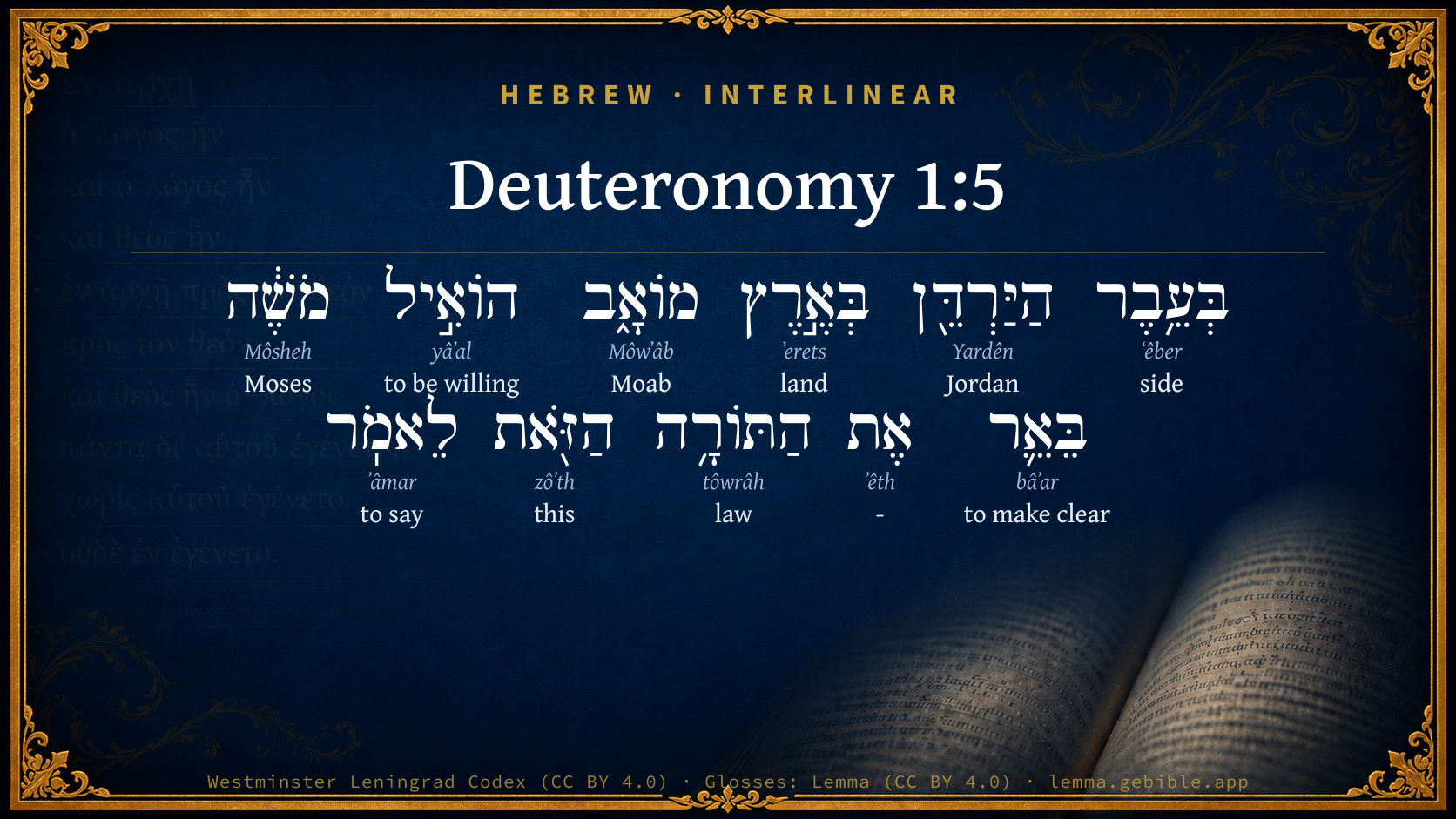
  1. בְּעֵ֥בֶר ʻêber H5676 “in/at · side of” Preposition + Noun, Common, Masculine, Singular, Construct
  2. הַיַּרְדֵּ֖ן Yardên H3383 “the · Jordan” Particle, Definite Article + Noun, Proper
  3. בְּאֶ֣רֶץ ʼerets H776 “in/at · land of” Preposition + Noun, Common, Both, Singular, Construct
  4. מוֹאָ֑ב Môwʼâb H4124 “Moab” Noun, Proper
  5. הוֹאִ֣יל yâʼal H2974 “to be willing” Verb, Hiphil, Perfect, 3rd Person, Masculine, Singular
  6. מֹשֶׁ֔ה Môsheh H4872 “Moses” Noun, Proper
  7. אֶת ʼêth H853 “-” Particle, Direct Object
  8. הַתּוֹרָ֥ה tôwrâh H8451 “the · law” Particle, Definite Article + Noun, Common, Feminine, Singular, Absolute
  9. הַזֹּ֖את zôʼth H2063 “the · this” Particle, Definite Article + Pronoun, Demonstrative, Feminine, Singular
  10. לֵאמֹֽר ʼâmar H559 “to say” Preposition + Verb, Qal, Infinitive Construct

About this verse

These counts appear in no published source. They are computed here, from the morphology-tagged text and Lemma’s own curated glosses. What Lemma adds →

11
words
11
distinct lemmas
Pentateuch
section

Notable vocabulary

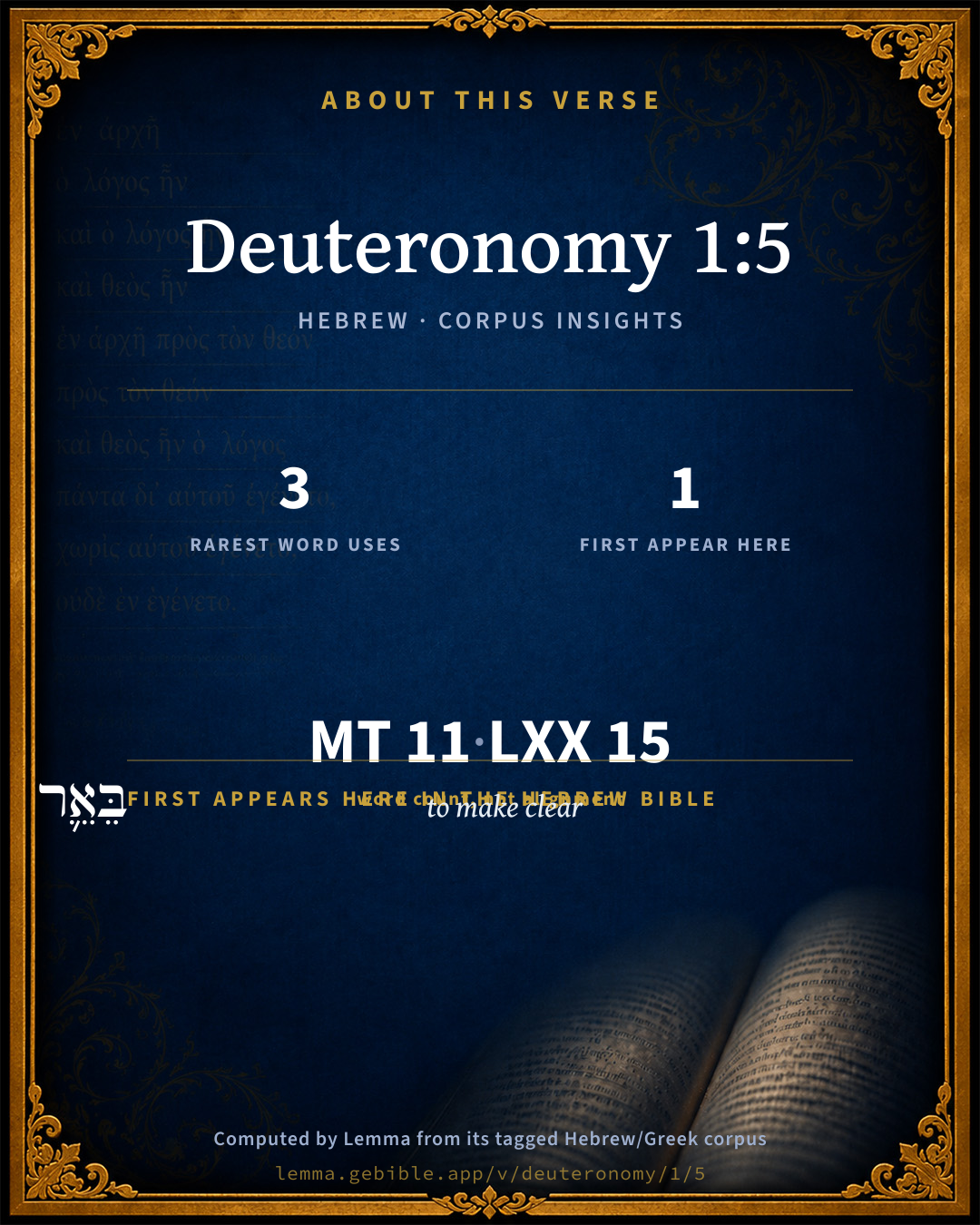
The rarest word here is בֵּאֵ֛ר to make clear H874 — appearing just 3 times in the whole Hebrew Bible.

First appearance in Scripture

This word makes its first canonical appearance in the Hebrew Bible here:

  • בֵּאֵ֛ר to make clear H874

Shared distinctive vocabulary

בֵּאֵ֛ר to make clear H874 occurs in 3 verses of the Hebrew Bible. Also found in:

Grammatical profile

  • 3 verbs
  • 6 nouns
  • 1 pronoun
  • 1 particle

Verb forms

  • הוֹאִ֣יל Hiphil · Perfect
  • בֵּאֵ֛ר Piel · Perfect
  • לֵאמֹֽר Qal · Infinitive Construct

Hebrew & Septuagint length

In English translation the verse runs 15 words from the Hebrew and 14 from the Septuagint (LXX English) — closely comparable.

A rough comparison of the two English renderings, which tokenize alike — not a word-level alignment.

Word counts can differ between the Hebrew and the Greek without any difference in meaning — e.g. the Hebrew direct-object marker אֵת has no separate Greek word, and Greek often adds the article ὁ.

In the original languages it is 11 Hebrew tokens and 15 Greek tokens — but the two are counted differently (Hebrew bundles its prefixes and suffixes into one token; the Greek is in lemma form), so that isn’t a like-for-like length.

Cross-references

4

Topical passages linked to Deuteronomy 1:5 in the Treasury of Scripture Knowledge — connected by theme and wording, ordered by reader-vote popularity; previews shown in the World English Bible.

  • Deuteronomy 4:8 What great nation is there, that has statutes and ordinances so righteous as all this law, which I set before you this day?
  • Deuteronomy 17:18–19 It shall be, when he sits on the throne of his kingdom, that he shall write him a copy of this law in a book, out of [that which is] before the priests the Levites:
  • Deuteronomy 31:9 Moses wrote this law, and delivered it to the priests the sons of Levi, who bore the ark of the covenant of Yahweh, and to all the elders of Israel.
  • Deuteronomy 32:46 He said to them, Set your heart to all the words which I testify to you this day, which you shall command your children to observe to do, [even] all the words of this law.

Cross-references courtesy of OpenBible.info (CC BY 4.0).

Hebrew and Greek witnesses Masoretic Hebrew ↔ Greek Septuagint

The same verse in the two great witnesses to the Old Testament, shown verse-for-verse.

These are two independent witnesses, not word-aligned to each other, and the Septuagint is shown in lemma (dictionary) form.

Hebrew Deuteronomy 1:5 Masoretic · Westminster Leningrad Codex

בְּעֵ֥בֶר הַיַּרְדֵּ֖ן בְּאֶ֣רֶץ מוֹאָ֑ב הוֹאִ֣יל מֹשֶׁ֔ה בֵּאֵ֛ר אֶת הַתּוֹרָ֥ה הַזֹּ֖את לֵאמֹֽר

Beyond the Jordan, in the land of Moab, began Moses to declare this law, saying,

World English Bible · Public Domain

Greek LXX Deuteronomy 1:5 Septuagint · lemma form

ἐν ὁ πέραν ὁ ἰορδάνης ἐν γῆ μωαβ ἄρχω μωυσῆς διασαφέω ὁ νόμος οὗτος λέγω

beyond Jordan in the land of Moab, Moses began to declare this law, saying,

LXX2012 (modern English Septuagint) · Public Domain

Hebrew: Westminster Leningrad Codex (CC BY 4.0). Greek: Septuagint (public domain); English from LXX2012 (modern English Septuagint) (Public Domain). How the Septuagint differs from the Hebrew →

Targum (Aramaic paraphrase)

2

The Targum is the ancient Jewish Aramaic paraphrase of the Hebrew Scriptures — an interpretive translation, not the Hebrew text itself. Onkelos (literal) and Pseudo-Jonathan (expansive) render the Torah, and Jonathan the Prophets. Coverage is partial: where no permissively-licensed English translation exists for a verse, only the Aramaic is shown. This is verse-level text, not a word-by-word alignment to the Hebrew.

  1. Targum Onkelos Torah (Genesis–Deuteronomy)
    בְּעִבְרָא דְיַרְדְנָא בְּאַרְעָא דְמוֹאָב שָׁרֵי מֹשֶׁה פָּרֵשׁ יָת אוּלְפַן אוֹרַיְתָא הָדָא לְמֵימָר

    (no public-domain English translation for this verse)

    Targum Onkelos — Aramaic: “Onkelos Genesis” (public domain); “Onkelos Exodus” (public domain); “Onkelos Leviticus” (public domain); “Onkelos Numbers” (public domain); “Onkelos Deuteronomy” (public domain). English: “Sefaria Community Translation” (CC0 1.0 (public-domain dedication)); “J.W. Etheridge. The Targums of Onkelos and Jonathan Ben Uzziel on the Pentateuch. London: Longmans, Green, 1862” (public domain). Text via Sefaria.

  2. Targum Pseudo-Jonathan Torah (Genesis–Deuteronomy)
    בְּעִיבְרָא דְיוֹרְדְּנָא בְּאַרְעָא דְמוֹאָב שׁוֹרֵי משֶׁה לְמַלְפָא יַת פִּתְגָמֵי אוֹרַיְיתָא הֲדָא לְמֵימָר

    beyond Jordan, in the land of Moab, began Mosheh to speak the words of this law, saying:

    Targum Pseudo-Jonathan — Aramaic: “Targum Jonathan on Genesis” (public domain); “Targum Jonathan on Exodus” (public domain); “Targum Jonathan on Leviticus” (public domain); “Targum Jonathan on Numbers” (public domain); “Targum Jonathan on Deuteronomy” (public domain). English: “The Targum of Jonathan ben Uzziel, trans. J. W. Etheridge, London, 1862” (public domain). Text via Sefaria.

Commentary

Notes on Deuteronomy 1:5 from classic Christian and Jewish commentators (each source and its license shown beneath its notes). The classic Christian expositions comment on the surrounding passage and are grouped to its opening verse, so a note may address several verses; the Jewish commentaries on the Tanakh (Rashi and others) are per-verse, so they appear only where the commentator wrote on this verse.

Lemma curates 59 commentaries, every one of them public domain or Creative Commons licensed, each selected and text-cleaned for this edition rather than reprinted as found. About our sources →

The Cambridge Bible for Schools and Colleges

gen. ed. J. J. S. Perowne

A. Duet Deu_1:5 to Deu_4:40. First Discourse and Introduction to the Law-Book

5. Special Title to the First Discourse of Moses

Usually taken as the continuation of the general title to the Book, 1a and 4, this appears rather—note the repetition of the datum beyond Jordan—to have been originally a special title to the following first discourse of Moses. Obviously written in W. Palestine.

5. in the land of Moab] So always in D as the place of this legislation, which P gives more exactly as the ‘Arboth-Moab, the sections of the ‘Arabah in Moabite territory, just N. of the Dead Sea (I.P. 209). Except for some doubtful cases in later writers Moab is always the name of the people, not of their land. See Enc. Bibl. art. ‘Moab.’ In Deu_3:29, Deu_4:46 the scene of the lawgiving is more exactly defined as in the gai or hollow over against Beth-pe‘or.

began] Heb. hô‘îl is stronger: undertook, or set himself to (Gen_18:27), or was pleased to (2Ki_5:23; Hos_5:11).

to declare] In the original sense of declare (Wright, Bible Word-Bk), make clear or distinct. The Heb. bç’çr, properly to dig or hew, is used of writing on stone (Deu_27:8), or tablets (Hab_2:2). Only here metaphorically, to explain or expound, as in post-Bibl. Heb., or to engrave in the mind of the people.

this law] Heb. this Tôrah, on the various meanings of the term see I.P. App. vi.; Driver, Exodus, 162, 165. In which of these it is to be taken here is disputed. Dillm., after stating that in D Tôrah is distinguished from Law proper, described as statutes and judgements, takes it here to mean instruction concerning law and justice. So Steuern. and Berth. But in the other 18 instances of the phrase this Tôrah in D) it is used of the deuteronomic code and indeed in Deu_4:8 is parallel to statutes and judgements. We may take it in the same sense here (so Driver), equivalent indeed to no mere catalogue of laws, but to laws with notes, exhortations, precedents and reminiscences. If that be the meaning of Tôrah in this title, it proves that the discourse to which the title is attached, Deu_1:6 to Deu_4:40, was originally designed as an introduction to the code Deu_1:12-26. But the terms of the title are more suitable to Deu_1:5 ff. in which discourse the actual exposition of the Law begins. See further on Deu_4:44-49.

The Cambridge Bible for Schools and Colleges (gen. ed. J. J. S. Perowne; Cambridge University Press, 1878–1918) — public domain. Text from a community e-Sword module.

Trapp's Complete Commentary

John Trapp

Deu 1:5 On this side Jordan, in the land of Moab, began Moses to declare this law, saying,

Ver. 5. Began Moses to declare.] And he was not long about it. {See Trapp on "Deu 1:1"} A ready heart makes riddance of God’s work; for being oiled with the Spirit, it becomes lithe and nimble, quick of despatch.

John Trapp, A Commentary or Exposition upon All the Books of the Old and New Testament (1647–1656) — public domain. Text from a community e-Sword module.

Geneva Bible (1599)

Geneva Bible translators

The second time.

Geneva Bible (1599) marginal notes — public domain. Text via Bolls.life.

Jamieson, Fausset & Brown

Robert Jamieson, A. R. Fausset & David Brown

On this side Jordan, in the land of Moab, began Moses to declare this law--that is, explain this law. He follows the same method here that he elsewhere observes; namely, that of first enumerating the marvellous doings of God in behalf of His people, and reminding them what an unworthy requital they had made for all His kindness--then he rehearses the law and its various precepts.

Jamieson, Fausset & Brown — Commentary Critical and Explanatory on the Whole Bible (1871) — public domain (CC PDM 1.0). Text via the HelloAO Bible API.

Adam Clarke's Commentary

Verse 5. Began Moses to declare this law] Began, הואיל hoil, willingly undertook; to declare, באר beer, to make bare, clear, &c., fully to explain, this law. See the conclusion of the preface.

Adam Clarke's Commentary on the Bible (1810–1826) — public domain. Text from a community e-Sword/MySword module.

Ellicott's Commentary for English Readers

(5) On this side Jordan, in the land of Moab.—This would be on the other side of Jordan from the stand-point of the writer, or of the readers for whom the book was intended, which is Palestine.

Began Moses.—“Began,” i.e., “determined” or “assayed.”

To declare.—The emphatic reiteration of what had been already received from God and delivered to Israel may be intended. But the Hebrew word here employed occurs in two other places only, and in both is connected with writing. (See Deu_17:8, “thou shalt write upon the stones all the words of this law very plainly” (bâêr hêtêb, in writing and in making good). Again, in Hab_2:2, “write the vision, and make it plain upon tables.” The etymological affinities of the word also suggest the idea of writing. It would seem, then, that at this period Moses began to throw the discourses and laws that he had delivered into a permanent form, arranging and writing them with the same motive which influenced the Apostle Peter (2Pe_1:15), “Moreover, I will endeavour that ye may be able after my decease to have these things always in remembrance.”

In this discourse the history of Israel, from the time of their departure from Sinai, is briefly recapitulated (Deu_3:29), and with a short practical exhortation. This portion of history comprises three periods of the exodus: (1) The march from Sinai to Kadesh-barnea, with the sending of the twelve spies and its results, related more at length in Num_10:11—end of Deuteronomy 14. The characteristic feature of this period is failure on the part of both leaders and people to rise to their high calling. Moses (Numbers 11), Aaron and Miriam (Num. xii), Joshua (Num_11:28), the spies, who were also rulers (Deuteronomy 13, 14), and the people throughout, all in turn exhibit the defects of their character. In the end the enterprise is abandoned for the time. (2) The thirty seven and a half years that follow are a period of disgrace, as appears by the absence of all note of time or place in the direct narrative between Numbers 14 and Numbers 20. Certain places are mentioned in Numbers 33 which must belong to this period, but nothing is recorded of them beyond the names. A single verse (Deu_2:1), is all that is assignable to that period in this discourse of Moses. This long wandering was also a period of training and discipline. (3) The fortieth year of the exodus, in which the conquest of Sihon and Og was effected, and Israel reached the banks of Jordan. The sentence of death pronounced against their elder generation having been executed, a new life was now begun.

A Bible Commentary for English Readers, edited by Charles John Ellicott (1878–1897) — public domain. Text from a community e-Sword module.

John Gill's Exposition

On this side Jordan, in the land of Moab,.... On that side of Jordan in which the land of Moab was, and which with respect to the land of Canaan was beyond Jordan; this the Vulgate Latin version joins to the preceding verse:

began Moses to declare this law: to explain it, make it clear and manifest; namely, the whole system and body of laws, which had been before given him, which he "willed" (k), as some render the word, or willingly took upon him to repeat and explain unto them, which their fathers had heard, and had been delivered unto them; but before he entered upon this, he gave them a short history of events which had befallen them, from the time of their departure from Horeb unto the present time, which is contained in this and the two next chapters:

saying; as follows.

(k) "voluit", Montanus; "placuit", Junius & Tremellius, Piscator; "statuit", Tigurine version.

John Gill's Exposition of the Whole Bible (1746–1763) — public domain (CC PDM 1.0). Text via the HelloAO Bible API.

Albert Barnes' Notes on the Bible

In the land of Moab - This district had formerly been occupied by the Moabites, and retained its name from them: but had been conquered by the Amorites. Compare Num 21:25, note; Num 22:5, note.

Declare - Render, explain the Law already declared.

Albert Barnes' Notes on the Bible (1834–1885) — public domain. Text from a community e-Sword/MySword module.

Haydock's Catholic Bible Commentary

Expound. He begins, as usual, with commemorating the wonders of God, in favour of an ungrateful people. This book may be considered as a supplement to the other four books. (Calmet) --- We need not wonder, therefore, if we find some new observations. The reason why the sabbath is to be kept, is here said to be in memory of the law being given to the Hebrews, and their liberation from slavery; (chap. v. 15,) whereas in Exodus, it seems to be designed to remind people that God rested on the seventh day. But here is no contradiction. (Watson)

George Leo Haydock (1774–1849), Haydock's Catholic Family Bible and Commentary, 1859 edition — public domain. Excludes Psalms (Douay-Rheims chapter numbering differs from Protestant) and Deuterocanonical books (Catholic canon only).

The Pulpit Commentary

The locality is again described as beyond Jordan (see on ver. 1), and in the land of Moab. This designates the region elsewhere called Arboth Moab the Plains of Moab (Num_22:1; Deu_34:1, etc.) the region on the east of the Jordan, opposite to Jericho, now known as the region of Kerak (Burckhardt, "Syria," p. 377, etc.; Robinson, "Bib. Res.," 2:569). Began; rather set himself to. The Hebrew word signifies to undertake, to betake one"s self to, and so to begin It is variously rendered in the Authorized Version. (comp. Gen_18:27, "taken it upon me;". Exo_2:21, "was content," had made up his 1Sa_12:22, "it pleased;" 17:39,"assayed," etc.) To declare, i.e. make clear, explain, expound. (Hab_2:2, "make plain The Hebrew word here used (rab) signifies primarily to cut or dig, then to cut into, to grave, and then to cut or dig out so as to make evident, to declare, to make plain. What Moses set himself to do, then, was not to publish a new law, but to make plain to the people the Law already promulgated, to set forth clearly and pointedly what they were required by the Law to be and to do. This explains more fully the "spake" (rBdi) of ver. 3. This exposition of the Law was designed specially for the sake of those who, at the time the Law was first promulgated, either were not born or were incapable of understanding it (Grotius). The expression used by Moses plainly indicates that this book was not intended to furnish a second code of laws different from the former, but simply to explain and enforce what had before been enjoined.

The Pulpit Commentary (1880–1919), ed. H.D.M. Spence-Jones & Joseph S. Exell — public domain. Text from a community e-Sword module.

unfoldingWord translationNotes

Door43 World Missions Community

Beyond the Jordan

This refers to the land across the Jordan River, to the east of Israel. Moses was east of the Jordan when he said this. See how you translated these words in Deuteronomy 1:1. AT: "East of the Jordan River"

spoke to us

The word "us" refers to Moses and the other people of Israel.

You have lived long enough in this hill country

This is an idiom. AT: "You do not need to stay near this mountain any longer" (See: Idiom)

translationWords

Jordan River

Moab

Moses

Yahweh

God

Horeb

unfoldingWord translationNotes — © Distant Shores Media and the Door43 World Missions Community, licensed CC BY-SA 4.0. Source: git.door43.org/Door43/en_tn.

Rashi

Rabbi Shlomo Yitzchaki (Rashi)

הואיל means HE BEGAN, just as (Genesis 18:27) "Behold, now I have begun (הואלתי)" (cf. Sifrei Devarim 4:1).

באר את התורה [MOSES BEGAN] TO EXPLAIN THIS LAW — in the seventy languages of the ancient world did he explain it to them (Midrash Tanchuma, Devarim 2; Genesis Rabbah 49; cf. Sotah 32a and Rashi on Deuteronomy 27:8).

Rashi on the Tanakh — English translations: “The Judaica Press complete Tanach with Rashi, translated by A. J. Rosenberg” (CC BY 4.0); “Pentateuch with Rashi's commentary by M. Rosenbaum and A.M. Silbermann, 1929-1934” (public domain); “The Metsudah Tanach series, Lakewood, N.J” (CC BY 4.0); and “The Book of Joshua, Metsudah Publications, 1997” (CC BY 4.0). Text via Sefaria.

Lesson kit

Teaching starters — assembled from the data on this page, not authored interpretation. Every prompt links to the verse data it draws on. Edit before teaching.

Deuteronomy, in the Pentateuch, opens this verse with 11 words (11 distinct Hebrew lemmas). Its most distinctive word is bâʼar (“to make clear”). A historical commentator’s framing appears above. Read the whole chapter for the surrounding context.

Discussion questions

  1. The word bâʼar carries the sense “to make clear.” How does it shape the verse?
  2. This is the first place “to make clear” appears in Scripture (first appears here). What does its debut here establish?
  3. How does Deuteronomy 27:8, which shares the word «to make clear», read alongside this verse?
  4. These translations render this verse differently. What is at stake in choosing one wording over another?
  5. «הוֹאִ֣יל» is a Hiphil Perfect verb. How does that grammatical form shape the action described?
  6. Compare how The Cambridge Bible for Schools and Colleges and Trapp's Complete Commentary read this verse. Where do they agree or differ?

Things to notice

Reading settings

Reading text

Shown beneath each verse's original-language words.

Old Testament
Old Testament edition

Read the OT as the Masoretic Hebrew (MT) or the Greek Septuagint (LXX).

English shown for the Greek Septuagint (in the Hebrew ↔ Greek comparison).

Comparing translations? Open the Compare panel on any verse page to stack up to four side by side.