
Deuteronomy 34:4

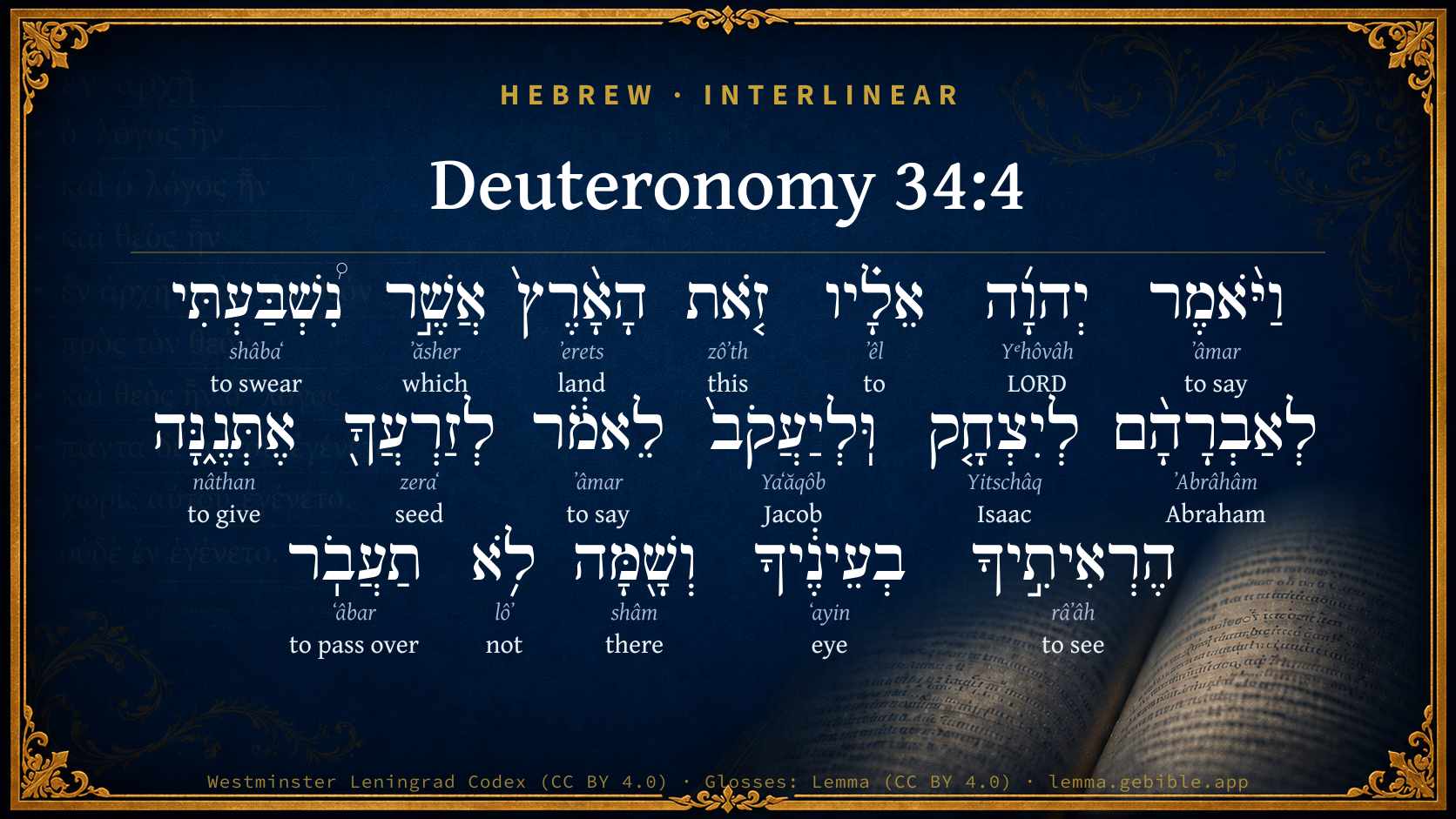
Hebrew (Westminster Leningrad Codex) Deuteronomy 34:4 appears in the Hebrew Old Testament. The text above is from the Westminster Leningrad Codex. Each word links to its Strong’s number, a concise gloss, and parsing drawn from the Open Scriptures Hebrew Bible morphology. Click any word for its full Brown-Driver-Briggs (BDB) entry.
Download image
Cite this verse

Deuteronomy 34:4 (World English Bible). Public Domain. Lemma interlinear Bible study tool, https://lemma.gebible.app/v/deuteronomy/34/4.

Show BibTeX & RIS
BibTeX
RIS
English Translation
Yahweh said to him, This is the land which I swore to Abraham, to Isaac, and to Jacob, saying, I will give it to your seed: I have caused you to see it with your eyes, but you shall not go over there.
World English Bible · Public Domain
Download a study sheet

One document with this verse’s original text, its word-by-word gloss line, the meaning frame, cross-references with their text, attributed commentary, and full source and license credits — printable, and it pastes into notes with its structure intact.

This verse Autodidact and up

Study sheet (.html) Plain text (.txt)

A passage Seminary Student

Up to 50 verses in one chapter. A passage sheet keeps up to 6 commentary sources and 12 cross-references per verse, in the order this page ranks them, and says so on the sheet whenever that leaves anything out. Ask for a single verse and you get the Autodidact verse sheet above.

Everything on this page stays free to read, with no account — the sheet is a download of what is already on screen, not access to it.

Want to remove ads? Support Godless Engineer
Compare translations 3

The same verse in 3 English versions, stacked beneath the original-language interlinear above. Click any original word for its lexicon entry.

Each is an independent rendering of the whole verse — the interlinear is not word-aligned to these translations.

Highlighted words mark where these versions differ — a whole-verse word diff, not a word-by-word alignment.

  • World English Bible Public Domain
    Yahweh said to him, This is the land which I swore to Abraham, to Isaac, and to Jacob, saying, I will give it to your seed: I have caused you to see it with your eyes, but you shall not go over there.
  • King James Version Public Domain
    And the LORD said unto him, This is the land which I sware unto Abraham, unto Isaac, and unto Jacob, saying, I will give it unto thy seed: I have caused thee to see it with thine eyes, but thou shalt not go over thither.
  • unfoldingWord Literal Text CC BY-SA 4.0
    And Yahweh said to him, “This the land that I swore to Abraham, to Isaac, and to Jacob, saying, ‘I will give it to your seed.’ I have showed you, to your eyes, but you will not go over there.”

unfoldingWord Literal Text — © unfoldingWord, licensed CC BY-SA 4.0. Word-aligned USFM3 via Door43 (git.door43.org/unfoldingWord/en_ult).

Versions to compare (up to 4)

3 of 4 selected

Show all 18 translations

Every available English version of this verse, each an independent rendering of the whole verse.

  • World English Bible Public Domain
    Yahweh said to him, This is the land which I swore to Abraham, to Isaac, and to Jacob, saying, I will give it to your seed: I have caused you to see it with your eyes, but you shall not go over there.
  • Berean Standard Bible Public Domain
    And the LORD said to him, “This is the land that I swore to give Abraham, Isaac, and Jacob when I said, ‘I will give it to your descendants.’ I have let you see it with your own eyes, but you will not cross into it.”
  • Majority Standard Bible Public Domain
    And the LORD said to him, “This is the land that I swore to give Abraham, Isaac, and Jacob when I said, ‘I will give it to your descendants.’ I have let you see it with your own eyes, but you will not cross into it.”
  • King James Version Public Domain
    And the LORD said unto him, This is the land which I sware unto Abraham, unto Isaac, and unto Jacob, saying, I will give it unto thy seed: I have caused thee to see it with thine eyes, but thou shalt not go over thither.
  • American Standard Version (1901) Public Domain
    And Jehovah said unto him, This is the land which I sware unto Abraham, unto Isaac, and unto Jacob, saying, I will give it unto thy seed: I have caused thee to see it with thine eyes, but thou shalt not go over thither.
  • Revised Version (1885) Public Domain
    And the LORD said unto him, This is the land which I sware unto Abraham, unto Isaac, and unto Jacob, saying, I will give it unto thy seed: I have caused thee to see it with thine eyes, but thou shalt not go over thither.
  • Geneva Bible (1599) Public Domain
    And the Lord said vnto him, This is the lande which I sware vnto Abraham, to Izhak and to Iaacob saying, I will giue it vnto thy seede: I haue caused thee to see it with thine eyes, but thou shalt not goe ouer thither.
  • Douay-Rheims (1899) Public Domain
    And the Lord said to him: This is the land, for which I swore to Abraham, Isaac, and Jacob, saying: I will give it to thy seed. Thou hast seen it with thy eyes, and shalt not pass over to it.
  • Young's Literal Translation Public Domain
    And Jehovah saith unto him, `This `is' the land which I have sworn to Abraham, to Isaac, and to Jacob, saying, To thy seed I give it; I have caused thee to see with thine eyes, and thither thou dost not pass over.'
  • Literal Standard Version CC BY-SA 4.0
    And YHWH says to him, “This [is] the land which I have sworn to Abraham, to Isaac, and to Jacob, saying, I give it to your seed; I have caused you to see with your eyes, but you do not pass over there.”
  • Unlocked Literal Bible CC BY-SA 4.0
    Yahweh said to him, “This is the land that I swore to Abraham, to Isaac, and to Jacob, saying, 'I will give it to your descendants.' I have allowed you to look at it with your eyes, but you will not go over there.”
  • unfoldingWord Literal Text CC BY-SA 4.0
    And Yahweh said to him, “This the land that I swore to Abraham, to Isaac, and to Jacob, saying, ‘I will give it to your seed.’ I have showed you, to your eyes, but you will not go over there.”
  • Darby Bible Public Domain
    And Jehovah said unto him, This is the land that I swore unto Abraham, unto Isaac, and unto Jacob, saying, Unto thy seed will I give it: I have caused thee to see it with thine eyes, but thou shalt not go over thither.
  • World Messianic Bible Public Domain
    The LORD said to him, “This is the land which I swore to Abraham, to Isaac, and to Jacob, saying, ‘I will give it to your offspring.’ I have caused you to see it with your eyes, but you shall not go over there.”
  • Webster's Bible Public Domain
    And the LORD said to him, This is the land which I swore to Abraham, to Isaac, and to Jacob, saying, I will give it to thy seed: I have caused thee to see it with thy eyes, but thou shalt not go over thither.
  • Free Bible Version CC BY-SA 4.0
    The Lord told him, “This is the country I solemnly promised to Abraham, Isaac, and Jacob when I said, ‘I'm giving it to your descendants.’ I have allowed you to see it for yourself, but you're not going to enter it.”
  • Bible in Basic English Public Domain
    And the Lord said to him, This is the land about which I made an oath to Abraham, Isaac, and Jacob, saying, I will give it to your seed: now I have let you see it with your eyes, but you will not go in there.
  • JPS Tanakh (1917) Public Domain
    And the LORD said unto him: 'This is the land which I swore unto Abraham, unto Isaac, and unto Jacob, saying: I will give it unto thy seed; I have caused thee to see it with thine eyes, but thou shalt not go over thither.'

Literal Standard Version (2020), Covenant Press — licensed CC BY-SA 4.0. Text via the HelloAO Bible API (eBible.org). Unlocked Literal Bible (unfoldingWord) — licensed CC BY-SA 4.0. Text via the HelloAO Bible API (eBible.org). unfoldingWord Literal Text — © unfoldingWord, licensed CC BY-SA 4.0. Word-aligned USFM3 via Door43 (git.door43.org/unfoldingWord/en_ult). Free Bible Version, Dr. Jonathan Gallagher — licensed CC BY-SA 4.0. Text via the HelloAO Bible API (eBible.org).

Word by word

More ways to search: Search by grammar → Find every occurrence → Compare this word →

Practice this passage: Drill this verse → Learn its vocabulary →

לְיִצְחָ֤ק
Yitschâq
H3327
“to/for · Isaac”
Preposition + Noun, Proper
Part of Speech
Preposition + Noun
Type
Proper
Full BDB Definition

Origin: from H6711

TWOT: 1905b

Isaac = "he laughs" - son of Abraham by Sarah his wife and father of Jacob and Esau
  1. וַיֹּ֨אמֶר ʼâmar H559 “and · to say” Conjunction + Verb, Qal, Sequential Imperfect, 3rd Person, Masculine, Singular
  2. יְהוָ֜ה Yᵉhôvâh H3068 “LORD” Noun, Proper
  3. אֵלָ֗יו ʼêl H413 “to · him” Preposition + Suffix, Personal, 3rd Person, Masculine, Singular
  4. זֹ֤את zôʼth H2063 “this” Pronoun, Demonstrative, Feminine, Singular
  5. הָאָ֨רֶץ֙ ʼerets H776 “the · land” Particle, Definite Article + Noun, Common, Both, Singular, Absolute
  6. אֲשֶׁ֣ר ʼăsher H834 “which” Particle, Relative
  7. נִ֠שְׁבַּעְתִּי shâbaʻ H7650 “to swear” Verb, Niphal, Perfect, 1st Person, Common, Singular
  8. לְאַבְרָהָ֨ם ʼAbrâhâm H85 “to/for · Abraham” Preposition + Noun, Proper
  9. וּֽלְיַעֲקֹב֙ Yaʻăqôb H3290 “and · to/for · Jacob” Conjunction + Preposition + Noun, Proper
  10. לֵאמֹ֔ר ʼâmar H559 “to say” Preposition + Verb, Qal, Infinitive Construct
  11. לְזַרְעֲךָ֖ zeraʻ H2233 “to/for · seed · your” Preposition + Noun, Common, Masculine, Singular, Construct + Suffix, Personal, 2nd Person, Masculine, Singular
  12. אֶתְּנֶ֑נָּה nâthan H5414 “to give · her” Verb, Qal, Imperfect, 1st Person, Common, Singular + Suffix, Personal, 3rd Person, Feminine, Singular
  13. הֶרְאִיתִ֣יךָ râʼâh H7200 “to see · you” Verb, Hiphil, Perfect, 1st Person, Common, Singular + Suffix, Personal, 2nd Person, Masculine, Singular
  14. בְעֵינֶ֔יךָ ʻayin H5869 “in/at · eyes · your” Preposition + Noun, Common, Both, Dual, Construct + Suffix, Personal, 2nd Person, Masculine, Singular
  15. וְשָׁ֖מָּה shâm H8033 “and · there · toward” Conjunction + Adverb + Suffix, Demonstrative
  16. לֹ֥א lôʼ H3808 “not” Particle, Negative
  17. תַעֲבֹֽר ʻâbar H5674 “to pass over” Verb, Qal, Imperfect, 2nd Person, Masculine, Singular

About this verse

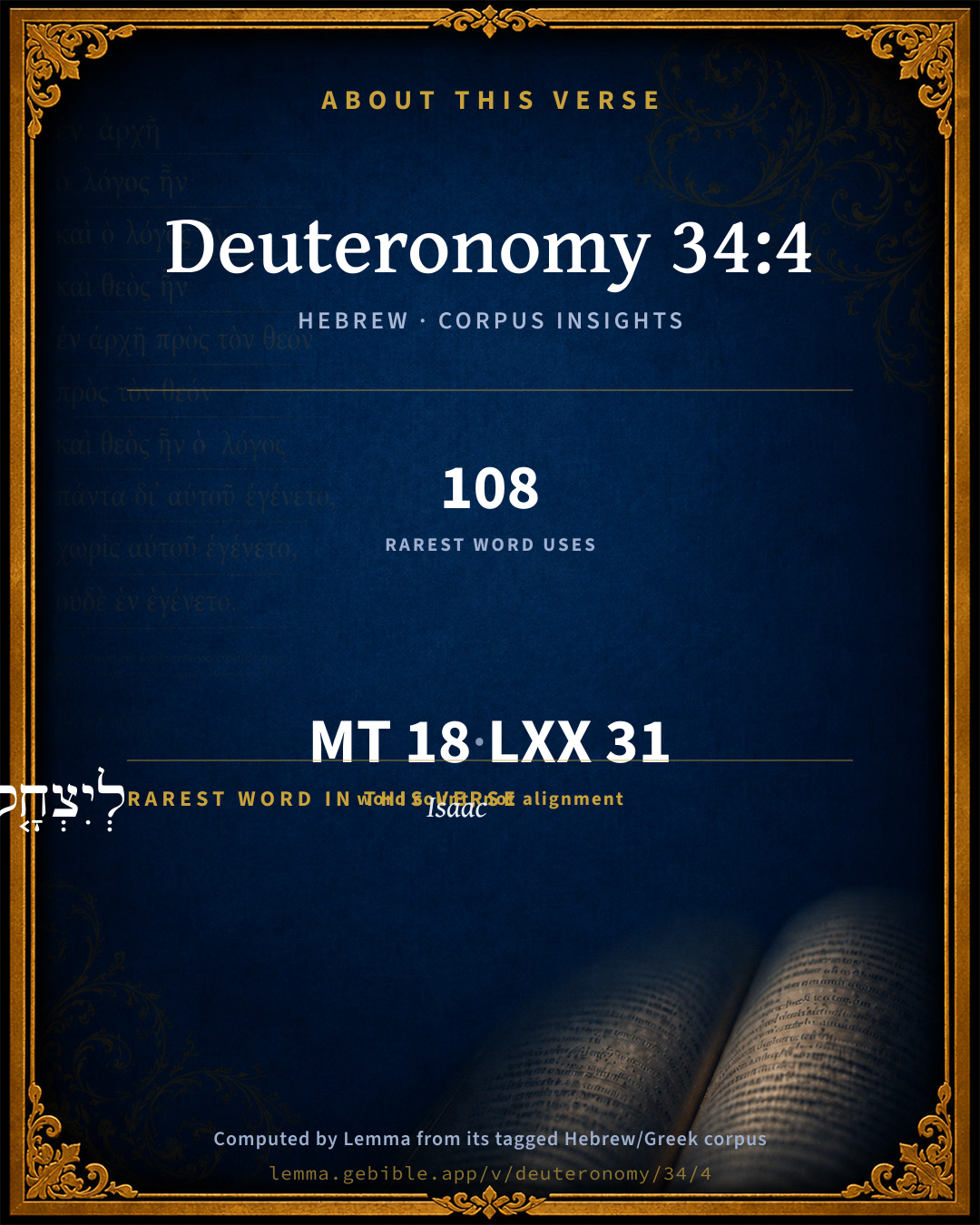
These counts appear in no published source. They are computed here, from the morphology-tagged text and Lemma’s own curated glosses. What Lemma adds →

18
words
17
distinct lemmas
Pentateuch
section

Grammatical profile

  • 6 verbs
  • 7 nouns
  • 1 pronoun
  • 1 preposition
  • 1 adverb
  • 2 particles

Verb forms

  • וַיֹּ֨אמֶר Qal · Sequential Imperfect
  • נִ֠שְׁבַּעְתִּי Niphal · Perfect
  • לֵאמֹ֔ר Qal · Infinitive Construct
  • אֶתְּנֶ֑נָּה Qal · Imperfect
  • הֶרְאִיתִ֣יךָ Hiphil · Perfect
  • תַעֲבֹֽר Qal · Imperfect

Repetition

A word recurs within this verse — often emphatic in Hebrew:

  • וַיֹּ֨אמֶר to say H559 ×2

Hebrew & Septuagint length

In English translation the verse runs 43 words from the Hebrew and 43 from the Septuagint (LXX English) — the same length.

A rough comparison of the two English renderings, which tokenize alike — not a word-level alignment.

Word counts can differ between the Hebrew and the Greek without any difference in meaning — e.g. the Hebrew direct-object marker אֵת has no separate Greek word, and Greek often adds the article ὁ.

In the original languages it is 18 Hebrew tokens and 31 Greek tokens — but the two are counted differently (Hebrew bundles its prefixes and suffixes into one token; the Greek is in lemma form), so that isn’t a like-for-like length.

Cross-references

10

Topical passages linked to Deuteronomy 34:4 in the Treasury of Scripture Knowledge — connected by theme and wording, ordered by reader-vote popularity; previews shown in the World English Bible.

  • Deuteronomy 32:52 For you shall see the land before you; but you shall not go there into the land which I give the children of Israel.
  • Genesis 12:7 Yahweh appeared to Abram, and said, "I will give this land to your seed." He built an altar there to Yahweh, who appeared to him.
  • Genesis 28:13 Behold, Yahweh stood above it, and said, "I am Yahweh, the God of Abraham your father, and the God of Isaac. The land whereon you lie, to you will I give it, and to your seed.
  • Deuteronomy 3:26–27 But Yahweh was angry with me for your sakes, and didn't listen to me; and Yahweh said to me, Let it suffice you; speak no more to me of this matter.
  • Genesis 13:15 for all the land which you see, I will give to you, and to your offspring forever.
  • Genesis 15:18–21 In that day Yahweh made a covenant with Abram, saying, "To your seed have I given this land, from the river of Egypt to the great river, the river Euphrates:
  • Genesis 26:3 Sojourn in this land, and I will be with you, and will bless you. For to you, and to your seed, I will give all these lands, and I will establish the oath which I swore to Abraham your father.
  • Numbers 20:12 Yahweh said to Moses and Aaron, Because you didn't believe in me, to sanctify me in the eyes of the children of Israel, therefore you shall not bring this assembly into the land which I have given them.
  • Psalms 105:9–11 The covenant which he made with Abraham, His oath to Isaac,
  • John 1:17 For the law was given through Moses. Grace and truth came through Jesus Christ.

Cross-references courtesy of OpenBible.info (CC BY 4.0).

Hebrew and Greek witnesses Masoretic Hebrew ↔ Greek Septuagint

The same verse in the two great witnesses to the Old Testament, shown verse-for-verse.

These are two independent witnesses, not word-aligned to each other, and the Septuagint is shown in lemma (dictionary) form.

Hebrew Deuteronomy 34:4 Masoretic · Westminster Leningrad Codex

וַיֹּ֨אמֶר יְהוָ֜ה אֵלָ֗יו זֹ֤את הָאָ֨רֶץ֙ אֲשֶׁ֣ר נִ֠שְׁבַּעְתִּי לְאַבְרָהָ֨ם לְיִצְחָ֤ק וּֽלְיַעֲקֹב֙ לֵאמֹ֔ר לְזַרְעֲךָ֖ אֶתְּנֶ֑נָּה הֶרְאִיתִ֣יךָ בְעֵינֶ֔יךָ וְשָׁ֖מָּה לֹ֥א תַעֲבֹֽר

Yahweh said to him, This is the land which I swore to Abraham, to Isaac, and to Jacob, saying, I will give it to your seed: I have caused you to see it with your eyes, but you shall not go over there.

World English Bible · Public Domain

Greek LXX Deuteronomy 34:4 Septuagint · lemma form

καί εἶπον κύριος πρός μωυσῆς οὗτος ὁ γῆ ὅς ὄμνυμι ἀβραάμ καί ισαακ καί ἰακώβ λέγω ὁ σπέρμα σύ δίδωμι αὐτός καί δεικνύω αὐτός ὁ ὀφθαλμός σύ καί ἐκεῖ οὐ εἰςἔρχομαι

And the Lord said to Moses, This is the land of which I swore to Abraam, and Isaac, and Jacob, saying, To your seed will I give it: and I have showed it to your eyes, but you shall not go in there.

LXX2012 (modern English Septuagint) · Public Domain

Hebrew: Westminster Leningrad Codex (CC BY 4.0). Greek: Septuagint (public domain); English from LXX2012 (modern English Septuagint) (Public Domain). How the Septuagint differs from the Hebrew →

Targum (Aramaic paraphrase)

2

The Targum is the ancient Jewish Aramaic paraphrase of the Hebrew Scriptures — an interpretive translation, not the Hebrew text itself. Onkelos (literal) and Pseudo-Jonathan (expansive) render the Torah, and Jonathan the Prophets. Coverage is partial: where no permissively-licensed English translation exists for a verse, only the Aramaic is shown. This is verse-level text, not a word-by-word alignment to the Hebrew.

  1. Targum Onkelos Torah (Genesis–Deuteronomy)
    וַאֲמַר יְיָ לֵהּ דָא אַרְעָא דִי קַיֵמִית לְאַבְרָהָם לְיִצְחָק וּלְיַעֲקֹב לְמֵימָר לִבְנָיךְ אֶתְּנִנַהּ אַחֲזִיתָךְ בְּעֵינָיךְ וּלְתַמָן לָא תְעִבַּר

    (no public-domain English translation for this verse)

    Targum Onkelos — Aramaic: “Onkelos Genesis” (public domain); “Onkelos Exodus” (public domain); “Onkelos Leviticus” (public domain); “Onkelos Numbers” (public domain); “Onkelos Deuteronomy” (public domain). English: “Sefaria Community Translation” (CC0 1.0 (public-domain dedication)); “J.W. Etheridge. The Targums of Onkelos and Jonathan Ben Uzziel on the Pentateuch. London: Longmans, Green, 1862” (public domain). Text via Sefaria.

  2. Targum Pseudo-Jonathan Torah (Genesis–Deuteronomy)
    וַאֲמַר יְיָ לֵיהּ דָא הוּא סֵיפָא דְמִלְתָא בְּאַרְעָא וְדָא אַרְעָא דְּקַיֵּימִית לְאַבְרָהָם לְיִצְחָק וּלְיַעֲקב לְמֵימָר לִבְנֵיכוֹן אֶתְּנִינָהּ אַחְמְיַית יָתָהּ בְּעֵינָךְ וְתַמָּן לָא תְעִבַּר

    And the Lord said to him, This is the end of the word concerning the land, and this is the land which I covenanted unto Abraham, to Izhak, and to Jacob, saying, I will give it unto your children. I grant thee to see it with thine eyes, but thou shalt not pass over to it.

    Targum Pseudo-Jonathan — Aramaic: “Targum Jonathan on Genesis” (public domain); “Targum Jonathan on Exodus” (public domain); “Targum Jonathan on Leviticus” (public domain); “Targum Jonathan on Numbers” (public domain); “Targum Jonathan on Deuteronomy” (public domain). English: “The Targum of Jonathan ben Uzziel, trans. J. W. Etheridge, London, 1862” (public domain). Text via Sefaria.

Commentary

Notes on Deuteronomy 34:4 from classic Christian and Jewish commentators (each source and its license shown beneath its notes). The classic Christian expositions comment on the surrounding passage and are grouped to its opening verse, so a note may address several verses; the Jewish commentaries on the Tanakh (Rashi and others) are per-verse, so they appear only where the commentator wrote on this verse.

Lemma curates 59 commentaries, every one of them public domain or Creative Commons licensed, each selected and text-cleaned for this edition rather than reprinted as found. About our sources →

Trapp's Complete Commentary

John Trapp

Deu 34:4 And the LORD said unto him, This [is] the land which I sware unto Abraham, unto Isaac, and unto Jacob, saying, I will give it unto thy seed: I have caused thee to see [it] with thine eyes, but thou shalt not go over thither.

Ver. 4. I have caused thee to see it.] By an extraordinary power, for in an ordinary way Moses could never have taken so large a prospect at once. Faith puts a man’s head into heaven, and gives him a view of far better things; neither vision only, but fruition also, which Moses had not.

John Trapp, A Commentary or Exposition upon All the Books of the Old and New Testament (1647–1656) — public domain. Text from a community e-Sword module.

Joseph Benson's Commentary

Deu 34:4. I have caused thee to see it — For though his sight was good, yet he could not have seen all Canaan, a hundred and sixty miles in length, and fifty or sixty in breadth, if his sight had not been miraculously assisted and enlarged, He saw it at a distance. Such a sight the Old Testament believers had of the kingdom of the Messiah. And such a sight believers have now of the glory that shall be revealed. Such a sight have we now, of the knowledge of the glory of the Lord, which shall cover the earth. Those that come after us shall undoubtedly enter into that promised land; which is a comfort to us, when we find our own carcasses falling in this wilderness.

Joseph Benson's Commentary on the Old and New Testaments (1811–1818) — public domain. Text from a community e-Sword module.

Ellicott's Commentary for English Readers

(4) This is the land which I sware unto Abraham, unto Isaac, and unto Jacob, saying, I will give it unto thy seed: I have caused thee to see it.—“That thou mayest go and say to Abraham, Isaac, and Jacob, The oath which He sware to you, the Holy One, blessed be He! hath performed it,” is Raehi’s comment. But in Paradise they scarcely needed Moses to tell them of His faithfulness.

A Bible Commentary for English Readers, edited by Charles John Ellicott (1878–1897) — public domain. Text from a community e-Sword module.

The Cambridge Bible for Schools and Colleges

gen. ed. J. J. S. Perowne

4. the land which I sware, etc.] As Exo_33:1, see above on Deu_1:8.

thou shalt not go over thither] Deu_1:37, Deu_3:27, Deu_4:21 f., and in P, Deu_32:52, Num_20:12.

The Cambridge Bible for Schools and Colleges (gen. ed. J. J. S. Perowne; Cambridge University Press, 1878–1918) — public domain. Text from a community e-Sword module.

John Gill's Exposition

And the Lord said unto him,.... The Word of the Lord, as the Jerusalem Targum, having shown him all the land of Canaan:

this is the land which I sware unto Abraham, unto Isaac, and unto Jacob, saying, I will give it unto thy seed; to Abraham, Gen 15:18; to Isaac, Gen 26:3; to Jacob, Gen 28:13,

I have caused thee to see it with thine eyes; not only had indulged him with a general view of it, but had strengthened his eyesight, that he had a full, clear, and distinct sight of it:

but thou shalt not go over thither; which he had said more than once before and abides by it, and this because of the behaviour of Moses at the waters of Meribah, Num 20:12; see Deu 3:25.

John Gill's Exposition of the Whole Bible (1746–1763) — public domain (CC PDM 1.0). Text via the HelloAO Bible API.

Albert Barnes' Notes on the Bible

I have caused thee to see it - The sight thus afforded to Moses, like that of “all the kingdoms of the world in a moment of time” Luk 4:5, was no doubt supernatural.

Albert Barnes' Notes on the Bible (1834–1885) — public domain. Text from a community e-Sword/MySword module.

Haydock's Catholic Bible Commentary

This land, which has been just described, is what God chiefly promised to the Patriarchs, comprising the countries on the east, as well as those on the western side of the Jordan. (Haydock) --- To it. But thou shalt be translated to a better land, the land of the living. Moses was now perfectly resigned to the will of God. (Salien) --- He no longer cherished those ardent desires of introducing the people into Chanaan, which he had not long before expressed: as he found that God had decreed that he should be deprived of the honour. He received this refusal as a just punishment of his transgression, and calmly reposed in the Lord. There seems to be no reason why Moses might not have written the preceding verses at least, though the names of some of the tribes are mentioned, who obtained possession only after his death. As he knew the limits of the promised land, so, by the prophetic spirit, he might know that these tribes would be settled in the country; and he does not mark out their divisions with any degree of precision. In a word, there seems to be hardly a single passage in the Pentateuch which may not have Moses for its author. (Haydock)

George Leo Haydock (1774–1849), Haydock's Catholic Family Bible and Commentary, 1859 edition — public domain. Excludes Psalms (Douay-Rheims chapter numbering differs from Protestant) and Deuterocanonical books (Catholic canon only).

Matthew Poole's English Annotations

With thine eyes, to wit, by a miraculous power strengthening thy sight, or making a clear representation of all these parts to thy view.

Matthew Poole's English Annotations on the Holy Bible (1683–1685) — public domain. Text from a community e-Sword/MySword module.

Whedon's Commentary on the Bible

Daniel D. Whedon

4. This is the land which I sware unto Abraham — At the oak of Moreh, centuries before this, Jehovah had manifested himself to Abraham and said to him, “Unto thy seed will I give this land.” Gen_12:7.

I have caused thee to see it with thine eyes — Tristram (Land of Moab, American edition, p. 338) gives the following description of the view from the summit of Nebo: “Anxious to verify exactly the view of Moses, we paid three visits to Nebo; but we were not so fortunate as on my former visit, when for the first time Nebo was identified. On each occasion there was a haze from the heat which dimmed the distant features and outlines, producing a sort of mirage, which rendered it most difficult clearly to trace distant objects. Still, we had a clear distant view of western Palestine and the whole Judean range from far south of Hebron up to Galilee. We could see the west side of the Dead Sea from Engedi northward. Bethlehem, Jerusalem, and Nebi-Samwil, (Mizpeh.) Ebal and Gerizim were very easily made out, and the opening of the vale of Shechem. Carmel could be recognised, but we were never able to make out the sea to the north of it; and though it is certainly possible that it might be seen from this elevation I could not satisfy myself that I saw more than the haze over the plain of Esdraelon. The rest of the view was like that from Muslubeiyah, only that a corner of the Hauran Mountains could be caught in a depression of the Gilead range. Hermon certainly could be made out in a clear atmosphere over the Jordan valley, the whole of which lay open as far as Kurn Surtabeh. After testing repeatedly every view in the neighbourhood I am perfectly satisfied that there is none which equals in extent that from Nebo — that is, from the flat ridge which rises slightly about half a mile behind the ruined city, and which I take to be ‘the true field of Zophim, the top of Pisgah.’”

But thou shalt not go over thither — In Numbers xx it is related that when the people murmured for lack of water Jehovah directed Moses to take the rod with which the miracles in Egypt had been wrought, and with Aaron to call the people together to speak unto the rock before their eyes, and it would give forth water. The people assembled, Moses takes the rod as Jehovah commanded. He says to the people, “Hear now, ye rebels, must we fetch you water out of this rock?” He did not obey to the letter the command of Jehovah, and he “spake unadvisedly with his lips.” Psa_106:33. It was in reference to this incident that Jehovah said to Moses and Aaron, “Because ye believed me not to sanctify me in the eyes of the children of Israel, therefore ye shall not bring this congregation into the land which I have given them.” Num_20:12.

Daniel D. Whedon (gen. ed.), Commentary on the Old and New Testaments (1874–1909) — public domain. Text from a community e-Sword module.

John Wesley's Explanatory Notes

I have caused thee to see it - For tho' his sight was good, yet he could not have seen all Canaan, an hundred and sixty miles in length, and fifty or sixty in breadth, if his sight had not been miraculously assisted and enlarged. He saw it at a distance. Such a sight the Old Testament believers had of the kingdom of the Messiah. And such a sight believers have now of the glory that shall he revealed. Such a sight have we now, of the knowledge of the glory of the Lord, which shall cover the earth. Those that come after us shall undoubtedly enter into that promised land: which is a comfort to us, when we find our own carcases falling in this wilderness.

John Wesley, Explanatory Notes Upon the Whole Bible (1754–1765) — public domain. Text via the GEBible commentary corpus.

unfoldingWord translationNotes

Door43 World Missions Community

Beth Peor

This was a town in Moab. See how you translated this in Deuteronomy 3:29.

look at it with your eyes

"see it for yourself"

to this day

This refers to the time that this was written or edited, not to the present time in the twenty-first century.

translationWords

oath

Abraham

Isaac

Jacob

descend

servant

die

word

bury

grave

unfoldingWord translationNotes — © Distant Shores Media and the Door43 World Missions Community, licensed CC BY-SA 4.0. Source: git.door43.org/Door43/en_tn.

Rashi

Rabbi Shlomo Yitzchaki (Rashi)

לאמר לזרעך אתננה הראיתיך TO SAY, TO THY SEED WILL I GIVE IT, I HAVE LET THEE SEE IT, i.e. in order that you may go and say to Abraham, to Isaac and to Jacob: The oath which the Holy One, blessed be He, swore to you — that oath He has fulfilled. This is the force of לאמר (Berakhot 18b), “to say it”, viz., that you may say it — for that reason have I let you see it. But it is a decree from Me that שמה לא תעבר THERE YOU SHALL NOT CROSS OVER; for were this not so, I would keep you alive even until you saw them planted and settled in it, and you would then go and tell them (the patriarchs).

Rashi on the Tanakh — English translations: “The Judaica Press complete Tanach with Rashi, translated by A. J. Rosenberg” (CC BY 4.0); “Pentateuch with Rashi's commentary by M. Rosenbaum and A.M. Silbermann, 1929-1934” (public domain); “The Metsudah Tanach series, Lakewood, N.J” (CC BY 4.0); and “The Book of Joshua, Metsudah Publications, 1997” (CC BY 4.0). Text via Sefaria.

Lesson kit

Teaching starters — assembled from the data on this page, not authored interpretation. Every prompt links to the verse data it draws on. Edit before teaching.

Deuteronomy, in the Pentateuch, opens this verse with 18 words (17 distinct Hebrew lemmas). Its most distinctive word is Yitschâq (“Isaac”). A historical commentator’s framing appears above. Read the whole chapter for the surrounding context.

Discussion questions

  1. How does “Isaac” (Yitschâq) shape what this verse is saying?
  2. Deuteronomy 32:52 shares this passage’s theme. How do the two illuminate each other?
  3. “to say” occurs 2× in this one verse. What is the effect of the repetition?
  4. The translations on this page render this verse differently — a whole-verse word diff, not a word-by-word alignment. What might account for the different wordings?
  5. The verb «וַיֹּ֨אמֶר» is Qal Sequential Imperfect. How does its form color the action?
  6. Reading how Trapp's Complete Commentary and Joseph Benson's Commentary read this verse, where do the two commentators agree and where do they part?

Things to notice

Reading settings

Reading text

Shown beneath each verse's original-language words.

Old Testament
Old Testament edition

Read the OT as the Masoretic Hebrew (MT) or the Greek Septuagint (LXX).

English shown for the Greek Septuagint (in the Hebrew ↔ Greek comparison).

Comparing translations? Open the Compare panel on any verse page to stack up to four side by side.