Numbers 6:13

Hebrew (Westminster Leningrad Codex) Numbers 6:13 appears in the Hebrew Old Testament. The text above is from the Westminster Leningrad Codex. Each word links to its Strong’s number, a concise gloss, and parsing drawn from the Open Scriptures Hebrew Bible morphology. Click any word for its full Brown-Driver-Briggs (BDB) entry.
Download image
Cite this verse

Numbers 6:13 (World English Bible). Public Domain. Lemma interlinear Bible study tool, https://lemma.gebible.app/v/numbers/6/13.

Show BibTeX & RIS
BibTeX
RIS
English Translation
"This is the law of the Nazirite: when the days of his separation are fulfilled, he shall be brought to the door of the Tent of Meeting,
World English Bible · Public Domain
Download a study sheet

One document with this verse’s original text, its word-by-word gloss line, the meaning frame, cross-references with their text, attributed commentary, and full source and license credits — printable, and it pastes into notes with its structure intact.

This verse Autodidact and up

Study sheet (.html) Plain text (.txt)

A passage Seminary Student

Up to 50 verses in one chapter. A passage sheet keeps up to 6 commentary sources and 12 cross-references per verse, in the order this page ranks them, and says so on the sheet whenever that leaves anything out. Ask for a single verse and you get the Autodidact verse sheet above.

Everything on this page stays free to read, with no account — the sheet is a download of what is already on screen, not access to it.

Want to remove ads? Support Godless Engineer
Compare translations 3

The same verse in 3 English versions, stacked beneath the original-language interlinear above. Click any original word for its lexicon entry.

Each is an independent rendering of the whole verse — the interlinear is not word-aligned to these translations.

Highlighted words mark where these versions differ — a whole-verse word diff, not a word-by-word alignment.

  • World English Bible Public Domain
    "This is the law of the Nazirite: when the days of his separation are fulfilled, he shall be brought to the door of the Tent of Meeting,
  • King James Version Public Domain
    And this is the law of the Nazarite, when the days of his separation are fulfilled: he shall be brought unto the door of the tabernacle of the congregation:
  • unfoldingWord Literal Text CC BY-SA 4.0
    And this is the law of the Nazirite: On the day of the fulfilling of the days of his separation, he shall bring him to the opening of the tent of meeting,

unfoldingWord Literal Text — © unfoldingWord, licensed CC BY-SA 4.0. Word-aligned USFM3 via Door43 (git.door43.org/unfoldingWord/en_ult).

Versions to compare (up to 4)

3 of 4 selected

Show all 18 translations

Every available English version of this verse, each an independent rendering of the whole verse.

  • World English Bible Public Domain
    "This is the law of the Nazirite: when the days of his separation are fulfilled, he shall be brought to the door of the Tent of Meeting,
  • Berean Standard Bible Public Domain
    Now this is the law of the Nazirite when his time of separation is complete: He must be brought to the entrance to the Tent of Meeting,
  • Majority Standard Bible Public Domain
    Now this is the law of the Nazirite when his time of separation is complete: He must be brought to the entrance to the Tent of Meeting,
  • King James Version Public Domain
    And this is the law of the Nazarite, when the days of his separation are fulfilled: he shall be brought unto the door of the tabernacle of the congregation:
  • American Standard Version (1901) Public Domain
    And this is the law of the Nazirite, when the days of his separation are fulfilled: he shall be brought unto the door of the tent of meeting:
  • Revised Version (1885) Public Domain
    And this is the law of the Nazirite, when the days of his separation are fulfilled: he shall be brought unto the door of the tent of meeting:
  • Geneva Bible (1599) Public Domain
    This then is the lawe of the Nazarite: When the time of his consecration is out, he shall come to the doore of the Tabernacle of the Congregation,
  • Douay-Rheims (1899) Public Domain
    This is the law of consecration. When the days which he had determined by vow shall be expired, he shall bring him to the door of the tabernacle of the covenant,
  • Young's Literal Translation Public Domain
    `And this `is' the law of the Nazarite; in the day of the fulness of the days of his separation doth `one' bring him in unto the opening of the tent of meeting,
  • Literal Standard Version CC BY-SA 4.0
    And this [is] the law of the Nazarite: in the day of the fullness of the days of his separation, he is brought to the opening of the Tent of Meeting,
  • Unlocked Literal Bible CC BY-SA 4.0
    This is the law about the Nazirite for when the time of his separation is complete. He must be brought to the entrance of the tent of meeting.
  • unfoldingWord Literal Text CC BY-SA 4.0
    And this is the law of the Nazirite: On the day of the fulfilling of the days of his separation, he shall bring him to the opening of the tent of meeting,
  • Darby Bible Public Domain
    And this is the law of the Nazarite on the day when the days of his consecration are fulfilled: he shall be brought to the entrance of the tent of meeting.
  • World Messianic Bible Public Domain
    “‘This is the law of the Nazirite: when the days of his separation are fulfilled, he shall be brought to the door of the Tent of Meeting,
  • Webster's Bible Public Domain
    And this is the law of the Nazarite, when the days of his separation are fulfilled: he shall be brought to the door of the tabernacle of the congregation:
  • Free Bible Version CC BY-SA 4.0
    These are the rules to be observed when the Nazirite's time of dedication is finished. They are to be taken to the entrance to the Tent of Meeting.
  • Bible in Basic English Public Domain
    And this is the law for him who is separate, when the necessary days are ended: he is to come to the door of the Tent of meeting,
  • JPS Tanakh (1917) Public Domain
    And this is the law of the Nazirite, when the days of his consecration are fulfilled: he shall bring it unto the door of the tent of meeting;

Literal Standard Version (2020), Covenant Press — licensed CC BY-SA 4.0. Text via the HelloAO Bible API (eBible.org). Unlocked Literal Bible (unfoldingWord) — licensed CC BY-SA 4.0. Text via the HelloAO Bible API (eBible.org). unfoldingWord Literal Text — © unfoldingWord, licensed CC BY-SA 4.0. Word-aligned USFM3 via Door43 (git.door43.org/unfoldingWord/en_ult). Free Bible Version, Dr. Jonathan Gallagher — licensed CC BY-SA 4.0. Text via the HelloAO Bible API (eBible.org).

Word by word

More ways to search: Search by grammar → Find every occurrence → Compare this word →

Practice this passage: Drill this verse → Learn its vocabulary →

הַנָּזִ֑יר
nâzîyr
H5139
“the · Nazarite”
Particle, Definite Article + Noun, Common, Masculine, Singular, Absolute
Part of Speech
Particle + Noun
Type
Common
Gender
Masculine
Number
Singular
State
Absolute
Full BDB Definition

Origin: from H5144

TWOT: 1340b

consecrated or devoted one, Nazarite - consecrated one - devotee, Nazarite - untrimmed (vine)
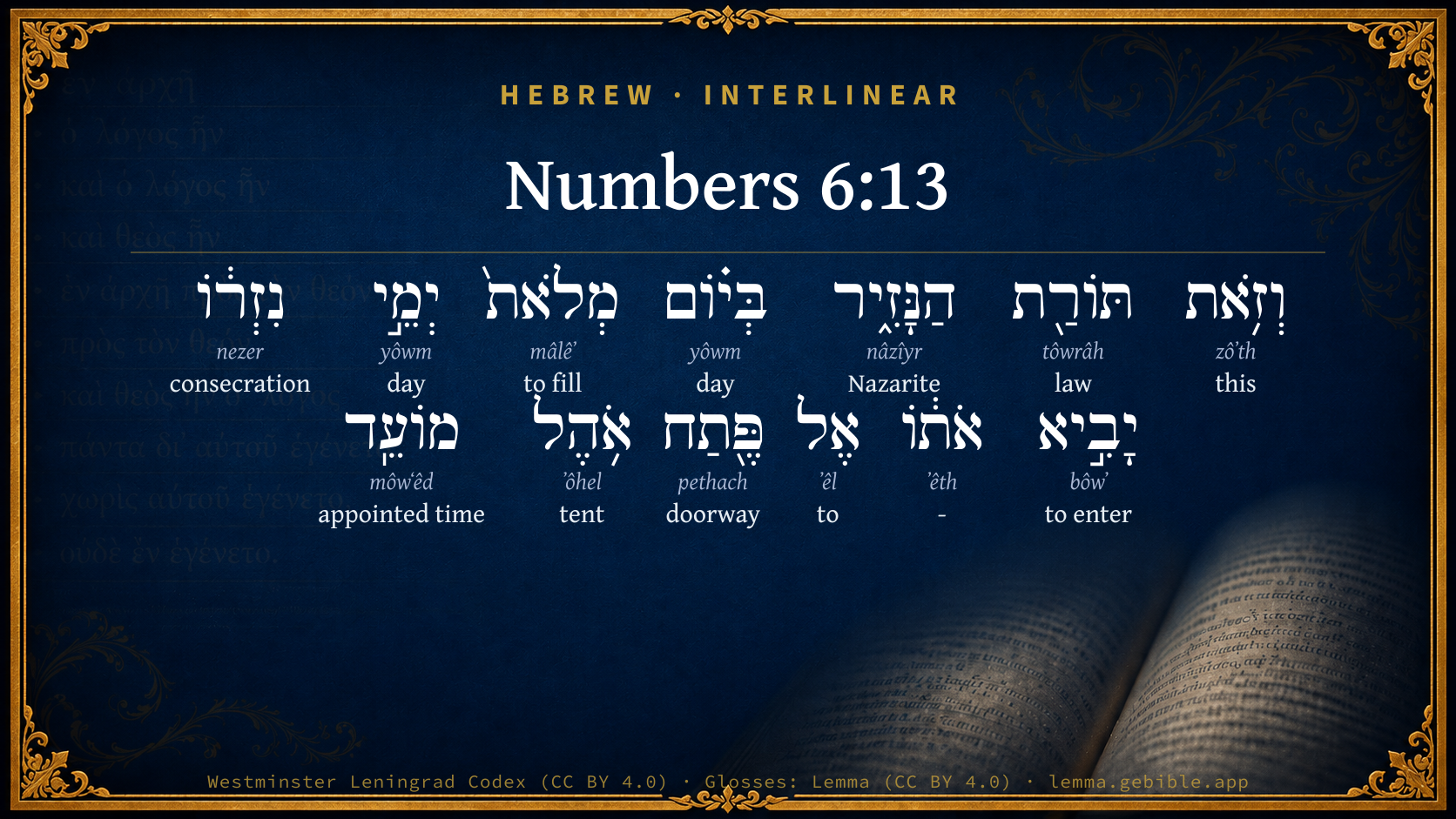
  1. וְזֹ֥את zôʼth H2063 “and · this” Conjunction + Pronoun, Demonstrative, Feminine, Singular
  2. תּוֹרַ֖ת tôwrâh H8451 “law of” Noun, Common, Feminine, Singular, Construct
  3. בְּי֗וֹם yôwm H3117 “in/at · day” Preposition + Noun, Common, Masculine, Singular, Absolute
  4. מְלֹאת֙ mâlêʼ H4390 “to fill” Verb, Qal, Infinitive Construct
  5. יְמֵ֣י yôwm H3117 “days of” Noun, Common, Masculine, Plural, Construct
  6. נִזְר֔וֹ nezer H5145 “consecration · his” Noun, Common, Masculine, Singular, Construct + Suffix, Personal, 3rd Person, Masculine, Singular
  7. יָבִ֣יא bôwʼ H935 “to enter” Verb, Hiphil, Imperfect, 3rd Person, Masculine, Singular
  8. אֹת֔וֹ ʼêth H853 “- · him” Particle, Direct Object + Suffix, Personal, 3rd Person, Masculine, Singular
  9. אֶל ʼêl H413 “to” Preposition
  10. פֶּ֖תַח pethach H6607 “doorway of” Noun, Common, Masculine, Singular, Construct
  11. אֹ֥הֶל ʼôhel H168 “tent of” Noun, Common, Masculine, Singular, Construct
  12. מוֹעֵֽד môwʻêd H4150 “appointed time” Noun, Common, Masculine, Singular, Absolute

About this verse

These counts appear in no published source. They are computed here, from the morphology-tagged text and Lemma’s own curated glosses. What Lemma adds →

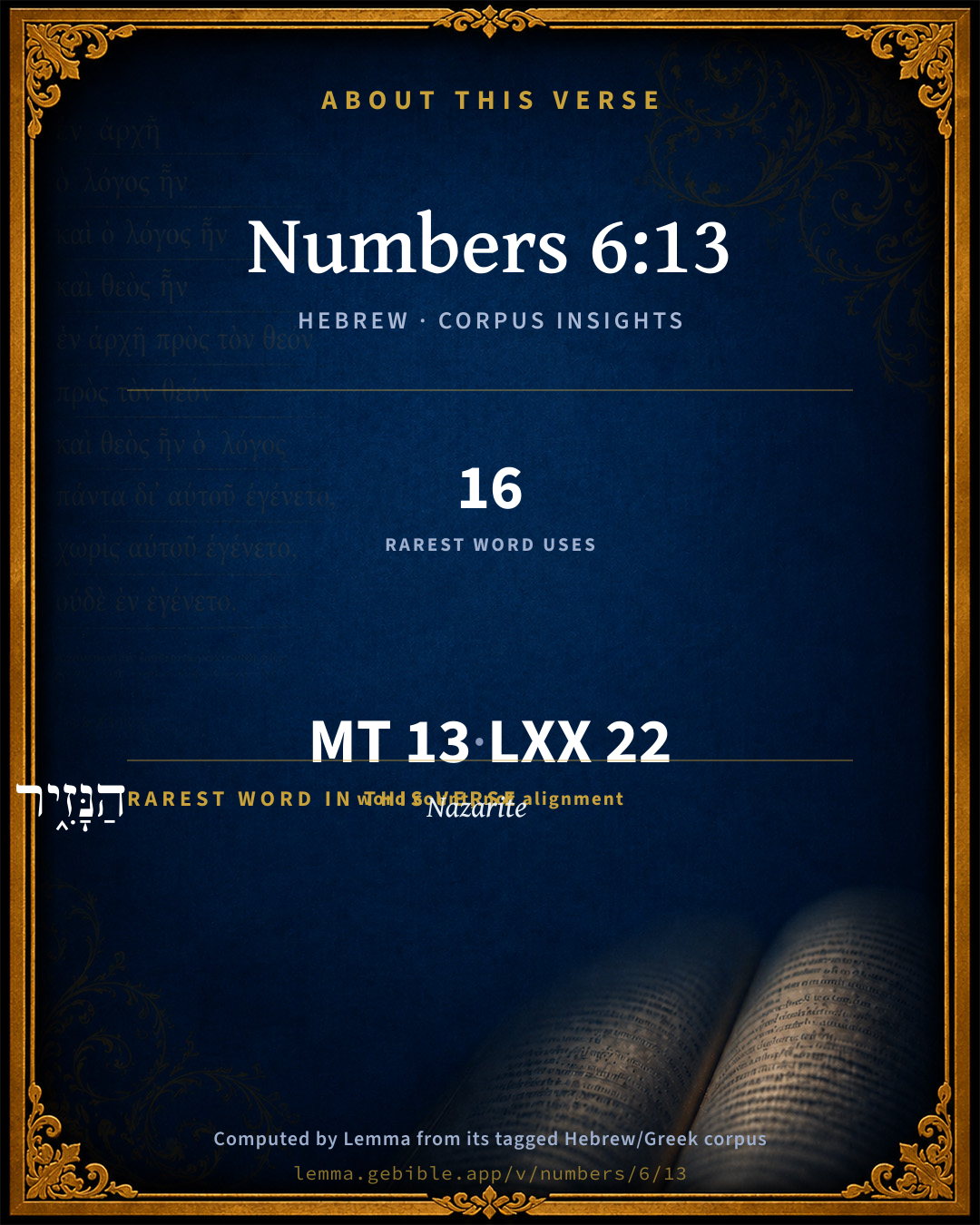
13
words
12
distinct lemmas
Pentateuch
section

Notable vocabulary

The rarest word here is הַנָּזִ֑יר Nazarite H5139 — appearing just 16 times in the whole Hebrew Bible.

Shared distinctive vocabulary

הַנָּזִ֑יר Nazarite H5139 occurs in 16 verses of the Hebrew Bible. Also found in:

Grammatical profile

  • 2 verbs
  • 8 nouns
  • 1 pronoun
  • 1 preposition
  • 1 particle

Verb forms

  • מְלֹאת֙ Qal · Infinitive Construct
  • יָבִ֣יא Hiphil · Imperfect

Repetition

A word recurs within this verse — often emphatic in Hebrew:

  • בְּי֗וֹם day H3117 ×2

Hebrew & Septuagint length

In English translation the verse runs 27 words from the Hebrew and 36 from the Septuagint (LXX English) — closely comparable.

A rough comparison of the two English renderings, which tokenize alike — not a word-level alignment.

Word counts can differ between the Hebrew and the Greek without any difference in meaning — e.g. the Hebrew direct-object marker אֵת has no separate Greek word, and Greek often adds the article ὁ.

In the original languages it is 13 Hebrew tokens and 22 Greek tokens — but the two are counted differently (Hebrew bundles its prefixes and suffixes into one token; the Greek is in lemma form), so that isn’t a like-for-like length.

Cross-references

1

Topical passages linked to Numbers 6:13 in the Treasury of Scripture Knowledge — connected by theme and wording, ordered by reader-vote popularity; previews shown in the World English Bible.

  • Acts 21:26 Then Paul took the men, and the next day, purified himself and went with them into the temple, declaring the fulfillment of the days of purification, until the offering was offered for every one of them.

Cross-references courtesy of OpenBible.info (CC BY 4.0).

Hebrew and Greek witnesses Masoretic Hebrew ↔ Greek Septuagint

The same verse in the two great witnesses to the Old Testament, shown verse-for-verse.

These are two independent witnesses, not word-aligned to each other, and the Septuagint is shown in lemma (dictionary) form.

Hebrew Numbers 6:13 Masoretic · Westminster Leningrad Codex

וְזֹ֥את תּוֹרַ֖ת הַנָּזִ֑יר בְּי֗וֹם מְלֹאת֙ יְמֵ֣י נִזְר֔וֹ יָבִ֣יא אֹת֔וֹ אֶל פֶּ֖תַח אֹ֥הֶל מוֹעֵֽד

"This is the law of the Nazirite: when the days of his separation are fulfilled, he shall be brought to the door of the Tent of Meeting,

World English Bible · Public Domain

Greek LXX Numbers 6:13 Septuagint · lemma form

καί οὗτος ὁ νόμος ὁ εὔχομαι ὅς ἄν ἡμέρα πληρόω ἡμέρα εὐχή αὐτός προςφέρω αὐτός παρά ὁ θύρα ὁ σκηνή ὁ μαρτύριον

And this is the law of him that has vowed: in whatever day he shall have fulfilled the days of his vow, he shall himself bring his gift to the doors of the tabernacle of witness.

LXX2012 (modern English Septuagint) · Public Domain

Hebrew: Westminster Leningrad Codex (CC BY 4.0). Greek: Septuagint (public domain); English from LXX2012 (modern English Septuagint) (Public Domain). How the Septuagint differs from the Hebrew →

Targum (Aramaic paraphrase)

2

The Targum is the ancient Jewish Aramaic paraphrase of the Hebrew Scriptures — an interpretive translation, not the Hebrew text itself. Onkelos (literal) and Pseudo-Jonathan (expansive) render the Torah, and Jonathan the Prophets. Coverage is partial: where no permissively-licensed English translation exists for a verse, only the Aramaic is shown. This is verse-level text, not a word-by-word alignment to the Hebrew.

  1. Targum Onkelos Torah (Genesis–Deuteronomy)
    וְדָא אוֹרַיְתָא דִנְזִירָא בְּיוֹם מִשְׁלַם יוֹמֵי נִזְרֵהּ יַיְתִי יָתֵהּ לִתְרַע מַשְׁכַּן זִמְנָא

    (no public-domain English translation for this verse)

    Targum Onkelos — Aramaic: “Onkelos Genesis” (public domain); “Onkelos Exodus” (public domain); “Onkelos Leviticus” (public domain); “Onkelos Numbers” (public domain); “Onkelos Deuteronomy” (public domain). English: “Sefaria Community Translation” (CC0 1.0 (public-domain dedication)); “J.W. Etheridge. The Targums of Onkelos and Jonathan Ben Uzziel on the Pentateuch. London: Longmans, Green, 1862” (public domain). Text via Sefaria.

  2. Targum Pseudo-Jonathan Torah (Genesis–Deuteronomy)
    וְדָא אַחֲוָויַת אוֹרַיְתָא נִזְרָא בְּיוֹם מִשְׁלַם יוֹמֵי אַפְרָשׁוּתָא יַמְטֵי יַת גַרְמֵיהּ לִתְרַע מַשְׁכַּן זִמְנָא

    And this is the law of the Nazir on the day when his separation days are fulfilled: Let him present himself at the door of the tabernacle of ordinance,

    Targum Pseudo-Jonathan — Aramaic: “Targum Jonathan on Genesis” (public domain); “Targum Jonathan on Exodus” (public domain); “Targum Jonathan on Leviticus” (public domain); “Targum Jonathan on Numbers” (public domain); “Targum Jonathan on Deuteronomy” (public domain). English: “The Targum of Jonathan ben Uzziel, trans. J. W. Etheridge, London, 1862” (public domain). Text via Sefaria.

Commentary

Notes on Numbers 6:13 from classic Christian and Jewish commentators (each source and its license shown beneath its notes). The classic Christian expositions comment on the surrounding passage and are grouped to its opening verse, so a note may address several verses; the Jewish commentaries on the Tanakh (Rashi and others) are per-verse, so they appear only where the commentator wrote on this verse.

Lemma curates 59 commentaries, every one of them public domain or Creative Commons licensed, each selected and text-cleaned for this edition rather than reprinted as found. About our sources →

The Cambridge Bible for Schools and Colleges

gen. ed. J. J. S. Perowne

13–21. The ceremony at the completion of the vow. This consisted of three parts: (a) The Nazirite brought a burnt-offering, sin-offering, and peace-offering, with the usual meal-offering and libations attached to the burnt-offering and the sin-offering (see Num_15:4-6), and the priest offered them (Num_6:13-17). (b) He shaved his head, standing near the door of the Tent by the altar in the court, and threw the hair into the fire on the altar that was consuming the fat of the peace-offering (Num_6:18). (c) After the fat was burnt, the priest waved the shoulder of the peace-offering and part of the meal-offering, and took them as his own perquisite, together with the breast and the ‘thigh of contribution’ which usually fell to him. A sacrificial feast, not here mentioned, must have followed, at which the meat was eaten, and perhaps the Nazirite joined in it, for the worshipper in all other cases had a share in the peace-offering (see art. ‘Sacrifice’ in Hastings’ DB. iv. 338).

The Cambridge Bible for Schools and Colleges (gen. ed. J. J. S. Perowne; Cambridge University Press, 1878–1918) — public domain. Text from a community e-Sword module.

Trapp's Complete Commentary

John Trapp

Num 6:13 And this [is] the law of the Nazarite, when the days of his separation are fulfilled: he shall be brought unto the door of the tabernacle of the congregation:

Ver. 13. And this is the law of the Nazarite.] The third part of it, to teach him thankfulness, that most needful, but much neglected duty.

John Trapp, A Commentary or Exposition upon All the Books of the Old and New Testament (1647–1656) — public domain. Text from a community e-Sword module.

Jamieson, Fausset & Brown

Robert Jamieson, A. R. Fausset & David Brown

when the days of his separation are fulfilled, &c.--On the accomplishment of a limited vow of Nazaritism, Nazarites might cut their hair wherever they happened to be (Act 18:18); but the hair was to be carefully kept and brought to the door of the sanctuary. Then after the presentation of sin offerings and burnt offerings, it was put under the vessel in which the peace offerings were boiled; and the priest, taking the shoulder (Lev 7:32), when boiled, and a cake and wafer of the meat offering, put them on the hands of the Nazarites to wave before the Lord, as a token of thanksgiving, and thus released them from their vow.

Jamieson, Fausset & Brown — Commentary Critical and Explanatory on the Whole Bible (1871) — public domain (CC PDM 1.0). Text via the HelloAO Bible API.

John Gill's Exposition

And he shall offer his offering unto the Lord,.... The Nazarite was to present his offering at the door of the tabernacle, to the priest, in order to be offered for him to the Lord:

one he lamb of the first year without blemish for a burnt offering; according to the law, manner, and custom of a burnt offering, as Aben Ezra observes, which, whether of the herd or of the flock, was to be a male and unblemished, and not more than a year old, Lev 1:3,

and one ewe lamb of the first year without blemish for a sin offering; as was the manner and custom of a sin offering, to be a female, as is remarked by the same writer, see Lev 4:32,

and one ram without blemish for peace offerings; all sorts of offerings were offered on this occasion; a "sin offering", though the vow was performed, and not any mistake made, or anything omitted that was known; yet, lest there should be any secret and unknown breach of the law of Nazariteship committed, a sin offering was required: this teaches us that there may be secret and unknown sins committed by the best of men, in their most sacred and solemn services; and that there is no justification before God by the best works of men, find that the purest and most perfect stand in need of the atoning sacrifice of Christ: a "burnt offering" was to be offered, which usually followed the sin offering, as it did here, though mentioned first, see Num 6:16; and which was done by way of thanksgiving to God for his acceptance of the sin offering: and "peace offerings" were, as Aben Ezra observes, for joy that he had performed his vow: the burnt offering was wholly the Lord's, the sin offering the priest had his part of, and the peace offerings the Nazarite and his friends ate of, and so everyone had their share in these oblations.

John Gill's Exposition of the Whole Bible (1746–1763) — public domain (CC PDM 1.0). Text via the HelloAO Bible API.

Haydock's Catholic Bible Commentary

He. The priest.

George Leo Haydock (1774–1849), Haydock's Catholic Family Bible and Commentary, 1859 edition — public domain. Excludes Psalms (Douay-Rheims chapter numbering differs from Protestant) and Deuterocanonical books (Catholic canon only).

Matthew Poole's English Annotations

By the priest’s appointment and direction.

Matthew Poole's English Annotations on the Holy Bible (1683–1685) — public domain. Text from a community e-Sword/MySword module.

Whedon's Commentary on the Bible

Daniel D. Whedon

13. This is the law of the Nazarite — The following verses (13-21) contain the rites required for the discharge of a Nazarite of days, prescribing the mode of expressing his gratitude for the attainment of the object of his vow and for its successful termination. The whole list of sacrifices described in Leviticus i-vii is exhausted, with the exception of the trespass offering, which is appropriated to a broken vow.

He shall be brought — Literally, he shall bring him, or it — that is, the offering. We are left in doubt whether the priest brings the Nazarite, or he brings himself or his sacrifice, or some unknown person presents him. The English happily expresses the ambiguity.

Daniel D. Whedon (gen. ed.), Commentary on the Old and New Testaments (1874–1909) — public domain. Text from a community e-Sword module.

The Pulpit Commentary

When the days of his separation are fulfilled. The original law contemplated only a vow for a certain period, longer or shorter. All the Nazirites, however, of whom we read in Scripture were lifelong Nazirites: Samson, (Jud_1:13:5) Samuel, (1Sa_1:11) John the Baptist. (Luk_1:15) In all these cases, however, the vow was made for them before their birth. Hegesippus (in Euseb. 2:23) tells us that James, the Lord"s brother, was a Nazirite: "He did not drink wine nor strong drink, and no razor came on his head."

The Pulpit Commentary (1880–1919), ed. H.D.M. Spence-Jones & Joseph S. Exell — public domain. Text from a community e-Sword module.

Kretzmann's Popular Commentary

Paul E. Kretzmann

The Nazarite Sacrifices

v. 13. And this is the law of the Nazarite, when the days of his separation are fulfilled, when he has completed the period for which his vow was in force: He shall be brought unto the door of the Tabernacle of the Congregation,

v. 14. and he shall offer his offering unto the Lord, one he-lamb of the first year without blemish for a burnt offering, and one ewe-lamb of the first year without blemish for a sin-offering, the former to establish complete fellowship between Jehovah and the worshiper, the latter to atone for any sins of weakness that may have happened during the period of separation, and one ram without blemish for peace-offerings,

v. 15. and a basket of unleavened bread, cakes of fine flour mingled with oil, and wafers of unleavened bread anointed with oil, as they were prescribed for every peace-offering, Lev 7:12, and their meat-offering, and their drink-offerings, as they pertained to the burnt offerings and to the peace-offerings, in the form of flour, oil, and wine, Num 15:3-15.

v. 16. And the priest shall bring them before the Lord, and shall offer his sin-offering and his burnt offering;

v. 17. and he shall offer the ram for a sacrifice of peace-offerings unto the Lord, with the basket of unleavened bread; the priest shall offer also his meat-offering and his drink-offering.

v. 18. And the Nazarite shall shave the head of his separation, the head of hair which had so long remained unshorn as a token of his devotion to Jehovah, at the door of the Tabernacle of the Congregation, and shall take the hair of the head of his separation, and put it in the fire which is under the sacrifice of the peace-offerings, thus dedicating the ornamental covering of his head entirely to Jehovah.

v. 19. And the priest shall take the sodden shoulder, the upper part of the fore quarter, of the ram, and one unleavened cake out of the basket, and one unleavened wafer, and shall put them upon the hands of the Nazarite, after the hair of his separation is shaven;

v. 20. and the priest shall wave them for a wave-offering before the Lord. This is holy for the priest, with the wave-breast and heave-shoulder, Exo 29:27-28. And after that the Nazarite may drink wine, he is absolved from the external obligations attending his vow.

v. 21. This is the law of the Nazarite "who hath vowed, and of his offering unto the Lord for his separation, beside that that his hand shall get, whatever else he may afford in the line of gifts to Jehovah; according to the vow which he vowed, so he must do after the law of his separation. Nazarite vows are not enjoined in the New Testament, but it may often serve for a Christian’s self-discipline if he practices some form of self-denial, especially if there are many people in need of assistance.

Paul E. Kretzmann, Popular Commentary of the Bible (1921–1924) — public domain. Text from a community e-Sword module.

unfoldingWord translationNotes

Door43 World Missions Community

of his separation

Here "separation" means "dedication." Also, this abstract noun can be expressed as a verb. AT: "of his dedication" or "that he has dedicated himself" (See: Idiom or Abstract Nouns)

He must be brought

This can be stated in active form. AT: "Someone must bring him" or "He must go" (See: Active or Passive)

He must present his offering to Yahweh

He must bring his offering to the priest to be sacrificed to Yahweh. The full meaning of this statement can be made clear. AT: "He must present his offering to Yahweh by bringing it to the priest to be sacrificed" or "He must present his offering to Yahweh by bringing it to the priest who will sacrifice it" (See: Assumed Knowledge and Implicit Information)

bread made without yeast

This can be stated in active form. AT: "bread he made without yeast" (See: Active or Passive)

fine flour mixed with oil

This can be stated in active form. AT: "fine flour that he mixed with oil" (See: Active or Passive)

wafers without yeast rubbed with oil

This can be stated in active form. AT: "wafers without yeast which he rubbed with oil" (See: Active or Passive)

wafers without yeast

small pieces of flat bread

together with their grain offering and drink offerings

The word "their" refers to the other offerings that the Nazirite man was told to bring. Often grain offerings and drink offerings were required to accompany other types of sacrifices. The full meaning of this statement can be made clear. AT: "together with the grain offering and drink offering that Yahweh required to accompany the other offerings" (See: Assumed Knowledge and Implicit Information)

translationWords

law, laws

Nazirite

blemish

ewe

fellowship offering

bread

yeast

oil

grain offering

drink offering

unfoldingWord translationNotes — © Distant Shores Media and the Door43 World Missions Community, licensed CC BY-SA 4.0. Source: git.door43.org/Door43/en_tn.

Rashi

Rabbi Shlomo Yitzchaki (Rashi)

יביא אתו means, he shall bring himself. This (the word אתו) is one of the three cases of את with a pronominal suffix which R. Ishmael explained thus (as being reflexive and not accusative pronouns). Similar to it is (Leviticus 22:16): והשאיו אותם עון אשמה “and they will bring אותם the iniquity of trespass”, i.e., “and they will bring upon themselves”. Similar to it is, (Deuteronomy 34:6) ויקבר אתו בני “He (Moses) buried himself in the glen”, (Sifrei Bamidbar 32; cf. Rashi on Leviticus 22:16 and Note thereon).

Rashi on the Tanakh — English translations: “The Judaica Press complete Tanach with Rashi, translated by A. J. Rosenberg” (CC BY 4.0); “Pentateuch with Rashi's commentary by M. Rosenbaum and A.M. Silbermann, 1929-1934” (public domain); “The Metsudah Tanach series, Lakewood, N.J” (CC BY 4.0); and “The Book of Joshua, Metsudah Publications, 1997” (CC BY 4.0). Text via Sefaria.

Lesson kit

Teaching starters — assembled from the data on this page, not authored interpretation. Every prompt links to the verse data it draws on. Edit before teaching.

Numbers, in the Pentateuch, opens this verse with 13 words (12 distinct Hebrew lemmas). Its most distinctive word is nâzîyr (“Nazarite”). A historical commentator’s framing appears above. Read the whole chapter for the surrounding context.

Discussion questions

  1. The word nâzîyr carries the sense “Nazarite.” How does it shape the verse?
  2. Genesis 49:26 shares the word «Nazarite» with this verse. How do the two illuminate each other?
  3. “day” occurs 2× in this one verse. What is the effect of the repetition?
  4. The translations on this page render this verse differently — a whole-verse word diff, not a word-by-word alignment. What might account for the different wordings?
  5. The verb «מְלֹאת֙» is Qal Infinitive Construct. How does its form color the action?
  6. Reading how The Cambridge Bible for Schools and Colleges and Trapp's Complete Commentary read this verse, where do the two commentators agree and where do they part?

Things to notice

Reading settings

Reading text

Shown beneath each verse's original-language words.

Old Testament
Old Testament edition

Read the OT as the Masoretic Hebrew (MT) or the Greek Septuagint (LXX).

English shown for the Greek Septuagint (in the Hebrew ↔ Greek comparison).

Comparing translations? Open the Compare panel on any verse page to stack up to four side by side.