Deuteronomy 31:24

Hebrew (Westminster Leningrad Codex) Deuteronomy 31:24 appears in the Hebrew Old Testament. The text above is from the Westminster Leningrad Codex. Each word links to its Strong’s number, a concise gloss, and parsing drawn from the Open Scriptures Hebrew Bible morphology. Click any word for its full Brown-Driver-Briggs (BDB) entry.
Download image
Cite this verse

Deuteronomy 31:24 (World English Bible). Public Domain. Lemma interlinear Bible study tool, https://lemma.gebible.app/v/deuteronomy/31/24.

Show BibTeX & RIS
BibTeX
RIS
English Translation
It happened, when Moses had made an end of writing the words of this law in a book, until they were finished,
World English Bible · Public Domain
Download a study sheet

One document with this verse’s original text, its word-by-word gloss line, the meaning frame, cross-references with their text, attributed commentary, and full source and license credits — printable, and it pastes into notes with its structure intact.

This verse Autodidact and up

Study sheet (.html) Plain text (.txt)

A passage Seminary Student

Up to 50 verses in one chapter. A passage sheet keeps up to 6 commentary sources and 12 cross-references per verse, in the order this page ranks them, and says so on the sheet whenever that leaves anything out. Ask for a single verse and you get the Autodidact verse sheet above.

Everything on this page stays free to read, with no account — the sheet is a download of what is already on screen, not access to it.

Want to remove ads? Support Godless Engineer
Compare translations 3

The same verse in 3 English versions, stacked beneath the original-language interlinear above. Click any original word for its lexicon entry.

Each is an independent rendering of the whole verse — the interlinear is not word-aligned to these translations.

Highlighted words mark where these versions differ — a whole-verse word diff, not a word-by-word alignment.

  • World English Bible Public Domain
    It happened, when Moses had made an end of writing the words of this law in a book, until they were finished,
  • King James Version Public Domain
    And it came to pass, when Moses had made an end of writing the words of this law in a book, until they were finished,
  • unfoldingWord Literal Text CC BY-SA 4.0
    And it happened as Moses finished writing the words of this law in a scroll until complete,

unfoldingWord Literal Text — © unfoldingWord, licensed CC BY-SA 4.0. Word-aligned USFM3 via Door43 (git.door43.org/unfoldingWord/en_ult).

Versions to compare (up to 4)

3 of 4 selected

Show all 18 translations

Every available English version of this verse, each an independent rendering of the whole verse.

  • World English Bible Public Domain
    It happened, when Moses had made an end of writing the words of this law in a book, until they were finished,
  • Berean Standard Bible Public Domain
    When Moses had finished writing in a book the words of this law from beginning to end,
  • Majority Standard Bible Public Domain
    When Moses had finished writing in a book the words of this law from beginning to end,
  • King James Version Public Domain
    And it came to pass, when Moses had made an end of writing the words of this law in a book, until they were finished,
  • American Standard Version (1901) Public Domain
    And it came to pass, when Moses had made an end of writing the words of this law in a book, until they were finished,
  • Revised Version (1885) Public Domain
    And it came to pass, when Moses had made an end of writing the words of this law in a book, until they were finished,
  • Geneva Bible (1599) Public Domain
    And when Moses had made an ende of writing the wordes of this Lawe in a booke vntill he had finished them,
  • Douay-Rheims (1899) Public Domain
    Therefore after Moses had wrote the words of this law in a volume, and finished it:
  • Young's Literal Translation Public Domain
    And it cometh to pass, when Moses finisheth to write the words of this law on a book till their completion,
  • Literal Standard Version CC BY-SA 4.0
    And it comes to pass, when Moses finishes to write the words of this law on a scroll, until their completion,
  • Unlocked Literal Bible CC BY-SA 4.0
    It happened that when Moses had finished writing the words of this law in a book,
  • unfoldingWord Literal Text CC BY-SA 4.0
    And it happened as Moses finished writing the words of this law in a scroll until complete,
  • Darby Bible Public Domain
    And it came to pass, when Moses had ended writing the words of this law in a book, until their conclusion,
  • World Messianic Bible Public Domain
    When Moses had finished writing the words of this law in a book, until they were finished,
  • Webster's Bible Public Domain
    And it came to pass, when Moses had made an end of writing the words of this law in a book, until they were finished,
  • Free Bible Version CC BY-SA 4.0
    After Moses had finished writing down this Law in a book from start to finish,
  • Bible in Basic English Public Domain
    Now after writing all the words of this law in a book till the record of them was complete,
  • JPS Tanakh (1917) Public Domain
    And it came to pass, when Moses had made an end of writing the words of this law in a book, until they were finished,

Literal Standard Version (2020), Covenant Press — licensed CC BY-SA 4.0. Text via the HelloAO Bible API (eBible.org). Unlocked Literal Bible (unfoldingWord) — licensed CC BY-SA 4.0. Text via the HelloAO Bible API (eBible.org). unfoldingWord Literal Text — © unfoldingWord, licensed CC BY-SA 4.0. Word-aligned USFM3 via Door43 (git.door43.org/unfoldingWord/en_ult). Free Bible Version, Dr. Jonathan Gallagher — licensed CC BY-SA 4.0. Text via the HelloAO Bible API (eBible.org).

Word by word

More ways to search: Search by grammar → Find every occurrence → Compare this word →

Practice this passage: Drill this verse → Learn its vocabulary →

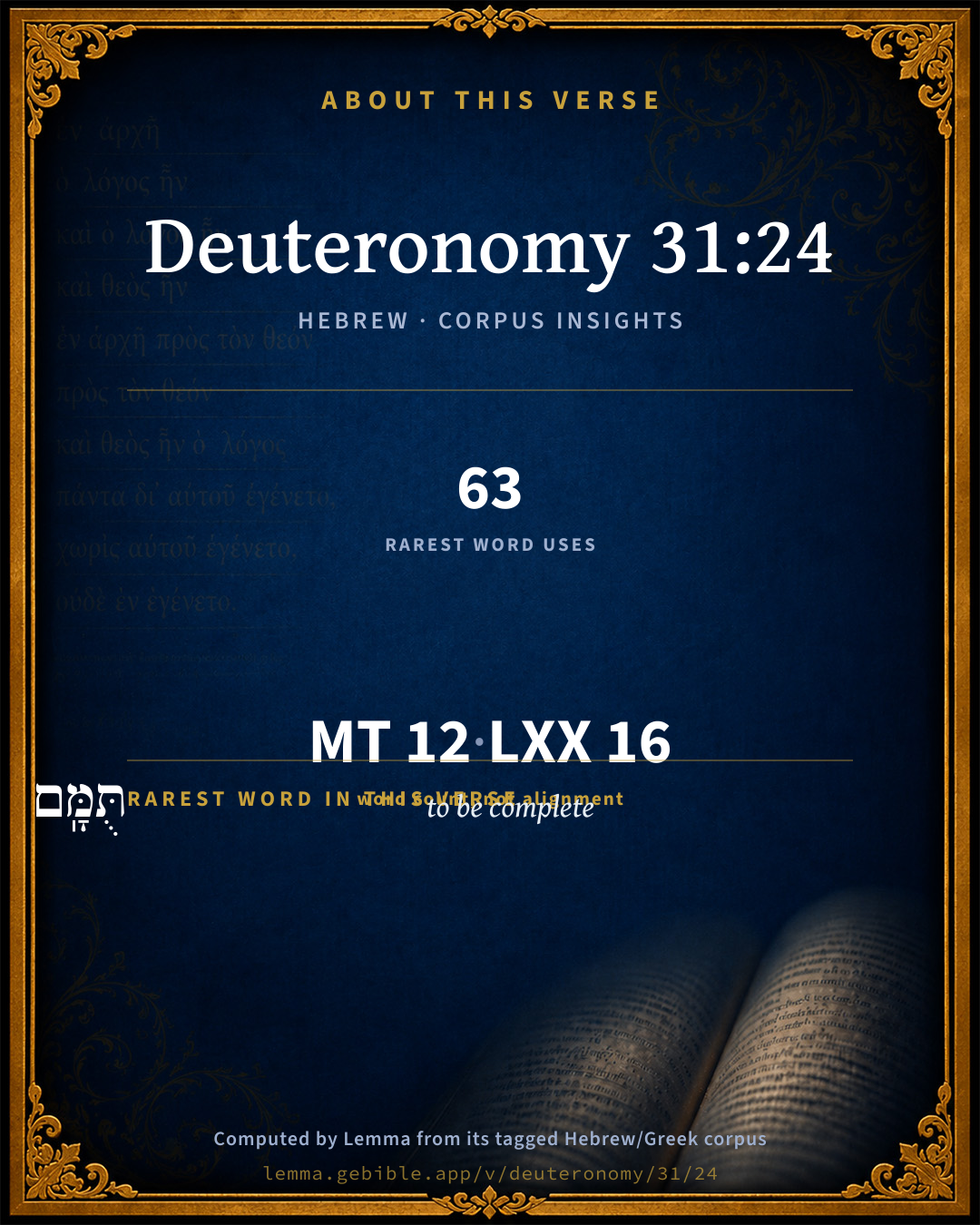
תֻּמָּֽם
tâmam
H8552
“to be complete · them”
Verb, Qal, Infinitive Construct + Suffix, Personal, 3rd Person, Masculine, Plural
Part of Speech
Verb
Stem
Qal
Form
Infinitive Construct
Full BDB Definition

Origin: a primitive root

TWOT: 2522

to be complete, be finished, be at an end - (Qal) - to be finished, be completed - completely, wholly, entirely (as auxiliary with verb) - to be finished, come to an end, cease - to be complete (of number) - to be consumed, be exhausted, be spent - to be finished, be consumed, be destroyed - to be complete, be sound, be unimpaired, be upright - to complete, finish - to be completely crossed over - (Niphal) to be consumed - (Hiphil) - to finish, complete, perfect - to finish, cease doing, leave off doing - to complete, sum up, make whole - to destroy (uncleanness) - to make sound - (Hithpael) to deal in integrity, act uprightly

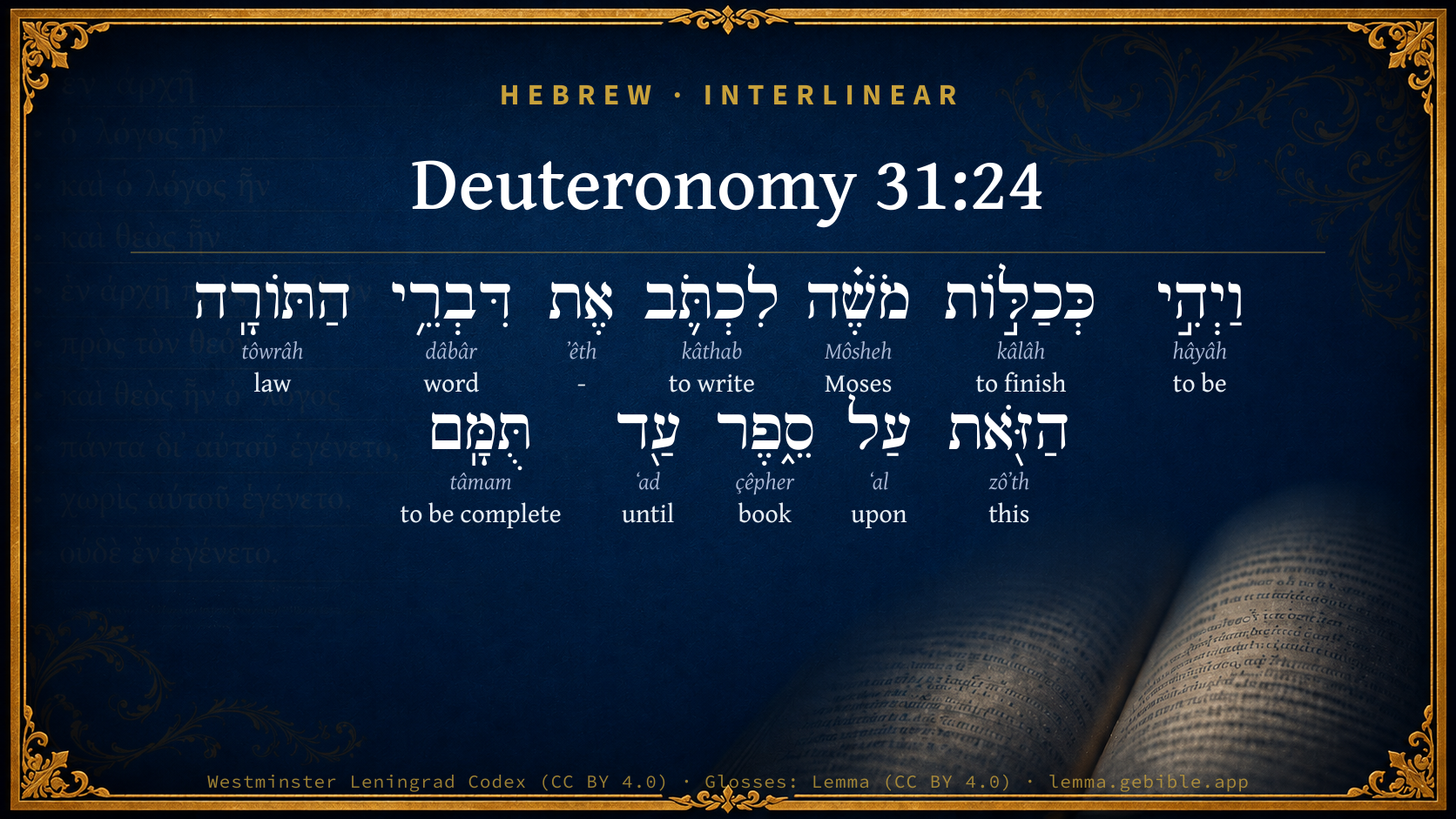
  1. וַיְהִ֣י hâyâh H1961 “and · to be” Conjunction + Verb, Qal, Sequential Imperfect, 3rd Person, Masculine, Singular
  2. כְּכַלּ֣וֹת kâlâh H3615 “like/as · to finish” Preposition + Verb, Piel, Infinitive Construct
  3. מֹשֶׁ֗ה Môsheh H4872 “Moses” Noun, Proper
  4. לִכְתֹּ֛ב kâthab H3789 “to write” Preposition + Verb, Qal, Infinitive Construct
  5. אֶת ʼêth H853 “-” Particle, Direct Object
  6. דִּבְרֵ֥י dâbâr H1697 “words of” Noun, Common, Masculine, Plural, Construct
  7. הַתּוֹרָֽה tôwrâh H8451 “the · law” Particle, Definite Article + Noun, Common, Feminine, Singular, Absolute
  8. הַזֹּ֖את zôʼth H2063 “the · this” Particle, Definite Article + Pronoun, Demonstrative, Feminine, Singular
  9. עַל ʻal H5921 “upon” Preposition
  10. סֵ֑פֶר çêpher H5612 “book” Noun, Common, Masculine, Singular, Absolute
  11. עַ֖ד ʻad H5704 “until” Preposition

About this verse

These counts appear in no published source. They are computed here, from the morphology-tagged text and Lemma’s own curated glosses. What Lemma adds →

12
words
12
distinct lemmas
Pentateuch
section

Grammatical profile

  • 4 verbs
  • 4 nouns
  • 1 pronoun
  • 2 prepositions
  • 1 particle

Verb forms

  • וַיְהִ֣י Qal · Sequential Imperfect
  • כְּכַלּ֣וֹת Piel · Infinitive Construct
  • לִכְתֹּ֛ב Qal · Infinitive Construct
  • תֻּמָּֽם Qal · Infinitive Construct

Hebrew & Septuagint length

In English translation the verse runs 22 words from the Hebrew and 18 from the Septuagint (LXX English) — closely comparable.

A rough comparison of the two English renderings, which tokenize alike — not a word-level alignment.

Word counts can differ between the Hebrew and the Greek without any difference in meaning — e.g. the Hebrew direct-object marker אֵת has no separate Greek word, and Greek often adds the article ὁ.

In the original languages it is 12 Hebrew tokens and 16 Greek tokens — but the two are counted differently (Hebrew bundles its prefixes and suffixes into one token; the Greek is in lemma form), so that isn’t a like-for-like length.

Cross-references

2

Topical passages linked to Deuteronomy 31:24 in the Treasury of Scripture Knowledge — connected by theme and wording, ordered by reader-vote popularity; previews shown in the World English Bible.

  • Deuteronomy 31:9 Moses wrote this law, and delivered it to the priests the sons of Levi, who bore the ark of the covenant of Yahweh, and to all the elders of Israel.
  • Deuteronomy 17:18 It shall be, when he sits on the throne of his kingdom, that he shall write him a copy of this law in a book, out of [that which is] before the priests the Levites:

Cross-references courtesy of OpenBible.info (CC BY 4.0).

Hebrew and Greek witnesses Masoretic Hebrew ↔ Greek Septuagint

The same verse in the two great witnesses to the Old Testament, shown verse-for-verse.

These are two independent witnesses, not word-aligned to each other, and the Septuagint is shown in lemma (dictionary) form.

Hebrew Deuteronomy 31:24 Masoretic · Westminster Leningrad Codex

וַיְהִ֣י כְּכַלּ֣וֹת מֹשֶׁ֗ה לִכְתֹּ֛ב אֶת דִּבְרֵ֥י הַתּוֹרָֽה הַזֹּ֖את עַל סֵ֑פֶר עַ֖ד תֻּמָּֽם

It happened, when Moses had made an end of writing the words of this law in a book, until they were finished,

World English Bible · Public Domain

Greek LXX Deuteronomy 31:24 Septuagint · lemma form

ἡνίκα δέ συντελέω μωυσῆς γράφω πᾶς ὁ λόγος ὁ νόμος οὗτος εἰς βιβλίον ἕως εἰς τέλος

And when Moses finished writing all the words of this law in a book, even to the end,

LXX2012 (modern English Septuagint) · Public Domain

Hebrew: Westminster Leningrad Codex (CC BY 4.0). Greek: Septuagint (public domain); English from LXX2012 (modern English Septuagint) (Public Domain). How the Septuagint differs from the Hebrew →

Targum (Aramaic paraphrase)

2

The Targum is the ancient Jewish Aramaic paraphrase of the Hebrew Scriptures — an interpretive translation, not the Hebrew text itself. Onkelos (literal) and Pseudo-Jonathan (expansive) render the Torah, and Jonathan the Prophets. Coverage is partial: where no permissively-licensed English translation exists for a verse, only the Aramaic is shown. This is verse-level text, not a word-by-word alignment to the Hebrew.

  1. Targum Onkelos Torah (Genesis–Deuteronomy)
    וַהֲוָה כַּד שֵׁצֵי מֹשֶׁה לְמִכְתַּב יָת פִּתְגָמֵי אוֹרַיְתָא הָדָא עַל סִפְרָא עַד דִשְׁלִימוּ

    (no public-domain English translation for this verse)

    Targum Onkelos — Aramaic: “Onkelos Genesis” (public domain); “Onkelos Exodus” (public domain); “Onkelos Leviticus” (public domain); “Onkelos Numbers” (public domain); “Onkelos Deuteronomy” (public domain). English: “Sefaria Community Translation” (CC0 1.0 (public-domain dedication)); “J.W. Etheridge. The Targums of Onkelos and Jonathan Ben Uzziel on the Pentateuch. London: Longmans, Green, 1862” (public domain). Text via Sefaria.

  2. Targum Pseudo-Jonathan Torah (Genesis–Deuteronomy)
    וַהֲוָה כְּמִפְסַק משֶׁה לְמִכְתּוֹב יַת פִּתְגָמֵי אוֹרַיְיתָא הֲדָא עַל גְוִוילָא עַד דִי אַשְׁלִימוּנוּן

    And when Mosheh had finished to write the words of this law upon parchment to complete them,

    Targum Pseudo-Jonathan — Aramaic: “Targum Jonathan on Genesis” (public domain); “Targum Jonathan on Exodus” (public domain); “Targum Jonathan on Leviticus” (public domain); “Targum Jonathan on Numbers” (public domain); “Targum Jonathan on Deuteronomy” (public domain). English: “The Targum of Jonathan ben Uzziel, trans. J. W. Etheridge, London, 1862” (public domain). Text via Sefaria.

Commentary

Notes on Deuteronomy 31:24 from classic Christian and Jewish commentators (each source and its license shown beneath its notes). The classic Christian expositions comment on the surrounding passage and are grouped to its opening verse, so a note may address several verses; the Jewish commentaries on the Tanakh (Rashi and others) are per-verse, so they appear only where the commentator wrote on this verse.

Lemma curates 59 commentaries, every one of them public domain or Creative Commons licensed, each selected and text-cleaned for this edition rather than reprinted as found. About our sources →

Ellicott's Commentary for English Readers

Deu_31:24-28. DELIVERY OF THE BOOKS OF MOSES TO THE LEVITES.

(24) When Moses had made an end of writing.—This means the completion of the books of Moses as he delivered them to Israel; not merely Deuteronomy, as above, in Deu_31:9, but the whole, including the song mentioned in Deu_31:22. The song was probably the end of the book as delivered to them by Moses.

In a book.—’Al-sêpher; upon a roll. The Pentateuch is written upon a single roll to this day.

(25) The Levites, which bare the ark.—Observe this, and comp. Deu_31:9, above.

(26) In the side of the ark.—More literally, beside, Rashi says, “The wise men of Israel differ about this in the treatise Baba Bathra (in the Talmud). Some of them say there was a leaf or slab projecting from the ark outside, and there the book was placed. Others say that it was placed beside the tables of the covenant in the ark itself.”

(28) Gather unto me all the elders.—In like manner Joshua gave a special charge to the elders at the close of his life (Joshua 23).

A Bible Commentary for English Readers, edited by Charles John Ellicott (1878–1897) — public domain. Text from a community e-Sword module.

The Cambridge Bible for Schools and Colleges

gen. ed. J. J. S. Perowne

24. had made an end of writing the words of this law] If Law be the original reading, Deu_31:24-26 are not the sequel, but a parallel to Deu_31:9-13, for 9 also implies the completion of the writing of the Law in recording its delivery to the priests, the sons of Levi. But, as already said, it has been conjectured that for Law = Tôrah we should read Song = Shîrah.

until they were finished] Deu_31:30, Deu_2:15; cp. Jos_4:10; Jos_5:6; Jos_8:24; Jos_10:20.

24–30. Again the Law-Book (?) and the Song

A less vague description of these vv. is not possible. The text says that Moses having written the Law in a book charged the Levites to put it beside the Ark as a witness against thee (Deu_31:24-26). For Israel, which has been rebellious in his life—here the address changes from Sg. to Pl.—will be more so after his death (Deu_31:27). They shall assemble the elders of their tribes and officers that he may recite to them these words and call heaven and earth to witness against them. For after his death they will corrupt themselves and evil will befall them in the latter days (Deu_31:28-30).—These words can hardly refer to the Law, already recited to the people; they must be the words of this Song (Deu_31:30) which follows in 32. If the text be original which reads Tôrah = Law in Deu_31:24; Deu_31:26, then Deu_31:24-26 are parallel (not consecutive) to Deu_31:9-13, and we cannot conjecture a reason for separating the two passages by Deu_31:14-23, on Joshua and the Song.

Staerk (followed by Steuern. and Berth.) holds that Tôrah was originally Shîrah = Song. This conjecture is attractive. It restores unity to Deu_31:24-30 and their natural connection with Deu_31:16-22, and gets rid of the improbable fact that both Law and Song are described as witness against Israel; note too that this book (Deu_31:24; Deu_31:26) is not to be put in, but beside, the Ark. At the same time there is no other evidence (in the versions or elsewhere) that Shîrah may have stood in place of Tôrah, the Law may equally well with the Song be described as a witness against Israel, and the phrase these words more usually refers to what precedes than to what follows it. Notice a symptom of compilation, in that while the Levites are addressed in Deu_31:25 it is all Israel, against thee, which is addressed in Deu_31:26. The whole passage is therefore editorial, and the questions it raises are insoluble by us.

Staerk distinguishes two introductions to the Song, Deu_31:16-22; Deu_31:24-30, and so independently Driver; note the difference in their styles. Cullen (p. 181) retains the reading Tôrah = Law, and takes Deu_31:24-29 as a later addition to Deu_31:9-13, the original conclusion of the epilogue to the Code of D composed when Israel’s attitude to this was still satisfactory, and added when the nation fell away. For another view see the Oxf. Hex.

The Cambridge Bible for Schools and Colleges (gen. ed. J. J. S. Perowne; Cambridge University Press, 1878–1918) — public domain. Text from a community e-Sword module.

Albert Barnes' Notes on the Bible

Moses completes the writing out of the book of the Law, and directs it to be placed by the ark of the covenant.

Deu 31:24

The “book” here spoken of would contain the whole Pentateuch up to this verse, and be “the Book of Moses,” called generally by the Jews “the Law” (compare Mat 22:40; Gal 4:21).

Deu 31:25

The Levites, which bare the ark - i. e., as in Deu 31:9, “the priests the sons of Levi.” The non-priestly Levites could not so much as enter the sanctuary or touch the ark (compare Num 4:15). Though in the journeys through the wilderness the ark was borne by the non-priestly Kohathites, yet on occasions of a more solemn and public character it was carried by the priests themselves (Jos 3:3 ff, Jos 4:9-10; Jos 6:6, Jos 6:12; Jos 8:33; 1Ki 8:3).

Deu 31:26

Put it in the side of the ark - Rather, by the side of the ark. The two tables of the Decalogue were in the ark 1Ki 8:9; the Book of the Law was to be laid up in the holy of holies close by the ark of the covenant, probably in a chest. Compare 2Ki 22:8.

Deu 31:27

How much more after my death - Hence, Deu 31:24 and the rest of the book (with the exception of the song, Deu 31:19) must be regarded as a kind of appendix added after Moses’ death by another hand; though the Blessing Deut. 33 is of course to be regarded as a composition of Moses.

Albert Barnes' Notes on the Bible (1834–1885) — public domain. Text from a community e-Sword/MySword module.

Keil & Delitzsch

C. F. Keil & F. Delitzsch

With the installation of Joshua on the part of God, the official life of Moses was brought to a close. Having returned from the tabernacle, he finished the writing out of the laws, and then gave the book of the law to the Levites, with a command to put it by the side of the ark of the covenant, that it might be there for a witness against the people, as He knew its rebellion and stiffneckedness (Deu 31:24-27). על־ספר כּתב, to write upon a book, equivalent to write down, commit to writing. תּמּם עד, till their being finished, i.e., complete. By the "Levites who bare the ark of the covenant" we are not to understand ordinary Levites, but the Levitical priests, who were entrusted with the ark. "The Levites" is simply a contraction for the full expression, "the priests the sons of Levi" (Deu 31:9). It is true that, according to Num 4:4., the Kohathites were appointed to carry the holy vessels, which included the ark of the covenant, on the journey through the desert; but it was the priests, and not they, who were the true bearers and guardians of the holy things, as we may see from the fact that the priests had first of all to wrap up these holy things in a careful manner, before they handed them over to the Kohathites, that they might not touch the holy things and die (Num 4:15). Hence we find that on solemn occasions, when the ark was to be brought out in all its full significance and glory, - as, for example, in the crossing of the Jordan (Jos 3:3., Deu 4:9-10), when encompassing Jericho (Jos 6:6, Jos 6:12), at the setting up of the law on Ebal and Gerizim (Jos 8:33), and at the consecration of Solomon's temple (Kg1 8:3), - it was not by the Levites, but by the priests, that the ark of the covenant was borne. In fact the Levites were, strictly speaking, only their (the priests') servants, who relieved them of this and the other labour, so that what they did was done in a certain sense through them. If the (non-priestly) Levites were not to touch the ark of the covenant, and not even to put in the poles (Num 4:6), Moses would not have handed over the law-book, to be kept by the ark of the covenant to them, but to the priests. ארון מצּד, at the side of the ark, or, according to the paraphrase of Jonathan, "in a case on the right side of the ark of the covenant," which may be correct, although we must not think of this case, as many of the early theologians do, as a secondary ark attached to the ark of the covenant (see Lundius, Jd. Heiligth. pp. 73, 74). The tables of the law were deposited in the ark (Exo 25:16; Exo 40:20), and the book of the law was to be kept by its side. As it formed, from its very nature, simply an elaborate commentary upon the decalogue, it was also to have its place outwardly as an accompaniment to the tables of the law, for a witness against the people, in the same manner as the song in the mouth of the people (Deu 31:21). For, as Moses adds in Deu 31:27, in explanation of his instructions, "I know thy rebelliousness, and thy stiff neck: behold, while I am yet alive with you this day, ye have been rebellious against the Lord (vid., Deu 9:7); and how much more after my death."

With these words Moses handed over the complete book of the law to the Levitical priests. For although the handing over is not expressly mentioned, it is unquestionably implied in the words, "Take this book, and put it by the side of the ark of the covenant," as the finishing of the writing of the laws is mentioned immediately before. But if Moses finished the writing of the law after he had received instructions from the Lord to compose the ode, what he wrote will reach to Deu 31:23; and what follows from Deu 31:24 onwards will form the appendix to his work by a different hand.

(Note: The objection brought against this view by Riehm, namely, that "it founders on the fact that the style and language in Deu 31:24-30 and Deu 32:44-47 are just the same as in the earlier portion of the book," simply shows that he has not taken into consideration that, with the simple style adopted in Hebrew narrative, we could hardly expect in eleven verses, which contain for the most part simply words and sayings of Moses, to find any very striking difference of language or of style. This objection, therefore, merely proves that no valid arguments can be adduced against the view in question.)

The supposition that Moses himself inserted his instructions concerning the preservation of the book of the law, and the ode which follows, is certainly possible, but not probable. The decision as to the place where it should be kept was not of such importance as to need insertion in the book of the law, since sufficient provision for its safe keeping had been made by the directions in Deu 31:9.; and although God had commanded him to write the ode, it was not for the purpose of inserting it on the Thorah as an essential portion of it, but to let the people learn it, to put it in the mouth of the people. The allusion to this ode in Deu 31:19. furnishes no conclusive evidence, either that Moses himself included it in the law-book which he had written with the account of his oration in Deu 31:28-30 and Deut 32:1-43, or that the appendix which Moses did not write commences at Deu 31:14 of this chapter. For all that follows with certainty from the expression "this song" (Deu 31:19 and Deu 31:22), which certainly points to the song in ch. 32, is that Moses himself handed over the ode to the priests with the complete book of the law, as a supplement to the law, and that this ode was then inserted by the writer of the appendix in the appendix itself.

Keil & Delitzsch — Biblical Commentary on the Old Testament (1861–1891) — public domain (CC PDM 1.0). Text via the HelloAO Bible API. (Old Testament only.)

John Gill's Exposition

That Moses commanded the Levites,.... These were not the common Levites, but the priests who were also Levites, to whom the law was given, Deu 31:9; and none but they might touch the ark, or go so near it as, they are bid to do, to put the law on the side of it; so Aben Ezra; it follows:

which bare the ark of the covenant of the Lord; as the priests are said to do; see Gill on Deu 31:9; for though in journeying the Kohathites carried it, yet not until it was covered by the priests, for they must not touch it; as these must do when they put the law on the side of it, as they are ordered in Deu 31:26.

saying; as follows.

John Gill's Exposition of the Whole Bible (1746–1763) — public domain (CC PDM 1.0). Text via the HelloAO Bible API.

The Pulpit Commentary

Vers. 24-29. After the installation of Joshua, only one thing remained for Moses to do that all things might be set in order before his departure. This was the finishing of the writing of the Book of the Law, and the committing it finally to the priests, to be by them placed by the ark of the covenant, that it might be kept for all future generations as a witness against the people, whose apostasy and rebellion were foreseen.

Whether this section is to be regarded as wholly written by Moses himself, or as an appendix to his writing added by some other writer, has been made matter of question. It is quite possible, however, that Moses himself, ere he laid down the pen, may have recorded what he said when delivering the Book of the Law to the priests, and there is nothing in the manner or style of the record to render it probable that it was added by another. What follows from ver. 30 to the end of the book was probably added to the writing of Moses by some one after his death, though, of course, both the song in Deuteronomy 32, and the blessing in Deuteronomy 33, are the composition of Moses (see Introduction,

Vers. 24-30. The Divine testimony deposited in the ark.

Moses, being thus commissioned of God to utter the inspired warning, loses no time in summoning the congregation. But while doing so, he gives precise directions to the Kohathites, who had charge of the ark, to deposit his manuscripts within it. Is anything to be learned from this consignment of the sacred books?

I THE SACRED BOOKS ARE NOT COMPLIMENTARY TO HUMAN NATURE. The Pentateuch, in its tremendous charges and indictments against mankind, is in unison with the rest of the Word. It is a sustained witness against the human race. "Others may perhaps suspect," says Henry Rogers, "that Jewish vanity led the writers thus to ignore or treat lightly the affairs of all nations except their own. The answer is concise, but conclusive. Let Jewish vanity in general be what the reader pleases, these writers would seem to have had none of it. If they have passed by the glorious achievements of secular history, they have recorded all the infamies of their own nation; and, indeed, their principal references to other nations are as "scourges" of their own scourges justly sent, they confess and avow, for apostasies which had wearied out the patience of Heaven!" The marvel is that the Jews and Christians should conspire to preserve what is a most humiliating account of the race.

II THE ARK WAS THE TREASURE-HOUSE OF GOD PROTECTED BY HIS PRESENCE. It was the "safe" of Israel, not, alas! "fire-proof," like Milner"s, as the Babylonians demonstrated, yet as durable and as sacred as the times allowed. It was fenced around by the holiest sanctions. Nowhere could the manuscripts be so safe. Now, the ark is regarded as a type of Jesus; and if so, then the depositing of the Law within the ark would convey the idea of the Law of God being within the heart of Christ. (Psa_40:8) In other words, Jesus Christ embodies the Divine Law or will, add is at once its most brilliant exposition and the most tremendous indictment of human nature. The Jews were not so careful of the living Law as their forefathers were of the written Law. They recognized its charge against themselves: the charge had become oral; it walked before them; it was something that they could not shake off except through the desperate alternative of assassination. They killed in Christ their living Conscience.

III WE SHOULD LEARN FROM THE EXAMPLE OF CHRIST TO TREASURE UP GOD"S LAW WITHIN OUR OWN HEARTS. We cannot have too much of the Bible in our minds and memories. The more we study it, the more like Christ shall we become. He whose "delight is in the Law of the Lord, and in his Law doth he meditate day and night," is blessed, and he shall be like the tree whose roots are in the waters, duly fruitful and ever green. (Psa_1:2, Psa_1:3) His conscience shall be reinforced and become increasingly tender; his heart shall be elevated in its affections and longings; and his mind shall be trained to what is high and holy. Thus is the whole being enriched and the life enlarged. May we deposit the Word of God with as much care in our hearts as the Levites did the rolls of Moses in the ark! R.M.E.

The Pulpit Commentary (1880–1919), ed. H.D.M. Spence-Jones & Joseph S. Exell — public domain. Text from a community e-Sword module.

unfoldingWord translationNotes

Door43 World Missions Community

witness against you

Moses speaks to the Levites as if they were one man, so the word "you" is singular. (See: Forms of You)

translationWords

Moses

word

law

command

Levi

ark of the covenant

testimony

unfoldingWord translationNotes — © Distant Shores Media and the Door43 World Missions Community, licensed CC BY-SA 4.0. Source: git.door43.org/Door43/en_tn.

Ramban (Nachmanides)

Rabbi Moshe ben Nachman (Ramban / Nachmanides)

AND IT CAME TO PASS, WHEN MOSES HAD FINISHED WRITING [THE WORDS OF THIS LAW]. The meaning thereof is that, at first, he wrote the Law and delivered it unto the priests as is stated above, but he did not tell them where they were to put it. Afterwards he was commanded concerning this Song — he wrote it and taught it the children of Israel that same day, and thus added it to the Law. And it came to pass, when Moses had finished writing everything in the Book of the Law, then he commanded the priests, Take this Book of the Law, and put it by the side of the ark of the covenant of the Eternal your G-d, meaning that it should remain in the ark at the side [of the Tablets], for henceforth they would not even touch it to add [thereto] or to diminish [from it]. This is the sense of the verse, And it came to pass, when Moses had finished writing [the words of this Law in a book] until they were completed. Therefore Rabbi Abraham ibn Ezra commented that [Seder] V’zoth Habrachah was [written] earlier, and its proper place is above as it is stated And Moses went and spoke these words unto all Israel..It is possible that after he wrote the Song and taught it the children of Israel one by one according to their tribes as he had them brought before him to the House of Learning, he wrote it in the Book of the Law and commanded the priests Take this Book of the Law, meaning that the Song too, should remain in the ark with the Law, for it is part of the Law since it is there as a testimony. Then Moses told them to assemble before him again — all the elders of the tribes and the officers — and that the people should join them, for so it is stated at the end, And Moses came and spoke all the words of this Song in the ears of the people. Now the priests did so and they assembled the entire people before him and he called heaven and earth to witness against them in assembly in the hearing of the priests and all the people. Then G-d, blessed be He, told him Get thee up into this mountain of Abarim., Verse 49. This he was bound to do immediately, and so he stood up and blessed them: ‘V’zoth Habrachah’ (And this is the blessing)., 33:1. He then wrote it at the end of the book which he gave to the priests. Then the priests did as he commanded them — they placed the complete book by the side of the ark of the covenant. Thus everything took place in the order stated in the Torah. Ha’azinu

Ramban (Nachmanides) on the Tanakh — English translation: “Commentary on the Torah by Ramban (Nachmanides). Translated and annotated by Charles B. Chavel. New York, Shilo Pub. House, 1971-1976” (CC BY 4.0). Text via Sefaria.

Lesson kit

Teaching starters — assembled from the data on this page, not authored interpretation. Every prompt links to the verse data it draws on. Edit before teaching.

Deuteronomy, in the Pentateuch, opens this verse with 12 words (12 distinct Hebrew lemmas). Its most distinctive word is tâmam (“to be complete”). A historical commentator’s framing appears above. Read the whole chapter for the surrounding context.

Discussion questions

  1. How does “to be complete” (tâmam) shape what this verse is saying?
  2. How does Deuteronomy 31:9, which shares this passage’s theme, read alongside this verse?
  3. These translations render this verse differently; the difference is in the English rendering, not the original. What questions does that raise?
  4. «וַיְהִ֣י» is a Qal Sequential Imperfect verb. How does that grammatical form shape the action described?
  5. Compare how Ellicott's Commentary for English Readers and The Cambridge Bible for Schools and Colleges read this verse. Where do they agree or differ?

Things to notice

Reading settings

Reading text

Shown beneath each verse's original-language words.

Old Testament
Old Testament edition

Read the OT as the Masoretic Hebrew (MT) or the Greek Septuagint (LXX).

English shown for the Greek Septuagint (in the Hebrew ↔ Greek comparison).

Comparing translations? Open the Compare panel on any verse page to stack up to four side by side.