
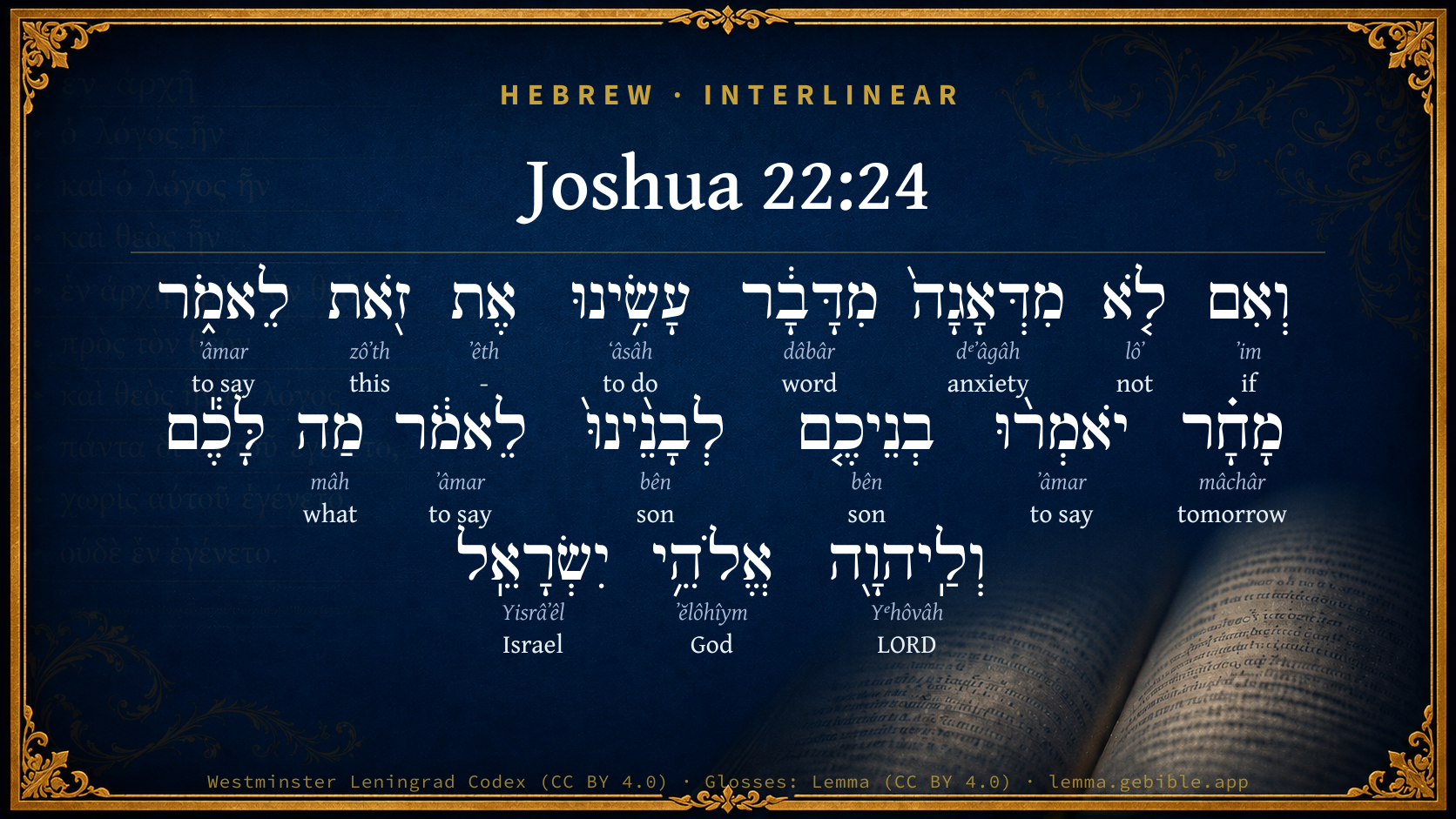
Joshua 22:24

Hebrew (Westminster Leningrad Codex) Joshua 22:24 appears in the Hebrew Old Testament. The text above is from the Westminster Leningrad Codex. Each word links to its Strong’s number, a concise gloss, and parsing drawn from the Open Scriptures Hebrew Bible morphology. Click any word for its full Brown-Driver-Briggs (BDB) entry.
Download image
Cite this verse

Joshua 22:24 (World English Bible). Public Domain. Lemma interlinear Bible study tool, https://lemma.gebible.app/v/joshua/22/24.

Show BibTeX & RIS
BibTeX
RIS
English Translation
and if we have not [rather] out of carefulness done this, [and] of purpose, saying, In time to come your children might speak to our children, saying, What have you to do with Yahweh, the God of Israel?
World English Bible · Public Domain
Highlights
  • 1 first appearance in the Hebrew Bible
Full analysis ↓
Download a study sheet

One document with this verse’s original text, its word-by-word gloss line, the meaning frame, cross-references with their text, attributed commentary, and full source and license credits — printable, and it pastes into notes with its structure intact.

This verse Autodidact and up

Study sheet (.html) Plain text (.txt)

A passage Seminary Student

Up to 50 verses in one chapter. A passage sheet keeps up to 6 commentary sources and 12 cross-references per verse, in the order this page ranks them, and says so on the sheet whenever that leaves anything out. Ask for a single verse and you get the Autodidact verse sheet above.

Everything on this page stays free to read, with no account — the sheet is a download of what is already on screen, not access to it.

Want to remove ads? Support Godless Engineer
Compare translations 3

The same verse in 3 English versions, stacked beneath the original-language interlinear above. Click any original word for its lexicon entry.

Each is an independent rendering of the whole verse — the interlinear is not word-aligned to these translations.

Highlighted words mark where these versions differ — a whole-verse word diff, not a word-by-word alignment.

  • World English Bible Public Domain
    and if we have not [rather] out of carefulness done this, [and] of purpose, saying, In time to come your children might speak to our children, saying, What have you to do with Yahweh, the God of Israel?
  • King James Version Public Domain
    And if we have not rather done it for fear of this thing, saying, In time to come your children might speak unto our children, saying, What have ye to do with the LORD God of Israel?
  • unfoldingWord Literal Text CC BY-SA 4.0
    But if not from anxiety from a matter we did this, saying, ‘Tomorrow your sons might speak to our sons, saying, “What to you and to Yahweh, the God of Israel?

unfoldingWord Literal Text — © unfoldingWord, licensed CC BY-SA 4.0. Word-aligned USFM3 via Door43 (git.door43.org/unfoldingWord/en_ult).

Versions to compare (up to 4)

3 of 4 selected

Show all 18 translations

Every available English version of this verse, each an independent rendering of the whole verse.

  • World English Bible Public Domain
    and if we have not [rather] out of carefulness done this, [and] of purpose, saying, In time to come your children might speak to our children, saying, What have you to do with Yahweh, the God of Israel?
  • Berean Standard Bible Public Domain
    But in fact we have done this for fear that in the future your descendants might say to ours, ‘What have you to do with the LORD, the God of Israel?
  • Majority Standard Bible Public Domain
    But in fact we have done this for fear that in the future your descendants might say to ours, ‘What have you to do with the LORD, the God of Israel?
  • King James Version Public Domain
    And if we have not rather done it for fear of this thing, saying, In time to come your children might speak unto our children, saying, What have ye to do with the LORD God of Israel?
  • American Standard Version (1901) Public Domain
    and if we have not `rather' out of carefulness done this, `and' of purpose, saying, In time to come your children might speak unto our children, saying, What have ye to do with Jehovah, the God of Israel?
  • Revised Version (1885) Public Domain
    and if we have not rather out of carefulness done this, and of purpose, saying, In time to come your children might speak unto our children, saying, What have ye to do with the LORD, the God of Israel?
  • Geneva Bible (1599) Public Domain
    And if we haue not rather done it for feare of this thing, saying, In time to come your children might say vnto our children, What haue ye to doe with the Lord God of Israel?
  • Douay-Rheims (1899) Public Domain
    And not rather with this thought and design, that we should say: To morrow your children will say to our children: What have you to do with the Lord the God of Israel?
  • Young's Literal Translation Public Domain
    `And if not, from fear of `this' thing we have done it, saying, Hereafter your sons do speak to ours sons, saying, What to you and to Jehovah God of Israel?
  • Literal Standard Version CC BY-SA 4.0
    And nevertheless, we have done it from fear of [this] thing, saying, Hereafter your sons speak to our sons, saying, And what have you to [do with] YHWH God of Israel?
  • Unlocked Literal Bible CC BY-SA 4.0
    No! We did it for fear that in time to come your children might say to our children, 'What have you to do with Yahweh, the God of Israel?
  • unfoldingWord Literal Text CC BY-SA 4.0
    But if not from anxiety from a matter we did this, saying, ‘Tomorrow your sons might speak to our sons, saying, “What to you and to Yahweh, the God of Israel?
  • Darby Bible Public Domain
    and if we have not done it from fear of this thing, saying, In future your children will speak to our children, saying, What have ye to do with Jehovah the God of Israel?
  • World Messianic Bible Public Domain
    “If we have not out of concern done this, and for a reason, saying, ‘In time to come your children might speak to our children, saying, “What have you to do with the LORD, the God of Israel?
  • Webster's Bible Public Domain
    And if we have not rather done it for fear of this thing, saying, In time to come your children may speak to our children, saying, What have ye to do with the LORD God of Israel?
  • Free Bible Version CC BY-SA 4.0
    We did this because we were worried that in the future your descendants might say to ours, ‘What have you got to do with the Lord, the God of Israel?
  • Bible in Basic English Public Domain
    And if we have not, in fact, done this designedly and with purpose, having in our minds the fear that in time to come your children might say to our children, What have you to do with the Lord, the God of Israel?
  • JPS Tanakh (1917) Public Domain
    and if we have not rather out of anxiety about a matter done this, saying: In time to come your children might speak unto our children, saying: What have ye to do with the LORD, the God of Israel?

Literal Standard Version (2020), Covenant Press — licensed CC BY-SA 4.0. Text via the HelloAO Bible API (eBible.org). Unlocked Literal Bible (unfoldingWord) — licensed CC BY-SA 4.0. Text via the HelloAO Bible API (eBible.org). unfoldingWord Literal Text — © unfoldingWord, licensed CC BY-SA 4.0. Word-aligned USFM3 via Door43 (git.door43.org/unfoldingWord/en_ult). Free Bible Version, Dr. Jonathan Gallagher — licensed CC BY-SA 4.0. Text via the HelloAO Bible API (eBible.org).

Word by word

More ways to search: Search by grammar → Find every occurrence → Compare this word →

Practice this passage: Drill this verse → Learn its vocabulary →

מִדְּאָגָה֙
dᵉʼâgâh
H1674
“from · anxiety”
Preposition + Noun, Common, Feminine, Singular, Absolute
Part of Speech
Preposition + Noun
Type
Common
Gender
Feminine
Number
Singular
State
Absolute
Full BDB Definition

Origin: from H1672

TWOT: 393a

anxiety, anxious care, care
  1. וְאִם ʼim H518 “and · if” Conjunction + Conjunction
  2. לֹ֤א lôʼ H3808 “not” Particle, Negative
  3. מִדָּבָ֔ר dâbâr H1697 “from · word” Preposition + Noun, Common, Masculine, Singular, Absolute
  4. עָשִׂ֥ינוּ ʻâsâh H6213 “to do” Verb, Qal, Perfect, 1st Person, Common, Plural
  5. אֶת ʼêth H853 “-” Particle, Direct Object
  6. זֹ֖את zôʼth H2063 “this” Pronoun, Demonstrative, Feminine, Singular
  7. לֵאמֹ֑ר ʼâmar H559 “to say” Preposition + Verb, Qal, Infinitive Construct
  8. מָחָ֗ר mâchâr H4279 “tomorrow” Noun, Common, Masculine, Singular, Absolute
  9. יֹאמְר֨וּ ʼâmar H559 “to say” Verb, Qal, Imperfect, 3rd Person, Masculine, Plural
  10. בְנֵיכֶ֤ם bên H1121 “sons · your” Noun, Common, Masculine, Plural, Construct + Suffix, Personal, 2nd Person, Masculine, Plural
  11. לְבָנֵ֨ינוּ֙ bên H1121 “to/for · sons · our” Preposition + Noun, Common, Masculine, Plural, Construct + Suffix, Personal, 1st Person, Common, Plural
  12. לֵאמֹ֔ר ʼâmar H559 “to say” Preposition + Verb, Qal, Infinitive Construct
  13. מַה mâh H4100 “what” Particle, Interrogative
  14. וְלַֽיהוָ֖ה Yᵉhôvâh H3068 “and · to/for · LORD” Conjunction + Preposition + Noun, Proper
  15. אֱלֹהֵ֥י ʼĕlôhîym H430 “God(s) of” Noun, Common, Masculine, Plural, Construct
  16. יִשְׂרָאֵֽל Yisrâʼêl H3478 “Israel” Noun, Proper

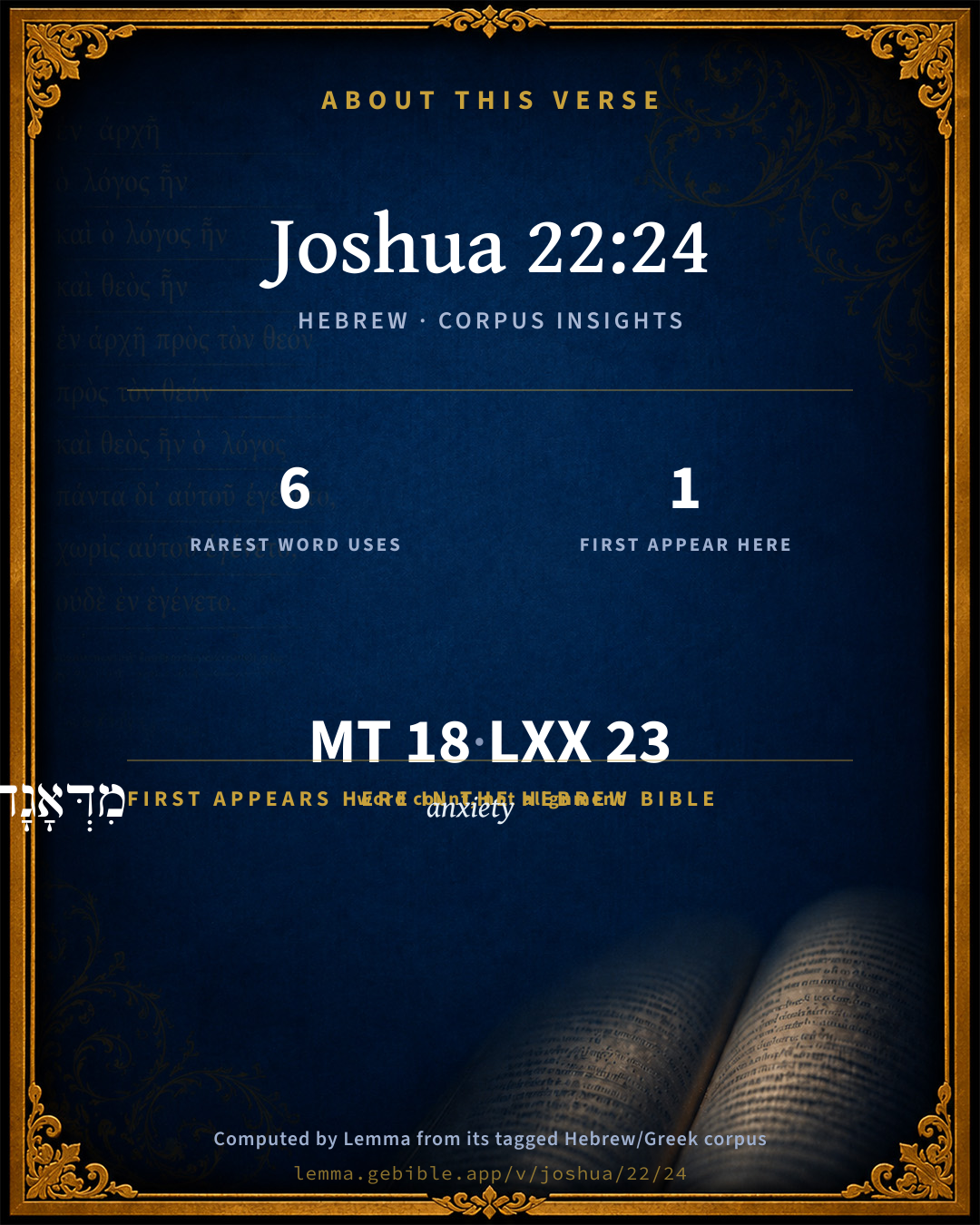
About this verse

These counts appear in no published source. They are computed here, from the morphology-tagged text and Lemma’s own curated glosses. What Lemma adds →

18
words
14
distinct lemmas
Historical
section

Notable vocabulary

The rarest word here is מִדְּאָגָה֙ anxiety H1674 — appearing just 6 times in the whole Hebrew Bible.

First appearance in Scripture

This word makes its first canonical appearance in the Hebrew Bible here:

  • מִדְּאָגָה֙ anxiety H1674

Shared distinctive vocabulary

מִדְּאָגָה֙ anxiety H1674 occurs in 6 verses of the Hebrew Bible. Also found in:

Grammatical profile

  • 4 verbs
  • 8 nouns
  • 1 pronoun
  • 1 preposition
  • 1 conjunction
  • 3 particles

Verb forms

  • עָשִׂ֥ינוּ Qal · Perfect
  • לֵאמֹ֑ר Qal · Infinitive Construct
  • יֹאמְר֨וּ Qal · Imperfect
  • לֵאמֹ֔ר Qal · Infinitive Construct

Repetition

Words recur within this verse — often emphatic in Hebrew:

  • לֵאמֹ֑ר to say H559 ×3
  • בְנֵיכֶ֤ם son H1121 ×2

Hebrew & Septuagint length

In English translation the verse runs 38 words from the Hebrew and 34 from the Septuagint (LXX English) — closely comparable.

A rough comparison of the two English renderings, which tokenize alike — not a word-level alignment.

Word counts can differ between the Hebrew and the Greek without any difference in meaning — e.g. the Hebrew direct-object marker אֵת has no separate Greek word, and Greek often adds the article ὁ.

In the original languages it is 18 Hebrew tokens and 23 Greek tokens — but the two are counted differently (Hebrew bundles its prefixes and suffixes into one token; the Greek is in lemma form), so that isn’t a like-for-like length.

Cross-references

5

Topical passages linked to Joshua 22:24 in the Treasury of Scripture Knowledge — connected by theme and wording, ordered by reader-vote popularity; previews shown in the World English Bible.

  • Joshua 4:6 that this may be a sign among you, that when your children ask in time to come, saying, What do you mean by these stones?
  • Genesis 18:19 For I have known him, to the end that he may command his children and his household after him, that they may keep the way of Yahweh, to do righteousness and justice; to the end that Yahweh may bring on Abraham that which he has spoken of him."
  • Genesis 30:33 So my righteousness will answer for me hereafter, when you come concerning my hire that is before you. Everyone that is not speckled and spotted among the goats, and black among the sheep, that might be with me, will be counted stolen."
  • Exodus 13:14 It shall be, when your son asks you in time to come, saying, 'What is this?' that you shall tell him, 'By strength of hand Yahweh brought us out from Egypt, from the house of bondage;
  • Deuteronomy 6:20 When your son asks you in time to come, saying, What mean the testimonies, and the statutes, and the ordinances, which Yahweh our God has commanded you?

Cross-references courtesy of OpenBible.info (CC BY 4.0).

Hebrew and Greek witnesses Masoretic Hebrew ↔ Greek Septuagint

The same verse in the two great witnesses to the Old Testament, shown verse-for-verse.

These are two independent witnesses, not word-aligned to each other, and the Septuagint is shown in lemma (dictionary) form.

Hebrew Joshua 22:24 Masoretic · Westminster Leningrad Codex

וְאִם לֹ֤א מִדְּאָגָה֙ מִדָּבָ֔ר עָשִׂ֥ינוּ אֶת זֹ֖את לֵאמֹ֑ר מָחָ֗ר יֹאמְר֨וּ בְנֵיכֶ֤ם לְבָנֵ֨ינוּ֙ לֵאמֹ֔ר מַה לָּכֶ֕ם וְלַֽיהוָ֖ה אֱלֹהֵ֥י יִשְׂרָאֵֽל

and if we have not [rather] out of carefulness done this, [and] of purpose, saying, In time to come your children might speak to our children, saying, What have you to do with Yahweh, the God of Israel?

World English Bible · Public Domain

Greek LXX Joshua 22:24 Septuagint · lemma form

ἀλλά ἕνεκεν εὐλάβεια ῥῆμα ποιέω οὗτος λέγω ἵνα μή λέγω αὔριον ὁ τέκνον σύ ὁ τέκνον ἐγώ τίς σύ κύριος ὁ θεός ἰσραήλ

But we have done this for the sake of precaution concerning this thing, saying, Lest hereafter your sons should say to our sons, What have you⌃ to do with the Lord God of Israel?

LXX2012 (modern English Septuagint) · Public Domain

On this verse, The Pulpit Commentary discusses the Septuagint’s reading. Read the note in Commentary ↓

Hebrew: Westminster Leningrad Codex (CC BY 4.0). Greek: Septuagint (public domain); English from LXX2012 (modern English Septuagint) (Public Domain). How the Septuagint differs from the Hebrew →

Targum (Aramaic paraphrase)

1

The Targum is the ancient Jewish Aramaic paraphrase of the Hebrew Scriptures — an interpretive translation, not the Hebrew text itself. Onkelos (literal) and Pseudo-Jonathan (expansive) render the Torah, and Jonathan the Prophets. Coverage is partial: where no permissively-licensed English translation exists for a verse, only the Aramaic is shown. This is verse-level text, not a word-by-word alignment to the Hebrew.

  1. Targum Jonathan Prophets (Joshua–Malachi)
    וְאִם לָא מְיוֹצְפָא מִפִּתְגַם עָבַדְנָא יַת דָא לְמֵימָר מְחַר יֵימְרוּן בְּנֵיכוֹן לִבְנָנָא לְמֵימָר לֵית לְכוֹן חוּלַק בְּמֵימְרָא דַייָ אֱלָהָא דְיִשְׂרָאֵל:

    (no public-domain English translation for this verse)

    Targum Jonathan — Aramaic: “Mikraot Gedolot” (public domain). English: “Sefaria Community Translation” (CC0 1.0 (public-domain dedication)); “London "Chaldee Paraphrase," 1871” (public domain). Text via Sefaria.

Commentary

Notes on Joshua 22:24 from classic Christian and Jewish commentators (each source and its license shown beneath its notes). The classic Christian expositions comment on the surrounding passage and are grouped to its opening verse, so a note may address several verses; the Jewish commentaries on the Tanakh (Rashi and others) are per-verse, so they appear only where the commentator wrote on this verse.

Lemma curates 59 commentaries, every one of them public domain or Creative Commons licensed, each selected and text-cleaned for this edition rather than reprinted as found. About our sources →

Trapp's Complete Commentary

John Trapp

Jos 22:24 And if we have not [rather] done it for fear of [this] thing, saying, In time to come your children might speak unto our children, saying, What have ye to do with the LORD God of Israel?

Ver. 24. And if we have not rather done it.] In communionis symbolum: to a quite contrary purpose. The ten tribes therefore were to blame for misconstruing them. Quid minus est non dico Oratoris sed hominis, quam id obiecere adversario quod si ille verbo negarit, ulterius progredi non possis? {a} Say the best of things.

{a} Cicero.

John Trapp, A Commentary or Exposition upon All the Books of the Old and New Testament (1647–1656) — public domain. Text from a community e-Sword module.

Tyndale Open Study Notes

Tyndale Open Resources

22:24-29 The eastern tribes feared exclusion from Israel at a later time because the Jordan River divided them from the western tribes.

Tyndale Open Study Notes — © Tyndale Open Resources, licensed CC BY-SA 4.0. Text via the HelloAO Bible API.

Adam Clarke's Commentary

Verse 24. For fear of this thing] The motive that actuated us was directly the reverse of that of which we have been suspected.

Adam Clarke's Commentary on the Bible (1810–1826) — public domain. Text from a community e-Sword/MySword module.

The Cambridge Bible for Schools and Colleges

gen. ed. J. J. S. Perowne

24. and if we have not] More literally, and if not rather from anxiety, for a reason we have done this thing. The word rendered “fear” is translated “care” in Eze_4:16; “carefulness” Eze_12:18-19.

The Cambridge Bible for Schools and Colleges (gen. ed. J. J. S. Perowne; Cambridge University Press, 1878–1918) — public domain. Text from a community e-Sword module.

John Gill's Exposition

For the Lord hath made Jordan a border between us and you,.... And by it separated them from them, as if they were a distinct people; not that this was really the case, but so they feared it would be represented in time to come; for though Jordan was the border of the land of Canaan, strictly so called, eastward, Num 34:12; yet it did not exclude the land of the two tribes and a half from being part of the land of promise; for the Amorites, which before inhabited it, and were driven out of it, were Canaanites, and were one part of the people, whose land the Lord promised to Abraham, Gen 15:18,

ye children of Reuben, and children of Gad, have no part in the Lord; in his covenant and promises, in his worship, word, and ordinances; these are things you have nothing to do with, being separated from us his peculiar people; or "have no part in the Word of the Lord", as the Targum, the promised Messiah, being without, or separated from him, as the Gentiles are said to be, Eph 2:12,

so shall your children make our children cease from fearing the Lord; from worshipping the Lord, the fear of the Lord being often put for the whole worship of God, external and internal, Ecc 12:13; by behaving in the above manner towards them, they would be the cause and occasion of their apostasy from the true God, and it would be in effect to say to them, "go, serve other gods", Sa1 26:19.

John Gill's Exposition of the Whole Bible (1746–1763) — public domain (CC PDM 1.0). Text via the HelloAO Bible API.

Haydock's Catholic Bible Commentary

To-morrow. At any future period. (Haydock) --- Israel. The same idea is expressed, ver. 27. You have no part in the Lord. You are not his peculiar people. Of this title the Israelites were always very jealous, even when they neglected the worship and covenant of the Lord. (Calmet) --- Hence these tribes take these precautions, that they may not be excluded from the society and privileges of their brethren on the other side of the Jordan. They profess openly that they do not esteem it lawful to offer sacrifice in any other place, besides that which God had chosen. (Haydock)

George Leo Haydock (1774–1849), Haydock's Catholic Family Bible and Commentary, 1859 edition — public domain. Excludes Psalms (Douay-Rheims chapter numbering differs from Protestant) and Deuterocanonical books (Catholic canon only).

Matthew Poole's English Annotations

You have no relation to him, nor interest in him, or his worship.

Matthew Poole's English Annotations on the Holy Bible (1683–1685) — public domain. Text from a community e-Sword/MySword module.

Whedon's Commentary on the Bible

Daniel D. Whedon

24. For fear — The Hebrew word indicates great and distressing solicitude. The motive of their action was just the opposite of that ascribed to them. It was their intense desire to preserve themselves and their children in the worship of Jehovah that had induced the erection of the memorial altar.

Our children — The truly pious man will seek to place the safeguards of piety about the path of his offspring. These eastern tribes had received by far the best portion of the Holy Land, yet they are not satisfied with worldly good. Their broad acres and vast herds are worthless without a portion in the God of Israel.

Daniel D. Whedon (gen. ed.), Commentary on the Old and New Testaments (1874–1909) — public domain. Text from a community e-Sword module.

The Pulpit Commentary

From fear of this thing. This translation cannot be correct. Had the Hebrew original intended to convey this meaning, we should have had hZh rbDh tgaDmi. The literal rendering is, "from anxiety, from a word." The word here translated "anxiety" (LXX eulabeia ) is applied to the sea, and is translated "sorrow" in Jer_49:23. It is translated "heaviness" in Pro_12:25. In Eze_4:16 Eze_12:18, Eze_12:19, it is translated "care," "carefulness," and is applied to eating food. It obviously refers to agitation or anxiety of mind, and the proper translation here is, "we did it out of anxiety, for a cause." So Masius and Rosenmuller, who render the word hgad here by sollicitudo.

Ver. 24, 25. What have you to do with the Lord God of Israel? For the Lord hath made Jordan a border. Literally, What to you and to Jehovah the God of Israel, since He hath given a border between us and between you, sons of Reuben and sons of Gad, even the Jordan. Thus the reason for the erection of the altar was the very converse of what it had been supposed to be. So far from considering themselves as shut out from the communion of Israel by the natural boundary formed by Jordan, the two and a half tribes were resolved that no one else should ever think so. If the descendants of the remainder of the Israelites should ever venture to assert anything of the kind, there was the altar, erected in a conspicuous position on the west side of Jordan, left as a perpetual memorial of the great struggle in which Reuben, Gad, and the half tribe of Manasseh had taken part, and which had resulted in the final occupation of the land of Canaan. Keil and Delitzsch remark that there was some reason for this anxiety. The promises made to Abraham and his posterity related only to the land of Canaan. For their own advantage these tribes had chosen to remain in the trans-Jordanic territory conquered by Moses. It was quite possible that in future ages they might be regarded as outside the blessings and privileges of the Mosaic covenant. For the present, at least, they value those blessings and privileges, and desired to have some permanent memorial of the fact that they had a right to share them. From fearing. It may be worth while to notice, as a sign of later, or at least of different authorship, that the Pentateuch employs a different (the feminine) form of the infinitive for the form found here.

The Pulpit Commentary (1880–1919), ed. H.D.M. Spence-Jones & Joseph S. Exell — public domain. Text from a community e-Sword module.

John Wesley's Explanatory Notes

With the Lord - You have no relation to him, nor interest in him, or his worship.

John Wesley, Explanatory Notes Upon the Whole Bible (1754–1765) — public domain. Text via the GEBible commentary corpus.

unfoldingWord translationNotes

Door43 World Missions Community

General Information:

The tribes of Reuben, Gad and the half tribe of Manasseh now give their answer.

your children might say to our children ... God of Israel?

This is a hypothetical accusation that the three tribes think the children of the other tribes may make sometime in the future. (See: Hypothetical Situations)

What have you to do with Yahweh, the God of Israel?

The three tribes use this rhetorical question to emphasize the situation they are trying to avoid. This can be written as a statement. AT: "You have nothing to do with Yahweh, the God of Israel!" (See: Rhetorical Question)

translationWords

children

unfoldingWord translationNotes — © Distant Shores Media and the Door43 World Missions Community, licensed CC BY-SA 4.0. Source: git.door43.org/Door43/en_tn.

Rashi

Rabbi Shlomo Yitzchaki (Rashi)

Our anxiety of this. Because of anxiety, and the fear of insulting words, have we done this, as is further explained in the Scripture: ‘Lest tomorrow your children will say,’ Lest they insult our children— when they go to bring sacrifices in the Mishkan at Shiloh— lest they say to them, ‘What have you to do with Adonoy?’ Did he not set a boundary between us and you, namely, the Jordan. This was our fear and thus we made it. Every word, דְּאָגָה, found in Scripture expresses fear, similar to, “I am concerned [fear] that the Jews etc.” [These were the words] of Tzidkiahu.

Rashi on the Tanakh — English translations: “The Judaica Press complete Tanach with Rashi, translated by A. J. Rosenberg” (CC BY 4.0); “Pentateuch with Rashi's commentary by M. Rosenbaum and A.M. Silbermann, 1929-1934” (public domain); “The Metsudah Tanach series, Lakewood, N.J” (CC BY 4.0); and “The Book of Joshua, Metsudah Publications, 1997” (CC BY 4.0). Text via Sefaria.

Lesson kit

Teaching starters — assembled from the data on this page, not authored interpretation. Every prompt links to the verse data it draws on. Edit before teaching.

Joshua, in the Historical, opens this verse with 18 words (14 distinct Hebrew lemmas). Its most distinctive word is dᵉʼâgâh (“anxiety”). A historical commentator’s framing appears above. Read the whole chapter for the surrounding context.

Discussion questions

  1. How does “anxiety” (dᵉʼâgâh) shape what this verse is saying?
  2. The word “anxiety” first appears here in Scripture. What is being introduced at this debut?
  3. Proverbs 12:25 shares the word «anxiety» with this verse. How do the two illuminate each other?
  4. “to say” occurs 3× in this one verse. What is the effect of the repetition?
  5. These translations render this verse differently; the difference is in the English rendering, not the original. What questions does that raise?
  6. The verb «עָשִׂ֥ינוּ» is Qal Perfect. How does its form color the action?
  7. Reading how Trapp's Complete Commentary and Tyndale Open Study Notes read this verse, where do the two commentators agree and where do they part?

Things to notice

Reading settings

Reading text

Shown beneath each verse's original-language words.

Old Testament
Old Testament edition

Read the OT as the Masoretic Hebrew (MT) or the Greek Septuagint (LXX).

English shown for the Greek Septuagint (in the Hebrew ↔ Greek comparison).

Comparing translations? Open the Compare panel on any verse page to stack up to four side by side.