
Leviticus 7:35

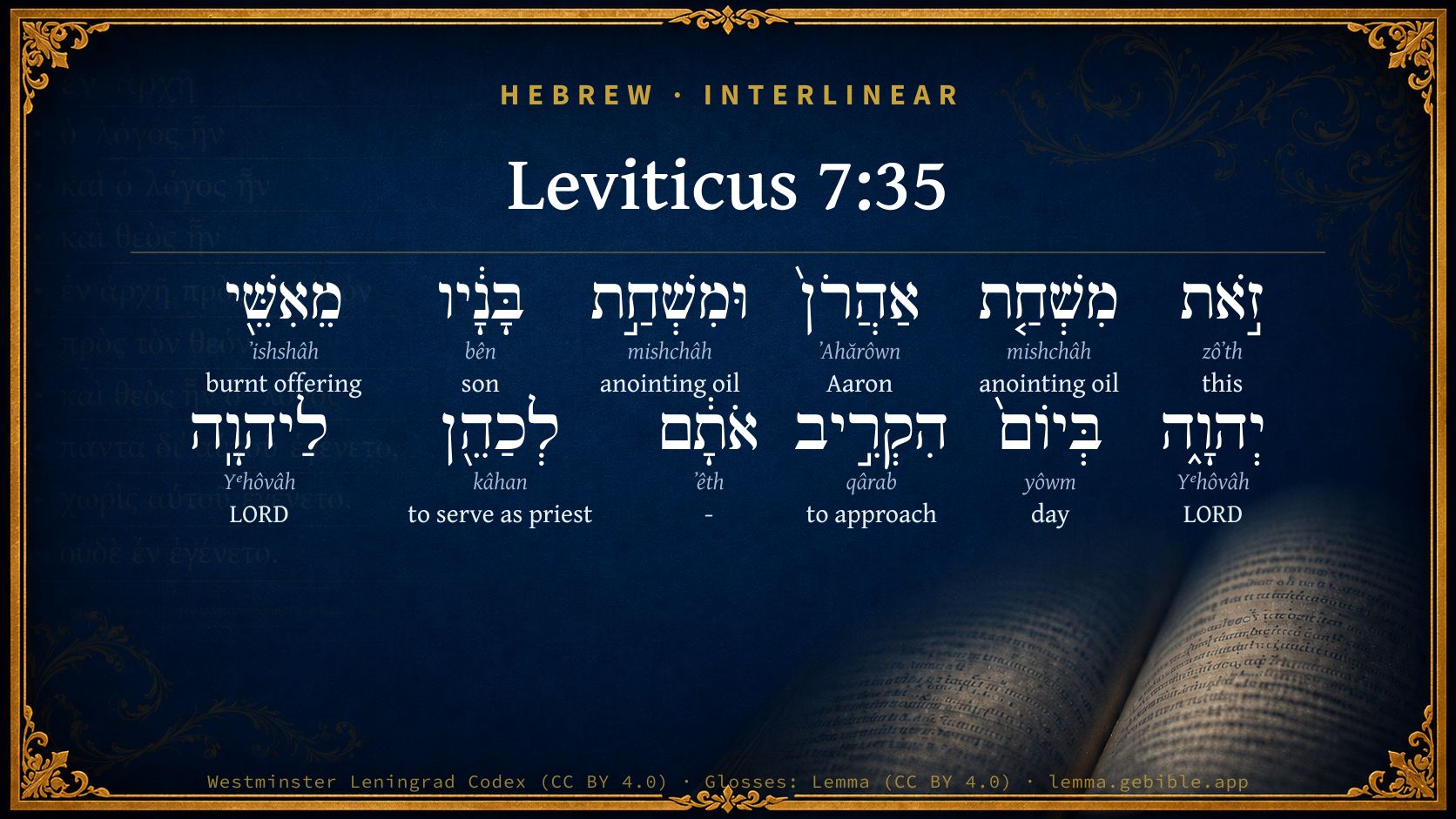
Hebrew (Westminster Leningrad Codex) Leviticus 7:35 appears in the Hebrew Old Testament. The text above is from the Westminster Leningrad Codex. Each word links to its Strong’s number, a concise gloss, and parsing drawn from the Open Scriptures Hebrew Bible morphology. Click any word for its full Brown-Driver-Briggs (BDB) entry.
Download image
Cite this verse

Leviticus 7:35 (World English Bible). Public Domain. Lemma interlinear Bible study tool, https://lemma.gebible.app/v/leviticus/7/35.

Show BibTeX & RIS
BibTeX
RIS
English Translation
This is the anointing portion of Aaron, and the anointing portion of his sons, out of the offerings of Yahweh made by fire, in the day when he presented them to minister to Yahweh in the priest's office;
World English Bible · Public Domain
Download a study sheet

One document with this verse’s original text, its word-by-word gloss line, the meaning frame, cross-references with their text, attributed commentary, and full source and license credits — printable, and it pastes into notes with its structure intact.

This verse Autodidact and up

Study sheet (.html) Plain text (.txt)

A passage Seminary Student

Up to 50 verses in one chapter. A passage sheet keeps up to 6 commentary sources and 12 cross-references per verse, in the order this page ranks them, and says so on the sheet whenever that leaves anything out. Ask for a single verse and you get the Autodidact verse sheet above.

Everything on this page stays free to read, with no account — the sheet is a download of what is already on screen, not access to it.

Want to remove ads? Support Godless Engineer
Compare translations 3

The same verse in 3 English versions, stacked beneath the original-language interlinear above. Click any original word for its lexicon entry.

Each is an independent rendering of the whole verse — the interlinear is not word-aligned to these translations.

Highlighted words mark where these versions differ — a whole-verse word diff, not a word-by-word alignment.

  • World English Bible Public Domain
    This is the anointing portion of Aaron, and the anointing portion of his sons, out of the offerings of Yahweh made by fire, in the day when he presented them to minister to Yahweh in the priest's office;
  • King James Version Public Domain
    This is the portion of the anointing of Aaron, and of the anointing of his sons, out of the offerings of the LORD made by fire, in the day when he presented them to minister unto the LORD in the priest's office;
  • unfoldingWord Literal Text CC BY-SA 4.0
    This the allotment of Aaron and the allotment of his sons from the gifts of Yahweh, on the day he presented them as priests to Yahweh,

unfoldingWord Literal Text — © unfoldingWord, licensed CC BY-SA 4.0. Word-aligned USFM3 via Door43 (git.door43.org/unfoldingWord/en_ult).

Versions to compare (up to 4)

3 of 4 selected

Show all 18 translations

Every available English version of this verse, each an independent rendering of the whole verse.

  • World English Bible Public Domain
    This is the anointing portion of Aaron, and the anointing portion of his sons, out of the offerings of Yahweh made by fire, in the day when he presented them to minister to Yahweh in the priest's office;
  • Berean Standard Bible Public Domain
    This is the portion of the offerings made by fire to the LORD for Aaron and his sons since the day they were presented to serve the LORD as priests.
  • Majority Standard Bible Public Domain
    This is the portion of the food offerings to the LORD for Aaron and his sons since the day they were presented to serve the LORD as priests.
  • King James Version Public Domain
    This is the portion of the anointing of Aaron, and of the anointing of his sons, out of the offerings of the LORD made by fire, in the day when he presented them to minister unto the LORD in the priest's office;
  • American Standard Version (1901) Public Domain
    This is the anointing-portion of Aaron, and the anointing-portion of his sons, out of the offerings of Jehovah made by fire, in the day when he presented them to minister unto Jehovah in the priest's office;
  • Revised Version (1885) Public Domain
    This is the anointing-portion of Aaron, and the anointing-portion of his sons, out of the offerings of the LORD made by fire, in the day when he presented them to minister unto the LORD in the priest’s office;
  • Geneva Bible (1599) Public Domain
    This is the anointing of Aaron, and the anointing of his sonnes, concerning the offerings of the Lord made by fire, in the day when he presented them to serue in the Priestes office vnto the Lord.
  • Douay-Rheims (1899) Public Domain
    This is the anointing of Aaron and his sons, in the ceremonies of the Lord, in the day when Moses offered them, that they might do the office of priesthood,
  • Young's Literal Translation Public Domain
    This `is' the anointing of Aaron, and the anointing of his sons out of the fire-offerings of Jehovah, in the day he hath brought them near to act as priest to Jehovah,
  • Literal Standard Version CC BY-SA 4.0
    This [is] an anointed portion [for] Aaron, and an anointed portion [for] his sons out of the fire-offerings of YHWH, in the day he has brought them near to act as priest of YHWH,
  • Unlocked Literal Bible CC BY-SA 4.0
    This is the share for Aaron and his descendants from the offerings for Yahweh made by fire, on the day when Moses presented them to serve Yahweh in the work of priest.
  • unfoldingWord Literal Text CC BY-SA 4.0
    This the allotment of Aaron and the allotment of his sons from the gifts of Yahweh, on the day he presented them as priests to Yahweh,
  • Darby Bible Public Domain
    This is [the portion] of the anointing of Aaron and of the anointing of his sons, from Jehovah's offerings by fire, in the day [when] he presented them to serve Jehovah as priests,
  • World Messianic Bible Public Domain
    This is the consecrated portion of Aaron, and the consecrated portion of his sons, out of the offerings of the LORD made by fire, in the day when he presented them to minister to the LORD in the priest’s office;
  • Webster's Bible Public Domain
    This is the portion of the anointing of Aaron, and of the anointing of his sons, out of the offerings of the LORD made by fire, in the day when he presented them to minister to the LORD in the priest's office;
  • Free Bible Version CC BY-SA 4.0
    This is the share of the food offerings given to the Lord that belongs to Aaron and his sons since the day they were appointed to serve the Lord as priests.
  • Bible in Basic English Public Domain
    This is the holy part given to Aaron and to his sons, out of the offerings made to the Lord by fire, on the day when they were made priests before the Lord;
  • JPS Tanakh (1917) Public Domain
    This is the consecrated portion of Aaron, and the consecrated portion of his sons, out of the offerings of the LORD made by fire, in the day when they were presented to minister unto the LORD in the priest's office;

Literal Standard Version (2020), Covenant Press — licensed CC BY-SA 4.0. Text via the HelloAO Bible API (eBible.org). Unlocked Literal Bible (unfoldingWord) — licensed CC BY-SA 4.0. Text via the HelloAO Bible API (eBible.org). unfoldingWord Literal Text — © unfoldingWord, licensed CC BY-SA 4.0. Word-aligned USFM3 via Door43 (git.door43.org/unfoldingWord/en_ult). Free Bible Version, Dr. Jonathan Gallagher — licensed CC BY-SA 4.0. Text via the HelloAO Bible API (eBible.org).

Word by word

More ways to search: Search by grammar → Find every occurrence → Compare this word →

Practice this passage: Drill this verse → Learn its vocabulary →

לְכַהֵ֖ן
kâhan
H3547
“to serve as priest”
Preposition + Verb, Piel, Infinitive Construct
Part of Speech
Preposition + Verb
Stem
Piel
Form
Infinitive Construct
Full BDB Definition

Origin: a primitive root, apparently meaning to mediate in religious services

TWOT: 959

to act as a priest, minister in a priest's office - (Piel) - to minister as a priest, serve as a priest - to be or become a priest - to play the priest
  1. זֹ֣את zôʼth H2063 “this” Pronoun, Demonstrative, Feminine, Singular
  2. מִשְׁחַ֤ת mishchâh H4888 “anointing oil of” Noun, Common, Feminine, Singular, Construct
  3. אַהֲרֹן֙ ʼAhărôwn H175 “Aaron” Noun, Proper
  4. וּמִשְׁחַ֣ת mishchâh H4888 “and · anointing oil of” Conjunction + Noun, Common, Feminine, Singular, Construct
  5. בָּנָ֔יו bên H1121 “sons · his” Noun, Common, Masculine, Plural, Construct + Suffix, Personal, 3rd Person, Masculine, Singular
  6. מֵאִשֵּׁ֖י ʼishshâh H801 “from · burnt offerings of” Preposition + Noun, Common, Masculine, Plural, Construct
  7. יְהוָ֑ה Yᵉhôvâh H3068 “LORD” Noun, Proper
  8. בְּיוֹם֙ yôwm H3117 “in/at · day of” Preposition + Noun, Common, Masculine, Singular, Construct
  9. הִקְרִ֣יב qârab H7126 “to approach” Verb, Hiphil, Perfect, 3rd Person, Masculine, Singular
  10. אֹתָ֔ם ʼêth H853 “- · them” Particle, Direct Object + Suffix, Personal, 3rd Person, Masculine, Plural
  11. לַיהוָֽה Yᵉhôvâh H3068 “to/for · LORD” Preposition + Noun, Proper

About this verse

These counts appear in no published source. They are computed here, from the morphology-tagged text and Lemma’s own curated glosses. What Lemma adds →

12
words
10
distinct lemmas
Pentateuch
section

Notable vocabulary

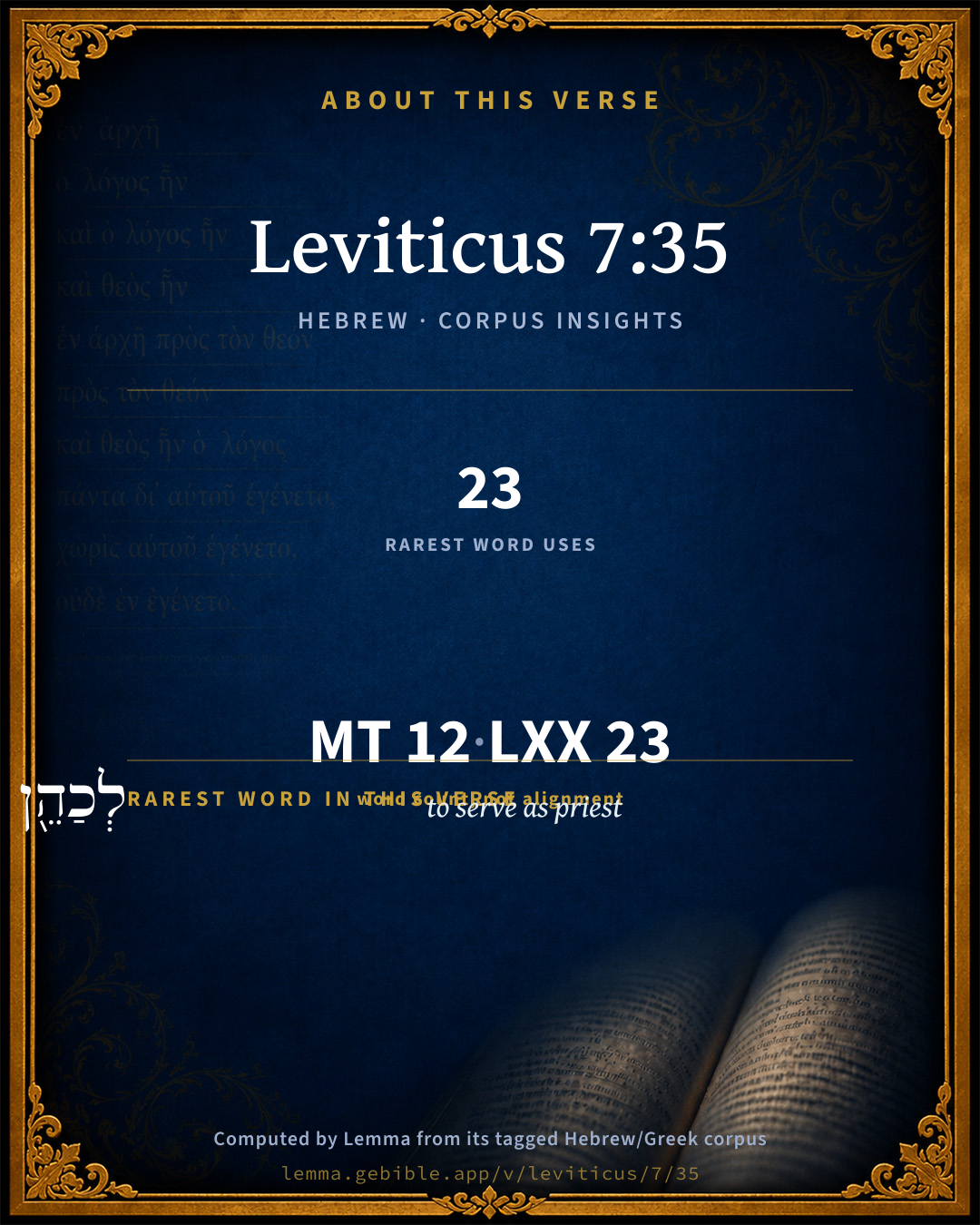
The rarest word here is לְכַהֵ֖ן to serve as priest H3547 — appearing just 23 times in the whole Hebrew Bible.

Shared distinctive vocabulary

לְכַהֵ֖ן to serve as priest H3547 occurs in 23 verses of the Hebrew Bible. Also found in:

Grammatical profile

  • 2 verbs
  • 8 nouns
  • 1 pronoun
  • 1 particle

Verb forms

  • הִקְרִ֣יב Hiphil · Perfect
  • לְכַהֵ֖ן Piel · Infinitive Construct

Repetition

Words recur within this verse — often emphatic in Hebrew:

  • מִשְׁחַ֤ת anointing oil H4888 ×2
  • יְהוָ֑ה LORD H3068 ×2

Hebrew & Septuagint length

In the original languages it is 12 Hebrew tokens and 23 Greek tokens — but the two are counted differently (Hebrew bundles its prefixes and suffixes into one token; the Greek is in lemma form), so that isn’t a like-for-like length.

Cross-references

14

Topical passages linked to Leviticus 7:35 in the Treasury of Scripture Knowledge — connected by theme and wording, ordered by reader-vote popularity; previews shown in the World English Bible.

  • 1 John 2:20 You have an anointing from the Holy One, and you know the truth.
  • Exodus 28:1 "Bring Aaron your brother, and his sons with him, near to you from among the children of Israel, that he may minister to me in the priest's office, even Aaron, Nadab and Abihu, Eleazar and Ithamar, Aaron's sons.
  • Exodus 29:1 "This is the thing that you shall do to them to make them holy, to minister to me in the priest's office: take one young bull and two rams without blemish,
  • Exodus 29:7 Then you shall take the anointing oil, and pour it on his head, and anoint him.
  • Exodus 29:21 You shall take of the blood that is on the altar, and of the anointing oil, and sprinkle it on Aaron, and on his garments, and on his sons, and on the garments of his sons with him: and he shall be made holy, and his garments, and his sons, and his sons' garments with him.
  • Exodus 40:13–15 You shall put on Aaron the holy garments; and you shall anoint him, and sanctify him, that he may minister to me in the priest's office.
  • Leviticus 8:10–12 Moses took the anointing oil, and anointed the tabernacle and all that was in it, and sanctified them.
  • Leviticus 8:30 Moses took some of the anointing oil, and some of the blood which was on the altar, and sprinkled it on Aaron, on his garments, and on his sons, and on his sons' garments with him, and sanctified Aaron, his garments, and his sons, and his sons' garments with him.
  • Numbers 18:7–19 You and your sons with you shall keep your priesthood for everything of the altar, and for that within the veil; and you shall serve: I give you the priesthood as a service of gift: and the stranger who comes near shall be put to death.
  • Isaiah 10:27 It shall happen in that day, that his burden shall depart from off your shoulder, and his yoke from off your neck, and the yoke shall be destroyed by reason of fatness.
  • Isaiah 61:1 The Spirit of the Lord Yahweh is on me; because Yahweh has anointed me to preach good news to the humble; he has sent me to bind up the broken-hearted, to proclaim liberty to the captives, and the opening [of the prison] to those who are bound;
  • John 3:34 For he whom God has sent speaks the words of God; for God gives the Spirit without measure.
  • 2 Corinthians 1:21 Now he who establishes us with you in Christ, and anointed us, is God;
  • 1 John 2:27 As for you, the anointing which you received from him remains in you, and you don't need for anyone to teach you. But as his anointing teaches you concerning all things, and is true, and is no lie, and even as it taught you, you will remain in him.

Cross-references courtesy of OpenBible.info (CC BY 4.0).

Hebrew and Greek witnesses Masoretic Hebrew ↔ Greek Septuagint

The same verse in the two great witnesses to the Old Testament, shown verse-for-verse.

These are two independent witnesses, not word-aligned to each other, and the Septuagint is shown in lemma (dictionary) form.

Hebrew Leviticus 7:35 Masoretic · Westminster Leningrad Codex

זֹ֣את מִשְׁחַ֤ת אַהֲרֹן֙ וּמִשְׁחַ֣ת בָּנָ֔יו מֵאִשֵּׁ֖י יְהוָ֑ה בְּיוֹם֙ הִקְרִ֣יב אֹתָ֔ם לְכַהֵ֖ן לַיהוָֽה

This is the anointing portion of Aaron, and the anointing portion of his sons, out of the offerings of Yahweh made by fire, in the day when he presented them to minister to Yahweh in the priest's office;

World English Bible · Public Domain

Greek LXX Leviticus 7:35 Septuagint · lemma form

οὗτος ὁ χρῖσις ἀαρών καί ὁ χρῖσις ὁ υἱός αὐτός ἀπό ὁ κάρπωμα κύριος ἐν ὅς ἡμέρα προςἄγω αὐτός ὁ ἱερατεύω ὁ κύριος

No English rendering of this Greek verse — the small residue in the structurally divergent books.

Hebrew: Westminster Leningrad Codex (CC BY 4.0). Greek: Septuagint (public domain); English from a public-domain English Septuagint. How the Septuagint differs from the Hebrew →

Targum (Aramaic paraphrase)

2

The Targum is the ancient Jewish Aramaic paraphrase of the Hebrew Scriptures — an interpretive translation, not the Hebrew text itself. Onkelos (literal) and Pseudo-Jonathan (expansive) render the Torah, and Jonathan the Prophets. Coverage is partial: where no permissively-licensed English translation exists for a verse, only the Aramaic is shown. This is verse-level text, not a word-by-word alignment to the Hebrew.

  1. Targum Onkelos Torah (Genesis–Deuteronomy)
    דָא רְבוּת אַהֲרֹן וּרְבוּת בְּנוֹהִי מִקוּרְבָּנַיָא דַיְיָ בְּיוֹמָא דְקָרֵב יָתְהוֹן לְשַׁמָשָׁא קֳדָם יְיָ

    (no public-domain English translation for this verse)

    Targum Onkelos — Aramaic: “Onkelos Genesis” (public domain); “Onkelos Exodus” (public domain); “Onkelos Leviticus” (public domain); “Onkelos Numbers” (public domain); “Onkelos Deuteronomy” (public domain). English: “Sefaria Community Translation” (CC0 1.0 (public-domain dedication)); “J.W. Etheridge. The Targums of Onkelos and Jonathan Ben Uzziel on the Pentateuch. London: Longmans, Green, 1862” (public domain). Text via Sefaria.

  2. Targum Pseudo-Jonathan Torah (Genesis–Deuteronomy)
    דָא רְבוּתָא דְאַהֲרן וּרְבוּתָא דִבְנוֹי עַל כָּל אֲחוּהוֹן לֵיוָאֵי דְיֵיכְלוּן מִקוּרְבָּנַיָא דַיְיָ בְּיוֹמָא דִיְקָרְבוּן יַתְהוֹן לְשַׁמָשָׁא קֳדָם יְיָ

    This pertaineth to the consecration of Aharon and to the consecration of his sons over all the Levites their brethren, that they may eat of the Lord's oblations in the day that they present them to minister before the Lord;

    Targum Pseudo-Jonathan — Aramaic: “Targum Jonathan on Genesis” (public domain); “Targum Jonathan on Exodus” (public domain); “Targum Jonathan on Leviticus” (public domain); “Targum Jonathan on Numbers” (public domain); “Targum Jonathan on Deuteronomy” (public domain). English: “The Targum of Jonathan ben Uzziel, trans. J. W. Etheridge, London, 1862” (public domain). Text via Sefaria.

Commentary

Notes on Leviticus 7:35 from classic Christian and Jewish commentators (each source and its license shown beneath its notes). The classic Christian expositions comment on the surrounding passage and are grouped to its opening verse, so a note may address several verses; the Jewish commentaries on the Tanakh (Rashi and others) are per-verse, so they appear only where the commentator wrote on this verse.

Lemma curates 59 commentaries, every one of them public domain or Creative Commons licensed, each selected and text-cleaned for this edition rather than reprinted as found. About our sources →

Matthew Henry's Commentary

Here is the conclusion of these laws concerning the sacrifices, though some of them are afterwards repeated and explained. The are to be considered, 1. As a grant to the priests, Lev 7:35, Lev 7:36. In the day they were ordained to that work and office this provision was made for their comfortable maintenance. Note, God will take care that those who are employed for him be well paid and well provided for. Those that receive the anointing of the Spirit to minister unto the Lord shall have their portion, and it shall be a worthy portion, out of the offerings of the Lord; for God's work is its own wages, and there is a present reward of obedience in obedience. 2. As a statute for ever to the people, that they should bring these offerings according to the rules prescribed, and cheerfully give the priests their share out of them. God commanded the children of Israel to offer their oblations, Lev 7:38. Note, The solemn acts religious worship are commanded. They are not things that we are left to our liberty in, and which we may do or not do at our pleasure; but we are under indispensable obligations to perform them in their season, and it is at our peril if we omit them. The observance of the laws of Christ cannot be less necessary than the observance of the laws of Moses was.

Matthew Henry's Commentary on the Whole Bible (1708–1710) — public domain (CC PDM 1.0). Text via the HelloAO Bible API.

The Cambridge Bible for Schools and Colleges

gen. ed. J. J. S. Perowne

35. anointing-portion] R.V. mg. portion. The Heb. root which means to anoint is found in Aramaic and Assyrian in the sense to measure. The word here and the similar word in Num_18:8 (by reason of the anointing, ‘for a portion,’ R.V. mg.) probably indicate an assigned or ‘measured portion,’ without excluding a play on the other sense of the root.

Conclusion (35–38)

The summary in Lev_7:35-36 refers to the priestly dues, either to those just mentioned in Lev_7:31-34, or more generally to those prescribed in the section Lev_6:8 to Lev_7:34.

The Cambridge Bible for Schools and Colleges (gen. ed. J. J. S. Perowne; Cambridge University Press, 1878–1918) — public domain. Text from a community e-Sword module.

Trapp's Complete Commentary

John Trapp

Lev 7:35 This [is the portion] of the anointing of Aaron, and of the anointing of his sons, out of the offerings of the LORD made by fire, in the day [when] he presented them to minister unto the LORD in the priest’s office;

Ver. 35. This is the portion of the anointing.] That is, Of the anointed priests; and that because they were anointed to the office. Here Origen, according to his manner, turns all into allegories and mysteries, and tells us of a threefold sense of Scripture, (1.) Literal; (2.) Moral; (3.) Mystical: comparing them to the gridiron, frying pan, and oven, used in dressing the meat offering. Lev 7:9 But this itch of allegorising dark and difficult texts hath no small danger in it. And I may doubt of Origen, as one doth of Jerome, Utrum plus boni peritia linguarum, qua excelluit, an mali suis allegoriis, in quibus dominatus fuit, ecclesiae Dei attulerit; whether he did more harm or good to the Church. {a}

{a} Allegorias spumam scripturae vocat Luth., in Gen. iii., p. 67. Amama, Antibarb.

John Trapp, A Commentary or Exposition upon All the Books of the Old and New Testament (1647–1656) — public domain. Text from a community e-Sword module.

Joseph Benson's Commentary

Lev 7:35-37. This is the portion of the anointing — That is, their portion in consequence of their unction to the priests’ office, appointed them by God in that day, and therefore to be given them in after ages. Thus God kindly provides for them that are given up entirely to his service in things sacred. Of the consecration — That is, of the sacrifice offered at the consecration of the priests.

Joseph Benson's Commentary on the Old and New Testaments (1811–1818) — public domain. Text from a community e-Sword module.

Whedon's Commentary on the Bible

Daniel D. Whedon

SUMMARY OF PRECEDING LAWS, Lev_7:35-38.

35. This is the portion of the anointing of Aaron — This is the provision made for those who are anointed priests — the perquisite by virtue of the holy office. The abstract anointing is put for the concrete, the anointed.

Daniel D. Whedon (gen. ed.), Commentary on the Old and New Testaments (1874–1909) — public domain. Text from a community e-Sword module.

Geneva Bible (1599)

Geneva Bible translators

That is, his privilege, reward and portion.

Geneva Bible (1599) marginal notes — public domain. Text via Bolls.life.

Jamieson, Fausset & Brown

Robert Jamieson, A. R. Fausset & David Brown

This is the portion of the anointing of Aaron--These verses contain a general summing up of the laws which regulate the privileges and duties of the priests. The word "anointing" is often used as synonymous with "office" or "dignity." So that the "portion of the anointing of Aaron" probably means the provision made for the maintenance of the high priest and the numerous body of functionaries which composed the sacerdotal order.

in the day when he presented them to minister unto the Lord, &c.--that is, from the day they approached the Lord in the duties of their ministry.

Next: Leviticus Chapter 8

Jamieson, Fausset & Brown — Commentary Critical and Explanatory on the Whole Bible (1871) — public domain (CC PDM 1.0). Text via the HelloAO Bible API.

Ellicott's Commentary for English Readers

(35) This is the portion of the anointing of Aaron and of the anointing of his sons.—Better, this is the share of Aaron and the share of his sons. That is, the wave breast and the heave shoulder.

A Bible Commentary for English Readers, edited by Charles John Ellicott (1878–1897) — public domain. Text from a community e-Sword module.

John Gill's Exposition

Which the Lord commanded to be given them of the children of Israel,.... Whenever they brought their offerings to be offered up by them, such parts thereof were ordered to be allowed them as theirs:

in the day that he anointed them; or from the day they were anointed of Moses, by the direction of the Lord, from that time they had a right and claim to the above things, out of the sacrifices brought, so Aben Ezra: and this was

by a statute for ever throughout their generations; in all successive generations, unto the coming of the Messiah, which would put an end to their priesthood. Thus the Lord provided for the maintenance of his ministers, till that time came; and since it has been the ordinance of Christ, that they which preach the Gospel should live of the Gospel, Co1 9:13.

John Gill's Exposition of the Whole Bible (1746–1763) — public domain (CC PDM 1.0). Text via the HelloAO Bible API.

Albert Barnes' Notes on the Bible

The portion of the anointing ... - Rather, the appointed share of Aaron and of his sons.

Albert Barnes' Notes on the Bible (1834–1885) — public domain. Text from a community e-Sword/MySword module.

Haydock's Catholic Bible Commentary

Anointing. Le Clerc translates the food. On this Aaron shall be maintained. This shall be his salary or portion, in quality of God’s anointed.

George Leo Haydock (1774–1849), Haydock's Catholic Family Bible and Commentary, 1859 edition — public domain. Excludes Psalms (Douay-Rheims chapter numbering differs from Protestant) and Deuterocanonical books (Catholic canon only).

Matthew Poole's English Annotations

Of the anointing, i.e. of the priesthood; the sign put for the thing signified; and the anointing by a like figure is put for the right, or part of the sacrifices belonging to the priest by virtue of his anointing, as plainly appears from the words here following,

out of the offering, & c.

In the day when he presented them: this was their portion appointed them by God in that day, and therefore to be given to them in after-ages. Or, from the day, &c., and thenceforward; the Hebrew preposition beth being put for rain, as it is frequently.

Matthew Poole's English Annotations on the Holy Bible (1683–1685) — public domain. Text from a community e-Sword/MySword module.

The Pulpit Commentary

Vers. 35, 36. Conclusion of the section. This is the portion of the anointing of Aaron, and of the anointing of his sons, may be translated simply, This is the portion of Aaron, and the portion of his sons, as the word mischah" will bear the meaning of portion as well as of anointing. This rendering, however, is not necessary, as it was the anointing of Aaron and Ms sons that entitled them to these portions.

The Pulpit Commentary (1880–1919), ed. H.D.M. Spence-Jones & Joseph S. Exell — public domain. Text from a community e-Sword module.

John Wesley's Explanatory Notes

Of the anointing of Aaron - That is, of the priesthood; the sign put for the thing signified; and the anointing by a like figure is put for the part of the sacrifices belonging to the priest by virtue of his anointing. This was their portion appointed them by God in that day, and therefore to be given to them in after ages.

John Wesley, Explanatory Notes Upon the Whole Bible (1754–1765) — public domain. Text via the GEBible commentary corpus.

unfoldingWord translationNotes

Door43 World Missions Community

the offerings for Yahweh made by fire

This can be translated in active form. AT: "the burnt offerings for Yahweh" (See: Active or Passive)

that Yahweh commanded to be given them from the people of Israel

This can be stated in active form. AT: "that Yahweh commanded the people of Israel to give to them" (See: Active or Passive)

that he anointed the priests

"that Moses anointed the priests"

throughout all generations

See how you translated these words in Leviticus 3:17.

translationWords

Aaron

descend

sacrifice

Yahweh

fire

Moses

servant

works

priest

command

Israel

anoint

generation

unfoldingWord translationNotes — © Distant Shores Media and the Door43 World Missions Community, licensed CC BY-SA 4.0. Source: git.door43.org/Door43/en_tn.

Lesson kit

Teaching starters — assembled from the data on this page, not authored interpretation. Every prompt links to the verse data it draws on. Edit before teaching.

Leviticus, in the Pentateuch, opens this verse with 12 words (10 distinct Hebrew lemmas). Its most distinctive word is kâhan (“to serve as priest”). A historical commentator’s framing appears above. Read the whole chapter for the surrounding context.

Discussion questions

  1. What does “to serve as priest” (kâhan) contribute to the verse as a whole?
  2. How does Exodus 28:1, which shares the word «to serve as priest», read alongside this verse?
  3. What does the repetition of “anointing oil” (2× in this one verse) do in this verse?
  4. The translations on this page render this verse differently — a whole-verse word diff, not a word-by-word alignment. What might account for the different wordings?
  5. «הִקְרִ֣יב» is a Hiphil Perfect verb. How does that grammatical form shape the action described?
  6. Compare how Matthew Henry's Commentary and The Cambridge Bible for Schools and Colleges read this verse. Where do they agree or differ?

Things to notice

Reading settings

Reading text

Shown beneath each verse's original-language words.

Old Testament
Old Testament edition

Read the OT as the Masoretic Hebrew (MT) or the Greek Septuagint (LXX).

English shown for the Greek Septuagint (in the Hebrew ↔ Greek comparison).

Comparing translations? Open the Compare panel on any verse page to stack up to four side by side.