
Joshua 16:8

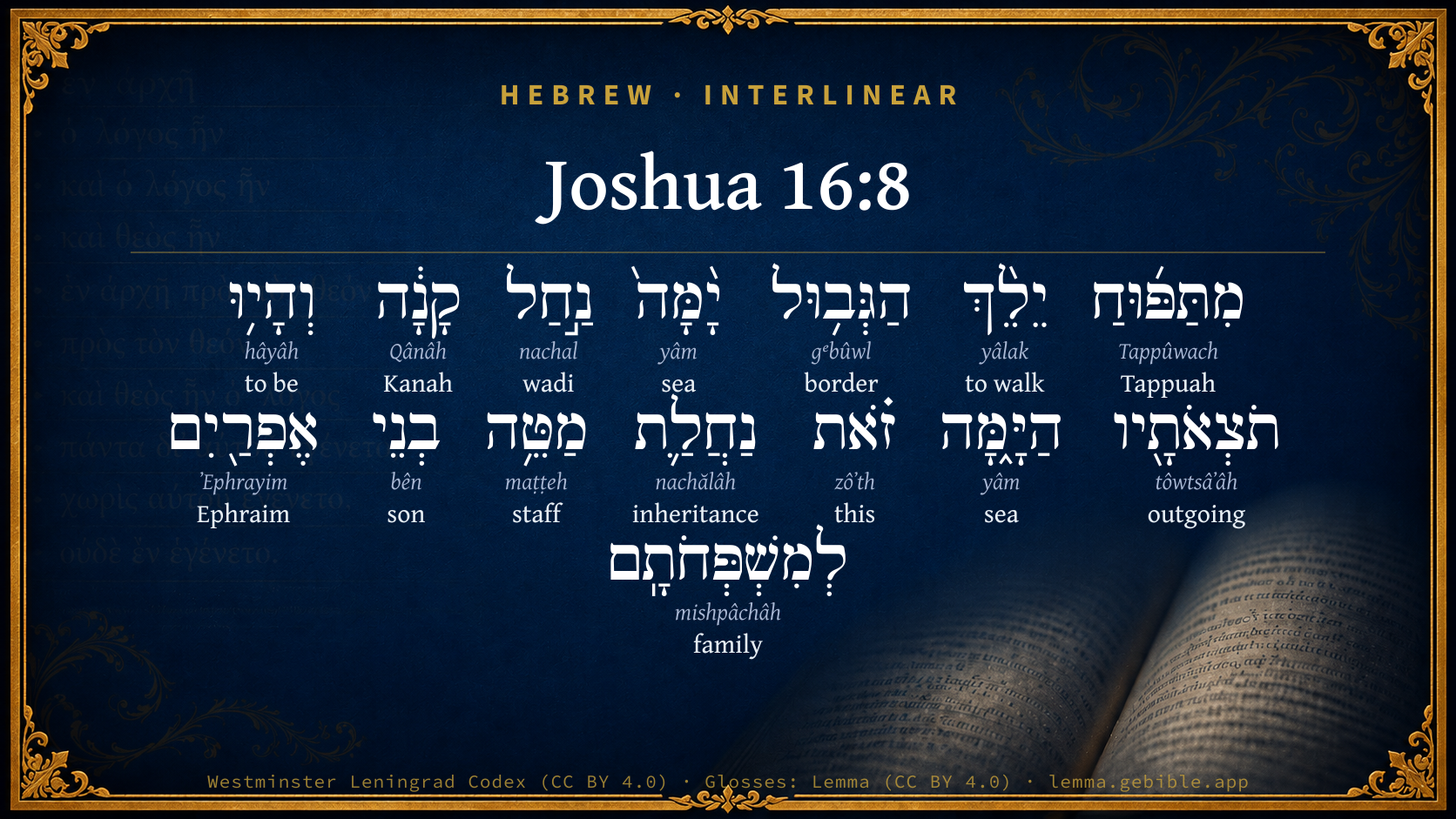
Hebrew (Westminster Leningrad Codex) Joshua 16:8 appears in the Hebrew Old Testament. The text above is from the Westminster Leningrad Codex. Each word links to its Strong’s number, a concise gloss, and parsing drawn from the Open Scriptures Hebrew Bible morphology. Click any word for its full Brown-Driver-Briggs (BDB) entry.
Download image
Cite this verse

Joshua 16:8 (World English Bible). Public Domain. Lemma interlinear Bible study tool, https://lemma.gebible.app/v/joshua/16/8.

Show BibTeX & RIS
BibTeX
RIS
English Translation
From Tappuah the border went along westward to the brook of Kanah; and the goings out of it were at the sea. This is the inheritance of the tribe of the children of Ephraim according to their families;
World English Bible · Public Domain
Highlights
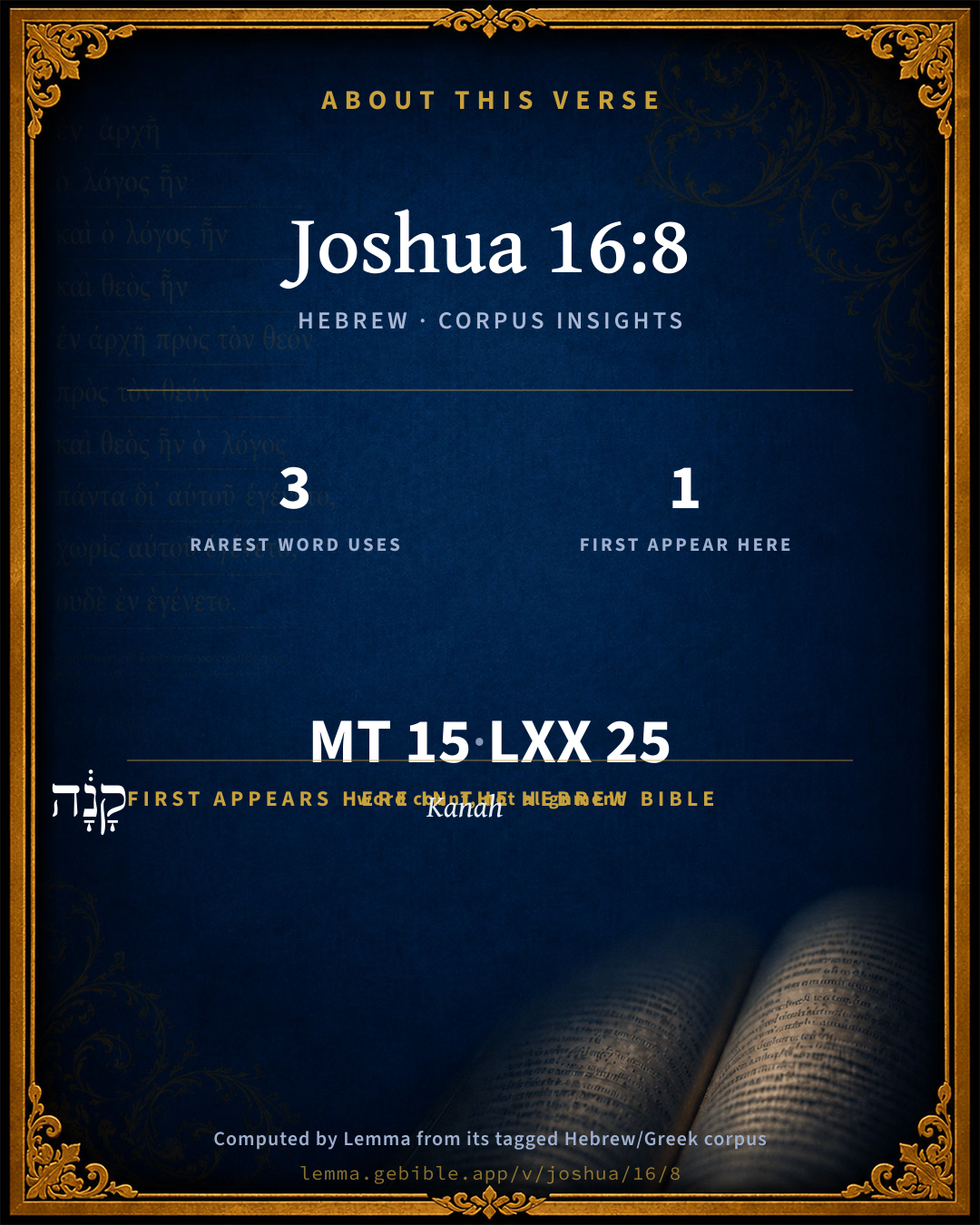
  • 1 first appearance in the Hebrew Bible
Full analysis ↓
Download a study sheet

One document with this verse’s original text, its word-by-word gloss line, the meaning frame, cross-references with their text, attributed commentary, and full source and license credits — printable, and it pastes into notes with its structure intact.

This verse Autodidact and up

Study sheet (.html) Plain text (.txt)

A passage Seminary Student

Up to 50 verses in one chapter. A passage sheet keeps up to 6 commentary sources and 12 cross-references per verse, in the order this page ranks them, and says so on the sheet whenever that leaves anything out. Ask for a single verse and you get the Autodidact verse sheet above.

Everything on this page stays free to read, with no account — the sheet is a download of what is already on screen, not access to it.

Want to remove ads? Support Godless Engineer
Compare translations 3

The same verse in 3 English versions, stacked beneath the original-language interlinear above. Click any original word for its lexicon entry.

Each is an independent rendering of the whole verse — the interlinear is not word-aligned to these translations.

Highlighted words mark where these versions differ — a whole-verse word diff, not a word-by-word alignment.

  • World English Bible Public Domain
    From Tappuah the border went along westward to the brook of Kanah; and the goings out of it were at the sea. This is the inheritance of the tribe of the children of Ephraim according to their families;
  • King James Version Public Domain
    The border went out from Tappuah westward unto the river Kanah; and the goings out thereof were at the sea. This is the inheritance of the tribe of the children of Ephraim by their families.
  • unfoldingWord Literal Text CC BY-SA 4.0
    From Tappuah, the border went seaward the wadi of Kanah, and its goings out were seaward. This the inheritance of the tribe of the sons of Ephraim according to their clans.

unfoldingWord Literal Text — © unfoldingWord, licensed CC BY-SA 4.0. Word-aligned USFM3 via Door43 (git.door43.org/unfoldingWord/en_ult).

Versions to compare (up to 4)

3 of 4 selected

Show all 18 translations

Every available English version of this verse, each an independent rendering of the whole verse.

  • World English Bible Public Domain
    From Tappuah the border went along westward to the brook of Kanah; and the goings out of it were at the sea. This is the inheritance of the tribe of the children of Ephraim according to their families;
  • Berean Standard Bible Public Domain
    From Tappuah the border went westward to the Brook of Kanah and ended at the Sea. This was the inheritance of the clans of the tribe of Ephraim,
  • Majority Standard Bible Public Domain
    From Tappuah the border went westward to the Brook of Kanah and ended at the Sea. This was the inheritance of the clans of the tribe of Ephraim,
  • King James Version Public Domain
    The border went out from Tappuah westward unto the river Kanah; and the goings out thereof were at the sea. This is the inheritance of the tribe of the children of Ephraim by their families.
  • American Standard Version (1901) Public Domain
    From Tappuah the border went along westward to the brook of Kanah; and the goings out thereof were at the sea. This is the inheritance of the tribe of the children of Ephraim according to their families;
  • Revised Version (1885) Public Domain
    From Tappuah the border went along westward to the brook of Kanah; and the goings out thereof were at the sea. This is the inheritance of the tribe of the children of Ephraim according to their families;
  • Geneva Bible (1599) Public Domain
    And this border goeth from Tappuah Westward vnto the riuer Kanah, and the endes thereof are at the Sea: this is the inheritance of the tribe of the children of Ephraim by their families.
  • Douay-Rheims (1899) Public Domain
    From Taphua it passeth on towards the sea into the valley of reeds, and the goings out thereof are at the most salt sea. This is the possession of the tribe of the children of Ephraim by their families.
  • Young's Literal Translation Public Domain
    From Tappuah the border goeth westward unto the brook of Kanah, and its outgoings have been at the sea: this `is' the inheritance of the tribe of the sons of Ephraim, for their families.
  • Literal Standard Version CC BY-SA 4.0
    From Tappuah the border goes westward to the Brook of Kanah, and its outgoings have been at the sea: this [is] the inheritance of the tribe of the sons of Ephraim, for their families.
  • Unlocked Literal Bible CC BY-SA 4.0
    From Tappuah the border went westward to the brook of Kanah and ended at the sea. This was the inheritance of the tribe of Ephraim, clan by clan,
  • unfoldingWord Literal Text CC BY-SA 4.0
    From Tappuah, the border went seaward the wadi of Kanah, and its goings out were seaward. This the inheritance of the tribe of the sons of Ephraim according to their clans.
  • Darby Bible Public Domain
    From Tappuah the border went westwards to the torrent Kanah, and ended at the sea. This is the inheritance of the tribe of the children of Ephraim according to their families,
  • World Messianic Bible Public Domain
    From Tappuah the border went along westward to the brook of Kanah; and ended at the sea. This is the inheritance of the tribe of the children of Ephraim according to their families;
  • Webster's Bible Public Domain
    The border went out from Tappuah westward to the river Kanah; and the limits of it were at the sea. This is the inheritance of the tribe of the children of Ephraim by their families.
  • Free Bible Version CC BY-SA 4.0
    From Tappuah the boundary ran west to the Brook of Kanah and then out to the sea. This was the land allotted to the tribe of Ephraim, by families.
  • Bible in Basic English Public Domain
    From Tappuah the line goes on to the west to the river of Kanah; ending at the sea. This is the heritage of the children of Ephraim by their families;
  • JPS Tanakh (1917) Public Domain
    From Tappuah the border went along westward to the brook of Kanah; and the goings out thereof were at the sea. This is the inheritance of the tribe of the children of Ephraim according to their families;

Literal Standard Version (2020), Covenant Press — licensed CC BY-SA 4.0. Text via the HelloAO Bible API (eBible.org). Unlocked Literal Bible (unfoldingWord) — licensed CC BY-SA 4.0. Text via the HelloAO Bible API (eBible.org). unfoldingWord Literal Text — © unfoldingWord, licensed CC BY-SA 4.0. Word-aligned USFM3 via Door43 (git.door43.org/unfoldingWord/en_ult). Free Bible Version, Dr. Jonathan Gallagher — licensed CC BY-SA 4.0. Text via the HelloAO Bible API (eBible.org).

Word by word

More ways to search: Search by grammar → Find every occurrence → Compare this word →

Practice this passage: Drill this verse → Learn its vocabulary →

קָנָ֔ה
Qânâh
H7071
“Kanah”
Noun, Proper
Part of Speech
Noun
Type
Proper
Full BDB Definition

Origin: fem. of H7070

TWOT: None

Kanah = "reed" - a stream flowing into the Mediterranean Sea that marked the boundary between Ephraim on the south and Manasseh on the north - a town marking the boundary of Asher
  1. מִתַּפּ֜וּחַ Tappûwach H8599 “from · Tappuah” Preposition + Noun, Proper
  2. יֵלֵ֨ךְ yâlak H3212 “to walk” Verb, Qal, Imperfect, 3rd Person, Masculine, Singular
  3. הַגְּב֥וּל gᵉbûwl H1366 “the · border” Particle, Definite Article + Noun, Common, Masculine, Singular, Absolute
  4. יָ֨מָּה֙ yâm H3220 “sea · toward” Noun, Common, Masculine, Singular, Absolute + Suffix, Demonstrative
  5. נַ֣חַל nachal H5158 “wadi of” Noun, Common, Masculine, Singular, Construct
  6. וְהָי֥וּ hâyâh H1961 “and · to be” Conjunction + Verb, Qal, Sequential Perfect, 3rd Person, Common, Plural
  7. תֹצְאֹתָ֖יו tôwtsâʼâh H8444 “outgoings · his” Noun, Common, Feminine, Plural, Construct + Suffix, Personal, 3rd Person, Masculine, Singular
  8. הַיָּ֑מָּה yâm H3220 “the · sea · toward” Particle, Definite Article + Noun, Common, Masculine, Singular, Absolute + Suffix, Demonstrative
  9. זֹ֗את zôʼth H2063 “this” Pronoun, Demonstrative, Feminine, Singular
  10. נַחֲלַ֛ת nachălâh H5159 “inheritance of” Noun, Common, Feminine, Singular, Construct
  11. מַטֵּ֥ה maṭṭeh H4294 “staff of” Noun, Common, Masculine, Singular, Construct
  12. בְנֵי bên H1121 “sons of” Noun, Common, Masculine, Plural, Construct
  13. אֶפְרַ֖יִם ʼEphrayim H669 “Ephraim” Noun, Proper
  14. לְמִשְׁפְּחֹתָֽם mishpâchâh H4940 “to/for · families · their” Preposition + Noun, Common, Feminine, Plural, Construct + Suffix, Personal, 3rd Person, Masculine, Plural

About this verse

These counts appear in no published source. They are computed here, from the morphology-tagged text and Lemma’s own curated glosses. What Lemma adds →

15
words
14
distinct lemmas
Historical
section

Notable vocabulary

The rarest word here is קָנָ֔ה Kanah H7071 — appearing just 3 times in the whole Hebrew Bible.

First appearance in Scripture

This word makes its first canonical appearance in the Hebrew Bible here:

  • קָנָ֔ה Kanah H7071

Shared distinctive vocabulary

קָנָ֔ה Kanah H7071 occurs in 3 verses of the Hebrew Bible. Also found in:

Grammatical profile

  • 2 verbs
  • 12 nouns
  • 1 pronoun

Verb forms

  • יֵלֵ֨ךְ Qal · Imperfect
  • וְהָי֥וּ Qal · Sequential Perfect

Repetition

A word recurs within this verse — often emphatic in Hebrew:

  • יָ֨מָּה֙ sea H3220 ×2

Hebrew & Septuagint length

In English translation the verse runs 38 words from the Hebrew and 33 from the Septuagint (LXX English) — closely comparable.

A rough comparison of the two English renderings, which tokenize alike — not a word-level alignment.

Word counts can differ between the Hebrew and the Greek without any difference in meaning — e.g. the Hebrew direct-object marker אֵת has no separate Greek word, and Greek often adds the article ὁ.

In the original languages it is 15 Hebrew tokens and 25 Greek tokens — but the two are counted differently (Hebrew bundles its prefixes and suffixes into one token; the Greek is in lemma form), so that isn’t a like-for-like length.

Cross-references

5

Topical passages linked to Joshua 16:8 in the Treasury of Scripture Knowledge — connected by theme and wording, ordered by reader-vote popularity; previews shown in the World English Bible.

  • Joshua 17:8–9 The land of Tappuah belonged to Manasseh; but Tappuah on the border of Manasseh belonged to the children of Ephraim.
  • Numbers 34:6 For the western border, you shall have the great sea and the border [of it]: this shall be your west border.
  • Joshua 12:17 the king of Tappuah, one; the king of Hepher, one;
  • Joshua 16:3–6 and it went down westward to the border of the Japhletites, to the border of Beth Horon the lower, even to Gezer; and the goings out of it were at the sea.
  • Joshua 19:28 and Ebron, and Rehob, and Hammon, and Kanah, even to great Sidon;

Cross-references courtesy of OpenBible.info (CC BY 4.0).

Hebrew and Greek witnesses Masoretic Hebrew ↔ Greek Septuagint

The same verse in the two great witnesses to the Old Testament, shown verse-for-verse.

These are two independent witnesses, not word-aligned to each other, and the Septuagint is shown in lemma (dictionary) form.

Hebrew Joshua 16:8 Masoretic · Westminster Leningrad Codex

מִתַּפּ֜וּחַ יֵלֵ֨ךְ הַגְּב֥וּל יָ֨מָּה֙ נַ֣חַל קָנָ֔ה וְהָי֥וּ תֹצְאֹתָ֖יו הַיָּ֑מָּה זֹ֗את נַחֲלַ֛ת מַטֵּ֥ה בְנֵי אֶפְרַ֖יִם לְמִשְׁפְּחֹתָֽם

From Tappuah the border went along westward to the brook of Kanah; and the goings out of it were at the sea. This is the inheritance of the tribe of the children of Ephraim according to their families;

World English Bible · Public Domain

Greek LXX Joshua 16:8 Septuagint · lemma form

καί ἀπό ταφου πορεύομαι ὁ ὅριον ἐπί θάλασσα ἐπί χελκανα καί εἰμί ὁ διέξοδος αὐτός ἐπί θάλασσα οὗτος ὁ κληρονομία φυλή ἐφράιμ κατά δῆμος αὐτός

And the borders will proceed from Tapho to the sea to Chelcana; and their termination will be at the sea; this is the inheritance of the tribe of Ephraim according to their families.

LXX2012 (modern English Septuagint) · Public Domain

On this verse, Haydock's Catholic Bible Commentary discusses the Septuagint’s reading. Read the note in Commentary ↓

Hebrew: Westminster Leningrad Codex (CC BY 4.0). Greek: Septuagint (public domain); English from LXX2012 (modern English Septuagint) (Public Domain). How the Septuagint differs from the Hebrew →

Targum (Aramaic paraphrase)

1

The Targum is the ancient Jewish Aramaic paraphrase of the Hebrew Scriptures — an interpretive translation, not the Hebrew text itself. Onkelos (literal) and Pseudo-Jonathan (expansive) render the Torah, and Jonathan the Prophets. Coverage is partial: where no permissively-licensed English translation exists for a verse, only the Aramaic is shown. This is verse-level text, not a word-by-word alignment to the Hebrew.

  1. Targum Jonathan Prophets (Joshua–Malachi)
    מִתַּפּוּחַ אָזִיל תְּחוּמָא לְיַמָא לְנַחֲלָא דְקָנָה וַהֲווֹן מִפְקָנוֹהִי לְיַמָא דָא אַחֲסָנַת שִׁבְטָא דִבְנֵי אֶפְרַיִם לְזַרְעֲיַתְהוֹן:

    (no public-domain English translation for this verse)

    Targum Jonathan — Aramaic: “Mikraot Gedolot” (public domain). English: “Sefaria Community Translation” (CC0 1.0 (public-domain dedication)); “London "Chaldee Paraphrase," 1871” (public domain). Text via Sefaria.

Commentary

Notes on Joshua 16:8 from classic Christian and Jewish commentators (each source and its license shown beneath its notes). The classic Christian expositions comment on the surrounding passage and are grouped to its opening verse, so a note may address several verses; the Jewish commentaries on the Tanakh (Rashi and others) are per-verse, so they appear only where the commentator wrote on this verse.

Lemma curates 59 commentaries, every one of them public domain or Creative Commons licensed, each selected and text-cleaned for this edition rather than reprinted as found. About our sources →

Trapp's Complete Commentary

John Trapp

Jos 16:8 The border went out from Tappuah westward unto the river Kanah; and the goings out thereof were at the sea. This [is] the inheritance of the tribe of the children of Ephraim by their families.

Ver. 8. The border went out from Tappuah.] So called from the plenty of apples that grew there: as Perton in Worcestershire is from the plenty of pears.

John Trapp, A Commentary or Exposition upon All the Books of the Old and New Testament (1647–1656) — public domain. Text from a community e-Sword module.

Jamieson, Fausset & Brown

Robert Jamieson, A. R. Fausset & David Brown

from Tappuah westward unto the river Kanah--It is retraced from east to west, to describe the prospective and intended boundary, which was to reach to the sea. Kanah ("reedy") flows into the Mediterranean.

Jamieson, Fausset & Brown — Commentary Critical and Explanatory on the Whole Bible (1871) — public domain (CC PDM 1.0). Text via the HelloAO Bible API.

Adam Clarke's Commentary

Verse 8. Tappuah] This was a city in the tribe of Manasseh, and gave name to a certain district called the land of Tappuah. See Jos 17:8.

The sea] The Mediterranean, as before.

Adam Clarke's Commentary on the Bible (1810–1826) — public domain. Text from a community e-Sword/MySword module.

The Cambridge Bible for Schools and Colleges

gen. ed. J. J. S. Perowne

8. The border] In this verse the western half of the northern border is described.

from Tappuah] It ran from Tappuah, which has not yet been met with at all in the central district of Palestine, south of Shechem, “westward unto the river Kanah,” or rather “the brook of reeds.” This is probably the modern Nahr el Khassab, which reaches the Sea between Joppa and Cæsarea, under the name of Nahr Falaik, or as some think, the Nahr el Aujeh, just below the last-mentioned city.

The Cambridge Bible for Schools and Colleges (gen. ed. J. J. S. Perowne; Cambridge University Press, 1878–1918) — public domain. Text from a community e-Sword module.

John Gill's Exposition

And the separate cities for the children of Ephraim,.... The tribe of Ephraim, being much larger than the half tribe of Manasseh, besides the lot that fell to it, described before by its boundaries, had several particular and distinct cities given to it: which

were among the inheritance of the children of Manasseh; some that were upon the borders of Ephraim, and within the territory of Manasseh, and it may be where it jetted out in a nook or corner, see Jos 17:8,

all the cities with their villages; not the separate cities only, but the little towns adjacent to them.

John Gill's Exposition of the Whole Bible (1746–1763) — public domain (CC PDM 1.0). Text via the HelloAO Bible API.

Haydock's Catholic Bible Commentary

Reeds. Septuagint, "of Cana." The vale belonged to Manasses, but the cities were ceded to Ephraim, ver. 9., chap. xvii. 19. The limits of these two tribes are very confused. (Calmet) --- Most salt. This is the title generally applied to the lake of Sodom. But here the Mediterranean is meant, which, compared with many of the seas of Palestine, is certainly most salt. (Menochius) --- The epithet is not, however, found in Hebrew or Septuagint (Calmet) and Serarius thinks it has crept in here by mistake. (Menochius)

George Leo Haydock (1774–1849), Haydock's Catholic Family Bible and Commentary, 1859 edition — public domain. Excludes Psalms (Douay-Rheims chapter numbering differs from Protestant) and Deuterocanonical books (Catholic canon only).

Whedon's Commentary on the Bible

Daniel D. Whedon

8. From Tappuah westward unto the river Kanah — This is a completion of the northern boundary westward from the central ridge of Palestine. The site of Tappuah is unknown. The river Kanah is uncertain. Robinson identifies it with a wady still bearing the name Kanah, which rises south of Shechem and runs southwest, and empties into the Mediterranean four miles north of Joppa. But this is too far south to be a boundary between Ephraim and Manasseh. Compare Jos_17:8-9. It is more probably identical with the Wady Kassab, (stream of reeds,) which falls into the sea nearly west of Shechem.

Daniel D. Whedon (gen. ed.), Commentary on the Old and New Testaments (1874–1909) — public domain. Text from a community e-Sword module.

The Pulpit Commentary

The border went out from Tappuah westward. This would seem to be a more minute description of the border line drawn from the sea to Michmethah above. Tappuah seems to have been near Mich-methah, and on the border (Jos_17:8) of Manasseh. According to Knobel, Tappuah signifies plain, which is a little inconsistent with his idea that Michmethah, close by, was the watershed. Tappuah elsewhere signifies apple. Unto the river Trench. The winter-bound torrent Kanah, so named from its reeds and canes, formed the border between Ephraim and Manasseh. And the goings out (literally, extremities) thereof were at the sea This is the only possible interpretation of the passage, in spite of the obscurity caused by the same word being used for "sea" and "west."

The Pulpit Commentary (1880–1919), ed. H.D.M. Spence-Jones & Joseph S. Exell — public domain. Text from a community e-Sword module.

Keil & Delitzsch

C. F. Keil & F. Delitzsch

The western half of the northern boundary went from Tappuah westwards to the Cane-brook, and terminated at the sea. Tappuah, called En-tappuah in Jos 17:7, as the southern boundary of Manasseh, which is there described, and which ran from Michmethah to En-tappuah, coincides with the northern boundary of Ephraim, must not be identified with the royal town of that name mentioned in Jos 12:17, and therefore was not Kefr Kud (Capercota), on the west of Jenin (Gina). This place was so far to the north, viz., seven hours to the north of Nabulus, that the boundary from Michmethah, in the neighbourhood of Shechem (Nabulus) onwards, would have run from south to north instead of in a westerly direction. Still less can En-tappuah be found, as Van de Velde supposes, in the old well of the deserted village of Atf, five hours to the east of Nabulus. It must have been to the west of Shechem; but it has not yet been discovered, as the country to the west of Nabulus and Sebastieh has "not been examined" (Van de Velde). The Cane-brook is no doubt the brook of that name mentioned by Bohad. (vita Salad. pp. 191, 193); only it is not quite clear "whether the Abu Zabura is intended, or a brook somewhat farther south, where there is still a Nahr el Kassab."

Keil & Delitzsch — Biblical Commentary on the Old Testament (1861–1891) — public domain (CC PDM 1.0). Text via the HelloAO Bible API. (Old Testament only.)

unfoldingWord translationNotes

Door43 World Missions Community

Tappuah ... Kanah

These are the names of places. (See: How to Translate Names)

This was the inheritance of the tribe of Ephraim

The land that Ephraim possessed is spoken of as if it were an inheritance that they received as a permanent possession. AT: "This was the land that the tribe of Ephraim received as an inheritance" (See: Metaphor)

clan by clan

This can be stated in active form. AT: "which Joshua assigned to their clans" (See: Active or Passive)

the cities that were chosen

This can be stated in active form. AT: "the cities that Joshua had chosen" (See: Active or Passive)

within the inheritance of the tribe of Manasseh

The land that the tribe of Manasseh possessed is spoken of as if it were an inheritance that they received as a permanent possession. AT: "within the land that the tribe of Manasseh had received as an inheritance" (See: Metaphor)

unfoldingWord translationNotes — © Distant Shores Media and the Door43 World Missions Community, licensed CC BY-SA 4.0. Source: git.door43.org/Door43/en_tn.

Lesson kit

Teaching starters — assembled from the data on this page, not authored interpretation. Every prompt links to the verse data it draws on. Edit before teaching.

Joshua, in the Historical, opens this verse with 15 words (14 distinct Hebrew lemmas). Its most distinctive word is Qânâh (“Kanah”). A historical commentator’s framing appears above. Read the whole chapter for the surrounding context.

Discussion questions

  1. What does “Kanah” (Qânâh) contribute to the verse as a whole?
  2. This is the first place “Kanah” appears in Scripture (first appears here). What does its debut here establish?
  3. How does Joshua 17:9, which shares the word «Kanah», read alongside this verse?
  4. What does the repetition of “sea” (2× in this one verse) do in this verse?
  5. These translations render this verse differently. What is at stake in choosing one wording over another?
  6. «יֵלֵ֨ךְ» is a Qal Imperfect verb. How does that grammatical form shape the action described?
  7. Compare how Trapp's Complete Commentary and Jamieson, Fausset & Brown read this verse. Where do they agree or differ?

Things to notice

Reading settings

Reading text

Shown beneath each verse's original-language words.

Old Testament
Old Testament edition

Read the OT as the Masoretic Hebrew (MT) or the Greek Septuagint (LXX).

English shown for the Greek Septuagint (in the Hebrew ↔ Greek comparison).

Comparing translations? Open the Compare panel on any verse page to stack up to four side by side.