
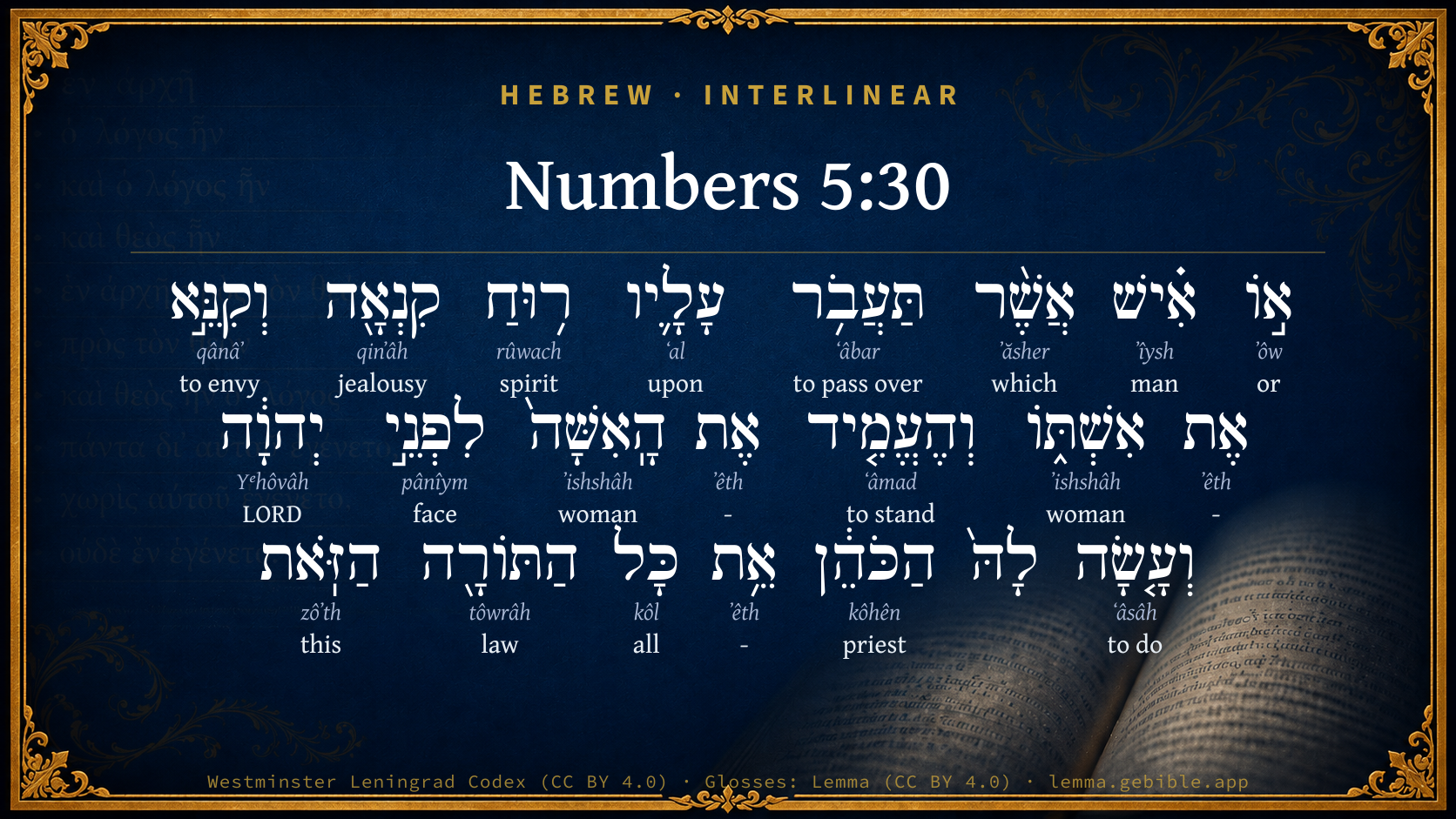
Numbers 5:30

Hebrew (Westminster Leningrad Codex) Numbers 5:30 appears in the Hebrew Old Testament. The text above is from the Westminster Leningrad Codex. Each word links to its Strong’s number, a concise gloss, and parsing drawn from the Open Scriptures Hebrew Bible morphology. Click any word for its full Brown-Driver-Briggs (BDB) entry.
Download image
Cite this verse

Numbers 5:30 (World English Bible). Public Domain. Lemma interlinear Bible study tool, https://lemma.gebible.app/v/numbers/5/30.

Show BibTeX & RIS
BibTeX
RIS
English Translation
or when the spirit of jealousy comes on a man, and he is jealous of his wife; then he shall set the woman before Yahweh, and the priest shall execute on her all this law.
World English Bible · Public Domain
Download a study sheet

One document with this verse’s original text, its word-by-word gloss line, the meaning frame, cross-references with their text, attributed commentary, and full source and license credits — printable, and it pastes into notes with its structure intact.

This verse Autodidact and up

Study sheet (.html) Plain text (.txt)

A passage Seminary Student

Up to 50 verses in one chapter. A passage sheet keeps up to 6 commentary sources and 12 cross-references per verse, in the order this page ranks them, and says so on the sheet whenever that leaves anything out. Ask for a single verse and you get the Autodidact verse sheet above.

Everything on this page stays free to read, with no account — the sheet is a download of what is already on screen, not access to it.

Want to remove ads? Support Godless Engineer
Compare translations 3

The same verse in 3 English versions, stacked beneath the original-language interlinear above. Click any original word for its lexicon entry.

Each is an independent rendering of the whole verse — the interlinear is not word-aligned to these translations.

Highlighted words mark where these versions differ — a whole-verse word diff, not a word-by-word alignment.

  • World English Bible Public Domain
    or when the spirit of jealousy comes on a man, and he is jealous of his wife; then he shall set the woman before Yahweh, and the priest shall execute on her all this law.
  • King James Version Public Domain
    Or when the spirit of jealousy cometh upon him, and he be jealous over his wife, and shall set the woman before the LORD, and the priest shall execute upon her all this law.
  • unfoldingWord Literal Text CC BY-SA 4.0
    or a man, when a spirit of jealousy passes over on him and he is jealous of his wife, then he shall stand the woman to the face of Yahweh, and the priest shall do all this law to her.

unfoldingWord Literal Text — © unfoldingWord, licensed CC BY-SA 4.0. Word-aligned USFM3 via Door43 (git.door43.org/unfoldingWord/en_ult).

Versions to compare (up to 4)

3 of 4 selected

Show all 18 translations

Every available English version of this verse, each an independent rendering of the whole verse.

  • World English Bible Public Domain
    or when the spirit of jealousy comes on a man, and he is jealous of his wife; then he shall set the woman before Yahweh, and the priest shall execute on her all this law.
  • Berean Standard Bible Public Domain
    or when a feeling of jealousy comes over a husband and he suspects his wife. He is to have the woman stand before the LORD, and the priest is to apply to her this entire law.
  • Majority Standard Bible Public Domain
    or when a feeling of jealousy comes over a husband and he suspects his wife. He is to have the woman stand before the LORD, and the priest is to apply to her this entire law.
  • King James Version Public Domain
    Or when the spirit of jealousy cometh upon him, and he be jealous over his wife, and shall set the woman before the LORD, and the priest shall execute upon her all this law.
  • American Standard Version (1901) Public Domain
    or when the spirit of jealousy cometh upon a man, and he is jealous of his wife; then shall he set the woman before Jehovah, and the priest shall execute upon her all this law.
  • Revised Version (1885) Public Domain
    or when the spirit of jealousy cometh upon a man, and he be jealous over his wife; then shall he set the woman before the LORD, and the priest shall execute upon her all this law.
  • Geneva Bible (1599) Public Domain
    Or when a man is moued with a ielous minde being ielous ouer his wife then shall he bring the woman before the Lord, and the Priest shall do to her according to al this lawe,
  • Douay-Rheims (1899) Public Domain
    And the husband stirred up by the spirit of jealousy bring her before the Lord, and the priest do to her according to all things that are here written:
  • Young's Literal Translation Public Domain
    or when a spirit of jealousy passeth over a man, and he hath been jealous of his wife, then he hath caused the woman to stand before Jehovah, and the priest hath done to her all this law,
  • Literal Standard Version CC BY-SA 4.0
    or when a spirit of jealousy passes over a man and he has been jealous of his wife, then he has caused the woman to stand before YHWH, and the priest has done to her all this law,
  • Unlocked Literal Bible CC BY-SA 4.0
    It is the law for a man with a spirit of jealousy when he is jealous of his wife. He must bring the woman before Yahweh, and the priest must do to her everything that this law of jealousy describes.
  • unfoldingWord Literal Text CC BY-SA 4.0
    or a man, when a spirit of jealousy passes over on him and he is jealous of his wife, then he shall stand the woman to the face of Yahweh, and the priest shall do all this law to her.
  • Darby Bible Public Domain
    or when the spirit of jealousy cometh upon a man, and he is jealous as regards his wife; then shall he set the woman before Jehovah, and the priest shall do to her according to all this law.
  • World Messianic Bible Public Domain
    or when the spirit of jealousy comes on a man, and he is jealous of his wife; then he shall set the woman before the LORD, and the priest shall execute on her all this law.
  • Webster's Bible Public Domain
    Or when the spirit of jealousy cometh upon him, and he is jealous over his wife, and shall set the woman before the LORD, and the priest shall execute upon her all this law.
  • Free Bible Version CC BY-SA 4.0
    or when a husband starts feeling jealous and becomes suspicious of his wife. He shall have his wife stand before the Lord, and the priest is to carry out every part of this rule.
  • Bible in Basic English Public Domain
    Or for a husband who, in a bitter spirit, has doubts in his heart about his wife; let him take her to the priest, who will put in force this law.
  • JPS Tanakh (1917) Public Domain
    or when the spirit of jealousy cometh upon a man, and he be jealous over his wife; then shall he set the woman before the LORD, and the priest shall execute upon her all this law.

Literal Standard Version (2020), Covenant Press — licensed CC BY-SA 4.0. Text via the HelloAO Bible API (eBible.org). Unlocked Literal Bible (unfoldingWord) — licensed CC BY-SA 4.0. Text via the HelloAO Bible API (eBible.org). unfoldingWord Literal Text — © unfoldingWord, licensed CC BY-SA 4.0. Word-aligned USFM3 via Door43 (git.door43.org/unfoldingWord/en_ult). Free Bible Version, Dr. Jonathan Gallagher — licensed CC BY-SA 4.0. Text via the HelloAO Bible API (eBible.org).

Word by word

More ways to search: Search by grammar → Find every occurrence → Compare this word →

Practice this passage: Drill this verse → Learn its vocabulary →

וְקִנֵּ֣א
qânâʼ
H7065
“and · to envy”
Conjunction + Verb, Piel, Sequential Perfect, 3rd Person, Masculine, Singular
Part of Speech
Conjunction + Verb
Stem
Piel
Form
Sequential Perfect
Person
3rd Person
Gender
Masculine
Number
Singular
Full BDB Definition

Origin: a primitive root

TWOT: 2038

to envy, be jealous, be envious, be zealous - (Piel) - to be jealous of - to be envious of - to be zealous for - to excite to jealous anger - (Hiphil) to provoke to jealous anger, cause jealousy
  1. א֣וֹ ʼôw H176 “or” Conjunction
  2. אִ֗ישׁ ʼîysh H376 “man” Noun, Common, Masculine, Singular, Absolute
  3. אֲשֶׁ֨ר ʼăsher H834 “which” Particle, Relative
  4. תַּעֲבֹ֥ר ʻâbar H5674 “to pass over” Verb, Qal, Imperfect, 3rd Person, Feminine, Singular
  5. עָלָ֛יו ʻal H5921 “upon · him” Preposition + Suffix, Personal, 3rd Person, Masculine, Singular
  6. ר֥וּחַ rûwach H7307 “spirit of” Noun, Common, Both, Singular, Construct
  7. קִנְאָ֖ה qinʼâh H7068 “jealousy” Noun, Common, Feminine, Singular, Absolute
  8. אֶת ʼêth H853 “-” Particle, Direct Object
  9. אִשְׁתּ֑וֹ ʼishshâh H802 “woman · his” Noun, Common, Feminine, Singular, Construct + Suffix, Personal, 3rd Person, Masculine, Singular
  10. וְהֶעֱמִ֤יד ʻâmad H5975 “and · to stand” Conjunction + Verb, Hiphil, Sequential Perfect, 3rd Person, Masculine, Singular
  11. אֶת ʼêth H853 “-” Particle, Direct Object
  12. הָֽאִשָּׁה֙ ʼishshâh H802 “the · woman” Particle, Definite Article + Noun, Common, Feminine, Singular, Absolute
  13. לִפְנֵ֣י pânîym H6440 “to/for · face(s) of” Preposition + Noun, Common, Both, Plural, Construct
  14. יְהוָ֔ה Yᵉhôvâh H3068 “LORD” Noun, Proper
  15. וְעָ֤שָׂה ʻâsâh H6213 “and · to do” Conjunction + Verb, Qal, Sequential Perfect, 3rd Person, Masculine, Singular
  16. הַכֹּהֵ֔ן kôhên H3548 “the · priest” Particle, Definite Article + Noun, Common, Masculine, Singular, Absolute
  17. אֵ֥ת ʼêth H853 “-” Particle, Direct Object
  18. כָּל kôl H3605 “all of” Noun, Common, Masculine, Singular, Construct
  19. הַתּוֹרָ֖ה tôwrâh H8451 “the · law” Particle, Definite Article + Noun, Common, Feminine, Singular, Absolute
  20. הַזֹּֽאת zôʼth H2063 “the · this” Particle, Definite Article + Pronoun, Demonstrative, Feminine, Singular

About this verse

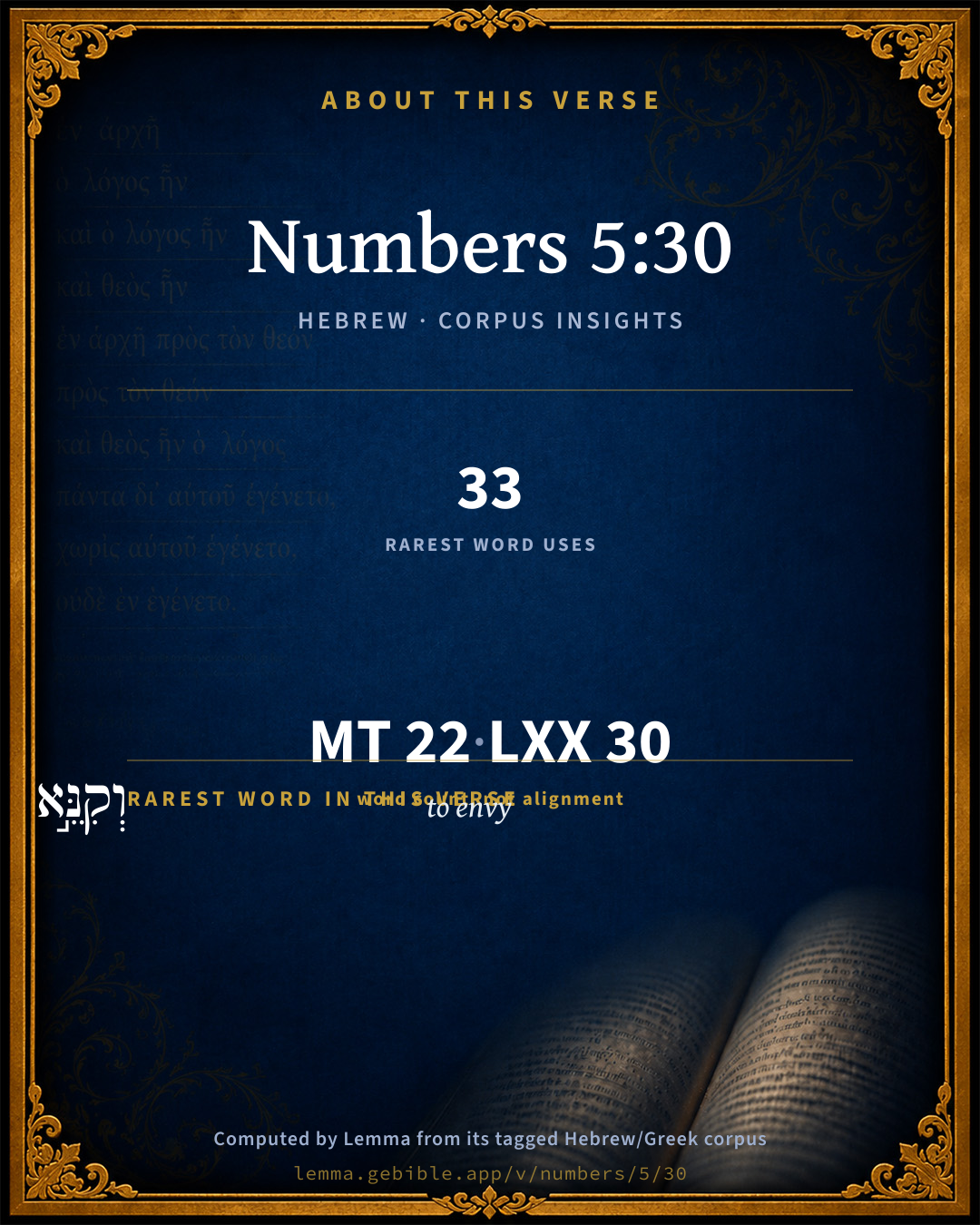
These counts appear in no published source. They are computed here, from the morphology-tagged text and Lemma’s own curated glosses. What Lemma adds →

22
words
18
distinct lemmas
Pentateuch
section

Shared distinctive vocabulary

וְקִנֵּ֣א to envy H7065 occurs in 28 verses of the Hebrew Bible. Also found in:

Grammatical profile

  • 4 verbs
  • 10 nouns
  • 1 pronoun
  • 2 prepositions
  • 1 conjunction
  • 4 particles

Verb forms

  • תַּעֲבֹ֥ר Qal · Imperfect
  • וְקִנֵּ֣א Piel · Sequential Perfect
  • וְהֶעֱמִ֤יד Hiphil · Sequential Perfect
  • וְעָ֤שָׂה Qal · Sequential Perfect

Repetition

A word recurs within this verse — often emphatic in Hebrew:

  • אִשְׁתּ֑וֹ woman H802 ×2

Hebrew & Septuagint length

In English translation the verse runs 35 words from the Hebrew and 42 from the Septuagint (LXX English) — closely comparable.

A rough comparison of the two English renderings, which tokenize alike — not a word-level alignment.

Word counts can differ between the Hebrew and the Greek without any difference in meaning — e.g. the Hebrew direct-object marker אֵת has no separate Greek word, and Greek often adds the article ὁ.

In the original languages it is 22 Hebrew tokens and 30 Greek tokens — but the two are counted differently (Hebrew bundles its prefixes and suffixes into one token; the Greek is in lemma form), so that isn’t a like-for-like length.

Hebrew and Greek witnesses Masoretic Hebrew ↔ Greek Septuagint

The same verse in the two great witnesses to the Old Testament, shown verse-for-verse.

These are two independent witnesses, not word-aligned to each other, and the Septuagint is shown in lemma (dictionary) form.

Hebrew Numbers 5:30 Masoretic · Westminster Leningrad Codex

א֣וֹ אִ֗ישׁ אֲשֶׁ֨ר תַּעֲבֹ֥ר עָלָ֛יו ר֥וּחַ קִנְאָ֖ה וְקִנֵּ֣א אֶת אִשְׁתּ֑וֹ וְהֶעֱמִ֤יד אֶת הָֽאִשָּׁה֙ לִפְנֵ֣י יְהוָ֔ה וְעָ֤שָׂה לָהּ֙ הַכֹּהֵ֔ן אֵ֥ת כָּל הַתּוֹרָ֖ה הַזֹּֽאת

or when the spirit of jealousy comes on a man, and he is jealous of his wife; then he shall set the woman before Yahweh, and the priest shall execute on her all this law.

World English Bible · Public Domain

Greek LXX Numbers 5:30 Septuagint · lemma form

ἤ ἄνθρωπος ὅς ἐάν ἐπιἔρχομαι ἐπί αὐτός πνεῦμα ζηλώσις καί ζηλόω ὁ γυνή αὐτός καί ἵστημι ὁ γυνή αὐτός ἔναντι κύριος καί ποιέω αὐτός ὁ ἱερεύς πᾶς ὁ νόμος οὗτος

or in the case of a man on whoever the spirit of jealousy should come, and he should be jealous of his wife, and he should place his wife before the Lord, and the priest shall execute towards her all this law.

LXX2012 (modern English Septuagint) · Public Domain

Hebrew: Westminster Leningrad Codex (CC BY 4.0). Greek: Septuagint (public domain); English from LXX2012 (modern English Septuagint) (Public Domain). How the Septuagint differs from the Hebrew →

Targum (Aramaic paraphrase)

2

The Targum is the ancient Jewish Aramaic paraphrase of the Hebrew Scriptures — an interpretive translation, not the Hebrew text itself. Onkelos (literal) and Pseudo-Jonathan (expansive) render the Torah, and Jonathan the Prophets. Coverage is partial: where no permissively-licensed English translation exists for a verse, only the Aramaic is shown. This is verse-level text, not a word-by-word alignment to the Hebrew.

  1. Targum Onkelos Torah (Genesis–Deuteronomy)
    אוֹ גְבַר דִי תֶעְבַּר עֲלוֹהִי רוּחַ קִנְאָה וִיקַנֵי יָת אִתְּתֵהּ וִיקֵם יָת אִתְּתָא קֳדָם יְיָ וְיַעֲבֵד לַהּ כַּהֲנָא יָת כָּל אוֹרַיְתָא הָדָא

    (no public-domain English translation for this verse)

    Targum Onkelos — Aramaic: “Onkelos Genesis” (public domain); “Onkelos Exodus” (public domain); “Onkelos Leviticus” (public domain); “Onkelos Numbers” (public domain); “Onkelos Deuteronomy” (public domain). English: “Sefaria Community Translation” (CC0 1.0 (public-domain dedication)); “J.W. Etheridge. The Targums of Onkelos and Jonathan Ben Uzziel on the Pentateuch. London: Longmans, Green, 1862” (public domain). Text via Sefaria.

  2. Targum Pseudo-Jonathan Torah (Genesis–Deuteronomy)
    אוֹ גְבַר דְיִתְעַבָּר עֲלוֹי רוּחַ קִנְאֵיתָא וִיקַנֵי יַת אִתְּתֵיהּ וְיָקִים יַת אִיתְּתָא קֳדָם יְיָ וִיעַבַּד לָהּ כַּהֲנָא יַת כָּל אוֹרַיְתָא הֲדָא

    or when the spirit of jealousy cometh upon a man, that he be so jealous of his wife as to make her stand before the Lord, then shall the priest perform all this law.

    Targum Pseudo-Jonathan — Aramaic: “Targum Jonathan on Genesis” (public domain); “Targum Jonathan on Exodus” (public domain); “Targum Jonathan on Leviticus” (public domain); “Targum Jonathan on Numbers” (public domain); “Targum Jonathan on Deuteronomy” (public domain). English: “The Targum of Jonathan ben Uzziel, trans. J. W. Etheridge, London, 1862” (public domain). Text via Sefaria.

Commentary

Notes on Numbers 5:30 from classic Christian and Jewish commentators (each source and its license shown beneath its notes). The classic Christian expositions comment on the surrounding passage and are grouped to its opening verse, so a note may address several verses; the Jewish commentaries on the Tanakh (Rashi and others) are per-verse, so they appear only where the commentator wrote on this verse.

Lemma curates 59 commentaries, every one of them public domain or Creative Commons licensed, each selected and text-cleaned for this edition rather than reprinted as found. About our sources →

John Gill's Exposition

Or when the spirit of jealousy cometh upon him, and he be jealous over his wife,.... See Gill on Num 5:14,

and shall set the woman before the Lord; has carried the matter so far as to bring his wife to the priest or civil magistrate, and declare his suspicion, and the ground of it:

and the priest shall execute upon her all this law; he shall proceed according to the law, and perform every rite and ceremony required; nor could any stop be put to it, unless the woman owned she was defiled.

John Gill's Exposition of the Whole Bible (1746–1763) — public domain (CC PDM 1.0). Text via the HelloAO Bible API.

Rashi

Rabbi Shlomo Yitzchaki (Rashi)

או איש — The word או here has the same meaning as in the phrase (Exodus 21:36): או נודע, “If it be known” (cf. Rashi on that verse and our Note thereon) — that is to say: if the man is a jealous man, then just on account of this, he shall present the woman [before the Lord and then the priest shall execute upon her all this law].”

Rashi on the Tanakh — English translations: “The Judaica Press complete Tanach with Rashi, translated by A. J. Rosenberg” (CC BY 4.0); “Pentateuch with Rashi's commentary by M. Rosenbaum and A.M. Silbermann, 1929-1934” (public domain); “The Metsudah Tanach series, Lakewood, N.J” (CC BY 4.0); and “The Book of Joshua, Metsudah Publications, 1997” (CC BY 4.0). Text via Sefaria.

Lesson kit

Teaching starters — assembled from the data on this page, not authored interpretation. Every prompt links to the verse data it draws on. Edit before teaching.

Numbers, in the Pentateuch, opens this verse with 22 words (18 distinct Hebrew lemmas). Its most distinctive word is qânâʼ (“to envy”). A historical commentator’s framing appears above. Read the whole chapter for the surrounding context.

Discussion questions

  1. How does “to envy” (qânâʼ) shape what this verse is saying?
  2. Genesis 26:14 shares the word «to envy» with this verse. How do the two illuminate each other?
  3. “woman” occurs 2× in this one verse. What is the effect of the repetition?
  4. These translations render this verse differently; the difference is in the English rendering, not the original. What questions does that raise?
  5. The verb «תַּעֲבֹ֥ר» is Qal Imperfect. How does its form color the action?
  6. Reading how John Gill's Exposition and Rashi read this verse, where do the two commentators agree and where do they part?

Things to notice

Reading settings

Reading text

Shown beneath each verse's original-language words.

Old Testament
Old Testament edition

Read the OT as the Masoretic Hebrew (MT) or the Greek Septuagint (LXX).

English shown for the Greek Septuagint (in the Hebrew ↔ Greek comparison).

Comparing translations? Open the Compare panel on any verse page to stack up to four side by side.