Joshua 19:48

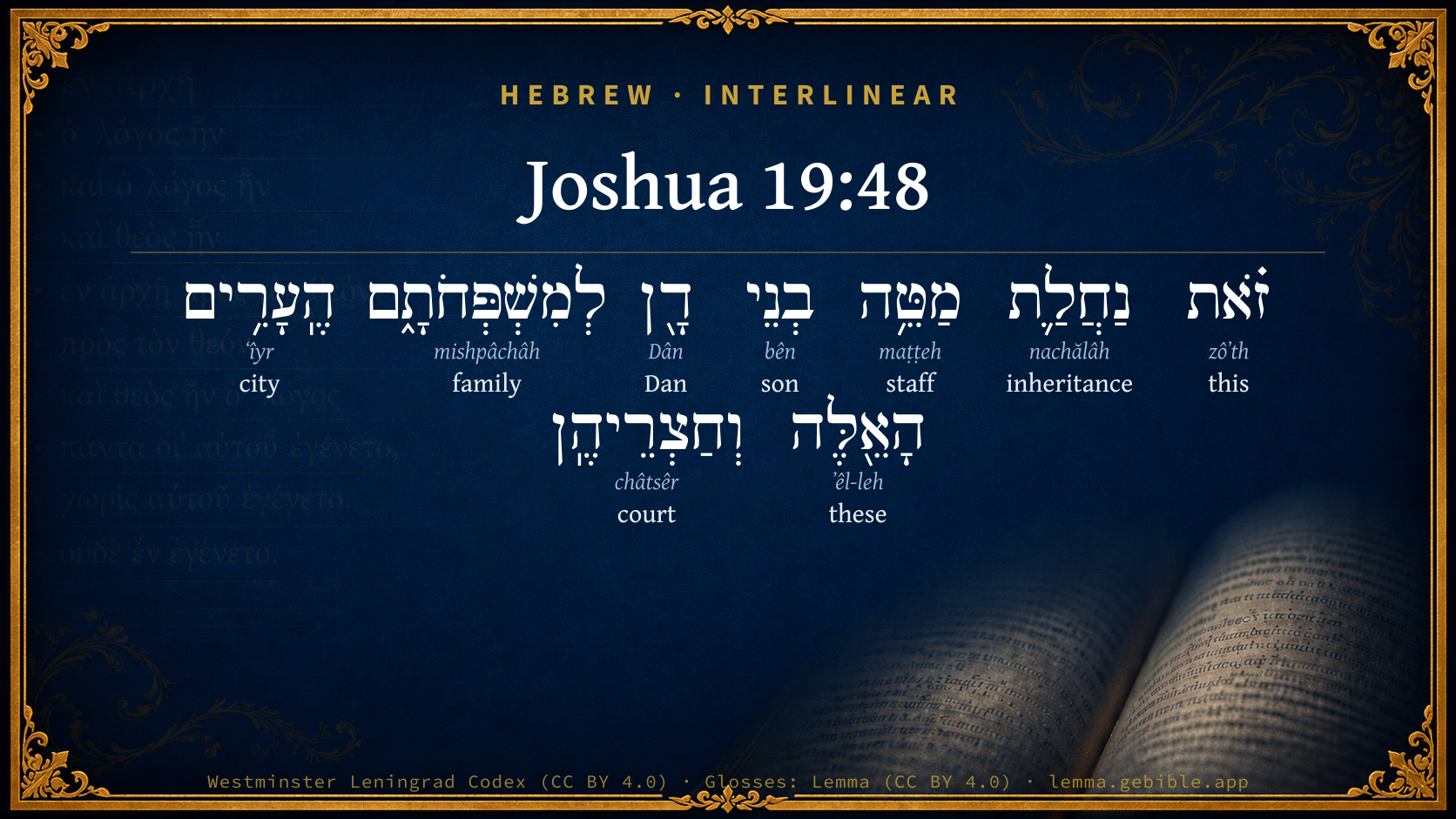
Hebrew (Westminster Leningrad Codex) Joshua 19:48 appears in the Hebrew Old Testament. The text above is from the Westminster Leningrad Codex. Each word links to its Strong’s number, a concise gloss, and parsing drawn from the Open Scriptures Hebrew Bible morphology. Click any word for its full Brown-Driver-Briggs (BDB) entry.
Download image
Cite this verse

Joshua 19:48 (World English Bible). Public Domain. Lemma interlinear Bible study tool, https://lemma.gebible.app/v/joshua/19/48.

Show BibTeX & RIS
BibTeX
RIS
English Translation
This is the inheritance of the tribe of the children of Dan according to their families, these cities with their villages.
World English Bible · Public Domain
Download a study sheet

One document with this verse’s original text, its word-by-word gloss line, the meaning frame, cross-references with their text, attributed commentary, and full source and license credits — printable, and it pastes into notes with its structure intact.

This verse Autodidact and up

Study sheet (.html) Plain text (.txt)

A passage Seminary Student

Up to 50 verses in one chapter. A passage sheet keeps up to 6 commentary sources and 12 cross-references per verse, in the order this page ranks them, and says so on the sheet whenever that leaves anything out. Ask for a single verse and you get the Autodidact verse sheet above.

Everything on this page stays free to read, with no account — the sheet is a download of what is already on screen, not access to it.

Want to remove ads? Support Godless Engineer
Compare translations 3

The same verse in 3 English versions, stacked beneath the original-language interlinear above. Click any original word for its lexicon entry.

Each is an independent rendering of the whole verse — the interlinear is not word-aligned to these translations.

Highlighted words mark where these versions differ — a whole-verse word diff, not a word-by-word alignment.

  • World English Bible Public Domain
    This is the inheritance of the tribe of the children of Dan according to their families, these cities with their villages.
  • King James Version Public Domain
    This is the inheritance of the tribe of the children of Dan according to their families, these cities with their villages.
  • unfoldingWord Literal Text CC BY-SA 4.0
    This the inheritance of the tribe of the sons of Dan according to their clans, these cities and their villages.

unfoldingWord Literal Text — © unfoldingWord, licensed CC BY-SA 4.0. Word-aligned USFM3 via Door43 (git.door43.org/unfoldingWord/en_ult).

Versions to compare (up to 4)

3 of 4 selected

Show all 18 translations

Every available English version of this verse, each an independent rendering of the whole verse.

  • World English Bible Public Domain
    This is the inheritance of the tribe of the children of Dan according to their families, these cities with their villages.
  • Berean Standard Bible Public Domain
    This was the inheritance of the clans of the tribe of Dan, including these cities and their villages.
  • Majority Standard Bible Public Domain
    This was the inheritance of the clans of the tribe of Dan, including these cities and their villages.
  • King James Version Public Domain
    This is the inheritance of the tribe of the children of Dan according to their families, these cities with their villages.
  • American Standard Version (1901) Public Domain
    This is the inheritance of the tribe of the children of Dan according to their families, these cities with their villages.
  • Revised Version (1885) Public Domain
    This is the inheritance of the tribe of the children of Dan according to their families, these cities with their villages.
  • Geneva Bible (1599) Public Domain
    This is the inheritance of the tribe of the childre of Dan according to their families: that is, these cities and their villages.
  • Douay-Rheims (1899) Public Domain
    This is the possession of the tribe of the sons of Dan, by their kindreds, the cities and their villages.
  • Young's Literal Translation Public Domain
    This `is' the inheritance of the tribe of the sons of Dan, for their families, these cities and their villages.
  • Literal Standard Version CC BY-SA 4.0
    This [is] the inheritance of the tribe of the sons of Dan, for their families, these cities and their villages.
  • Unlocked Literal Bible CC BY-SA 4.0
    This was the inheritance of the tribe of Dan, clan by clan—the cities, including their villages.
  • unfoldingWord Literal Text CC BY-SA 4.0
    This the inheritance of the tribe of the sons of Dan according to their clans, these cities and their villages.
  • Darby Bible Public Domain
    This was the inheritance of the tribe of the children of Dan according to their families, these cities and their hamlets.
  • World Messianic Bible Public Domain
    This is the inheritance of the tribe of the children of Dan according to their families, these cities with their villages.
  • Webster's Bible Public Domain
    This is the inheritance of the tribe of the children of Dan according to their families, these cities with their villages.
  • Free Bible Version CC BY-SA 4.0
    This was the allocation—the land, towns, and villages—given to the tribe of Dan, by families.
  • Bible in Basic English Public Domain
    This is the heritage of the tribe of the children of Dan by their families, these towns with their unwalled places.
  • JPS Tanakh (1917) Public Domain
    This is the inheritance of the tribe of the children of Dan according to their families, these cities with their villages.

Literal Standard Version (2020), Covenant Press — licensed CC BY-SA 4.0. Text via the HelloAO Bible API (eBible.org). Unlocked Literal Bible (unfoldingWord) — licensed CC BY-SA 4.0. Text via the HelloAO Bible API (eBible.org). unfoldingWord Literal Text — © unfoldingWord, licensed CC BY-SA 4.0. Word-aligned USFM3 via Door43 (git.door43.org/unfoldingWord/en_ult). Free Bible Version, Dr. Jonathan Gallagher — licensed CC BY-SA 4.0. Text via the HelloAO Bible API (eBible.org).

Word by word

More ways to search: Search by grammar → Find every occurrence → Compare this word →

Practice this passage: Drill this verse → Learn its vocabulary →

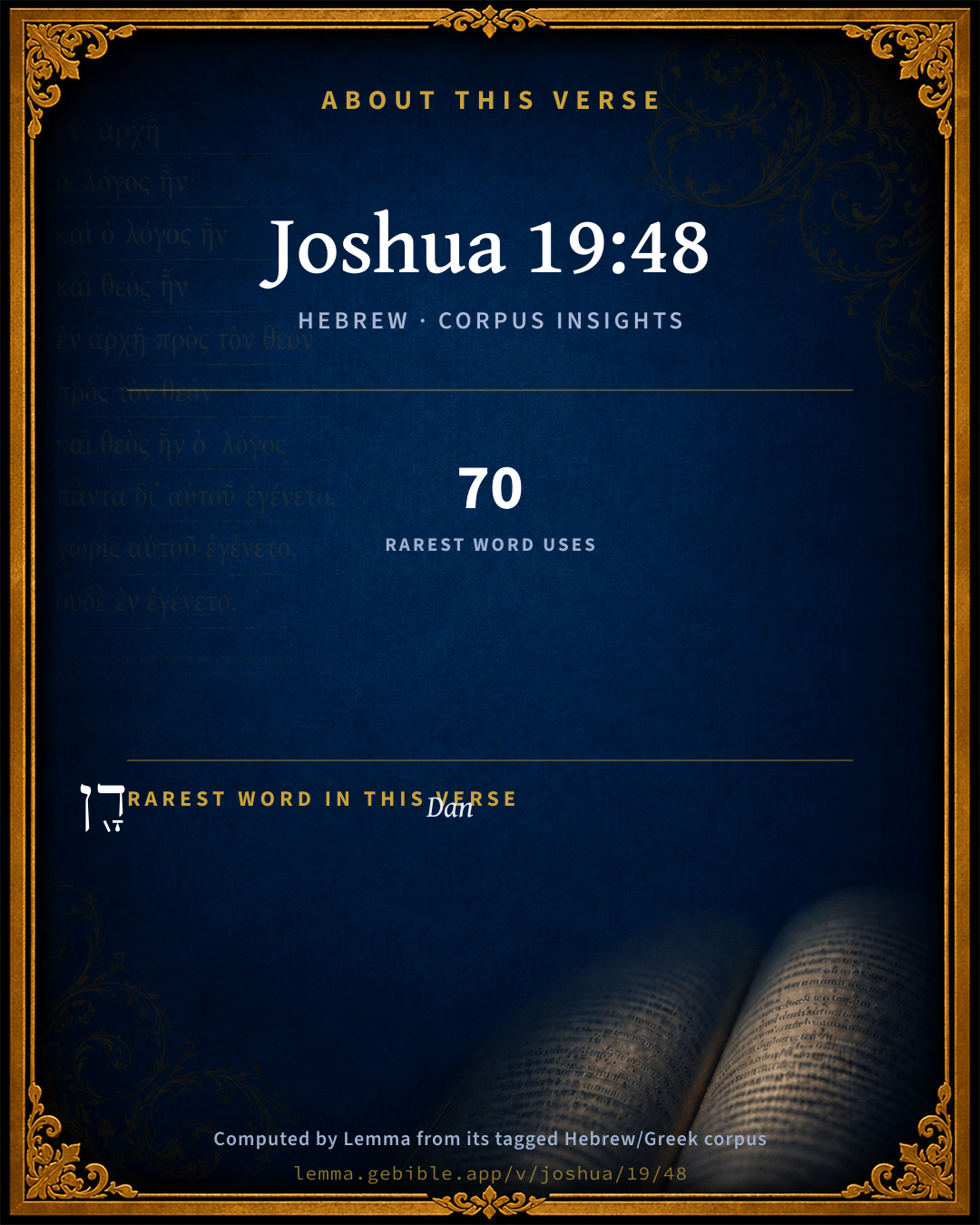
דָ֖ן
Dân
H1835
“Dan”
Noun, Proper
Part of Speech
Noun
Type
Proper
Full BDB Definition

Origin: from H1777

TWOT: None

Dan = "a judge" - the 5th son of Jacob, the 1st of Bilhah, Rachel's handmaid (noun proper masculine) - the tribe descended from Dan, the son of Jacob (noun proper masculine) - a city in Dan, the most northern landmark of Palestine (noun proper locative)
  1. זֹ֗את zôʼth H2063 “this” Pronoun, Demonstrative, Feminine, Singular
  2. נַחֲלַ֛ת nachălâh H5159 “inheritance of” Noun, Common, Feminine, Singular, Construct
  3. מַטֵּ֥ה maṭṭeh H4294 “staff of” Noun, Common, Masculine, Singular, Construct
  4. בְנֵי bên H1121 “sons of” Noun, Common, Masculine, Plural, Construct
  5. לְמִשְׁפְּחֹתָ֑ם mishpâchâh H4940 “to/for · families · their” Preposition + Noun, Common, Feminine, Plural, Construct + Suffix, Personal, 3rd Person, Masculine, Plural
  6. הֶֽעָרִ֥ים ʻîyr H5892 “the · cities” Particle, Definite Article + Noun, Common, Feminine, Plural, Absolute
  7. הָאֵ֖לֶּה ʼêl-leh H428 “the · these” Particle, Definite Article + Pronoun, Demonstrative, Common, Plural
  8. וְחַצְרֵיהֶֽן châtsêr H2691 “and · courts · their” Conjunction + Noun, Common, Both, Plural, Construct + Suffix, Personal, 3rd Person, Feminine, Plural

About this verse

These counts appear in no published source. They are computed here, from the morphology-tagged text and Lemma’s own curated glosses. What Lemma adds →

9
words
9
distinct lemmas
Historical
section

Grammatical profile

  • 7 nouns
  • 2 pronouns

Hebrew & Septuagint length

In English translation the verse runs 21 words from the Hebrew and 59 from the Septuagint (LXX English) — the Septuagint runs noticeably longer here. See the side-by-side →

A rough comparison of the two English renderings, which tokenize alike — not a word-level alignment.

Word counts can differ between the Hebrew and the Greek without any difference in meaning — e.g. the Hebrew direct-object marker אֵת has no separate Greek word, and Greek often adds the article ὁ.

Hebrew and Greek witnesses Masoretic Hebrew ↔ Greek Septuagint

The same verse in the two great witnesses to the Old Testament, shown verse-for-verse.

Here the Septuagint runs noticeably longer than the Hebrew — LXX2012 (modern English Septuagint) 59 words vs World English Bible 21. A rough length comparison of the two English translations, not a word-level alignment — read both below.

These are two independent witnesses, not word-aligned to each other, and the Septuagint is shown in lemma (dictionary) form.

Hebrew Joshua 19:48 Masoretic · Westminster Leningrad Codex

זֹ֗את נַחֲלַ֛ת מַטֵּ֥ה בְנֵי דָ֖ן לְמִשְׁפְּחֹתָ֑ם הֶֽעָרִ֥ים הָאֵ֖לֶּה וְחַצְרֵיהֶֽן

This is the inheritance of the tribe of the children of Dan according to their families, these cities with their villages.

World English Bible · Public Domain

Greek LXX Joshua 19:48 Septuagint · lemma form

καί πορεύομαι ὁ υἱός ιουδα καί πολεμέω ὁ λαχις καί καταλαμβάνω αὐτός καί πατάσσω αὐτός ἐν στόμα μάχαιρα καί καταοἰκέω αὐτός καί καλέω ὁ ὄνομα αὐτός λασενδακ καί ὁ ἀμορραῖος ὑπομένω ὁ καταοἰκέω ἐν ελωμ καί ἐν σαλαμιν καί βαρύνω ὁ χείρ ὁ ἐφράιμ ἐπί αὐτός καί γίγνομαι αὐτός εἰς φόρος

And the sons of Dan went and fought against Lachis, and took it, and struck it with the edge of the sword; and they lived in it, and called the name of it Lasendan: and the Amorite continued to dwell in Edom and in Salamin: and the hand of Ephraim prevailed against them, and they became tribute to them.

LXX2012 (modern English Septuagint) · Public Domain

Hebrew: Westminster Leningrad Codex (CC BY 4.0). Greek: Septuagint (public domain); English from LXX2012 (modern English Septuagint) (Public Domain). How the Septuagint differs from the Hebrew →

Targum (Aramaic paraphrase)

1

The Targum is the ancient Jewish Aramaic paraphrase of the Hebrew Scriptures — an interpretive translation, not the Hebrew text itself. Onkelos (literal) and Pseudo-Jonathan (expansive) render the Torah, and Jonathan the Prophets. Coverage is partial: where no permissively-licensed English translation exists for a verse, only the Aramaic is shown. This is verse-level text, not a word-by-word alignment to the Hebrew.

  1. Targum Jonathan Prophets (Joshua–Malachi)
    דָא אַחֲסָנַת שַׁבְטָא דִבְנֵי דָן לְזַרְעֲיַתְהוֹן קִרְוַיָא הָאִלֵין וּפַצְחֵיהֶן:

    (no public-domain English translation for this verse)

    Targum Jonathan — Aramaic: “Mikraot Gedolot” (public domain). English: “Sefaria Community Translation” (CC0 1.0 (public-domain dedication)); “London "Chaldee Paraphrase," 1871” (public domain). Text via Sefaria.

Commentary

Notes on Joshua 19:48 from classic Christian and Jewish commentators (each source and its license shown beneath its notes). The classic Christian expositions comment on the surrounding passage and are grouped to its opening verse, so a note may address several verses; the Jewish commentaries on the Tanakh (Rashi and others) are per-verse, so they appear only where the commentator wrote on this verse.

Lemma curates 59 commentaries, every one of them public domain or Creative Commons licensed, each selected and text-cleaned for this edition rather than reprinted as found. About our sources →

The Cambridge Bible for Schools and Colleges

gen. ed. J. J. S. Perowne

48. This is the inheritance of the tribe … of Dan] In length it extends but 14 miles from Joppa to Ekron, but it was one of the most fertile tracts in the land, the cornfield and garden of southern Palestine. The dying Jacob had said of the tribe (Gen_49:16):

“Dan shall judge his people,

As one of the tribes of Israel.

Dan shall be a serpent by the way,

An adder in the path,

That biteth the horse heels,

So that his rider shall fall backward;”

and, as it has been observed, “the privilege of Dan was, that he was to lie in wait for the invader from the south or from the north.” “A serpent,” an indigenous, home-born “adder,” to bite the heels of the invading stranger’s horse; “a lion’s whelp” (Deu_33:22), small and fierce, to “leap from the heights of Bashan,” on the armies of Damascus or Nineveh. “For thy salvation, O Lord, have I waited” seems to have been his war cry, as if of a warrior in the constant attitude of expectation. Once only in the history of the tribe, so far as we know, was this expectation fully realised—in the life of Samson. Stanley’s Lectures, i. p. 269.

The Cambridge Bible for Schools and Colleges (gen. ed. J. J. S. Perowne; Cambridge University Press, 1878–1918) — public domain. Text from a community e-Sword module.

John Gill's Exposition

And when they made an end of dividing the land for inheritance by their coasts,.... That is, Eleazar, Joshua, and the ten men appointed for this, purpose; when all the lots were drawn, and the several inheritances which came up to them were divided among the families of the respective tribes, this work being finished:

the children of Israel gave an inheritance to Joshua the son of Nun among them; most interpreters observe the modesty of Joshua, that though the oldest and the greatest man in the nation, the chief governor, yet had his inheritance last of all; nor did he take any part to himself, it was given to him by the people, who had the whole land divided among them; in which he was a type of Christ; see Co2 8:9 Phi 2:6.

John Gill's Exposition of the Whole Bible (1746–1763) — public domain (CC PDM 1.0). Text via the HelloAO Bible API.

The Pulpit Commentary

This is the inheritance of the children of Dan. We read little of Dan in the after history of Israel. Samson is the only hero this tribe produced, and his exploits were limited to a very narrow area, and his influence apparently to his own tribe.

The Pulpit Commentary (1880–1919), ed. H.D.M. Spence-Jones & Joseph S. Exell — public domain. Text from a community e-Sword module.

Lesson kit

Teaching starters — assembled from the data on this page, not authored interpretation. Every prompt links to the verse data it draws on. Edit before teaching.

Joshua, in the Historical, opens this verse with 9 words (9 distinct Hebrew lemmas). Its most distinctive word is Dân (“Dan”). The Greek Septuagint runs longer here. A historical commentator’s framing appears above. Read the whole chapter for the surrounding context.

Discussion questions

  1. What does “Dan” (Dân) contribute to the verse as a whole?
  2. Compared with the Hebrew, the Septuagint runs longer here. What questions does that raise?
  3. The translations on this page render this verse differently — a whole-verse word diff, not a word-by-word alignment. What might account for the different wordings?
  4. Reading how The Cambridge Bible for Schools and Colleges and John Gill's Exposition read this verse, where do the two commentators agree and where do they part?

Things to notice

Reading settings

Reading text

Shown beneath each verse's original-language words.

Old Testament
Old Testament edition

Read the OT as the Masoretic Hebrew (MT) or the Greek Septuagint (LXX).

English shown for the Greek Septuagint (in the Hebrew ↔ Greek comparison).

Comparing translations? Open the Compare panel on any verse page to stack up to four side by side.