Exodus 12:43

Hebrew (Westminster Leningrad Codex) Exodus 12:43 appears in the Hebrew Old Testament. The text above is from the Westminster Leningrad Codex. Each word links to its Strong’s number, a concise gloss, and parsing drawn from the Open Scriptures Hebrew Bible morphology. Click any word for its full Brown-Driver-Briggs (BDB) entry.
Download image
Cite this verse

Exodus 12:43 (World English Bible). Public Domain. Lemma interlinear Bible study tool, https://lemma.gebible.app/v/exodus/12/43.

Show BibTeX & RIS
BibTeX
RIS
English Translation
Yahweh said to Moses and Aaron, "This is the ordinance of the Passover. There shall no foreigner eat of it,
World English Bible · Public Domain
Download a study sheet

One document with this verse’s original text, its word-by-word gloss line, the meaning frame, cross-references with their text, attributed commentary, and full source and license credits — printable, and it pastes into notes with its structure intact.

This verse Autodidact and up

Study sheet (.html) Plain text (.txt)

A passage Seminary Student

Up to 50 verses in one chapter. A passage sheet keeps up to 6 commentary sources and 12 cross-references per verse, in the order this page ranks them, and says so on the sheet whenever that leaves anything out. Ask for a single verse and you get the Autodidact verse sheet above.

Everything on this page stays free to read, with no account — the sheet is a download of what is already on screen, not access to it.

Want to remove ads? Support Godless Engineer
Compare translations 3

The same verse in 3 English versions, stacked beneath the original-language interlinear above. Click any original word for its lexicon entry.

Each is an independent rendering of the whole verse — the interlinear is not word-aligned to these translations.

Highlighted words mark where these versions differ — a whole-verse word diff, not a word-by-word alignment.

  • World English Bible Public Domain
    Yahweh said to Moses and Aaron, "This is the ordinance of the Passover. There shall no foreigner eat of it,
  • King James Version Public Domain
    And the LORD said unto Moses and Aaron, This is the ordinance of the passover: There shall no stranger eat thereof:
  • unfoldingWord Literal Text CC BY-SA 4.0
    And Yahweh said to Moses and Aaron, “This is the statute of the Passover: Any son of foreignness shall not eat it.

unfoldingWord Literal Text — © unfoldingWord, licensed CC BY-SA 4.0. Word-aligned USFM3 via Door43 (git.door43.org/unfoldingWord/en_ult).

Versions to compare (up to 4)

3 of 4 selected

Show all 18 translations

Every available English version of this verse, each an independent rendering of the whole verse.

  • World English Bible Public Domain
    Yahweh said to Moses and Aaron, "This is the ordinance of the Passover. There shall no foreigner eat of it,
  • Berean Standard Bible Public Domain
    And the LORD said to Moses and Aaron, “This is the statute of the Passover: No foreigner is to eat of it.
  • Majority Standard Bible Public Domain
    And the LORD said to Moses and Aaron, “This is the statute of the Passover: No foreigner is to eat of it.
  • King James Version Public Domain
    And the LORD said unto Moses and Aaron, This is the ordinance of the passover: There shall no stranger eat thereof:
  • American Standard Version (1901) Public Domain
    And Jehovah said unto Moses and Aaron, This is the ordinance of the passover: there shall no foreigner eat thereof;
  • Revised Version (1885) Public Domain
    And the LORD said unto Moses and Aaron, This is the ordinance of the passover: there shall no alien eat thereof:
  • Geneva Bible (1599) Public Domain
    Also the Lord said vnto Moses and Aaron, This is the Lawe of the Passeouer: no stranger shall eate thereof.
  • Douay-Rheims (1899) Public Domain
    And the Lord said to Moses and Aaron: This is the service of the Phase: No foreigner shall eat of it.
  • Young's Literal Translation Public Domain
    And Jehovah saith unto Moses and Aaron, `This `is' a statute of the passover; Any son of a stranger doth not eat of it;
  • Literal Standard Version CC BY-SA 4.0
    And YHWH says to Moses and Aaron, “This [is] a statute of the Passover; any son of a stranger does not eat of it;
  • Unlocked Literal Bible CC BY-SA 4.0
    Yahweh said to Moses and Aaron, “Here is the rule for the Passover: No foreigner may share in eating it.
  • unfoldingWord Literal Text CC BY-SA 4.0
    And Yahweh said to Moses and Aaron, “This is the statute of the Passover: Any son of foreignness shall not eat it.
  • Darby Bible Public Domain
    And Jehovah said to Moses and Aaron, This is the ordinance of the passover: No stranger shall eat of it;
  • World Messianic Bible Public Domain
    The LORD said to Moses and Aaron, “This is the ordinance of the Passover. No foreigner shall eat of it,
  • Webster's Bible Public Domain
    And the LORD said to Moses and Aaron, This is the ordinance of the passover: there shall no stranger eat of it.
  • Free Bible Version CC BY-SA 4.0
    The Lord told Moses and Aaron, “This is the Passover ceremony. No foreigner is allowed to eat it.
  • Bible in Basic English Public Domain
    And the Lord said to Moses and Aaron, This is the law of the Passover: no man who is not an Israelite is to take of it:
  • JPS Tanakh (1917) Public Domain
    And the LORD said unto Moses and Aaron: 'This is the ordinance of the passover: there shall no alien eat thereof;

Literal Standard Version (2020), Covenant Press — licensed CC BY-SA 4.0. Text via the HelloAO Bible API (eBible.org). Unlocked Literal Bible (unfoldingWord) — licensed CC BY-SA 4.0. Text via the HelloAO Bible API (eBible.org). unfoldingWord Literal Text — © unfoldingWord, licensed CC BY-SA 4.0. Word-aligned USFM3 via Door43 (git.door43.org/unfoldingWord/en_ult). Free Bible Version, Dr. Jonathan Gallagher — licensed CC BY-SA 4.0. Text via the HelloAO Bible API (eBible.org).

Word by word

More ways to search: Search by grammar → Find every occurrence → Compare this word →

Practice this passage: Drill this verse → Learn its vocabulary →

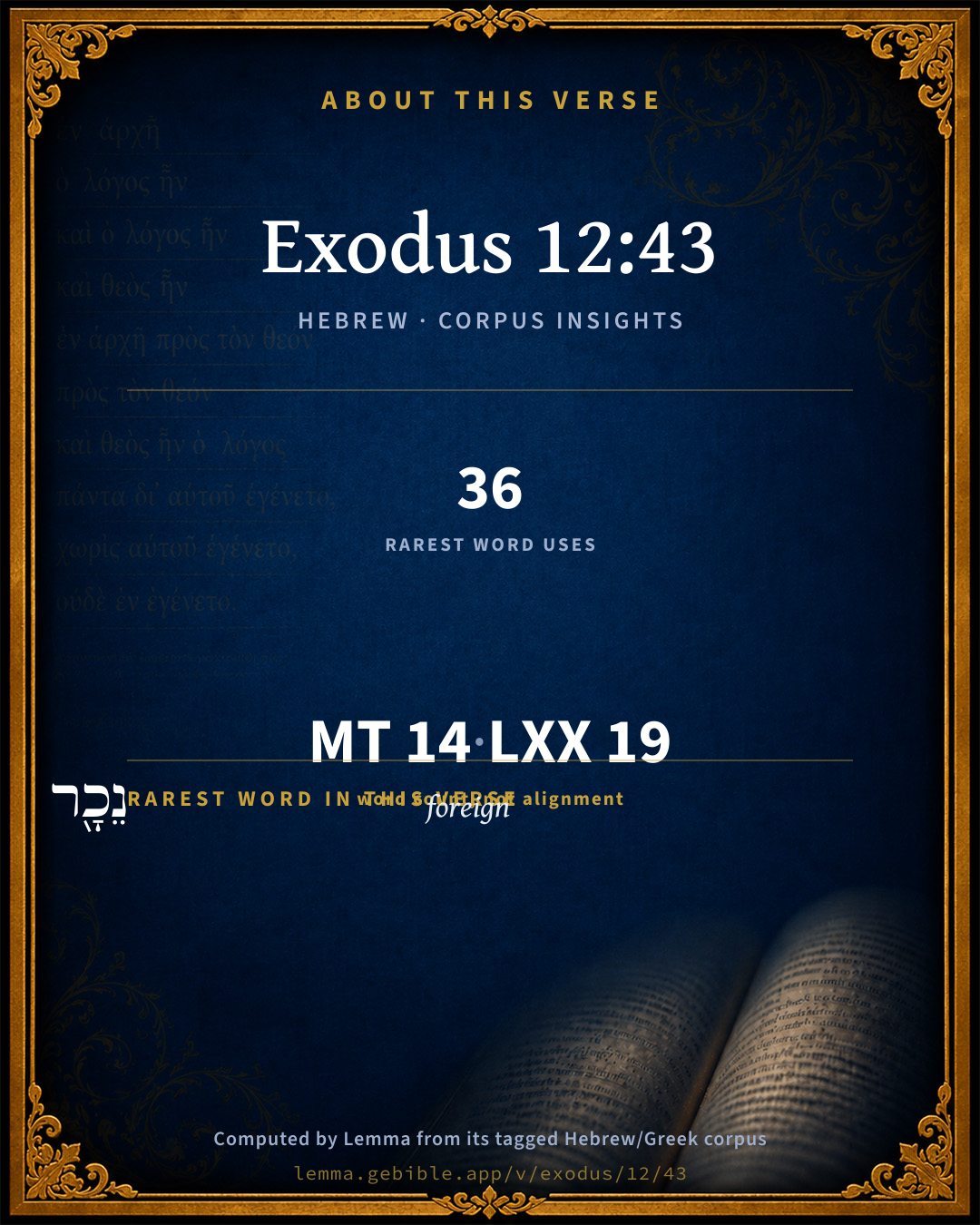
נֵכָ֖ר
nêkâr
H5236
“foreign”
Noun, Common, Masculine, Singular, Absolute
Part of Speech
Noun
Type
Common
Gender
Masculine
Number
Singular
State
Absolute
Full BDB Definition

Origin: from H5234

TWOT: 1368b

foreign, alien, foreignness, that which is foreign - foreignness, foreign gods - alien, foreigner - foreign (vanities)
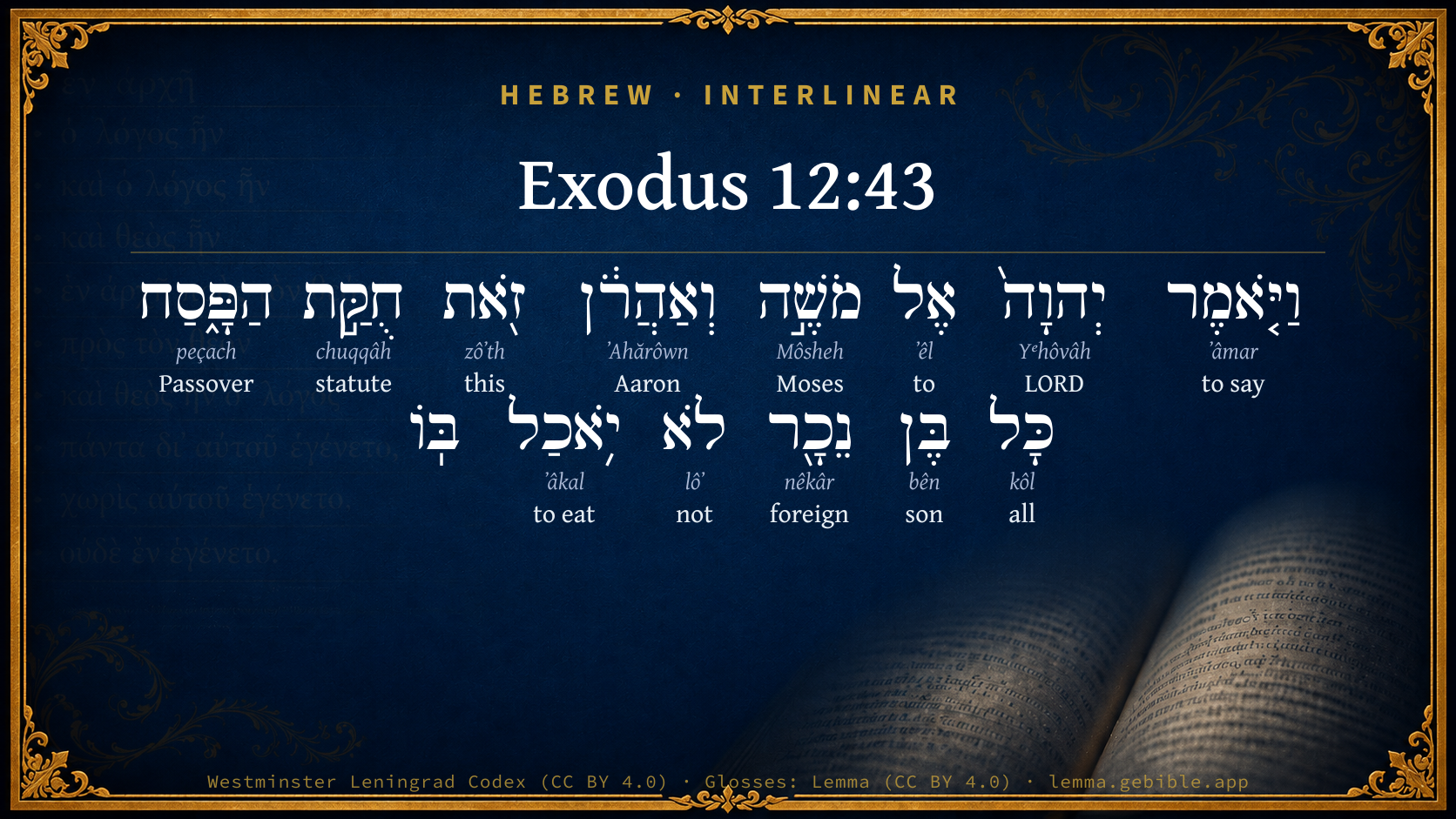
  1. וַיֹּ֤אמֶר ʼâmar H559 “and · to say” Conjunction + Verb, Qal, Sequential Imperfect, 3rd Person, Masculine, Singular
  2. יְהוָה֙ Yᵉhôvâh H3068 “LORD” Noun, Proper
  3. אֶל ʼêl H413 “to” Preposition
  4. מֹשֶׁ֣ה Môsheh H4872 “Moses” Noun, Proper
  5. וְאַהֲרֹ֔ן ʼAhărôwn H175 “and · Aaron” Conjunction + Noun, Proper
  6. זֹ֖את zôʼth H2063 “this” Pronoun, Demonstrative, Feminine, Singular
  7. חֻקַּ֣ת chuqqâh H2708 “statute of” Noun, Common, Both, Singular, Construct
  8. הַפָּ֑סַח peçach H6453 “the · Passover” Particle, Definite Article + Noun, Common, Masculine, Singular, Absolute
  9. כָּל kôl H3605 “all of” Noun, Common, Masculine, Singular, Construct
  10. בֶּן bên H1121 “son of” Noun, Common, Masculine, Singular, Construct
  11. לֹא lôʼ H3808 “not” Particle, Negative
  12. יֹ֥אכַל ʼâkal H398 “to eat” Verb, Qal, Imperfect, 3rd Person, Masculine, Singular

About this verse

These counts appear in no published source. They are computed here, from the morphology-tagged text and Lemma’s own curated glosses. What Lemma adds →

14
words
13
distinct lemmas
Pentateuch
section

Shared distinctive vocabulary

נֵכָ֖ר foreign H5236 occurs in 35 verses of the Hebrew Bible. Also found in:

Grammatical profile

  • 2 verbs
  • 8 nouns
  • 1 pronoun
  • 2 prepositions
  • 1 particle

Verb forms

  • וַיֹּ֤אמֶר Qal · Sequential Imperfect
  • יֹ֥אכַל Qal · Imperfect

Hebrew & Septuagint length

In English translation the verse runs 20 words from the Hebrew and 21 from the Septuagint (LXX English) — closely comparable.

A rough comparison of the two English renderings, which tokenize alike — not a word-level alignment.

Word counts can differ between the Hebrew and the Greek without any difference in meaning — e.g. the Hebrew direct-object marker אֵת has no separate Greek word, and Greek often adds the article ὁ.

In the original languages it is 14 Hebrew tokens and 19 Greek tokens — but the two are counted differently (Hebrew bundles its prefixes and suffixes into one token; the Greek is in lemma form), so that isn’t a like-for-like length.

Cross-references

5

Topical passages linked to Exodus 12:43 in the Treasury of Scripture Knowledge — connected by theme and wording, ordered by reader-vote popularity; previews shown in the World English Bible.

  • Exodus 12:48 When a stranger shall live as a foreigner with you, and will keep the Passover to Yahweh, let all his males be circumcised, and then let him come near and keep it; and he shall be as one who is born in the land: but no uncircumcised person shall eat of it.
  • Numbers 9:14 If a foreigner lives among you, and desires to keep the Passover to Yahweh; according to the statute of the Passover, and according to its ordinance, so shall he do. You shall have one statute, both for the foreigner, and for him who is born in the land.'"
  • Exodus 12:11 This is how you shall eat it: with your loins girded, your shoes on your feet, and your staff in your hand; and you shall eat it in haste: it is Yahweh's Passover.
  • Leviticus 22:10 "'No stranger shall eat of the holy thing: a foreigner living with the priests, or a hired servant, shall not eat of the holy thing.
  • Ephesians 2:12 that you were at that time separate from Christ, alienated from the commonwealth of Israel, and strangers from the covenants of the promise, having no hope and without God in the world.

Cross-references courtesy of OpenBible.info (CC BY 4.0).

Hebrew and Greek witnesses Masoretic Hebrew ↔ Greek Septuagint

The same verse in the two great witnesses to the Old Testament, shown verse-for-verse.

These are two independent witnesses, not word-aligned to each other, and the Septuagint is shown in lemma (dictionary) form.

Hebrew Exodus 12:43 Masoretic · Westminster Leningrad Codex

וַיֹּ֤אמֶר יְהוָה֙ אֶל מֹשֶׁ֣ה וְאַהֲרֹ֔ן זֹ֖את חֻקַּ֣ת הַפָּ֑סַח כָּל בֶּן נֵכָ֖ר לֹא יֹ֥אכַל בּֽוֹ

Yahweh said to Moses and Aaron, "This is the ordinance of the Passover. There shall no foreigner eat of it,

World English Bible · Public Domain

Greek LXX Exodus 12:43 Septuagint · lemma form

εἶπον δέ κύριος πρός μωυσῆς καί ααρων λέγω οὗτος ὁ νόμος ὁ πασχα πᾶς ἀλλογενής οὐ ἐσθίω ἀπό αὐτός

And the Lord said to Moses and Aaron, This is the law of the passover: no stranger shall eat of it.

LXX2012 (modern English Septuagint) · Public Domain

Hebrew: Westminster Leningrad Codex (CC BY 4.0). Greek: Septuagint (public domain); English from LXX2012 (modern English Septuagint) (Public Domain). How the Septuagint differs from the Hebrew →

Targum (Aramaic paraphrase)

2

The Targum is the ancient Jewish Aramaic paraphrase of the Hebrew Scriptures — an interpretive translation, not the Hebrew text itself. Onkelos (literal) and Pseudo-Jonathan (expansive) render the Torah, and Jonathan the Prophets. Coverage is partial: where no permissively-licensed English translation exists for a verse, only the Aramaic is shown. This is verse-level text, not a word-by-word alignment to the Hebrew.

  1. Targum Onkelos Torah (Genesis–Deuteronomy)
    וַאֲמַר יְיָ לְמשֶׁה וּלְאַהֲרֹן דָא גְזֵירַת פִּסְחָא כָּל בַּר יִשְׂרָאֵל דְיִשְׁתַּמַד לָא יֵכוּל בֵּהּ:

    (no public-domain English translation for this verse)

    Targum Onkelos — Aramaic: “Onkelos Genesis” (public domain); “Onkelos Exodus” (public domain); “Onkelos Leviticus” (public domain); “Onkelos Numbers” (public domain); “Onkelos Deuteronomy” (public domain). English: “Sefaria Community Translation” (CC0 1.0 (public-domain dedication)); “J.W. Etheridge. The Targums of Onkelos and Jonathan Ben Uzziel on the Pentateuch. London: Longmans, Green, 1862” (public domain). Text via Sefaria.

  2. Targum Pseudo-Jonathan Torah (Genesis–Deuteronomy)
    וַאֲמַר יְיָ לְמשֶׁה וְאַהֲרן דָּא הִיא גְזֵירַת פִּסְחָא כָּל בַּר עַמְמִין אוֹ בַּר יִשְרָאֵל דְּאִיסְתְּלַק וְלָא הָדַר לָא יֵיכוּל בֵּיהּ

    (no public-domain English translation for this verse)

    Targum Pseudo-Jonathan — Aramaic: “Targum Jonathan on Genesis” (public domain); “Targum Jonathan on Exodus” (public domain); “Targum Jonathan on Leviticus” (public domain); “Targum Jonathan on Numbers” (public domain); “Targum Jonathan on Deuteronomy” (public domain). English: “The Targum of Jonathan ben Uzziel, trans. J. W. Etheridge, London, 1862” (public domain). Text via Sefaria.

Commentary

Notes on Exodus 12:43 from classic Christian and Jewish commentators (each source and its license shown beneath its notes). The classic Christian expositions comment on the surrounding passage and are grouped to its opening verse, so a note may address several verses; the Jewish commentaries on the Tanakh (Rashi and others) are per-verse, so they appear only where the commentator wrote on this verse.

Lemma curates 59 commentaries, every one of them public domain or Creative Commons licensed, each selected and text-cleaned for this edition rather than reprinted as found. About our sources →

Matthew Henry's Commentary

Some further precepts are here given concerning the passover, as it should be observed in times to come.

I. All the congregation of Israel must keep it, Exo 12:47. All that share in God's mercies should join in thankful praises for them. Though it was observed in families apart, yet it is looked upon as the act of the whole congregation; for the smaller communities constituted the greater. The New Testament passover, the Lord's supper, ought not to be neglected by any who are capable of celebrating it. He is unworthy the name of an Israelite that can contentedly neglect the commemoration of so great a deliverance. 1. No stranger that was uncircumcised might be admitted to eat of it, Exo 12:43, Exo 12:45, Exo 12:48. None might sit at the table but those that came in by the door; nor may any now approach to the improving ordinance of the Lord's supper who have not first submitted to the initiating ordinance of baptism. We must be born again by the word ere we can be nourished by it. Nor shall any partake of the benefit of Christ's sacrifice, or feast upon it, who are not first circumcised in heart, Col 2:11. 2. Any stranger that was circumcised might be welcome to eat of the passover, even servants, Exo 12:44. If, by circumcision, they would make themselves debtors to the law in its burdens, they were welcome to share in the joy of its solemn feasts, and not otherwise. Only it is intimated (Exo 12:48) that those who were masters of families must not only be circumcised themselves, but have all their males circumcised too. If in sincerity, and with that zeal which the thing required and deserves, we give up ourselves to God, we shall, with ourselves, give up all we have to him, and do our utmost that all ours may be his too. Here is an early indication of favour to the poor Gentiles, that the stranger, if circumcised, stands upon the same level with the home-born Israelite. One law for both, Exo 12:49. This was a mortification to the Jews, and taught them that it was their dedication to God, not their descent from Abraham, that entitled them to their privileges. A sincere proselyte was as welcome to the passover as a native Israelite, Isa 56:6, Isa 56:7.

II. In one house shall it be eaten (Exo 12:46), for good-fellowship sake, that they might rejoice together, and edify one another in the eating of it. None of it must be carried to another place, nor left to another time; for God would not have them so taken up with care about their departure as to be indisposed to take the comfort of it, but to leave Egypt, and enter upon a wilderness, with cheerfulness, and, in token of that, to eat a good hearty meal. The papists' carrying their consecrated host from house to house is not only superstitious in itself, but contrary to this typical law of the passover, which directed that no part of the lamb should be carried abroad.

The chapter concludes with a repetition of the whole matter, that the children of Israel did as they were bidden, and God did for them as he promised (Exo 12:50, Exo 12:51); for he will certainly be the author of salvation to those that obey him.

Matthew Henry's Commentary on the Whole Bible (1708–1710) — public domain (CC PDM 1.0). Text via the HelloAO Bible API.

Ellicott's Commentary for English Readers

(43) No stranger.—Comp, Exo_12:48 for limitations. If a stranger wished to join, and would accept circumcision for himself and the males of his family, he might partake in the rite.

FURTHER DIRECTIONS RESPECTING THE PASSOVER.

(43-51) This is the ordinance.—These directions, together with those which follow with respect to the sanctification of the firstborn (Exo_13:1-16), seem to have been given to Moses at Succoth, and were consequently recorded at this point of the narrative. They comprise three principal points:—(1) The exclusion of all uncircumcised persons from the Passover (Exo_12:43); (2) the admission of all full proselytes (Exo_12:48-49); and (3) the injunction that no bone of the lamb should be broken (Exo_12:46).

A Bible Commentary for English Readers, edited by Charles John Ellicott (1878–1897) — public domain. Text from a community e-Sword module.

Trapp's Complete Commentary

John Trapp

Exo 12:43 And the LORD said unto Moses and Aaron, This [is] the ordinance of the passover: There shall no stranger eat thereof:

Ver. 43. There shall no stranger, &c.] Strangers are excluded; to show that the faithful only have fellowship with Christ; contra quam Lutherani ineptiunt, saith one.

John Trapp, A Commentary or Exposition upon All the Books of the Old and New Testament (1647–1656) — public domain. Text from a community e-Sword module.

The Biblical Illustrator

Joseph S. Exell

Exo_12:43-48

The ordinance of the Passover.

Minute instructions in reference to the observance of the Passover

I. That God not only institutes ordinances for men, but also shows in what way they are to be observed.

II. That God will not allow any stranger to the death of Christ to partake of His Holy Sacrament. There shall no stranger eat thereof.

III. That a mere hired and nominal relation to the Church does not give a true right to the Holy Sacrament. An hired servant shall not eat thereof.

IV. That circumcision of heart is necessary (Exo_12:48). (J. S. Exell, M. A.)

.

The Biblical Illustrator, edited by Joseph S. Exell (c. 1880s–1900s) — public domain. Text from a community e-Sword module.

Whedon's Commentary on the Bible

Daniel D. Whedon

ADDITIONAL PASSOVER REGULATIONS, Exio 12:43-50.

This additional ordinance, defining the character of the participants in the passover feast, now became necessary, since aliens and strangers of various nations attached themselves to Israel. Exo_12:38. Israel was called to be a blessing to all nations, and, therefore, aliens were not excluded from the covenant privileges if they would take upon them the covenant sign, but this was an essential condition. Transient settlers or labourers for wages were not to be admitted to the passover; but all who had become incorporated into the families of Israel by marriage or by purchase (and who bore the covenant sign) became spiritually as well as outwardly one with the covenant people. Concerning Hebrew servitude see on Exodus 21.

Daniel D. Whedon (gen. ed.), Commentary on the Old and New Testaments (1874–1909) — public domain. Text from a community e-Sword module.

The Preacher's Complete Homiletical Commentary

Joseph S. Exell (gen. ed.)

MAIN HOMILETICS OF THE PARAGRAPH.—Exo_12:43-51

MINUTE INSTRUCTIONS IN REFERENCE TO THE OBSERVANCE OF THE PASSOVER

I. That God not only institutes ordinances for men, but also shows in what way they are to be observed. God had instituted the Passover, and now He gives to the Israelites clear injunctions as to the manner in which they are to observe it. The ordinances of Heaven are not to be kept according to the fearful and arbitrary dictates of the human mind, but according to the revelation and will of God. God tells men how they are to keep His ordinances. Thus they are protected against unwisdom and presumption in reference to them. Men are liable to error in the worship of the Eternal, especially at the Sacrament of the Lord’s Supper. This is a solemn feast, and must be observed after a pattern Divinely made known.

II. That God will not allow any stranger to the death of Christ to partake of His Holy Sacrament. “There shall no stranger eat thereof.” It would be impossible for a stranger to enter fully into the meaning of the Passover; he would know but little or nothing of Israel’s deliverance from the bondage of Egypt by the mighty hand of God. He would not, therefore, be in sympathy with the ordinance. And so those who are strangers to the death of Christ ought not, and cannot, truly come to the sacramental table of the Lord. That sacrament finds its explanation in the Cross, and no one can enter into it who has not realised in his inner nature the deliverance and blessing consequent on the death of Christ. The believer in the atonement alone can fully realise the blessing of the Lord’s table.

III. That a mere hired and nominal relation to the Church does not give a, true right to the Holy Sacrament. “And an hired servant shall not eat thereof.” There would be many sustaining this relationship to Israel, as there are in relation to the Church in our own age. There are many hired servants of the Church; they are nominally, and perhaps officially, connected with Christian people, but they are not of the true Israel, either by birth or by circumcision; hence they have no right to take part in the Passover, or in the Supper of the Lord.

IV. That circumcision of heart is necessary in order to partake of this Holy Sacrament. (Exo_12:48.) If the stranger wished to keep the Passover, he was to be circumcised; no uncircumcised person was to eat thereof. Nor should any one eat of the Supper of the Lord unless he be circumcised in heart, and be brought into deep sympathy with the sign of the Christian life, the Cross. None are excluded from the sacrament of the Lord’s Supper who are willing to comply with the moral requirements of the service.

SUGGESTIVE COMMENTS ON THE VERSES

Exo_12:43-51. Faith and obedience make all proselytes as home-born, as the children of the Church.

The table of the Lord must not be profaned by unhallowed communicants.

All God’s Israel must observe His ordinance of worship, especially His Passover.

One law of God unites them that be nigh and afar off in Passover worship.

One law of God makes one heart of His people in obedience.

ILLUSTRATIONS

BY

REV. WM. ADAMSON

Freedom! Exo_12:51. Stretching from one end to the other of the mighty continent of South America are the lofty mountains of the Cordilleras. On the summit of a spur of the main chain, at a distance from the city of Lima in Peru, was perched a house of ancient construction, originally built as a fortification to command the pass through the mountains. Behind it rose range above range of mountains, the more distant lowering to the sky, and covered with eternal snows; while from its windows could be seen the fertile plains of Peru stretching away to the ocean, distinguishable on clear days by a silvery line in the horizon. During the rebellion of the hapless Indian descendants of the Incas of Peru against the cruel oppressions of the Spanish conquerors, this building, occupied by an English merchant, became the centre of a terrible struggle. While the army of the Incas rushed impetuously down the mountain side, the Spaniards pressed up to gain possession of the building, as the key to the mountain pass. The English owner and his family remained passive spectators, feeling that the first to reach would be the masters of the situation. The Spanish soldiers gained first the house; but no sooner had they barricaded their positions, than the Indian warriors surrounded and besieged them. Desperate was the struggle; but, step by step, the oppressed natives gained possession of the outworks, walls, gardens, and at last of the building itself. All this was through the bravery, prudence, and resolution of their noble leader Manco. Thus, step by step, did the oppressed people of Israel gain their liberty, through the undaunted courage, matchless judgment, and iron resolution of Moses, their leader; who depended, however, not on human arms, but on weapons from the Divine Armoury, and the dread artillery of heaven. A like deliverance, after prolonged struggles, is at hand for the Christian Church—

“Already she is on her august way,

And marching upward to her final goal.”

—Percival

The Preacher's Complete Homiletical Commentary (gen. ed. Joseph S. Exell; Funk & Wagnalls, c. 1892) — public domain (pre-1929). A full-Bible homiletical/sermon-outline anthology covering 65 of 66 books (2 John is absent from the source module). Text from a community e-Sword module.

Tyndale Open Study Notes

Tyndale Open Resources

12:43-50 These additional instructions for the observance of Passover relate primarily to outsiders (12:43) and foreigners (12:48). Perhaps the presence of the non-Israelite rabble (12:38) in the community prompted these instructions. The key factor was whether or not the person was willing to become fully identified with Israel and with the Lord by submitting to circumcision.

Tyndale Open Study Notes — © Tyndale Open Resources, licensed CC BY-SA 4.0. Text via the HelloAO Bible API.

Geneva Bible (1599)

Geneva Bible translators

Except he be circumcised, and only profess your religion.

Geneva Bible (1599) marginal notes — public domain. Text via Bolls.life.

Adam Clarke's Commentary

Verse 43. This is the ordinance of the passover] From the last verse of this chapter it appears pretty evident that this, to the 50th verse inclusive, constituted a part of the directions given to Moses relative to the proper observance of the first passover, and should be read conjointly with the preceding account beginning at Ex 12:21. It may be supposed that these latter parts contain such particular directions as God gave to Moses after he had given those general ones mentioned in the preceding verses, but they seem all to belong to this first passover.

There shall no stranger eat thereof] בן נכר ben nechar, the son of a stranger or foreigner, i.e., one who was not of the genuine Hebrew stock, or one who had not received circumcision; for any circumcised person might eat the passover, as the total exclusion extends only to the uncircumcised, see Ex 12:48. As there are two sorts of strangers mentioned in the sacred writings; one who was admitted to all the Jewish ordinances, and another who, though he dwelt among the Jews, was not permitted to eat the passover or partake of any of their solemn feasts; it may be necessary to show what was the essential point of distinction through which the one was admitted and the other excluded.

In treatises on the religious customs of the Jews we frequently meet with the term proselyte, from the Greek προσηλυτος, a stranger or foreigner; one who is come from his own people and country to sojourn with another. All who were not descendants of some one of the twelve sons of Jacob, or of Ephraim and Manasseh, the two sons of Joseph, were reputed strangers or proselytes among the Jews. But of those strangers or proselytes there were two kinds, called among them proselytes of the gate, and proselytes of injustice or of the covenant. The former were such as wished to dwell among the Jews, but would not submit to be circumcised; they, however, acknowledged the true God, avoided all idolatry, and observed the seven precepts of Noah, but were not obliged to observe any of the Mosaic institutions. The latter submitted to be circumcised, obliged themselves to observe all the rites and ceremonies of the law, and were in nothing different from the Jews but merely in their having once been heathens. The former, or proselytes of the gate, might not eat the passover or partake of any of the sacred festivals; but the latter, the proselytes of the covenant, had the same rights, spiritual and secular, as the Jews themselves. See Ex 12:48.

Adam Clarke's Commentary on the Bible (1810–1826) — public domain. Text from a community e-Sword/MySword module.

The Cambridge Bible for Schools and Colleges

gen. ed. J. J. S. Perowne

43. no alien] or foreigner, i.e. a foreigner temporarily resident in Israel. It was a distinctively Israelitish observance.

The Cambridge Bible for Schools and Colleges (gen. ed. J. J. S. Perowne; Cambridge University Press, 1878–1918) — public domain. Text from a community e-Sword module.

John Gill's Exposition

A foreigner and an hired servant shall not eat thereof. One of another nation, and one that was only hired by the day, week, or year; as they were not obliged to circumcision, so without it they had no right to eat of the passover, none but such as became proselytes of righteousness.

A foreigner and an hired servant shall not eat thereof. One of another nation, and one that was only hired by the day, week, or year; as they were not obliged to circumcision, so without it they had no right to eat of the passover, none but such as became proselytes of righteousness.

Exodus 12:46

exo 12:46

exo 12:46

exo 12:46In one house shall it be eaten,.... For though there might be more lambs than one eaten in a house, where there were a sufficient number to eat them; and there might be more societies than one in a house, provided they kept themselves distinct, and were large enough each of them to eat up a lamb; yet one lamb might not be eaten in different houses, a part of it in one house, and a part of it in another; which may denote the unity of the general assembly and church of the firstborn, and the distinct separate congregations of the saints, and the right that each have to a whole Christ, who is not to be divided from his ministers, word, and ordinances; See Gill on Mat 26:18,

thou shall not carry forth ought of the flesh abroad out of the house: into another house; for where there was not a sufficient number in one house to eat a lamb, their neighbours in the next house were to join with them; but then they were not to part it, and one portion of it to be eaten in one house, and the other in another, but they were to meet together in one of their houses, and there partake of it; thus, though Christ may be fed upon by faith any where by particular believers, yet in an ordinance way only in the church of God:

neither shall ye break a bone thereof; any of its tender bones to get out the marrow; and so the Targum of Jonathan adds,"that ye may eat that which is in the midst of it:''this was remarkably fulfilled in Christ the antitype, Joh 19:32.

John Gill's Exposition of the Whole Bible (1746–1763) — public domain (CC PDM 1.0). Text via the HelloAO Bible API.

Albert Barnes' Notes on the Bible

And the Lord said - From this verse to Exo 13:16 are instructions regarding the Passover. Such instructions were needed when the Israelites were joined by the “mixed multitude:” of strangers; and they were probably given at Succoth, on the morning following the departure from Rameses.

No stranger - Literally, “son of a stranger.” The term is general; it includes all who were aliens from Israel, until they were incorporated into the nation by circumcision.

Albert Barnes' Notes on the Bible (1834–1885) — public domain. Text from a community e-Sword/MySword module.

Matthew Poole's English Annotations

This which here followeth is the law or appointment of God concerning the celebration of the passover.

No stranger, or, foreigner, who is so both by nation and religion; for if he were circumcised, he might eat of it, Exo 12:44,48.

Matthew Poole's English Annotations on the Holy Bible (1683–1685) — public domain. Text from a community e-Sword/MySword module.

The Pulpit Commentary

Vers. 43-51. SUPPLEMENTARY ORDINANCE WITH RESPECT TO THE PASSOVER. The position of these verses is curious. We should have expected them to have followed immediately on ver. 20, or else to have been reserved for the further consideration of the subject in ch. 23. It is suggested, in order to account for their place, that they formed the matter of a special revelation made to Moses at Succoth. They comprise three main points:

1. The absolute exclusion of all uncircumcised persons from participationin the passover rite;

2. The extension of the rite (implied in ver. 19) to all full proselytes; and,

3. The injunction that not a bone of the lamb should be broken. (This last isrepeated in Num_9:12)

This is the ordinance of the passoveri.e. , "This is the law, in respect of the persons who are to partake of it there shall no stranger eat thereof, or literally, "No son of a stranger shall eat thereof." By a "stranger" here is meant one of a foreign race who wishes to retain his foreign character and to remain uncircumcised. Compare ver. 48.

HOMILIES BY J. ORR Vers. 43-51. The spirit of the Passover ordinance.

The features to be specified reappear in the Lord"s Supper. The ordinance was

I EXCLUSIVE. (Vers. 43, 45, 48.) A stranger, an uncircumcised person, and a hired servant, were not to be permitted to oat of it. Their relation to Israel was wholly external. In like manner, the Lord"s Supper is exclusive. It excludes the stranger to the death of Christ, the uncircumcised in heart, and those who sustain a merely legal and hireling relation to the Church. These have "neither part nor lot" in the matter.

II YET CATHOLIC. (Vers. 48, 49.) The sojourning stranger who wished to keep the passover had only to be circumcised he and his males to be admitted to the ordinance. He was then to be as one born in the land. This catholicity of spirit, and kindliness to foreigners, blending with a stern exclusiveness in religion, is characteristic of the whole Mosaic code. Cf. Vinet on the tolerance and intolerance of the Christian religion ("Vital Christianity"). The Lord"s Supper is the most catholic of ordinances. It overleaps all barriers of race, nationality, clime, and religion. At the Lord"s table there is neither Greek, nor Jew, barbarian, Scythian, bond nor free.

III EQUALISING. (Ver. 44.) The master and slave sat down at the same board. See last homily. Christianity is the great social equaliser.

IV UNIFYING. (Vers. 46, 47.)it taught the congregation to feel its unity.

1. The lamb was to be eaten in one house.

2. Not a bone of it was to be broken. "Through the unity and integrity ofthe lamb given them to eat, the participants were to be joined into an undivided unity and fellowship with the Lord, who had provided them with the meal" (Keil).

3. All the congregation were to eat it. The Lord"s Supper, in like manner,is a social meal, in which the Church, eating "one bread," and drinking one cup," declares itself to be "one body" (cf. 1Co_10:16, 1Co_10:17) "The preservation of Christ, so that not a bone was broken, had the same signification; and God ordained this that he might appear as the true Paschal Lamb, that was slain for the sins of the world. J.O.

HOMILIES BY J. URQUHART Vers. 43-51. The Law of the Passover.

I WHAT GOD REQUIRES IN ITS OBSERVANCE.

1. God demands purity of communion. No stranger is to cat of it.

(1) Our holy things are not to be profaned. The life of Christ is lowered and endangered by indiscriminate admission to the Lord"s table.

(2) They are not to be degraded into superstitious rites. When they are given as if salvation resided in them, we are substituting idols for the unseen Saviour. The only safeguard for purity of worship is purity of communion.

1. It is not to be carried out from the midst of the household of faith. Thepeace and fellowship of the Gospel are only for the circumcised in heart.

2. Communion with Christ to be characterised by reverence and holy awe: not a bone of him is to be broken.

3. Every wall of partition is removed. All who believe have a right to joinin the feast (vers. 41-49); but they must come with the mark of God"s people, a circumcised heart.

II THE OBEDIENCE OF FAITH IS BLESSED NOT ONLY WITH SAFETY BUT ALSO WITH DELIVERANCE. "Thus did all the children of Israel and on the self-same day" they passed out of Egypt (50, 51). Fellowship with Christ is deliverance from the bondage of evil. U.

The Pulpit Commentary (1880–1919), ed. H.D.M. Spence-Jones & Joseph S. Exell — public domain. Text from a community e-Sword module.

Keil & Delitzsch

C. F. Keil & F. Delitzsch

Regulations Concerning the Participants in the Passover. - These regulations, which were supplementary to the law of the Passover in Exo 12:3-11, were not communicated before the exodus; because it was only by the fact that a crowd of foreigners attached themselves to the Israelites, that Israel was brought into a connection with foreigners, which needed to be clearly defined, especially so far as the Passover was concerned, the festival of Israel's birth as the people of God. If the Passover was still to retain this signification, of course no foreigner could participate in it. This is the first regulation. But as it was by virtue of a divine call, and not through natural descent, that Israel had become the people of Jehovah, and as it was destined in that capacity to be a blessing to all nations, the attitude assumed towards foreigners was not to be an altogether repelling one. Hence the further directions in Exo 12:44 : purchased servants, who had been politically incorporated as Israel's property, were to be entirely incorporated by circumcision, so as even to take part in the Passover. But settlers, and servants working for wages, were not to eat of it, for they stood in a purely external relation, which might be any day dissolved. בּ אכל, lit., to eat at anything, to take part in the eating (Lev 22:11). The deeper ground fore this was, that in this meal Israel was to preserve and celebrate its unity and fellowship with Jehovah. This was the meaning of the regulations, which were repeated in Exo 12:46 and Exo 12:47 from Exo 12:4, Exo 12:9, and Exo 12:10, where they had been already explained. If, therefore, a foreigner living among the Israelites wished to keep the Passover, he was first of all to be spiritually incorporated into the nation of Jehovah by circumcision (Exo 12:48). פס ועשׂה: "And he has made (i.e., made ready) a passover to Jehovah, let every male be circumcised to him (i.e., he himself, and the male members of his house), and then he may draw near (sc., to Jehovah) to keep it." The first עשׂה denotes the wish or intention to do it, the second, the actual execution of the wish. The words בּן־נכר, גּר, תּושׁב and שׂכיר, are all indicative of non-Israelites. בּן־נכר was applied quite generally to any foreigner springing from another nation; גּר was a foreigner living for a shorter or longer time in the midst of the Israelites; תּושׁב, lit., a dweller, settler, was one who settled permanently among the Israelites, without being received into their religious fellowship; שׂכיר was the non-Israelite, who worked for an Israelite for wages.

Keil & Delitzsch — Biblical Commentary on the Old Testament (1861–1891) — public domain (CC PDM 1.0). Text via the HelloAO Bible API. (Old Testament only.)

unfoldingWord translationNotes

Door43 World Missions Community

No foreigner may share in eating it

The pronoun "it" refers to the Passover meal.

every Israelite's slave

"any slave of an Israelite"

bought with money

This can be stated in active form. AT: "whom the Israelite has bought with money" (See: Active or Passive)

translationWords

Moses

Aaron

Passover

alien

servant

circumcise

unfoldingWord translationNotes — © Distant Shores Media and the Door43 World Missions Community, licensed CC BY-SA 4.0. Source: git.door43.org/Door43/en_tn.

Rashi

Rabbi Shlomo Yitzchaki (Rashi)

זאת חקת הפסח THIS IS THE ORDINANCE OF THE PASSOVER — This chapter was spoken to them on the 14th day of Nisan.

כל בן נכר NO STRANGE PERSON — one whose actions are estranged from his Heavenly Father (Zevachim 22b); both a heathen and an apostate Israelite therefore are implied in this term (Mekhilta).

Rashi on the Tanakh — English translations: “The Judaica Press complete Tanach with Rashi, translated by A. J. Rosenberg” (CC BY 4.0); “Pentateuch with Rashi's commentary by M. Rosenbaum and A.M. Silbermann, 1929-1934” (public domain); “The Metsudah Tanach series, Lakewood, N.J” (CC BY 4.0); and “The Book of Joshua, Metsudah Publications, 1997” (CC BY 4.0). Text via Sefaria.

Ramban (Nachmanides)

Rabbi Moshe ben Nachman (Ramban / Nachmanides)

AND THE ETERNAL SAID UNTO MOSES AND AARON: THIS IS THE ORDINANCE OF THE PASSOVER. “This chapter was related to them on the fourteenth day of Nisan.” Thus the language of Rashi. This is correct, since at the end of this chapter it is written, Thus did all the children of Israel, as the Eternal hath commanded, attesting concerning them that they and their servants were circumcised, [as this is a prerequisite for eating the Passover-offering]. But if so, Scripture should have logically mentioned this chapter before the section, And it came to pass at midnight. But the reason [the section of the ordinance of the Passover is placed here] is as follows: The chapter of This month shall be unto you the beginning of months, Verse 2. was said on the first of the month. Immediately on that day, Moses fulfilled his mission, [as it states], Then Moses called for all the elders of Israel, and said unto them, meaning that he commanded them concerning the ordinance of the Passover [mentioned here], and he assured them that they will be redeemed on the night of the fifteenth day [of Nisan]. They believed, and the people bowed the head and worshipped., Verse 27. To this account Scripture adjoined the section, And it came to pass at midnight, in order to state that He fulfilled the promise He made to them. On finishing this section, Scripture then reverts to the first theme in order to complete the ordinance of the Passover.This chapter adds many commandments [concerning the Passover-offering]: the prohibitions of an alien or an uncircumcised Israelite eating thereof, the prohibitions of removing the flesh thereof from where it is eaten and of breaking any of its bones, and the law of the Passover-offering of a proselyte. These commandments applied immediately and for all generations. Then Scripture completed the section by saying that the children of Israel did all this; as G-d commanded… so did they. It uses the expression, all the children of Israel, in order to explain that there was not one person who transgressed the command of G-d concerning all these matters [mentioned here in the section beginning, This is the ordinance of the Passover], as well as all He commanded regarding the laws of the Passover mentioned in the sections above.Rabbi Abraham ibn Ezra wrote that this chapter dealing with the Passover of the generations, [as distinguished from the Passover of Egypt], was said after the Passover of Egypt, and the verse, Thus did all the children of Israel, refers to the Passover in the wilderness, which they observed in the second year after the exodus. [Although it should logically precede the Passover in the wilderness, according to Ibn Ezra] it is written here because of the general commandment [on the Passover here], the case being similar [to that of the jar of manna which Aaron was to put up before the Testimony in the Tabernacle, of which Scripture says], And Aaron laid it up before the Testimony, for a charge. [This account should logically follow that of the building of the Tabernacle, but instead it was mentioned in the chapter dealing with the manna in order to complete the subject.]This opinion [of Ibn Ezra here] is a mistake. The commandments in all these chapters deal only with the Passover of Egypt and the Passovers which they were to observe in the Land of Israel, as it is said above, And it shall come to pass, when ye be come to the Land, etc. The Passover in the wilderness, however, was a commandment only for that particular time.

THERE SHALL NO ‘BEN NEICHAR’ (ALIEN) EAT THEREOF. “This means one whose actions are estranged from his Heavenly Father, and applies both to a non-Israelite and an Israelite.” Thus the language of Rashi quoting from the Mechilta. The verse of course is needed only for the case of an [apostate] Israelite. And so did Onkelos translate: “There shall no ‘ben neichar’ eat thereof, i.e, any Israelite who has become an apostate,” meaning he has estranged himself from his brethren and from his Heavenly Father through his evil deeds.This is the word neichar, mentioned by the Sages in all places, which means estranged, and the purport thereof is m’shumad, one who is a known [opponent to the Torah]. The usage of the word is similar to the Aramaic expression, ‘ve’isht’moda’ (And) Joseph (knew) his brethren, but they ‘isht’modei’ (knew) him not. In the case of the word m’shumad, it is missing the letter ayin, just as it is absorbed in many [Aramaic] words: midam (anything) in place of mida’am; dor kati in place of dor katia (a chopped generation), baki in place of b’kia (expert).

Ramban (Nachmanides) on the Tanakh — English translation: “Commentary on the Torah by Ramban (Nachmanides). Translated and annotated by Charles B. Chavel. New York, Shilo Pub. House, 1971-1976” (CC BY 4.0). Text via Sefaria.

Lesson kit

Teaching starters — assembled from the data on this page, not authored interpretation. Every prompt links to the verse data it draws on. Edit before teaching.

Exodus, in the Pentateuch, opens this verse with 14 words (13 distinct Hebrew lemmas). Its most distinctive word is nêkâr (“foreign”). A historical commentator’s framing appears above. Read the whole chapter for the surrounding context.

Discussion questions

  1. What does “foreign” (nêkâr) contribute to the verse as a whole?
  2. Genesis 17:12 shares the word «foreign» with this verse. How do the two illuminate each other?
  3. The translations on this page render this verse differently — a whole-verse word diff, not a word-by-word alignment. What might account for the different wordings?
  4. The verb «וַיֹּ֤אמֶר» is Qal Sequential Imperfect. How does its form color the action?
  5. Reading how Matthew Henry's Commentary and Ellicott's Commentary for English Readers read this verse, where do the two commentators agree and where do they part?

Things to notice

Reading settings

Reading text

Shown beneath each verse's original-language words.

Old Testament
Old Testament edition

Read the OT as the Masoretic Hebrew (MT) or the Greek Septuagint (LXX).

English shown for the Greek Septuagint (in the Hebrew ↔ Greek comparison).

Comparing translations? Open the Compare panel on any verse page to stack up to four side by side.