Genesis 9:17

Hebrew (Westminster Leningrad Codex) Genesis 9:17 appears in the Hebrew Old Testament. The text above is from the Westminster Leningrad Codex. Each word links to its Strong’s number, a concise gloss, and parsing drawn from the Open Scriptures Hebrew Bible morphology. Click any word for its full Brown-Driver-Briggs (BDB) entry.
Download image
Cite this verse

Genesis 9:17 (World English Bible). Public Domain. Lemma interlinear Bible study tool, https://lemma.gebible.app/v/genesis/9/17.

Show BibTeX & RIS
BibTeX
RIS
English Translation
God said to Noah, "This is the token of the covenant which I have established between me and all flesh that is on the earth."
World English Bible · Public Domain
Download a study sheet

One document with this verse’s original text, its word-by-word gloss line, the meaning frame, cross-references with their text, attributed commentary, and full source and license credits — printable, and it pastes into notes with its structure intact.

This verse Autodidact and up

Study sheet (.html) Plain text (.txt)

A passage Seminary Student

Up to 50 verses in one chapter. A passage sheet keeps up to 6 commentary sources and 12 cross-references per verse, in the order this page ranks them, and says so on the sheet whenever that leaves anything out. Ask for a single verse and you get the Autodidact verse sheet above.

Everything on this page stays free to read, with no account — the sheet is a download of what is already on screen, not access to it.

Want to remove ads? Support Godless Engineer
Compare translations 3

The same verse in 3 English versions, stacked beneath the original-language interlinear above. Click any original word for its lexicon entry.

Each is an independent rendering of the whole verse — the interlinear is not word-aligned to these translations.

Highlighted words mark where these versions differ — a whole-verse word diff, not a word-by-word alignment.

  • World English Bible Public Domain
    God said to Noah, "This is the token of the covenant which I have established between me and all flesh that is on the earth."
  • King James Version Public Domain
    And God said unto Noah, This is the token of the covenant, which I have established between me and all flesh that is upon the earth.
  • unfoldingWord Literal Text CC BY-SA 4.0
    Then God said to Noah, “That the sign of the covenant that I have established between me and all flesh that on the earth.” Noah and His Three Sons After the Flood 9:18-29

unfoldingWord Literal Text — © unfoldingWord, licensed CC BY-SA 4.0. Word-aligned USFM3 via Door43 (git.door43.org/unfoldingWord/en_ult).

Versions to compare (up to 4)

3 of 4 selected

Show all 18 translations

Every available English version of this verse, each an independent rendering of the whole verse.

  • World English Bible Public Domain
    God said to Noah, "This is the token of the covenant which I have established between me and all flesh that is on the earth."
  • Berean Standard Bible Public Domain
    So God said to Noah, “This is the sign of the covenant that I have established between Me and every creature on the earth.”
  • Majority Standard Bible Public Domain
    So God said to Noah, “This is the sign of the covenant that I have established between Me and every creature on the earth.”
  • King James Version Public Domain
    And God said unto Noah, This is the token of the covenant, which I have established between me and all flesh that is upon the earth.
  • American Standard Version (1901) Public Domain
    And God said unto Noah, This is the token of the covenant which I have established between me and all flesh that is upon the earth.
  • Revised Version (1885) Public Domain
    And God said unto Noah, This is the token of the covenant which I have established between me and all flesh that is upon the earth.
  • Geneva Bible (1599) Public Domain
    God said yet to Noah, This is the signe of the couenant, which I haue established betweene me and all flesh that is vpon the earth.
  • Douay-Rheims (1899) Public Domain
    And God said to Noe: This shall be the sign of the covenant which I have established between me and all flesh upon the earth.
  • Young's Literal Translation Public Domain
    And God saith unto Noah, `This `is' a token of the covenant which I have established between Me and all flesh that `is' upon the earth.'
  • Literal Standard Version CC BY-SA 4.0
    And God says to Noah, “This [is] a token of the covenant which I have established between Me and all flesh that [is] on the earth.”
  • Unlocked Literal Bible CC BY-SA 4.0
    Then God said to Noah, “This is the sign of the covenant that I have confirmed between me and all flesh that is on the earth.”
  • unfoldingWord Literal Text CC BY-SA 4.0
    Then God said to Noah, “That the sign of the covenant that I have established between me and all flesh that on the earth.” Noah and His Three Sons After the Flood 9:18-29
  • Darby Bible Public Domain
    And God said to Noah, This is the sign of the covenant which I have established between me and all flesh that is upon the earth.
  • World Messianic Bible Public Domain
    God said to Noah, “This is the token of the covenant which I have established between me and all flesh that is on the earth.”
  • Webster's Bible Public Domain
    And God said to Noah, This is the token of the covenant which I have established between me and all flesh that is upon the earth.
  • Free Bible Version CC BY-SA 4.0
    Then God told Noah, “This is the sign of the agreement I'm making between me and every creature on earth.”
  • Bible in Basic English Public Domain
    And God said to Noah, This is the sign of the agreement which I have made between me and all flesh on the earth.
  • JPS Tanakh (1917) Public Domain
    And God said unto Noah: 'This is the token of the covenant which I have established between Me and all flesh that is upon the earth.'

Literal Standard Version (2020), Covenant Press — licensed CC BY-SA 4.0. Text via the HelloAO Bible API (eBible.org). Unlocked Literal Bible (unfoldingWord) — licensed CC BY-SA 4.0. Text via the HelloAO Bible API (eBible.org). unfoldingWord Literal Text — © unfoldingWord, licensed CC BY-SA 4.0. Word-aligned USFM3 via Door43 (git.door43.org/unfoldingWord/en_ult). Free Bible Version, Dr. Jonathan Gallagher — licensed CC BY-SA 4.0. Text via the HelloAO Bible API (eBible.org).

Word by word

More ways to search: Search by grammar → Find every occurrence → Compare this word →

Practice this passage: Drill this verse → Learn its vocabulary →

נֹ֑חַ
Nôach
H5146
“Noah”
Noun, Proper
Part of Speech
Noun
Type
Proper
Full BDB Definition

Origin: the same as H5118

TWOT: 1323b

Noah = "rest" - son of Lamech, father of Shem, Ham, and Japheth; builder of the ark which saved his family from the destruction of the world which God sent on the world by the flood; became the new seminal head of mankind because his family were the only survivors of the flood
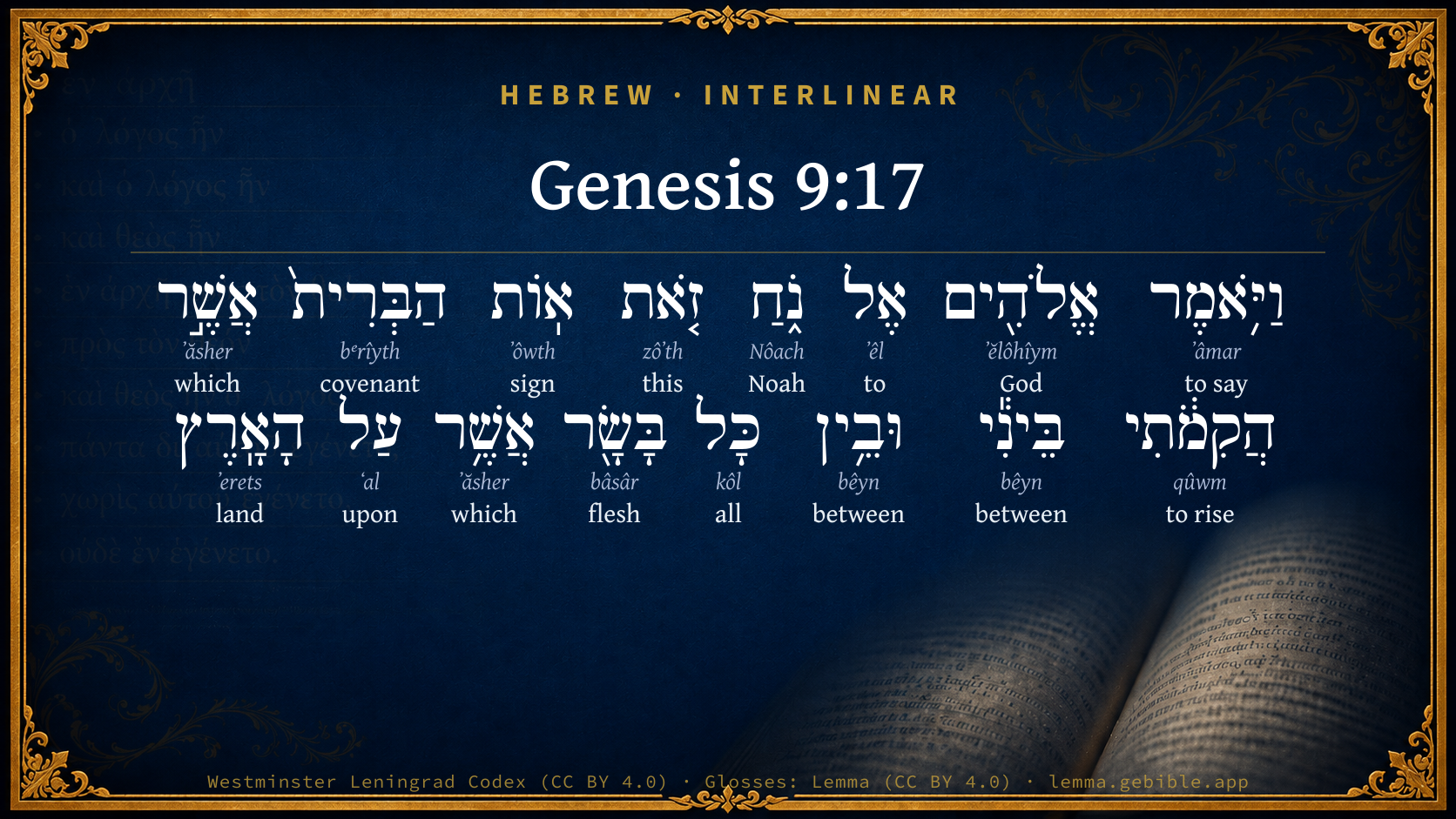
  1. וַיֹּ֥אמֶר ʼâmar H559 “and · to say” Conjunction + Verb, Qal, Sequential Imperfect, 3rd Person, Masculine, Singular
  2. אֱלֹהִ֖ים ʼĕlôhîym H430 “God(s)” Noun, Common, Masculine, Plural, Absolute
  3. אֶל ʼêl H413 “to” Preposition
  4. זֹ֤את zôʼth H2063 “this” Pronoun, Demonstrative, Feminine, Singular
  5. אֽוֹת ʼôwth H226 “sign of” Noun, Common, Both, Singular, Construct
  6. הַבְּרִית֙ bᵉrîyth H1285 “the · covenant” Particle, Definite Article + Noun, Common, Feminine, Singular, Absolute
  7. אֲשֶׁ֣ר ʼăsher H834 “which” Particle, Relative
  8. הֲקִמֹ֔תִי qûwm H6965 “to rise” Verb, Hiphil, Perfect, 1st Person, Common, Singular
  9. בֵּינִ֕י bêyn H996 “between · me” Preposition + Suffix, Personal, 1st Person, Common, Singular
  10. וּבֵ֥ין bêyn H996 “and · between” Conjunction + Preposition
  11. כָּל kôl H3605 “all of” Noun, Common, Masculine, Singular, Construct
  12. בָּשָׂ֖ר bâsâr H1320 “flesh” Noun, Common, Masculine, Singular, Absolute
  13. אֲשֶׁ֥ר ʼăsher H834 “which” Particle, Relative
  14. עַל ʻal H5921 “upon” Preposition
  15. הָאָֽרֶץ ʼerets H776 “the · land” Particle, Definite Article + Noun, Common, Both, Singular, Absolute

About this verse

These counts appear in no published source. They are computed here, from the morphology-tagged text and Lemma’s own curated glosses. What Lemma adds →

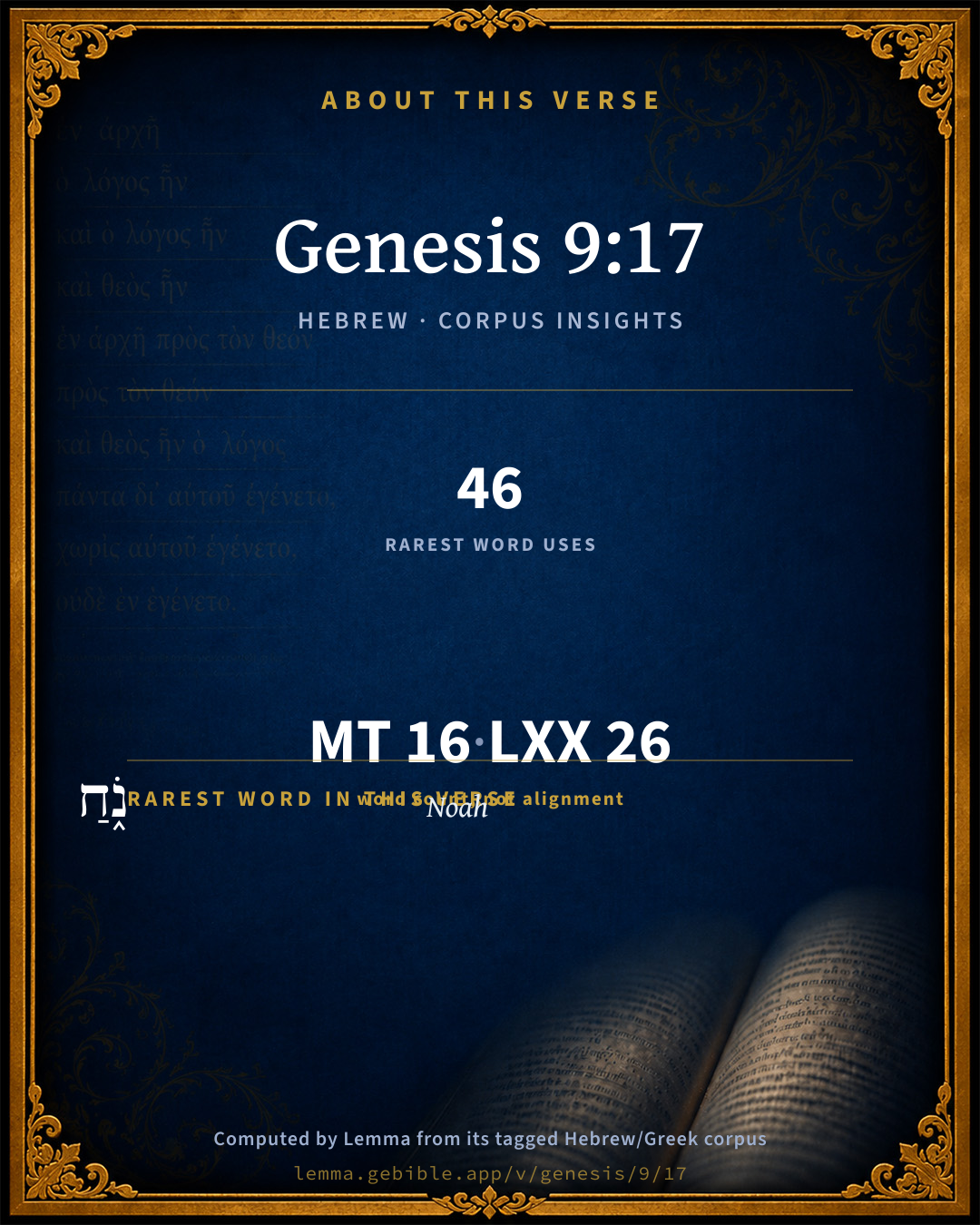
16
words
14
distinct lemmas
Pentateuch
section

Shared distinctive vocabulary

נֹ֑חַ Noah H5146 occurs in 39 verses of the Hebrew Bible. Also found in:

Grammatical profile

  • 2 verbs
  • 7 nouns
  • 1 pronoun
  • 4 prepositions
  • 2 particles

Verb forms

  • וַיֹּ֥אמֶר Qal · Sequential Imperfect
  • הֲקִמֹ֔תִי Hiphil · Perfect

Repetition

Words recur within this verse — often emphatic in Hebrew:

  • בֵּינִ֕י between H996 ×2
  • אֲשֶׁ֣ר which H834 ×2

Hebrew & Septuagint length

In English translation the verse runs 25 words from the Hebrew and 26 from the Septuagint (LXX English) — closely comparable.

A rough comparison of the two English renderings, which tokenize alike — not a word-level alignment.

Word counts can differ between the Hebrew and the Greek without any difference in meaning — e.g. the Hebrew direct-object marker אֵת has no separate Greek word, and Greek often adds the article ὁ.

In the original languages it is 16 Hebrew tokens and 26 Greek tokens — but the two are counted differently (Hebrew bundles its prefixes and suffixes into one token; the Greek is in lemma form), so that isn’t a like-for-like length.

Hebrew and Greek witnesses Masoretic Hebrew ↔ Greek Septuagint

The same verse in the two great witnesses to the Old Testament, shown verse-for-verse.

These are two independent witnesses, not word-aligned to each other, and the Septuagint is shown in lemma (dictionary) form.

Hebrew Genesis 9:17 Masoretic · Westminster Leningrad Codex

וַיֹּ֥אמֶר אֱלֹהִ֖ים אֶל נֹ֑חַ זֹ֤את אֽוֹת הַבְּרִית֙ אֲשֶׁ֣ר הֲקִמֹ֔תִי בֵּינִ֕י וּבֵ֥ין כָּל בָּשָׂ֖ר אֲשֶׁ֥ר עַל הָאָֽרֶץ

God said to Noah, "This is the token of the covenant which I have established between me and all flesh that is on the earth."

World English Bible · Public Domain

Greek LXX Genesis 9:17 Septuagint · lemma form

καί εἶπον ὁ θεός ὁ νωε οὗτος ὁ σημεῖον ὁ διαθήκη ὅς διατίθημι ἀνά μέσος ἐγώ καί ἀνά μέσος πᾶς σάρξ ὅς εἰμί ἐπί ὁ γῆ

And God said to Noe, This is the sign of the covenant, which I have made between me and all flesh, which is upon the earth.

LXX2012 (modern English Septuagint) · Public Domain

Hebrew: Westminster Leningrad Codex (CC BY 4.0). Greek: Septuagint (public domain); English from LXX2012 (modern English Septuagint) (Public Domain). How the Septuagint differs from the Hebrew →

Targum (Aramaic paraphrase)

2

The Targum is the ancient Jewish Aramaic paraphrase of the Hebrew Scriptures — an interpretive translation, not the Hebrew text itself. Onkelos (literal) and Pseudo-Jonathan (expansive) render the Torah, and Jonathan the Prophets. Coverage is partial: where no permissively-licensed English translation exists for a verse, only the Aramaic is shown. This is verse-level text, not a word-by-word alignment to the Hebrew.

  1. Targum Onkelos Torah (Genesis–Deuteronomy)
    וַאֲמַר יְיָ לְנֹחַ דָּא אָת קְיָם דִּי אֲקֵמִית בֵּין מֵימְרִי וּבֵין כָּל בִּשְׂרָא דִּי עַל אַרְעָא

    And the Lord said, This is the sign of the covenant which I have established between My Word and between all flesh which is upon the earth.

    Targum Onkelos — Aramaic: “Onkelos Genesis” (public domain); “Onkelos Exodus” (public domain); “Onkelos Leviticus” (public domain); “Onkelos Numbers” (public domain); “Onkelos Deuteronomy” (public domain). English: “Sefaria Community Translation” (CC0 1.0 (public-domain dedication)); “J.W. Etheridge. The Targums of Onkelos and Jonathan Ben Uzziel on the Pentateuch. London: Longmans, Green, 1862” (public domain). Text via Sefaria.

  2. Targum Pseudo-Jonathan Torah (Genesis–Deuteronomy)
    וַאֲמַר יְיָ לְנחַ דָא אָת קְיַים דְקַיְימִית בֵּין מֵימְרִי וּבֵין מֵימַר כָּל בִּסְרָא דְעַל אַרְעָא

    And the Lord said to Noah, This is the sign of the covenant that I have covenanted between My Word and between the word for all flesh that is upon the earth.

    Targum Pseudo-Jonathan — Aramaic: “Targum Jonathan on Genesis” (public domain); “Targum Jonathan on Exodus” (public domain); “Targum Jonathan on Leviticus” (public domain); “Targum Jonathan on Numbers” (public domain); “Targum Jonathan on Deuteronomy” (public domain). English: “The Targum of Jonathan ben Uzziel, trans. J. W. Etheridge, London, 1862” (public domain). Text via Sefaria.

Commentary

Notes on Genesis 9:17 from classic Christian and Jewish commentators (each source and its license shown beneath its notes). The classic Christian expositions comment on the surrounding passage and are grouped to its opening verse, so a note may address several verses; the Jewish commentaries on the Tanakh (Rashi and others) are per-verse, so they appear only where the commentator wrote on this verse.

Lemma curates 59 commentaries, every one of them public domain or Creative Commons licensed, each selected and text-cleaned for this edition rather than reprinted as found. About our sources →

Trapp's Complete Commentary

John Trapp

Gen 9:17 And God said unto Noah, This [is] the token of the covenant, which I have established between me and all flesh that [is] upon the earth.

Ver. 17. This is the token of the Covenant.] This is often repeated, {a} that it may be the better observed, and we full assured; as Pharaoh’s dream was for this cause doubled. God goes over the same thing often with us, as the knife doth the whetstone, which is the scriptural allusion. He well knows how slow of heart we are, and how dull of hearing; and therefore whets and beats things of high concernment upon us, that we may once apprehend andm embrace them. Christ is said to have "a rainbow on his head," {Rev 10:1} to show that he is faithful and constant in his promises, and that tempests shall blow over. Let us see God’s love in his corrections, as by a rainbow we see the beautiful image of the sun’s light, in the midst of a dark and waterish cloud.

{a} Deu 6:7. Exacues ea: id est, accurate et commodissime inculcabis. - Buxtorf. Lexic.

John Trapp, A Commentary or Exposition upon All the Books of the Old and New Testament (1647–1656) — public domain. Text from a community e-Sword module.

Geneva Bible (1599)

Geneva Bible translators

God doth repeat this the oftener, to confirm Noah’s faith so much the more.

Geneva Bible (1599) marginal notes — public domain. Text via Bolls.life.

Adam Clarke's Commentary

Verse 17. This is the token] אות oth, The Divine sign or portent: The bow shall be in the cloud. For the reasons above specified it must be there, when the circumstances already mentioned occur; if therefore it cannot fail because of the reasons before assigned, no more shall my promise; and the bow shall be the proof of its perpetuity.

Both the Greeks and Latins, as well as the Hebrews, have ever considered the rainbow as a Divine token or portent; and both of these nations have even deified it, and made it a messenger of the gods.

Homer, Il. xi., ver. 27, speaking of the figures on Agamemnon's breastplate, says there were three dragons, whose colours were

- - ιρισσιν εοικοτες, ἁς τε Κρονων.

Εν νεφεΐ στηριξε, τερας μεροπων ανθρωπων.

"like to the rainbow which the son of Saturn has placed in the cloud as a SIGN to mankind," or to men of various languages, for so the μεροπων αντρωπων of the poet has been understood. Some have thought that the ancient Greek writers give this epithet to man from some tradition of the confusion and multiplication of tongues at Babel; hence in this place the words may be understood as implying mankind at large, the whole human race; God having given the rainbow for a sign to all the descendants of Noah, by whom the whole earth was peopled after the flood. Thus the celestial bow speaks a universal language, understood by all the sons and daughters of Adam. Virgil, from some disguised traditionary figure of the truth, considers the rainbow as a messenger of the gods. AEn. v., ver. 606:

IRIM de caelo misit Saturnia Juno.

"Juno, the daughter of Saturn, sent down the rainbow from heaven;" and again, AEn. ix., ver. 803: -

aeriam caelo nam Jupiter IRIM Demisit.

"For Jupiter sent down the ethereal rainbow from heaven."

It is worthy of remark that both these poets understood the rainbow to be a sign, warning, or portent from heaven."

As I believe the rainbow to have been intended solely for the purpose mentioned in the text, I forbear to make spiritual uses and illustrations of it. Many have done this, and their observations may be very edifying, but they certainly have no foundation in the text.

Adam Clarke's Commentary on the Bible (1810–1826) — public domain. Text from a community e-Sword/MySword module.

The Cambridge Bible for Schools and Colleges

gen. ed. J. J. S. Perowne

17. This is the token, &c.] This verse, according to the style of P, reiterates the substance of 11–13.

The Cambridge Bible for Schools and Colleges (gen. ed. J. J. S. Perowne; Cambridge University Press, 1878–1918) — public domain. Text from a community e-Sword module.

John Gill's Exposition

And God said to Noah, this is the token of the covenant,.... Which is repeated for the greater confirmation and certainty of it, since the fears of men would be apt to run very high, especially while the flood was fresh in memory:

which I have established between me and all flesh that is upon the earth: see Gen 9:9, it is highly probable, that from the rainbow being the token of the covenant between God and Noah, and the creatures, sprung the fable of the Chinese concerning their first emperor, Fohi, who seems to be the same with Noah, and whom they call the son of heaven, and say he had no father; which is this, that his mother, walking on the bank of a lake near Lanthien, in the province of Xensi, trod upon a large footstep of a man impressed upon the sand, and from thence, being surrounded with the rainbow, conceived and brought forth Fohi (x).

(x) Martin. Sinic. Hist. p. 11.

John Gill's Exposition of the Whole Bible (1746–1763) — public domain (CC PDM 1.0). Text via the HelloAO Bible API.

Matthew Poole's English Annotations

The same thing is so oft repeated for the strengthening of the faith of all men, and especially of Noah and his sons, whom the remembrance of that dreadful deluge, which they had experience of, had made exceeding prone to fears of the like for time to come.

Matthew Poole's English Annotations on the Holy Bible (1683–1685) — public domain. Text from a community e-Sword/MySword module.

The Pulpit Commentary

And God said unto Noah, This is the token of the covenant. Murphy thinks that God here directed the patriarch"s attention to an actual rainbow; it seems more natural to conclude that from the beginning of the interview (Gen_8:20) the ark, altar, and worshippers were encircled by its variegated arch. Kalisch compares with the rainbow the other signs which God subsequently appended to his covenants; as, e.g., circumcision, (Gen_17:11) the passover, (Exo_12:13) the sabbath (ibid. 31:13). The Noachic covenant being universal, the sign was also universal meropwn ajnqrwpwn" (I1., 11:27), a sign to men of many tongues. The later covenants being limited to Israel, their signs were local and provisional, and have now been supplanted by the higher symbolism of the Christian Church, viz., baptism, the Lord"s Supper, and the Christian sabbath. Which I have established . The different verbs used in this passage in connection with tyriB may be here brought together.

1. tn; (ver. 12) representing the covenant as a gift of Divine grace.

2. sWq (Hiph.; vers. 9, 11, 17) exhibiting the covenant as something which God has both caused to stand and raised up when fallen.

3. rkz; (ver. 15) depicting the covenant as always present to the Divine mind. Tuch, Stahelin, and Delitzsch detect an idiosyncrasy of the Elohist in using the first and second of these verbs instead of trK; the favorite expression of the Jehovist. But trK; is used by the Elohist in Gen_21:27, Gen_21:32, while in Deu_4:18 the Jehovist uses syqihe. Between ms and all flesh that is upon the earth.

The Pulpit Commentary (1880–1919), ed. H.D.M. Spence-Jones & Joseph S. Exell — public domain. Text from a community e-Sword module.

Rashi

Rabbi Shlomo Yitzchaki (Rashi)

זאת אות הברית THIS IS THE SIGN OF THE COVENANT — He pointed to the rainbow, and said to him, “This is the sign of which I have spoken.”

Rashi on the Tanakh — English translations: “The Judaica Press complete Tanach with Rashi, translated by A. J. Rosenberg” (CC BY 4.0); “Pentateuch with Rashi's commentary by M. Rosenbaum and A.M. Silbermann, 1929-1934” (public domain); “The Metsudah Tanach series, Lakewood, N.J” (CC BY 4.0); and “The Book of Joshua, Metsudah Publications, 1997” (CC BY 4.0). Text via Sefaria.

Radak

Rabbi David Kimhi (Radak)

ויאמר אלוקים, G’d repeated His blessings a third time in order to reassure him beyond doubt. According to Bereshit Rabbah 38 our paragraph contains 6 covenants which were meant to correspond to the six days of the creation. If you were to question that actually there are 7, the answer is that the first one was needed in its own right, and cannot be used to relate to other matters. [what are meant by “6 covenants,” are the 6 (respectively 7) separate utterances reported by G’d in this paragraph, utterances which could have been considerably condensed by the use of longer sentences and conjunctive letters. Ed.]

Radak on the Tanakh — English translations: “Sefaria Community Translation” (CC0 1.0 (public-domain dedication)); “Eliyahu Munk, HaChut Hameshulash” (CC BY 4.0); “Rabbi Mike Feuer, Jerusalem Anthology” (CC BY 4.0); and “R. David Kimhi on the first book of Psalms, Translated by R.G. Finch, London, 1919” (public domain). Text via Sefaria.

Lesson kit

Teaching starters — assembled from the data on this page, not authored interpretation. Every prompt links to the verse data it draws on. Edit before teaching.

Genesis, in the Pentateuch, opens this verse with 16 words (14 distinct Hebrew lemmas). Its most distinctive word is Nôach (“Noah”). A historical commentator’s framing appears above. Read the whole chapter for the surrounding context.

Discussion questions

  1. The word Nôach carries the sense “Noah.” How does it shape the verse?
  2. How does Genesis 5:29, which shares the word «Noah», read alongside this verse?
  3. What does the repetition of “between” (2× in this one verse) do in this verse?
  4. These translations render this verse differently. What is at stake in choosing one wording over another?
  5. «וַיֹּ֥אמֶר» is a Qal Sequential Imperfect verb. How does that grammatical form shape the action described?
  6. Compare how Trapp's Complete Commentary and Geneva Bible (1599) read this verse. Where do they agree or differ?

Things to notice

Reading settings

Reading text

Shown beneath each verse's original-language words.

Old Testament
Old Testament edition

Read the OT as the Masoretic Hebrew (MT) or the Greek Septuagint (LXX).

English shown for the Greek Septuagint (in the Hebrew ↔ Greek comparison).

Comparing translations? Open the Compare panel on any verse page to stack up to four side by side.