Joshua 19:16

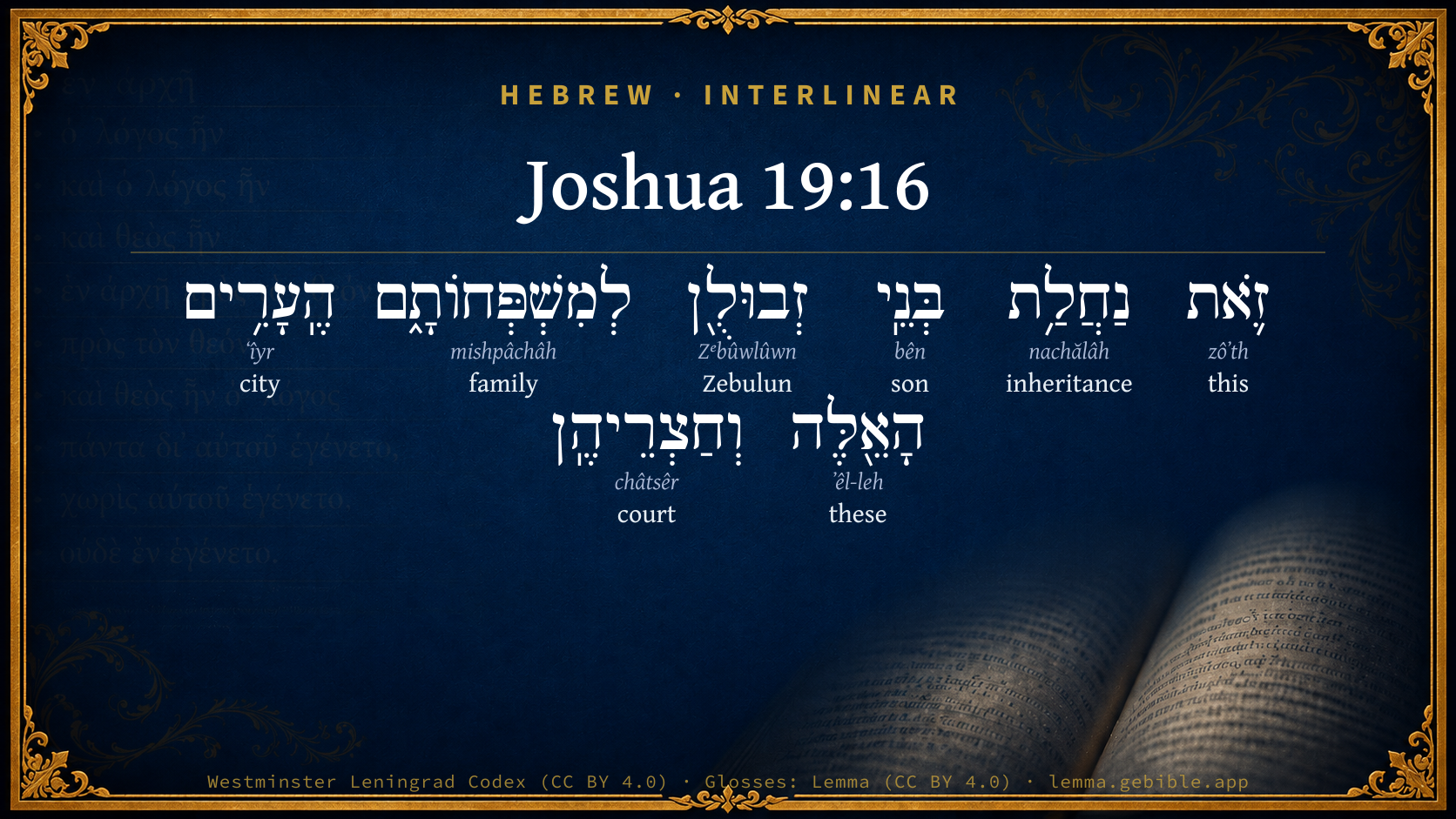
Hebrew (Westminster Leningrad Codex) Joshua 19:16 appears in the Hebrew Old Testament. The text above is from the Westminster Leningrad Codex. Each word links to its Strong’s number, a concise gloss, and parsing drawn from the Open Scriptures Hebrew Bible morphology. Click any word for its full Brown-Driver-Briggs (BDB) entry.
Download image
Cite this verse

Joshua 19:16 (World English Bible). Public Domain. Lemma interlinear Bible study tool, https://lemma.gebible.app/v/joshua/19/16.

Show BibTeX & RIS
BibTeX
RIS
English Translation
This is the inheritance of the children of Zebulun according to their families, these cities with their villages.
World English Bible · Public Domain
Download a study sheet

One document with this verse’s original text, its word-by-word gloss line, the meaning frame, cross-references with their text, attributed commentary, and full source and license credits — printable, and it pastes into notes with its structure intact.

This verse Autodidact and up

Study sheet (.html) Plain text (.txt)

A passage Seminary Student

Up to 50 verses in one chapter. A passage sheet keeps up to 6 commentary sources and 12 cross-references per verse, in the order this page ranks them, and says so on the sheet whenever that leaves anything out. Ask for a single verse and you get the Autodidact verse sheet above.

Everything on this page stays free to read, with no account — the sheet is a download of what is already on screen, not access to it.

Want to remove ads? Support Godless Engineer
Compare translations 3

The same verse in 3 English versions, stacked beneath the original-language interlinear above. Click any original word for its lexicon entry.

Each is an independent rendering of the whole verse — the interlinear is not word-aligned to these translations.

Highlighted words mark where these versions differ — a whole-verse word diff, not a word-by-word alignment.

  • World English Bible Public Domain
    This is the inheritance of the children of Zebulun according to their families, these cities with their villages.
  • King James Version Public Domain
    This is the inheritance of the children of Zebulun according to their families, these cities with their villages.
  • unfoldingWord Literal Text CC BY-SA 4.0
    This the inheritance of the sons of Zebulun according to their clans, these cities, and their villages.

unfoldingWord Literal Text — © unfoldingWord, licensed CC BY-SA 4.0. Word-aligned USFM3 via Door43 (git.door43.org/unfoldingWord/en_ult).

Versions to compare (up to 4)

3 of 4 selected

Show all 18 translations

Every available English version of this verse, each an independent rendering of the whole verse.

  • World English Bible Public Domain
    This is the inheritance of the children of Zebulun according to their families, these cities with their villages.
  • Berean Standard Bible Public Domain
    This was the inheritance of the clans of the tribe of Zebulun, including these cities and their villages.
  • Majority Standard Bible Public Domain
    This was the inheritance of the clans of the tribe of Zebulun, including these cities and their villages.
  • King James Version Public Domain
    This is the inheritance of the children of Zebulun according to their families, these cities with their villages.
  • American Standard Version (1901) Public Domain
    This is the inheritance of the children of Zebulun according to their families, these cities with their villages.
  • Revised Version (1885) Public Domain
    This is the inheritance of the children of Zebulun according to their families, these cities with their villages.
  • Geneva Bible (1599) Public Domain
    This is the inheritance of the children of Zebulun according to their families: that is, these cities and their villages.
  • Douay-Rheims (1899) Public Domain
    This is the inheritance of the tribe of the children of Zabulon by their kindreds, the cities and their villages.
  • Young's Literal Translation Public Domain
    This `is' the inheritance of the sons of Zebulun, for their families, these cities and their villages.
  • Literal Standard Version CC BY-SA 4.0
    This [is] the inheritance of the sons of Zebulun, for their families, these cities and their villages.
  • Unlocked Literal Bible CC BY-SA 4.0
    This was the inheritance of the tribe of Zebulun, clan by clan, including these cities, including their villages.
  • unfoldingWord Literal Text CC BY-SA 4.0
    This the inheritance of the sons of Zebulun according to their clans, these cities, and their villages.
  • Darby Bible Public Domain
    This was the inheritance of the children of Zebulun according to their families, these cities and their hamlets.
  • World Messianic Bible Public Domain
    This is the inheritance of the children of Zebulun according to their families, these cities with their villages.
  • Webster's Bible Public Domain
    This is the inheritance of the children of Zebulun according to their families, these cities with their villages.
  • Free Bible Version CC BY-SA 4.0
    This was the allocation—the land, towns, and villages—given to the tribe of Zebulun, by families.
  • Bible in Basic English Public Domain
    This is the heritage of the children of Zebulun by their families, these towns with their unwalled places.
  • JPS Tanakh (1917) Public Domain
    This is the inheritance of the children of Zebulun according to their families, these cities with their villages.

Literal Standard Version (2020), Covenant Press — licensed CC BY-SA 4.0. Text via the HelloAO Bible API (eBible.org). Unlocked Literal Bible (unfoldingWord) — licensed CC BY-SA 4.0. Text via the HelloAO Bible API (eBible.org). unfoldingWord Literal Text — © unfoldingWord, licensed CC BY-SA 4.0. Word-aligned USFM3 via Door43 (git.door43.org/unfoldingWord/en_ult). Free Bible Version, Dr. Jonathan Gallagher — licensed CC BY-SA 4.0. Text via the HelloAO Bible API (eBible.org).

Word by word

More ways to search: Search by grammar → Find every occurrence → Compare this word →

Practice this passage: Drill this verse → Learn its vocabulary →

זְבוּלֻ֖ן
Zᵉbûwlûwn
H2074
“Zebulun”
Noun, Proper
Part of Speech
Noun
Type
Proper
Full BDB Definition

Origin: from H2082

TWOT: 526b

Zebulun = "exalted" - the 10th of the sons of Jacob, 6th and last of Leah; progenitor of Zebulun (noun proper masculine) - the tribe descended from Zebulun (noun proper masculine) - the land allocated to the tribe of Zebulun (noun proper locative)
  1. זֹ֛את zôʼth H2063 “this” Pronoun, Demonstrative, Feminine, Singular
  2. נַחֲלַ֥ת nachălâh H5159 “inheritance of” Noun, Common, Feminine, Singular, Construct
  3. בְּנֵֽי bên H1121 “sons of” Noun, Common, Masculine, Plural, Construct
  4. לְמִשְׁפְּחוֹתָ֑ם mishpâchâh H4940 “to/for · families · their” Preposition + Noun, Common, Feminine, Plural, Construct + Suffix, Personal, 3rd Person, Masculine, Plural
  5. הֶֽעָרִ֥ים ʻîyr H5892 “the · cities” Particle, Definite Article + Noun, Common, Feminine, Plural, Absolute
  6. הָאֵ֖לֶּה ʼêl-leh H428 “the · these” Particle, Definite Article + Pronoun, Demonstrative, Common, Plural
  7. וְחַצְרֵיהֶֽן châtsêr H2691 “and · courts · their” Conjunction + Noun, Common, Both, Plural, Construct + Suffix, Personal, 3rd Person, Feminine, Plural

About this verse

These counts appear in no published source. They are computed here, from the morphology-tagged text and Lemma’s own curated glosses. What Lemma adds →

8
words
8
distinct lemmas
Historical
section

Shared distinctive vocabulary

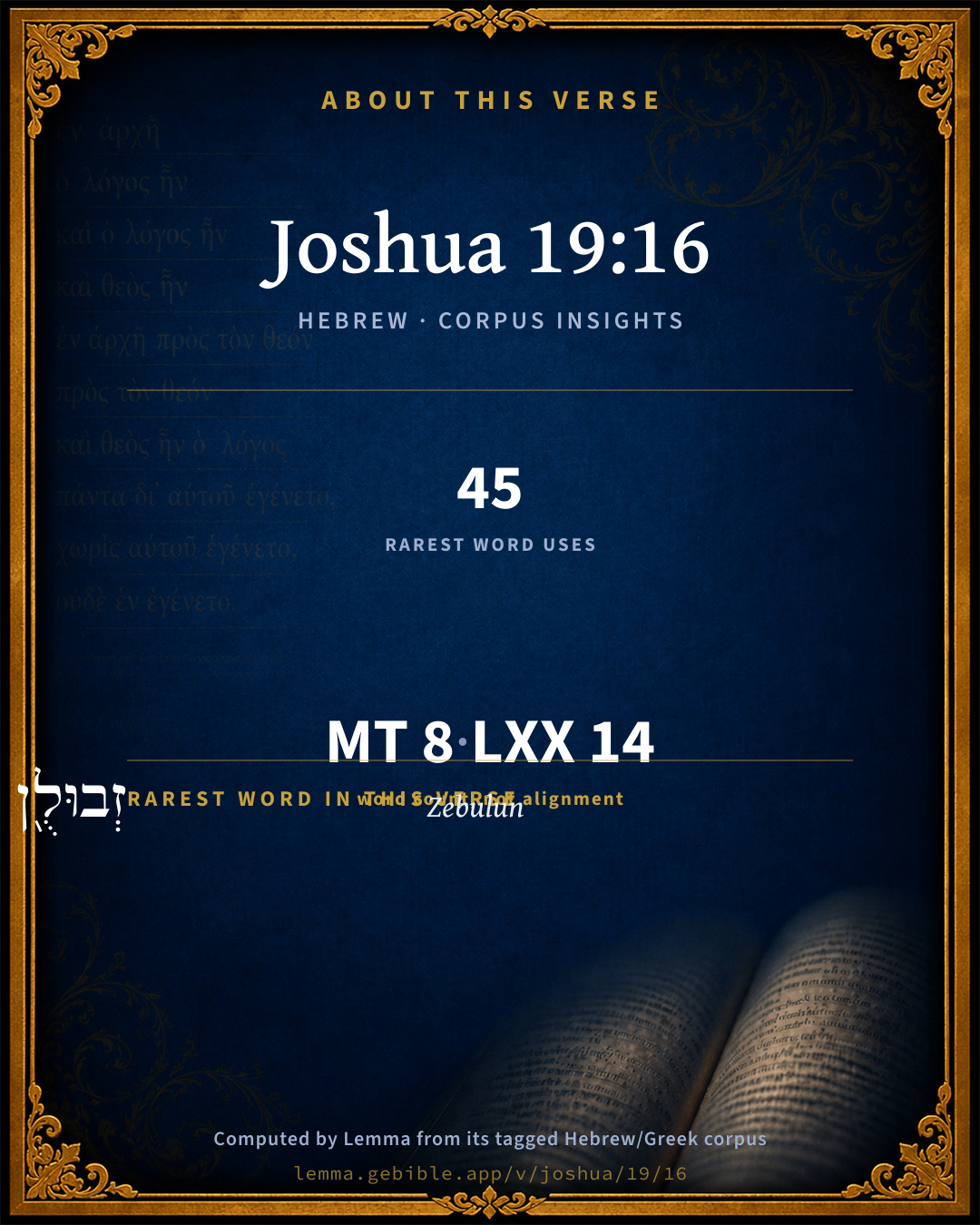
זְבוּלֻ֖ן Zebulun H2074 occurs in 43 verses of the Hebrew Bible. Also found in:

Grammatical profile

  • 6 nouns
  • 2 pronouns

Hebrew & Septuagint length

In English translation the verse runs 18 words from the Hebrew and 21 from the Septuagint (LXX English) — closely comparable.

A rough comparison of the two English renderings, which tokenize alike — not a word-level alignment.

Word counts can differ between the Hebrew and the Greek without any difference in meaning — e.g. the Hebrew direct-object marker אֵת has no separate Greek word, and Greek often adds the article ὁ.

In the original languages it is 8 Hebrew tokens and 14 Greek tokens — but the two are counted differently (Hebrew bundles its prefixes and suffixes into one token; the Greek is in lemma form), so that isn’t a like-for-like length.

Hebrew and Greek witnesses Masoretic Hebrew ↔ Greek Septuagint

The same verse in the two great witnesses to the Old Testament, shown verse-for-verse.

These are two independent witnesses, not word-aligned to each other, and the Septuagint is shown in lemma (dictionary) form.

Hebrew Joshua 19:16 Masoretic · Westminster Leningrad Codex

זֹ֛את נַחֲלַ֥ת בְּנֵֽי זְבוּלֻ֖ן לְמִשְׁפְּחוֹתָ֑ם הֶֽעָרִ֥ים הָאֵ֖לֶּה וְחַצְרֵיהֶֽן

This is the inheritance of the children of Zebulun according to their families, these cities with their villages.

World English Bible · Public Domain

Greek LXX Joshua 19:16 Septuagint · lemma form

οὗτος ὁ κληρονομία φυλή υἱός ζαβουλων κατά δῆμος αὐτός πόλις καί ὁ κώμη αὐτός

This is the inheritance of the tribe of the sons of Zabulon according to their families, these cities and their villages.

LXX2012 (modern English Septuagint) · Public Domain

Hebrew: Westminster Leningrad Codex (CC BY 4.0). Greek: Septuagint (public domain); English from LXX2012 (modern English Septuagint) (Public Domain). How the Septuagint differs from the Hebrew →

Targum (Aramaic paraphrase)

1

The Targum is the ancient Jewish Aramaic paraphrase of the Hebrew Scriptures — an interpretive translation, not the Hebrew text itself. Onkelos (literal) and Pseudo-Jonathan (expansive) render the Torah, and Jonathan the Prophets. Coverage is partial: where no permissively-licensed English translation exists for a verse, only the Aramaic is shown. This is verse-level text, not a word-by-word alignment to the Hebrew.

  1. Targum Jonathan Prophets (Joshua–Malachi)
    דָא אַחְסָנַת בְּנֵי זְבוּלֻן לְזַרְעֲיַתְהוֹן קִרְוַיָא הָאִלֵין וּפַצְחֵיהֶן:

    (no public-domain English translation for this verse)

    Targum Jonathan — Aramaic: “Mikraot Gedolot” (public domain). English: “Sefaria Community Translation” (CC0 1.0 (public-domain dedication)); “London "Chaldee Paraphrase," 1871” (public domain). Text via Sefaria.

Commentary

Notes on Joshua 19:16 from classic Christian and Jewish commentators (each source and its license shown beneath its notes). The classic Christian expositions comment on the surrounding passage and are grouped to its opening verse, so a note may address several verses; the Jewish commentaries on the Tanakh (Rashi and others) are per-verse, so they appear only where the commentator wrote on this verse.

Lemma curates 59 commentaries, every one of them public domain or Creative Commons licensed, each selected and text-cleaned for this edition rather than reprinted as found. About our sources →

Tyndale Open Study Notes

Tyndale Open Resources

19:16 Both by number of towns and by size of its territory, Zebulun was smallest of all the tribes. However, the New Testament village of Nazareth, where Jesus grew up, was in the tribal territory of Zebulun (Matt 2:19-23; 4:13-16).

Tyndale Open Study Notes — © Tyndale Open Resources, licensed CC BY-SA 4.0. Text via the HelloAO Bible API.

The Cambridge Bible for Schools and Colleges

gen. ed. J. J. S. Perowne

16. This is the inheritance of the children of Zebulun] It is evidently impossible in the present state of our knowledge exactly to define the limits of this tribe. But it seems to have reached on the one side nearly to the lake of Gennesareth, and on the other to Carmel and the Mediterranean. It enclosed one of the fairest portions of Palestine. Besides the fertile plain near the fisheries of the lake of Gennesareth, and the rich mountain-valleys, the tribe possessed the goings out, the outlet, of the plain of Akka (Deu_33:18), where he could “dwell at the shore,” and “suck of the abundance of the seas” (Gen_49:13; Deu_33:19). But though possessing a district excelling in natural beauty and fertility, Zebulun, like the other northern tribes, occupies quite a subordinate position in Old Testament History. We read of it as emerging from its obscurity only on two occasions; (a) first, when side by side with Naphtali the men of the tribe “jeoparded their lives unto the death” upon “the high places” of Tabor in the contest with Sisera; and (b) secondly, when fifty thousand “expert in war,” with “all instruments of war,” came up to the coronation of David at Hebron (1Ch_12:33).

The Cambridge Bible for Schools and Colleges (gen. ed. J. J. S. Perowne; Cambridge University Press, 1878–1918) — public domain. Text from a community e-Sword module.

John Gill's Exposition

And the fourth lot came out to Issachar,.... The fourth of the seven drawn at Shiloh:

for the children of Issachar, according to their families: among whom the inheritance that came to them by the lot was divided, according to the number of them.

John Gill's Exposition of the Whole Bible (1746–1763) — public domain (CC PDM 1.0). Text via the HelloAO Bible API.

The Pulpit Commentary

The inheritance of the children of Zebulun. It is strange that the beautiful and fertile land occupied by the tribe of Zebulun does not appear to have brought prosperity with it. Possibly the fact that the "lines" of this tribe had "fallen in pleasant places," had tended to induce sloth. Certain it is that we hear but little of this tribe in the after history of Israel. They were not, like Reuben, absent from the great battle of Tabor, for there we read that, like Issachar, they "jeoparded their lives unto the death" for their homes and liberties. Yet though they seem thenceforth to have slackened in their zeal, theirs was a fair portion. It bordered on the slopes of Tabor, and seems (though the fact is not mentioned here) to have extended to the Sea of Galilee, as we may gather from Isa_9:1.

The Pulpit Commentary (1880–1919), ed. H.D.M. Spence-Jones & Joseph S. Exell — public domain. Text from a community e-Sword module.

Lesson kit

Teaching starters — assembled from the data on this page, not authored interpretation. Every prompt links to the verse data it draws on. Edit before teaching.

Joshua, in the Historical, opens this verse with 8 words (8 distinct Hebrew lemmas). Its most distinctive word is Zᵉbûwlûwn (“Zebulun”). A historical commentator’s framing appears above. Read the whole chapter for the surrounding context.

Discussion questions

  1. The word Zᵉbûwlûwn carries the sense “Zebulun.” How does it shape the verse?
  2. How does Genesis 30:20, which shares the word «Zebulun», read alongside this verse?
  3. These translations render this verse differently. What is at stake in choosing one wording over another?
  4. Compare how Tyndale Open Study Notes and The Cambridge Bible for Schools and Colleges read this verse. Where do they agree or differ?

Things to notice

Reading settings

Reading text

Shown beneath each verse's original-language words.

Old Testament
Old Testament edition

Read the OT as the Masoretic Hebrew (MT) or the Greek Septuagint (LXX).

English shown for the Greek Septuagint (in the Hebrew ↔ Greek comparison).

Comparing translations? Open the Compare panel on any verse page to stack up to four side by side.