
Jeremiah 9:24

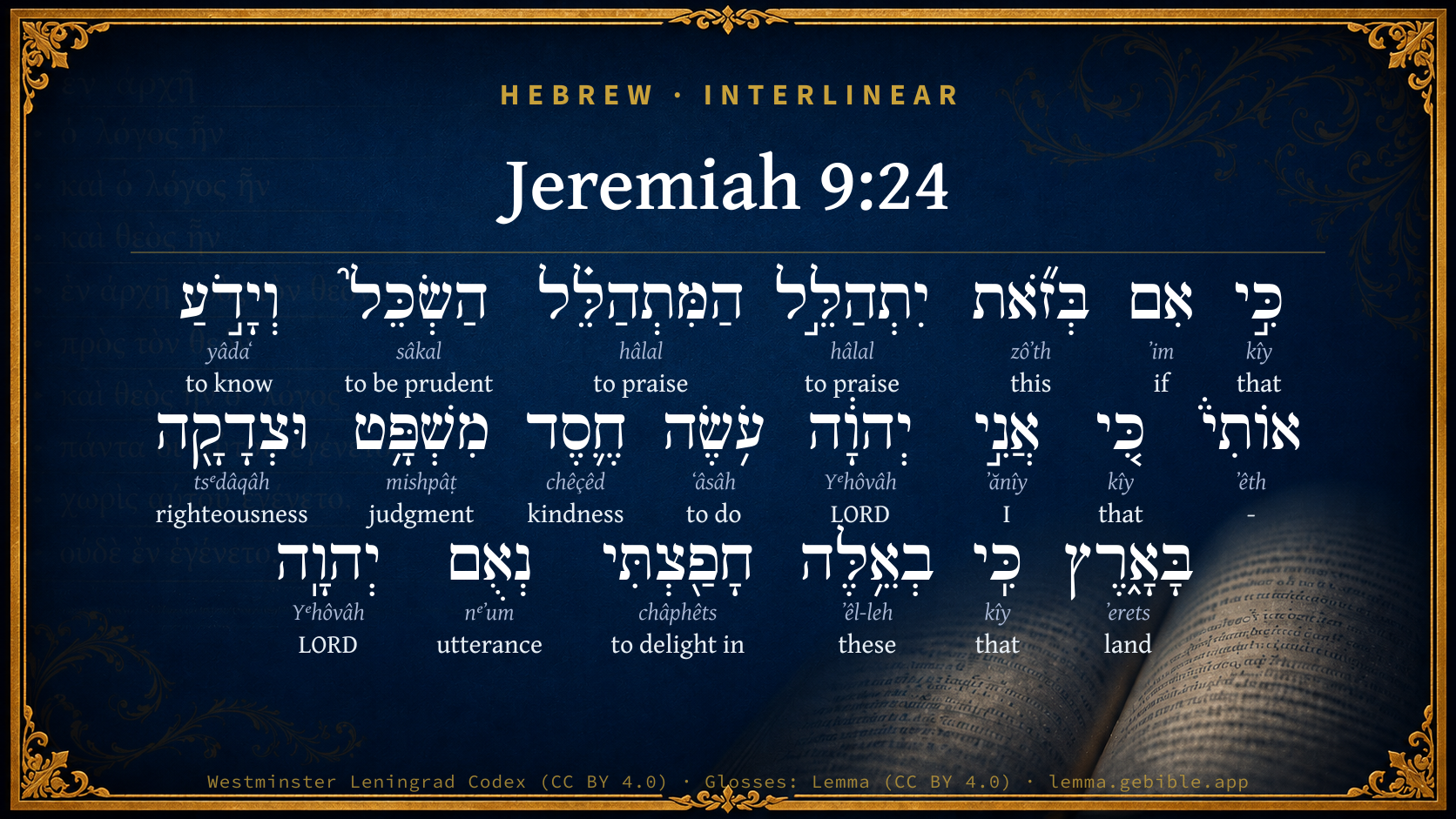
Hebrew (Westminster Leningrad Codex) Jeremiah 9:24 appears in the Hebrew Old Testament. The text above is from the Westminster Leningrad Codex. Each word links to its Strong’s number, a concise gloss, and parsing drawn from the Open Scriptures Hebrew Bible morphology. Click any word for its full Brown-Driver-Briggs (BDB) entry.
Download image
Cite this verse

Jeremiah 9:24 (World English Bible). Public Domain. Lemma interlinear Bible study tool, https://lemma.gebible.app/v/jeremiah/9/24.

Show BibTeX & RIS
BibTeX
RIS
English Translation
but let him who glories glory in this, that he has understanding, and knows me, that I am Yahweh who exercises loving kindness, justice, and righteousness, in the earth: for in these things I delight, says Yahweh.
World English Bible · Public Domain
Download a study sheet

One document with this verse’s original text, its word-by-word gloss line, the meaning frame, cross-references with their text, attributed commentary, and full source and license credits — printable, and it pastes into notes with its structure intact.

This verse Autodidact and up

Study sheet (.html) Plain text (.txt)

A passage Seminary Student

Up to 50 verses in one chapter. A passage sheet keeps up to 6 commentary sources and 12 cross-references per verse, in the order this page ranks them, and says so on the sheet whenever that leaves anything out. Ask for a single verse and you get the Autodidact verse sheet above.

Everything on this page stays free to read, with no account — the sheet is a download of what is already on screen, not access to it.

Want to remove ads? Support Godless Engineer
Compare translations 3

The same verse in 3 English versions, stacked beneath the original-language interlinear above. Click any original word for its lexicon entry.

Each is an independent rendering of the whole verse — the interlinear is not word-aligned to these translations.

Highlighted words mark where these versions differ — a whole-verse word diff, not a word-by-word alignment.

  • World English Bible Public Domain
    but let him who glories glory in this, that he has understanding, and knows me, that I am Yahweh who exercises loving kindness, justice, and righteousness, in the earth: for in these things I delight, says Yahweh.
  • King James Version Public Domain
    But let him that glorieth glory in this, that he understandeth and knoweth me, that I am the LORD which exercise lovingkindness, judgment, and righteousness, in the earth: for in these things I delight, saith the LORD.
  • unfoldingWord Literal Text CC BY-SA 4.0
    But let him who boasts, boast in this, understanding and knowing me, that I Yahweh, the one doing covenant faithfulness, justice and righteousness in the earth, for in these I take pleasure—the declaration of Yahweh.”

unfoldingWord Literal Text — © unfoldingWord, licensed CC BY-SA 4.0. Word-aligned USFM3 via Door43 (git.door43.org/unfoldingWord/en_ult).

Versions to compare (up to 4)

3 of 4 selected

Show all 18 translations

Every available English version of this verse, each an independent rendering of the whole verse.

  • World English Bible Public Domain
    but let him who glories glory in this, that he has understanding, and knows me, that I am Yahweh who exercises loving kindness, justice, and righteousness, in the earth: for in these things I delight, says Yahweh.
  • Berean Standard Bible Public Domain
    But let him who boasts boast in this, that he understands and knows Me, that I am the LORD, who exercises loving devotion, justice and righteousness on the earth—for I delight in these things,” declares the LORD.
  • Majority Standard Bible Public Domain
    But let him who boasts boast in this, that he understands and knows Me, that I am the LORD, who exercises loving devotion, justice and righteousness on the earth—for I delight in these things,” declares the LORD.
  • King James Version Public Domain
    But let him that glorieth glory in this, that he understandeth and knoweth me, that I am the LORD which exercise lovingkindness, judgment, and righteousness, in the earth: for in these things I delight, saith the LORD.
  • American Standard Version (1901) Public Domain
    but let him that glorieth glory in this, that he hath understanding, and knoweth me, that I am Jehovah who exerciseth lovingkindness, justice, and righteousness, in the earth: for in these things I delight, saith Jehovah.
  • Revised Version (1885) Public Domain
    but let him that glorieth glory in this, that he understandeth, and knoweth me, that I am the LORD which exercise lovingkindness, judgment, and righteousness, in the earth: for in these things I delight, saith the LORD.
  • Geneva Bible (1599) Public Domain
    But let him that glorieth, glorie in this, that he vnderstandeth, and knoweth me: for I am the Lord, which shewe mercie, iudgement, and righteousnes in the earth: for in these things I delite, sayth the Lord.
  • Douay-Rheims (1899) Public Domain
    But let him that glorieth glory in this, that he understandeth and knoweth me, for I am the Lord that exercise mercy, and judgment, and justice in the earth: for these things please me, saith the Lord.
  • Young's Literal Translation Public Domain
    But -- in this let the boaster boast himself, In understanding and knowing Me, For I `am' Jehovah, doing kindness, Judgment, and righteousness, in the earth, For in these I have delighted, An affirmation of Jehovah.
  • Literal Standard Version CC BY-SA 4.0
    But let the boaster boast himself in this, || In understanding and knowing Me, || For I [am] YHWH, doing kindness, || Judgment, and righteousness, in the earth, || For I have delighted in these,” || A declaration of YHWH.
  • Unlocked Literal Bible CC BY-SA 4.0
    For if a man takes pride in anything, let it be in this, that he has insight and knows me. For I am Yahweh, who acts with covenant loyalty, justice and righteousness on earth. For it is in these that I take pleasure —this is Yahweh's declaration.”
  • unfoldingWord Literal Text CC BY-SA 4.0
    But let him who boasts, boast in this, understanding and knowing me, that I Yahweh, the one doing covenant faithfulness, justice and righteousness in the earth, for in these I take pleasure—the declaration of Yahweh.”
  • Darby Bible Public Domain
    but let him that glorieth glory in this, that he understandeth and knoweth me, that I [am] Jehovah, who exercise loving-kindness, judgment, and righteousness in the earth; for in these things I delight, saith Jehovah.
  • World Messianic Bible Public Domain
    But let him who glories glory in this, that he has understanding, and knows me, that I am the LORD who exercises loving kindness, justice, and righteousness in the earth, for I delight in these things,” says the LORD.
  • Webster's Bible Public Domain
    But let him that glorieth, glory in this, that he understandeth and knoweth me, that I am the LORD who exercise loving-kindness, judgment, and righteousness, in the earth: for in these things I delight, saith the LORD.
  • Free Bible Version CC BY-SA 4.0
    Anyone who wants to boast should boast that they really know and understand me, recognizing that I am the Lord who acts with trustworthy love, who shows fairness, and who does what is right everywhere on earth, because these mean the most to me, declares the Lord.
  • Bible in Basic English Public Domain
    But if any man has pride, let it be in this, that he has the wisdom to have knowledge of me, that I am the Lord, working mercy, giving true decisions, and doing righteousness in the earth: for in these things I have delight, says the Lord.
  • JPS Tanakh (1917) Public Domain
    (9-23) But let him that glorieth glory in this, that he understandeth, and knoweth Me, that I am the LORD who exercise mercy, justice, and righteousness, in the earth; for in these things I delight, saith the LORD.

Literal Standard Version (2020), Covenant Press — licensed CC BY-SA 4.0. Text via the HelloAO Bible API (eBible.org). Unlocked Literal Bible (unfoldingWord) — licensed CC BY-SA 4.0. Text via the HelloAO Bible API (eBible.org). unfoldingWord Literal Text — © unfoldingWord, licensed CC BY-SA 4.0. Word-aligned USFM3 via Door43 (git.door43.org/unfoldingWord/en_ult). Free Bible Version, Dr. Jonathan Gallagher — licensed CC BY-SA 4.0. Text via the HelloAO Bible API (eBible.org).

Word by word

More ways to search: Search by grammar → Find every occurrence → Compare this word →

Practice this passage: Drill this verse → Learn its vocabulary →

הַשְׂכֵּל֮
sâkal
H7919
“to be prudent”
Verb, Hiphil, Infinitive Absolute
Part of Speech
Verb
Stem
Hiphil
Form
Infinitive Absolute
Full BDB Definition

Origin: a primitive root

TWOT: 2263 , 2264

to be prudent, be circumspect, wisely understand, prosper - (Qal) to be prudent, be circumspect - (Hiphil) - to look at or upon, have insight - to give attention to, consider, ponder, be prudent - to have insight, have comprehension - insight, comprehension (substantive) - to cause to consider, give insight, teach - the teachers, the wise - to act circumspectly, act prudently, act wisely - to prosper, have success - to cause to prosper - (Piel) to lay crosswise, cross (hands)
  1. כִּ֣י kîy H3588 “that” Conjunction
  2. אִם ʼim H518 “if” Conjunction
  3. בְּזֹ֞את zôʼth H2063 “in/at · this” Preposition + Pronoun, Demonstrative, Feminine, Singular
  4. יִתְהַלֵּ֣ל hâlal H1984 “to praise” Verb, Hithpael, Imperfect, 3rd Person, Masculine, Singular
  5. הַמִּתְהַלֵּ֗ל hâlal H1984 “the · praising” Particle, Definite Article + Verb, Hithpael, Participle Active, Masculine, Singular, Absolute
  6. וְיָדֹ֣עַ yâdaʻ H3045 “and · to know” Conjunction + Verb, Qal, Infinitive Absolute
  7. אוֹתִי֒ ʼêth H853 “- · me” Particle, Direct Object + Suffix, Personal, 1st Person, Common, Singular
  8. כִּ֚י kîy H3588 “that” Conjunction
  9. אֲנִ֣י ʼănîy H589 “I” Pronoun, Personal, 1st Person, Common, Singular
  10. יְהוָ֔ה Yᵉhôvâh H3068 “LORD” Noun, Proper
  11. עֹ֥שֶׂה ʻâsâh H6213 “doing” Verb, Qal, Participle Active, Masculine, Singular, Absolute
  12. חֶ֛סֶד chêçêd H2617 “kindness” Noun, Common, Masculine, Singular, Absolute
  13. מִשְׁפָּ֥ט mishpâṭ H4941 “judgment” Noun, Common, Masculine, Singular, Absolute
  14. וּצְדָקָ֖ה tsᵉdâqâh H6666 “and · righteousness” Conjunction + Noun, Common, Feminine, Singular, Absolute
  15. בָּאָ֑רֶץ ʼerets H776 “in/at the · land” Preposition, Determined + Noun, Common, Both, Singular, Absolute
  16. כִּֽי kîy H3588 “that” Conjunction
  17. בְאֵ֥לֶּה ʼêl-leh H428 “in/at · these” Preposition + Pronoun, Demonstrative, Common, Plural
  18. חָפַ֖צְתִּי châphêts H2654 “to delight in” Verb, Qal, Perfect, 1st Person, Common, Singular
  19. נְאֻם nᵉʼum H5002 “utterance of” Noun, Common, Masculine, Singular, Construct
  20. יְהוָֽה Yᵉhôvâh H3068 “LORD” Noun, Proper

About this verse

These counts appear in no published source. They are computed here, from the morphology-tagged text and Lemma’s own curated glosses. What Lemma adds →

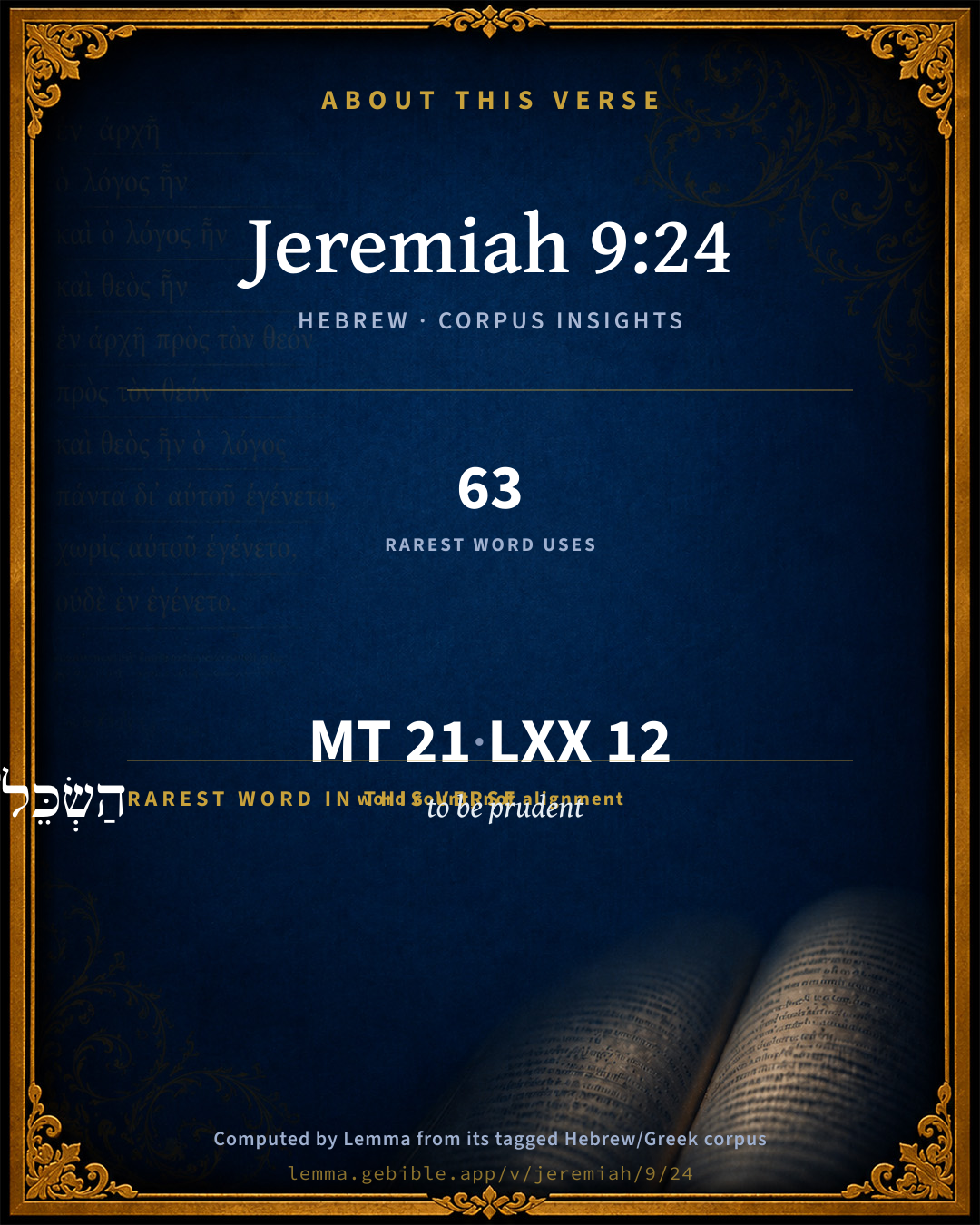
21
words
17
distinct lemmas
Prophets
section

Grammatical profile

  • 6 verbs
  • 7 nouns
  • 3 pronouns
  • 4 conjunctions
  • 1 particle

Verb forms

  • יִתְהַלֵּ֣ל Hithpael · Imperfect
  • הַמִּתְהַלֵּ֗ל Hithpael · Participle Active
  • הַשְׂכֵּל֮ Hiphil · Infinitive Absolute
  • וְיָדֹ֣עַ Qal · Infinitive Absolute
  • עֹ֥שֶׂה Qal · Participle Active
  • חָפַ֖צְתִּי Qal · Perfect

Repetition

Words recur within this verse — often emphatic in Hebrew:

  • יִתְהַלֵּ֣ל to praise H1984 ×2
  • יְהוָ֔ה LORD H3068 ×2
  • כִּ֣י that H3588 ×3

Hebrew & Septuagint length

In the original languages it is 21 Hebrew tokens and 12 Greek tokens — but the two are counted differently (Hebrew bundles its prefixes and suffixes into one token; the Greek is in lemma form), so that isn’t a like-for-like length.

Cross-references

23

Topical passages linked to Jeremiah 9:24 in the Treasury of Scripture Knowledge — connected by theme and wording, ordered by reader-vote popularity; previews shown in the World English Bible.

  • 2 Corinthians 10:17 But "he who boasts, let him boast in the Lord."
  • Galatians 6:14 But far be it from me to boast, except in the cross of our Lord Jesus Christ, through which the world has been crucified to me, and I to the world.
  • 1 Corinthians 1:31 that, according as it is written, "He who boasts, let him boast in the Lord."
  • Micah 6:8 He has shown you, O man, what is good. What does Yahweh require of you, but to act justly, To love mercy, and to walk humbly with your God?
  • Micah 7:18 Who is a God like you, who pardons iniquity, And passes over the disobedience of the remnant of his heritage? He doesn't retain his anger forever, Because he delights in loving kindness.
  • Psalms 44:8 In God we have made our boast all day long, We will give thanks to your name forever. Selah.
  • 1 John 5:20 We know that the Son of God has come, and has given us an understanding, that we know him who is true, and we are in him who is true, in his Son Jesus Christ. This is the true God, and eternal life.
  • Psalms 146:7–9 Who executes justice for the oppressed; Who gives food to the hungry. Yahweh frees the prisoners.
  • John 17:3 This is eternal life, that they should know you, the only true God, and him whom you sent, Jesus Christ.
  • Psalms 36:5–7 Your loving kindness, Yahweh, is in the heavens. Your faithfulness reaches to the skies.
  • 1 Samuel 15:22 Samuel said, Has Yahweh as great delight in burnt offerings and sacrifices, as in obeying the voice of Yahweh? Behold, to obey is better than sacrifice, and to listen than the fat of rams.
  • Psalms 51:1 Have mercy on me, God, according to your loving kindness. According to the multitude of your tender mercies, blot out my transgressions.
  • Psalms 91:14 "Because he has set his love on me, therefore I will deliver him. I will set him on high, because he has known my name.
  • 2 Corinthians 4:6 seeing it is God who said, "Light will shine out of darkness," who has shone in our hearts, to give the light of the knowledge of the glory of God in the face of Jesus Christ.
  • Exodus 34:5–7 Yahweh descended in the cloud, and stood with him there, and proclaimed the name of Yahweh.
  • Psalms 145:7–8 They will utter the memory of your great goodness, And will sing of your righteousness.
  • Isaiah 41:16 You shall winnow them, and the wind shall carry them away, and the whirlwind shall scatter them; and you shall rejoice in Yahweh, you shall glory in the Holy One of Israel.
  • Romans 3:25–26 whom God set forth to be an atoning sacrifice, through faith in his blood, for a demonstration of his righteousness through the passing over of prior sins, in God's forbearance;
  • Psalms 99:4 The King's strength also loves justice. You do establish equity. You execute justice and righteousness in Jacob.
  • Isaiah 61:8 For I, Yahweh, love justice, I hate robbery with iniquity; and I will give them their recompense in truth, and I will make an everlasting covenant with them.
  • Jeremiah 4:2 and you shall swear, As Yahweh lives, in truth, in justice, and in righteousness; and the nations shall bless themselves in him, and in him shall they glory.
  • Jeremiah 31:33–34 But this is the covenant that I will make with the house of Israel after those days, says Yahweh: I will put my law in their inward parts, and in their heart will I write it; and I will be their God, and they shall be my people:
  • Romans 5:11 Not only so, but we also rejoice in God through our Lord Jesus Christ, through whom we have now received the reconciliation.

Cross-references courtesy of OpenBible.info (CC BY 4.0).

Hebrew and Greek witnesses Masoretic Hebrew ↔ Greek Septuagint

The same verse in the two great witnesses to the Old Testament, shown verse-for-verse.

These are two independent witnesses, not word-aligned to each other, and the Septuagint is shown in lemma (dictionary) form.

Hebrew Jeremiah 9:24 Masoretic · Westminster Leningrad Codex

כִּ֣י אִם בְּזֹ֞את יִתְהַלֵּ֣ל הַמִּתְהַלֵּ֗ל הַשְׂכֵּל֮ וְיָדֹ֣עַ אוֹתִי֒ כִּ֚י אֲנִ֣י יְהוָ֔ה עֹ֥שֶׂה חֶ֛סֶד מִשְׁפָּ֥ט וּצְדָקָ֖ה בָּאָ֑רֶץ כִּֽי בְאֵ֥לֶּה חָפַ֖צְתִּי נְאֻם יְהוָֽה

but let him who glories glory in this, that he has understanding, and knows me, that I am Yahweh who exercises loving kindness, justice, and righteousness, in the earth: for in these things I delight, says Yahweh.

World English Bible · Public Domain

Greek LXX Structure differs

In the Septuagint, Jeremiah is about an eighth shorter than the Hebrew and arranges its material differently — the Oracles Against the Nations (Hebrew chapters 46–51) appear in the middle of the Greek book, after 25:13. Because the chapter and verse boundaries do not line up, a verse-for-verse comparison with the Hebrew is not shown.

A verse-for-verse comparison isn’t shown here because the chapters and verses don’t line up. Switch to the LXX edition with the MT / LXX toggle above to read the Greek directly.

Hebrew: Westminster Leningrad Codex (CC BY 4.0). Greek: Septuagint (public domain); English from a public-domain English Septuagint. How the Septuagint differs from the Hebrew →

Targum (Aramaic paraphrase)

1

The Targum is the ancient Jewish Aramaic paraphrase of the Hebrew Scriptures — an interpretive translation, not the Hebrew text itself. Onkelos (literal) and Pseudo-Jonathan (expansive) render the Torah, and Jonathan the Prophets. Coverage is partial: where no permissively-licensed English translation exists for a verse, only the Aramaic is shown. This is verse-level text, not a word-by-word alignment to the Hebrew.

  1. Targum Jonathan Prophets (Joshua–Malachi)
    הָא יוֹמַיָא אָתַן אֲמַר יְיָ וְאַסְעַר עַל כָּל עַמְמַיָא פַּלְחֵי כּוֹכְבַיָא וְעַל בֵּית יִשְׂרָאֵל דְדָמָן עוֹבָדֵיהוֹן לְפַלְחֵי כוֹכְבַיָא:

    (no public-domain English translation for this verse)

    Targum Jonathan — Aramaic: “Mikraot Gedolot” (public domain). English: “Sefaria Community Translation” (CC0 1.0 (public-domain dedication)); “London "Chaldee Paraphrase," 1871” (public domain). Text via Sefaria.

Commentary

Notes on Jeremiah 9:24 from classic Christian and Jewish commentators (each source and its license shown beneath its notes). The classic Christian expositions comment on the surrounding passage and are grouped to its opening verse, so a note may address several verses; the Jewish commentaries on the Tanakh (Rashi and others) are per-verse, so they appear only where the commentator wrote on this verse.

Lemma curates 59 commentaries, every one of them public domain or Creative Commons licensed, each selected and text-cleaned for this edition rather than reprinted as found. About our sources →

Trapp's Complete Commentary

John Trapp

Jer 9:24 But let him that glorieth glory in this, that he understandeth and knoweth me, that I [am] the LORD which exercise lovingkindness, judgment, and righteousness, in the earth: for in these [things] I delight, saith the LORD.

Ver. 24. But let him that glorieth, glory in this.] And yet not in this either, unless he can do it with self-denial and lowly mindedness. "Let him glory only in the Lord," saith Paul. The pride of virginity is as foul a sin as impurity, saith Augustine; so here.

John Trapp, A Commentary or Exposition upon All the Books of the Old and New Testament (1647–1656) — public domain. Text from a community e-Sword module.

The Biblical Illustrator

Joseph S. Exell

Jer_9:24

I am the Lord which exercise loving kindness, Judgment, and righteousness in the earth.

God and the earth

These words teach us--

I. The earth is the scene of Gods operations. There is a Divine intelligence, a Divine goodness, a Divine hand everywhere visible to the truly scientific eye, and deeply felt by the devout consciousness of men. Then--

1. Do not be frivolous. Take your shoes from off your feet: an is holy ground.

2. Do not be indifferent. His eye is on you.

3. Do not be slothful. Be earnest.

4. Do not be sinful. Do not break His laws in His presence. Do not profane His name, when His ears catch every sound.

II. Gods operations on the earth are marked by rectitude and mercy. Because righteousness is here, sufferings follow crime; because mercy is here, the world itself is kept up: the sun shines, the air breathes, etc.

III. In the exercise of His righteousness and mercy on this earth, God himself has delight. Gods happiness is in the exercise of His moral perfections.

1. It is therefore in Himself alone. It is in His own self-activity: happiness is not in quiescence, but in action.

2. Therefore participation in His blessedness is a participation in His perfections. (Homilist.)

God working on the earth

I. God is acting on this earth.

1. He is working in natural phenomena. He is in all, the force of all forces, the impulse of all motion.

2. He is working in human history. He works with individual men, His constant visitation preserveth their lives; He works with families, communities, churches, nations.

II. Gods agency on this earth is characterised by rectitude and love.

1. Who does not see loving kindness, or mercy, in the continuation and enjoyments of human life?

2. Who does not see judgment, or righteousness, in the miseries that follow sin on this earth?

III. In the exercise of these moral attributes the great God is happy. Justice and mercy are but modifications of love; and love in action is the happiness of God as well of His intelligent creation. (Homilist.)

Divine government

I. The scene of the Divine operations. While there are those who, under the name of science, falsely so called, deny that God exercises any direct control over the forces and circumstances of our earth, we who believe in the Divine Word are prepared to accept this fact as settled. But, while we accept this as a theory, many of us practically deny it. We see the workings of nature around us, and observe the constant and rapid changes that take place in our own and others history, and we speak of laws and of chance, of mechanism and of routine, until we forget God, and so leave Him out of our calculations altogether. We have need, therefore, to remind each other now and again, that there is a Divine intelligence and a Divine hand visible in all the operations that are at work in our world.

1. Let us realise that God is at hand, and that He is working around us and in us, and it would put an end to frivolity, and destroy indifference. We would then feel that earth is holy ground, and that life is great and solemn reality.

2. If we were to realise day by day that God is near, exercising His power, and putting forth His operations around us and in us, we would feel that life is too solemn and too real to spend in any other way than with earnestness of purpose.

3. We could not live profoundly and earnestly without realising a purifying and ennobling influence.

II. The character of the Divine operations. He is here not to frown upon and denounce us, but to exercise loving kindness, judgment, and righteousness in the earth. In all Gods dealings with men, love, justice, and fairness of the most perfect kind are blended in the truest harmony. They work one upon the other, so as to maintain the perfect balance of the Divine nature.

1. There is nothing He does, there is nothing He can do, that is not the outcome and result of His love.

2. When He sends sorrow or trial upon us, it is in order to take from us something that He knows will injure us if left in our possession, or to inflict upon us that wholesome chastisement that He sees necessary for our future well-being.

3. Retribution is manifest everywhere, but there is mercy equally, and even more, manifest in supporting the criminal, in mitigating miseries, and in the power of the Gospel to overcome crime itself. Let any one of us here this morning read his own history intelligently, and he will find in every chapter and in every verso loving kindness and judgment blended together and displaying perfect and complete righteousness.

III. The cause of the Divine operations.

1. God delights in exercising these principles Himself. He is love, He is just, He is righteous. He has not therefore to force Himself to their exercise. The spontaneous outgoing of His nature runs necessarily in these channels, and hence He delights in their display.

2. God delights in the exercise of these principles by man. Were we to gather all the teaching of the New Testament upon practical Christian life together we might fairly reduce it all to these elements of loving kindness, judgment, and righteousness. This is to be made a partaker of the Divine nature, and to imitate Christ. But we cannot do this by our own strength. We need the inspiration and the power of Christ. On the Cross of Calvary God has shown us this most blessed combination in its fullest and most perfect light. (W. Le Pla.)

.

The Biblical Illustrator, edited by Joseph S. Exell (c. 1880s–1900s) — public domain. Text from a community e-Sword module.

Tyndale Open Study Notes

Tyndale Open Resources

9:24 The Lord would recognize just one kind of boast—the testimony of persons who truly know and understand that the Lord is the one true God (1 Cor 1:31; 2 Cor 10:17). • unfailing love: This key covenant term (Hebrew khesed) carries the basic meaning of passionate loyalty. It is often undeserved, and the word may be translated as “mercy,” “grace,” “kindness,” or love. It is the Old Testament equivalent of the New Testament affirmation that “God is love” (1 Jn 4:8). • righteousness: God deals with his people on an ethical, moral level. He does what is right in every situation. • I delight in these things: God does not find joy in bringing vicious sinners to judgment and then punishing them. Rather, he actively seeks to redeem sinners.

Tyndale Open Study Notes — © Tyndale Open Resources, licensed CC BY-SA 4.0. Text via the HelloAO Bible API.

Geneva Bible (1599)

Geneva Bible translators

These three points are necessary to know aright: his mercy, wherein consisteth our salvation, his judgment, which he executeth continually against the wicked, and his justice, whereby he defendeth and maintaineth the faithful.

Geneva Bible (1599) marginal notes — public domain. Text via Bolls.life.

Jamieson, Fausset & Brown

Robert Jamieson, A. R. Fausset & David Brown

Nothing but an experimental knowledge of God will save the nation.

understandeth--theoretically; in the intellect.

knoweth--practically: so as to walk in My ways (Jer 22:16; Job 22:21; Co1 1:31).

loving kindness--God's mercy is put in the first and highest place, because without it we should flee from God in fear and despair.

judgment . . . righteousness--loving-kindness towards the godly; judgment towards the ungodly; righteousness the most perfect fairness in all cases [GROTIUS]. Faithfulness to His promises to preserve the godly, as well as stern execution of judgment on the ungodly, is included in "righteousness."

in the earth--contrary to the dogma of some philosophers, that God does not interfere in terrestrial concerns (Psa 58:11).

in these . . . I delight--as well in doing them as in seeing them done by others (Mic 6:8; Mic 7:18).

Jamieson, Fausset & Brown — Commentary Critical and Explanatory on the Whole Bible (1871) — public domain (CC PDM 1.0). Text via the HelloAO Bible API.

Adam Clarke's Commentary

Verse 24. But let him that glorieth] To glory in a thing is to depend on it as the means or cause of procuring happiness. But there can be no happiness but in being experimentally acquainted with that God who exercises loving-kindness, judgment, and righteousness in the earth. He who has God's mercy for his portion may well exult; for he need not fear the power of any adversary.

Sometimes the ancient heathen poets uttered sentiments of morality far beyond their dispensation. Witness PHOCYLIDES on this subject: -

Μη γαυρου σοφιῃ, μητ' αλκῃ, μητ' ενι πλουτῳ·

Εις Θεος εστι σοφος, δυνατος θ' ἁμα, και τολυολβος.

"If wisdom, strength, or riches be thy lot,

Boast not; but rather think thou hast them not.

ONE GOD alone from whom those gifts proceed

Is wise, is mighty, and is rich indeed."

Adam Clarke's Commentary on the Bible (1810–1826) — public domain. Text from a community e-Sword/MySword module.

John Calvin's Commentaries

Thus saith Jehovah, Let not the wise glory, etc By way of concession he calls those wise who were without the fear of God, which yet we know is the beginning of wisdom. (Psalm 111:10; Proverbs 1:7.) But the Prophet speaks according to the common opinion; and the meaning may be thus given, “Let; not him who seenas wise to himself glory in his own wisdom:” and so the other words may be understood. It is then added, But let him who glories, glory in this, etc. It appears from the second verse, that men are not so stripped of all glory, that they may be down in disgrace; but that they may seek a better glory, for God detights not in the degradation of men. But as they arrogate to themselves more than what is right, and even inebriate themselves with delusions, he strips them naked, that after having known that all they think they have, either from nature, or from themselves, or from other creatures, is a mere phantom, they may seek true glory.

He afterwards adds, In understanding and knowing me Though by these two word the Prophet means the same thing, yet they are not used without a design; for as men despised the knowledge of God, it was necessary to remind them, that to know God is the chief part of perfect wisdom. He therefore intended to correct the mischievous error under which almost the whole world labors; for while all attend to wxrious pursuits, the knowledge of God is neglected. We see with what ardor every one pursues his own fancies, while hardly one in a hundred deigns to spend half an hour in the day in seeking the knowledge of God. And there is also another evil, a false opinion, which proceeds from pride, — that to know God is a common thing. We hence perceive why the Prophet has employed these two words to designate the same thing; it was to rouse more fully the attention of men; for he saw that almost all were torpid and indifferent on a subject which is justly entitled to the labor of a whole life; nay, were a hundred lives given us, this one thing would be sufficient to engage our attention. But, as it has been said, what ought to be preferred to all other things is despised and neglected.

He afterwards adds, That I am Jehovah, who doeth judgment. By calling himself Jehovah, he doubtless excludes all those devices which then engaged the attention of the Jews; for the whole land was corrupted by so many superstitions, that the name of the only true God was unknown. They all, indeed, professed to worship the God of Abraham, who had delivered to them his law by the hand of Moses; but as many errors were mingled with the true doctrine, God was deprived of his own honor. It was, then, God’s will that he should be so known as to appear alone supreme, and to be alone as it were kept in view. But the explanation which follows ought to be carefully observed; for had he said only, “Let every one who glories, glory in the knowledge of me, that I am Jehovah,” it would, indeed, have been a plain truth, but not sufficiently persplcuous or evident; for the minds of men might have been in suspense, and they might have said, “What does this mean? or, why is it, that God regards the knowledge of himself to be so important? They might also have supposed that it was quite enough to confess him to be the only true God. Hence God here reminds the Jews of his own divine perfections, that they might really know that he is God, and that they might not ascribe to him an empty name. It was for this reason that I have said, that these words, who doeth mercy and judgement and justice, ought to be carefully observed.

We see at this day, under the Papacy, that the name of God is presumptuously gloried in: there is no one who is not ready boldly to declare that he worships the one true God, and yet they profane his name; for they afterwards rob God, and bestow the spoils on the dead. This passage then teaches us, that the name of God of itself would be of no importance, if stripped of his power and perfections. Hence we have then only the true knowledge of God, when we not only acknowledge him to be the creator of the world, but when we also fully believe that the world is governed by him, and when we further understand the way in which he governs it, that is, by doing mercy and judgment and justice

Now, the first thing respecting God is, that we should acknowledge him to be beneficient and bountiful; for what would become of us without the mercy of God? Therefore the true and right knowledge of God begins here, that is, when we know him to be merciful towards us. For what would it avail us to know that God is just, except we had a previous knowledge of his mercy and gratuitous goodness? We cannot know God without knowing ourselves. These two things are connected. Now, if any examines himself, what will he find but what will make him to despair? Thus, whenever God is thought of, we feel a dread, and despair in a manner swallows us up. In short, all avoid God, except the sweetness of his grace allures them. Why? Because, as I have said, there is nothing but what brings misery to us, and a cause of dread. Hence Jeremiah, while bidding men to glory in the knowledge of God, has not in vain given the first and the highest place to his mercy.

He afterwards adds, Judgement and justice When these two words are joined together, they denote perfect government; that is, that God defends his faithful people, aids the miserable, and delivers them when unjustly oppressed; and also that he restrains the wicked, and suffers them not to injure the innocent at their pleasure. These then are the things which the Scripture everywhere means by the two words, judgment and justice. The justice of God is not to be taken according to what is commonly understood by it; and they speak incorrectly who represent God’s justice as in opposition to his mercy: hence the common proverb, “I appeal from justice to mercy.” The Scripture speaks otherwise; for justice is to be taken for that faithful protection of God, by which he defends and preserves his own people; and judgment, for the rigor which he exercises against the transgressors of his law.

But, as I have already said, judgment and justice, when found together, are to be taken for that legitimate government, by which God so regulates the affairs of the world, that there is nothing but what is just and right: and hence is confirmed more fully what I have already stated, that he not only speaks generally, but intends also to remove the evils which then stood in the way, and prevented the Jews from rightly receiving either promises or threatenings; for a false glory inebriated them all, inasmuch as one thought his riches to be like an invincible fortress; another, his wisdom; and the third, his strength. As then they were full of vain pride, and thus despised God and his heavenly truth, it was necessary to bring them to order, and even wholly to strip them, that they might know that they were not to glory in anything but in the knowledge of God.

Now, the knowledge mentioned here produces two fruits, even faith and fear; for if we are fully, persuaded that there is propitiation with God, as it is said in Psalm 130:4 we recumb on him, and hesitate not to flee to him, and to place our salvation in his hand. This is one thing. Then faith brings fear, as it is said in the psalm referred to,

“There is propitiation with thee, that thou mayest be feared.”

But the Prophet here distinctly refers to these two things; for God, by expressing his will to be known as being merciful, doubtless encourages us to exercise faith, so that we may call on him witIx tranquil minds, and not doubt but he is propitious to us; for he looks not on what we are, in order to repay to us wlmt we deserve, but deals graciously with us according to his mercy: and by saying that he doeth judgment and justice, he intimates, that these two things ought to dispose and turn our hearts to fear and reverence. At the same time, when God declares that he doeth justice, He supplies us with a reason for confidence; for he thus promises to be the guardian of our salvation: for, as I have said, his justice is not to render to every one his just reward, but is to be extended further, and is to be taken for his faithfulness. As then God never forsakes his own people, but aids them in due time, and restrains the wicked, he is on this account called just: we hence can then more securely, and with quieter minds, recumb on him, when we know that his justice is such, that he will never leave us destitute of help whenever necessary.

He afterwards adds, For in these I delight, saith Jehovah This refers to men; as though God had said, that he hated all who pass by the knowledge of his mercy, judgment, and justice, and become ferocious and elated with a vain hope on account of riches, or of strength, or of wisdom, according to what is said in Psalm 147:10,

“The strength of a horse pleases not God, nor is he delighted with the legs of a man;”

as though he had said, that God hates that confidence by which men presumptuously extol themselves, while they think their life and their safety to be in their own hand. So also, in this passage, there is a contrast to be understood between the knowledge of God’s mercy, judgment, and justice, and the wisdom, strength, riches, and the foolish glorying, by which men are inflated, when they seek in these their happiness.

We now also more clearly see what I have before said, — that not only condemned in these words is the boasting of human power, and the glowing in wisdom and in wealth, but that men are wholly stripped of all the confidence they place in themselves, or seek from the world, in order that the knowledge of God alone may be deemed enough for obtaining perfect happiness. For the Prophet shews, with sufficient clearness, that all men without God are miserable: it hence follows, that they are not otherwise happy but in him. Then the way and manner is to be added. How are we made happy in God? Even by knowing his mercy towards us, and then by delivering up ourselves to his defense and protection, and by suffering ourselves to be ruled by him, and by obeying also his law, because we fear his judgment. This passage might indeed be more fully handled; but it is enough for me, according to my custom, to point out the main things. It now follows —

John Calvin's Commentaries (1540-1563) — public domain. Text from the Calvin Translation Society English edition (1840s-50s) via the Christian Classics Ethereal Library (ccel.org). Calvin's coverage is partial (roughly two-thirds of the Bible); uncommented books and verses are honest gaps, never fabricated. The 19th-century editor's footnotes and remarks are omitted so the notes are faithfully Calvin's own voice.

Ellicott's Commentary for English Readers

(24) Let him that glorieth glory in this . . .—The passage is interesting as having clearly been present to the mind of St. Paul in writing 1Co_1:31; 2Co_10:17. He had learnt from it to estimate the wisdom and the greatness on which the Corinthians prided themselves at their true value. We may find a parallel even in the higher words which teach us that “eternal life is to know God” (Joh_17:3), to understand those attributes, love, judgment, righteousness, which we associate with our thoughts of Him, as indeed they are in their infinite perfection, and which when we know them as we ought to know, we must needs strive to reproduce.

A Bible Commentary for English Readers, edited by Charles John Ellicott (1878–1897) — public domain. Text from a community e-Sword module.

The Cambridge Bible for Schools and Colleges

gen. ed. J. J. S. Perowne

24. Quoted freely 1Co_1:31; 2Co_10:17.

The Cambridge Bible for Schools and Colleges (gen. ed. J. J. S. Perowne; Cambridge University Press, 1878–1918) — public domain. Text from a community e-Sword module.

John Gill's Exposition

But let him that glorieth glory in this,.... In the Lord alone, as it is interpreted by the apostle, Co1 1:31,

that he understandeth and knoweth me; or, "in understanding and knowing me" (g); or, "he understanding and knowing me"; for this clause is descriptive of the person that is to glory in the Lord, and not of the thing in which he is to glory; for it is not even in the knowledge of God that men are to glory, but in the Lord himself; and he that understands himself as a creature dependent on God, and especially as a fallen sinful creature; and still more as one regenerated by the grace of God; he will never glory in himself, but in the Lord; and so, if he understands divine things, and the scheme of salvation by the grace of God, and not by the works of men; and if he knows the Lord, he will never glory in his own wisdom, nor in his own strength, nor in his riches, nor in his righteousness, nor in any man or creature, but in the Lord only; and particularly in what follows:

that I am the Lord, which exercise lovingkindness; in such various instances; in election, redemption, effectual calling, the pardon of sin, justification, adoption, and eternal life; and towards persons so very undeserving of any favour; and to have an interest in this exceeds all things else; it is better than life, and all the enjoyments of it:

judgment; exercising it on Christ, sin being laid, found, and condemned on him; and through Christ protecting and defending his people; and by Christ at the last day:

and righteousness in the earth; wrought by Christ here on earth in our nature, and imputed to his people in their present state, whereby they have a right to eternal glory:

for in these things I delight, saith the Lord; in showing mercy, grace, and favour, to miserable and undeserving men; in making his Son an offering for sin, and bruising him; and in his righteousness, whereby the law is magnified and made honourable.

(g) "intelligendo et sciendo me", Montanus.

John Gill's Exposition of the Whole Bible (1746–1763) — public domain (CC PDM 1.0). Text via the HelloAO Bible API.

Albert Barnes' Notes on the Bible

This is the prophet’s remedy for the healing of the nation. It is the true understanding and knowledge of God, of which the first means the spiritual enlightenment of the mind 1Co 2:13-14, the other the training of the heart unto obedience Joh 8:31-32. This knowledge of God is further said to find in Him three chief attributes,

(1) “lovingkindness,” i. e., readiness to show grace and mercy;

(2) “judgment,” a belief in which is declared in Heb 11:6 to be essential to faith;

(3) “righteousness,” which is essential to religion absolutely.

Unless men believe that God’s dealings with them in life and death are right and just, they can neither love nor reverence him.

Albert Barnes' Notes on the Bible (1834–1885) — public domain. Text from a community e-Sword/MySword module.

Haydock's Catholic Bible Commentary

Me. Virtue will save, when riches, &c., will prove useless. (Menochius) --- Phocilides, a pagan, said, (Calmet) "Boast not of wisdom, strength, or riches great. One God is wise, and potent too, and rich." (Haydock)

George Leo Haydock (1774–1849), Haydock's Catholic Family Bible and Commentary, 1859 edition — public domain. Excludes Psalms (Douay-Rheims chapter numbering differs from Protestant) and Deuterocanonical books (Catholic canon only).

Matthew Poole's English Annotations

Understandeth and knoweth me: whether we make any curious distinction between understanding God, as if that be more speculative, whereby we rightly apprehend his nature; and knowing God, as if that be more practical, as directing the conversation; we need not here inquire; yet certainly both centre in this, that we so know and understand God as to trust in him and depend on him alone in all conditions.

Which exercise loving-kindness, judgment, and righteousness in the earth; kindness, as it relates to his own people, Psa 5:12; judgment, with reference to his punishing the wicked; righteousness, namely, as he deals justly and uprightly with both, Psa 92:15. The meaning here, I conceive is to show God’s orderly governing and disposing of things in the world in his distributive justice, that all things are right and equal.

In these things I delight; both in himself and others, Psa 11:7.

Matthew Poole's English Annotations on the Holy Bible (1683–1685) — public domain. Text from a community e-Sword/MySword module.

Whedon's Commentary on the Bible

Daniel D. Whedon

24. I am the Lord — Driven from all these human defences. God still remains, and so the grand lesson for this time and for all time is, Let him that glorieth glory in this, that he understandeth and knoweth… the Lord.

Daniel D. Whedon (gen. ed.), Commentary on the Old and New Testaments (1874–1909) — public domain. Text from a community e-Sword module.

The Pulpit Commentary

The knowledge of God relates to three leading attributes, the combination of which is very instructive. First, loving-kindness. This is not to be understood in a vague and general sense of the love of God to all mankind; the term has a special connotation with regard to the Israelitish people. God shows loving-kindness to those with whom he is in covenant; hence the combination "loving-kindness and faithfulness", (Psa_85:10, corrected version) and as here, (comp. Psa_5:7, 8 36:5, 6) "mercy and righteousness." Israel is weak and erring, and needs mercies of all sorts, which Jehovah, in his "loving-kindness," vouchsafes. Next, judgment, or justice. Jehovah is a King, helps the poor and weak to their right, and punishes the wrong-doer. (comp. Jer_21:12) Then, righteousness a similar but wider term. This is the quality which leads its subject to adhere to a fixed rule of conduct. God"s rule is his covenant; hence "righteousness" shows itself in all such acts as tend to the full realizing of the covenant with Israel, including the "plan of salvation." It is by no means to be confined to exacting penalties and conferring rewards.

The Pulpit Commentary (1880–1919), ed. H.D.M. Spence-Jones & Joseph S. Exell — public domain. Text from a community e-Sword module.

John Wesley's Explanatory Notes

Knoweth - Whether we make any curious distinction between understanding God, as if that be more speculative, whereby we rightly apprehend his nature; and knowing God, as if that be more practical, as directing the conversation, we need not here inquire; yet certainly both center in this, that we so know and understand God as to trust in him, and depend on him alone in all conditions. Exercise - Kindness, as it relates to his own people; judgment, in punishing the wicked; righteousness, as he deals justly and uprightly with both.

John Wesley, Explanatory Notes Upon the Whole Bible (1754–1765) — public domain. Text via the GEBible commentary corpus.

Rashi

Rabbi Shlomo Yitzchaki (Rashi)

every circumcised one for his uncircumcision Every circumcised one who has a foreskin, even an uncircumcised heart, and surely I will punish the heathens.

Rashi on the Tanakh — English translations: “The Judaica Press complete Tanach with Rashi, translated by A. J. Rosenberg” (CC BY 4.0); “Pentateuch with Rashi's commentary by M. Rosenbaum and A.M. Silbermann, 1929-1934” (public domain); “The Metsudah Tanach series, Lakewood, N.J” (CC BY 4.0); and “The Book of Joshua, Metsudah Publications, 1997” (CC BY 4.0). Text via Sefaria.

Lesson kit

Teaching starters — assembled from the data on this page, not authored interpretation. Every prompt links to the verse data it draws on. Edit before teaching.

Jeremiah, in the Prophets, opens this verse with 21 words (17 distinct Hebrew lemmas). Its most distinctive word is sâkal (“to be prudent”). A historical commentator’s framing appears above. Read the whole chapter for the surrounding context.

Discussion questions

  1. The word sâkal carries the sense “to be prudent.” How does it shape the verse?
  2. 2 Corinthians 10:17 shares this passage’s theme. How do the two illuminate each other?
  3. “to praise” occurs 2× in this one verse. What is the effect of the repetition?
  4. The translations on this page render this verse differently — a whole-verse word diff, not a word-by-word alignment. What might account for the different wordings?
  5. The verb «יִתְהַלֵּ֣ל» is Hithpael Imperfect. How does its form color the action?
  6. Reading how Trapp's Complete Commentary and The Biblical Illustrator read this verse, where do the two commentators agree and where do they part?

Things to notice

Reading settings

Reading text

Shown beneath each verse's original-language words.

Old Testament
Old Testament edition

Read the OT as the Masoretic Hebrew (MT) or the Greek Septuagint (LXX).

English shown for the Greek Septuagint (in the Hebrew ↔ Greek comparison).

Comparing translations? Open the Compare panel on any verse page to stack up to four side by side.