
Daniel 10:8

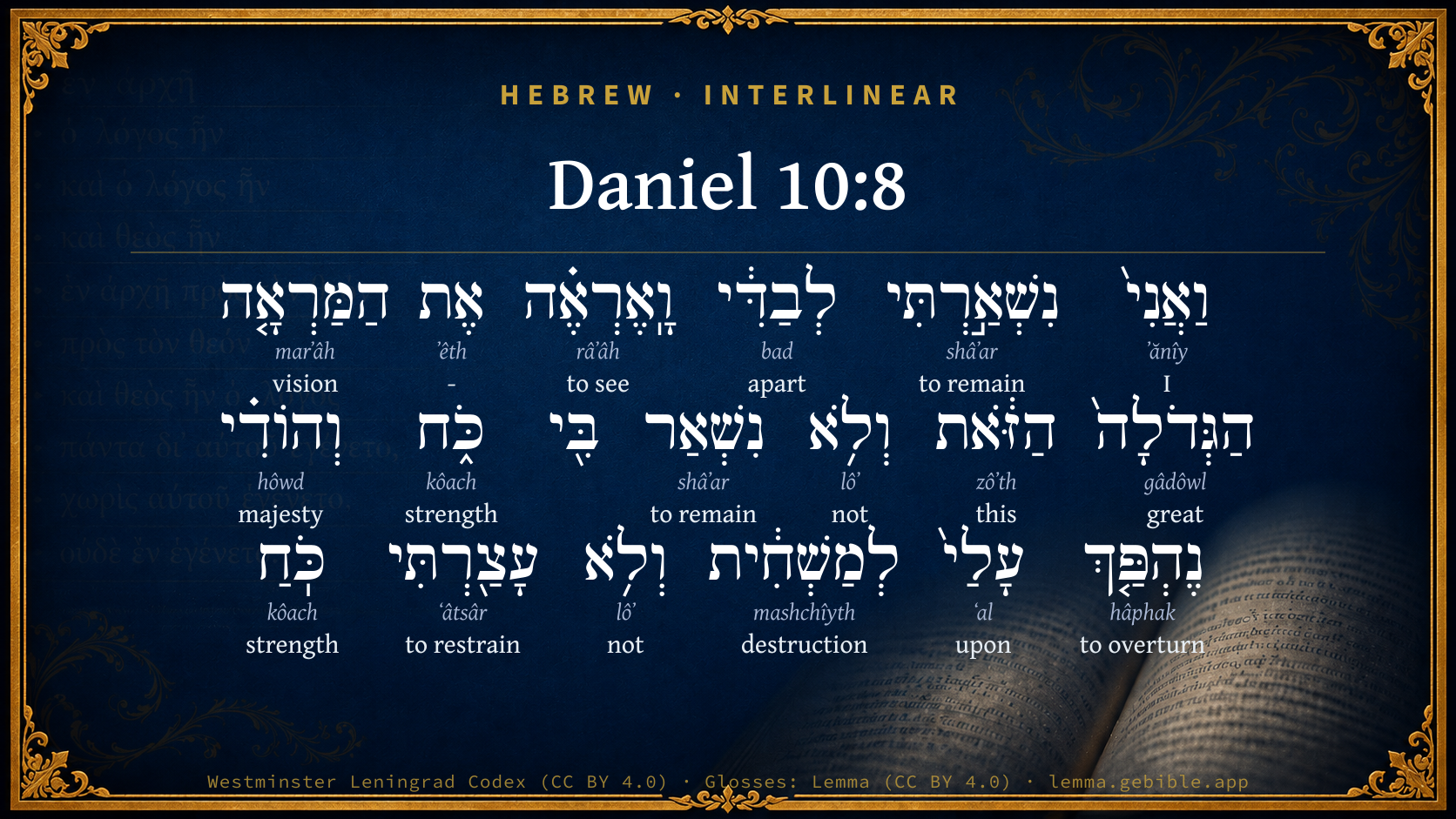
Hebrew (Westminster Leningrad Codex) Daniel 10:8 appears in the Hebrew Old Testament. The text above is from the Westminster Leningrad Codex. Each word links to its Strong’s number, a concise gloss, and parsing drawn from the Open Scriptures Hebrew Bible morphology. Click any word for its full Brown-Driver-Briggs (BDB) entry.
Download image
Cite this verse

Daniel 10:8 (World English Bible). Public Domain. Lemma interlinear Bible study tool, https://lemma.gebible.app/v/daniel/10/8.

Show BibTeX & RIS
BibTeX
RIS
English Translation
So I was left alone, and saw this great vision, and there remained no strength in me; for my comeliness was turned in me into corruption, and I retained no strength.
World English Bible · Public Domain
Download a study sheet

One document with this verse’s original text, its word-by-word gloss line, the meaning frame, cross-references with their text, attributed commentary, and full source and license credits — printable, and it pastes into notes with its structure intact.

This verse Autodidact and up

Study sheet (.html) Plain text (.txt)

A passage Seminary Student

Up to 50 verses in one chapter. A passage sheet keeps up to 6 commentary sources and 12 cross-references per verse, in the order this page ranks them, and says so on the sheet whenever that leaves anything out. Ask for a single verse and you get the Autodidact verse sheet above.

Everything on this page stays free to read, with no account — the sheet is a download of what is already on screen, not access to it.

Want to remove ads? Support Godless Engineer
Compare translations 3

The same verse in 3 English versions, stacked beneath the original-language interlinear above. Click any original word for its lexicon entry.

Each is an independent rendering of the whole verse — the interlinear is not word-aligned to these translations.

Highlighted words mark where these versions differ — a whole-verse word diff, not a word-by-word alignment.

  • World English Bible Public Domain
    So I was left alone, and saw this great vision, and there remained no strength in me; for my comeliness was turned in me into corruption, and I retained no strength.
  • King James Version Public Domain
    Therefore I was left alone, and saw this great vision, and there remained no strength in me: for my comeliness was turned in me into corruption, and I retained no strength.
  • unfoldingWord Literal Text CC BY-SA 4.0
    So I was left alone and saw this great vision. No strength remained in me; my complexion turned to deathly pale, and I retained no strength.

unfoldingWord Literal Text — © unfoldingWord, licensed CC BY-SA 4.0. Word-aligned USFM3 via Door43 (git.door43.org/unfoldingWord/en_ult).

Versions to compare (up to 4)

3 of 4 selected

Show all 18 translations

Every available English version of this verse, each an independent rendering of the whole verse.

  • World English Bible Public Domain
    So I was left alone, and saw this great vision, and there remained no strength in me; for my comeliness was turned in me into corruption, and I retained no strength.
  • Berean Standard Bible Public Domain
    So I was left alone, gazing at this great vision. No strength remained in me; my face grew deathly pale, and I was powerless.
  • Majority Standard Bible Public Domain
    So I was left alone, gazing at this great vision. No strength remained in me; my face grew deathly pale, and I was powerless.
  • King James Version Public Domain
    Therefore I was left alone, and saw this great vision, and there remained no strength in me: for my comeliness was turned in me into corruption, and I retained no strength.
  • American Standard Version (1901) Public Domain
    So I was left alone, and saw this great vision, and there remained no strength in me; for my comeliness was turned in me into corruption, and I retained no strength.
  • Revised Version (1885) Public Domain
    So I was left alone, and saw this great vision, and there remained no strength in me: for my comeliness was turned in me into corruption, and I retained no strength.
  • Geneva Bible (1599) Public Domain
    Therefore I was left alone, and sawe this great vision, and there remained no strength in me: for my strength was turned in me into corruption, and I reteined no power.
  • Douay-Rheims (1899) Public Domain
    And I being left alone saw this great vision: and there remained no strength in me, and the appearance of my countenance was changed in me, and I fainted away, and retained no strength.
  • Young's Literal Translation Public Domain
    and I have been left by myself, and I see this great appearance, and there hath been no power left in me, and my honour hath been turned in me to corruption, yea, I have not retained power.
  • Literal Standard Version CC BY-SA 4.0
    and I have been left by myself, and I see this great vision, and there has been no power left in me, and my splendor has been turned in me to corruption, indeed, I have not retained power.
  • Unlocked Literal Bible CC BY-SA 4.0
    So I was left alone and saw this great vision. No strength remained in me; my bright appearance was turned into a ruined look, and no strength remained in me.
  • unfoldingWord Literal Text CC BY-SA 4.0
    So I was left alone and saw this great vision. No strength remained in me; my complexion turned to deathly pale, and I retained no strength.
  • Darby Bible Public Domain
    And I was left alone, and saw this great vision, and there remained no strength in me; and my comeliness was turned in me into corruption, and I retained no strength.
  • World Messianic Bible Public Domain
    So I was left alone and saw this great vision. No strength remained in me; for my face grew deathly pale, and I retained no strength.
  • Webster's Bible Public Domain
    Therefore I was left alone, and saw this great vision, and there remained no strength in me: for my comeliness was turned in me into corruption, and I retained no strength.
  • Free Bible Version CC BY-SA 4.0
    I was left alone to see this wonderful vision. My strength drained away, and my face turned pale as death. I didn't have an ounce of strength left.
  • Bible in Basic English Public Domain
    So I was by myself, and I saw this great vision, and all my strength went from me; and the colour went from my face.
  • JPS Tanakh (1917) Public Domain
    So that I was left alone, and saw this great vision, and there remained no strength in me; for my comeliness was turned in me into corruption, and I retained no strength.

Literal Standard Version (2020), Covenant Press — licensed CC BY-SA 4.0. Text via the HelloAO Bible API (eBible.org). Unlocked Literal Bible (unfoldingWord) — licensed CC BY-SA 4.0. Text via the HelloAO Bible API (eBible.org). unfoldingWord Literal Text — © unfoldingWord, licensed CC BY-SA 4.0. Word-aligned USFM3 via Door43 (git.door43.org/unfoldingWord/en_ult). Free Bible Version, Dr. Jonathan Gallagher — licensed CC BY-SA 4.0. Text via the HelloAO Bible API (eBible.org).

Word by word

More ways to search: Search by grammar → Find every occurrence → Compare this word →

Practice this passage: Drill this verse → Learn its vocabulary →

הַמַּרְאָ֤ה
marʼâh
H4759
“the · vision”
Particle, Definite Article + Noun, Common, Feminine, Singular, Absolute
Part of Speech
Particle + Noun
Type
Common
Gender
Feminine
Number
Singular
State
Absolute
Full BDB Definition

Origin: from H4758

TWOT: 2095g , 2095h

vision - mode of revelation - mirror
  1. וַאֲנִי֙ ʼănîy H589 “and · I” Conjunction + Pronoun, Personal, 1st Person, Common, Singular
  2. נִשְׁאַ֣רְתִּי shâʼar H7604 “to remain” Verb, Niphal, Perfect, 1st Person, Common, Singular
  3. לְבַדִּ֔י bad H905 “to/for · apart · my” Preposition + Noun, Common, Masculine, Singular, Construct + Suffix, Personal, 1st Person, Common, Singular
  4. וָֽאֶרְאֶ֗ה râʼâh H7200 “and · to see” Conjunction + Verb, Qal, Sequential Imperfect, 1st Person, Common, Singular
  5. אֶת ʼêth H853 “-” Particle, Direct Object
  6. הַגְּדֹלָה֙ gâdôwl H1419 “the · great” Particle, Definite Article + Adjective, Adjective, Feminine, Singular, Absolute
  7. הַזֹּ֔את zôʼth H2063 “the · this” Particle, Definite Article + Pronoun, Demonstrative, Feminine, Singular
  8. וְלֹ֥א lôʼ H3808 “and · not” Conjunction + Particle, Negative
  9. נִשְׁאַר shâʼar H7604 “to remain” Verb, Niphal, Perfect, 3rd Person, Masculine, Singular
  10. כֹּ֑ח kôach H3581 “strength” Noun, Common, Masculine, Singular, Absolute
  11. וְהוֹדִ֗י hôwd H1935 “and · majesty · my” Conjunction + Noun, Common, Masculine, Singular, Construct + Suffix, Personal, 1st Person, Common, Singular
  12. נֶהְפַּ֤ךְ hâphak H2015 “to overturn” Verb, Niphal, Perfect, 3rd Person, Masculine, Singular
  13. עָלַי֙ ʻal H5921 “upon · me” Preposition + Suffix, Personal, 1st Person, Common, Singular
  14. לְמַשְׁחִ֔ית mashchîyth H4889 “to/for · destruction” Preposition + Noun, Common, Masculine, Singular, Absolute
  15. וְלֹ֥א lôʼ H3808 “and · not” Conjunction + Particle, Negative
  16. עָצַ֖רְתִּי ʻâtsâr H6113 “to restrain” Verb, Qal, Perfect, 1st Person, Common, Singular
  17. כֹּֽחַ kôach H3581 “strength” Noun, Common, Masculine, Singular, Absolute

About this verse

These counts appear in no published source. They are computed here, from the morphology-tagged text and Lemma’s own curated glosses. What Lemma adds →

19
words
15
distinct lemmas
Prophets
section

Notable vocabulary

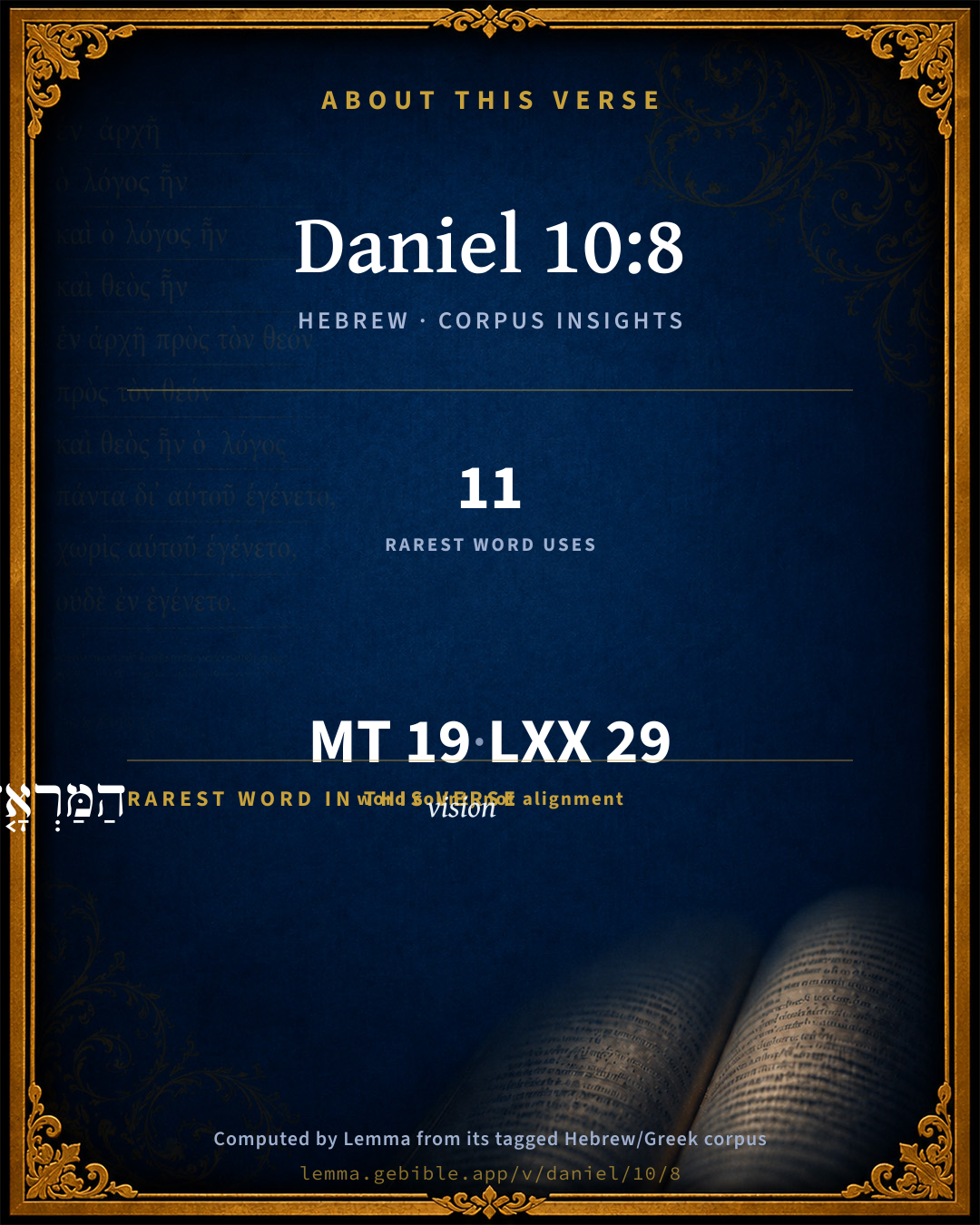
The rarest word here is הַמַּרְאָ֤ה vision H4759 — appearing just 11 times in the whole Hebrew Bible.

Shared distinctive vocabulary

הַמַּרְאָ֤ה vision H4759 occurs in 10 verses of the Hebrew Bible. Also found in:

Grammatical profile

  • 5 verbs
  • 6 nouns
  • 1 adjective
  • 2 pronouns
  • 2 prepositions
  • 3 particles

Verb forms

  • נִשְׁאַ֣רְתִּי Niphal · Perfect
  • וָֽאֶרְאֶ֗ה Qal · Sequential Imperfect
  • נִשְׁאַר Niphal · Perfect
  • נֶהְפַּ֤ךְ Niphal · Perfect
  • עָצַ֖רְתִּי Qal · Perfect

Repetition

Words recur within this verse — often emphatic in Hebrew:

  • נִשְׁאַ֣רְתִּי to remain H7604 ×2
  • כֹּ֑ח strength H3581 ×2
  • וְלֹ֥א not H3808 ×2

Hebrew & Septuagint length

In English translation the verse runs 31 words from the Hebrew and 30 from the Septuagint (LXX English) — closely comparable.

A rough comparison of the two English renderings, which tokenize alike — not a word-level alignment.

Word counts can differ between the Hebrew and the Greek without any difference in meaning — e.g. the Hebrew direct-object marker אֵת has no separate Greek word, and Greek often adds the article ὁ.

In the original languages it is 19 Hebrew tokens and 29 Greek tokens — but the two are counted differently (Hebrew bundles its prefixes and suffixes into one token; the Greek is in lemma form), so that isn’t a like-for-like length.

Cross-references

13

Topical passages linked to Daniel 10:8 in the Treasury of Scripture Knowledge — connected by theme and wording, ordered by reader-vote popularity; previews shown in the World English Bible.

  • Daniel 7:28 Here is the end of the matter. As for me, Daniel, my thoughts much troubled me, and my face was changed in me: but I kept the matter in my heart.
  • Daniel 8:27 I, Daniel, fainted, and was sick certain days; then I rose up, and did the king's business: and I wondered at the vision, but none understood it.
  • Habakkuk 3:16 I heard, and my body trembled. My lips quivered at the voice. Rottenness enters into my bones, and I tremble in my place, Because I must wait quietly for the day of trouble, For the coming up of the people who invade us.
  • Matthew 17:6 When the disciples heard it, they fell on their faces, and were very afraid.
  • Mark 9:6 For he didn't know what to say, for they were very afraid.
  • Revelation 1:17 When I saw him, I fell at his feet like a dead man. He laid his right hand on me, saying, "Don't be afraid. I am the first and the last,
  • Genesis 32:24–25 Jacob was left alone, and wrestled with a man there until the breaking of the day.
  • Genesis 32:31 The sun rose on him as he passed over Peniel, and he limped because of his thigh.
  • Daniel 8:7 I saw him come close to the ram, and he was moved with anger against him, and struck the ram, and broke his two horns; and there was no power in the ram to stand before him; but he cast him down to the ground, and trampled on him; and there was none who could deliver the ram out of his hand.
  • 2 Corinthians 12:2–3 I know a man in Christ, fourteen years ago (whether in the body, I don't know, or whether out of the body, I don't know; God knows), such a one caught up into the third heaven.
  • 2 Corinthians 12:7 By reason of the exceeding greatness of the revelations, that I should not be exalted excessively, there was given to me a thorn in the flesh, a messenger of Satan to buffet me, that I should not be exalted excessively.
  • Exodus 3:3 Moses said, I will turn aside now, and see this great sight, why the bush is not burnt.
  • John 16:32 Behold, the time is coming, yes, and has now come, that you will be scattered, everyone to his own place, and you will leave me alone. Yet I am not alone, because the Father is with me.

Cross-references courtesy of OpenBible.info (CC BY 4.0).

Hebrew and Greek witnesses Masoretic Hebrew ↔ Greek Septuagint

The same verse in the two great witnesses to the Old Testament, shown verse-for-verse.

These are two independent witnesses, not word-aligned to each other, and the Septuagint is shown in lemma (dictionary) form.

Hebrew Daniel 10:8 Masoretic · Westminster Leningrad Codex

וַאֲנִי֙ נִשְׁאַ֣רְתִּי לְבַדִּ֔י וָֽאֶרְאֶ֗ה אֶת הַמַּרְאָ֤ה הַגְּדֹלָה֙ הַזֹּ֔את וְלֹ֥א נִשְׁאַר בִּ֖י כֹּ֑ח וְהוֹדִ֗י נֶהְפַּ֤ךְ עָלַי֙ לְמַשְׁחִ֔ית וְלֹ֥א עָצַ֖רְתִּי כֹּֽחַ

So I was left alone, and saw this great vision, and there remained no strength in me; for my comeliness was turned in me into corruption, and I retained no strength.

World English Bible · Public Domain

Greek LXX Daniel 10:8 Septuagint · lemma form

καί ἐγώ καταλείπω μόνος καί ὁράω ὁ ὅρασις ὁ μέγας οὗτος καί οὐ ἐν καταλείπω ἐν ἐγώ ἰσχύς καί ἰδού πνεῦμα ἐπιστρέφω ἐπί ἐγώ εἰς φθορά καί οὐ καταἰσχύω

So I was left alone, and saw this great vision, and there was no strength left in me, and my glory was turned into corruption, and I retained no strength.

LXX2012 (modern English Septuagint) · Public Domain

On this verse, The Pulpit Commentary discusses the Septuagint’s reading. Read the note in Commentary ↓

Hebrew: Westminster Leningrad Codex (CC BY 4.0). Greek: Septuagint (public domain); English from LXX2012 (modern English Septuagint) (Public Domain). How the Septuagint differs from the Hebrew →

Commentary

Notes on Daniel 10:8 from classic Christian and Jewish commentators (each source and its license shown beneath its notes). The classic Christian expositions comment on the surrounding passage and are grouped to its opening verse, so a note may address several verses; the Jewish commentaries on the Tanakh (Rashi and others) are per-verse, so they appear only where the commentator wrote on this verse.

Lemma curates 59 commentaries, every one of them public domain or Creative Commons licensed, each selected and text-cleaned for this edition rather than reprinted as found. About our sources →

Trapp's Complete Commentary

John Trapp

Dan 10:8 Therefore I was left alone, and saw this great vision, and there remained no strength in me: for my comeliness was turned in me into corruption, and I retained no strength.

Ver. 8. Therefore I was left alone.] Daniel, though much frightened, keepeth his station, when the rest fled and hid themselves. Good is the counsel of the apostle, Heb 12:13, "Make straight steps unto your feet, lest that which is halting be turned out of the way; but let it rather be healed."

For my comeliness, &c.] See Dan 7:15; Dan 7:28; Dan 8:27.

John Trapp, A Commentary or Exposition upon All the Books of the Old and New Testament (1647–1656) — public domain. Text from a community e-Sword module.

Geneva Bible (1599)

Geneva Bible translators

The word also signifieth comeliness, or beauty, so that for fear he was like a dead man for deformity.

Geneva Bible (1599) marginal notes — public domain. Text via Bolls.life.

Jamieson, Fausset & Brown

Robert Jamieson, A. R. Fausset & David Brown

comeliness--literally, "vigor," that is, lively expression and color.

into corruption--"deadliness," that is, death-like paleness (Dan 5:6; Dan 7:28).

Jamieson, Fausset & Brown — Commentary Critical and Explanatory on the Whole Bible (1871) — public domain (CC PDM 1.0). Text via the HelloAO Bible API.

John Calvin's Commentaries

This language all tends to the same purpose — to assure us that Daniel did not write his own comments with rashness, but was truly and clearly taught by the angel on all the points which he committed to writing, and thus all hesitation is removed as to our embracing what we shall afterwards perceive, as he is a faithful interpreter of God. He first states he saw a vision. He had said so before, but he repeats it to produce a due impression; he calls the vision great, to arouse our attention to its importance. He adds, he was deprived of all vigor; as if he had been rendered lifeless by the blast of the Spirit. Thus we gather the object of the exhibition of all these outward signs; they not only bring before us God speaking by the mouth of his angel, but they prepared the Prophet himself, and trained him to reverence. God, however, does not terrify his sons, as if our disquiet was with him an object of delight, but solely because it is profitable for us; for unless our carnal feelings were utterly subdued, we should never be fit to receive improvement. This necessarily requires violence, on account of our inborn perverseness; and this is the reason why the Prophet was reduced to this state of lifelessness. Even my comeliness, or beauty, or appearance, was turned to corruption; meaning, my deformity was similar to that induced by death. He adds lastly, I did not retain my vigor. He uses a variety of phrases to shew himself depressed by the heavenly blast, for but a slight amount of vitality remained, and he was scarcely preserved from actual death. We ought to learn to transfer this instruction to ourselves, not by the vanishing of our rigor or the changing of our appearance whenever God addresses us, but by all our resistance giving way, and all our pride and loftiness becoming prostrate before God. Finally, our carnal disposition ought to be completely reduced to nothing, as true docility will never be found in us until all our senses are completely mortified; for we must always remember how hostile all our natural thoughts are to the will of God. It afterwards follows; — but I cannot proceed further today; I must delay my comment on the next verses till to-morrow.

John Calvin's Commentaries (1540-1563) — public domain. Text from the Calvin Translation Society English edition (1840s-50s) via the Christian Classics Ethereal Library (ccel.org). Calvin's coverage is partial (roughly two-thirds of the Bible); uncommented books and verses are honest gaps, never fabricated. The 19th-century editor's footnotes and remarks are omitted so the notes are faithfully Calvin's own voice.

Ellicott's Commentary for English Readers

(8) This great vision.—Daniel again distinguishes this from former visions: The glory of the man who appeared to him was far in excess of what he had witnessed previously (Dan_8:17). The effects of the vision upon him are also mentioned. His “comeliness was turned,” or, he grew pale with terror at what he saw, and fainted.

A Bible Commentary for English Readers, edited by Charles John Ellicott (1878–1897) — public domain. Text from a community e-Sword module.

The Cambridge Bible for Schools and Colleges

gen. ed. J. J. S. Perowne

8. And I (emph.) was left alone, and saw this great vision] ‘great,’ on account of the majestic appearance of the angel.

and there was left (Dan_10:17) no strength in me] Cf. 1Sa_28:20. The vision itself is more impressive than that of Gabriel in Dan_8:16-18, and its effects upon Daniel are more marked.

comeliness] The meaning is dignity of countenance. Majesty, glory, is the idea of the word: cf. (of God) Psa_8:1, Hab_3:3; (of a king), Psa_45:3, Jer_22:18 (‘Ah lord! or, Ah his glory!’); of the Israel of the future, compared to a nobly-spreading tree, Hos_14:6 (where ‘beauty,’ A.V., R.V., is inadequate).

was turned upon me into corruption] i.e. disfigured, or destroyed, by sudden pallor. The Hebrew word rendered ‘corruption’ is cognate with that rendered ‘marred’ in Isa_52:14 (also of the countenance). For ‘upon,’ cf. Dan_5:9, Dan_7:28; and see on Dan_2:1.

retained no strength] In the Heb., a late idiom, found otherwise only Dan_10:16, Dan_11:6; 1Ch_29:14; 2Ch_2:5; 2Ch_13:20; 2Ch_22:9.

8–9. Daniel was left alone, and fell motionless, as if stunned, upon the earth.

The Cambridge Bible for Schools and Colleges (gen. ed. J. J. S. Perowne; Cambridge University Press, 1878–1918) — public domain. Text from a community e-Sword module.

John Gill's Exposition

Therefore I was left alone, and saw this great vision,.... Which was great indeed, both with respect to the object now seen, and with respect to the subject matter, the things afterwards revealed, the nature, use, and importance of them; and it was so wisely ordered by the Lord, that the men with Daniel should be seized with a panic, and flee and leave him alone; that they being removed from him, he might have the secrets of the Lord revealed to him as a peculiar favourite of his, and hear and see the things he did:

and there remained no strength in me: either through the intenseness of his mind upon the object before him, and to what he said; or through the awe he was struck with at the sight of him; his blood running back to the heart to secure that; his nerves loosened; his hands weak and hanging down; his knees feeble, and spirits faint, just ready to sink and swoon away:

for my comeliness was turned in me into corruption; the form of his countenance was marred; his forehead wrinkled; his eyes sunk; the sprightliness and vivacity of them gone; his cheeks turned pale; his lips quivering; his joints trembling; his vigour and health impaired; all nature convulsed; and he lifeless and spiritless, like a dead carcass:

and I retained no strength; or, "restrained" (s) it not; his strength; could not keep it from going out of him, either of body or mind; he could not rally the powers of nature, so depressed was he with the vision: all which is observed, both to exaggerate the greatness of the vision, and the favour and goodness of God after shown him; as well as to observe the weakness of human nature, not being able to bear the sight of a divine Person, or such discoveries the Lord is sometimes pleased to make, without being strengthened and supported in an extraordinary manner.

(s) "non cohibui", Gejerus.

John Gill's Exposition of the Whole Bible (1746–1763) — public domain (CC PDM 1.0). Text via the HelloAO Bible API.

Albert Barnes' Notes on the Bible

Therefore I was left alone, and saw this great vision - That is, I distinctly saw it, or contemplated it. He perceived, doubtless, that it was a heavenly vision; and as he had often been favored with similar manifestations, he remained to receive the communication which probably he understood was to be made.

And there remained no strength in me - He was completely overcome. A similar effect was produced on John when he was in Patmos: “And when I saw him I fell at his feet as dead,” Rev 1:17. That he should be overcome, and his strength taken away, was not an unnatural effect; and what occurred to Daniel and John may demonstrate that there may be such views of the Divine character and glory now as to prostrate our physical powers. It is certain that such visions as those which appeared to Daniel and John would have this effect; and, though we are not to expect that they will now be vouchsafed to men, no one can doubt that there may be such views of God, and heaven, and eternal realities presented to the eye of faith and hope; such joy in the evidence of pardoned sin; such a change from a sense of condemnation to the peace resulting from forgiveness, that the powers of the body may be prostrated, and sink from exhaustion. Indeed, it is not much of the revelation of the Divine character that in our present state we can bear.

For my comeliness - Margin, “vigour.” Hebrew, הוד hôd. The word means, properly, majesty or splendor; then beauty or brightness, as of the complexion. The meaning here is, that his “bright complexion” (Gesenius, Lexicon) was changed upon him; that is, that he turned pale.

Into corruption - The phrase used here means literally “into destruction.” The sense is, that by the change that came over him. his beauty - his bright or florid complexion was completely “destroyed.” He became deadly pale.

Albert Barnes' Notes on the Bible (1834–1885) — public domain. Text from a community e-Sword/MySword module.

Matthew Poole's English Annotations

This great vision; great in the appearance, and great in the great things revealed.

There remained no strength in me; by the recoiling of his spirits inward.

My comeliness was turned in me into corruption; his colour was changed into paleness, as one that is faint, and pining into a consumption, by terror and consternation.

Matthew Poole's English Annotations on the Holy Bible (1683–1685) — public domain. Text from a community e-Sword/MySword module.

Whedon's Commentary on the Bible

Daniel D. Whedon

8. Daniel alone remained, but though accustomed to visions and angelic presences (Dan_7:10; Dan_7:16; Dan_9:21) he was almost prostrated by the awe which this dazzling, heavenly form inspired. (Compare Luk_9:32.)

For my comeliness was turned in me into corruption — Daniel’s natural “splendor” (Hebrews) of countenance faded before the splendor of this celestial messenger, and his face became ghastly with the pallor of death. (Compare Dan_7:28.)

Daniel D. Whedon (gen. ed.), Commentary on the Old and New Testaments (1874–1909) — public domain. Text from a community e-Sword module.

The Pulpit Commentary

Therefore I was left alone, and saw this great vision, and there remained no strength in me; for my comeliness was turned in me into corruption, and I retained no strength. The versions do not call for much remark. The LXX renders "glory" by "spirit" or "breath;" and the Peshitta renders it by "body." The Massoretic is superior, as more difficult and more likely to be the source of the other two than either of them. Theodotion"s rendering, doxa, confirms this. Daniel explains how he alone had seen the vision, and narrates the effects contact with the spiritual had on him, "There remained no strength in me; And I retained no strength a redoubled statement of weakness not necessarily meaning, as Jephet-ibn-Ali would have it, that the one refers to his inability to flee like his attendants, and the other to his inability to stand upright. It is probably due merely to the great impression this sudden powerlessness made on him. For my comeliness was turned in me into corruption. From the natural brightness of the skin in life the face assumed the yellow pallor of death. (comp. Dan_7:28) "And my countenance was changed in me;" comp. also Hab_3:16, "When I heard, my belly trembled; my lips quivered at the voice: rottenness entered into my bones." While the ideas here are the same, the parallelism is made more striking by the difference of the terms.

The Pulpit Commentary (1880–1919), ed. H.D.M. Spence-Jones & Joseph S. Exell — public domain. Text from a community e-Sword module.

Keil & Delitzsch

C. F. Keil & F. Delitzsch

Daniel here calls the appearance great with reference to the majesty displayed, such as had never hitherto been known to him. Its influence upon him is, therefore, also greater than that of the appearance of Gabriel, Dan 8:17. There remained in him no strength, i.e., he felt himself overwhelmed, and as if about to perish. His הוד, splendour - the same as the Chald. זיו, Dan 7:28; Dan 5:6, Dan 5:9 - i.e., the fresh colour of life which marked his countenance, was changed למשׁחית, properly, to destruction, to entire disfigurement, to corruption. The last clause, "and I retained no strength," gives greater force to the preceding statement.

Keil & Delitzsch — Biblical Commentary on the Old Testament (1861–1891) — public domain (CC PDM 1.0). Text via the HelloAO Bible API. (Old Testament only.)

Rashi

Rabbi Shlomo Yitzchaki (Rashi)

was turned in me into corruption Heb. לְמַשְׁחִית, lit. to a destroyer. To corruption, and it is customary for Biblical verses to speak in this manner, like (Jer. 5:8): “They were like armed stallions early in the morning.” מַשְׁכִּים is the equivalent of בְּהַשְׁכָּמַת הַבּקֶר, in the early morning.

I could not summon up strength i.e., I did not gather. All my strength left my innards.

Rashi on the Tanakh — English translations: “The Judaica Press complete Tanach with Rashi, translated by A. J. Rosenberg” (CC BY 4.0); “Pentateuch with Rashi's commentary by M. Rosenbaum and A.M. Silbermann, 1929-1934” (public domain); “The Metsudah Tanach series, Lakewood, N.J” (CC BY 4.0); and “The Book of Joshua, Metsudah Publications, 1997” (CC BY 4.0). Text via Sefaria.

Lesson kit

Teaching starters — assembled from the data on this page, not authored interpretation. Every prompt links to the verse data it draws on. Edit before teaching.

Daniel, in the Prophets, opens this verse with 19 words (15 distinct Hebrew lemmas). Its most distinctive word is marʼâh (“vision”). A historical commentator’s framing appears above. Read the whole chapter for the surrounding context.

Discussion questions

  1. How does “vision” (marʼâh) shape what this verse is saying?
  2. Genesis 46:2 shares the word «vision» with this verse. How do the two illuminate each other?
  3. “to remain” occurs 2× in this one verse. What is the effect of the repetition?
  4. These translations render this verse differently; the difference is in the English rendering, not the original. What questions does that raise?
  5. The verb «נִשְׁאַ֣רְתִּי» is Niphal Perfect. How does its form color the action?
  6. Reading how Trapp's Complete Commentary and Geneva Bible (1599) read this verse, where do the two commentators agree and where do they part?

Things to notice

Reading settings

Reading text

Shown beneath each verse's original-language words.

Old Testament
Old Testament edition

Read the OT as the Masoretic Hebrew (MT) or the Greek Septuagint (LXX).

English shown for the Greek Septuagint (in the Hebrew ↔ Greek comparison).

Comparing translations? Open the Compare panel on any verse page to stack up to four side by side.