
Deuteronomy 22:14

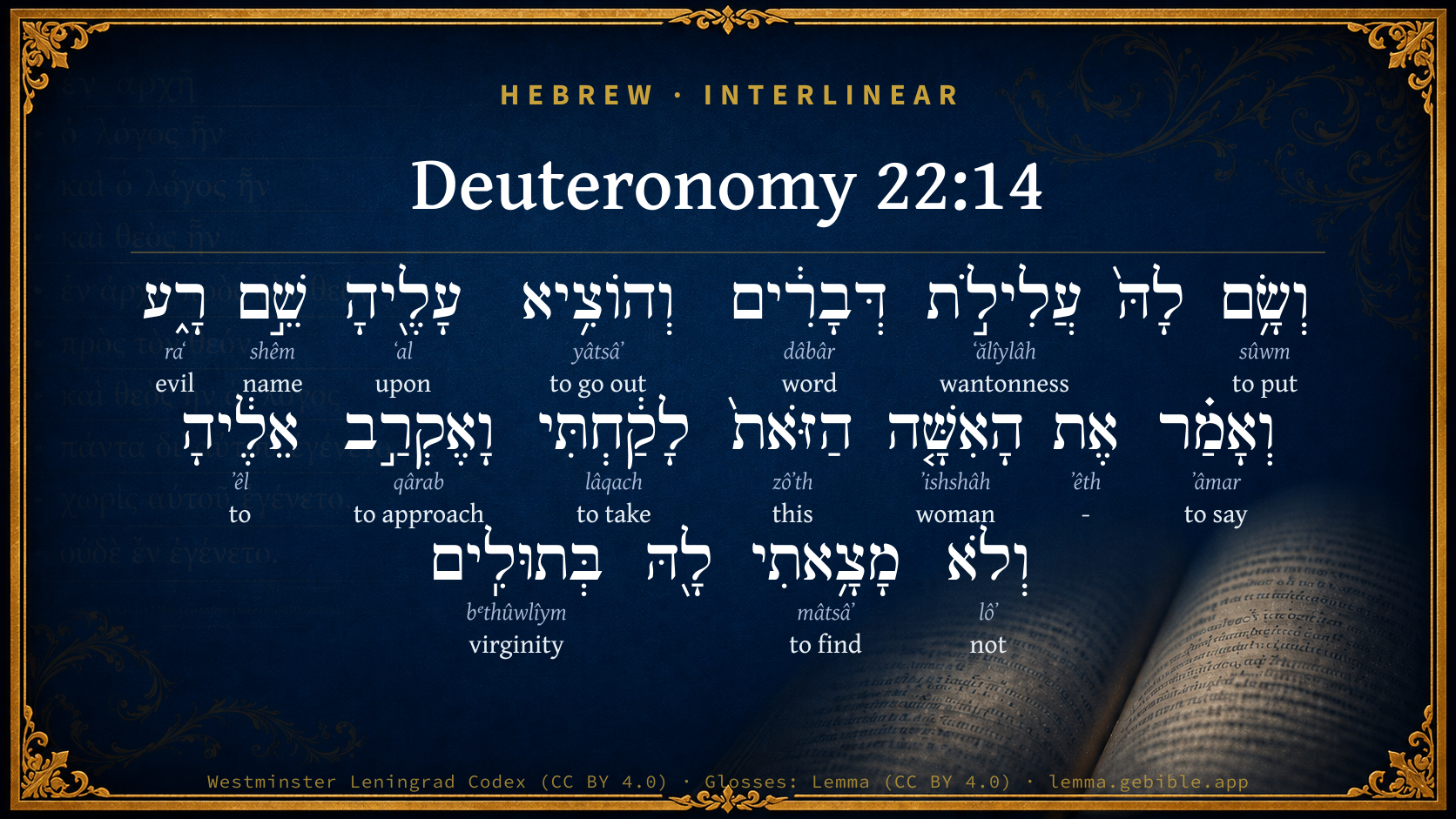
Hebrew (Westminster Leningrad Codex) Deuteronomy 22:14 appears in the Hebrew Old Testament. The text above is from the Westminster Leningrad Codex. Each word links to its Strong’s number, a concise gloss, and parsing drawn from the Open Scriptures Hebrew Bible morphology. Click any word for its full Brown-Driver-Briggs (BDB) entry.
Download image
Cite this verse

Deuteronomy 22:14 (World English Bible). Public Domain. Lemma interlinear Bible study tool, https://lemma.gebible.app/v/deuteronomy/22/14.

Show BibTeX & RIS
BibTeX
RIS
English Translation
and lay shameful things to her charge, and bring up an evil name on her, and say, I took this woman, and when I came near to her, I didn't find in her the tokens of virginity;
World English Bible · Public Domain
Highlights
  • 1 first appearance in the Hebrew Bible
Full analysis ↓
Download a study sheet

One document with this verse’s original text, its word-by-word gloss line, the meaning frame, cross-references with their text, attributed commentary, and full source and license credits — printable, and it pastes into notes with its structure intact.

This verse Autodidact and up

Study sheet (.html) Plain text (.txt)

A passage Seminary Student

Up to 50 verses in one chapter. A passage sheet keeps up to 6 commentary sources and 12 cross-references per verse, in the order this page ranks them, and says so on the sheet whenever that leaves anything out. Ask for a single verse and you get the Autodidact verse sheet above.

Everything on this page stays free to read, with no account — the sheet is a download of what is already on screen, not access to it.

Want to remove ads? Support Godless Engineer
Compare translations 3

The same verse in 3 English versions, stacked beneath the original-language interlinear above. Click any original word for its lexicon entry.

Each is an independent rendering of the whole verse — the interlinear is not word-aligned to these translations.

Highlighted words mark where these versions differ — a whole-verse word diff, not a word-by-word alignment.

  • World English Bible Public Domain
    and lay shameful things to her charge, and bring up an evil name on her, and say, I took this woman, and when I came near to her, I didn't find in her the tokens of virginity;
  • King James Version Public Domain
    And give occasions of speech against her, and bring up an evil name upon her, and say, I took this woman, and when I came to her, I found her not a maid:
  • unfoldingWord Literal Text CC BY-SA 4.0
    and accuses her of shameful things and brings against her a bad name and says, ‘I took this woman, and I came near to her, and I did not find her virginity,’

unfoldingWord Literal Text — © unfoldingWord, licensed CC BY-SA 4.0. Word-aligned USFM3 via Door43 (git.door43.org/unfoldingWord/en_ult).

Versions to compare (up to 4)

3 of 4 selected

Show all 18 translations

Every available English version of this verse, each an independent rendering of the whole verse.

  • World English Bible Public Domain
    and lay shameful things to her charge, and bring up an evil name on her, and say, I took this woman, and when I came near to her, I didn't find in her the tokens of virginity;
  • Berean Standard Bible Public Domain
    and he then accuses her of shameful conduct and gives her a bad name, saying, “I married this woman and had relations with her, but I discovered she was not a virgin.”
  • Majority Standard Bible Public Domain
    and he then accuses her of shameful conduct and gives her a bad name, saying, “I married this woman and had relations with her, but I discovered she was not a virgin.”
  • King James Version Public Domain
    And give occasions of speech against her, and bring up an evil name upon her, and say, I took this woman, and when I came to her, I found her not a maid:
  • American Standard Version (1901) Public Domain
    and lay shameful things to her charge, and bring up an evil name upon her, and say, I took this woman, and when I came nigh to her, I found not in her the tokens of virginity;
  • Revised Version (1885) Public Domain
    and lay shameful things to her charge, and bring up an evil name upon her, and say, I took this woman, and when I came nigh to her, I found not in her the tokens of virginity:
  • Geneva Bible (1599) Public Domain
    And laye slaunderous thinges vnto her charge, and bring vp an euill name vpon her, and say, I tooke this wife, and when I came to her, I found her not a mayde,
  • Douay-Rheims (1899) Public Domain
    And seek occasions to put her away, laying to her charge a very ill name, and say: I took this woman to wife, and going in to her, I found her not a virgin:
  • Young's Literal Translation Public Domain
    and laid against her actions of words, and brought out against her an evil name, and said, This woman I have taken, and I draw near unto her, and I have not found in her tokens of virginity:
  • Literal Standard Version CC BY-SA 4.0
    and laid evil deeds of words against her, and brought out an evil name against her, and said, I have taken this woman, and I draw near to her, and I have not found proofs of virginity in her;
  • Unlocked Literal Bible CC BY-SA 4.0
    and then accuses her of shameful things and puts a bad reputation on her, and says, 'I took this woman, but when I came near to her, I found no proof of virginity in her.'
  • unfoldingWord Literal Text CC BY-SA 4.0
    and accuses her of shameful things and brings against her a bad name and says, ‘I took this woman, and I came near to her, and I did not find her virginity,’
  • Darby Bible Public Domain
    and charge her with things for scandalous talk, and cause an evil name against her to be spread abroad, and say, This woman have I taken, and I came in unto her, and I did not find her a virgin;
  • World Messianic Bible Public Domain
    accuses her of shameful things, gives her a bad name, and says, “I took this woman, and when I came near to her, I didn’t find in her the tokens of virginity;”
  • Webster's Bible Public Domain
    And give occasions of speech against her, and bring an evil name upon her, and say, I took this woman, and when I came to her, I found her not a maid:
  • Free Bible Version CC BY-SA 4.0
    and accuses her of being immoral, giving her a bad name, saying, “I married this woman and slept with her, but I found out she wasn't a virgin.”
  • Bible in Basic English Public Domain
    And says evil things about her and gives her a bad name, saying, I took this woman, and when I had connection with her it was clear to me that she was not a virgin:
  • JPS Tanakh (1917) Public Domain
    and lay wanton charges against her, and bring up an evil name upon her, and say: 'I took this woman, and when I came nigh to her, I found not in her the tokens of virginity';

Literal Standard Version (2020), Covenant Press — licensed CC BY-SA 4.0. Text via the HelloAO Bible API (eBible.org). Unlocked Literal Bible (unfoldingWord) — licensed CC BY-SA 4.0. Text via the HelloAO Bible API (eBible.org). unfoldingWord Literal Text — © unfoldingWord, licensed CC BY-SA 4.0. Word-aligned USFM3 via Door43 (git.door43.org/unfoldingWord/en_ult). Free Bible Version, Dr. Jonathan Gallagher — licensed CC BY-SA 4.0. Text via the HelloAO Bible API (eBible.org).

Word by word

More ways to search: Search by grammar → Find every occurrence → Compare this word →

Practice this passage: Drill this verse → Learn its vocabulary →

בְּתוּלִֽים
bᵉthûwlîym
H1331
“virginity”
Noun, Common, Both, Plural, Absolute
Part of Speech
Noun
Type
Common
Gender
Both
Number
Plural
State
Absolute
Full BDB Definition

Origin: masculine plural of the same as H1330

TWOT: 295b

virginity
  1. וְשָׂ֥ם sûwm H7760 “and · to put” Conjunction + Verb, Qal, Sequential Perfect, 3rd Person, Masculine, Singular
  2. עֲלִילֹ֣ת ʻălîylâh H5949 “deeds of” Noun, Common, Feminine, Plural, Construct
  3. דְּבָרִ֔ים dâbâr H1697 “words” Noun, Common, Masculine, Plural, Absolute
  4. וְהוֹצִ֥יא yâtsâʼ H3318 “and · to go out” Conjunction + Verb, Hiphil, Sequential Perfect, 3rd Person, Masculine, Singular
  5. עָלֶ֖יהָ ʻal H5921 “upon · her” Preposition + Suffix, Personal, 3rd Person, Feminine, Singular
  6. שֵׁ֣ם shêm H8034 “name” Noun, Common, Masculine, Singular, Absolute
  7. רָ֑ע raʻ H7451 “evil” Adjective, Adjective, Masculine, Singular, Absolute
  8. וְאָמַ֗ר ʼâmar H559 “and · to say” Conjunction + Verb, Qal, Sequential Perfect, 3rd Person, Masculine, Singular
  9. אֶת ʼêth H853 “-” Particle, Direct Object
  10. הָאִשָּׁ֤ה ʼishshâh H802 “the · woman” Particle, Definite Article + Noun, Common, Feminine, Singular, Absolute
  11. הַזֹּאת֙ zôʼth H2063 “the · this” Particle, Definite Article + Pronoun, Demonstrative, Feminine, Singular
  12. לָקַ֔חְתִּי lâqach H3947 “to take” Verb, Qal, Perfect, 1st Person, Common, Singular
  13. וָאֶקְרַ֣ב qârab H7126 “and · to approach” Conjunction + Verb, Qal, Sequential Imperfect, 1st Person, Common, Singular
  14. אֵלֶ֔יהָ ʼêl H413 “to · her” Preposition + Suffix, Personal, 3rd Person, Feminine, Singular
  15. וְלֹא lôʼ H3808 “and · not” Conjunction + Particle, Negative
  16. מָצָ֥אתִי mâtsâʼ H4672 “to find” Verb, Qal, Perfect, 1st Person, Common, Singular

About this verse

These counts appear in no published source. They are computed here, from the morphology-tagged text and Lemma’s own curated glosses. What Lemma adds →

19
words
17
distinct lemmas
Pentateuch
section

Notable vocabulary

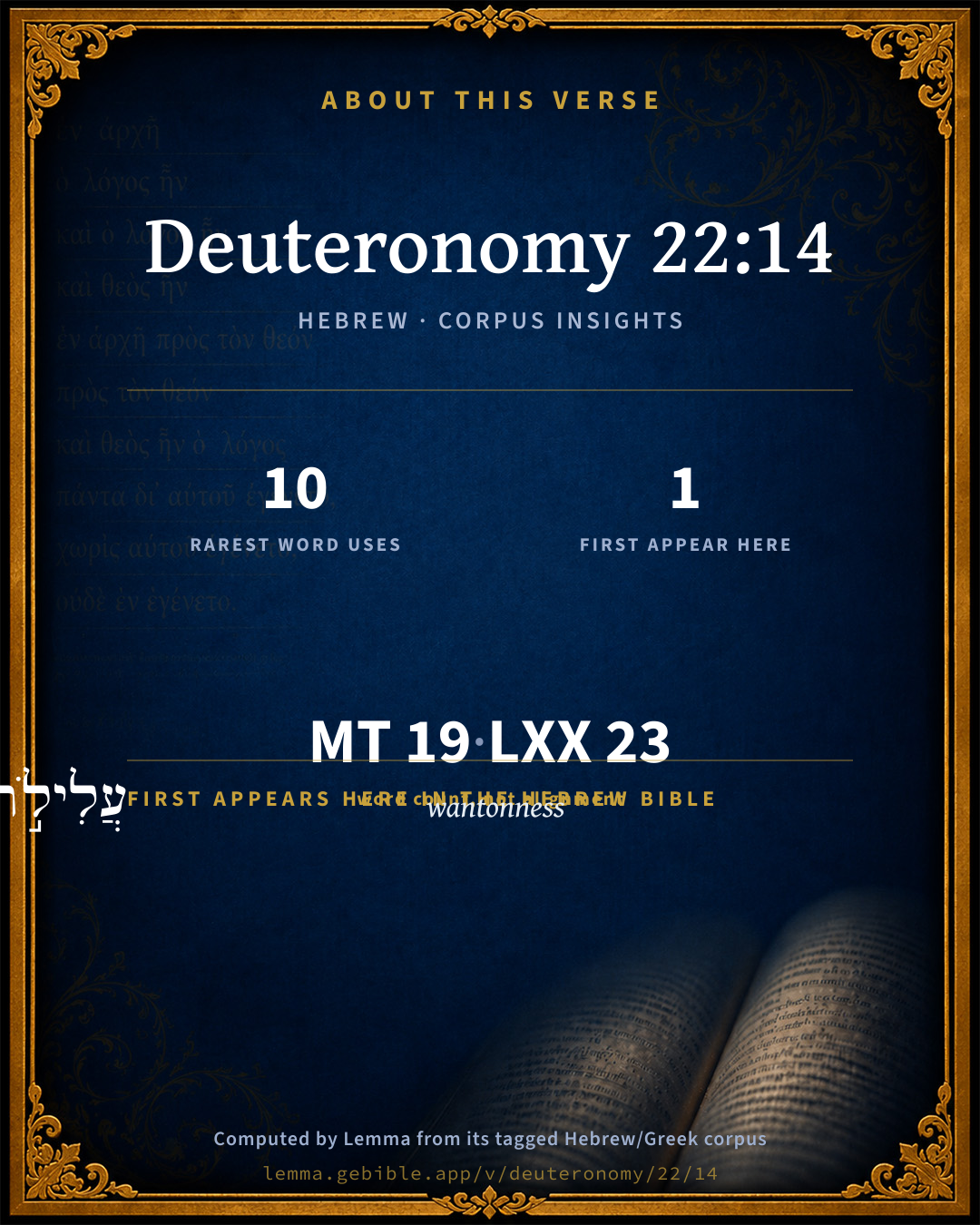
The rarest word here is בְּתוּלִֽים virginity H1331 — appearing just 10 times in the whole Hebrew Bible.

First appearance in Scripture

This word makes its first canonical appearance in the Hebrew Bible here:

  • עֲלִילֹ֣ת wantonness H5949

Shared distinctive vocabulary

בְּתוּלִֽים virginity H1331 occurs in 9 verses of the Hebrew Bible. Also found in:

Grammatical profile

  • 6 verbs
  • 5 nouns
  • 1 adjective
  • 1 pronoun
  • 4 prepositions
  • 2 particles

Verb forms

  • וְשָׂ֥ם Qal · Sequential Perfect
  • וְהוֹצִ֥יא Hiphil · Sequential Perfect
  • וְאָמַ֗ר Qal · Sequential Perfect
  • לָקַ֔חְתִּי Qal · Perfect
  • וָאֶקְרַ֣ב Qal · Sequential Imperfect
  • מָצָ֥אתִי Qal · Perfect

Hebrew & Septuagint length

In English translation the verse runs 37 words from the Hebrew and 32 from the Septuagint (LXX English) — closely comparable.

A rough comparison of the two English renderings, which tokenize alike — not a word-level alignment.

Word counts can differ between the Hebrew and the Greek without any difference in meaning — e.g. the Hebrew direct-object marker אֵת has no separate Greek word, and Greek often adds the article ὁ.

In the original languages it is 19 Hebrew tokens and 23 Greek tokens — but the two are counted differently (Hebrew bundles its prefixes and suffixes into one token; the Greek is in lemma form), so that isn’t a like-for-like length.

Cross-references

6

Topical passages linked to Deuteronomy 22:14 in the Treasury of Scripture Knowledge — connected by theme and wording, ordered by reader-vote popularity; previews shown in the World English Bible.

  • Exodus 20:16 "You shall not give false testimony against your neighbor.
  • Exodus 23:1 "You shall not spread a false report. Don't join your hand with the wicked to be a malicious witness.
  • Deuteronomy 22:19 and they shall fine him one hundred [shekels] of silver, and give them to the father of the young lady, because he has brought up an evil name on a virgin of Israel: and she shall be his wife; he may not put her away all his days.
  • Proverbs 18:8 The words of a gossip are like dainty morsels: They go down into a person's innermost parts.
  • Proverbs 18:21 Death and life are in the power of the tongue; Those who love it will eat its fruit.
  • 1 Timothy 5:14 I desire therefore that the younger widows marry, bear children, rule the household, and give no occasion to the adversary for reviling.

Cross-references courtesy of OpenBible.info (CC BY 4.0).

Hebrew and Greek witnesses Masoretic Hebrew ↔ Greek Septuagint

The same verse in the two great witnesses to the Old Testament, shown verse-for-verse.

These are two independent witnesses, not word-aligned to each other, and the Septuagint is shown in lemma (dictionary) form.

Hebrew Deuteronomy 22:14 Masoretic · Westminster Leningrad Codex

וְשָׂ֥ם לָהּ֙ עֲלִילֹ֣ת דְּבָרִ֔ים וְהוֹצִ֥יא עָלֶ֖יהָ שֵׁ֣ם רָ֑ע וְאָמַ֗ר אֶת הָאִשָּׁ֤ה הַזֹּאת֙ לָקַ֔חְתִּי וָאֶקְרַ֣ב אֵלֶ֔יהָ וְלֹא מָצָ֥אתִי לָ֖הּ בְּתוּלִֽים

and lay shameful things to her charge, and bring up an evil name on her, and say, I took this woman, and when I came near to her, I didn't find in her the tokens of virginity;

World English Bible · Public Domain

Greek LXX Deuteronomy 22:14 Septuagint · lemma form

καί ἐπιτίθημι αὐτός προφασιστικός λόγος καί καταφέρω αὐτός ὄνομα πονηρός καί λέγω ὁ γυνή οὗτος λαμβάνω καί προςἔρχομαι αὐτός οὐ εὑρίσκω αὐτός παρθένεια

and attach to her reproachful words, and bring against her an evil name, and say, I took this woman, and when I came to her I found not her tokens of virginity:

LXX2012 (modern English Septuagint) · Public Domain

On this verse, The Cambridge Bible for Schools and Colleges discusses the Septuagint’s reading. Read the note in Commentary ↓

Hebrew: Westminster Leningrad Codex (CC BY 4.0). Greek: Septuagint (public domain); English from LXX2012 (modern English Septuagint) (Public Domain). How the Septuagint differs from the Hebrew →

Targum (Aramaic paraphrase)

2

The Targum is the ancient Jewish Aramaic paraphrase of the Hebrew Scriptures — an interpretive translation, not the Hebrew text itself. Onkelos (literal) and Pseudo-Jonathan (expansive) render the Torah, and Jonathan the Prophets. Coverage is partial: where no permissively-licensed English translation exists for a verse, only the Aramaic is shown. This is verse-level text, not a word-by-word alignment to the Hebrew.

  1. Targum Onkelos Torah (Genesis–Deuteronomy)
    וִישַׁוִי לַהּ תַּסְקוֹפֵי מִלִין וְיַפֵּק עֲלַהּ שׁוּם בִּישׁ וְיֵימַר יָת אִתְּתָא הָדָא נְסֵבִית וְעַלִית לְוָתַהּ וְלָא אַשְׁכָּחִית לַהּ בְּתוּלִין

    (no public-domain English translation for this verse)

    Targum Onkelos — Aramaic: “Onkelos Genesis” (public domain); “Onkelos Exodus” (public domain); “Onkelos Leviticus” (public domain); “Onkelos Numbers” (public domain); “Onkelos Deuteronomy” (public domain). English: “Sefaria Community Translation” (CC0 1.0 (public-domain dedication)); “J.W. Etheridge. The Targums of Onkelos and Jonathan Ben Uzziel on the Pentateuch. London: Longmans, Green, 1862” (public domain). Text via Sefaria.

  2. Targum Pseudo-Jonathan Torah (Genesis–Deuteronomy)
    וִישַׁוֵּי לָהּ עֲרַד דְּמִילִין וְיִפּוֹק עֲלָהּ טִיב בִּישׁ וְיֵימַר יַת אִתְּתָא הֲדָא נְסִיבִית וְשַׁמָּשִׁית עִמָּהּ וְלָא אַשְׁכָּחִית לָהּ סְהִידַווֹן

    and bring upon her words of calumny in an evil report against her, and say, I took this woman, and lay with her, but found not the witnesses for her;

    Targum Pseudo-Jonathan — Aramaic: “Targum Jonathan on Genesis” (public domain); “Targum Jonathan on Exodus” (public domain); “Targum Jonathan on Leviticus” (public domain); “Targum Jonathan on Numbers” (public domain); “Targum Jonathan on Deuteronomy” (public domain). English: “The Targum of Jonathan ben Uzziel, trans. J. W. Etheridge, London, 1862” (public domain). Text via Sefaria.

Commentary

Notes on Deuteronomy 22:14 from classic Christian and Jewish commentators (each source and its license shown beneath its notes). The classic Christian expositions comment on the surrounding passage and are grouped to its opening verse, so a note may address several verses; the Jewish commentaries on the Tanakh (Rashi and others) are per-verse, so they appear only where the commentator wrote on this verse.

Lemma curates 59 commentaries, every one of them public domain or Creative Commons licensed, each selected and text-cleaned for this edition rather than reprinted as found. About our sources →

Trapp's Complete Commentary

John Trapp

Deu 22:14 And give occasions of speech against her, and bring up an evil name upon her, and say, I took this woman, and when I came to her, I found her not a maid:

Ver. 14. I found her not a maid.] Silvester Petra-sancta Iesuita calumniatur puellas plerunque corruptas nuptui dari in Reformato Evangelio: Quod de Evangelio Romano (ait Rivettus noster) potius dici posset; postquam puellae dementarunt a vobis seductae, et sub vestibus cordulis nodosis spurcis vestris manibus fuerunt ligatae. {a} Papists falsely affirm that few maids amongst us come clear to marriage: cuius contrarium verum est.

{a} Jesuita Vapulans, p. 146.

John Trapp, A Commentary or Exposition upon All the Books of the Old and New Testament (1647–1656) — public domain. Text from a community e-Sword module.

Tyndale Open Study Notes

Tyndale Open Resources

22:14 A husband who discovered evidence that his wife had lost her virginity prior to marriage (see 22:15) would accuse her of shameful conduct.

Tyndale Open Study Notes — © Tyndale Open Resources, licensed CC BY-SA 4.0. Text via the HelloAO Bible API.

Geneva Bible (1599)

Geneva Bible translators

That is, be an occasion that she is slandered.

Geneva Bible (1599) marginal notes — public domain. Text via Bolls.life.

The Cambridge Bible for Schools and Colleges

gen. ed. J. J. S. Perowne

14. and lay shameful things to her charge] So some versions, and so still Marti. But others following Dillm. trans. frame wanton charges against her (Heb. ‘ȧlilôth debarîm, cp. the cognate ta‘alulîm, caprice or wantonness, Isa_3:4; Isa_66:4, and Psa_141:4). So Dri. Berth., and the Oxford Heb. Lex. Aq. has ἐναλλακτικὰ ῥήματα, but LXX προφασιστικοὺς λόγους. Steuern., ‘evil deeds that are only words.’

bring up] Heb. bring out, techn. term.

tokens of virginity] See introd. note, and cp. Deu_22:17.

The Cambridge Bible for Schools and Colleges (gen. ed. J. J. S. Perowne; Cambridge University Press, 1878–1918) — public domain. Text from a community e-Sword module.

John Gill's Exposition

Then shall the father and the mother of the damsel take,.... Power from the court, according to the Targum of Jonathan; having leave and licence granted them to do what follows, these were to, and would, concern themselves in such an affair, partly for the credit and reputation of their child, and partly for their own honour, who were in danger, as Jarchi observes, of coming into contempt for their ill education of her:

and bring forth the tokens of the damsel's virginity; the sheet she lay in when she first bedded with her husband, in her parents' possession, and kept by them as a witness of her purity, should there ever be any occasion for it: and which were to be brought

unto the elders of the city in the gate; which sat in the gate of the city to try causes: the Targum of Jonathan calls it the gate of the sanhedrim, or court of judicature; and, according to Maimonides (q), this court was the court of twenty three judges; for this was a capital crime accused of, a cause relating to life and death, which could not be heard and tried in a lesser court.

(q) Hilchot Naarah Betulah, c. 3. sect. 3.

John Gill's Exposition of the Whole Bible (1746–1763) — public domain (CC PDM 1.0). Text via the HelloAO Bible API.

Haydock's Catholic Bible Commentary

Name. Hebrew, "and occasion reports against her to bring an evil name upon her," (Haydock) that he may not have to return her dowry. For, according to many of the Rabbins, he might give her a bill of divorce, simply if he did not like her. (Selden, Uxor. iii. 1, &c.) --- They allow the proof here specified, only with respect to a Hebrew woman between twelve and twelve and a half years old, during the period of her being espoused, but not taken home by her husband. The cause was to be tried before the 23 judges. Oftentimes only witnesses, probably matrons, were examined in defence of the woman. (Josephus, [Antiquities?] iv. 8.) St. Ambrose (ep. 8. 64. ad Syagr.) highly disapproves of such unsatisfactory methods. The marks assigned by the law were commonly observed in Syria, Persia, &c. The Arab physicians speak of them. See Valesius, c. xxv. The age in which women were then married, the climate, &c., caused these indications to be more clear, and deposed for or against the fidelity of the bride. The mother had them entrusted to her care by the friends of the husband, who had kept watch at the door on the wedding night. (M.[Menochius;?] Nachman, ap. Fagium.)

George Leo Haydock (1774–1849), Haydock's Catholic Family Bible and Commentary, 1859 edition — public domain. Excludes Psalms (Douay-Rheims chapter numbering differs from Protestant) and Deuterocanonical books (Catholic canon only).

Matthew Poole's English Annotations

Of speech, Heb. of words, i.e. of discourses or defamations.

Matthew Poole's English Annotations on the Holy Bible (1683–1685) — public domain. Text from a community e-Sword/MySword module.

Rashi

Rabbi Shlomo Yitzchaki (Rashi)

ושם לה עלילת דברים that HE WILL IMPUTE ACTIONS UPON HER BY MERE WORDS (i.e. he will slander her); one sin brings another sin in its train: if he transgresses the prohibition “thou shalt not hate [thy fellow]” (Leviticus 19:17), the end will be that he will fall into slander (cf. Sifrei Devarim 235:3).

את האשה הזאת THIS WOMAN — Hence we derive the law that one must not speak anything to the judge except in the presence of the opposing party (Sifrei Devarim 235:6).

Rashi on the Tanakh — English translations: “The Judaica Press complete Tanach with Rashi, translated by A. J. Rosenberg” (CC BY 4.0); “Pentateuch with Rashi's commentary by M. Rosenbaum and A.M. Silbermann, 1929-1934” (public domain); “The Metsudah Tanach series, Lakewood, N.J” (CC BY 4.0); and “The Book of Joshua, Metsudah Publications, 1997” (CC BY 4.0). Text via Sefaria.

Lesson kit

Teaching starters — assembled from the data on this page, not authored interpretation. Every prompt links to the verse data it draws on. Edit before teaching.

Deuteronomy, in the Pentateuch, opens this verse with 19 words (17 distinct Hebrew lemmas). Its most distinctive word is bᵉthûwlîym (“virginity”). A historical commentator’s framing appears above. Read the whole chapter for the surrounding context.

Discussion questions

  1. The word bᵉthûwlîym carries the sense “virginity.” How does it shape the verse?
  2. The word “wantonness” first appears here in Scripture. What is being introduced at this debut?
  3. Leviticus 21:13 shares the word «virginity» with this verse. How do the two illuminate each other?
  4. These translations render this verse differently. What is at stake in choosing one wording over another?
  5. The verb «וְשָׂ֥ם» is Qal Sequential Perfect. How does its form color the action?
  6. Reading how Trapp's Complete Commentary and Tyndale Open Study Notes read this verse, where do the two commentators agree and where do they part?

Things to notice

Reading settings

Reading text

Shown beneath each verse's original-language words.

Old Testament
Old Testament edition

Read the OT as the Masoretic Hebrew (MT) or the Greek Septuagint (LXX).

English shown for the Greek Septuagint (in the Hebrew ↔ Greek comparison).

Comparing translations? Open the Compare panel on any verse page to stack up to four side by side.