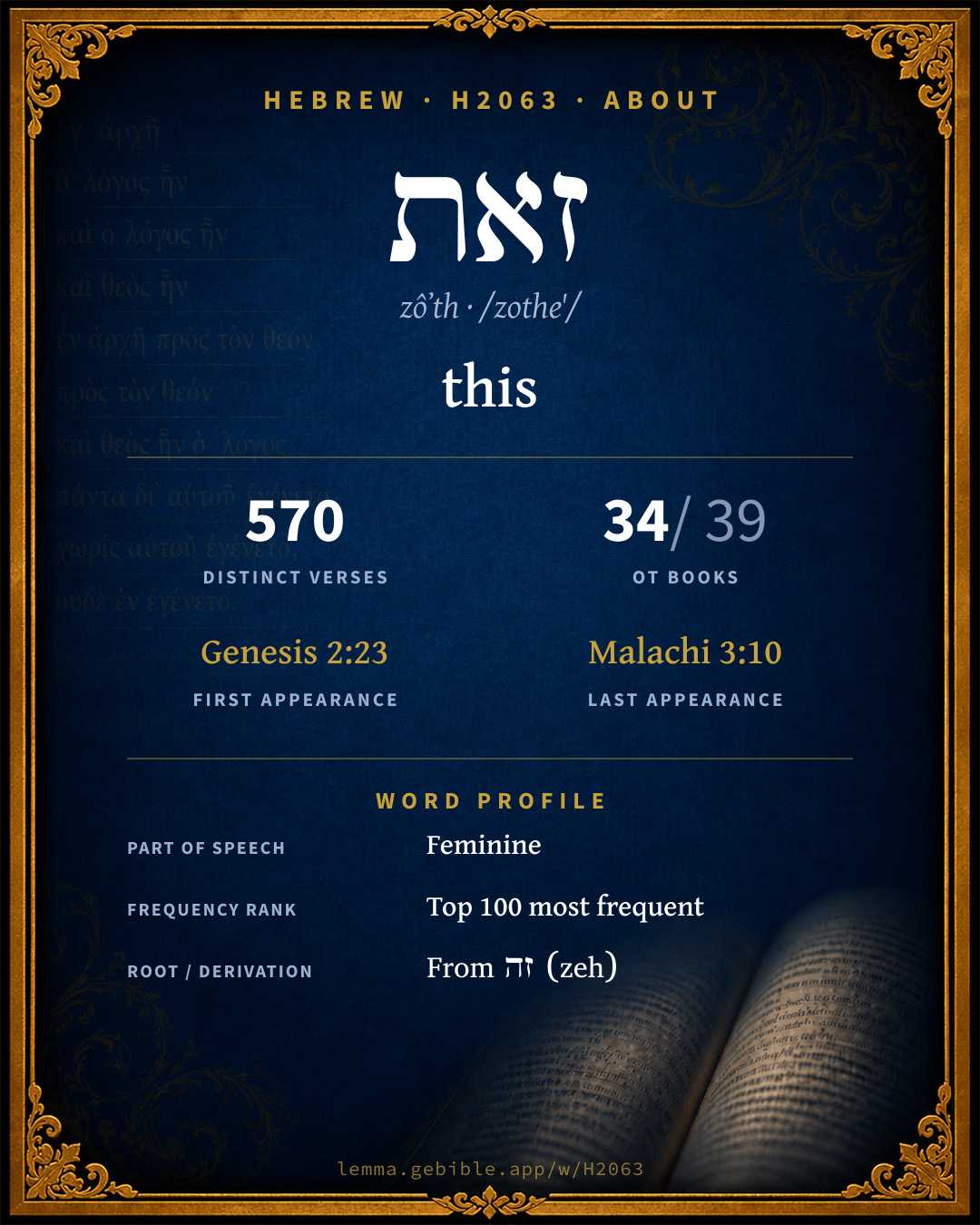
זֹאת
this
also: this one, here, which, this...that fuller range ↓
Full lexicon entry — Brown-Driver-Briggs (BDB)
From Brown-Driver-Briggs (BDB)
Where this word appears
Grammar key — what these labels mean
Part of speech
- Pronoun
- A word standing in for a noun (“he,” “this,” “who”).
Gender
- Feminine
- Grammatically feminine.
Number
- Singular
- One.
Every verse where H2063 appears in the Book of 2 Kings — 21 distinct verses. Click any verse to open its interlinear word-by-word view. Verse text shown in the World English Bible for context — . Each verse’s Hebrew form is shown with its reference; the English is not keyword-highlighted, since the data carries no word-level English alignment. Use “Compare translations” on any verse to read it across multiple English versions. This concordance covers the Hebrew Bible; Septuagint (Greek Old Testament) occurrences are not indexed here.
2 Kings
- 2 Kings 3:18 זֹ֖את pron dem fs This is but a light thing in the sight of Yahweh: he will also deliver the Moabites into your hand.
- 2 Kings 4:12 הַ/זֹּ֑את ptcl def.art + pron dem fs He said to Gehazi his servant, Call this Shunammite. When he had called her, she stood before him.
- 2 Kings 4:13 הַ/זֹּאת֒ ptcl def.art + pron dem fs He said to him, Say now to her, Behold, you have been careful for us with all this care; what is to be done for you? would you be spoken for to the king, or to the captain of the host? She answered, I dwell among my own people.
- 2 Kings 4:36 הַ/זֹּ֔את ptcl def.art + pron dem fs He called Gehazi, and said, Call this Shunammite. So he called her. When she was come in to him, he said, Take up your son.
- 2 Kings 5:4 כָּ/זֹ֤את וְ/כָ/זֹאת֙ prep + pron dem fs conj + prep + pron dem fs One went in, and told his lord, saying, Thus and thus said the maiden who is of the land of Israel.
- 2 Kings 6:28 הַ/זֹּ֜את ptcl def.art + pron dem fs The king said to her, What ails you? She answered, This woman said to me, Give your son, that we may eat him today, and we will eat my son tomorrow.
- 2 Kings 6:33 זֹ֤את pron dem fs While he was yet talking with them, behold, the messenger came down to him: and he said, Behold, this evil is of Yahweh; why should I wait for Yahweh any longer?
- 2 Kings 8:5 זֹ֚את pron dem fs It happened, as he was telling the king how he had restored to life him who was dead, that behold, the woman, whose son he had restored to life, cried to the king for her house and for her land. Gehazi said, My lord, O king, this is the woman, and this is her son, whom Elisha restored to life.
- 2 Kings 9:12 כָּ/זֹ֤את וְ/כָ/זֹאת֙ prep + pron dem fs conj + prep + pron dem fs They said, It is false; tell us now. He said, Thus and thus spoke he to me, saying, Thus says Yahweh, I have anointed you king over Israel.
- 2 Kings 9:26 הַ/זֹּ֖את ptcl def.art + pron dem fs Surely I have seen yesterday the blood of Naboth, and the blood of his sons, says Yahweh; and I will requite you in this plat, says Yahweh. Now therefore take and cast him into the plat [of ground], according to the word of Yahweh.
- 2 Kings 9:34 הַ/זֹּאת֙ ptcl def.art + pron dem fs When he was come in, he ate and drink; and he said, See now to this cursed woman, and bury her; for she is a king's daughter.
- 2 Kings 9:37 זֹ֥את pron dem fs and the body of Jezebel shall be as dung on the face of the field in the portion of Jezreel, so that they shall not say, This is Jezebel.
- 2 Kings 18:25 הַ/זֹּ֖את ptcl def.art + pron dem fs Am I now come up without Yahweh against this place to destroy it? Yahweh said to me, Go up against this land, and destroy it.
- 2 Kings 18:30 הַ/זֹּ֔את ptcl def.art + pron dem fs neither let Hezekiah make you trust in Yahweh, saying, Yahweh will surely deliver us, and this city shall not be given into the hand of the king of Assyria.
- 2 Kings 19:31 זֹּֽאת pron dem fs For out of Jerusalem shall go forth a remnant, and out of Mount Zion those who shall escape: the zeal of Yahweh shall perform this.
- 2 Kings 19:32 הַ/זֹּ֔את ptcl def.art + pron dem fs Therefore thus says Yahweh concerning the king of Assyria, He shall not come to this city, nor shoot an arrow there, neither shall he come before it with shield, nor cast up a mound against it.
- 2 Kings 19:33 הַ/זֹּ֛את ptcl def.art + pron dem fs By the way that he came, by the same shall he return, and he shall not come to this city, says Yahweh.
- 2 Kings 19:34 הַ/זֹּ֖את ptcl def.art + pron dem fs For I will defend this city to save it, for my own sake, and for my servant David's sake.
- 2 Kings 20:6 הַ/זֹּ֑את הַ/זֹּ֔את ptcl def.art + pron dem fs ptcl def.art + pron dem fs I will add to your days fifteen years; and I will deliver you and this city out of the hand of the king of Assyria; and I will defend this city for my own sake, and for my servant David's sake.
- 2 Kings 23:3 הַ/זֹּ֔את ptcl def.art + pron dem fs The king stood by the pillar, and made a covenant before Yahweh, to walk after Yahweh, and to keep his commandments, and his testimonies, and his statutes, with all [his] heart, and all [his] soul, to confirm the words of this covenant that were written in this book: and all the people stood to the covenant.
- 2 Kings 23:27 הַ/זֹּ֤את ptcl def.art + pron dem fs Yahweh said, I will remove Judah also out of my sight, as I have removed Israel, and I will cast off this city which I have chosen, even Jerusalem, and the house of which I said, My name shall be there.
About this entry
At a glance — auto-summarized from this page’s data, not written by a person. Every figure links to its source below. This summary describes the numbers; it doesn’t interpret them.
The Hebrew word זאת centers on the idea of “this.” Lexicons map it across 21 senses — beyond “this” it also covers “this one”, “here”, and “which”. It appears 570 verses across 34 books of the Hebrew Bible, among its most common vocabulary. Its earliest occurrence is Genesis 2:23. For the data behind this summary, explore the sense tree and the renderings breakdown below.
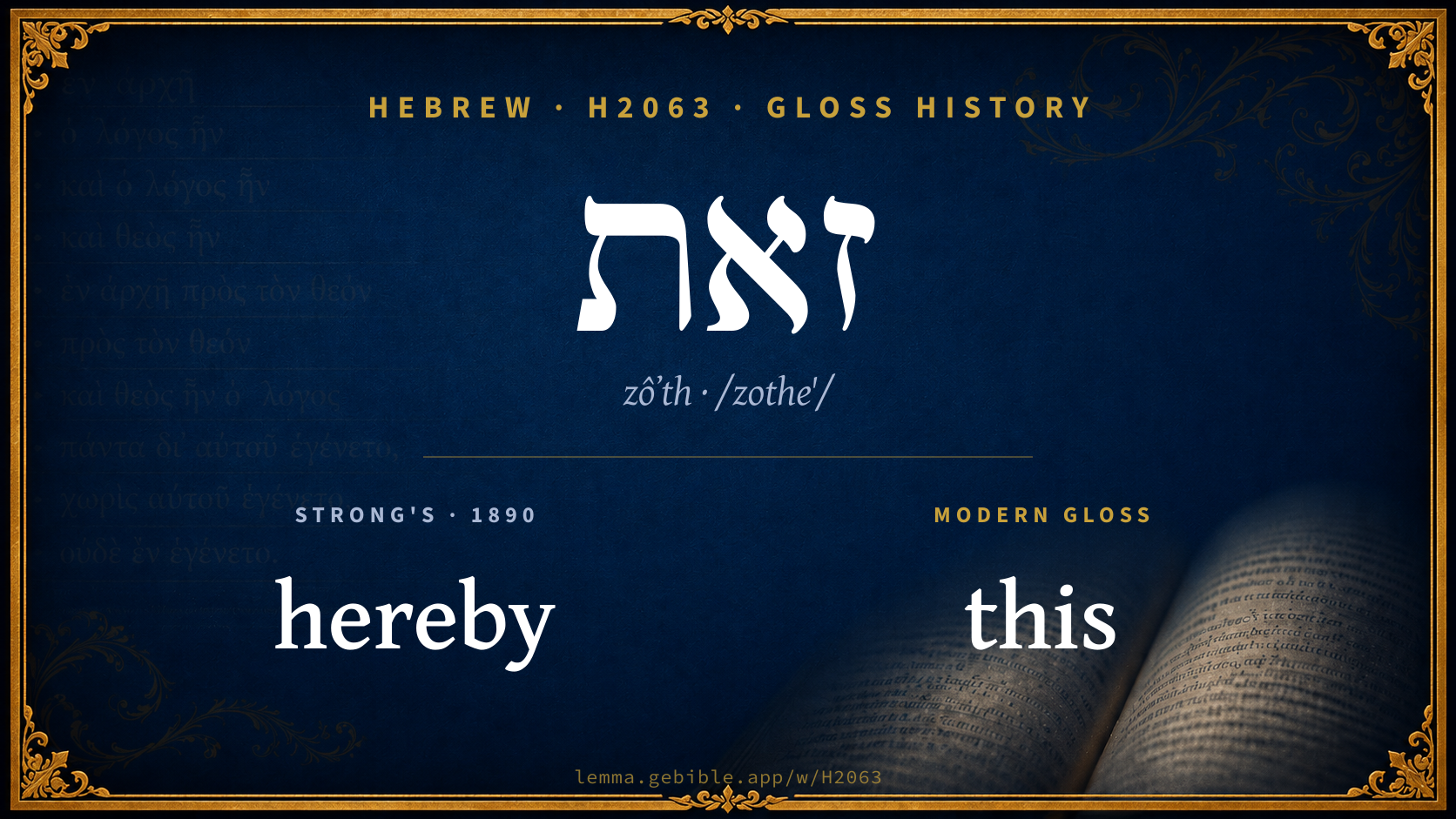
Gloss history
Strong's 1890 vs modern scholarship
About this word
Strong's H2063 catalogs a Hebrew word from the Hebrew Old Testament.
These counts are not copied from any lexicon or concordance. They are computed here, from the morphology-tagged Hebrew Old Testament. What Lemma adds →
- 570
- distinct verses
- The word appears in 570 distinct verses.
- 34 / 39
- OT books
- The word appears in 34 of 39 Old Testament books.
- #79
- by frequency
- Top 100 most frequent Hebrew words (rank 79 of 8,640 Hebrew words by occurrence).
View all 570 occurrences in the concordance →
Most concentrated in
- Jeremiah 90 verses 16%
- Deuteronomy 50 verses 9%
- Genesis 48 verses 8%
By section of the Old Testament
By traditional corpus
Conventional, traditional groupings — biblical authorship is debated, so this is a traditional corpus grouping, not an authorship claim. Each share is this word’s portion of its verses in that division of the Hebrew canon. Each figure is a share of the word’s 570 distinct verses.
- Prophets (Nevi'im) 300 verses · 53%
- Torah (Pentateuch) 171 verses · 30%
- Writings (Ketuvim) 99 verses · 17%
How translations render this word
Counts come from each version’s own published word-to-Strong’s tagging or interlinear alignment — an approximate guide to how each version renders this word, not a word-level alignment the data otherwise carries. Because each total is that version’s own tagged count, the per-version totals vary from one another and need not match the appearance or distinct-verse counts above. These counts may also differ from a printed concordance because Lemma counts each distinctly tagged rendering and does not collapse phrase taggings into a single head-word total. This is a fixed set of word-tagged versions (KJV, ASV, BSB, ULT) and does not change with the reading translation you choose elsewhere. Each version’s license is shown beside its name below (and on Sources).
- King James Version: This 9×, It 2×, She 2×
- American Standard Version: This 4×, After this 2×, Herewith 2×
- Berean Standard Bible: This 438×, Is this 12×, These 8×
- unfoldingWord Literal Text: This 467×, Is 37×, Like this 21×
King James Version Public Domain
Renders H2063 across 41 tagged occurrences — most commonly:
Plus 26 renderings that appear only once — usually multi-word phrases or single function words the recovered tagging swept in, not distinct renderings.
American Standard Version Public Domain
Renders H2063 across 41 tagged occurrences — most commonly:
Plus 25 renderings that appear only once — usually multi-word phrases or single function words the recovered tagging swept in, not distinct renderings.
Berean Standard Bible Public Domain
Renders H2063 across 559 tagged occurrences — most commonly:
Plus other, less common renderings. Plus 38 renderings that appear only once — usually multi-word phrases or single function words the recovered tagging swept in, not distinct renderings. Not rendered by a distinct English word in 45 further occurrences.
unfoldingWord Literal Text CC BY-SA 4.0
Renders H2063 across 615 tagged occurrences — most commonly:
Plus 21 renderings that appear only once — usually multi-word phrases or single function words the recovered tagging swept in, not distinct renderings.
21 senses in BDB, in lexicon order
The 21 senses BDB distinguishes for this word, in lexicon order (not ranked by frequency or importance). The full entry — with sub-senses — is in the Lexicon Entry tab.
- this, this one, here, which, this...that, the one...the other, such
(alone)
- this one
- this...that, the one...the other, another
(appos to subst)
- this
(as predicate)
- this, such
(enclitically)
- then
- who, whom
- how now, what now
- what now
- wherefore now
This word has an unusually long lexicon entry — 21 senses across its verb stems. The first 10 are shown above in lexicon order; the remaining 11 senses (more of the same, repeated under each stem) and the full sub-sense tree are in the Lexicon Entry tab.
Word origin
Derived from זה (zeh) (H2089) — lamb, sheep.
Jastrow Dictionary
A second Hebrew/Aramaic lexicon for comparison, covering Aramaic and post-biblical (Talmudic, Targumic, Midrashic) usage that the biblical-Hebrew BDB does not. Matched by lemma rather than by Strong’s number, so a lemma may carry more than one Jastrow headword (shown separately below), and the entries cover usage well beyond the Bible.
זֹאת
- , v. זֶה
A Dictionary of the Targumim, the Talmud Babli and Yerushalmi, and the Midrashic Literature (Marcus Jastrow; London, Luzac, 1903) — Public Domain. Digitized via Sefaria. Digitized via Sefaria. Full attribution on Sources.
Forms in the corpus
The 94 distinct written forms H2063 takes in the Hebrew Bible, most frequent first — each parse links to that state’s occurrences in the concordance. Hebrew forms include their vowel points and cantillation, so a single lemma takes many written forms.
| Form | Parsing | Example | Uses |
|---|---|---|---|
| הַ/זֹּ֔את | Pronoun, Demonstrative, Feminine, Singular | Daniel 10:8 | 67 |
| הַ/זֹּ֖את | Pronoun, Demonstrative, Feminine, Singular | Daniel 9:13 | 48 |
| הַ/זֹּ֑את | Pronoun, Demonstrative, Feminine, Singular | Deuteronomy 5:3 | 46 |
| הַ/זֹּֽאת | Pronoun, Demonstrative, Feminine, Singular | Deuteronomy 4:22 | 41 |
| זֹ֣את | Pronoun, Demonstrative, Feminine, Singular | Amos 4:12 | 32 |
| זֹ֑את | Pronoun, Demonstrative, Feminine, Singular | Amos 7:3 | 27 |
| הַ/זֹּאת֙ | Pronoun, Demonstrative, Feminine, Singular | Deuteronomy 3:18 | 22 |
| זֹ֥את | Pronoun, Demonstrative, Feminine, Singular | Deuteronomy 14:4 | 21 |
| זֹ֗את | Pronoun, Demonstrative, Feminine, Singular | Genesis 29:27 | 20 |
| זֹ֖את | Pronoun, Demonstrative, Feminine, Singular | Exodus 12:43 | 19 |
| הַ/זֹּ֛את | Pronoun, Demonstrative, Feminine, Singular | Deuteronomy 3:12 | 17 |
| זֹ֤את | Pronoun, Demonstrative, Feminine, Singular | Deuteronomy 34:4 | 16 |
| זֹאת֙ | Pronoun, Demonstrative, Feminine, Singular | Amos 8:8 | 15 |
| זֹ֛את | Pronoun, Demonstrative, Feminine, Singular | Amos 2:11 | 13 |
| זֹ֔את | Pronoun, Demonstrative, Feminine, Singular | Deuteronomy 32:6 | 12 |
| זֹֽאת | Pronoun, Demonstrative, Feminine, Singular | Deuteronomy 32:27 | 11 |
| הַ/זֹּ֗את | Pronoun, Demonstrative, Feminine, Singular | Deuteronomy 6:25 | 9 |
| זֹ֚את | Pronoun, Demonstrative, Feminine, Singular | Ezekiel 5:5 | 9 |
| זֹּ֣את | Pronoun, Demonstrative, Feminine, Singular | Exodus 14:5 | 8 |
| הַ/זֹּ֜את | Pronoun, Demonstrative, Feminine, Singular | Deuteronomy 19:9 | 7 |
| וְ/זֹ֣את | Pronoun, Demonstrative, Feminine, Singular | Deuteronomy 6:1 | 6 |
| זֹּֽאת | Pronoun, Demonstrative, Feminine, Singular | Amos 9:12 | 6 |
| וְ/זֹ֥את | Pronoun, Demonstrative, Feminine, Singular | Leviticus 6:14 | 5 |
| זֹ֭את | Pronoun, Demonstrative, Feminine, Singular | Job 5:27 | 5 |
| זֹּ֑את | Pronoun, Demonstrative, Feminine, Singular | Exodus 13:14 | 5 |
| בְּ/זֹאת֙ | Pronoun, Demonstrative, Feminine, Singular | 1 Samuel 11:2 | 4 |
| הַ/זֹּאת֒ | Pronoun, Demonstrative, Feminine, Singular | Deuteronomy 31:9 | 4 |
| וְ/זֹאת֙ | Pronoun, Demonstrative, Feminine, Singular | Exodus 25:3 | 4 |
| זֹּ֔את | Pronoun, Demonstrative, Feminine, Singular | Genesis 20:6 | 4 |
| זֹּ֖את | Pronoun, Demonstrative, Feminine, Singular | Genesis 12:18 | 4 |
| כָּ/זֹֽאת | Pronoun, Demonstrative, Feminine, Singular | Ezra 9:13 | 4 |
| בְּ/זֹ֖את | Pronoun, Demonstrative, Feminine, Singular | Ezekiel 16:29 | 3 |
| בְּ/זֹ֣את | Pronoun, Demonstrative, Feminine, Singular | Exodus 7:17 | 3 |
| וְ/זֹ֛את | Pronoun, Demonstrative, Feminine, Singular | 2 Samuel 7:19 | 3 |
| זֹ֕את | Pronoun, Demonstrative, Feminine, Singular | Amos 8:4 | 3 |
| זֹ֡את | Pronoun, Demonstrative, Feminine, Singular | Isaiah 54:17 | 3 |
| זֹּאת֙ | Pronoun, Demonstrative, Feminine, Singular | Exodus 14:11 | 3 |
| כָּ/זֹ֑את | Pronoun, Demonstrative, Feminine, Singular | 1 Chronicles 29:14 | 3 |
| הֲ/זֹ֣את | Pronoun, Demonstrative, Feminine, Singular | Job 20:4 | 2 |
| הֲ/זֹ֥את | Pronoun, Demonstrative, Feminine, Singular | Isaiah 23:7 | 2 |
| הַ/זֹּ֤את | Pronoun, Demonstrative, Feminine, Singular | Deuteronomy 31:21 | 2 |
| הַ/זֹּ֧את | Pronoun, Demonstrative, Feminine, Singular | Genesis 19:20 | 2 |
| הַ/זֹּאת֮ | Pronoun, Demonstrative, Feminine, Singular | 1 Samuel 14:45 | 2 |
| וְ/זֹ֖את | Pronoun, Demonstrative, Feminine, Singular | Deuteronomy 4:44 | 2 |
| וְ/זֹ֤את | Pronoun, Demonstrative, Feminine, Singular | 1 Kings 3:22 | 2 |
| וְ/כָ/זֹ֖את | Pronoun, Demonstrative, Feminine, Singular | 2 Samuel 17:15 | 2 |
| וְ/כָ/זֹ֥את | Pronoun, Demonstrative, Feminine, Singular | 2 Samuel 17:15 | 2 |
| וְ/כָ/זֹאת֙ | Pronoun, Demonstrative, Feminine, Singular | 2 Kings 5:4 | 2 |
| זֹ֠את | Pronoun, Demonstrative, Feminine, Singular | Leviticus 13:59 | 2 |
| זֹ֨את | Pronoun, Demonstrative, Feminine, Singular | Hosea 5:1 | 2 |
| זֹּ֥את | Pronoun, Demonstrative, Feminine, Singular | Judges 2:2 | 2 |
| כָּ/זֹ֔את | Pronoun, Demonstrative, Feminine, Singular | Esther 4:14 | 2 |
| כָּ/זֹ֖את | Pronoun, Demonstrative, Feminine, Singular | 1 Samuel 4:7 | 2 |
| כָּ/זֹ֣את | Pronoun, Demonstrative, Feminine, Singular | 1 Kings 7:37 | 2 |
| כָּ/זֹ֤את | Pronoun, Demonstrative, Feminine, Singular | 2 Kings 5:4 | 2 |
| בָ/זֹ֛את | Pronoun, Demonstrative, Feminine, Singular | 1 Chronicles 27:24 | 1 |
| בְּ/זֹ֔את | Pronoun, Demonstrative, Feminine, Singular | Leviticus 26:27 | 1 |
| בְּ/זֹ֛את | Pronoun, Demonstrative, Feminine, Singular | Leviticus 16:3 | 1 |
| בְּ/זֹ֞את | Pronoun, Demonstrative, Feminine, Singular | Jeremiah 9:24 | 1 |
| בְּ֝/זֹ֗את | Pronoun, Demonstrative, Feminine, Singular | Psalms 27:3 | 1 |
The 60 most common forms are shown; 34 rarer forms follow in the full concordance.
Septuagint verse parallels
This word appears in 532 verses that also exist in the Greek Old Testament (Septuagint), out of the 570 Hebrew verses it occurs in. You can read those verses in Greek by switching the Old Testament edition to the Septuagint.
Read these verses in the Septuagint
- Genesis 2:23
- Exodus 7:17
- Leviticus 6:9
- Numbers 4:4
- Deuteronomy 1:5
- Joshua 1:13
- Judges 1:27
- Ruth 1:19
- 1 Samuel 2:20
- 2 Samuel 1:17
- 1 Kings 3:17
- 2 Kings 3:18
This is a verse-level parallel only — the same verses exist in both the Hebrew and Greek Old Testaments. No word-level Hebrew↔Greek correspondence is claimed: the data carries no such alignment, so no Greek word is shown as this Hebrew word’s translation. Coverage is not total — the Septuagint omits the deuterocanon and renumbers the Psalms, so some Hebrew verses have no direct Greek parallel.