
Joshua 18:28

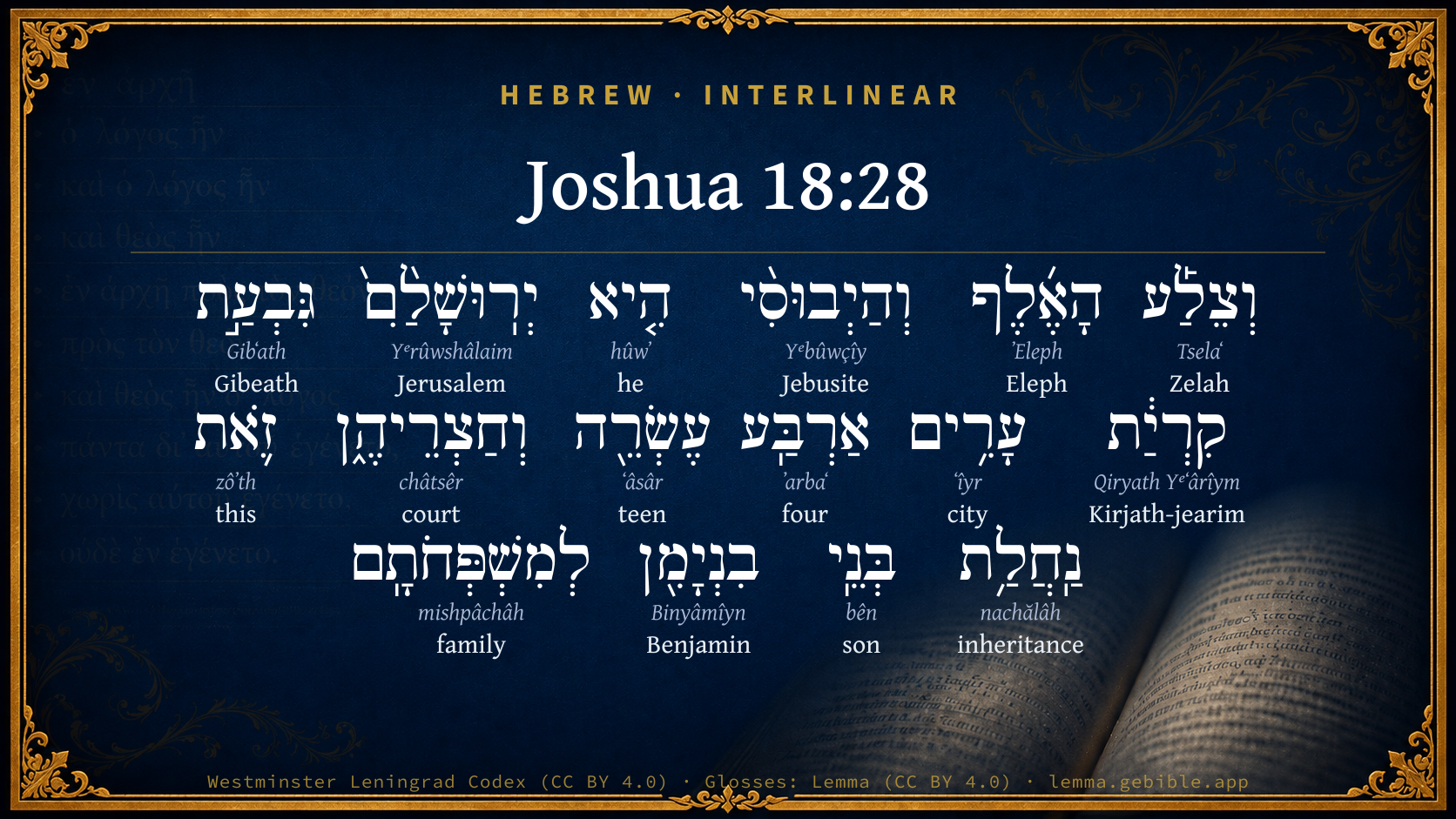
Hebrew (Westminster Leningrad Codex) Joshua 18:28 appears in the Hebrew Old Testament. The text above is from the Westminster Leningrad Codex. Each word links to its Strong’s number, a concise gloss, and parsing drawn from the Open Scriptures Hebrew Bible morphology. Click any word for its full Brown-Driver-Briggs (BDB) entry.
Download image
Cite this verse

Joshua 18:28 (World English Bible). Public Domain. Lemma interlinear Bible study tool, https://lemma.gebible.app/v/joshua/18/28.

Show BibTeX & RIS
BibTeX
RIS
English Translation
and Zelah, Eleph, and the Jebusite (the same is Jerusalem), Gibeath, [and] Kiriath; fourteen cities with their villages. This is the inheritance of the children of Benjamin according to their families.
World English Bible · Public Domain
Highlights
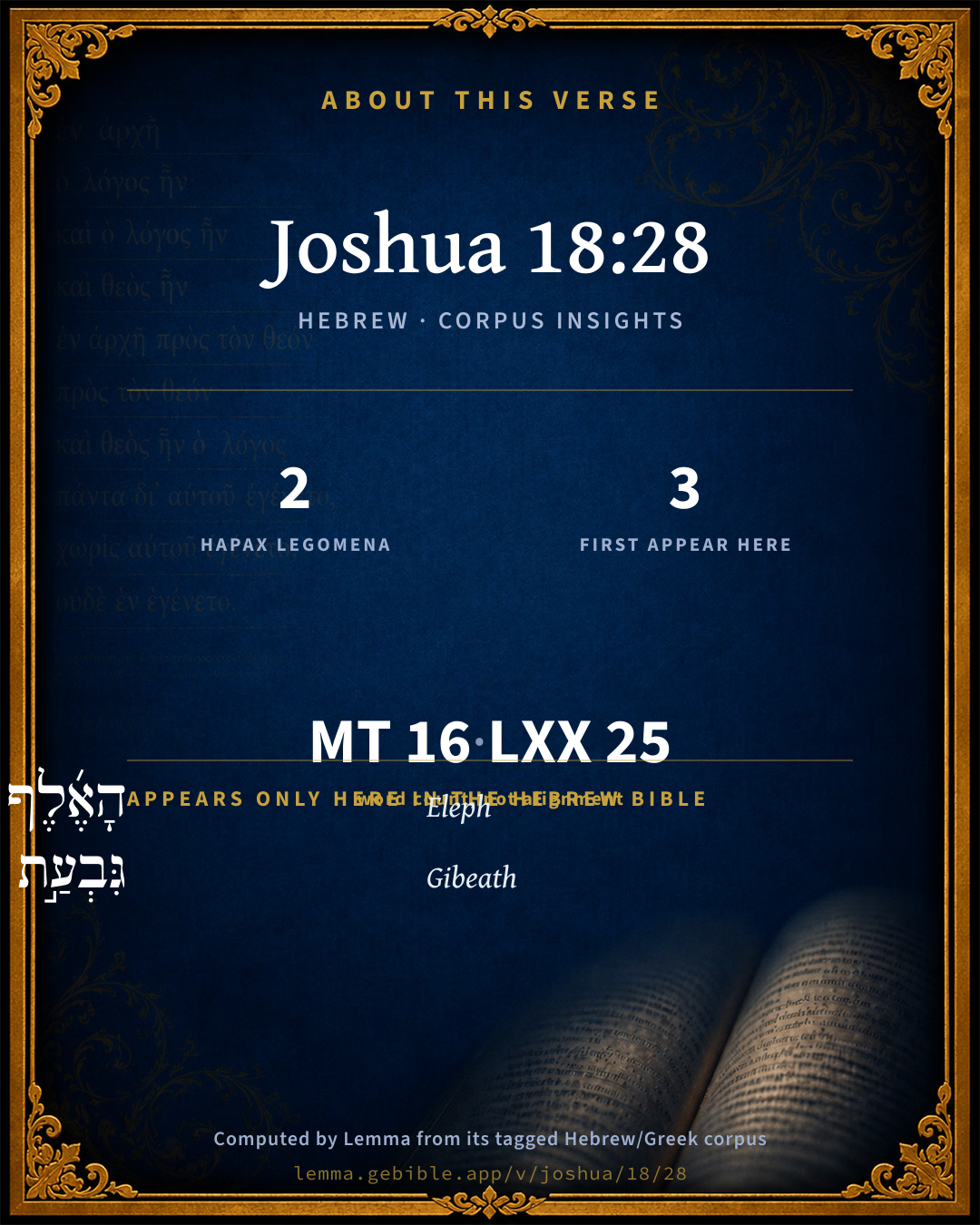
  • 2 hapax legomena — only here in the Hebrew Bible
  • 3 first appearances in the Hebrew Bible
Full analysis ↓
Download a study sheet

One document with this verse’s original text, its word-by-word gloss line, the meaning frame, cross-references with their text, attributed commentary, and full source and license credits — printable, and it pastes into notes with its structure intact.

This verse Autodidact and up

Study sheet (.html) Plain text (.txt)

A passage Seminary Student

Up to 50 verses in one chapter. A passage sheet keeps up to 6 commentary sources and 12 cross-references per verse, in the order this page ranks them, and says so on the sheet whenever that leaves anything out. Ask for a single verse and you get the Autodidact verse sheet above.

Everything on this page stays free to read, with no account — the sheet is a download of what is already on screen, not access to it.

Want to remove ads? Support Godless Engineer
Compare translations 3

The same verse in 3 English versions, stacked beneath the original-language interlinear above. Click any original word for its lexicon entry.

Each is an independent rendering of the whole verse — the interlinear is not word-aligned to these translations.

Highlighted words mark where these versions differ — a whole-verse word diff, not a word-by-word alignment.

  • World English Bible Public Domain
    and Zelah, Eleph, and the Jebusite (the same is Jerusalem), Gibeath, [and] Kiriath; fourteen cities with their villages. This is the inheritance of the children of Benjamin according to their families.
  • King James Version Public Domain
    And Zelah, Eleph, and Jebusi, which is Jerusalem, Gibeath, and Kirjath; fourteen cities with their villages. This is the inheritance of the children of Benjamin according to their families.
  • unfoldingWord Literal Text CC BY-SA 4.0
    and Zelah, Haeleph, and the Jebusite (it Jerusalem), Gibeah, Kiriath: 14 cities and their villages. This the inheritance of the sons of Benjamin according to their clans.

unfoldingWord Literal Text — © unfoldingWord, licensed CC BY-SA 4.0. Word-aligned USFM3 via Door43 (git.door43.org/unfoldingWord/en_ult).

Versions to compare (up to 4)

3 of 4 selected

Show all 18 translations

Every available English version of this verse, each an independent rendering of the whole verse.

  • World English Bible Public Domain
    and Zelah, Eleph, and the Jebusite (the same is Jerusalem), Gibeath, [and] Kiriath; fourteen cities with their villages. This is the inheritance of the children of Benjamin according to their families.
  • Berean Standard Bible Public Domain
    Zelah, Haeleph, Jebus (that is, Jerusalem), Gibeah, and Kiriath-jearim—fourteen cities, along with their villages. This was the inheritance of the clans of the tribe of Benjamin.
  • Majority Standard Bible Public Domain
    Zelah, Haeleph, Jebus (that is, Jerusalem), Gibeah, and Kiriath-jearim—fourteen cities, along with their villages. This was the inheritance of the clans of the tribe of Benjamin.
  • King James Version Public Domain
    And Zelah, Eleph, and Jebusi, which is Jerusalem, Gibeath, and Kirjath; fourteen cities with their villages. This is the inheritance of the children of Benjamin according to their families.
  • American Standard Version (1901) Public Domain
    and Zelah, Eleph, and the Jebusite (the same is Jerusalem), Gibeath, `and' Kiriath; fourteen cities with their villages. This is the inheritance of the children of Benjamin according to their families.
  • Revised Version (1885) Public Domain
    and Zelah, Eleph, and the Jebusite (the same is Jerusalem), Gibeath, and Kiriath; fourteen cities with their villages. This is the inheritance of the children of Benjamin according to their families.
  • Geneva Bible (1599) Public Domain
    And Zela, Eleph, and Iebusi, (which is Ierusalem) Gibeath, and Kiriath: fourteene cities with their villages: this is the inheritance of the children of Beniamin according to their families.
  • Douay-Rheims (1899) Public Domain
    And Recem, Jarephel and Tharela,
  • Young's Literal Translation Public Domain
    and Zelah, Eleph, and Jebusi (it `is' Jerusalem), Gibeath, Kirjath: fourteen cities and their villages. This `is' the inheritance of the sons of Benjamin, for their families.
  • Literal Standard Version CC BY-SA 4.0
    and Zelah, Eleph, and Jebusi (it [is] Jerusalem), Gibeath, Kirjath; fourteen cities and their villages. This [is] the inheritance of the sons of Benjamin, for their families.
  • Unlocked Literal Bible CC BY-SA 4.0
    Zelah, Haeleph, Jebus (the same as Jerusalem), Gibeah, and Kiriath. There were fourteen cities, including their villages. This was the inheritance of Benjamin for their clans.
  • unfoldingWord Literal Text CC BY-SA 4.0
    and Zelah, Haeleph, and the Jebusite (it Jerusalem), Gibeah, Kiriath: 14 cities and their villages. This the inheritance of the sons of Benjamin according to their clans.
  • Darby Bible Public Domain
    and Zelah, Eleph, and Jebusi, that is, Jerusalem, Gibeah, Kirjath: fourteen cities and their hamlets. This was the inheritance of the children of Benjamin according to their families.
  • World Messianic Bible Public Domain
    Zelah, Eleph, the Jebusite (also called Jerusalem), Gibeath, and Kiriath; fourteen cities with their villages. This is the inheritance of the children of Benjamin according to their families.
  • Webster's Bible Public Domain
    And Zelah, Eleph, and Jebusi, (which is Jerusalem) Gibeath, and Kirjath; fourteen cities with their villages. This is the inheritance of the children of Benjamin according to their families.
  • Free Bible Version CC BY-SA 4.0
    Zela, Haeleph, Jebus (or Jerusalem), Gibeah, and Kiriath-jearim—fourteen towns with their associated villages. This was the land allotted to the tribe of Benjamin, by families.
  • Bible in Basic English Public Domain
    And Zela, Eleph and the Jebusite (which is Jerusalem), Gibeath and Kiriath; fourteen towns with their unwalled places. This is the heritage of the children of Benjamin by their families.
  • JPS Tanakh (1917) Public Domain
    and Zela, Eleph, and the Jebusite — the same is Jerusalem, Gibeath, and Kiriath; fourteen cities with their villages. This is the inheritance of the children of Benjamin according to their families.

Literal Standard Version (2020), Covenant Press — licensed CC BY-SA 4.0. Text via the HelloAO Bible API (eBible.org). Unlocked Literal Bible (unfoldingWord) — licensed CC BY-SA 4.0. Text via the HelloAO Bible API (eBible.org). unfoldingWord Literal Text — © unfoldingWord, licensed CC BY-SA 4.0. Word-aligned USFM3 via Door43 (git.door43.org/unfoldingWord/en_ult). Free Bible Version, Dr. Jonathan Gallagher — licensed CC BY-SA 4.0. Text via the HelloAO Bible API (eBible.org).

Word by word

More ways to search: Search by grammar → Find every occurrence → Compare this word →

Practice this passage: Drill this verse → Learn its vocabulary →

הָאֶ֜לֶף
ʼEleph
H507
“Eleph”
Noun, Proper
Part of Speech
Noun
Type
Proper
Full BDB Definition

Origin: the same as H505

TWOT: None

Eleph = "thousand" - a city in the territory of Benjamin
  1. וְצֵלַ֡ע Tselaʻ H6762 “and · Zelah” Conjunction + Noun, Proper
  2. וְהַיְבוּסִ֨י Yᵉbûwçîy H2983 “and · the · Jebusite” Conjunction + Particle, Definite Article + Noun, Gentilic, Masculine, Singular, Absolute
  3. הִ֤יא hûwʼ H1931 “he” Pronoun, Personal, 3rd Person, Feminine, Singular
  4. יְרֽוּשָׁלִַ֨ם֙ Yᵉrûwshâlaim H3389 “Jerusalem” Noun, Proper
  5. גִּבְעַ֣ת Gibʻath H1394 “Gibeath” Noun, Proper
  6. קִרְיַ֔ת Qiryath Yᵉʻârîym H7157 “Kirjath-jearim” Noun, Proper
  7. עָרִ֥ים ʻîyr H5892 “cities” Noun, Common, Feminine, Plural, Absolute
  8. אַרְבַּֽע ʼarbaʻ H702 “four” Adjective, Cardinal number, Feminine, Singular, Absolute
  9. עֶשְׂרֵ֖ה ʻâsâr H6240 “teen” Adjective, Cardinal number, Feminine, Singular, Absolute
  10. וְחַצְרֵיהֶ֑ן châtsêr H2691 “and · courts · their” Conjunction + Noun, Common, Both, Plural, Construct + Suffix, Personal, 3rd Person, Feminine, Plural
  11. זֹ֛את zôʼth H2063 “this” Pronoun, Demonstrative, Feminine, Singular
  12. נַֽחֲלַ֥ת nachălâh H5159 “inheritance of” Noun, Common, Feminine, Singular, Construct
  13. בְּנֵֽי bên H1121 “sons of” Noun, Common, Masculine, Plural, Construct
  14. בִנְיָמִ֖ן Binyâmîyn H1144 “Benjamin” Noun, Proper
  15. לְמִשְׁפְּחֹתָֽם mishpâchâh H4940 “to/for · families · their” Preposition + Noun, Common, Feminine, Plural, Construct + Suffix, Personal, 3rd Person, Masculine, Plural

About this verse

These counts appear in no published source. They are computed here, from the morphology-tagged text and Lemma’s own curated glosses. What Lemma adds →

16
words
16
distinct lemmas
Historical
section

Notable vocabulary

2 hapax legomena — words that appear only here in the entire Hebrew Bible:

  • הָאֶ֜לֶף Eleph H507
  • גִּבְעַ֣ת Gibeath H1394

First appearance in Scripture

These words make their first canonical appearance in the Hebrew Bible here:

  • וְצֵלַ֡ע Zelah H6762
  • הָאֶ֜לֶף Eleph H507
  • גִּבְעַ֣ת Gibeath H1394

Shared distinctive vocabulary

וְצֵלַ֡ע Zelah H6762 occurs in 2 verses of the Hebrew Bible. Also found in:

Grammatical profile

  • 12 nouns
  • 2 adjectives
  • 2 pronouns

Hebrew & Septuagint length

In English translation the verse runs 31 words from the Hebrew and 26 from the Septuagint (LXX English) — closely comparable.

A rough comparison of the two English renderings, which tokenize alike — not a word-level alignment.

Word counts can differ between the Hebrew and the Greek without any difference in meaning — e.g. the Hebrew direct-object marker אֵת has no separate Greek word, and Greek often adds the article ὁ.

In the original languages it is 16 Hebrew tokens and 25 Greek tokens — but the two are counted differently (Hebrew bundles its prefixes and suffixes into one token; the Greek is in lemma form), so that isn’t a like-for-like length.

Cross-references

13

Topical passages linked to Joshua 18:28 in the Treasury of Scripture Knowledge — connected by theme and wording, ordered by reader-vote popularity; previews shown in the World English Bible.

  • 2 Samuel 21:14 They buried the bones of Saul and Jonathan his son in the country of Benjamin in Zela, in the tomb of Kish his father: and they performed all that the king commanded. After that God was entreated for the land.
  • Joshua 15:8 and the border went up by the valley of the son of Hinnom to the side of the Jebusite southward (the same is Jerusalem); and the border went up to the top of the mountain that lies before the valley of Hinnom westward, which is at the uttermost part of the valley of Rephaim northward;
  • Numbers 33:54 You shall inherit the land by lot according to your families; to the more you shall give the more inheritance, and to the fewer you shall give the less inheritance: wherever the lot falls to any man, that shall be his; according to the tribes of your fathers shall you inherit.
  • Joshua 15:63 As for the Jebusites, the inhabitants of Jerusalem, the children of Judah couldn't drive them out: but the Jebusites dwell with the children of Judah at Jerusalem to this day.
  • Joshua 18:16 and the border went down to the uttermost part of the mountain that lies before the valley of the son of Hinnom, which is in the valley of Rephaim northward; and it went down to the valley of Hinnom, to the side of the Jebusite southward, and went down to En Rogel;
  • Judges 19:12–15 His master said to him, We won't turn aside into the city of a foreigner, that is not of the children of Israel; but we will pass over to Gibeah.
  • Judges 20:4–5 The Levite, the husband of the woman who was murdered, answered, I came into Gibeah that belongs to Benjamin, I and my concubine, to lodge.
  • 1 Samuel 10:26 Saul also went to his house to Gibeah; and there went with him the host, whose hearts God had touched.
  • 1 Samuel 13:15–16 Samuel arose, and got him up from Gilgal to Gibeah of Benjamin. Saul numbered the people who were present with him, about six hundred men.
  • 2 Samuel 5:8 David said on that day, Whoever strikes the Jebusites, let him get up to the watercourse, and [strike] the lame and the blind, who are hated of David's soul. Therefore they say, There are the blind and the lame; he can't come into the house.
  • Isaiah 10:29 they are gone over the pass; they have taken up their lodging at Geba; Ramah trembles; Gibeah of Saul is fled.
  • Hosea 10:9 "Israel, you have sinned from the days of Gibeah. There they remained. The battle against the children of iniquity doesn't overtake them in Gibeah.
  • Numbers 26:54 To the more you shall give the more inheritance, and to the fewer you shall give the less inheritance: to everyone according to those who were numbered of him shall his inheritance be given.

Cross-references courtesy of OpenBible.info (CC BY 4.0).

Hebrew and Greek witnesses Masoretic Hebrew ↔ Greek Septuagint

The same verse in the two great witnesses to the Old Testament, shown verse-for-verse.

These are two independent witnesses, not word-aligned to each other, and the Septuagint is shown in lemma (dictionary) form.

Hebrew Joshua 18:28 Masoretic · Westminster Leningrad Codex

וְצֵלַ֡ע הָאֶ֜לֶף וְהַיְבוּסִ֨י הִ֤יא יְרֽוּשָׁלִַ֨ם֙ גִּבְעַ֣ת קִרְיַ֔ת עָרִ֥ים אַרְבַּֽע עֶשְׂרֵ֖ה וְחַצְרֵיהֶ֑ן זֹ֛את נַֽחֲלַ֥ת בְּנֵֽי בִנְיָמִ֖ן לְמִשְׁפְּחֹתָֽם

and Zelah, Eleph, and the Jebusite (the same is Jerusalem), Gibeath, [and] Kiriath; fourteen cities with their villages. This is the inheritance of the children of Benjamin according to their families.

World English Bible · Public Domain

Greek LXX Joshua 18:28 Septuagint · lemma form

καί ιεβους οὗτος εἰμί ἰερουσαλήμ καί πόλις καί γαβαωθιαριμ πόλις τρεῖς καί δέκα καί ὁ κώμη αὐτός οὗτος ὁ κληρονομία υἱός βενιαμίν κατά δῆμος αὐτός

and Jebus (this is Jerusalem); and Gabaoth, Jarim, thirteen cities, and their villages; this is the inheritance of the sons of Benjamin according to their families.

LXX2012 (modern English Septuagint) · Public Domain

Hebrew: Westminster Leningrad Codex (CC BY 4.0). Greek: Septuagint (public domain); English from LXX2012 (modern English Septuagint) (Public Domain). How the Septuagint differs from the Hebrew →

Targum (Aramaic paraphrase)

1

The Targum is the ancient Jewish Aramaic paraphrase of the Hebrew Scriptures — an interpretive translation, not the Hebrew text itself. Onkelos (literal) and Pseudo-Jonathan (expansive) render the Torah, and Jonathan the Prophets. Coverage is partial: where no permissively-licensed English translation exists for a verse, only the Aramaic is shown. This is verse-level text, not a word-by-word alignment to the Hebrew.

  1. Targum Jonathan Prophets (Joshua–Malachi)
    וּצְלַע אֶלֶף וִיבוּסָאֵי הִיא יְרוּשְׁלֵם גִבְעַת קִרְיַת קִרְוִין אַרְבַּע עַסְרֵי וּפַצְחֵיהֶן דָא אַחֲסָנַת בְּנֵי בִנְיָמִין לְזַרְעֲיַתְהוֹן:

    (no public-domain English translation for this verse)

    Targum Jonathan — Aramaic: “Mikraot Gedolot” (public domain). English: “Sefaria Community Translation” (CC0 1.0 (public-domain dedication)); “London "Chaldee Paraphrase," 1871” (public domain). Text via Sefaria.

Commentary

Notes on Joshua 18:28 from classic Christian and Jewish commentators (each source and its license shown beneath its notes). The classic Christian expositions comment on the surrounding passage and are grouped to its opening verse, so a note may address several verses; the Jewish commentaries on the Tanakh (Rashi and others) are per-verse, so they appear only where the commentator wrote on this verse.

Lemma curates 59 commentaries, every one of them public domain or Creative Commons licensed, each selected and text-cleaned for this edition rather than reprinted as found. About our sources →

Joseph Benson's Commentary

Jos 18:28. And Jebusi, which is Jerusalem — See Jos 15:63, where it is reckoned to the tribe of Judah; for both that tribe and Benjamin had an interest in it, as we have there stated. The inheritance of the children of Benjamin — Which was one of the smallest, with respect to the quantity of ground which they possessed, but the soil was the richest of all the other tribes, as Josephus informs us.

Joseph Benson's Commentary on the Old and New Testaments (1811–1818) — public domain. Text from a community e-Sword module.

Tyndale Open Study Notes

Tyndale Open Resources

18:28 Jerusalem: See study note on 15:8. • Kiriath: The Kiriath-jearim of 18:14 belonged to Judah; another town with this name might have existed but is otherwise unknown. The word Kiriath here was probably originally followed by a word that has been lost in the process of copying.

Tyndale Open Study Notes — © Tyndale Open Resources, licensed CC BY-SA 4.0. Text via the HelloAO Bible API.

Geneva Bible (1599)

Geneva Bible translators

Which was not wholly in the tribe of Benjamin, but part of it was also in the tribe of Judah.

Geneva Bible (1599) marginal notes — public domain. Text via Bolls.life.

Adam Clarke's Commentary

Verse 28. And Zelah] This was the burying-place of Saul, Jonathan, and the family of Kish. See 2Sa 21:14.

Jebusi, which is Jerusalem] We often meet with this name, and it is evident that it was the ancient name of Jerusalem, which was also called Salem; and was probably the place in which Melchizedek reigned in the days of Abraham; though some think a different place is meant; for that there was another place of the same name, is evident from Joh 3:23. This place, called Salim by the evangelist, is said to be near to Enon, and there John baptized, because there was much water in the place. This, however, must not be confounded with the Salem mentioned above; for that this was a name of Jerusalem, is evident from Ps 76:1-2: In Judah is God known: his name is great in Israel. In SALEM also is his tabernacle, and his dwelling-place in Zion. This must refer to Jerusalem, where the temple was situated. Whether Jebus or Jebusi had its name from the Jebusites, or the Jebusites from it, cannot be ascertained.

Adam Clarke's Commentary on the Bible (1810–1826) — public domain. Text from a community e-Sword/MySword module.

The Cambridge Bible for Schools and Colleges

gen. ed. J. J. S. Perowne

28. 10. Zelah] = Beit Jala, S. of the plain of Rephaim, is afterwards mentioned as the burial-place of Saul and Jonathan (2Sa_21:14). 11. Eleph is unknown; 12. Jebusi, which is Jerusalem, see note above, Jos_15:8. 13. Gibeath is the Gibeah of Saul, now Tuleil-el-Fûl, about one hour and 25 minutes north of Jerusalem. Here (a) occurred the outrage recorded in Judges 19; here (b) was Jonathan with a thousand chosen warriors when he made his victorious onslaught on the garrison of the Philistines (1Sa_13:2-3). 14. Kirjath is at present unrecognised.

This is the inheritance of the children of Benjamin] The situation of the territory of this tribe was highly favourable, forming almost a parallelogram, of about 26 miles in length by 12 in breadth. The smallness of the district, hardly larger than the county of Middlesex, was compensated for by the excellence of the land.

(a) The general level of this part of Palestine is very high, being 2000 feet above the level of the Mediterranean on the western side, and 3000 feet above the deep valley of the Jordan on the eastern side. This plateau is surmounted by a large number of eminences (Gibeon, Gibeah, Geba, all = “hill;” Ramah = “eminence;” Mizpeh = “a watch-tower”), which presented favourable sites for strong fortresses.

(b) No less important than these eminences are the torrent-beds and ravines by which the upper country looks down into the deep tracts on each side of it, forming then, as they do now, the only mode of access from either the plains of Philistia and of Sharon on the west, or the Ghôr of the Jordan on the east.

(c) In the broken and hilly country, “little Benjamin” (Psa_68:27), famous above the rest for skill in archery (2Sa_1:22), for its slingers (Jdg_20:16) and left-handed warriors (Jdg_3:15), became warlike and indomitable. “In his mountain passes—the ancient haunt of beasts of prey, he ‘ravined as a wolf in the morning,’ descended into the rich plains of Philistia on the one side, and of the Jordan on the other, and ‘returned in the evening to divide the spoil’ (Gen_49:27). In the troubled period of the Judges, the tribe of Benjamin maintained a struggle, unaided and for some time with success, against the whole of the rest of the nation (Judges 20, 21.). And to the latest times they never could forget that they had given birth to the first king.” Stanley’s Sinai and Palestine, pp. 200, 201.

The Cambridge Bible for Schools and Colleges (gen. ed. J. J. S. Perowne; Cambridge University Press, 1878–1918) — public domain. Text from a community e-Sword module.

Haydock's Catholic Bible Commentary

Jebus. The city was called Salem in the days of Abraham, Genesis xiv. 18., and Psalm lxxv. 3. St. Jerome supposes that Melchisedec resided near Scythopolis, at Salem. (Genesis xxxiii. 17., ep. ad Evag.) Usher thinks he lived at Salim, John iii. 23. --- Gabaath. There seems to have been two cities of this name; one famous for the tomb of Habacuc, (St. Jerome) and the other in the tribe of Ephraim, chap. xxiv. 33. (Calmet)

George Leo Haydock (1774–1849), Haydock's Catholic Family Bible and Commentary, 1859 edition — public domain. Excludes Psalms (Douay-Rheims chapter numbering differs from Protestant) and Deuterocanonical books (Catholic canon only).

Matthew Poole's English Annotations

Which is Jerusalem: so it seems this city did properly and primarily belong to Benjamin, although the tribe of Judah had also an interest in it, either because some part of it was allotted to them, or because the Benjamites gave them a share in it, for the assistance which either they had received or did expect from that potent tribe, for the getting or defending of that very important place. See Poole "Jos 15:63". It is more than probable that all the cities belonging to this tribe are not here named, because Anathoth and Almon are omitted here, but expressed Jos 21:18.

Matthew Poole's English Annotations on the Holy Bible (1683–1685) — public domain. Text from a community e-Sword/MySword module.

Whedon's Commentary on the Bible

Daniel D. Whedon

28. Jebusi, or, the Jebusite. See Jos_10:1. Gibeath, commonly called Gibeah, famous as the birthplace and residence of Saul, the first king of Israel. It was the scene of that atrocious crime which led almost to the annihilation of the tribe of Benjamin. Jdg_19:15, ff. Robinson identifies it with the lofty and commanding hill el-Fal, three or four miles north of Jerusalem.

Kirjath — See Jos_9:17. “For a short time Benjamin rose to the highest rank in the commonwealth, when this tribe gave birth to the first king. Its ultimate position in the nation was altered by the one great change which affected the polarity of the whole political and geographical organization of the country, but of none more than that of Benjamin, when the fortress of Jebus, hitherto within its territory, was annexed by Judah, and became the capital of the monarchy.” — Stanley.

Daniel D. Whedon (gen. ed.), Commentary on the Old and New Testaments (1874–1909) — public domain. Text from a community e-Sword module.

The Pulpit Commentary

Gibeath. Almost certainly the same as "Gibeah of Saul". (1Sa_11:4) It was Saul"s home. (1Sa_10:26 1Sa_13:2, 1Sa_13:15, 1Sa_13:16) It was near Saul"s home, at the time his temporary refuge, that the Philistines encamped when Jonathan (1Sa 14) made his daring attack on them. It was the scene of the terrible outrage recorded in Judges 19 Lieut. Conder has identified it with Jeba, not far from Miehmash, situated on one of the branches of the precipitous Wady Suwaynit. The situation explains the otherwise unintelligible narrative in 1Sa_13:14. This is the inheritance of the children of Benjamin. Dean Stanley ("Sinai and Palestine," ch. 4) reminds us how the very names suggest the "remarkable heights" which constitute the "table land" of which the inheritance of Benjamin consists. Thus Gibeon, Gibeah, Geba, or Gaba, all signify hill. Ramah signifies high place, and Mizpeh, watch tower, which of necessity must be situated on an eminence. Only by narrow passes along deep torrent beds could access be obtained to this mountainous region. Thus it was that the otherwise inexplicable resistance to all Israel in arms, recorded in Jud_1:20 Jud_1:21, was maintained. In a country like this the skill of the Benjamites with the sling (Jud_1:20:16) and the bow (2Sa_1:22) could be used with terrible effect upon foes powerless to come to a hand-to-hand conflict. To Dean Stanley"s vivid description of the physical geography of the country the student is referred for a detailed account.

The Pulpit Commentary (1880–1919), ed. H.D.M. Spence-Jones & Joseph S. Exell — public domain. Text from a community e-Sword module.

Rashi

Rabbi Shlomo Yitzchaki (Rashi)

Tzeilah, Eleph and Yevusi which is Yerushalayim. Each of these are individual cities. Similarly, Givas and Kiryas [are individual cities]. Thus five cities are mentioned in this verse.

Rashi on the Tanakh — English translations: “The Judaica Press complete Tanach with Rashi, translated by A. J. Rosenberg” (CC BY 4.0); “Pentateuch with Rashi's commentary by M. Rosenbaum and A.M. Silbermann, 1929-1934” (public domain); “The Metsudah Tanach series, Lakewood, N.J” (CC BY 4.0); and “The Book of Joshua, Metsudah Publications, 1997” (CC BY 4.0). Text via Sefaria.

Lesson kit

Teaching starters — assembled from the data on this page, not authored interpretation. Every prompt links to the verse data it draws on. Edit before teaching.

Joshua, in the Historical, opens this verse with 16 words (16 distinct Hebrew lemmas). Its most distinctive word is ʼEleph (“Eleph”). A historical commentator’s framing appears above. Read the whole chapter for the surrounding context.

Discussion questions

  1. How does “Eleph” (ʼEleph) shape what this verse is saying?
  2. 2 words here appear nowhere else in the Hebrew Bible. Why might the author reach for such rare wording?
  3. 3 words make their first appearance in Scripture here. What does this debut establish?
  4. How does 2 Samuel 21:14, which shares the word «Zelah», read alongside this verse?
  5. These translations render this verse differently. What is at stake in choosing one wording over another?
  6. Compare how Joseph Benson's Commentary and Tyndale Open Study Notes read this verse. Where do they agree or differ?

Things to notice

Reading settings

Reading text

Shown beneath each verse's original-language words.

Old Testament
Old Testament edition

Read the OT as the Masoretic Hebrew (MT) or the Greek Septuagint (LXX).

English shown for the Greek Septuagint (in the Hebrew ↔ Greek comparison).

Comparing translations? Open the Compare panel on any verse page to stack up to four side by side.