
Numbers 6:21

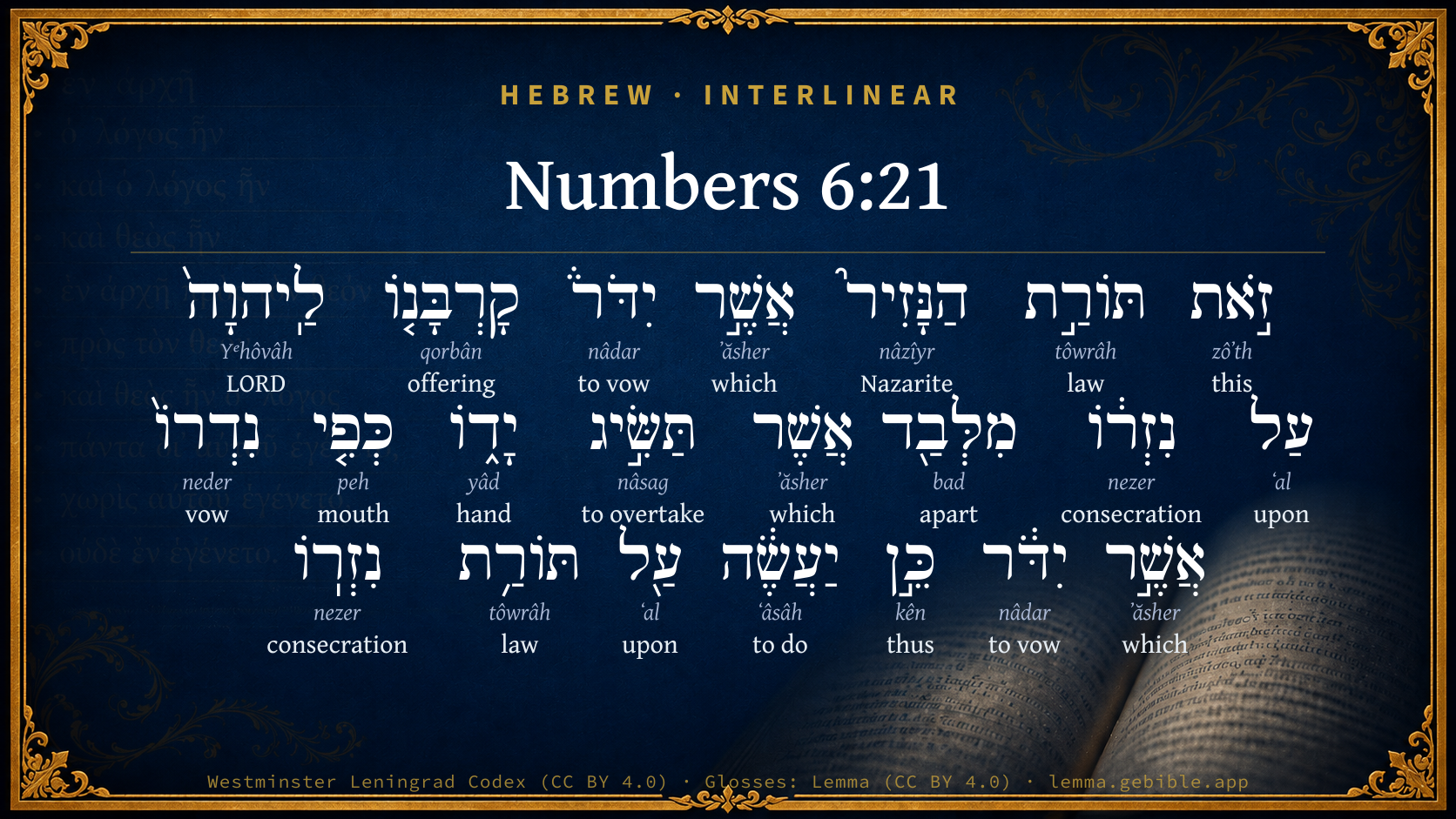
Hebrew (Westminster Leningrad Codex) Numbers 6:21 appears in the Hebrew Old Testament. The text above is from the Westminster Leningrad Codex. Each word links to its Strong’s number, a concise gloss, and parsing drawn from the Open Scriptures Hebrew Bible morphology. Click any word for its full Brown-Driver-Briggs (BDB) entry.
Download image
Cite this verse

Numbers 6:21 (World English Bible). Public Domain. Lemma interlinear Bible study tool, https://lemma.gebible.app/v/numbers/6/21.

Show BibTeX & RIS
BibTeX
RIS
English Translation
"This is the law of the Nazirite who vows, and of his offering to Yahweh for his separation, besides that which he is able to get. According to his vow which he vows, so he must do after the law of his separation."
World English Bible · Public Domain
Download a study sheet

One document with this verse’s original text, its word-by-word gloss line, the meaning frame, cross-references with their text, attributed commentary, and full source and license credits — printable, and it pastes into notes with its structure intact.

This verse Autodidact and up

Study sheet (.html) Plain text (.txt)

A passage Seminary Student

Up to 50 verses in one chapter. A passage sheet keeps up to 6 commentary sources and 12 cross-references per verse, in the order this page ranks them, and says so on the sheet whenever that leaves anything out. Ask for a single verse and you get the Autodidact verse sheet above.

Everything on this page stays free to read, with no account — the sheet is a download of what is already on screen, not access to it.

Want to remove ads? Support Godless Engineer
Compare translations 3

The same verse in 3 English versions, stacked beneath the original-language interlinear above. Click any original word for its lexicon entry.

Each is an independent rendering of the whole verse — the interlinear is not word-aligned to these translations.

Highlighted words mark where these versions differ — a whole-verse word diff, not a word-by-word alignment.

  • World English Bible Public Domain
    "This is the law of the Nazirite who vows, and of his offering to Yahweh for his separation, besides that which he is able to get. According to his vow which he vows, so he must do after the law of his separation."
  • King James Version Public Domain
    This is the law of the Nazarite who hath vowed, and of his offering unto the LORD for his separation, beside that that his hand shall get: according to the vow which he vowed, so he must do after the law of his separation.
  • unfoldingWord Literal Text CC BY-SA 4.0
    This the law of the Nazirite who vows his offering to Yahweh upon his separation, besides what his hand reaches. According to the mouth of his vow that he vowed, thus he shall do in accordance with the law of his separation.’”

unfoldingWord Literal Text — © unfoldingWord, licensed CC BY-SA 4.0. Word-aligned USFM3 via Door43 (git.door43.org/unfoldingWord/en_ult).

Versions to compare (up to 4)

3 of 4 selected

Show all 18 translations

Every available English version of this verse, each an independent rendering of the whole verse.

  • World English Bible Public Domain
    "This is the law of the Nazirite who vows, and of his offering to Yahweh for his separation, besides that which he is able to get. According to his vow which he vows, so he must do after the law of his separation."
  • Berean Standard Bible Public Domain
    This is the law of the Nazirite who vows his offering to the LORD for his separation, in addition to whatever else he can afford; he must fulfill whatever vow he makes, according to the law of his separation.”
  • Majority Standard Bible Public Domain
    This is the law of the Nazirite who vows his offering to the LORD for his separation, in addition to whatever else he can afford; he must fulfill whatever vow he makes, according to the law of his separation.”
  • King James Version Public Domain
    This is the law of the Nazarite who hath vowed, and of his offering unto the LORD for his separation, beside that that his hand shall get: according to the vow which he vowed, so he must do after the law of his separation.
  • American Standard Version (1901) Public Domain
    This is the law of the Nazirite who voweth, `and of' his oblation unto Jehovah for his separation, besides that which he is able to get: according to his vow which he voweth, so he must do after the law of his separation.
  • Revised Version (1885) Public Domain
    This is the law of the Nazirite who voweth, and of his oblation unto the LORD for his separation, beside that which he is able to get: according to his vow which he voweth, so he must do after the law of his separation.
  • Geneva Bible (1599) Public Domain
    This is the Lawe of the Nazarite, which he hath vowed, and of his offering vnto the Lord for his consecration, besides that that hee is able to bring: according to the vowe which he vowed, so shall he do after the lawe of his consecration.
  • Douay-Rheims (1899) Public Domain
    This is the law of the Nazarite, when he hath vowed his oblation to the Lord in the time of his consecration, besides those things which his hand shall find, according to that which he had vowed in his mind, so shall he do for the fulfilling of his sanctification.
  • Young's Literal Translation Public Domain
    `This `is' the law of the Nazarite, who voweth his offering to Jehovah for his separation, apart from that which his hand attaineth; according to his vow which he voweth so he doth by the law of his separation.'
  • Literal Standard Version CC BY-SA 4.0
    This [is] the law of the Nazarite who vows his offering to YHWH for his separation, apart from that which his hand attains; according to his vow which he vows so he does by the law of his separation.”
  • Unlocked Literal Bible CC BY-SA 4.0
    This is the law for the Nazirite who vows his offering to Yahweh for his separation. Whatever else he may give, he must keep the obligations of the vow he has taken, to keep the promise indicated by the law for the Nazirite.'”
  • unfoldingWord Literal Text CC BY-SA 4.0
    This the law of the Nazirite who vows his offering to Yahweh upon his separation, besides what his hand reaches. According to the mouth of his vow that he vowed, thus he shall do in accordance with the law of his separation.’”
  • Darby Bible Public Domain
    This is the law of the Nazarite who hath vowed: his offering to Jehovah for his consecration, beside what his hand is able to get; according to the vow which he vowed, so shall he do, according to the law of his consecration.
  • World Messianic Bible Public Domain
    “‘This is the law of the Nazirite who vows and of his offering to the LORD for his separation, in addition to that which he is able to afford. According to his vow which he vows, so he must do after the law of his separation.’”
  • Webster's Bible Public Domain
    This is the law of the Nazarite who hath vowed, and of his offering to the LORD for his separation, besides that which his hand shall get: according to the vow which he vowed, so he must do after the law of his separation.
  • Free Bible Version CC BY-SA 4.0
    These are the rules to be observed when a Nazirite promises to give offerings to the Lord regarding their dedication. They can also bring additional offerings if they can afford it. Every Nazirite must fulfill whatever promises they have made when they dedicated themselves.”
  • Bible in Basic English Public Domain
    This is the law for him who takes an oath to keep himself separate, and for his offering to the Lord on that account, in addition to what he may be able to get; this is the law of his oath, which he will have to keep.
  • JPS Tanakh (1917) Public Domain
    This is the law of the Nazirite who voweth, and of his offering unto the LORD for his Naziriteship, beside that for which his means suffice; according to his vow which he voweth, so he must do after the law of his Naziriteship.

Literal Standard Version (2020), Covenant Press — licensed CC BY-SA 4.0. Text via the HelloAO Bible API (eBible.org). Unlocked Literal Bible (unfoldingWord) — licensed CC BY-SA 4.0. Text via the HelloAO Bible API (eBible.org). unfoldingWord Literal Text — © unfoldingWord, licensed CC BY-SA 4.0. Word-aligned USFM3 via Door43 (git.door43.org/unfoldingWord/en_ult). Free Bible Version, Dr. Jonathan Gallagher — licensed CC BY-SA 4.0. Text via the HelloAO Bible API (eBible.org).

Word by word

More ways to search: Search by grammar → Find every occurrence → Compare this word →

Practice this passage: Drill this verse → Learn its vocabulary →

הַנָּזִיר֮
nâzîyr
H5139
“the · Nazarite”
Particle, Definite Article + Noun, Common, Masculine, Singular, Absolute
Part of Speech
Particle + Noun
Type
Common
Gender
Masculine
Number
Singular
State
Absolute
Full BDB Definition

Origin: from H5144

TWOT: 1340b

consecrated or devoted one, Nazarite - consecrated one - devotee, Nazarite - untrimmed (vine)
  1. זֹ֣את zôʼth H2063 “this” Pronoun, Demonstrative, Feminine, Singular
  2. תּוֹרַ֣ת tôwrâh H8451 “law of” Noun, Common, Feminine, Singular, Construct
  3. אֲשֶׁ֣ר ʼăsher H834 “which” Particle, Relative
  4. יִדֹּר֒ nâdar H5087 “to vow” Verb, Qal, Imperfect, 3rd Person, Masculine, Singular
  5. קָרְבָּנ֤וֹ qorbân H7133 “offering · his” Noun, Common, Masculine, Singular, Construct + Suffix, Personal, 3rd Person, Masculine, Singular
  6. לַֽיהוָה֙ Yᵉhôvâh H3068 “to/for · LORD” Preposition + Noun, Proper
  7. עַל ʻal H5921 “upon” Preposition
  8. נִזְר֔וֹ nezer H5145 “consecration · his” Noun, Common, Masculine, Singular, Construct + Suffix, Personal, 3rd Person, Masculine, Singular
  9. מִלְּבַ֖ד bad H905 “from · to/for · apart of” Preposition + Preposition + Noun, Common, Masculine, Singular, Construct
  10. אֲשֶׁר ʼăsher H834 “which” Particle, Relative
  11. תַּשִּׂ֣יג nâsag H5381 “to overtake” Verb, Hiphil, Imperfect, 3rd Person, Feminine, Singular
  12. יָד֑וֹ yâd H3027 “hand · his” Noun, Common, Both, Singular, Construct + Suffix, Personal, 3rd Person, Masculine, Singular
  13. כְּפִ֤י peh H6310 “like/as · mouth of” Preposition + Noun, Common, Masculine, Singular, Construct
  14. נִדְרוֹ֙ neder H5088 “vow · his” Noun, Common, Masculine, Singular, Construct + Suffix, Personal, 3rd Person, Masculine, Singular
  15. אֲשֶׁ֣ר ʼăsher H834 “which” Particle, Relative
  16. יִדֹּ֔ר nâdar H5087 “to vow” Verb, Qal, Imperfect, 3rd Person, Masculine, Singular
  17. כֵּ֣ן kên H3651 “thus” Particle, Demonstrative
  18. יַעֲשֶׂ֔ה ʻâsâh H6213 “to do” Verb, Qal, Imperfect, 3rd Person, Masculine, Singular
  19. עַ֖ל ʻal H5921 “upon” Preposition
  20. תּוֹרַ֥ת tôwrâh H8451 “law of” Noun, Common, Feminine, Singular, Construct
  21. נִזְרֽוֹ nezer H5145 “consecration · his” Noun, Common, Masculine, Singular, Construct + Suffix, Personal, 3rd Person, Masculine, Singular

About this verse

These counts appear in no published source. They are computed here, from the morphology-tagged text and Lemma’s own curated glosses. What Lemma adds →

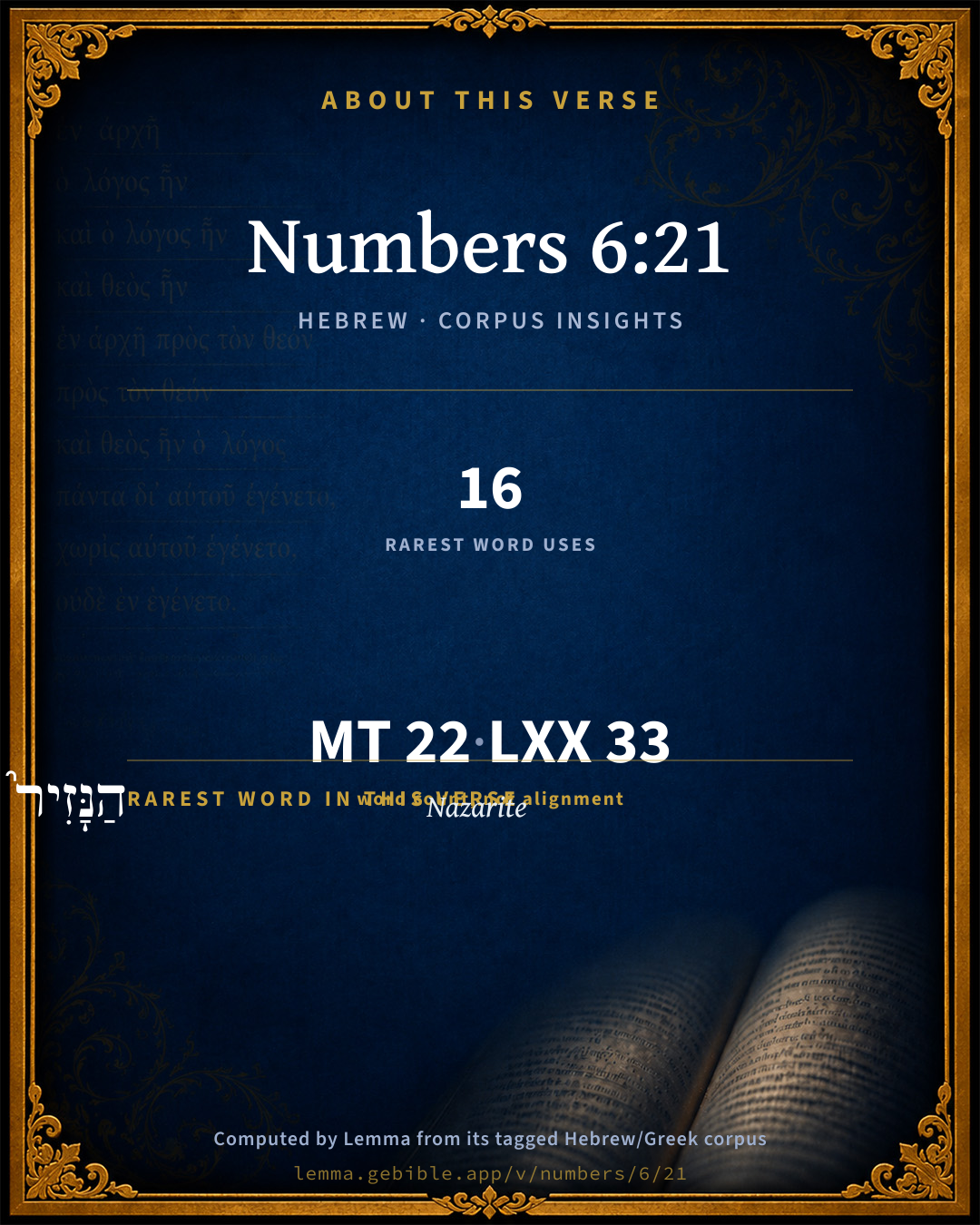
22
words
16
distinct lemmas
Pentateuch
section

Notable vocabulary

The rarest word here is הַנָּזִיר֮ Nazarite H5139 — appearing just 16 times in the whole Hebrew Bible.

Shared distinctive vocabulary

הַנָּזִיר֮ Nazarite H5139 occurs in 16 verses of the Hebrew Bible. Also found in:

Grammatical profile

  • 4 verbs
  • 11 nouns
  • 1 pronoun
  • 2 prepositions
  • 4 particles

Verb forms

  • יִדֹּר֒ Qal · Imperfect
  • תַּשִּׂ֣יג Hiphil · Imperfect
  • יִדֹּ֔ר Qal · Imperfect
  • יַעֲשֶׂ֔ה Qal · Imperfect

Repetition

Words recur within this verse — often emphatic in Hebrew:

  • תּוֹרַ֣ת law H8451 ×2
  • יִדֹּר֒ to vow H5087 ×2
  • עַל upon H5921 ×2
  • נִזְר֔וֹ consecration H5145 ×2
  • אֲשֶׁ֣ר which H834 ×3

Hebrew & Septuagint length

In English translation the verse runs 43 words from the Hebrew and 48 from the Septuagint (LXX English) — closely comparable.

A rough comparison of the two English renderings, which tokenize alike — not a word-level alignment.

Word counts can differ between the Hebrew and the Greek without any difference in meaning — e.g. the Hebrew direct-object marker אֵת has no separate Greek word, and Greek often adds the article ὁ.

In the original languages it is 22 Hebrew tokens and 33 Greek tokens — but the two are counted differently (Hebrew bundles its prefixes and suffixes into one token; the Greek is in lemma form), so that isn’t a like-for-like length.

Cross-references

4

Topical passages linked to Numbers 6:21 in the Treasury of Scripture Knowledge — connected by theme and wording, ordered by reader-vote popularity; previews shown in the World English Bible.

  • Numbers 5:29 "This is the law of jealousy, when a wife, being under her husband, goes astray, and is defiled;
  • Ezra 2:69 they gave after their ability into the treasury of the work sixty-one thousand darics of gold, and five thousand minas of silver, and one hundred priests' garments.
  • Galatians 6:6 But let him who is taught in the word share all good things with him who teaches.
  • Hebrews 13:16 But don't forget to be doing good and sharing, for with such sacrifices God is well pleased.

Cross-references courtesy of OpenBible.info (CC BY 4.0).

Hebrew and Greek witnesses Masoretic Hebrew ↔ Greek Septuagint

The same verse in the two great witnesses to the Old Testament, shown verse-for-verse.

These are two independent witnesses, not word-aligned to each other, and the Septuagint is shown in lemma (dictionary) form.

Hebrew Numbers 6:21 Masoretic · Westminster Leningrad Codex

זֹ֣את תּוֹרַ֣ת הַנָּזִיר֮ אֲשֶׁ֣ר יִדֹּר֒ קָרְבָּנ֤וֹ לַֽיהוָה֙ עַל נִזְר֔וֹ מִלְּבַ֖ד אֲשֶׁר תַּשִּׂ֣יג יָד֑וֹ כְּפִ֤י נִדְרוֹ֙ אֲשֶׁ֣ר יִדֹּ֔ר כֵּ֣ן יַעֲשֶׂ֔ה עַ֖ל תּוֹרַ֥ת נִזְרֽוֹ

"This is the law of the Nazirite who vows, and of his offering to Yahweh for his separation, besides that which he is able to get. According to his vow which he vows, so he must do after the law of his separation."

World English Bible · Public Domain

Greek LXX Numbers 6:21 Septuagint · lemma form

οὗτος ὁ νόμος ὁ εὔχομαι ὅς ἄν εὔχομαι κύριος δῶρον αὐτός κύριος περί ὁ εὐχή χωρίς ὅς ἄν εὑρίσκω ὁ χείρ αὐτός κατά δύναμις ὁ εὐχή αὐτός ὅς ἄν εὔχομαι κατά νόμος ἁγνεία

This is the law of the votary who shall have vowed to the Lord his gift to the Lord, concerning his vow, besides what he may be able to afford according to the value of his vow, which he may have vowed according to the law of separation.

LXX2012 (modern English Septuagint) · Public Domain

Hebrew: Westminster Leningrad Codex (CC BY 4.0). Greek: Septuagint (public domain); English from LXX2012 (modern English Septuagint) (Public Domain). How the Septuagint differs from the Hebrew →

Targum (Aramaic paraphrase)

2

The Targum is the ancient Jewish Aramaic paraphrase of the Hebrew Scriptures — an interpretive translation, not the Hebrew text itself. Onkelos (literal) and Pseudo-Jonathan (expansive) render the Torah, and Jonathan the Prophets. Coverage is partial: where no permissively-licensed English translation exists for a verse, only the Aramaic is shown. This is verse-level text, not a word-by-word alignment to the Hebrew.

  1. Targum Onkelos Torah (Genesis–Deuteronomy)
    דָא אוֹרַיְתָא דִנְזִירָא דִי יִדַר קֻרְבָּנֵהּ קֳדָם יְיָ עַל נִזְרֵהּ בַּר מִדְתַדְבֵּק יְדֵהּ כְּפוּם נִדְרֵהּ דִי יִדַר כֵּן יַעְבֵּד עַל אוֹרַיְתָא דְנִזְרֵהּ

    (no public-domain English translation for this verse)

    Targum Onkelos — Aramaic: “Onkelos Genesis” (public domain); “Onkelos Exodus” (public domain); “Onkelos Leviticus” (public domain); “Onkelos Numbers” (public domain); “Onkelos Deuteronomy” (public domain). English: “Sefaria Community Translation” (CC0 1.0 (public-domain dedication)); “J.W. Etheridge. The Targums of Onkelos and Jonathan Ben Uzziel on the Pentateuch. London: Longmans, Green, 1862” (public domain). Text via Sefaria.

  2. Targum Pseudo-Jonathan Torah (Genesis–Deuteronomy)
    דָא אַחְוָיַית אוֹרַיְיתָא נְזִירָא דִי יִדַר קוּרְבָּנֵיהּ קֳדָם יְיָ עַל נִזְרֵיהּ בַּר מִן מַה דְתִדְבַּק יְדֵיהּ כְּמֵסַת נִדְרֵיהּ לְאַיְיתָאָה מִן דִי יִדַר הֵיכְדֵין יַעֲבֵד עַל אוֹרַיְיתָא נִזְרֵיהּ

    This is the declaration of the law of the Nazir who shall have vowed his oblation before the Lord for his separation, besides what may come into his hand according to the rule (or measure) of his vow, to bring that which he had vowed; so shall he do according to the law of his nazirate.

    Targum Pseudo-Jonathan — Aramaic: “Targum Jonathan on Genesis” (public domain); “Targum Jonathan on Exodus” (public domain); “Targum Jonathan on Leviticus” (public domain); “Targum Jonathan on Numbers” (public domain); “Targum Jonathan on Deuteronomy” (public domain). English: “The Targum of Jonathan ben Uzziel, trans. J. W. Etheridge, London, 1862” (public domain). Text via Sefaria.

Commentary

Notes on Numbers 6:21 from classic Christian and Jewish commentators (each source and its license shown beneath its notes). The classic Christian expositions comment on the surrounding passage and are grouped to its opening verse, so a note may address several verses; the Jewish commentaries on the Tanakh (Rashi and others) are per-verse, so they appear only where the commentator wrote on this verse.

Lemma curates 59 commentaries, every one of them public domain or Creative Commons licensed, each selected and text-cleaned for this edition rather than reprinted as found. About our sources →

Trapp's Complete Commentary

John Trapp

Num 6:21 This [is] the law of the Nazarite who hath vowed, [and of] his offering unto the LORD for his separation, beside [that] that his hand shall get: according to the vow which he vowed, so he must do after the law of his separation.

Ver. 21. Besides that that his hand,] i.e., Beside his voluntary devotion, according to his ability. This he may do; but that he must do, be he poor or rich.

John Trapp, A Commentary or Exposition upon All the Books of the Old and New Testament (1647–1656) — public domain. Text from a community e-Sword module.

Geneva Bible (1599)

Geneva Bible translators

At the least he shall do this, if he be able to offer no more.

Geneva Bible (1599) marginal notes — public domain. Text via Bolls.life.

Adam Clarke's Commentary

Verse 21. This is the law of the Nazarite] We learn from Maimonides, in his Treatise of the Nazarite, that a man might become a Nazarite in behalf of another; that is, might assist him in bearing the expenses of the sacrifices, c. "A son may fulfil the vow his deceased father hath made, but did not live to accomplish: - He that saith, upon me be the shaving of a Nazarite, he is bound to bring the offerings of shaving for cleanness, and may offer them by the hand of what Nazarite he will. If he say, Upon me be half the oblations of a Nazarite, then he bringeth half the offerings by what Nazarite he will, and that Nazarite payeth his offerings out of that which is his."

"By this," says Mr. Ainsworth, "we may see the reason of that which James said to Paul, though he had no Nazarite's vow upon him: 'We have four men who have a vow on them them take and sanctify thyself with them, and BE AT CHARGES WITH THEM, that they may shave their heads, c. Then Paul took the men, and the next day, sanctifying himself with them, entered into the temple to signify the accomplishment of the days of sanctification, (or Nazariteship), until that an offering should be offered for every one of them' see Ac 21:23-26. For though Paul had not vowed or fulfilled a Nazariteship himself, yet might he contribute with them, and partake of their charges about the sacrifices."

Adam Clarke's Commentary on the Bible (1810–1826) — public domain. Text from a community e-Sword/MySword module.

Ellicott's Commentary for English Readers

(21) Beside that that his hand shall get.—i.e., besides any voluntary offerings which it may be in his power to make.

A Bible Commentary for English Readers, edited by Charles John Ellicott (1878–1897) — public domain. Text from a community e-Sword module.

The Cambridge Bible for Schools and Colleges

gen. ed. J. J. S. Perowne

21. and of his oblation] namely his oblation. The word is loosely in apposition to ‘the law.’ The oblation formed the most important factor in the regulations. On the word tôrâh ‘law’ see Chapman, Introd. Append, vi.

beside that which he is able to get] i.e. beside what his means enable him to offer further. The law prescribes only the minimum offering. The Nazirite was free, and was probably encouraged, to vow something larger; and he must faithfully do ‘according to the vow which he voweth.’ The warning given at a later time in Ecc_5:4 f. shews that vows were not always paid.

Num_6:22-27

The Priestly Blessing

This fragment of priestly tradition has no connexion with what precedes or follows it. The simple and beautiful three-fold petition probably dates from a time anterior to P ; but Num_6:22 f., 27 are a setting or framework in which P places it. The priestly function of blessing is recognised in Lev_9:22 f., Deu_10:8; Deu_21:5, 2Ch_30:27; cf. Psa_118:26, Sir_36:17; Sir_45:15; Sir_50:21. In the thrice repeated name ‘Jehovah’ the writer did not, of course, contemplate the doctrine of the three Persons in the Godhead. But the words may nevertheless be regarded as an unconscious foreshadowing of the fuller Christian revelation. The form of the prayer is due to the parallelism which distinguishes Hebrew poetry. The words, which find an echo in Psa_67:1, may be literally rendered:

Jehovah bless thee,and guard thee.Jehovah light up His face towards thee,and favour thee.Jehovah lift up His face towards thee,and appoint for thee welfare.27. put my name upon] This denotes that they are Jehovah’s possession, and stand in the closest relationship with Him. Cf. Deu_28:10, Jer_14:9.

The Cambridge Bible for Schools and Colleges (gen. ed. J. J. S. Perowne; Cambridge University Press, 1878–1918) — public domain. Text from a community e-Sword module.

John Gill's Exposition

And the Lord spake unto Moses,.... At the same time perhaps that the above law was given concerning the Nazarites; though why this should follow upon that, and what connection there is between the one and the other, it is not easy to say; the Nazarites were holy persons, and so were the priests; and therefore, according to Aben Ezra and others, the law of the one is joined to the law of the other:

saying; as follows.

John Gill's Exposition of the Whole Bible (1746–1763) — public domain (CC PDM 1.0). Text via the HelloAO Bible API.

Haydock's Catholic Bible Commentary

Mind. If he have vowed any thing more, he must perform it. (Haydock)

George Leo Haydock (1774–1849), Haydock's Catholic Family Bible and Commentary, 1859 edition — public domain. Excludes Psalms (Douay-Rheims chapter numbering differs from Protestant) and Deuterocanonical books (Catholic canon only).

Matthew Poole's English Annotations

Besides that that his hand shall get, i.e. besides what he shall voluntarily promise and give according to his ability.

Matthew Poole's English Annotations on the Holy Bible (1683–1685) — public domain. Text from a community e-Sword/MySword module.

Whedon's Commentary on the Bible

Daniel D. Whedon

21. Besides that that his hand shall get — Better, besides what his hand grasps. R.V., “which he is able to get.” The foregoing sacrifices are absolutely necessary to the discharge of a temporary Nazarite; but other sacrifices, according to his ability, are optional. In after times there grew up the charitable custom, on the part of the rich, of defraying the expenses of the sacrifices requisite for the discharge of indigent Nazarites. This was a very popular act among the Jews. See Act_21:24, note.

The ordinance of Nazariteship is full of interest and practical instruction to all who desire, in a very special manner, to set themselves apart from things which, though not absolutely sinful in themselves, nevertheless tend to interfere with that intense devotion and entire consecration of heart requisite to that evangelical perfection which consists in loving God with all the heart. It moreover foreshadows the pre-eminent consecration of “the Nazarite” and of all who fully follow the example of “the Holy One.”

Daniel D. Whedon (gen. ed.), Commentary on the Old and New Testaments (1874–1909) — public domain. Text from a community e-Sword module.

The Pulpit Commentary

This is the law of the Nazarite who hath vowed, and of his offering. "And of" are not in the text. We should probably read, "This is the law of the Nazirite who hath vowed his offering unto the Lord in accordance with his consecration," i.e., these are the offerings which, as a Nazirite, he is bound to make. Beside that his hand shall get. Literally, "grasp." If he can afford or can procure anything more as a free-will offering, he may well do so. In later days it became customary for richer people to defray for their poorer brethren,the cost of their sacrifices. (Josephus, "Ant., 19:6, 1; and cf. Act_21:24)

The Pulpit Commentary (1880–1919), ed. H.D.M. Spence-Jones & Joseph S. Exell — public domain. Text from a community e-Sword module.

John Wesley's Explanatory Notes

That his hand shall get - Besides what he shall voluntarily give according to his ability.

John Wesley, Explanatory Notes Upon the Whole Bible (1754–1765) — public domain. Text via the GEBible commentary corpus.

unfoldingWord translationNotes

Door43 World Missions Community

his separation

Here "separation" means "dedication." Also, this abstract noun may be written as a verb. AT: "his dedication" or "for having dedicated himself to Yahweh" (See: Idiom and Abstract Nouns)

Whatever else he may give

This refers to the Nazirite deciding to give other offering beyond what he has been commanded to give. The full meaning of this statement can be made clear. AT: "If he decides to give any additional offerings" (See: Assumed Knowledge and Implicit Information)

he must keep the obligations of the vow he has taken

"he must still obey the requirements of the vow he has taken"

he must keep the obligations ... to keep the promise indicated by the law for the Nazirite

These two phrases mean basically the same thing and are combined to emphasize that he must obey the obligations of his vow. (See: Parallelism)

the promise indicated by the law for the Nazirite

This can be stated in active form. AT: "the promise that the law for the Nazirite indicates" (See: Active or Passive)

translationWords

law, laws

vow

promise

unfoldingWord translationNotes — © Distant Shores Media and the Door43 World Missions Community, licensed CC BY-SA 4.0. Source: git.door43.org/Door43/en_tn.

Rashi

Rabbi Shlomo Yitzchaki (Rashi)

מלבד אשר תשיג ידו [THIS IS THE LAW OF THE NAZARITE WHO HATH VOWED, AND OF HIS OFFERING UNTO THE LORD …] BESIDES THAT WHICH HIS HAND SHALL GET — This implies that if he vowed: “Behold, I take upon myself to become a Nazir under the condition that I shall cut my hair (i.e. that I shall make the final ceremony) in connection with the offering of a hundred burnt offerings and a hundred feast offerings” (whilst really there is prescribed a single offering of each kind) — then כפי נדרו אשר ידור כן יעשה ACCORDING TO THE VOW WHICH HE HATH VOWED MUST HE DO, but “in addition to (על) what is prescribed in the usual law of the Nazarite”. In addition to it, but not omitting any of it — so that if he vowed: “Behold, I take upon myself to become a Nazir five times under the condition to cut my hair (i.e. to make the final ceremony once) in connection with the offering of only these three animals (i. e. one עולה, one שלמים and one חטאת, whilst after the elapse of each term an עולה and a שלמים offering are due), I do not read with reference to him (i.e. I do not apply to him the words): “According to the vow which he vowed, so must he do” [— but he must bring each of the offerings five times as prescribed] (Sifrei Bamidbar 38).

Rashi on the Tanakh — English translations: “The Judaica Press complete Tanach with Rashi, translated by A. J. Rosenberg” (CC BY 4.0); “Pentateuch with Rashi's commentary by M. Rosenbaum and A.M. Silbermann, 1929-1934” (public domain); “The Metsudah Tanach series, Lakewood, N.J” (CC BY 4.0); and “The Book of Joshua, Metsudah Publications, 1997” (CC BY 4.0). Text via Sefaria.

Ramban (Nachmanides)

Rabbi Moshe ben Nachman (Ramban / Nachmanides)

THIS IS THE LAW OF THE NAZIRITE WHO VOWETH HIS OFFERING UNTO THE ETERNAL FOR HIS NAZIRITEHOOD, BESIDES THAT WHICH HIS MEANS SUFFICE. The correct meaning of the verse is as if it had said: “This is the law of the Nazirite who voweth a vow of the Nazirite; his offering unto the Eternal for his Naziritehood shall be besides that which his means suffice.” Or it may mean: “This is the law of the Nazirite, and this is the law of his offering unto the Eternal for his Naziritehood.” It is possible that He is saying: “This is the law of the Nazirite, that he vow his offering unto the Eternal for his Naziritehood,” meaning to say that he should not specify a particular animal as an offering, but should vow: “I shall bring an offering for my Naziritehood,” or he should simply say: “I am a Nazirite,” for as soon as he vowed to be a Nazirite, it is [already] binding upon him as a vow [to bring] the offering mentioned [in the Torah]. He reverts and states, besides that which his means suffice, [meaning to say] that if he is rich he may [voluntarily] increase his offerings [i.e., the burnt-offerings and peace-offerings, as will be explained, but not the sin-offering]; and according to his vow which he voweth concerning these offerings, whether [he is] rich or poor, so he must do after the law of his Naziriteship — so that he may bring more, but not less [than what Scripture prescribes for him to bring]. He mentioned this in order to teach us that if the Nazirite was rich and wants to bring several offerings, or if he vowed at the beginning: “I am a Nazirite and I shall bring a thousand burnt-offerings and peace-offerings,” then he must bring them all on the day of completion [of his time as a Nazirite], and he may not drink wine until he has offered them all up, for they all constitute the law of his Naziriteship. It is possible that [the latter half of the verse means]: “besides that for which his means suffice so must he do according to his vow which he voweth.” This He mentioned because it is usually the rich who vow in this way. as referring to the rich, and according to his vow which he voweth as applying to the poor, as explained above. Now Ramban interprets both expressions as applying to the rich, for it is usually they who vow to bring several burnt-offerings or peace-offerings. The reason why Ramban gives this interpretation may be because it is unnecessary for Scripture to state specifically that a poor Nazirite must bring the minimum number of offerings, as was explained in the first interpretation, since this is self-understood.

Ramban (Nachmanides) on the Tanakh — English translation: “Commentary on the Torah by Ramban (Nachmanides). Translated and annotated by Charles B. Chavel. New York, Shilo Pub. House, 1971-1976” (CC BY 4.0). Text via Sefaria.

Lesson kit

Teaching starters — assembled from the data on this page, not authored interpretation. Every prompt links to the verse data it draws on. Edit before teaching.

Numbers, in the Pentateuch, opens this verse with 22 words (16 distinct Hebrew lemmas). Its most distinctive word is nâzîyr (“Nazarite”). A historical commentator’s framing appears above. Read the whole chapter for the surrounding context.

Discussion questions

  1. The word nâzîyr carries the sense “Nazarite.” How does it shape the verse?
  2. How does Genesis 49:26, which shares the word «Nazarite», read alongside this verse?
  3. What does the repetition of “law” (2× in this one verse) do in this verse?
  4. These translations render this verse differently; the difference is in the English rendering, not the original. What questions does that raise?
  5. «יִדֹּר֒» is a Qal Imperfect verb. How does that grammatical form shape the action described?
  6. Compare how Trapp's Complete Commentary and Geneva Bible (1599) read this verse. Where do they agree or differ?

Things to notice

Reading settings

Reading text

Shown beneath each verse's original-language words.

Old Testament
Old Testament edition

Read the OT as the Masoretic Hebrew (MT) or the Greek Septuagint (LXX).

English shown for the Greek Septuagint (in the Hebrew ↔ Greek comparison).

Comparing translations? Open the Compare panel on any verse page to stack up to four side by side.