Amos 9:12

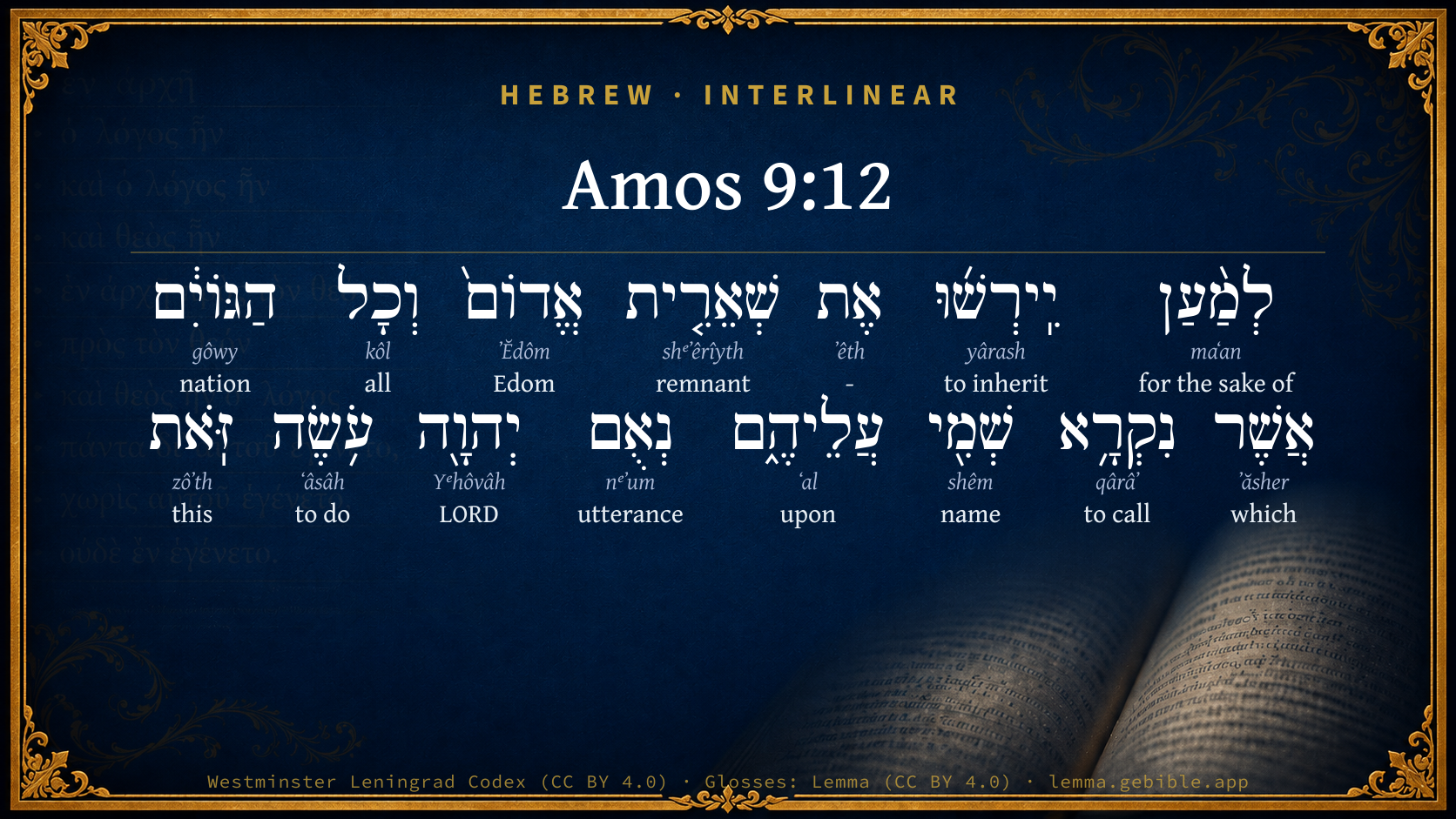
Hebrew (Westminster Leningrad Codex) Amos 9:12 appears in the Hebrew Old Testament. The text above is from the Westminster Leningrad Codex. Each word links to its Strong’s number, a concise gloss, and parsing drawn from the Open Scriptures Hebrew Bible morphology. Click any word for its full Brown-Driver-Briggs (BDB) entry.
Download image
Cite this verse

Amos 9:12 (World English Bible). Public Domain. Lemma interlinear Bible study tool, https://lemma.gebible.app/v/amos/9/12.

Show BibTeX & RIS
BibTeX
RIS
English Translation
that they may possess the remnant of Edom, and all the nations who are called by my name," says Yahweh who does this.
World English Bible · Public Domain
Download a study sheet

One document with this verse’s original text, its word-by-word gloss line, the meaning frame, cross-references with their text, attributed commentary, and full source and license credits — printable, and it pastes into notes with its structure intact.

This verse Autodidact and up

Study sheet (.html) Plain text (.txt)

A passage Seminary Student

Up to 50 verses in one chapter. A passage sheet keeps up to 6 commentary sources and 12 cross-references per verse, in the order this page ranks them, and says so on the sheet whenever that leaves anything out. Ask for a single verse and you get the Autodidact verse sheet above.

Everything on this page stays free to read, with no account — the sheet is a download of what is already on screen, not access to it.

Want to remove ads? Support Godless Engineer
Compare translations 3

The same verse in 3 English versions, stacked beneath the original-language interlinear above. Click any original word for its lexicon entry.

Each is an independent rendering of the whole verse — the interlinear is not word-aligned to these translations.

Highlighted words mark where these versions differ — a whole-verse word diff, not a word-by-word alignment.

  • World English Bible Public Domain
    that they may possess the remnant of Edom, and all the nations who are called by my name," says Yahweh who does this.
  • King James Version Public Domain
    That they may possess the remnant of Edom, and of all the heathen, which are called by my name, saith the LORD that doeth this.
  • unfoldingWord Literal Text CC BY-SA 4.0
    That they may possess the remnant of Edom, and all the nations that are called by my name after them— this is Yahweh’s declaration—he does this.

unfoldingWord Literal Text — © unfoldingWord, licensed CC BY-SA 4.0. Word-aligned USFM3 via Door43 (git.door43.org/unfoldingWord/en_ult).

Versions to compare (up to 4)

3 of 4 selected

Show all 18 translations

Every available English version of this verse, each an independent rendering of the whole verse.

  • World English Bible Public Domain
    that they may possess the remnant of Edom, and all the nations who are called by my name," says Yahweh who does this.
  • Berean Standard Bible Public Domain
    that they may possess the remnant of Edom and all the nations that bear My name,” declares the LORD, who will do this.
  • Majority Standard Bible Public Domain
    that they may possess the remnant of Edom and all the nations that bear My name,” declares the LORD, who will do this.
  • King James Version Public Domain
    That they may possess the remnant of Edom, and of all the heathen, which are called by my name, saith the LORD that doeth this.
  • American Standard Version (1901) Public Domain
    that they may possess the remnant of Edom, and all the nations that are called by my name, saith Jehovah that doeth this.
  • Revised Version (1885) Public Domain
    that they may possess the remnant of Edom, and all the nations, which are called by my name, saith the LORD that doeth this.
  • Geneva Bible (1599) Public Domain
    That they may possesse the remnant of Edom, and of all the heathen, because my Name is called vpon them, sayeth the Lord, that doeth this.
  • Douay-Rheims (1899) Public Domain
    That they may possess the remnant of Edom, and all nations, because my name is invoked upon them: saith the Lord that doth these things.
  • Young's Literal Translation Public Domain
    So that they possess the remnant of Edom, And all the nations on whom My name is called, An affirmation of Jehovah -- doer of this.
  • Literal Standard Version CC BY-SA 4.0
    So that they possess the remnant of Edom, || And all the nations on whom My Name is called,” || A declaration of YHWH—the doer of this.
  • Unlocked Literal Bible CC BY-SA 4.0
    That they may possess the remnant of Edom, and all the nations that are called by my name —this is Yahweh's declaration—he does this.
  • unfoldingWord Literal Text CC BY-SA 4.0
    That they may possess the remnant of Edom, and all the nations that are called by my name after them— this is Yahweh’s declaration—he does this.
  • Darby Bible Public Domain
    that they may possess the remnant of Edom, and all the nations upon whom my name is called, saith Jehovah who doeth this.
  • World Messianic Bible Public Domain
    that they may possess the remnant of Edom and all the nations who are called by my name,” says the LORD who does this.
  • Webster's Bible Public Domain
    That they may possess the remnant of Edom, and of all the heathen, who are called by my name, saith the LORD that doeth this.
  • Free Bible Version CC BY-SA 4.0
    And they will possess what is left of Edom and all the nations that were once mine, declares the Lord. He will make this happen.
  • Bible in Basic English Public Domain
    So that the rest of Edom may be their heritage, and all the nations who have been named by my name, says the Lord, who is doing this.
  • JPS Tanakh (1917) Public Domain
    That they may possess the remnant of Edom, and all the nations, upon whom My name is called, saith the LORD that doeth this.

Literal Standard Version (2020), Covenant Press — licensed CC BY-SA 4.0. Text via the HelloAO Bible API (eBible.org). Unlocked Literal Bible (unfoldingWord) — licensed CC BY-SA 4.0. Text via the HelloAO Bible API (eBible.org). unfoldingWord Literal Text — © unfoldingWord, licensed CC BY-SA 4.0. Word-aligned USFM3 via Door43 (git.door43.org/unfoldingWord/en_ult). Free Bible Version, Dr. Jonathan Gallagher — licensed CC BY-SA 4.0. Text via the HelloAO Bible API (eBible.org).

Word by word

More ways to search: Search by grammar → Find every occurrence → Compare this word →

Practice this passage: Drill this verse → Learn its vocabulary →

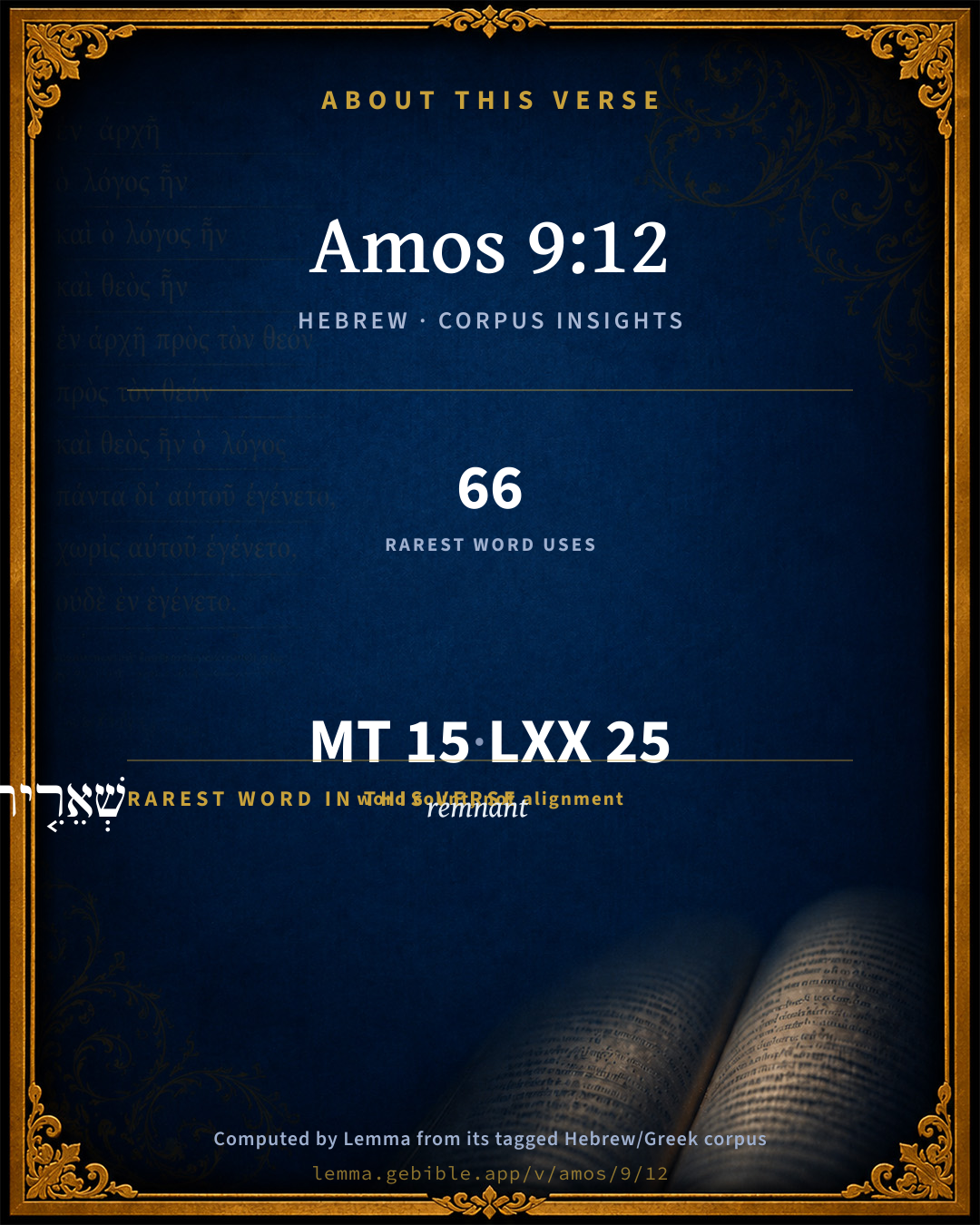
שְׁאֵרִ֤ית
shᵉʼêrîyth
H7611
“remnant of”
Noun, Common, Feminine, Singular, Construct
Part of Speech
Noun
Type
Common
Gender
Feminine
Number
Singular
State
Construct
Full BDB Definition

Origin: from H7604

TWOT: 2307b

rest, residue, remainder, remnant - rest, what is left - remainder, descendants
  1. לְמַ֨עַן maʻan H4616 “for the sake of” Preposition
  2. יִֽירְשׁ֜וּ yârash H3423 “to inherit” Verb, Qal, Imperfect, 3rd Person, Masculine, Plural
  3. אֶת ʼêth H853 “-” Particle, Direct Object
  4. אֱדוֹם֙ ʼĔdôm H123 “Edom” Noun, Proper
  5. וְכָל kôl H3605 “and · all of” Conjunction + Noun, Common, Masculine, Singular, Construct
  6. הַגּוֹיִ֔ם gôwy H1471 “the · nations” Particle, Definite Article + Noun, Common, Masculine, Plural, Absolute
  7. אֲשֶׁר ʼăsher H834 “which” Particle, Relative
  8. נִקְרָ֥א qârâʼ H7121 “to call” Verb, Niphal, Perfect, 3rd Person, Masculine, Singular
  9. שְׁמִ֖י shêm H8034 “name · my” Noun, Common, Masculine, Singular, Construct + Suffix, Personal, 1st Person, Common, Singular
  10. עֲלֵיהֶ֑ם ʻal H5921 “upon · them” Preposition + Suffix, Personal, 3rd Person, Masculine, Plural
  11. נְאֻם nᵉʼum H5002 “utterance of” Noun, Common, Masculine, Singular, Construct
  12. יְהוָ֖ה Yᵉhôvâh H3068 “LORD” Noun, Proper
  13. עֹ֥שֶׂה ʻâsâh H6213 “doing” Verb, Qal, Participle Active, Masculine, Singular, Absolute
  14. זֹּֽאת zôʼth H2063 “this” Pronoun, Demonstrative, Feminine, Singular

About this verse

These counts appear in no published source. They are computed here, from the morphology-tagged text and Lemma’s own curated glosses. What Lemma adds →

15
words
15
distinct lemmas
Prophets
section

Grammatical profile

  • 3 verbs
  • 7 nouns
  • 1 pronoun
  • 2 prepositions
  • 2 particles

Verb forms

  • יִֽירְשׁ֜וּ Qal · Imperfect
  • נִקְרָ֥א Niphal · Perfect
  • עֹ֥שֶׂה Qal · Participle Active

Hebrew & Septuagint length

In English translation the verse runs 23 words from the Hebrew and 27 from the Septuagint (LXX English) — closely comparable.

A rough comparison of the two English renderings, which tokenize alike — not a word-level alignment.

Word counts can differ between the Hebrew and the Greek without any difference in meaning — e.g. the Hebrew direct-object marker אֵת has no separate Greek word, and Greek often adds the article ὁ.

In the original languages it is 15 Hebrew tokens and 25 Greek tokens — but the two are counted differently (Hebrew bundles its prefixes and suffixes into one token; the Greek is in lemma form), so that isn’t a like-for-like length.

Cross-references

16

Topical passages linked to Amos 9:12 in the Treasury of Scripture Knowledge — connected by theme and wording, ordered by reader-vote popularity; previews shown in the World English Bible.

  • Isaiah 43:7 everyone who is called by my name, and whom I have created for my glory, whom I have formed, yes, whom I have made.
  • Isaiah 65:1 I am inquired of by those who didn't ask; I am found by those who didn't seek me: I said, See me, see me, to a nation that was not called by my name.
  • Acts 15:17 That the rest of men may seek after the Lord; All the Gentiles who are called by my name, Says the Lord, who does all these things.
  • Isaiah 63:19 We are become as they over whom you never bear rule, as those who were not called by your name.
  • Jeremiah 14:9 Why should you be like a scared man, as a mighty man who can't save? yet you, Yahweh, are in the midst of us, and we are called by your name; don't leave us.
  • Daniel 9:18–19 My God, turn your ear, and hear; open your eyes, and see our desolations, and the city which is called by your name: for we do not present our petitions before you for our righteousness, but for your great mercies' sake.
  • Numbers 24:17–18 I see him, but not now; I see him, but not near: There shall come forth a star out of Jacob, A scepter shall rise out of Israel, Shall strike through the corners of Moab, Break down all the sons of tumult.
  • Isaiah 14:1–2 For Yahweh will have compassion on Jacob, and will yet choose Israel, and set them in their own land: and the foreigner shall join himself with them, and they shall cleave to the house of Jacob.
  • Genesis 27:29 Let peoples serve you, Nations bow down to you. Be lord over your brothers, Let your mother's sons bow down to you. Cursed be everyone who curses you, Blessed be everyone who blesses you."
  • Genesis 27:37 Isaac answered Esau, "Behold, I have made him your lord, and all his brothers have I given to him for servants. With grain and new wine have I sustained him. What then will I do for you, my son?"
  • Psalms 60:8 Moab is my wash basin. I will throw my shoe on Edom. I shout in triumph over Philistia."
  • Isaiah 11:14 They shall fly down on the shoulder of the Philistines on the west; together shall they despoil the children of the east: they shall put forth their hand on Edom and Moab; and the children of Ammon shall obey them.
  • Jeremiah 15:16 Your words were found, and I ate them; and your words were to me a joy and the rejoicing of my heart: for I am called by your name, Yahweh, God of hosts.
  • Joel 3:8 And I will sell your sons and your daughters into the hands of the children of Judah, And they will sell them to the men of Sheba, To a faraway nation, For Yahweh has spoken it."
  • Malachi 1:4 Whereas Edom says, "We are beaten down, but we will return and build the waste places;" thus says Yahweh of Hosts, "They shall build, but I will throw down; and men will call them 'The Wicked Land,' even the people against whom Yahweh shows wrath forever."
  • Obadiah 1:18–21 The house of Jacob will be a fire, the house of Joseph a flame, and the house of Esau for stubble. They will burn among them, and devour them. There will not be any remaining to the house of Esau." Indeed, Yahweh has spoken.

Cross-references courtesy of OpenBible.info (CC BY 4.0).

Hebrew and Greek witnesses Masoretic Hebrew ↔ Greek Septuagint

The same verse in the two great witnesses to the Old Testament, shown verse-for-verse.

These are two independent witnesses, not word-aligned to each other, and the Septuagint is shown in lemma (dictionary) form.

Hebrew Amos 9:12 Masoretic · Westminster Leningrad Codex

לְמַ֨עַן יִֽירְשׁ֜וּ אֶת שְׁאֵרִ֤ית אֱדוֹם֙ וְכָל הַגּוֹיִ֔ם אֲשֶׁר נִקְרָ֥א שְׁמִ֖י עֲלֵיהֶ֑ם נְאֻם יְהוָ֖ה עֹ֥שֶׂה זֹּֽאת

that they may possess the remnant of Edom, and all the nations who are called by my name," says Yahweh who does this.

World English Bible · Public Domain

Greek LXX Amos 9:12 Septuagint · lemma form

ὅπως ἐκζητέω ὁ κατάλοιπος ὁ ἄνθρωπος καί πᾶς ὁ ἔθνος ἐπί ὅς ἐπικαλέω ὁ ὄνομα ἐγώ ἐπί αὐτός λέγω κύριος ὁ θεός ὁ ποιέω οὗτος

that the remnant of men, and all the Gentiles upon whom my name is called, may earnestly seek me, says the Lord who does all these things.

LXX2012 (modern English Septuagint) · Public Domain

On this verse, Adam Clarke's Commentary discusses the Septuagint’s reading. Read the note in Commentary ↓

Hebrew: Westminster Leningrad Codex (CC BY 4.0). Greek: Septuagint (public domain); English from LXX2012 (modern English Septuagint) (Public Domain). How the Septuagint differs from the Hebrew →

Targum (Aramaic paraphrase)

1

The Targum is the ancient Jewish Aramaic paraphrase of the Hebrew Scriptures — an interpretive translation, not the Hebrew text itself. Onkelos (literal) and Pseudo-Jonathan (expansive) render the Torah, and Jonathan the Prophets. Coverage is partial: where no permissively-licensed English translation exists for a verse, only the Aramaic is shown. This is verse-level text, not a word-by-word alignment to the Hebrew.

  1. Targum Jonathan Prophets (Joshua–Malachi)
    בְּדִיל דְיָרְתִין שְׁאָרָא דֶאֱדוֹם וְכָל עַמְמַיָא בֵּית יִשְׂרָאֵל דְאִתְקְרֵי שְׁמִי עֲלֵיהוֹן בְּכֵן אֲנָא יְיָ עָבֵד דָא:

    (no public-domain English translation for this verse)

    Targum Jonathan — Aramaic: “Mikraot Gedolot” (public domain). English: “Sefaria Community Translation” (CC0 1.0 (public-domain dedication)); “London "Chaldee Paraphrase," 1871” (public domain). Text via Sefaria.

Commentary

Notes on Amos 9:12 from classic Christian and Jewish commentators (each source and its license shown beneath its notes). The classic Christian expositions comment on the surrounding passage and are grouped to its opening verse, so a note may address several verses; the Jewish commentaries on the Tanakh (Rashi and others) are per-verse, so they appear only where the commentator wrote on this verse.

Lemma curates 59 commentaries, every one of them public domain or Creative Commons licensed, each selected and text-cleaned for this edition rather than reprinted as found. About our sources →

Trapp's Complete Commentary

John Trapp

Amo 9:12 That they may possess the remnant of Edom, and of all the heathen, which are called by my name, saith the LORD that doeth this.

Ver. 12. That they may possess the remnant of Edom] "That they" which are called by my name, which are called Christians, viz. the apostles and their successors to the end of the world, "may possess," together with Christ (to whom the Father hath given the heathen for his inheritance, and the uttermost parts of the earth for his possession), "the remnant of Edom"; those few of them that receive the faith, who are but as a remnant to the whole piece, a handful to a houseful. And not of the Edomites only, those inveterate and hereditary enemies to the Israel of God, but of all the heathen which are called by name, Psa 2:8, who beseech and are baptized into Christ’s name, being content to receive his mark and to profess his religion, which formerly they were perfect strangers to. These and those first preachers of the gospel, and planters of Churches (being Israelites by birth), are said to possess by inheritance, because Christ was pleased to make use of their ministry; and upon these his white horses to ride abroad the world, "conquering, and to conquer," Rev 6:1-2. In a like sense it is promised, Isa 14:2, that the house of Israel shall possess their proselytes in the land of the Lord for servants and for handmaids, and take them captives whose captives they were, and rule over their oppressors. Such a change shall the gospel make.

Saith the Lord that doeth this] For indeed none else could have done it. Effectual conversion is his work alone. God persuaded Japhet. Noah may speak persuasively, but God only can persuade. Rebecca may cook the venison, but Isaac only can give the blessing. "Paul may plant," &c. Deus potest facere, nec solet fallere.

John Trapp, A Commentary or Exposition upon All the Books of the Old and New Testament (1647–1656) — public domain. Text from a community e-Sword module.

Joseph Benson's Commentary

Amo 9:12. That they may possess the remnant of Edom — This the restored Jews did in the time of Hyrcanus, when they made an entire conquest of Edom, as Josephus relates. And of all the heathen (or nations) which are called by my name — Or rather, which have been called by my name; for so it is rendered in other versions. The Ishmaelites, Ammonites, Moabites, and other neighbouring nations, were in the beginning worshippers of the true God, as being descendants from Abraham, Lot, &c., with whom the knowledge of the true God was preserved. And the Jews subdued a considerable part of these nations in the times of the Maccabees. But this is also a prophecy of setting up the kingdom of the Messiah, and bringing in the Gentiles.

Joseph Benson's Commentary on the Old and New Testaments (1811–1818) — public domain. Text from a community e-Sword module.

Whedon's Commentary on the Bible

Daniel D. Whedon

12. The restoration of the dynasty is needed in order that the splendor of the kingdom may be re-established. The new kingdom will be harassed no longer by its neighbors, but will triumph over all.

Remnant of Edom — All that may be left of Edom after the conquest. Edom is singled out on account of the long-continued hostility between Israel and Edom (Amo_1:12; Oba_1:18-21; Joe_3:19; Psa_137:7).

All the heathen — Better, R.V., “nations.”

Which are (better, R.V. margin, “were”) called by my name — Literally, over which my name was called. The meaning of the expression may be gathered from 2Sa_12:28. Joab, while besieging Rabbah of the Ammonites, invited David to come and take the city, “lest I take the city and my name be called over it,” that is, lest I get the credit for the capture. The nations are those conquered by David, for whose conquest he gave the credit and glory to Jehovah. The thought of Amo_9:12 is evidently that the territory of the new kingdom is to be extended as far as during the reign of David (1Ki_4:21).

That doeth this — The fact that Jehovah is interested in it assures its fulfillment (Jer_33:2). For a free New Testament application of the verse see Act_15:16-18.

Daniel D. Whedon (gen. ed.), Commentary on the Old and New Testaments (1874–1909) — public domain. Text from a community e-Sword module.

Tyndale Open Study Notes

Tyndale Open Resources

9:12 Edom (see 1:11) represents the enemies of God and of Israel (see Isa 34:5-6, 11; 63:1). In the time of restoration, God’s enemies are subject to his people and to God himself. • the nations I have called: God promised Abraham that he would be a blessing to all the people of the earth (Gen 12:2-3). God’s kingdom would embrace the outcasts and foreigners previously excluded (Isa 56; see Acts 8:27-39).

Tyndale Open Study Notes — © Tyndale Open Resources, licensed CC BY-SA 4.0. Text via the HelloAO Bible API.

Geneva Bible (1599)

Geneva Bible translators

Meaning, that the very enemies as were the Edomites, and others should be joined with the Jews in one society, and body, whereof Christ should be the head.

Geneva Bible (1599) marginal notes — public domain. Text via Bolls.life.

Jamieson, Fausset & Brown

Robert Jamieson, A. R. Fausset & David Brown

That they may possess . . . remnant of Edom, and of all the heathen--"Edom," the bitter foe, though the brother, of Israel; therefore to be punished (Amo 1:11-12), Israel shall be lord of the "remnant" of Edom left after the punishment of the latter. James quotes it, "That the residue of men might seek after the Lord, and all the Gentiles," &c. For "all the heathen" nations stand on the same footing as Edom: Edom is the representative of them all. The residue or remnant in both cases expresses those left after great antecedent calamities (Rom 9:27; Zac 14:16). Here the conversion of "all nations" (of which the earnest was given in James's time) is represented as only to be realized on the re-establishment of the theocracy under Messiah, the Heir of the throne of David (Amo 9:11). The possession of the heathen nations by Israel is to be spiritual, the latter being the ministers to the former for their conversion to Messiah, King of the Jews; just as the first conversions of pagans were through the ministry of the apostles, who were Jews. Compare Isa 54:3, "thy seed shall inherit the Gentiles" (compare Isa 49:8; Rom 4:13). A remnant of Edom became Jews under John Hyrcanus, and the rest amalgamated with the Arabians, who became Christians subsequently.

which are called by my name--that is, who belong to Me, whom I claim as Mine (Psa 2:8); in the purposes of electing grace, God terms them already called by His name. Compare the title, "the children," applied by anticipation, Heb 2:14. Hence as an act of sovereign grace, fulfilling His promise, it is spoken of God. Proclaim His title as sovereign, "the Lord that doeth this" ("all these things," Act 15:17, namely, all these and such like acts of sovereign love).

Jamieson, Fausset & Brown — Commentary Critical and Explanatory on the Whole Bible (1871) — public domain (CC PDM 1.0). Text via the HelloAO Bible API.

Adam Clarke's Commentary

Verse 12. That they may possess the remnant of Edom] Bp. Newcome translates this clause as follows: "That the residue of men may seek Jehovah, and all the heathen who are called by my name." Here, instead of אדום Edom, he reads אדם Adam, men or mankind, which is the reading of the Arabic, and some MSS. of the Syriac, and of Ac 15:17.

The Pachomian MS. of the Septuagint adds here, ὁπως εκζητησωσι με, that they may seek me. And the Arabic has [Arabic] the Lord; and in stead of יירשו yireshu, "they shall possess," the learned bishop seems to have read ידרשו yidreshu, "they may seek;" and thus the text resembles the quotation by St. James, Ac 15:17, "That the residue of men might seek after the Lord." It is strange that not one of the MSS. collated by Kennicott and De Rossi, nor any of my own, favours or countenances any of these alterations. I am of opinion, therefore, that we must dismiss all these conjectural emendations, and take the Hebrew text as we find it. That it speaks of the conversion of the Jews in Gospel times, we have the authority of the New Testament as above to prove; and if we cannot make the words, as they stand there, entirely to agree with the words here, the subject is not affected by it. The Jews shall be converted and restored, and this text in both covenants is a proof of it.

Adam Clarke's Commentary on the Bible (1810–1826) — public domain. Text from a community e-Sword/MySword module.

John Calvin's Commentaries

By these words the Prophet shows that the kingdom under Christ would be more renowned and larger than it had ever been under David. Since then the kingdom had been greatest in dignity, and wealth, and power, in the age of David, the Prophet here says, that its borders would be enlarged; for then he says, Possess shall the Israelites the remnant of Edom He speaks here in common of the Israelites and of the Jews, as before, at the beginning of the last chapter, he threatened both. But we now apprehend what he means, — that Edom shall come under the yoke.

And it is sufficiently evident why he mentions here especially the Idumeans, and that is because they had been most inveterate enemies; and vicinity gave them greater opportunity for doing harm. As then the Idumeans harassed the miserable Jews, and gave them no respite, this is the reason why the Prophet says that they would come under the power of his elect people. He afterwards adds, that all nations would come also to the Jews. He speaks first of the Idumeans, but he also adds all other nations. I cannot finish today.

John Calvin's Commentaries (1540-1563) — public domain. Text from the Calvin Translation Society English edition (1840s-50s) via the Christian Classics Ethereal Library (ccel.org). Calvin's coverage is partial (roughly two-thirds of the Bible); uncommented books and verses are honest gaps, never fabricated. The 19th-century editor's footnotes and remarks are omitted so the notes are faithfully Calvin's own voice.

The Cambridge Bible for Schools and Colleges

gen. ed. J. J. S. Perowne

12. That they may possess the remnant of Edom &c.] i.e. that the empire of David may be restored to its former limits. The allusion is to the nations—the Philistines, Moab, Ammon, Aram of Zobah, Damascus, Edom, &c.—which, though they had been conquered by David (2 Samuel 8, &c.), had afterwards revolted: these, Amos promises, should again be incorporated in the restored empire of David.

the remnant of Edom] No doubt Edom is named specially on account of the ancient rivalry subsisting between it and Israel; in the happy future which the prophet here anticipates, he pictures it as reduced to a mere remnant (cf. Amo_1:12; Oba_1:18-21). This seems better than to suppose an allusion to recent defeats, whether the victory of Amaziah (2Ki_14:7),—which, however, must have taken place some 30 years previously,—or the subjugation by Uzziah, which appears to be presupposed by 2Ki_14:22 (cf. 2Ki_16:6 R.V. marg.).

and all the nations, over whom my name has been called] viz. in token of conquest, or ownership. The reference is to the nations which, as just stated, had been conquered by David: in virtue of their subjugation by him, they had passed under the dominion of Jehovah. The sense of the expression, over whom my name was called, appears clearly from 2Sa_12:28, where Joab, while besieging Rabbah of the Ammonites, invites David to come and take it himself “lest I (emph.) take the city, and my name be called over it,” i.e. lest I get the credit of having captured it, and it be counted as my conquest. The phrase expresses thus the fact of ownership—whether acquired by actual conquest or otherwise (cf. Isa_4:1). It is used especially of the people of Israel, Jerusalem, or the temple, as owned by Jehovah: see Deu_28:10; Jer_7:10-11; Jer_7:14; Jer_7:30; Jer_14:9; Jer_15:16 (of Jeremiah himself), Jer_25:29, Jer_32:34, Jer_34:15; 1Ki_8:43 (= 2Ch_6:33); Isa_63:19; 2Ch_7:14; Dan_9:18-19; and the newly-recovered Hebrew text of Sir_47:18. In A.V., R.V., the phrase is often, unfortunately, represented by the obscure paraphrase, “called by my name”; but the literal rendering, which is both clearer and more forcible than the paraphrase, is sometimes added in the margin of R.V. (e.g. 1Ki_8:43).

that doeth this] An epithet confirmatory of the preceding promise; cf. Jer_33:2.

Amo_9:11-12 stands in the LXX. (cod. B) thus: ἐν τῇ ἡμέρᾳ ἐκείνῃ ἀναστήσω τὴν σκηνὴν Δαυεὶδ τὴν πεπτωκυῖαν, καὶ ἀνοικοδομήσω τὰ πεπτωκότα αὐτῆς, καὶ τὰ κατεσκαμμένα (AbQ* κατεστραμμένα) αὐτῆς ἀναστήσω, καὶ ἀνοικοδομήσω αὐτὴν καθὼς αἱ ἡμέραι τοῦ αἰῶνος, 12ὅπως (A+ἂν) ἐκζητήσωσιν οἱ κατάλοιποι τῶν ἀνθρώπων (A+τὸν Κύριον), καὶ πάντα τὰ ἔθνη ἐφʼ οὒς ἐπικέκληται τὸ ὄνομά μου ἐπʼ αὐτούς, λέγει Κύριος ὁ ποιῶν ταῦτα. In Act_15:17 the verses are quoted by St James—or by St Luke in his report of St James’ speech—in this form (μετὰ ταῦτα ἀναστρέψω καὶ ἀνοικοδομήσω τὴν σκηνὴν Δαυεὶδ τὴν πεπτωκυῖαν, καὶ τὰ κατεστραμμένα αὐτῆς ἀνοικοδομήσω, καὶ ἀνορθώσω αὐτήν, ὅπως ἂν ἐκζητήσωσιν οἱ κατάλοιποι τῶν ἀνθρώπων τὸν Κύριον, καὶ πάντα τὰ ἔθνη ἐφʼ οὒς ἐπικέκληται τὸ ὄνομά μου ἐπʼ αὐτούς, λέγει Κύριος ποιῶν ταῦτα γνωστὰ ἀπʼ αἰῶνος), for the purpose of shewing that God’s having visited the Gentiles “to take out of them a people to his name” was in accordance with the teaching of the prophets. The passage illustrates the freedom which New Testament writers allow themselves in quoting from the Old Testament. Not only are there many minor variations from the text of the LXX.; but in the most important part of the quotation, the rendering adopted implies a reading of the Hebrew text (אָדָם למען יִדְרְשׁוּ שארית “that the remnant of men may seek [the Lord],” for למען יִירְשׁוּ את שארית אֱדֹם “that they may inherit the remnant of Edom”), which cannot be right, and can hardly even express a thought implicit in Amos’ words, though it is no doubt one found in other prophets, viz. that the ultimate aim of Israel’s restoration is to exert upon the nations a spiritual influence, and bring them to the knowledge of the true God (cf. Isa_55:5). Τὸν Κύριον (“the Lord”), to which nothing corresponds in the Heb., has been supplied, it will be observed, in order to provide the verb “seek” with an object. The text of the Vatican MS. of the LXX. (cod. B) is purer and more original than that of the Alexandrian MS. (cod. A): the quotation in the Acts agrees in several particulars with the latter against the former; and it is not improbable that the text of cod. A has been corrected on the basis of the quotation. In Psalms 14 (13) 3, the composite quotation of St Paul (Rom_3:13-18) has found its way even into the text of Cod. B.

The Cambridge Bible for Schools and Colleges (gen. ed. J. J. S. Perowne; Cambridge University Press, 1878–1918) — public domain. Text from a community e-Sword module.

John Gill's Exposition

That they may possess the remnant or Edom, and of all the Heathen, which are called by my name,.... Or that these may be possessed; that is, by David or Christ, who shall have the Heathen given him for his inheritance, and the uttermost parts of the earth for his possession, Psa 2:8; when the remnant, according to the election of grace, in those nations that have been the greatest enemies to Christ and his Gospel, signified by Edom, shall be converted, and call upon the name of the Lord, and worship him; and be called by his name, Christians, and so become his inheritance and possession. The Targum understands, by the Heathen or people, all the people of the house of Israel; and Kimchi, Aben Ezra, and Ben Melech, think the words are to be inverted, thus,

"that all the people on whom my name is called, nay possess the remnant of Edom;''

and the forager says, that all the Edomites shall be destroyed in the days of the Messiah, but Israel shall inherit their land; and Aben Ezra says, that if this prophecy is interpreted of the Messiah, the matter is clear; as it is in the sense we have given, and as the apostle explains it; See Gill on Act 15:17. Some render the words, "that the remnant of Edom, and of all the Heathen, that are" (that is, shall be) "called by my name, may possess me the Lord" (x). The truth and certainty of its performance is expressed in the following clause,

saith the Lord, that doeth this: whose word is true, whose power is great, whose grace is efficacious, to accomplish all that is here promised and foretold.

(x) "Ut possideant reliquiae Edom", De Dieu. See Bishop Chandler's Defence of Christianity, p. 172.

John Gill's Exposition of the Whole Bible (1746–1763) — public domain (CC PDM 1.0). Text via the HelloAO Bible API.

Albert Barnes' Notes on the Bible

That they may possess - rather, “inherit

The remnant of Edom - The restoration was not to be for themselves alone. No gifts of God end in the immediate object of His bounty and love. They were restored, in order that they, the first objects of God’s mercies, might win others to God; not Edom only, “but all nations, upon whom,” God says, “My Name is called.” Plainly then, it is no temporal subjugation, nor any earthly kingdom. The words, “upon whom the name is called,” involve, in any case, belonging to, and being owned by, him whose name is called upon them. It is said of the wife bearing the name of the husband and becoming his, “let thy name be called upon us Isa 4:1. When Jacob especially adopts Ephraim and Manasseh as his he says, “let my name be named upon them, and the name of My fathers, Abraham and Isaac” Gen 48:16. In relation to God, the words are used of persons and of places especially appropriated to God; as the whole Jewish Church and people, His Temple 1Ki 8:43; Jer 7:10-11, Jer 7:14, Jer 7:30; Jer 34:15, His prophets Jer 15:16, the city of Jerusalem Dan 9:18-19 by virtue of the temple built there. Contrariwise, Isaiah pleads to God, that the pagan “were never called by Thy Name” Isa 63:19. This relation of being “called” by the “Name” of God, was not outward only, nor was it ineffective. Its characteristics were holiness imparted by God to man, and protection by God. Thus Moses, in his blessing on Israel if obedient, says, “The Lord shall establish thee an holy people unto Himself, as He hath sworn to thee, if thou shalt keep the commandments of the Lord thy God, and walk in His ways; and all the people of the earth shall see that the Name of the Lord thy God is called upon thee, and they shall fear thee” Deu 28:9-10. And Jeremiah says to God , “Thy word was unto me the joy and rejoicing of my heart, for Thy name was called upon me, O Lord God of Hosts.”

Israel then, or the Jewish Church, was to inherit, or take into itself, not Edom only, but all nations, and that, by their belonging to God. Edom, as the brother of Israel and yet his implacable enemy, stands as a symbol of all who were alien from God, over against His people. He says, the “residue of Edom,” because he had foretold the destruction which was first to come upon Edom; and Holy Scripture everywhere speaks of those who should be converted, as a “remnant” only. The Jews themselves are the keepers and witnesses of these words. Was it not foretold? It stands written. Is it not fulfilled? The whole world from this country to China, and from China round again to us, as far as it is Christian, and as, year by year, more are gathered into the fold of Christ, are the inheritance of those who were the seed of Abraham, Isaac and Jacob.

James quoted these words in the Council of Jerusalem, to show how the words of the prophet were in harmony with what Peter had related, how “God at the first did visit the Gentiles, to take out of them a people for His Name” Act 15:14. He quotes the words as they stood in the version which was understood by the Gentiles who came from Antioch. In it the words are paraphrased, but the meaning remains the same. The Greek translators took away the metaphor, in order, probably, to make the meaning more intelligible to Greeks, and paraphrased the Hebrew words, imagining other words, as like as might be to the Hebrew. They render, “that the residue of men may seek, and all the nations upon whom My name is called.” The force of the prophecy lies in these last words, that “the Name of God should be called upon all nations.” James, then, quoted the words as they were familiar to his hearers, not correcting those which did not impair the meaning. The so doing, he shows us incidentally, that even imperfection of translation does not empty the fullness of God’s word. The words, “shall seek the Lord,” although not representing anything expressed here in the original, occur in the corresponding prophecy of Isaiah as to the root of Jesse, “In that day there shall be a root” (that is, a sucker from the root) “of Jesse, which shall stand for an ensign of the people, and to it shall the Gentiles seek” Isa 11:10. It may be, that James purposely uses the plural, “the words of the prophets,” in order to include, together with the prophet Amos, other prophets who had foretold the same thing. The statements, that the Jewish Church should inherit the Gentiles, that the Name of God should be called upon the Gentiles, and that the Gentiles should seek the Lord, are parts of one whole; that they should be called, that they should obey the call, and, obeying, he enrolled in the one family of God.

Albert Barnes' Notes on the Bible (1834–1885) — public domain. Text from a community e-Sword/MySword module.

Haydock's Catholic Bible Commentary

Edom, subdued by Hircan, with the surrounding nations. The same letters may be read Adam, "man," as the Septuagint have, agreeably to Acts xv. 17. (Calmet) --- "That the rest of men might seek the Lord, (Grabe substitutes me) and all the nations upon whom my," &c. Edom and all mankind shall receive the glad tidings of salvation. (Haydock)

George Leo Haydock (1774–1849), Haydock's Catholic Family Bible and Commentary, 1859 edition — public domain. Excludes Psalms (Douay-Rheims chapter numbering differs from Protestant) and Deuterocanonical books (Catholic canon only).

Matthew Poole's English Annotations

That they; literally and historically the Jews, or they of the two tribes, and with them such of the ten tribes as did unite to them, and returned to Jerusalem.

May possess, both the lands of Edom, and some of the posterity of Edom; these as servants, the other as their propriety. The remnant, left by Nebuchadnezzar, or that fled out of his reach and lived privately where they could find a hiding-place till Israel’s return.

Of Edom; the posterity of Esau, wasted by Nebuchadnezzar, and ruined so that they never did recover to be a kingdom, but who remained of them did shelter themselves as retainers to other nations, and among these some did betake themselves to the Jews, and lived under them. Though formerly they had been desperate enemies to the Jews, Edomites, who cried, Rase, rase, Psa 137:7, shall now assist as servants in laying the foundations, and building Jerusalem.

All the heathen, i.e. round about, as Moabites, Ammonites, &c., by usual phrase called all the heathen.

Which are called by my name: these words either must refer to heathen and Edomites proselyted, or they are by a trajection laid here, but in construction are to be joined with the foregoing words thus. That they which are called by my name may possess, & c.

Saith the Lord; this immutably confirms the promise.

That doeth this; who saith and doth, who willeth and effecteth, whose command is almighty. That this is a prophecy of setting up the kingdom of the Messiah, and bringing in the Gentiles, is very certain, but appertains to the mystic sense, not to the literal, which is our work.

Matthew Poole's English Annotations on the Holy Bible (1683–1685) — public domain. Text from a community e-Sword/MySword module.

The Pulpit Commentary

That they (the true children of Israel) may possess the remnant of Edom; i.e. those who were nearest in blood, and yet most hostile of all men. David had subdued the Edomites (2Sa_8:14; 1Ki_11:16) and Amaziah had inflicted a great slaughter upon them; (2Ki_14:7) but later they recovered their independence 2Ki_16:6, where "Edomites" should be read for "Syrians;", (2Ch_28:17) and were actively hostile against the Jews. It was on this account that they were emphatically denounced by Obadiah. "The remnant" is mentioned because, according to the threat in Amo_1:11, Amo_1:12, they would be punished so that only a few would escape. The Septuagint gives, Opwv ejkzhthswsin oiJ kataloipoi twpwn, torion, Alexandrian, "That the remnant of men may earnestly seek the Lord," regarding Edom as a representative of aliens from God, and altering the text to make the sense more generally intelligible, This version, which reads "Adam," men, instead of "Edom," is endorsed by St. James. Which are called by my Name; " over whom my Name hath been called" (Septuagint). This is closer to the Hebrew; but the meaning is much the same, viz. all those who are dedicated to God and belong to him being by faith incorporated into the true Israel. (For the phrase, comp. Isa_4:1; and to illustrate the idea, refer to Isa_44:5; Psa_87:5, Psa_87:6) The Messianic kingdom shall be established in order that salvation may be extended to all hastens who embrace it. Saith the Lord; is the saying of Jehovah. This is added to show the immutability of the promise. The covenant God himself hath predicted it.

The Pulpit Commentary (1880–1919), ed. H.D.M. Spence-Jones & Joseph S. Exell — public domain. Text from a community e-Sword module.

John Wesley's Explanatory Notes

They - Literally the Jews. Possess - Both the lands of Edom, and some of the posterity of Edom; these as servants, the other as their propriety. The remnant - Left by Nebuchadnezzar. All the heathen - That is, round about. That doth this - But this is also a prophecy of setting up the kingdom of the Messiah, and bringing in the Gentiles.

John Wesley, Explanatory Notes Upon the Whole Bible (1754–1765) — public domain. Text via the GEBible commentary corpus.

Rashi

Rabbi Shlomo Yitzchaki (Rashi)

In order that they inherit—[I.e, in order that] Israel [inherit] the remnant of Edom etc. because My Name is called upon them Heb. אֲשֶׁר, like כִּי, because.

Rashi on the Tanakh — English translations: “The Judaica Press complete Tanach with Rashi, translated by A. J. Rosenberg” (CC BY 4.0); “Pentateuch with Rashi's commentary by M. Rosenbaum and A.M. Silbermann, 1929-1934” (public domain); “The Metsudah Tanach series, Lakewood, N.J” (CC BY 4.0); and “The Book of Joshua, Metsudah Publications, 1997” (CC BY 4.0). Text via Sefaria.

Lesson kit

Teaching starters — assembled from the data on this page, not authored interpretation. Every prompt links to the verse data it draws on. Edit before teaching.

Amos, in the Prophets, opens this verse with 15 words (15 distinct Hebrew lemmas). Its most distinctive word is shᵉʼêrîyth (“remnant”). A historical commentator’s framing appears above. Read the whole chapter for the surrounding context.

Discussion questions

  1. How does “remnant” (shᵉʼêrîyth) shape what this verse is saying?
  2. Isaiah 43:7 shares this passage’s theme. How do the two illuminate each other?
  3. These translations render this verse differently; the difference is in the English rendering, not the original. What questions does that raise?
  4. The verb «יִֽירְשׁ֜וּ» is Qal Imperfect. How does its form color the action?
  5. Reading how Trapp's Complete Commentary and Joseph Benson's Commentary read this verse, where do the two commentators agree and where do they part?

Things to notice

Reading settings

Reading text

Shown beneath each verse's original-language words.

Old Testament
Old Testament edition

Read the OT as the Masoretic Hebrew (MT) or the Greek Septuagint (LXX).

English shown for the Greek Septuagint (in the Hebrew ↔ Greek comparison).

Comparing translations? Open the Compare panel on any verse page to stack up to four side by side.