Leviticus 11:46

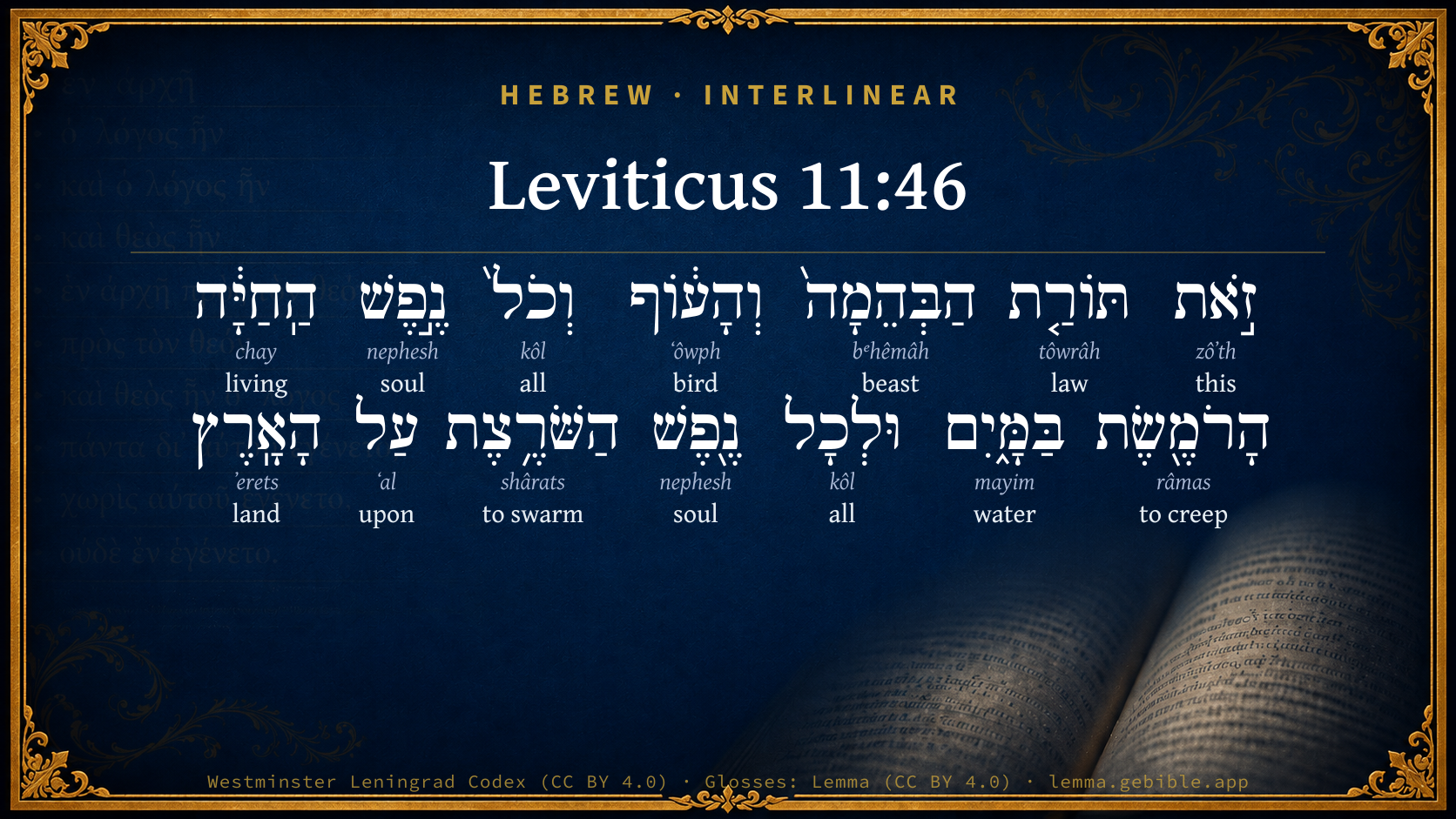
Hebrew (Westminster Leningrad Codex) Leviticus 11:46 appears in the Hebrew Old Testament. The text above is from the Westminster Leningrad Codex. Each word links to its Strong’s number, a concise gloss, and parsing drawn from the Open Scriptures Hebrew Bible morphology. Click any word for its full Brown-Driver-Briggs (BDB) entry.
Download image
Cite this verse

Leviticus 11:46 (World English Bible). Public Domain. Lemma interlinear Bible study tool, https://lemma.gebible.app/v/leviticus/11/46.

Show BibTeX & RIS
BibTeX
RIS
English Translation
"'This is the law of the animal, and of the bird, and of every living creature that moves in the waters, and of every creature that creeps on the earth,
World English Bible · Public Domain
Download a study sheet

One document with this verse’s original text, its word-by-word gloss line, the meaning frame, cross-references with their text, attributed commentary, and full source and license credits — printable, and it pastes into notes with its structure intact.

This verse Autodidact and up

Study sheet (.html) Plain text (.txt)

A passage Seminary Student

Up to 50 verses in one chapter. A passage sheet keeps up to 6 commentary sources and 12 cross-references per verse, in the order this page ranks them, and says so on the sheet whenever that leaves anything out. Ask for a single verse and you get the Autodidact verse sheet above.

Everything on this page stays free to read, with no account — the sheet is a download of what is already on screen, not access to it.

Want to remove ads? Support Godless Engineer
Compare translations 3

The same verse in 3 English versions, stacked beneath the original-language interlinear above. Click any original word for its lexicon entry.

Each is an independent rendering of the whole verse — the interlinear is not word-aligned to these translations.

Highlighted words mark where these versions differ — a whole-verse word diff, not a word-by-word alignment.

  • World English Bible Public Domain
    "'This is the law of the animal, and of the bird, and of every living creature that moves in the waters, and of every creature that creeps on the earth,
  • King James Version Public Domain
    This is the law of the beasts, and of the fowl, and of every living creature that moveth in the waters, and of every creature that creepeth upon the earth:
  • unfoldingWord Literal Text CC BY-SA 4.0
    This the law of the livestock and the bird and every life of the living thing, the ones swarming in the water, and of every life, the ones crawling on the earth,

unfoldingWord Literal Text — © unfoldingWord, licensed CC BY-SA 4.0. Word-aligned USFM3 via Door43 (git.door43.org/unfoldingWord/en_ult).

Versions to compare (up to 4)

3 of 4 selected

Show all 18 translations

Every available English version of this verse, each an independent rendering of the whole verse.

  • World English Bible Public Domain
    "'This is the law of the animal, and of the bird, and of every living creature that moves in the waters, and of every creature that creeps on the earth,
  • Berean Standard Bible Public Domain
    This is the law regarding animals, birds, all living creatures that move in the water, and all creatures that crawl along the ground.
  • Majority Standard Bible Public Domain
    This is the law regarding animals, birds, all living creatures that move in the water, and all creatures that crawl along the ground.
  • King James Version Public Domain
    This is the law of the beasts, and of the fowl, and of every living creature that moveth in the waters, and of every creature that creepeth upon the earth:
  • American Standard Version (1901) Public Domain
    This is the law of the beast, and of the bird, and of every living creature that moveth in the waters, and of every creature that creepeth upon the earth;
  • Revised Version (1885) Public Domain
    This is the law of the beast, and of the fowl, and of every living creature that moveth in the waters, and of every creature that creepeth upon the earth:
  • Geneva Bible (1599) Public Domain
    This is the law of beasts, and of foules, and of euery liuing thing that moueth in the waters, and of euery thing that creepeth vpon the earth:
  • Douay-Rheims (1899) Public Domain
    You shall be holy, because I am holy. This is the law of beasts and fowls, and of every living creature that moveth in the waters, and creepeth on the earth:
  • Young's Literal Translation Public Domain
    `This `is' a law of the beasts, and of the fowl, and of every living creature which is moving in the waters, and of every creature which is teeming on the earth,
  • Literal Standard Version CC BY-SA 4.0
    This [is] a law of the beasts, and of the bird, and of every living creature which is moving in the waters, and of every creature which is teeming on the earth,
  • Unlocked Literal Bible CC BY-SA 4.0
    This is the law regarding the animals, the birds, every living creature that moves in the waters, and of every creature that creeps on the ground,
  • unfoldingWord Literal Text CC BY-SA 4.0
    This the law of the livestock and the bird and every life of the living thing, the ones swarming in the water, and of every life, the ones crawling on the earth,
  • Darby Bible Public Domain
    This is the law of cattle, and of fowl, and of every living soul that moveth in the waters, and of every soul that crawleth on the earth;
  • World Messianic Bible Public Domain
    “‘This is the law of the animal, and of the bird, and of every living creature that moves in the waters, and of every creature that creeps on the earth,
  • Webster's Bible Public Domain
    This is the law of the beasts, and of the fowl, and of every living creature that moveth in the waters, and of every creature that creepeth upon the earth;
  • Free Bible Version CC BY-SA 4.0
    These are the regulations about animals, birds, everything that lives in the water, and all animals that crawl along the ground.
  • Bible in Basic English Public Domain
    This is the law about beasts and birds and every living thing moving in the waters, and every living thing which goes flat on the earth:
  • JPS Tanakh (1917) Public Domain
    This is the law of the beast, and of the fowl, and of every living creature that moveth in the waters, and of every creature that swarmeth upon the earth;

Literal Standard Version (2020), Covenant Press — licensed CC BY-SA 4.0. Text via the HelloAO Bible API (eBible.org). Unlocked Literal Bible (unfoldingWord) — licensed CC BY-SA 4.0. Text via the HelloAO Bible API (eBible.org). unfoldingWord Literal Text — © unfoldingWord, licensed CC BY-SA 4.0. Word-aligned USFM3 via Door43 (git.door43.org/unfoldingWord/en_ult). Free Bible Version, Dr. Jonathan Gallagher — licensed CC BY-SA 4.0. Text via the HelloAO Bible API (eBible.org).

Word by word

More ways to search: Search by grammar → Find every occurrence → Compare this word →

Practice this passage: Drill this verse → Learn its vocabulary →

הַשֹּׁרֶ֥צֶת
shârats
H8317
“the · swarming”
Particle, Definite Article + Verb, Qal, Participle Active, Feminine, Singular, Absolute
Part of Speech
Particle + Verb
Stem
Qal
Form
Participle Active
Gender
Feminine
Number
Singular
State
Absolute
Full BDB Definition

Origin: a primitive root

TWOT: 2467

(Qal) to teem, swarm, multiply - to swarm, teem - to swarm
  1. זֹ֣את zôʼth H2063 “this” Pronoun, Demonstrative, Feminine, Singular
  2. תּוֹרַ֤ת tôwrâh H8451 “law of” Noun, Common, Feminine, Singular, Construct
  3. הַבְּהֵמָה֙ bᵉhêmâh H929 “the · beast” Particle, Definite Article + Noun, Common, Feminine, Singular, Absolute
  4. וְהָע֔וֹף ʻôwph H5775 “and · the · bird” Conjunction + Particle, Definite Article + Noun, Common, Masculine, Singular, Absolute
  5. וְכֹל֙ kôl H3605 “and · all of” Conjunction + Noun, Common, Masculine, Singular, Construct
  6. נֶ֣פֶשׁ nephesh H5315 “soul of” Noun, Common, Both, Singular, Construct
  7. הַֽחַיָּ֔ה chay H2416 “the · living” Particle, Definite Article + Adjective, Adjective, Feminine, Singular, Absolute
  8. הָרֹמֶ֖שֶׂת râmas H7430 “the · creeping” Particle, Definite Article + Verb, Qal, Participle Active, Feminine, Singular, Absolute
  9. בַּמָּ֑יִם mayim H4325 “in/at the · water(s)” Preposition, Determined + Noun, Common, Masculine, Plural, Absolute
  10. וּלְכָל kôl H3605 “and · to/for · all of” Conjunction + Preposition + Noun, Common, Masculine, Singular, Construct
  11. נֶ֖פֶשׁ nephesh H5315 “soul” Noun, Common, Both, Singular, Absolute
  12. עַל ʻal H5921 “upon” Preposition
  13. הָאָֽרֶץ ʼerets H776 “the · land” Particle, Definite Article + Noun, Common, Both, Singular, Absolute

About this verse

These counts appear in no published source. They are computed here, from the morphology-tagged text and Lemma’s own curated glosses. What Lemma adds →

14
words
12
distinct lemmas
Pentateuch
section

Notable vocabulary

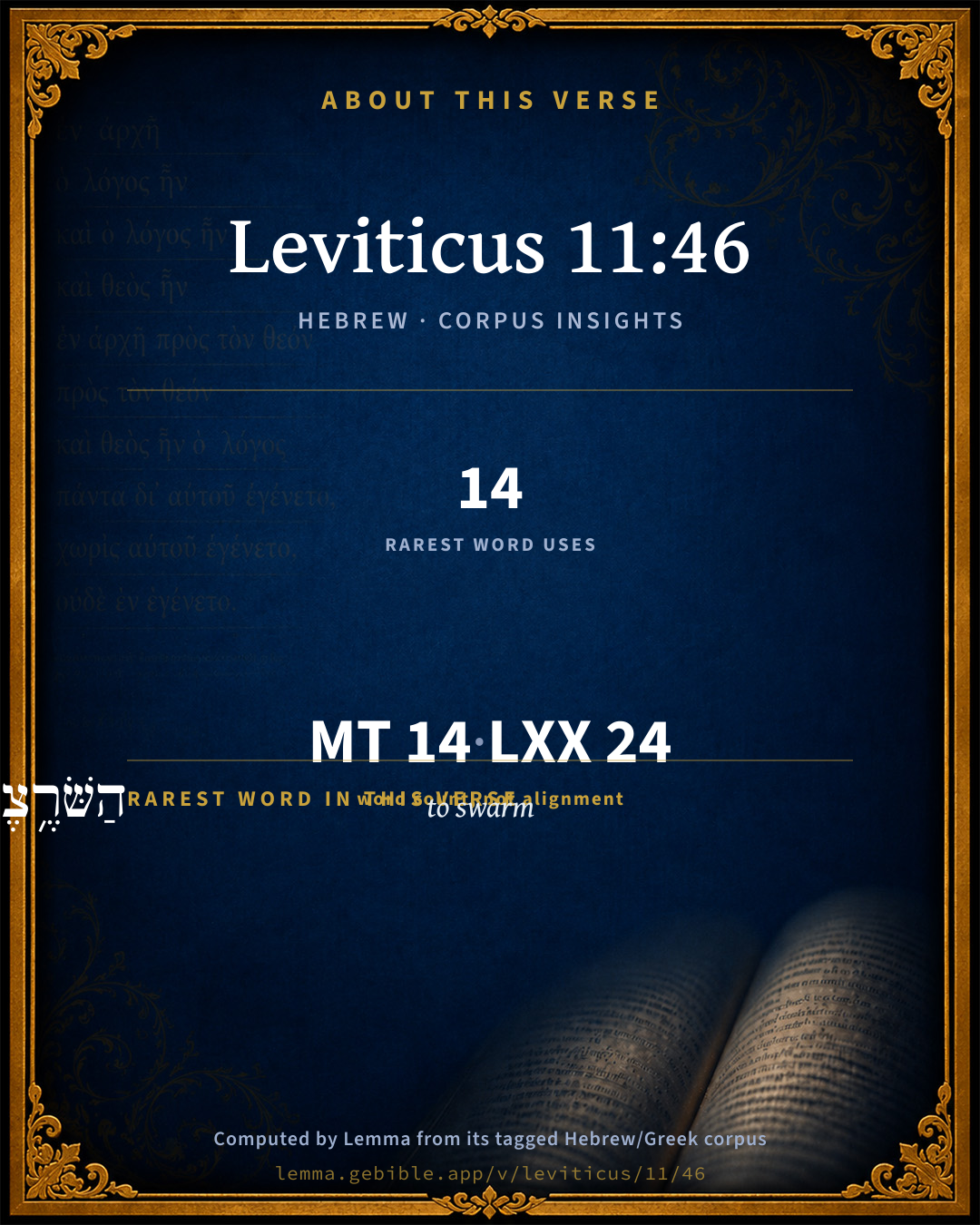
The rarest word here is הַשֹּׁרֶ֥צֶת to swarm H8317 — appearing just 14 times in the whole Hebrew Bible.

Shared distinctive vocabulary

הַשֹּׁרֶ֥צֶת to swarm H8317 occurs in 14 verses of the Hebrew Bible. Also found in:

Grammatical profile

  • 2 verbs
  • 9 nouns
  • 1 adjective
  • 1 pronoun
  • 1 preposition

Verb forms

  • הָרֹמֶ֖שֶׂת Qal · Participle Active
  • הַשֹּׁרֶ֥צֶת Qal · Participle Active

Repetition

Words recur within this verse — often emphatic in Hebrew:

  • וְכֹל֙ all H3605 ×2
  • נֶ֣פֶשׁ soul H5315 ×2

Hebrew & Septuagint length

In English translation the verse runs 30 words from the Hebrew and 24 from the Septuagint (LXX English) — closely comparable.

A rough comparison of the two English renderings, which tokenize alike — not a word-level alignment.

Word counts can differ between the Hebrew and the Greek without any difference in meaning — e.g. the Hebrew direct-object marker אֵת has no separate Greek word, and Greek often adds the article ὁ.

In the original languages it is 14 Hebrew tokens and 24 Greek tokens — but the two are counted differently (Hebrew bundles its prefixes and suffixes into one token; the Greek is in lemma form), so that isn’t a like-for-like length.

Cross-references

4

Topical passages linked to Leviticus 11:46 in the Treasury of Scripture Knowledge — connected by theme and wording, ordered by reader-vote popularity; previews shown in the World English Bible.

  • Leviticus 7:37 This is the law of the burnt offering, of the meal offering, and of the sin offering, and of the trespass offering, and of the consecration, and of the sacrifice of peace offerings;
  • Leviticus 14:54 This is the law for any plague of leprosy, and for an itch,
  • Leviticus 15:32 This is the law of him who has a discharge, and of him who has an emission of semen, so that he is unclean thereby;
  • Ezekiel 43:12 This is the law of the house: on the top of the mountain the whole limit of it round about shall be most holy. Behold, this is the law of the house.

Cross-references courtesy of OpenBible.info (CC BY 4.0).

Hebrew and Greek witnesses Masoretic Hebrew ↔ Greek Septuagint

The same verse in the two great witnesses to the Old Testament, shown verse-for-verse.

These are two independent witnesses, not word-aligned to each other, and the Septuagint is shown in lemma (dictionary) form.

Hebrew Leviticus 11:46 Masoretic · Westminster Leningrad Codex

זֹ֣את תּוֹרַ֤ת הַבְּהֵמָה֙ וְהָע֔וֹף וְכֹל֙ נֶ֣פֶשׁ הַֽחַיָּ֔ה הָרֹמֶ֖שֶׂת בַּמָּ֑יִם וּלְכָל נֶ֖פֶשׁ הַשֹּׁרֶ֥צֶת עַל הָאָֽרֶץ

"'This is the law of the animal, and of the bird, and of every living creature that moves in the waters, and of every creature that creeps on the earth,

World English Bible · Public Domain

Greek LXX Leviticus 11:46 Septuagint · lemma form

οὗτος ὁ νόμος περί ὁ κτῆνος καί ὁ πετεινόν καί πᾶς ψυχή ὁ κινέω ἐν ὁ ὕδωρ καί πᾶς ψυχή ἕρπω ἐπί ὁ γῆ

This is the law concerning beasts and birds and every living creature moving in the water, and every living creature creeping on the earth;

LXX2012 (modern English Septuagint) · Public Domain

Hebrew: Westminster Leningrad Codex (CC BY 4.0). Greek: Septuagint (public domain); English from LXX2012 (modern English Septuagint) (Public Domain). How the Septuagint differs from the Hebrew →

Targum (Aramaic paraphrase)

2

The Targum is the ancient Jewish Aramaic paraphrase of the Hebrew Scriptures — an interpretive translation, not the Hebrew text itself. Onkelos (literal) and Pseudo-Jonathan (expansive) render the Torah, and Jonathan the Prophets. Coverage is partial: where no permissively-licensed English translation exists for a verse, only the Aramaic is shown. This is verse-level text, not a word-by-word alignment to the Hebrew.

  1. Targum Onkelos Torah (Genesis–Deuteronomy)
    דָא אוֹרַיְתָא דִבְעִירָא וּדְעוֹפָא וּדְכָל נַפְשָׁתָא חַיְתָא דִרְחֵשָׁא בְּמַיָא וּלְכָל נַפְשָׁא דִרְחֵשָׁא עַל אַרְעָא

    (no public-domain English translation for this verse)

    Targum Onkelos — Aramaic: “Onkelos Genesis” (public domain); “Onkelos Exodus” (public domain); “Onkelos Leviticus” (public domain); “Onkelos Numbers” (public domain); “Onkelos Deuteronomy” (public domain). English: “Sefaria Community Translation” (CC0 1.0 (public-domain dedication)); “J.W. Etheridge. The Targums of Onkelos and Jonathan Ben Uzziel on the Pentateuch. London: Longmans, Green, 1862” (public domain). Text via Sefaria.

  2. Targum Pseudo-Jonathan Torah (Genesis–Deuteronomy)
    דָא הוּא גְזֵירַת אוֹרַיְיתָא דִבְעִירָא וְעוֹפָא וְכָל נַפְשַׁת חַיְיתָא דְרִחֲשָׁא בְּמַיָא וּלְכָל נַפְשָׁא דִרְחִישָׁא עַל אַרְעָא

    This is the decree of the law concerning beasts, and birds, and every living animal that creepeth upon the ground;

    Targum Pseudo-Jonathan — Aramaic: “Targum Jonathan on Genesis” (public domain); “Targum Jonathan on Exodus” (public domain); “Targum Jonathan on Leviticus” (public domain); “Targum Jonathan on Numbers” (public domain); “Targum Jonathan on Deuteronomy” (public domain). English: “The Targum of Jonathan ben Uzziel, trans. J. W. Etheridge, London, 1862” (public domain). Text via Sefaria.

Commentary

Notes on Leviticus 11:46 from classic Christian and Jewish commentators (each source and its license shown beneath its notes). The classic Christian expositions comment on the surrounding passage and are grouped to its opening verse, so a note may address several verses; the Jewish commentaries on the Tanakh (Rashi and others) are per-verse, so they appear only where the commentator wrote on this verse.

Lemma curates 59 commentaries, every one of them public domain or Creative Commons licensed, each selected and text-cleaned for this edition rather than reprinted as found. About our sources →

Trapp's Complete Commentary

John Trapp

Lev 11:46 This [is] the law of the beasts, and of the fowl, and of every living creature that moveth in the waters, and of every creature that creepeth upon the earth:

Ver. 46. This is the law of the beasts.] Grounded upon right reason, however it may seem otherwise, as is also every other law of God.

John Trapp, A Commentary or Exposition upon All the Books of the Old and New Testament (1647–1656) — public domain. Text from a community e-Sword module.

Joseph Benson's Commentary

Lev 11:46. This is the law of the beasts, &c.–It was to them a statute as long as that dispensation lasted, but under the gospel we find it expressly repealed, by a voice from heaven to Peter, (Act 10:15,) as it had before been virtually set aside by the death of Christ, with other ordinances that perished in the using, Touch not, taste not, handle not, (Col 2:21-22,) and now we are sure that meat commends us not to God, (1Co 8:8,) and that nothing is unclean of itself, Rom 14:14. Nor doth that defile a man which goes into his mouth, but that which comes out from the heart, Mat 15:11. Let us therefore, 1st, Give thanks to God that we are not under this yoke, but that to us every creature of God is allowed as good, and nothing to be refused. 2d, Stand fast in the liberty wherewith Christ hath made us free, and take heed of those doctrines which command to abstain from meats, and so would revive Moses again, 1Ti 4:3; 1Ti 4:3 d, Be strictly and conscientiously temperate in the use of the good creatures God has allowed us. If God’s law has given us liberty, let us lay restraints upon ourselves, and never feed ourselves without fear, lest our table be a snare. Set a knife to thy throat, if thou be a man given to appetite, and be not desirous of dainties or varieties, Pro 23:2-3. Nature is content with a little, grace with less, but lust with nothing.

Joseph Benson's Commentary on the Old and New Testaments (1811–1818) — public domain. Text from a community e-Sword module.

Keil & Delitzsch

C. F. Keil & F. Delitzsch

Lev 11:46, Lev 11:47 contain the concluding formula to the whole of this law. If we take a survey, in closing, of the animals that are enumerated as unclean and not suitable for food, we shall find that among the larger land animals they were chiefly beasts of prey, that seize upon other living creatures and devour them in their blood; among the water animals, all snake-like fishes and slimy shell-fish; among birds, the birds of prey, which watch for the life of other animals and kill them, the marsh-birds, which live on worms, carrion, and all kinds of impurities, and such mongrel creatures as the ostrich, which lives in the desert, and the bat, which flies about in the dark; and lastly, all the smaller animals, with the exception of a few graminivorous locusts, but more especially the snake-like lizards, - partly because they called to mind the old serpent, partly because they crawled in the dust, seeking their food in mire and filth, and suggested the thought of corruption by the slimy nature of their bodies. They comprised, in fact, all such animals as exhibited more or less the darker type of sin, death, and corruption; and it was on this ethical ground alone, and not for all kinds of sanitary reasons, or even from political motives, that the nation of Israel, which was called to sanctification, was forbidden to eat them. It is true there are several animals mentioned as unclean, e.g., the ass, the camel, and others, in which we can no longer recognise this type. But we must bear in mind, that the distinction between clean animals and unclean goes back to the very earliest times (Gen 7:2-3), and that in relation to the large land animals, as well as to the fishes, the Mosaic law followed the marks laid down by tradition, which took its rise in the primeval age, whose childlike mind, acute perception, and deep intuitive insight into nature generally, discerned more truly and essentially the real nature of the animal creation than we shall ever be able to do, with thoughts and perceptions disturbed as ours are by the influences of unnatural and ungodly culture.

(Note: "In its direct and deep insight into the entire nexus of the physical, psychical, and spiritual world, into the secret correspondences of the cosmos and nomos, this sense for nature anticipated discoveries which we shall never make with our ways of thinking, but which a purified humanity, when looking back from the new earth, will fully understand, and will no longer only 'see through a glass darkly.'" - Leyrer, Herzog's Cycl.)

Keil & Delitzsch — Biblical Commentary on the Old Testament (1861–1891) — public domain (CC PDM 1.0). Text via the HelloAO Bible API. (Old Testament only.)

Ellicott's Commentary for English Readers

(46) This is the law of the beasts.—This is a recapitulation of the different classes of animals proscribed in the dietary laws. It will, however, be seen that in this summary they are not enumerated in the same order in which they are discussed in the chapter before us. In the dietary law the order of the four classes is as follows :—(1) the land animals, (2) the water animals, (3) the birds of the air, and (4) the swarming animals; whilst the order of the summary is:—(1) the land animals, (2) the birds of the air, (3) the water animals, and (4) the swarming animals. Exactly the same is the case in the summary of the sacrificial law. (See Lev_7:37-38.)

A Bible Commentary for English Readers, edited by Charles John Ellicott (1878–1897) — public domain. Text from a community e-Sword module.

The Cambridge Bible for Schools and Colleges

gen. ed. J. J. S. Perowne

46. creepeth] swarmeth.

46, 47. Summary. It refers only to the rules about eating, and so makes no reference to Lev_11:24-30. See App. I (c).

The Cambridge Bible for Schools and Colleges (gen. ed. J. J. S. Perowne; Cambridge University Press, 1878–1918) — public domain. Text from a community e-Sword module.

John Gill's Exposition

This is the law of the beasts,.... Clean and unclean, what were to be eaten, and what not,

and of the fowl; Lev 11:2 the unclean ones, which are particularly mentioned that they might be avoided, all others excepting them being allowed:, Lev 11:13.

and of every living creature that moveth in the waters; all sorts of fish in the sea, rivers, ponds, and pools, such as have fins and scales, these were to be eaten, but, if they had neither, were forbidden:, Lev 11:9.

and of every creature that creepeth upon the earth; eight of which are mentioned particularly, which, when dead, defiled by touching; and all others are forbidden to be eaten, Lev 11:29 together with such creeping things that fly, excepting those that had legs above their feet to leap with, Lev 11:20. This is a recapitulation of the several laws respecting them, though not in the exact order in which they are delivered in this chapter.

John Gill's Exposition of the Whole Bible (1746–1763) — public domain (CC PDM 1.0). Text via the HelloAO Bible API.

The Pulpit Commentary

Vers. 46, 47. Clean and unclean the abolition of the law.

"This is the law" (verse 46). But "it is the law" no longer; consider

I THE FACT THAT THIS LEVITICAL LAW HAS BEEN SET ASIDE.

1. Perhaps by the word of our Lord in Mar_7:15, especially taking the translation of verse 19, "This he said, making all meats pure" (Farrar, "Life of Paul," volume 1, page 276).

2. Certainly by the heavenly voice and the apostolic conduct. (Act_10:14, Act_10:48)

3. By united apostolic agreement. (Act_15:22-29)

4. By inspired Epistles. (1Co_8:8 Rom_14:4 1Ti_4:3, 1Ti_4:4) Clearly we are not under any obligation to observe these statutes. We learn from this our immunity

II THAT SUCH PICTORIAL TEACHING IS NOT NOW NEEDED. What moral and spiritual lessons were to be conveyed by these injunctions and by the habits of thought and deed they created, have been learnt; the rudimentary lesson is no longer needed. We are supposed to understand or to be able to learn in other ways what God means by holiness, how hateful sin is in his sight, how prevalent it is, how manifold in its shapes and colours, how sedulously it is to be avoided.

III THAT GOD TRUSTS US TO ACT ARIGHT IN THIS MATTER OF BODILY NOURISH MEET. The Law treated the race as if it were in its religious childhood; the gospel as if it had attained to manhood. (Gal_4:1, Gal_4:23) Christ our Lord trusts us to act wisely and faithfully. We must honour his Divine confidence in us. We shall do so by:

1. Intelligent study of what is really wholesome and health-giving.

2. Moderation in the use of that which is "good for food.

3. Endeavour to make the body the active servant of the soul. C.

The Pulpit Commentary (1880–1919), ed. H.D.M. Spence-Jones & Joseph S. Exell — public domain. Text from a community e-Sword module.

John Wesley's Explanatory Notes

This is the law - It was so, as long the Mosaic dispensation lasted. But under the gospel we find it expressly repealed by a voice from heaven, Acts x, 15. Let us therefore bless God, that to us every creature of God is good, and nothing to be refused.

John Wesley, Explanatory Notes Upon the Whole Bible (1754–1765) — public domain. Text via the GEBible commentary corpus.

unfoldingWord translationNotes

Door43 World Missions Community

General Information:

Yahweh finishes telling Moses and Aaron what he permits the people to eat and what he forbids them to eat.

for which a distinction is to be made between

This can be translated in active form. AT: "for which you must distinguish between" (See: Active or Passive)

between the unclean and the clean

Animals that God declared to be unfit for the people to touch or eat are spoken of as if they were physically unclean, and those which he declared to be acceptable for the people to touch and eat are spoken of as if they were physically clean. (See: Metaphor)

that may be eaten ... that may not be eaten

This can be translated in active form. AT: "that you may eat ... that you may not eat" (See: Active or Passive)

translationWords

law, laws

life

creature

clean

clean

unfoldingWord translationNotes — © Distant Shores Media and the Door43 World Missions Community, licensed CC BY-SA 4.0. Source: git.door43.org/Door43/en_tn.

Lesson kit

Teaching starters — assembled from the data on this page, not authored interpretation. Every prompt links to the verse data it draws on. Edit before teaching.

Leviticus, in the Pentateuch, opens this verse with 14 words (12 distinct Hebrew lemmas). Its most distinctive word is shârats (“to swarm”). A historical commentator’s framing appears above. Read the whole chapter for the surrounding context.

Discussion questions

  1. What does “to swarm” (shârats) contribute to the verse as a whole?
  2. Genesis 1:20 shares the word «to swarm» with this verse. How do the two illuminate each other?
  3. “all” occurs 2× in this one verse. What is the effect of the repetition?
  4. The translations on this page render this verse differently — a whole-verse word diff, not a word-by-word alignment. What might account for the different wordings?
  5. The verb «הָרֹמֶ֖שֶׂת» is Qal Participle Active. How does its form color the action?
  6. Reading how Trapp's Complete Commentary and Joseph Benson's Commentary read this verse, where do the two commentators agree and where do they part?

Things to notice

Reading settings

Reading text

Shown beneath each verse's original-language words.

Old Testament
Old Testament edition

Read the OT as the Masoretic Hebrew (MT) or the Greek Septuagint (LXX).

English shown for the Greek Septuagint (in the Hebrew ↔ Greek comparison).

Comparing translations? Open the Compare panel on any verse page to stack up to four side by side.