
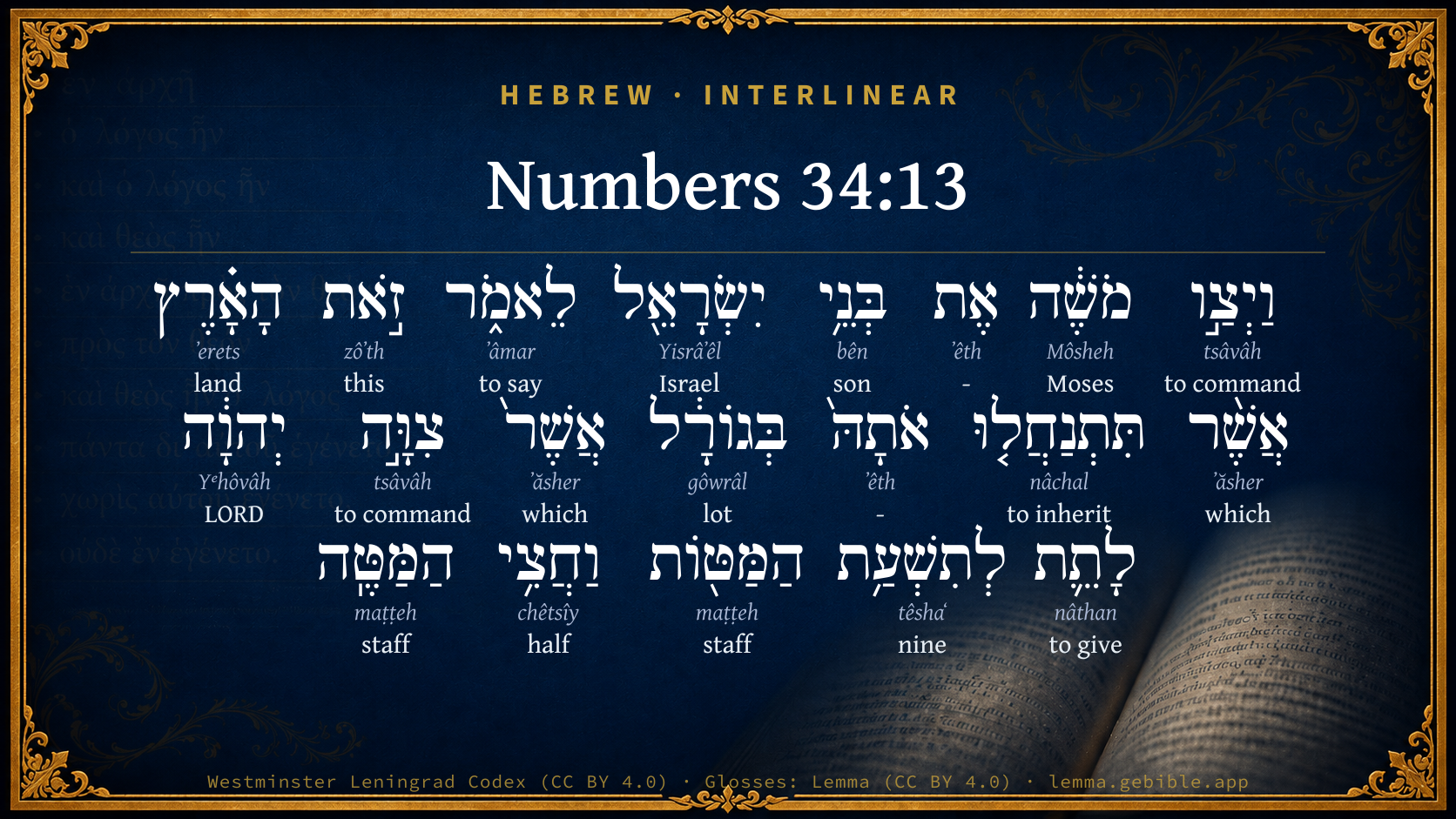
Numbers 34:13

Hebrew (Westminster Leningrad Codex) Numbers 34:13 appears in the Hebrew Old Testament. The text above is from the Westminster Leningrad Codex. Each word links to its Strong’s number, a concise gloss, and parsing drawn from the Open Scriptures Hebrew Bible morphology. Click any word for its full Brown-Driver-Briggs (BDB) entry.
Download image
Cite this verse

Numbers 34:13 (World English Bible). Public Domain. Lemma interlinear Bible study tool, https://lemma.gebible.app/v/numbers/34/13.

Show BibTeX & RIS
BibTeX
RIS
English Translation
Moses commanded the children of Israel, saying, This is the land which you shall inherit by lot, which Yahweh has commanded to give to the nine tribes, and to the half-tribe;
World English Bible · Public Domain
Download a study sheet

One document with this verse’s original text, its word-by-word gloss line, the meaning frame, cross-references with their text, attributed commentary, and full source and license credits — printable, and it pastes into notes with its structure intact.

This verse Autodidact and up

Study sheet (.html) Plain text (.txt)

A passage Seminary Student

Up to 50 verses in one chapter. A passage sheet keeps up to 6 commentary sources and 12 cross-references per verse, in the order this page ranks them, and says so on the sheet whenever that leaves anything out. Ask for a single verse and you get the Autodidact verse sheet above.

Everything on this page stays free to read, with no account — the sheet is a download of what is already on screen, not access to it.

Want to remove ads? Support Godless Engineer
Compare translations 3

The same verse in 3 English versions, stacked beneath the original-language interlinear above. Click any original word for its lexicon entry.

Each is an independent rendering of the whole verse — the interlinear is not word-aligned to these translations.

Highlighted words mark where these versions differ — a whole-verse word diff, not a word-by-word alignment.

  • World English Bible Public Domain
    Moses commanded the children of Israel, saying, This is the land which you shall inherit by lot, which Yahweh has commanded to give to the nine tribes, and to the half-tribe;
  • King James Version Public Domain
    And Moses commanded the children of Israel, saying, This is the land which ye shall inherit by lot, which the LORD commanded to give unto the nine tribes, and to the half tribe:
  • unfoldingWord Literal Text CC BY-SA 4.0
    And Moses commanded the sons of Israel, saying, “This is the land, it which you will inherit for yourselves by lot, which Yahweh has commanded to give to the nine tribes and to the half of the tribe.

unfoldingWord Literal Text — © unfoldingWord, licensed CC BY-SA 4.0. Word-aligned USFM3 via Door43 (git.door43.org/unfoldingWord/en_ult).

Versions to compare (up to 4)

3 of 4 selected

Show all 18 translations

Every available English version of this verse, each an independent rendering of the whole verse.

  • World English Bible Public Domain
    Moses commanded the children of Israel, saying, This is the land which you shall inherit by lot, which Yahweh has commanded to give to the nine tribes, and to the half-tribe;
  • Berean Standard Bible Public Domain
    So Moses commanded the Israelites, “Apportion this land by lot as an inheritance. The LORD has commanded that it be given to the nine and a half tribes.
  • Majority Standard Bible Public Domain
    So Moses commanded the Israelites, “Apportion this land by lot as an inheritance. The LORD has commanded that it be given to the nine and a half tribes.
  • King James Version Public Domain
    And Moses commanded the children of Israel, saying, This is the land which ye shall inherit by lot, which the LORD commanded to give unto the nine tribes, and to the half tribe:
  • American Standard Version (1901) Public Domain
    And Moses commanded the children of Israel, saying, This is the land which ye shall inherit by lot, which Jehovah hath commanded to give unto the nine tribes, and to the half-tribe;
  • Revised Version (1885) Public Domain
    And Moses commanded the children of Israel, saying, This is the land which ye shall inherit by lot, which the LORD hath commanded to give unto the nine tribes, and to the half tribe:
  • Geneva Bible (1599) Public Domain
    Then Moses commanded the children of Israel, saying, This is the lande which yee shall inherite by lot, which the Lord commanded to giue vnto nine tribes and halfe the tribe.
  • Douay-Rheims (1899) Public Domain
    And Moses commanded the children of Israel, saying: This shall be the land which you shall possess by lot, and which the Lord hath commanded to be given to the nine tribes, and to the half tribe.
  • Young's Literal Translation Public Domain
    And Moses commandeth the sons of Israel, saying, `This `is' the land which ye inherit by lot, which Jehovah hath commanded to give to the nine tribes and the half of the tribe;
  • Literal Standard Version CC BY-SA 4.0
    And Moses commands the sons of Israel, saying, “This [is] the land which you inherit by lot, which YHWH has commanded to give to the nine tribes and the half of the tribe;
  • Unlocked Literal Bible CC BY-SA 4.0
    Then Moses commanded the people of Israel and said, “This is the land that you will receive by lot, which Yahweh has commanded to give to the nine tribes and to the half tribe.
  • unfoldingWord Literal Text CC BY-SA 4.0
    And Moses commanded the sons of Israel, saying, “This is the land, it which you will inherit for yourselves by lot, which Yahweh has commanded to give to the nine tribes and to the half of the tribe.
  • Darby Bible Public Domain
    And Moses commanded the children of Israel, saying, This is the land which ye shall take for yourselves as inheritance by lot, which Jehovah commanded to give to the nine tribes, and to the half tribe.
  • World Messianic Bible Public Domain
    Moses commanded the children of Israel, saying, “This is the land which you shall inherit by lot, which the LORD has commanded to give to the nine tribes, and to the half-tribe;
  • Webster's Bible Public Domain
    And Moses commanded the children of Israel, saying, This is the land which ye shall inherit by lot, which the LORD commanded to give to the nine tribes, and to the half tribe:
  • Free Bible Version CC BY-SA 4.0
    Moses gave the order to the Israelites, “Allocate ownership of this land by lot. The Lord has commanded it to be given to the nine and a half tribes.
  • Bible in Basic English Public Domain
    And Moses gave orders to the children of Israel saying, This is the land which is to be your heritage, by the decision of the Lord, which by the Lord's order is to be given to the nine tribes and the half-tribe:
  • JPS Tanakh (1917) Public Domain
    And Moses commanded the children of Israel, saying: 'This is the land wherein ye shall receive inheritance by lot, which the LORD hath commanded to give unto the nine tribes, and to the half-tribe;

Literal Standard Version (2020), Covenant Press — licensed CC BY-SA 4.0. Text via the HelloAO Bible API (eBible.org). Unlocked Literal Bible (unfoldingWord) — licensed CC BY-SA 4.0. Text via the HelloAO Bible API (eBible.org). unfoldingWord Literal Text — © unfoldingWord, licensed CC BY-SA 4.0. Word-aligned USFM3 via Door43 (git.door43.org/unfoldingWord/en_ult). Free Bible Version, Dr. Jonathan Gallagher — licensed CC BY-SA 4.0. Text via the HelloAO Bible API (eBible.org).

Word by word

More ways to search: Search by grammar → Find every occurrence → Compare this word →

Practice this passage: Drill this verse → Learn its vocabulary →

לְתִשְׁעַ֥ת
têshaʻ
H8672
“to/for · nine”
Preposition + Adjective, Cardinal number, Masculine, Singular, Construct
Part of Speech
Preposition + Adjective
Type
Cardinal number
Gender
Masculine
Number
Singular
State
Construct
Full BDB Definition

Origin: perhaps from H8159 through the idea of a turn to the next or full number ten

TWOT: 2550

nine, nonad - nine (as cardinal number) - ninth (as ordinal number) - in combination with other numbers
  1. וַיְצַ֣ו tsâvâh H6680 “and · to command” Conjunction + Verb, Piel, Sequential Imperfect, 3rd Person, Masculine, Singular
  2. מֹשֶׁ֔ה Môsheh H4872 “Moses” Noun, Proper
  3. אֶת ʼêth H853 “-” Particle, Direct Object
  4. בְּנֵ֥י bên H1121 “sons of” Noun, Common, Masculine, Plural, Construct
  5. יִשְׂרָאֵ֖ל Yisrâʼêl H3478 “Israel” Noun, Proper
  6. לֵאמֹ֑ר ʼâmar H559 “to say” Preposition + Verb, Qal, Infinitive Construct
  7. זֹ֣את zôʼth H2063 “this” Pronoun, Demonstrative, Feminine, Singular
  8. הָאָ֗רֶץ ʼerets H776 “the · land” Particle, Definite Article + Noun, Common, Both, Singular, Absolute
  9. אֲשֶׁ֨ר ʼăsher H834 “which” Particle, Relative
  10. תִּתְנַחֲל֤וּ nâchal H5157 “to inherit” Verb, Hithpael, Imperfect, 2nd Person, Masculine, Plural
  11. אֹתָהּ֙ ʼêth H853 “- · her” Particle, Direct Object + Suffix, Personal, 3rd Person, Feminine, Singular
  12. בְּגוֹרָ֔ל gôwrâl H1486 “in/at · lot” Preposition + Noun, Common, Masculine, Singular, Absolute
  13. אֲשֶׁר֙ ʼăsher H834 “which” Particle, Relative
  14. צִוָּ֣ה tsâvâh H6680 “to command” Verb, Piel, Perfect, 3rd Person, Masculine, Singular
  15. יְהוָ֔ה Yᵉhôvâh H3068 “LORD” Noun, Proper
  16. לָתֵ֛ת nâthan H5414 “to give” Preposition + Verb, Qal, Infinitive Construct
  17. הַמַּטּ֖וֹת maṭṭeh H4294 “the · staffs” Particle, Definite Article + Noun, Common, Masculine, Plural, Absolute
  18. וַחֲצִ֥י chêtsîy H2677 “and · half of” Conjunction + Noun, Common, Masculine, Singular, Construct
  19. הַמַּטֶּֽה maṭṭeh H4294 “the · staff” Particle, Definite Article + Noun, Common, Masculine, Singular, Absolute

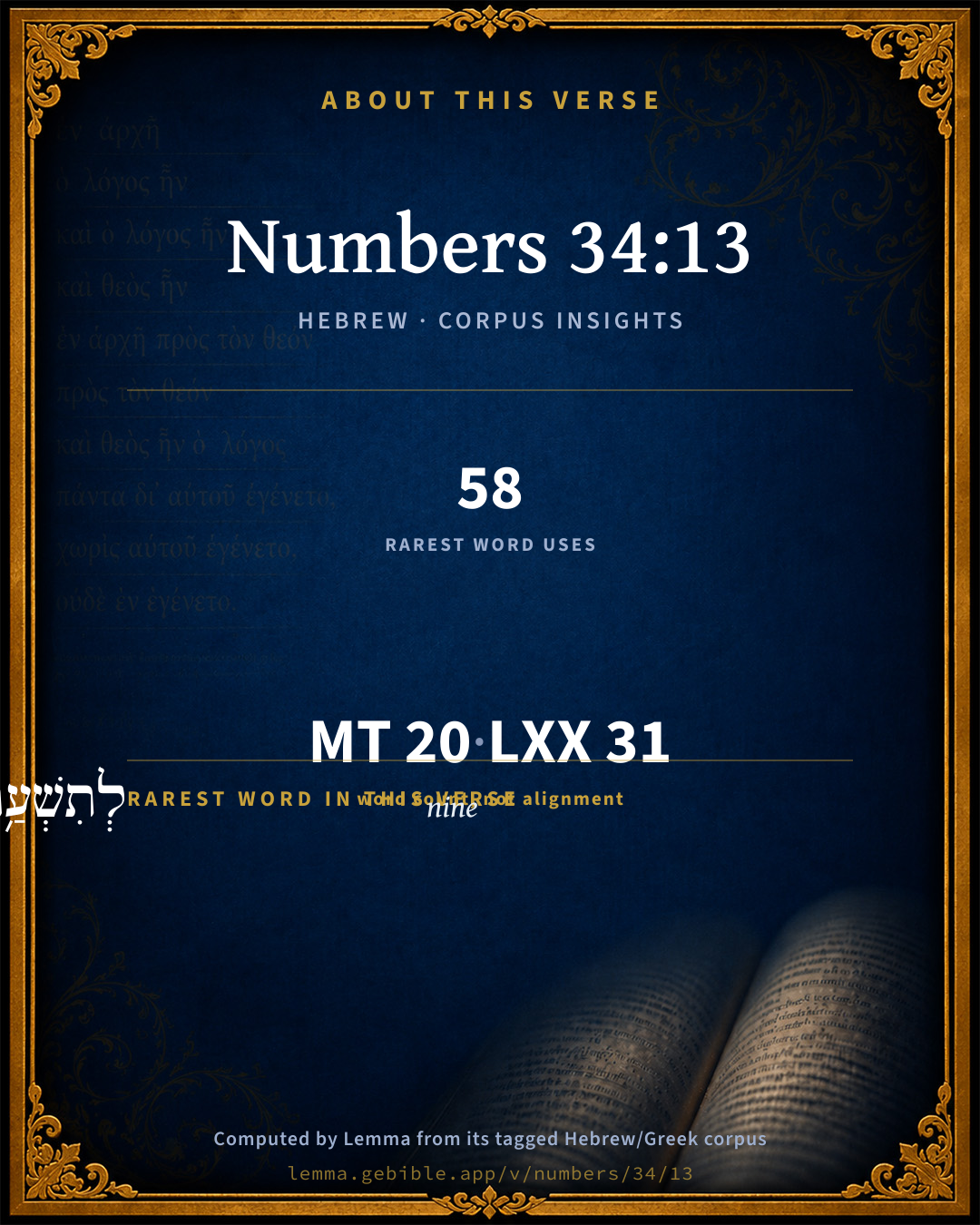
About this verse

These counts appear in no published source. They are computed here, from the morphology-tagged text and Lemma’s own curated glosses. What Lemma adds →

20
words
16
distinct lemmas
Pentateuch
section

Shared distinctive vocabulary

לְתִשְׁעַ֥ת nine H8672 occurs in 57 verses of the Hebrew Bible. Also found in:

Grammatical profile

  • 5 verbs
  • 9 nouns
  • 1 adjective
  • 1 pronoun
  • 4 particles

Verb forms

  • וַיְצַ֣ו Piel · Sequential Imperfect
  • לֵאמֹ֑ר Qal · Infinitive Construct
  • תִּתְנַחֲל֤וּ Hithpael · Imperfect
  • צִוָּ֣ה Piel · Perfect
  • לָתֵ֛ת Qal · Infinitive Construct

Repetition

Words recur within this verse — often emphatic in Hebrew:

  • וַיְצַ֣ו to command H6680 ×2
  • הַמַּטּ֖וֹת staff H4294 ×2
  • אֲשֶׁ֨ר which H834 ×2

Hebrew & Septuagint length

In English translation the verse runs 31 words from the Hebrew and 36 from the Septuagint (LXX English) — closely comparable.

A rough comparison of the two English renderings, which tokenize alike — not a word-level alignment.

Word counts can differ between the Hebrew and the Greek without any difference in meaning — e.g. the Hebrew direct-object marker אֵת has no separate Greek word, and Greek often adds the article ὁ.

In the original languages it is 20 Hebrew tokens and 31 Greek tokens — but the two are counted differently (Hebrew bundles its prefixes and suffixes into one token; the Greek is in lemma form), so that isn’t a like-for-like length.

Cross-references

2

Topical passages linked to Numbers 34:13 in the Treasury of Scripture Knowledge — connected by theme and wording, ordered by reader-vote popularity; previews shown in the World English Bible.

  • Numbers 34:1 Yahweh spoke to Moses, saying,
  • Joshua 14:1–5 These are the inheritances which the children of Israel took in the land of Canaan, which Eleazar the priest, and Joshua the son of Nun, and the heads of the fathers' [houses] of the tribes of the children of Israel, distributed to them,

Cross-references courtesy of OpenBible.info (CC BY 4.0).

Hebrew and Greek witnesses Masoretic Hebrew ↔ Greek Septuagint

The same verse in the two great witnesses to the Old Testament, shown verse-for-verse.

These are two independent witnesses, not word-aligned to each other, and the Septuagint is shown in lemma (dictionary) form.

Hebrew Numbers 34:13 Masoretic · Westminster Leningrad Codex

וַיְצַ֣ו מֹשֶׁ֔ה אֶת בְּנֵ֥י יִשְׂרָאֵ֖ל לֵאמֹ֑ר זֹ֣את הָאָ֗רֶץ אֲשֶׁ֨ר תִּתְנַחֲל֤וּ אֹתָהּ֙ בְּגוֹרָ֔ל אֲשֶׁר֙ צִוָּ֣ה יְהוָ֔ה לָתֵ֛ת לְתִשְׁעַ֥ת הַמַּטּ֖וֹת וַחֲצִ֥י הַמַּטֶּֽה

Moses commanded the children of Israel, saying, This is the land which you shall inherit by lot, which Yahweh has commanded to give to the nine tribes, and to the half-tribe;

World English Bible · Public Domain

Greek LXX Numbers 34:13 Septuagint · lemma form

καί ἐντέλλομαι μωυσῆς ὁ υἱός ἰσραήλ λέγω οὗτος ὁ γῆ ὅς κατακληρονομέω αὐτός μετά κλῆρος ὅς τρόπος συντάσσω κύριος ὁ μωυσῆς δίδωμι αὐτός ὁ ἐννέα φυλή καί ὁ ἥμισυς φυλή μανασσή

And Moses charged the children of Israel, saying, This is the land which you⌃ shall inherit by lot, even as the Lord commanded us to give it to the nine tribes and the half-tribe of Manasse.

LXX2012 (modern English Septuagint) · Public Domain

Hebrew: Westminster Leningrad Codex (CC BY 4.0). Greek: Septuagint (public domain); English from LXX2012 (modern English Septuagint) (Public Domain). How the Septuagint differs from the Hebrew →

Targum (Aramaic paraphrase)

2

The Targum is the ancient Jewish Aramaic paraphrase of the Hebrew Scriptures — an interpretive translation, not the Hebrew text itself. Onkelos (literal) and Pseudo-Jonathan (expansive) render the Torah, and Jonathan the Prophets. Coverage is partial: where no permissively-licensed English translation exists for a verse, only the Aramaic is shown. This is verse-level text, not a word-by-word alignment to the Hebrew.

  1. Targum Onkelos Torah (Genesis–Deuteronomy)
    וּפַקִיד משֶׁה יָת בְּנֵי יִשְׂרָאֵל לְמֵימָר דָא אַרְעָא דְתִתְחַסְנוּן יָתַהּ בְּעַדְבָא דִי פַקֵיד יְיָ לְמִתַּן לְתִשְׁעַת שִׁבְטִין וּפַלְגוּת שִׁבְטָא

    (no public-domain English translation for this verse)

    Targum Onkelos — Aramaic: “Onkelos Genesis” (public domain); “Onkelos Exodus” (public domain); “Onkelos Leviticus” (public domain); “Onkelos Numbers” (public domain); “Onkelos Deuteronomy” (public domain). English: “Sefaria Community Translation” (CC0 1.0 (public-domain dedication)); “J.W. Etheridge. The Targums of Onkelos and Jonathan Ben Uzziel on the Pentateuch. London: Longmans, Green, 1862” (public domain). Text via Sefaria.

  2. Targum Pseudo-Jonathan Torah (Genesis–Deuteronomy)
    וּפַקֵיד משֶׁה יַת בְּנֵי יִשְרָאֵל לְמֵימָר דָא אַרְעָא דְתַחְסְנוּן יָתָהּ בְּעַדְבָא דְפַקֵיד יְיָ לְמִתַּן לְתִשְׁעַת שִׁבְטִין וּפַלְגוּת שִׁבְטָא

    And Mosheh commanded the sons of Israel, saying: This is the land which you are to inherit by lot, which the Lord hath commanded to give to the nine tribes and the half tribe.

    Targum Pseudo-Jonathan — Aramaic: “Targum Jonathan on Genesis” (public domain); “Targum Jonathan on Exodus” (public domain); “Targum Jonathan on Leviticus” (public domain); “Targum Jonathan on Numbers” (public domain); “Targum Jonathan on Deuteronomy” (public domain). English: “The Targum of Jonathan ben Uzziel, trans. J. W. Etheridge, London, 1862” (public domain). Text via Sefaria.

Commentary

Notes on Numbers 34:13 from classic Christian and Jewish commentators (each source and its license shown beneath its notes). The classic Christian expositions comment on the surrounding passage and are grouped to its opening verse, so a note may address several verses; the Jewish commentaries on the Tanakh (Rashi and others) are per-verse, so they appear only where the commentator wrote on this verse.

Lemma curates 59 commentaries, every one of them public domain or Creative Commons licensed, each selected and text-cleaned for this edition rather than reprinted as found. About our sources →

Joseph Benson's Commentary

Num 34:13. This is the land which ye shall inherit — This is repeated, that they might not extend their desires beyond the bounds of God’s gracious grant to them. And, by the foregoing description, it appears that they were placed in a very pleasant land, sheltered from the sultry air of the deserts of Arabia by great mountains on the south, refreshed by western breezes from the Mediterranean sea, and on the north defended by mount Lebanon from the colder blasts of that quarter, and having the delightful plains of Jordan on the east.

Joseph Benson's Commentary on the Old and New Testaments (1811–1818) — public domain. Text from a community e-Sword module.

Tyndale Open Study Notes

Tyndale Open Resources

34:13-15 you are to divide . . . by sacred lot: Cp. 26:55-56. Because of the settlement of two and a half tribes (Reuben, Gad, and half the tribe of Manasseh) in Transjordan (cp. 32:33), Canaan was to be divided among the nine and a half remaining tribes.

Tyndale Open Study Notes — © Tyndale Open Resources, licensed CC BY-SA 4.0. Text via the HelloAO Bible API.

Jamieson, Fausset & Brown

Robert Jamieson, A. R. Fausset & David Brown

The two tribes and the half-tribe have received their inheritance on this side Jordan--The conquered territories of Sihon and Og, lying between the Arnon and mount Hermon, were allotted to them--that of Reuben in the most southerly part, Gad north of it, and the half Manasseh in the northernmost portion.

Jamieson, Fausset & Brown — Commentary Critical and Explanatory on the Whole Bible (1871) — public domain (CC PDM 1.0). Text via the HelloAO Bible API.

Adam Clarke's Commentary

Verse 13. This is the land which ye shall inherit by lot] Much of what is said concerning this land is peculiarly emphatic. It is a land that contains a multitude of advantages in its climate, its soil, situation, c. It is bounded on the south by a ridge of mountains, which separate it from Arabia, and screen it from the burning and often pestiferous winds which blow over the desert from that quarter. On the west it is bounded by the Mediterranean Sea on the north, by Mount Libanus, which defends it from the cold northern blasts; and on the east by the river Jordan, and its fertile, well-watered plains. It is described by God himself as "a good land, a land of brooks of water, of fountains, and depths that spring out of valleys and hills; a land of wheat, and barley, and vines, and fig trees, and pomegranates; a land of olive oil and honey; a land wherein there was no scarcity of bread, and where both iron and copper mines abounded," De 8:7-9: a land finely diversified with hills and valleys, and well watered by the rain of heaven, in this respect widely different from Egypt; a land which God cared for, on which his eyes were continually placed from the beginning to the end of the year; watched over by a most merciful Providence; in a word, a land which flowed with milk and honey, and was the most pleasant of all lands; De 11:11-12; Eze 20:6. Such was the land, and such were the advantages that this most favoured people were called to possess. They were called to possess it by lot that each might be satisfied with his possession, as considering it to be appointed to him by the especial providence of God; and its boundaries were ascertained on Divine authority, to prevent all covetousness after the territories of others.

Adam Clarke's Commentary on the Bible (1810–1826) — public domain. Text from a community e-Sword/MySword module.

John Gill's Exposition

And Moses commanded the children of Israel, saying,.... Strictly enjoining them to observe what he was about to say to them:

this is the land which ye shall inherit by lot; as above described and bounded:

which the Lord commanded to give unto the nine tribes, and to the half tribe; to the tribes of Judah, Simeon, Benjamin, Dan, Ephraim, Zebulun, Issachar, Asher, and Naphtali, and the half tribe of Manasseh; though this command is not before expressed, it is very probable it was delivered to Moses at the same time he had the mind of God concerning the settlement of the tribes of Reuben and Gad, and the other half tribe of Manasseh, on the other side Jordan; see Num 32:31.

John Gill's Exposition of the Whole Bible (1746–1763) — public domain (CC PDM 1.0). Text via the HelloAO Bible API.

Keil & Delitzsch

C. F. Keil & F. Delitzsch

This land, according to the boundaries thus described, the Israelites were to distribute by lot (Num 26:56), to give it to the nine tribes and a half, as the tribes of Reuben, Gad, and half Manasseh had already received their inheritance on the other side of the Jordan (Num 32:33.).

Keil & Delitzsch — Biblical Commentary on the Old Testament (1861–1891) — public domain (CC PDM 1.0). Text via the HelloAO Bible API. (Old Testament only.)

unfoldingWord translationNotes

Door43 World Missions Community

to the nine tribes and to the half tribe

This means the remaining tribes of Israel who will live on the west side of the Jordan River in the land of Canaan. The tribes of Reuben and Gad and the half tribe of Manasseh had already received their land on the east side of the Jordan River.

following the assignment of property to their ancestor's tribe

"according to how Yahweh assigned the property to their ancestor's tribe"

The two tribes and the half tribe

"The tribes of Reuben and Gad, and half of the tribe of Manasseh"

translationWords

Moses

command

Israel

lots

Yahweh

tribe

descend

Reuben

Gad

Manasseh

Jericho

unfoldingWord translationNotes — © Distant Shores Media and the Door43 World Missions Community, licensed CC BY-SA 4.0. Source: git.door43.org/Door43/en_tn.

Lesson kit

Teaching starters — assembled from the data on this page, not authored interpretation. Every prompt links to the verse data it draws on. Edit before teaching.

Numbers, in the Pentateuch, opens this verse with 20 words (16 distinct Hebrew lemmas). Its most distinctive word is têshaʻ (“nine”). A historical commentator’s framing appears above. Read the whole chapter for the surrounding context.

Discussion questions

  1. What does “nine” (têshaʻ) contribute to the verse as a whole?
  2. How does Genesis 5:5, which shares the word «nine», read alongside this verse?
  3. What does the repetition of “to command” (2× in this one verse) do in this verse?
  4. These translations render this verse differently; the difference is in the English rendering, not the original. What questions does that raise?
  5. «וַיְצַ֣ו» is a Piel Sequential Imperfect verb. How does that grammatical form shape the action described?
  6. Compare how Joseph Benson's Commentary and Tyndale Open Study Notes read this verse. Where do they agree or differ?

Things to notice

Reading settings

Reading text

Shown beneath each verse's original-language words.

Old Testament
Old Testament edition

Read the OT as the Masoretic Hebrew (MT) or the Greek Septuagint (LXX).

English shown for the Greek Septuagint (in the Hebrew ↔ Greek comparison).

Comparing translations? Open the Compare panel on any verse page to stack up to four side by side.