
Deuteronomy 14:4

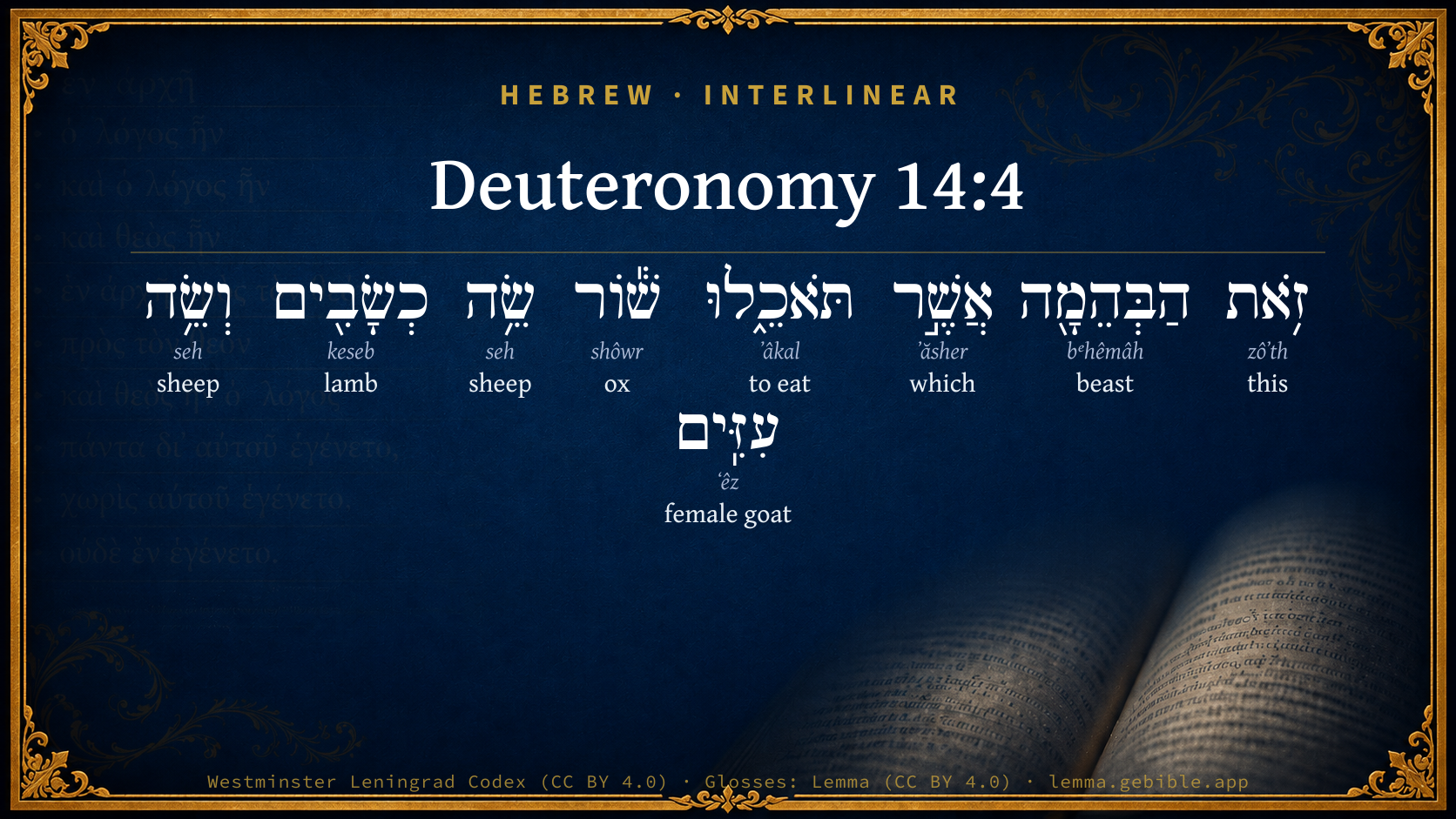
Hebrew (Westminster Leningrad Codex) Deuteronomy 14:4 appears in the Hebrew Old Testament. The text above is from the Westminster Leningrad Codex. Each word links to its Strong’s number, a concise gloss, and parsing drawn from the Open Scriptures Hebrew Bible morphology. Click any word for its full Brown-Driver-Briggs (BDB) entry.
Download image
Cite this verse

Deuteronomy 14:4 (World English Bible). Public Domain. Lemma interlinear Bible study tool, https://lemma.gebible.app/v/deuteronomy/14/4.

Show BibTeX & RIS
BibTeX
RIS
English Translation
These are the animals which you may eat: the ox, the sheep, and the goat,
World English Bible · Public Domain
Download a study sheet

One document with this verse’s original text, its word-by-word gloss line, the meaning frame, cross-references with their text, attributed commentary, and full source and license credits — printable, and it pastes into notes with its structure intact.

This verse Autodidact and up

Study sheet (.html) Plain text (.txt)

A passage Seminary Student

Up to 50 verses in one chapter. A passage sheet keeps up to 6 commentary sources and 12 cross-references per verse, in the order this page ranks them, and says so on the sheet whenever that leaves anything out. Ask for a single verse and you get the Autodidact verse sheet above.

Everything on this page stays free to read, with no account — the sheet is a download of what is already on screen, not access to it.

Want to remove ads? Support Godless Engineer
Compare translations 3

The same verse in 3 English versions, stacked beneath the original-language interlinear above. Click any original word for its lexicon entry.

Each is an independent rendering of the whole verse — the interlinear is not word-aligned to these translations.

Highlighted words mark where these versions differ — a whole-verse word diff, not a word-by-word alignment.

  • World English Bible Public Domain
    These are the animals which you may eat: the ox, the sheep, and the goat,
  • King James Version Public Domain
    These are the beasts which ye shall eat: the ox, the sheep, and the goat,
  • unfoldingWord Literal Text CC BY-SA 4.0
    These the animals that you may eat: the ox, the sheep from the flock and the goat from the flock,

unfoldingWord Literal Text — © unfoldingWord, licensed CC BY-SA 4.0. Word-aligned USFM3 via Door43 (git.door43.org/unfoldingWord/en_ult).

Versions to compare (up to 4)

3 of 4 selected

Show all 18 translations

Every available English version of this verse, each an independent rendering of the whole verse.

  • World English Bible Public Domain
    These are the animals which you may eat: the ox, the sheep, and the goat,
  • Berean Standard Bible Public Domain
    These are the animals that you may eat: The ox, the sheep, the goat,
  • Majority Standard Bible Public Domain
    These are the animals that you may eat: The ox, the sheep, the goat,
  • King James Version Public Domain
    These are the beasts which ye shall eat: the ox, the sheep, and the goat,
  • American Standard Version (1901) Public Domain
    These are the beasts which ye may eat: the ox, the sheep, and the goat,
  • Revised Version (1885) Public Domain
    These are the beasts which ye shall eat: the ox, the sheep, and the goat,
  • Geneva Bible (1599) Public Domain
    These are the beastes, which ye shall eate, the beefe, the sheepe, and the goate,
  • Douay-Rheims (1899) Public Domain
    These are the beasts that you shall eat, the ox, and the sheep, and the goat,
  • Young's Literal Translation Public Domain
    `this `is' the beast which ye do eat: ox, lamb of the sheep, or kid of the goats,
  • Literal Standard Version CC BY-SA 4.0
    this [is] the beast which you eat: ox, lamb of the sheep, or kid of the goats,
  • Unlocked Literal Bible CC BY-SA 4.0
    These are the animals that you may eat: the ox, the sheep, and the goat,
  • unfoldingWord Literal Text CC BY-SA 4.0
    These the animals that you may eat: the ox, the sheep from the flock and the goat from the flock,
  • Darby Bible Public Domain
    These are the beasts which ye shall eat: the ox, the sheep, and the goat;
  • World Messianic Bible Public Domain
    These are the animals which you may eat: the ox, the sheep, the goat,
  • Webster's Bible Public Domain
    These are the beasts which ye shall eat: the ox, the sheep, and the goat,
  • Free Bible Version CC BY-SA 4.0
    These are the animals that you are allowed to eat: cattle, sheep, goats,
  • Bible in Basic English Public Domain
    These are the beasts which you may have for food: the ox, the sheep, and the goat;
  • JPS Tanakh (1917) Public Domain
    These are the beasts which ye may eat: the ox, the sheep, and the goat,

Literal Standard Version (2020), Covenant Press — licensed CC BY-SA 4.0. Text via the HelloAO Bible API (eBible.org). Unlocked Literal Bible (unfoldingWord) — licensed CC BY-SA 4.0. Text via the HelloAO Bible API (eBible.org). unfoldingWord Literal Text — © unfoldingWord, licensed CC BY-SA 4.0. Word-aligned USFM3 via Door43 (git.door43.org/unfoldingWord/en_ult). Free Bible Version, Dr. Jonathan Gallagher — licensed CC BY-SA 4.0. Text via the HelloAO Bible API (eBible.org).

Word by word

More ways to search: Search by grammar → Find every occurrence → Compare this word →

Practice this passage: Drill this verse → Learn its vocabulary →

About this verse

These counts appear in no published source. They are computed here, from the morphology-tagged text and Lemma’s own curated glosses. What Lemma adds →

9
words
8
distinct lemmas
Pentateuch
section

Notable vocabulary

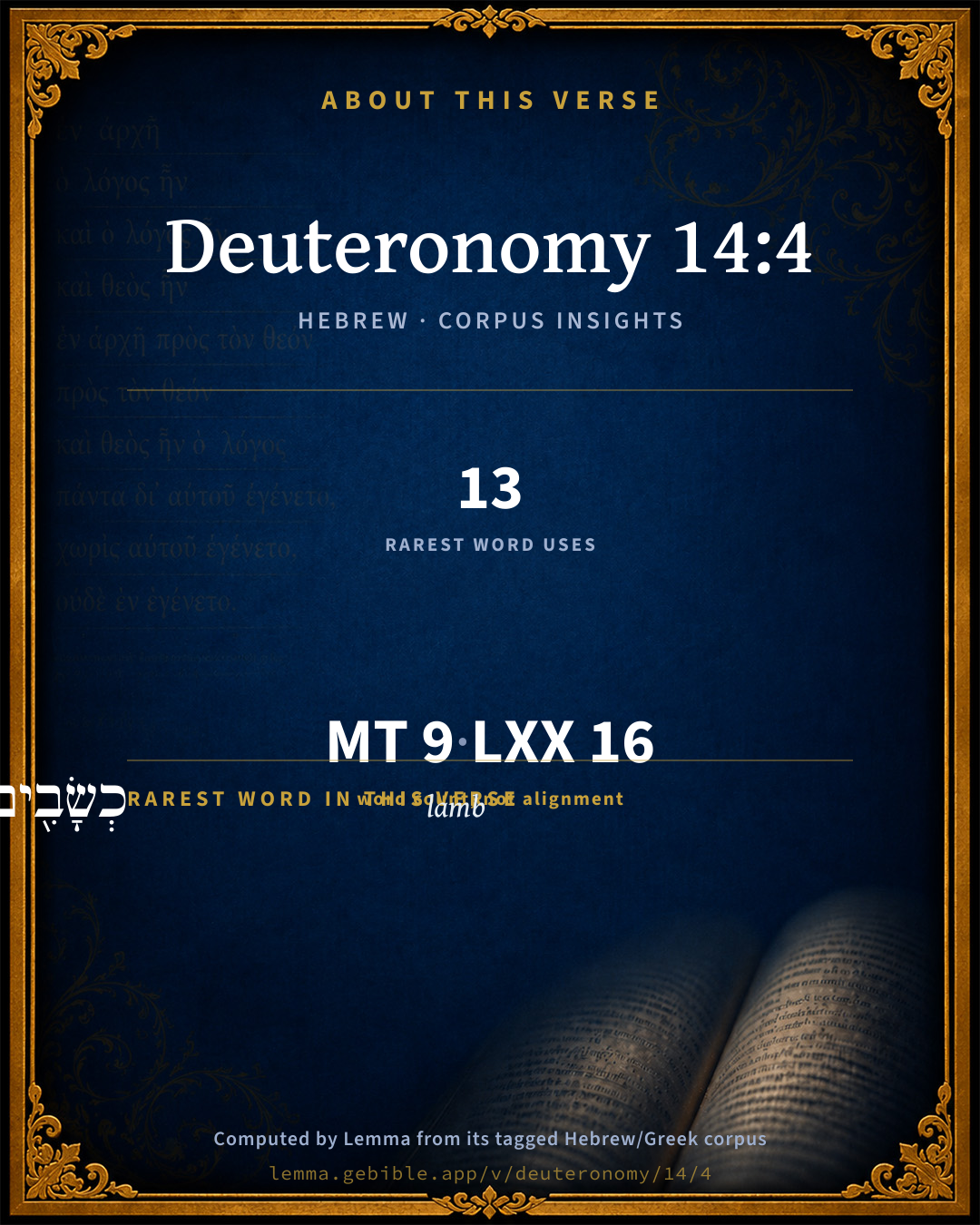
The rarest word here is כְשָׂבִ֖ים lamb H3775 — appearing just 13 times in the whole Hebrew Bible.

Shared distinctive vocabulary

כְשָׂבִ֖ים lamb H3775 occurs in 13 verses of the Hebrew Bible. Also found in:

Grammatical profile

  • 1 verb
  • 6 nouns
  • 1 pronoun
  • 1 particle

Verb forms

  • תֹּאכֵ֑לוּ Qal · Imperfect

Repetition

A word recurs within this verse — often emphatic in Hebrew:

  • שֵׂ֥ה sheep H7716 ×2

Hebrew & Septuagint length

In English translation the verse runs 15 words from the Hebrew and 23 from the Septuagint (LXX English) — the Septuagint runs noticeably longer here. See the side-by-side →

A rough comparison of the two English renderings, which tokenize alike — not a word-level alignment.

Word counts can differ between the Hebrew and the Greek without any difference in meaning — e.g. the Hebrew direct-object marker אֵת has no separate Greek word, and Greek often adds the article ὁ.

In the original languages it is 9 Hebrew tokens and 16 Greek tokens — but the two are counted differently (Hebrew bundles its prefixes and suffixes into one token; the Greek is in lemma form), so that isn’t a like-for-like length.

Cross-references

3

Topical passages linked to Deuteronomy 14:4 in the Treasury of Scripture Knowledge — connected by theme and wording, ordered by reader-vote popularity; previews shown in the World English Bible.

  • Leviticus 11:2–45 "Speak to the children of Israel, saying, 'These are the living things which you may eat among all the animals that are on the earth.
  • 1 Kings 4:23 ten fat oxen, and twenty oxen out of the pastures, and one hundred sheep, besides harts, and gazelles, and roebucks, and fattened fowl.
  • Acts 10:14 But Peter said, "Not so, Lord; for I have never eaten anything that is common or unclean."

Cross-references courtesy of OpenBible.info (CC BY 4.0).

Hebrew and Greek witnesses Masoretic Hebrew ↔ Greek Septuagint

The same verse in the two great witnesses to the Old Testament, shown verse-for-verse.

Here the Septuagint runs noticeably longer than the Hebrew — LXX2012 (modern English Septuagint) 23 words vs World English Bible 15. A rough length comparison of the two English translations, not a word-level alignment — read both below.

These are two independent witnesses, not word-aligned to each other, and the Septuagint is shown in lemma (dictionary) form.

Hebrew Deuteronomy 14:4 Masoretic · Westminster Leningrad Codex

זֹ֥את הַבְּהֵמָ֖ה אֲשֶׁ֣ר תֹּאכֵ֑לוּ שׁ֕וֹר שֵׂ֥ה כְשָׂבִ֖ים וְשֵׂ֥ה עִזִּֽים

These are the animals which you may eat: the ox, the sheep, and the goat,

World English Bible · Public Domain

Greek LXX Deuteronomy 14:4 Septuagint · lemma form

οὗτος ὁ κτῆνος ὅς ἐσθίω μόσχος ἐκ βοῦς καί ἀμνός ἐκ πρόβατον καί χίμαρος ἐκ αἴξ

These are the beasts which you⌃ shall eat; the calf of the herd, and lamb of the sheep, and kid of the goats;

LXX2012 (modern English Septuagint) · Public Domain

On this verse, John Gill's Exposition discusses the Septuagint’s reading. Read the note in Commentary ↓

Hebrew: Westminster Leningrad Codex (CC BY 4.0). Greek: Septuagint (public domain); English from LXX2012 (modern English Septuagint) (Public Domain). How the Septuagint differs from the Hebrew →

Targum (Aramaic paraphrase)

2

The Targum is the ancient Jewish Aramaic paraphrase of the Hebrew Scriptures — an interpretive translation, not the Hebrew text itself. Onkelos (literal) and Pseudo-Jonathan (expansive) render the Torah, and Jonathan the Prophets. Coverage is partial: where no permissively-licensed English translation exists for a verse, only the Aramaic is shown. This is verse-level text, not a word-by-word alignment to the Hebrew.

  1. Targum Onkelos Torah (Genesis–Deuteronomy)
    דֵין בְּעִירָא דְתֵיכְלוּן תּוֹרִין אִמְרִין דִרְחֵלִין וְגָדְיָן דְעִזִין

    (no public-domain English translation for this verse)

    Targum Onkelos — Aramaic: “Onkelos Genesis” (public domain); “Onkelos Exodus” (public domain); “Onkelos Leviticus” (public domain); “Onkelos Numbers” (public domain); “Onkelos Deuteronomy” (public domain). English: “Sefaria Community Translation” (CC0 1.0 (public-domain dedication)); “J.W. Etheridge. The Targums of Onkelos and Jonathan Ben Uzziel on the Pentateuch. London: Longmans, Green, 1862” (public domain). Text via Sefaria.

  2. Targum Pseudo-Jonathan Torah (Genesis–Deuteronomy)
    דָּא הִיא בְּעִירָא דְתֵיכְלוּן תּוֹרִין וְאִימְרֵי בְּנֵי רְחֵילִין וְלָא בְּנֵי מְסָאֲבִין וְגַדְיֵי בְּנֵי עִיזִין וְלָא עֵירוּבֵי טַמְיָין

    These are the animals which you may eat: oxen, and lambs of the ewes, such as are not blemished (unclean), and kids of the goats unmixed with what are unclean.

    Targum Pseudo-Jonathan — Aramaic: “Targum Jonathan on Genesis” (public domain); “Targum Jonathan on Exodus” (public domain); “Targum Jonathan on Leviticus” (public domain); “Targum Jonathan on Numbers” (public domain); “Targum Jonathan on Deuteronomy” (public domain). English: “The Targum of Jonathan ben Uzziel, trans. J. W. Etheridge, London, 1862” (public domain). Text via Sefaria.

Commentary

Notes on Deuteronomy 14:4 from classic Christian and Jewish commentators (each source and its license shown beneath its notes). The classic Christian expositions comment on the surrounding passage and are grouped to its opening verse, so a note may address several verses; the Jewish commentaries on the Tanakh (Rashi and others) are per-verse, so they appear only where the commentator wrote on this verse.

Lemma curates 59 commentaries, every one of them public domain or Creative Commons licensed, each selected and text-cleaned for this edition rather than reprinted as found. About our sources →

The Biblical Illustrator

Joseph S. Exell

Deu_14:4-20

The beasts which ye shall eat.

Gods provision for mans table

I. Provision, Divine in its source. Israel could not have procured it and would not have known without Divine teaching what was good for them. Recognise that power which can furnish a table in the wilderness (Psa_78:19).

II. Provision good in quality. Nothing unclean, nothing unwholesome, was specified. Not anything was to be eaten apt to stimulate sensual passions, or to foster coarse tastes and degrading habits.

III. Provisions abundant in quality. There was no stint in beasts, birds, or fish. The articles of food were nutritious and abundant. Gods legislation for our lower reminds us of His care for our higher nature. There is no lack anywhere. Let us remember our Benefactor, for we cannot put a morsel of food into our mouths till God puts it into our hands--discern kindness not only in prescribing, but in prohibiting, and be grateful to the living God who giveth us richly all things to enjoy (1Ti_6:17). For a man may be blessed with riches, wealth, and honour; want nothing; yet God giveth him not power to eat thereof (Ecc_6:2). (Matthew Henry, D. D.)

Food provided

In this provision of food we see--

1. A mark of Divine condescension. If kings legislated for the diet of their people, is it beneath the King of Israel to appoint the food for His chosen people? All that we know of God, says Dr. Cumming, in creation, in providence, in redemption, leads us to see that He takes as much care of what the world calls, in its ignorance, little things, as He does of what the world thinks, in equal ignorance, great and weighty things.

2. A proof of Divine benevolence. It is kind to provide at all. But what thought indicated, in the choice of animals which multiplied slowly, which were not difficult to obtain, found without leaving the camp, and without danger and contact with heathens around them! All this intended to reclaim and bless. (Matthew Henry, D. D.)

Every creeping thing that flieth is unclean.

Gilded sin

1. There is a natural disgust in everyone to the idea of eating, or even handling, a creeping worm or caterpillar. However difficult this feeling may be to analyse, God has given it to the race for some purpose. All things that are abhorrent to our human instincts--things which we call repulsive--are so many indications of the great truth that we are to make distinctions between clean and unclean, good and evil, right and wrong.

2. Now God saw fit to incorporate this natural instinct of man, which He had implanted, in the law for His people. He forbade their eating these repulsive, crawling things. We know how the natural instinct is often overcome by wilful habits, and we find degraded men taking pleasure in those articles of food which the human palate originally and instinctively rejects. Hence the necessity of a law behind the instinct, when God would teach by it His great spiritual lesson.

3. He would teach us that we may in conscience shrink from gross sins, and yet gradually blunt conscience and indulge in sins we formerly abhorred; and that, therefore, a Divine law must be made the norm of our lives, and not simply the protests of natural conscience.

4. We desire to call your attention to a different class of dalliers with sin--not the gross and vulgar, but the refined and elegant. Their refinement is such that gross forms of sin repel them--not because they are sin, but because they are gross. The nauseous caterpillar has dressed itself up as a beautiful butterfly, and in this form they sport with the creature. But what does Gods law say? Every creeping thing that flieth is unclean unto you. The wings and pretty colours have not altered the nature of the vermin. The same uncleanness is there as before. How many there are who would shrink with dismay from overt sensuality, and yet will, in the privacy of the chamber, gloat over a licentious novel! It is the very same crawling thing--only now it has pretty wings.

5. One of the most successful cloaks for sin at the present day is so-called art. Art is something very lovely and refined. It is a grand thing for the young to know all about art. It shows high breeding to admire and criticise art. Now, there is a grain of wheat and a bushel of chaff in all this talk. To one genuine artist who only looks to the art, there are a thousand hypocrites, who know nothing about art, and only adopt the language of art to hide their sinful tendencies. In the name of art they go to see the public performances of a loose woman and watch the movements of a play that makes light of the marriage relation. In the name of art they fill their parlours with nudities, in voluptuous form and colour, by which the youth of the families are stimulated to sensuality and debauchery; and, in the name of art, the young artist sits before his nude model for her destruction and his.

6. In every way luxury can devise, passions are inflamed, and then modesty is called prudery. Indecent dressing, lascivious dances, immoral innuendo in conversation, form part of this refined system of destroying the soul, in which Christians engage because they must he in the fashion. The creeping thing down in a dance house in Water Street they would exclaim against; but the winged creeping thing that flies in the uptown parlour they delight in; yet it is the same venomous beast.

7. Is it right for those who are washed in the blood of Christ, and who seek the sanctifying influences of the Holy Spirit, to enter wilfully into a social life where books and pictures and statuary and entertainments are most unblushingly promotive of sensuality and vicious thought? Is it right to become accustomed to such gilded filth, so that we lose our Christian delicacy and reserve, and at last make impurity a fashionable virtue? Satan is cunning in his temptations. He does not come to us in a vulgar form and so disgust us. He puts the many-coloured wings on the slimy crawler, and so fascinates us into his service. Beware! (H. Crosby, D. D.)

The Biblical Illustrator, edited by Joseph S. Exell (c. 1880s–1900s) — public domain. Text from a community e-Sword module.

Geneva Bible (1599)

Geneva Bible translators

This ceremonial Law instructed the Jews to seek a spiritual pureness, even in their meat and drink.

Geneva Bible (1599) marginal notes — public domain. Text via Bolls.life.

Adam Clarke's Commentary

Verse 4. These are the beasts which ye shall eat] On Le 11:1-47, I have entered into considerable detail relative to the clean and unclean animals there mentioned. For the general subject, the reader is referred to the notes on that chapter; but as there are particulars mentioned here which Moses does not introduce in Leviticus, it will be necessary to consider them in this place.

The ox] שור shor: BOS, fifth order Pecora, of the genus MAMMALIA, species 41. This term includes all clean animals of the beeve kind; not only the ox properly so called, but also the bull, the cow, heifer, and calf.

The sheep] שה seh: OVIS, fifth order Pecora, of the genus MAMMALIA, species 40; including the ram, the wether, the ewe, and the lamb.

The goat] עז az: CAPRA, fifth order Pecora, of the genus MAMMALIA, species 39; including the he-goat, she-goat, and kid. The words in the text, שה כשבים seh chesabim, signify the lamb or young of sheep; and שה עזים seh izzim, the young or kid of goats: but this is a Hebrew idiom which signifies every creature of the genus, as בן אנוש ben enosh and בן אדם ben adam, son of man, signify any human being. See Ps 144:3; Job 25:6.

The flesh of these animals is universally allowed to be the most wholesome and nutritive. They live on the very best vegetables; and having several stomachs, their food is well concocted, and the chyle formed from it the most pure because the best elaborated, as it is well refined before it enters into the blood. On ruminating or chewing the cud, See Clarke on Le 11:3.

Adam Clarke's Commentary on the Bible (1810–1826) — public domain. Text from a community e-Sword/MySword module.

Ellicott's Commentary for English Readers

(4) These are the beasts which ye shall eat.—The following paragraph to the end of Deu_14:8 answers to Lev_11:2-8, with this difference. The beasts that are to be eaten are specified in Deuteronomy. The exceptions are given in Leviticus.

The ox, the sheep, and the goat.—These being sacrificial animals, naturally stand first. “The sheep and the goat” are literally, “a young one of the sheep or of the goats.” This may serve to illustrate Exo_12:5, “Ye shall take it out from the sheep, or from the goats.” According to the letter of the Law in Exodus, the Passover victim might be either lamb or kid. The word sêh, used there and in Gen_22:7-8, is not distinctive of the species. This word is rendered “lamb” in several places in our English Version.

A Bible Commentary for English Readers, edited by Charles John Ellicott (1878–1897) — public domain. Text from a community e-Sword module.

The Cambridge Bible for Schools and Colleges

gen. ed. J. J. S. Perowne

4. These are the beasts which ye shall eat] Lev_11:2-23 has no list of clean beasts such as here follows.

ox, sheep, goat] For the sacramental nature of the slaying and eating of domestic animals see on Deu_12:20-28. In ancient times the enjoyment of flesh by ordinary people was rare; that of the domestic animals was limited to special occasions such as the arrival of a guest, or a family festival, but kings and the rich ate it every day, and successful raids were celebrated by feasting upon the animal spoil (e.g. Jdg_6:19, 1Sa_14:32; 1Sa_16:20; 1Sa_25:18; 1Sa_28:24, 2Sa_12:4, 1Ki_4:23, Amo_6:4). The flesh was, as still in Syria and Arabia, usually of sheep and goats; Arabs regard the former as the more honourable for a guest. Bullocks and calves were slain much more seldom, except in great houses. So it is still with the fellaḥin; while in Arabia, where pasture is scarce and the oxen are for the most part meagre and stunted, ox flesh is very rarely eaten; and its place is taken by that of the camel (see below). Ancient Arab physicians held beef to be poisonous; in parts of S. Arabia it was eaten only by the very poor; to set it even before a servant was regarded as an insult (Georg Jacob, Altarabisches Beduinenleben, 94).

The Cambridge Bible for Schools and Colleges (gen. ed. J. J. S. Perowne; Cambridge University Press, 1878–1918) — public domain. Text from a community e-Sword module.

John Gill's Exposition

The hart, the roebuck, and the fallow deer,.... All of the deer kind, and very agreeable food; harts were very common in the land of Canaan and parts adjacent; Aelianus says (u) harts are bred in the great mountains in Syria, Amanus, Lebanon, and Carmel: the roebuck, or "dorcas", from whence a good woman had her name, Act 9:36 is spoken of by Martial (w) as very delicious food, and so are fallow deer; the word "jachmur", here used, having the signification of redness in it, may be used for that sort which are called red deer: it is observed that in the Arabic language it is used for an animal with two horns, living in the woods, not unlike an hart, but swifter than that; and it is asked, is it not the "aloe" or "elch" (x)?

and the wild goat, and the pygarg, and the wild ox, and the chamois; the wild goat is reckoned by Pliny (y) among the half wild creatures in Africa; according to the philosopher (z) there are none but in Syria, on which Canaan bordered, and were very remarkable ones, having ears a span and nine inches long, and some reached to the ground. The Hebrew name for this creature is "akko"; and there is a fourfooted wild beast, by the Tartarians called "akkyk", and by the Turks "akoim", and which with the Scythians and Sarmatians are to be met with in flocks; it is between a hart and a ram, its body whitish, and the flesh exceeding sweet (a); it seems to be the same with the "tragelaphus", of which there were in Arabia, as Diodorus Siculus (b) says; the next is the "pygarg", which we so render from the Septuagint and Vulgate Latin versions, or white buttocks, so called from the hinder part of it being white; a species of the eagle with a white tail is called a "pygarg", but here a four footed animal is meant; and which is mentioned as such, along with hinds, does, and goats, by Herodotus (c), Aelian (d), and Pliny (e): it has its name "dishon", in Hebrew, from its ash colour, and the "tragelaphus", or goat deer, has part of its back ash coloured, and has ash coloured spots or streaks on its sides (f): some take it to be the "strepsiceros", a kind of buck or goat with writhed horns, which the Africans, as Pliny says (g), call "addaca", which is thought by some to be a corruption of "al-dashen", so Junius; the Targum of Jonathan takes it for the "unicorn" or "rhinoceros"; and the Talmudists say (h) that the unicorn, though it has but one horn, is free, i.e. lawful to be eaten: the "wild ox" was common in Arabia; Strabo (i) speaks of multitudes of wild oxen in some parts of Arabia, on the flesh of which and other animals the Arabians live; in the Septuagint version it is called the "oryx", which is a creature that has but one horn, and divides the hoof (k), and so might be eaten; See Gill on Isa 51:20, the last, the "chamois", has a French name, and is a creature of the goat kind, from whose skin the chamois leather is made; in the figure of its body it seems to approach very much to the stag kind (l); perhaps it is the same with the "cemas" of Aelian (m), mentioned by him along with roebucks. Some take it to be the "tarandus", of which Pliny says (n) it is of the size of an ox, has a head bigger than a hart, and not unlike it; its horns are branched, hoofs cloven, and is hairy like a bear. In the Targums of Onkelos and Jonathan this is the "pygarg"; these several sorts of beasts were allowed to be eaten; the three first there is no difficulty about them, but the other seven it is hard to determine what they are, at least some of them. Dr. Shaw (o) thinks that the deer, the antelope, the wild bear, the goat deer, the white buttocks, the buffalo, and jeraffa, may lay in the best claim to the "ailee", "tzebi", "yachmur", "akkub", "dishon", "thau", and "zomer", here.

(u) Hist. Animal. l. 5. c. 56. (w) "Delicium parvo", &c. Epigram. l. 13. 93. (x) Castel. Lex. Polyglott. Col. 1. 294. (y) Nat. Hist. l. 8. c. 53. (z) Aristot. Hist. Animal. l. 8. c. 28. (a) Scheuchzer. Physic. Sacr. vol. 3. p. 415. (b) Bibliothec. l. 2. p. 134. Vid. Plin. l. 8. c. 33. (c) Melpomene, sive, l. 4. c. 192. (d) Hist. Animal l. 7. c. 19. (e) Nat. Hist. l. 8. c. 53. (f) Calmet's Dictionary on the word "Pygarg". (g) Nat. Hist. l. 11. c. 39. (h) T. Bab. Cholin, fol. 59. 2. (i) Geograph. l. 16. p. 530. (k) Aristot. Hist. Animal, l. 2. c. 1. (l) Supplement to Chambers's Dictionary on the word "Rupricapra". (m) Hist. Animal. l. 14. c. 14. (n) Nat. Hist. l. 8. c. 34. 34. (o) Travels, p. 418.

John Gill's Exposition of the Whole Bible (1746–1763) — public domain (CC PDM 1.0). Text via the HelloAO Bible API.

Matthew Poole's English Annotations

Of which see Le 11. The small differences between some of their names here and there are not proper for this work. The learned reader may find them cleared in my Latin Synopsis. For others, they may well enough want the knowledge of them, both because these are the smaller matters of the law, and because this distinction of clean and unclean beasts is now out of date.

Matthew Poole's English Annotations on the Holy Bible (1683–1685) — public domain. Text from a community e-Sword/MySword module.

Whedon's Commentary on the Bible

Daniel D. Whedon

4. Ox,… sheep,… goat — These seem to be named first as the ordinary domestic animals that were considered clean. Then comes the enumeration of the wild animals that could be eaten.

Daniel D. Whedon (gen. ed.), Commentary on the Old and New Testaments (1874–1909) — public domain. Text from a community e-Sword module.

The Pulpit Commentary

Vers. 4-20. The regulations here concerning food, and the animals the use of which is forbidden, are substantially the same as in Le 2.

There are, however, some differences between the two accounts which may be noticed.

1. In Deuteronomy, the mammals which may be used for food are severally specified as well as described by the general characteristic of the class; in Leviticus, only the latter description is given.

2. In the list of fowls which may not be eaten, the raah (glade) is mentioned in Deuteronomy, but not in Leviticus; and the bird which in the one is called da"ah, is in the other called dayyah (vulture).

3. The class of reptiles which is carefully described in Leviticus is wholly omitted in Deuteronomy.

4. Winged insects are forbidden without exception in Deuteronomy; in Leviticus, the locust and certain other insects of the same kind are excepted.

5. Some slight differences in the order of enumeration appear.

The Pulpit Commentary (1880–1919), ed. H.D.M. Spence-Jones & Joseph S. Exell — public domain. Text from a community e-Sword module.

Rashi

Rabbi Shlomo Yitzchaki (Rashi)

זאת הבהמה … איל וצבי ויחמור THESE ARE THE BEASTS [WHICH YOU MAY EAT] THE HART AND THE GAZELLE AND THE FALLOW DEER — This (the fact that Scripture begins with זאת הבהמה and goes on to enumerate חיות) teaches us that חיה is included in the term בהמה (Sifrei Devarim 100:1; Chullin 71a; cf. Rashi on Leviticus 11:2, last sentence, and Note thereon). It further teaches us that there are more unclean beasts and wild animals than clean ones, for where two contrasted classes are spoken of it always enumerates by name the individuals of the smaller class (Sifrei Devarim 100:3; Chullin 63a.) (Since it enumerates here the clean animals these must be the minority.)

Rashi on the Tanakh — English translations: “The Judaica Press complete Tanach with Rashi, translated by A. J. Rosenberg” (CC BY 4.0); “Pentateuch with Rashi's commentary by M. Rosenbaum and A.M. Silbermann, 1929-1934” (public domain); “The Metsudah Tanach series, Lakewood, N.J” (CC BY 4.0); and “The Book of Joshua, Metsudah Publications, 1997” (CC BY 4.0). Text via Sefaria.

Lesson kit

Teaching starters — assembled from the data on this page, not authored interpretation. Every prompt links to the verse data it draws on. Edit before teaching.

Deuteronomy, in the Pentateuch, opens this verse with 9 words (8 distinct Hebrew lemmas). Its most distinctive word is keseb (“lamb”). The Greek Septuagint runs longer here. A historical commentator’s framing appears above. Read the whole chapter for the surrounding context.

Discussion questions

  1. How does “lamb” (keseb) shape what this verse is saying?
  2. Genesis 30:32 shares the word «lamb» with this verse. How do the two illuminate each other?
  3. “sheep” occurs 2× in this one verse. What is the effect of the repetition?
  4. Compared with the Hebrew, the Septuagint runs longer here. What questions does that raise?
  5. These translations render this verse differently. What is at stake in choosing one wording over another?
  6. The verb «תֹּאכֵ֑לוּ» is Qal Imperfect. How does its form color the action?
  7. Reading how The Biblical Illustrator and Geneva Bible (1599) read this verse, where do the two commentators agree and where do they part?

Things to notice

Reading settings

Reading text

Shown beneath each verse's original-language words.

Old Testament
Old Testament edition

Read the OT as the Masoretic Hebrew (MT) or the Greek Septuagint (LXX).

English shown for the Greek Septuagint (in the Hebrew ↔ Greek comparison).

Comparing translations? Open the Compare panel on any verse page to stack up to four side by side.