
Deuteronomy 27:3

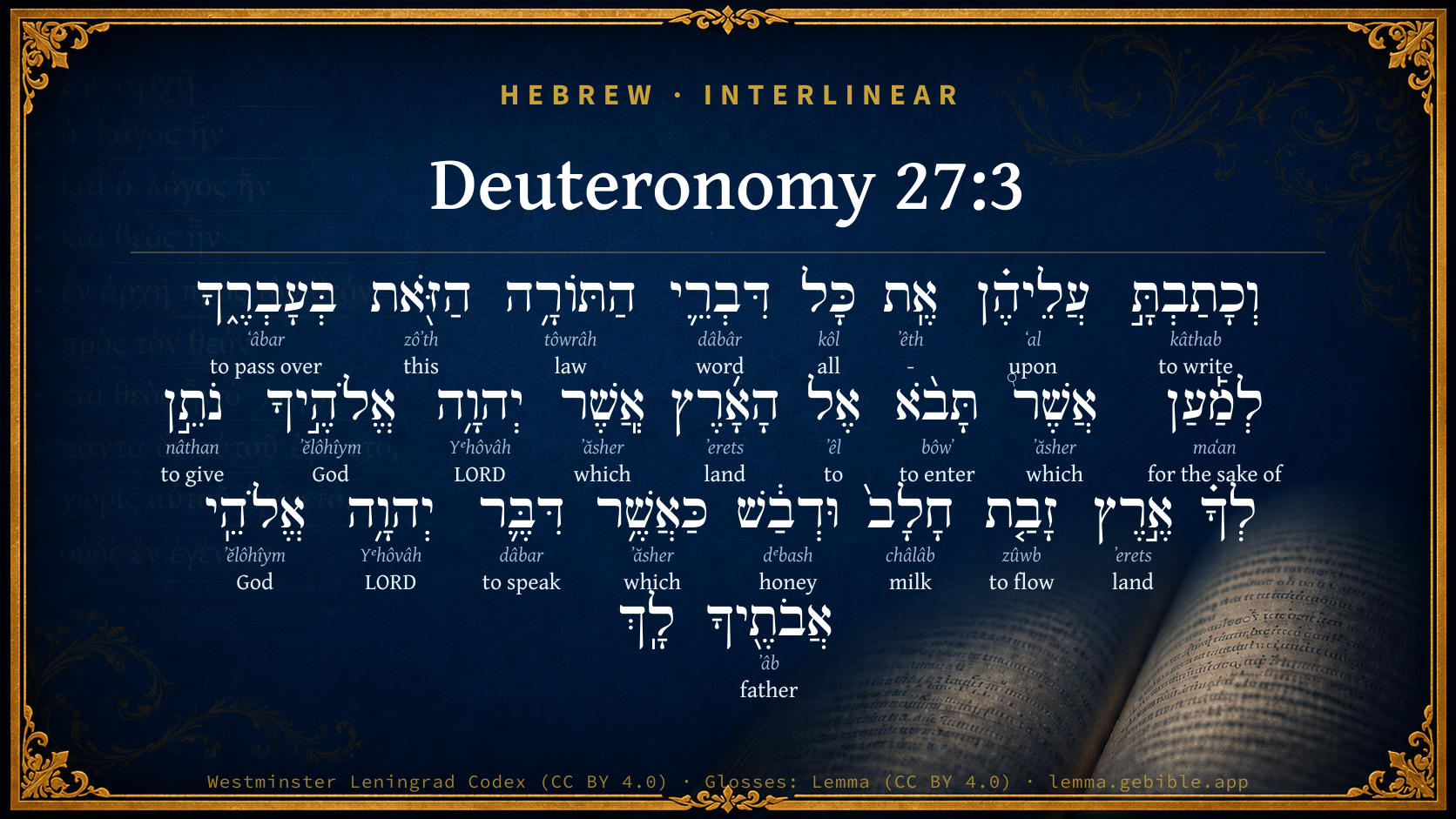
Hebrew (Westminster Leningrad Codex) Deuteronomy 27:3 appears in the Hebrew Old Testament. The text above is from the Westminster Leningrad Codex. Each word links to its Strong’s number, a concise gloss, and parsing drawn from the Open Scriptures Hebrew Bible morphology. Click any word for its full Brown-Driver-Briggs (BDB) entry.
Download image
Cite this verse

Deuteronomy 27:3 (World English Bible). Public Domain. Lemma interlinear Bible study tool, https://lemma.gebible.app/v/deuteronomy/27/3.

Show BibTeX & RIS
BibTeX
RIS
English Translation
and you shall write on them all the words of this law, when you are passed over; that you may go in to the land which Yahweh your God gives you, a land flowing with milk and honey, as Yahweh, the God of your fathers, has promised you.
World English Bible · Public Domain
Download a study sheet

One document with this verse’s original text, its word-by-word gloss line, the meaning frame, cross-references with their text, attributed commentary, and full source and license credits — printable, and it pastes into notes with its structure intact.

This verse Autodidact and up

Study sheet (.html) Plain text (.txt)

A passage Seminary Student

Up to 50 verses in one chapter. A passage sheet keeps up to 6 commentary sources and 12 cross-references per verse, in the order this page ranks them, and says so on the sheet whenever that leaves anything out. Ask for a single verse and you get the Autodidact verse sheet above.

Everything on this page stays free to read, with no account — the sheet is a download of what is already on screen, not access to it.

Want to remove ads? Support Godless Engineer
Compare translations 3

The same verse in 3 English versions, stacked beneath the original-language interlinear above. Click any original word for its lexicon entry.

Each is an independent rendering of the whole verse — the interlinear is not word-aligned to these translations.

Highlighted words mark where these versions differ — a whole-verse word diff, not a word-by-word alignment.

  • World English Bible Public Domain
    and you shall write on them all the words of this law, when you are passed over; that you may go in to the land which Yahweh your God gives you, a land flowing with milk and honey, as Yahweh, the God of your fathers, has promised you.
  • King James Version Public Domain
    And thou shalt write upon them all the words of this law, when thou art passed over, that thou mayest go in unto the land which the LORD thy God giveth thee, a land that floweth with milk and honey; as the LORD God of thy fathers hath promised thee.
  • unfoldingWord Literal Text CC BY-SA 4.0
    And you shall write on them all the words of this law when you have crossed over; so that you may go into the land that Yahweh your God is giving to you, a land flowing with milk and honey, as Yahweh, the God of your fathers, has spoken to you.

unfoldingWord Literal Text — © unfoldingWord, licensed CC BY-SA 4.0. Word-aligned USFM3 via Door43 (git.door43.org/unfoldingWord/en_ult).

Versions to compare (up to 4)

3 of 4 selected

Show all 18 translations

Every available English version of this verse, each an independent rendering of the whole verse.

  • World English Bible Public Domain
    and you shall write on them all the words of this law, when you are passed over; that you may go in to the land which Yahweh your God gives you, a land flowing with milk and honey, as Yahweh, the God of your fathers, has promised you.
  • Berean Standard Bible Public Domain
    Write on them all the words of this law when you have crossed over to enter the land that the LORD your God is giving you, a land flowing with milk and honey, just as the LORD, the God of your fathers, has promised you.
  • Majority Standard Bible Public Domain
    Write on them all the words of this law when you have crossed over to enter the land that the LORD your God is giving you, a land flowing with milk and honey, just as the LORD, the God of your fathers, has promised you.
  • King James Version Public Domain
    And thou shalt write upon them all the words of this law, when thou art passed over, that thou mayest go in unto the land which the LORD thy God giveth thee, a land that floweth with milk and honey; as the LORD God of thy fathers hath promised thee.
  • American Standard Version (1901) Public Domain
    and thou shalt write upon them all the words of this law, when thou art passed over; that thou mayest go in unto the land which Jehovah thy God giveth thee, a land flowing with milk and honey, as Jehovah, the God of thy fathers, hath promised thee.
  • Revised Version (1885) Public Domain
    and thou shalt write upon them all the words of this law, when thou art passed over; that thou mayest go in unto the land which the LORD thy God giveth thee, a land flowing with milk and honey, as the LORD, the God of thy fathers, hath promised thee.
  • Geneva Bible (1599) Public Domain
    And shalt write vpon them all the words of this Lawe, when thou shalt come ouer, that thou mayest go into the land which the Lord thy God giueth thee: a land that floweth with milke and hony, as the Lord God of thy fathers hath promised thee.
  • Douay-Rheims (1899) Public Domain
    That thou mayst write on them all the words of this law, when thou art passed over the Jordan: that thou mayst enter into the land which the Lord thy God will give thee, a land flowing with milk and honey, as he swore to thy fathers.
  • Young's Literal Translation Public Domain
    and written on them all the words of this law in thy passing over, so that thou goest in unto the land which Jehovah thy God is giving to thee -- a land flowing with milk and honey, as Jehovah, God of thy fathers, hath spoken to thee.
  • Literal Standard Version CC BY-SA 4.0
    and written on them all the words of this law in your passing over, so that you go into the land which your God YHWH is giving to you—a land flowing with milk and honey, as YHWH, God of your fathers, has spoken to you.
  • Unlocked Literal Bible CC BY-SA 4.0
    You must write on them all the words of this law when you have passed over; that you may go into the land that Yahweh your God is giving you, a land flowing with milk and honey, as Yahweh, the God of your ancestors, has promised you.
  • unfoldingWord Literal Text CC BY-SA 4.0
    And you shall write on them all the words of this law when you have crossed over; so that you may go into the land that Yahweh your God is giving to you, a land flowing with milk and honey, as Yahweh, the God of your fathers, has spoken to you.
  • Darby Bible Public Domain
    and thou shalt write upon them all the words of this law, when thou goest over that thou mayest enter into the land which Jehovah thy God giveth thee, a land flowing with milk and honey, as Jehovah the God of thy fathers hath promised thee.
  • World Messianic Bible Public Domain
    You shall write on them all the words of this law, when you have passed over, that you may go in to the land which the LORD your God gives you, a land flowing with milk and honey, as the LORD, the God of your fathers, has promised you.
  • Webster's Bible Public Domain
    And thou shalt write upon them all the words of this law, when thou hast passed over, that thou mayest enter in to the land which the LORD thy God giveth thee, a land that floweth with milk and honey; as the LORD God of thy fathers hath promised thee.
  • Free Bible Version CC BY-SA 4.0
    Then write all these laws on them once you've crossed over to enter the country that the Lord your God is giving you, a land flowing with milk and honey, just as the Lord, the God of your forefathers, promised you.
  • Bible in Basic English Public Domain
    And writing on them all the words of this law, after you have gone over; so that you may take the heritage which the Lord your God is giving you, a land flowing with milk and honey, as the Lord, the God of your fathers, has said.
  • JPS Tanakh (1917) Public Domain
    And thou shalt write upon them all the words of this law, when thou art passed over; that thou mayest go in unto the land which the LORD thy God giveth thee, a land flowing with milk and honey, as the LORD, the God of thy fathers, hath promised thee.

Literal Standard Version (2020), Covenant Press — licensed CC BY-SA 4.0. Text via the HelloAO Bible API (eBible.org). Unlocked Literal Bible (unfoldingWord) — licensed CC BY-SA 4.0. Text via the HelloAO Bible API (eBible.org). unfoldingWord Literal Text — © unfoldingWord, licensed CC BY-SA 4.0. Word-aligned USFM3 via Door43 (git.door43.org/unfoldingWord/en_ult). Free Bible Version, Dr. Jonathan Gallagher — licensed CC BY-SA 4.0. Text via the HelloAO Bible API (eBible.org).

Word by word

More ways to search: Search by grammar → Find every occurrence → Compare this word →

Practice this passage: Drill this verse → Learn its vocabulary →

זָבַ֤ת
zûwb
H2100
“flowing”
Verb, Qal, Participle Active, Feminine, Singular, Construct
Part of Speech
Verb
Stem
Qal
Form
Participle Active
Gender
Feminine
Number
Singular
State
Construct
Full BDB Definition

Origin: a primitive root

TWOT: 534

to flow, gush, issue, discharge - (Qal) - to flow, gush - to die, pine away (figuratively) - to flow (of issue from woman), have an issue, flux - flowing (participle)
  1. וְכָתַבְתָּ֣ kâthab H3789 “and · to write” Conjunction + Verb, Qal, Sequential Perfect, 2nd Person, Masculine, Singular
  2. עֲלֵיהֶ֗ן ʻal H5921 “upon · them” Preposition + Suffix, Personal, 3rd Person, Feminine, Plural
  3. אֶֽת ʼêth H853 “-” Particle, Direct Object
  4. כָּל kôl H3605 “all of” Noun, Common, Masculine, Singular, Construct
  5. דִּבְרֵ֛י dâbâr H1697 “words of” Noun, Common, Masculine, Plural, Construct
  6. הַתּוֹרָ֥ה tôwrâh H8451 “the · law” Particle, Definite Article + Noun, Common, Feminine, Singular, Absolute
  7. הַזֹּ֖את zôʼth H2063 “the · this” Particle, Definite Article + Pronoun, Demonstrative, Feminine, Singular
  8. בְּעָבְרֶ֑ךָ ʻâbar H5674 “in/at · to pass over · you” Preposition + Verb, Qal, Infinitive Construct + Suffix, Personal, 2nd Person, Masculine, Singular
  9. לְמַ֡עַן maʻan H4616 “for the sake of” Preposition
  10. אֲשֶׁר֩ ʼăsher H834 “which” Particle, Relative
  11. תָּבֹ֨א bôwʼ H935 “to enter” Verb, Qal, Imperfect, 2nd Person, Masculine, Singular
  12. אֶל ʼêl H413 “to” Preposition
  13. הָאָ֜רֶץ ʼerets H776 “the · land” Particle, Definite Article + Noun, Common, Both, Singular, Absolute
  14. אֲֽשֶׁר ʼăsher H834 “which” Particle, Relative
  15. יְהוָ֥ה Yᵉhôvâh H3068 “LORD” Noun, Proper
  16. אֱלֹהֶ֣יךָ ʼĕlôhîym H430 “God(s) · your” Noun, Common, Masculine, Plural, Construct + Suffix, Personal, 2nd Person, Masculine, Singular
  17. נֹתֵ֣ן nâthan H5414 “giving” Verb, Qal, Participle Active, Masculine, Singular, Absolute
  18. אֶ֣רֶץ ʼerets H776 “land” Noun, Common, Both, Singular, Absolute
  19. חָלָב֙ châlâb H2461 “milk” Noun, Common, Masculine, Singular, Absolute
  20. וּדְבַ֔שׁ dᵉbash H1706 “and · honey” Conjunction + Noun, Common, Masculine, Singular, Absolute
  21. כַּאֲשֶׁ֥ר ʼăsher H834 “like/as · which” Preposition + Particle, Relative
  22. דִּבֶּ֛ר dâbar H1696 “to speak” Verb, Piel, Perfect, 3rd Person, Masculine, Singular
  23. יְהוָ֥ה Yᵉhôvâh H3068 “LORD” Noun, Proper
  24. אֱלֹהֵֽי ʼĕlôhîym H430 “God(s) of” Noun, Common, Masculine, Plural, Construct
  25. אֲבֹתֶ֖יךָ ʼâb H1 “fathers · your” Noun, Common, Masculine, Plural, Construct + Suffix, Personal, 2nd Person, Masculine, Singular

About this verse

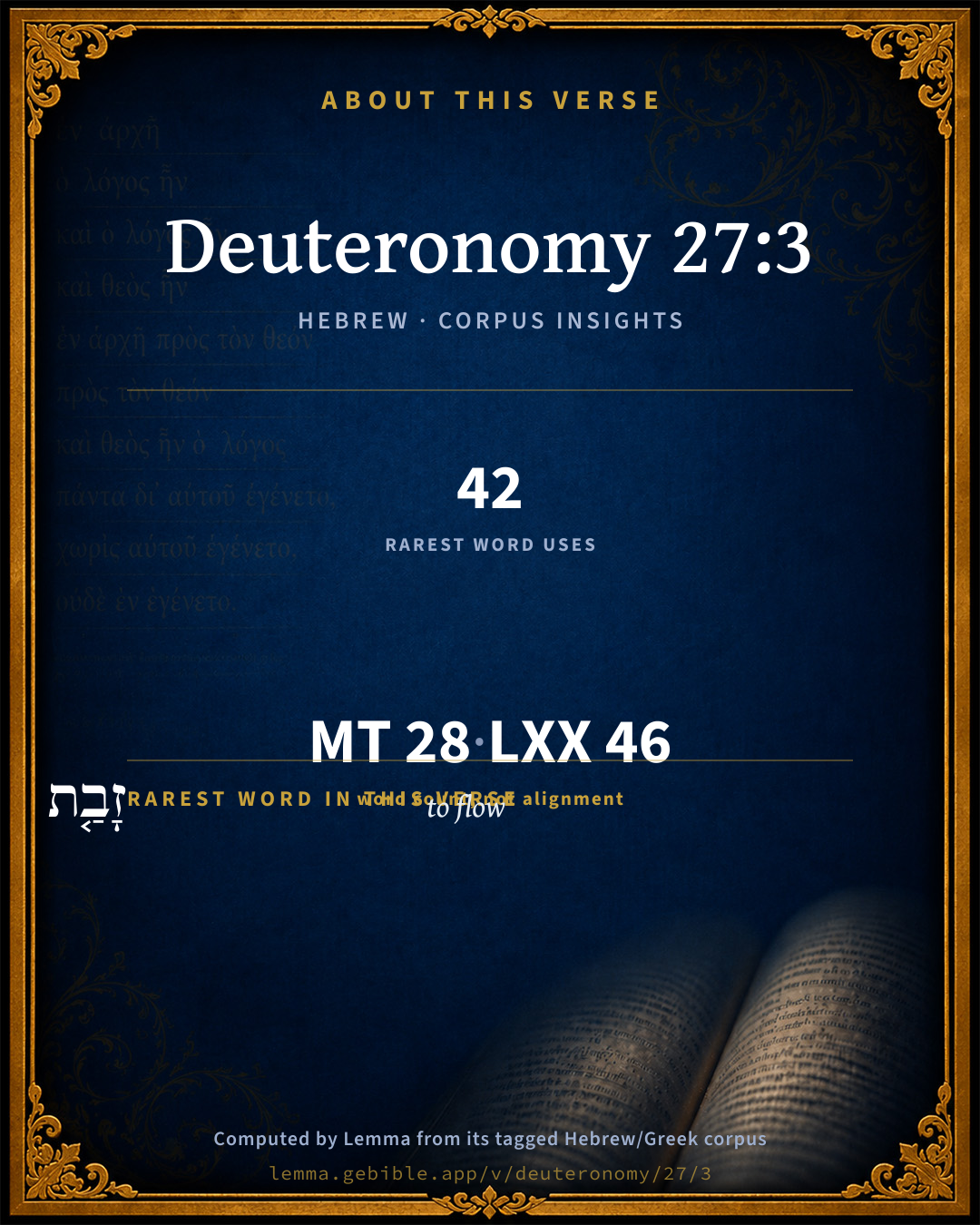
These counts appear in no published source. They are computed here, from the morphology-tagged text and Lemma’s own curated glosses. What Lemma adds →

28
words
21
distinct lemmas
Pentateuch
section

Shared distinctive vocabulary

זָבַ֤ת to flow H2100 occurs in 41 verses of the Hebrew Bible. Also found in:

Grammatical profile

  • 6 verbs
  • 12 nouns
  • 1 pronoun
  • 5 prepositions
  • 4 particles

Verb forms

  • וְכָתַבְתָּ֣ Qal · Sequential Perfect
  • בְּעָבְרֶ֑ךָ Qal · Infinitive Construct
  • תָּבֹ֨א Qal · Imperfect
  • נֹתֵ֣ן Qal · Participle Active
  • זָבַ֤ת Qal · Participle Active
  • דִּבֶּ֛ר Piel · Perfect

Repetition

Words recur within this verse — often emphatic in Hebrew:

  • הָאָ֜רֶץ land H776 ×2
  • יְהוָ֥ה LORD H3068 ×2
  • אֱלֹהֶ֣יךָ God H430 ×2
  • אֲשֶׁר֩ which H834 ×3

Hebrew & Septuagint length

In English translation the verse runs 48 words from the Hebrew and 54 from the Septuagint (LXX English) — closely comparable.

A rough comparison of the two English renderings, which tokenize alike — not a word-level alignment.

Word counts can differ between the Hebrew and the Greek without any difference in meaning — e.g. the Hebrew direct-object marker אֵת has no separate Greek word, and Greek often adds the article ὁ.

In the original languages it is 28 Hebrew tokens and 46 Greek tokens — but the two are counted differently (Hebrew bundles its prefixes and suffixes into one token; the Greek is in lemma form), so that isn’t a like-for-like length.

Cross-references

13

Topical passages linked to Deuteronomy 27:3 in the Treasury of Scripture Knowledge — connected by theme and wording, ordered by reader-vote popularity; previews shown in the World English Bible.

  • Joshua 8:32 He wrote there on the stones a copy of the law of Moses, which he wrote, in the presence of the children of Israel.
  • Deuteronomy 26:9 and he has brought us into this place, and has given us this land, a land flowing with milk and honey.
  • Numbers 13:27 They told him, and said, We came to the land where you sent us; and surely it flows with milk and honey; and this is the fruit of it.
  • Numbers 14:8 If Yahweh delight in us, then he will bring us into this land, and give it to us; a land which flows with milk and honey.
  • Joshua 5:6 For the children of Israel walked forty years in the wilderness, until all the nation, even the men of war who came forth out of Egypt, were consumed, because they didn't listen to the voice of Yahweh: to whom Yahweh swore that he wouldn't let them see the land which Yahweh swore to their fathers that he would give us, a land flowing with milk and honey.
  • Jeremiah 31:31–33 Behold, the days come, says Yahweh, that I will make a new covenant with the house of Israel, and with the house of Judah:
  • 2 Corinthians 3:2–3 You are our letter, written in our hearts, known and read by all men;
  • Hebrews 10:16 "This is the covenant that I will make with them: 'After those days,' says the Lord, 'I will put my laws on their heart, I will also write them on their mind;'" then he says,
  • Leviticus 20:24 But I have said to you, "You shall inherit their land, and I will give it to you to possess it, a land flowing with milk and honey." I am Yahweh your God, who has separated you from the peoples.
  • Deuteronomy 6:8 You shall bind them for a sign on your hand, and they shall be for symbols between your eyes.
  • Jeremiah 11:5 that I may establish the oath which I swore to your fathers, to give them a land flowing with milk and honey, as at this day. Then answered I, and said, Amen, Yahweh.
  • Jeremiah 32:22 and gave them this land, which you did swear to their fathers to give them, a land flowing with milk and honey;
  • Hebrews 8:6–10 But now he has obtained a more excellent ministry, by so much as he is also the mediator of a better covenant, which has been enacted on better promises.

Cross-references courtesy of OpenBible.info (CC BY 4.0).

Hebrew and Greek witnesses Masoretic Hebrew ↔ Greek Septuagint

The same verse in the two great witnesses to the Old Testament, shown verse-for-verse.

These are two independent witnesses, not word-aligned to each other, and the Septuagint is shown in lemma (dictionary) form.

Hebrew Deuteronomy 27:3 Masoretic · Westminster Leningrad Codex

וְכָתַבְתָּ֣ עֲלֵיהֶ֗ן אֶֽת כָּל דִּבְרֵ֛י הַתּוֹרָ֥ה הַזֹּ֖את בְּעָבְרֶ֑ךָ לְמַ֡עַן אֲשֶׁר֩ תָּבֹ֨א אֶל הָאָ֜רֶץ אֲֽשֶׁר יְהוָ֥ה אֱלֹהֶ֣יךָ נֹתֵ֣ן לְךָ֗ אֶ֣רֶץ זָבַ֤ת חָלָב֙ וּדְבַ֔שׁ כַּאֲשֶׁ֥ר דִּבֶּ֛ר יְהוָ֥ה אֱלֹהֵֽי אֲבֹתֶ֖יךָ לָֽךְ

and you shall write on them all the words of this law, when you are passed over; that you may go in to the land which Yahweh your God gives you, a land flowing with milk and honey, as Yahweh, the God of your fathers, has promised you.

World English Bible · Public Domain

Greek LXX Deuteronomy 27:3 Septuagint · lemma form

καί γράφω ἐπί ὁ λίθος πᾶς ὁ λόγος ὁ νόμος οὗτος ὡς ἄν διαβαίνω ὁ ἰορδάνης ἡνίκα ἐάν εἰςἔρχομαι εἰς ὁ γῆ ὅς κύριος ὁ θεός ὁ πατήρ σύ δίδωμι σύ γῆ ῥέω γάλα καί μέλι ὅς τρόπος εἶπον κύριος ὁ θεός ὁ πατήρ σύ σύ

And you shall write on these stones all the words of this law, as soon as you⌃ have crossed Jordan, when you⌃ are entered into the land, which the Lord God of your fathers gives you, a land flowing with milk and honey, according as the Lord God of your fathers said to you.

LXX2012 (modern English Septuagint) · Public Domain

On this verse, Haydock's Catholic Bible Commentary discusses the Septuagint’s reading. Read the note in Commentary ↓

Hebrew: Westminster Leningrad Codex (CC BY 4.0). Greek: Septuagint (public domain); English from LXX2012 (modern English Septuagint) (Public Domain). How the Septuagint differs from the Hebrew →

Targum (Aramaic paraphrase)

2

The Targum is the ancient Jewish Aramaic paraphrase of the Hebrew Scriptures — an interpretive translation, not the Hebrew text itself. Onkelos (literal) and Pseudo-Jonathan (expansive) render the Torah, and Jonathan the Prophets. Coverage is partial: where no permissively-licensed English translation exists for a verse, only the Aramaic is shown. This is verse-level text, not a word-by-word alignment to the Hebrew.

  1. Targum Onkelos Torah (Genesis–Deuteronomy)
    וְתִכְתּוֹב עֲלֵיהוֹן יָת כָּל פִּתְגָמֵי אוֹרַיְתָא הָדָא בְּמֶעְבְּרָךְ בְּדִיל דִי תֵעוּל לְאַרְעָא דַיְיָ אֱלָהָךְ יָהֵב לָךְ אַרְעָא עָבְדָא חֲלַב וּדְבַשׁ כְּמָא דִי מַלִיל יְיָ אֱלָהָא דַאֲבָהָתָךְ לָךְ

    (no public-domain English translation for this verse)

    Targum Onkelos — Aramaic: “Onkelos Genesis” (public domain); “Onkelos Exodus” (public domain); “Onkelos Leviticus” (public domain); “Onkelos Numbers” (public domain); “Onkelos Deuteronomy” (public domain). English: “Sefaria Community Translation” (CC0 1.0 (public-domain dedication)); “J.W. Etheridge. The Targums of Onkelos and Jonathan Ben Uzziel on the Pentateuch. London: Longmans, Green, 1862” (public domain). Text via Sefaria.

  2. Targum Pseudo-Jonathan Torah (Genesis–Deuteronomy)
    וְתִכְתּוֹב עֲלֵיהוֹן יַת כָּל פִּתְגָמֵי אוֹרַיְיתָא הֲדָא בְּמֶעֱבַרְכוֹן מִן בִּגְלַל דְתֵיעֲלוּן לְאַרְעָא דַיְיָ אֱלָהָכוֹן יָהִיב לְכוֹן אַרְעָא דְפֵירָהָא שְׁמֵינִין כַּחֲלָב וְעַבְדִין דְבַשׁ הֵיכְמָא דְמַלִיל אֱלָהָא דְאַבְהַתְכוֹן לְכוֹן

    and thou shalt write upon them all the words of this law, when you go over to enter the land which the Lord your God giveth you, a land whose fruits are rich as milk and producing honey, as the Lord God of your fathers hath said to you.

    Targum Pseudo-Jonathan — Aramaic: “Targum Jonathan on Genesis” (public domain); “Targum Jonathan on Exodus” (public domain); “Targum Jonathan on Leviticus” (public domain); “Targum Jonathan on Numbers” (public domain); “Targum Jonathan on Deuteronomy” (public domain). English: “The Targum of Jonathan ben Uzziel, trans. J. W. Etheridge, London, 1862” (public domain). Text via Sefaria.

Commentary

Notes on Deuteronomy 27:3 from classic Christian and Jewish commentators (each source and its license shown beneath its notes). The classic Christian expositions comment on the surrounding passage and are grouped to its opening verse, so a note may address several verses; the Jewish commentaries on the Tanakh (Rashi and others) are per-verse, so they appear only where the commentator wrote on this verse.

Lemma curates 59 commentaries, every one of them public domain or Creative Commons licensed, each selected and text-cleaned for this edition rather than reprinted as found. About our sources →

Tyndale Open Study Notes

Tyndale Open Resources

27:3 this whole body of instruction (literally all the words of this torah): This phrase could refer to the entire book of Deuteronomy, but considering the small surface (27:2) on which the text was to be inscribed, it probably just refers to the Ten Commandments.

Tyndale Open Study Notes — © Tyndale Open Resources, licensed CC BY-SA 4.0. Text via the HelloAO Bible API.

Geneva Bible (1599)

Geneva Bible translators

God would that his Law should be set up in the borders of the land of Canaan, that all that looked thereon might know that the land was dedicated to his service.

Geneva Bible (1599) marginal notes — public domain. Text via Bolls.life.

Jamieson, Fausset & Brown

Robert Jamieson, A. R. Fausset & David Brown

thou shalt write upon them all the words of this law--It might be, as some think, the Decalogue; but a greater probability is that it was "the blessings and curses," which comprised in fact an epitome of the law (Jos 8:34).

Jamieson, Fausset & Brown — Commentary Critical and Explanatory on the Whole Bible (1871) — public domain (CC PDM 1.0). Text via the HelloAO Bible API.

Adam Clarke's Commentary

Verse 3. All the words of this law] After all that has been said by ingenious critics concerning the law ordered to be written on these stones, some supposing the whole Mosaic law to be intended, others, only the decalogue, I am fully of opinion that the (תורה torah) law or ordinance in question simply means the blessings and curses mentioned in this and in the following chapter; and indeed these contained a very good epitome of the whole law in all its promises and threatenings, in reference to the whole of its grand moral design. See at the end of this chapter. See Clarke on De 27:26.

Adam Clarke's Commentary on the Bible (1810–1826) — public domain. Text from a community e-Sword/MySword module.

John Gill's Exposition

And thou shall write upon them all the words of this law,.... Not the whole book of Deuteronomy, as some think, at least not the historical part of it, only what concerns the laws of God; and it may be only a summary or abstract of them, and perhaps only the ten commandments. Josephus (q) is of opinion that the blessings and the curses after recited were what were written on them:

when thou art passed over; that is, the river Jordan:

that thou mayest go in unto the land which the Lord thy God giveth thee, a land flowing with milk and honey; this account of the land of Canaan is so frequently observed, to imprint upon their minds a sense of the great goodness of God in giving them such a fruitful country, and to point out to them the obligation they lay under to observe the laws of God ordered to be written on plastered stones, as soon as they came into it:

as the Lord God of thy fathers hath promised thee; Exo 3:8.

(q) Antiqu. l. 4. c. 8. sect. 44.

John Gill's Exposition of the Whole Bible (1746–1763) — public domain (CC PDM 1.0). Text via the HelloAO Bible API.

Albert Barnes' Notes on the Bible

All the words of this law - i. e. all the laws revealed from God to the people by Moses, regarded by the Jews as 613 (compare Num 15:38 note). The exhibition of laws in this manner on stones, pillars, or tables, was familiar to the ancients. The laws were probably graven in the stone (“very plainly,” Deu 27:8 is by some rendered “scoop it out well”), as are for the most part the Egyptian hieroglyphics, the “plaister” being afterward added to protect the inscription from the weather.

Albert Barnes' Notes on the Bible (1834–1885) — public domain. Text from a community e-Sword/MySword module.

Haydock's Catholic Bible Commentary

That, &c. Hebrew and Septuagint, "And thou shalt write upon them (stones) all the words of," &c. (Haydock) --- This law, the decalogue, (Masius in Josue viii. 32,) or all the laws of Moses, leaving out the historical parts of his work, or the 20th and three following chapters of Exodus, or the discourses of Moses in this book, &c. Josue, in effect, wrote upon stones the Deuteronomy of the law of Moses, which Josephus explains of the curses and blessings inscribed upon the two sides of the monument, as an abridgment of the whole law. (Calmet) --- The Jordan is not in Hebrew expressly, but in the Septuagint. After the Israelites had crossed this river, they were thus to make a solemn profession of their adherence to the law of God, (Haydock) as they did (ver. 12,) after they had taken Hai; though Josephus insinuates, that they deferred for five years the accomplishment of what is here required. (Tirinus)

George Leo Haydock (1774–1849), Haydock's Catholic Family Bible and Commentary, 1859 edition — public domain. Excludes Psalms (Douay-Rheims chapter numbering differs from Protestant) and Deuterocanonical books (Catholic canon only).

Matthew Poole's English Annotations

All the words of this law; either,

1. All the words of this Book of Deuteronomy. But that seems too large for this place. Or,

2. The blessings and curses here following. But they are mentioned as a different thing. Or,

3. The law properly so called, i.e. the sum and substance of the precepts or laws of Moses, especially such as were moral and general, as may be guessed from the following part of the chapter, where the curses pronounced against all that confirm not all the words of this law to do them are particularly applied unto the transgressors of moral laws only, Deu 27:15,16, &c. And especially the decalogue, which oft goes under that name. Compare Jos 8:32, &c.

Matthew Poole's English Annotations on the Holy Bible (1683–1685) — public domain. Text from a community e-Sword/MySword module.

Whedon's Commentary on the Bible

Daniel D. Whedon

3. Thou shalt write upon them — Before the cement put upon the stones became dry the words could be inscribed; or, on the smooth surface after it had become hard they could be traced, as we find in some ancient tombs.

All the words of this law — How large a portion of the requirements was to be written is uncertain. Some think only the Decalogue; others, that the blessings and the cursings were to be inscribed. Some of the rabbins held that the substance of the entire law, including its six hundred and thirteen enactments, was to be written on the stones. The object of setting up this stone was probably not so much for the purpose of handing down the law to the coming generations as it was to have a monument in the centre of the land which would be a public acknowledgment of the law of Jehovah on the part of the nation. It is useless to speculate as to the special words of the law that were to be written on this monument. It may have been the entire code. “The Behistun inscription in its triple form is twice as long as this entire code carved in bold characters in the solid rock.” — Presbyterian Review, January, 1882, p. 113. For a description of this celebrated inscription see Encyclopaedia Britannica, ninth edition, under “Behistun.” Compare GREEN’S Moses and the Prophets.

Daniel D. Whedon (gen. ed.), Commentary on the Old and New Testaments (1874–1909) — public domain. Text from a community e-Sword module.

The Pulpit Commentary

All the words of this law; i.e. all the purely legislative parts of the Mosaic institute. By the "Law" here cannot be intended merely the blessings and the curses afterwards mentioned (vers. 14-26); nor is there any reason why this term should be restricted to the precepts of this Book of Deuteronomy, as if they only were to be inscribed on the stones: the term must be extended so as to cover all that Moses had at any time delivered to Israel as a law from God. It is not necessary, however, to suppose that all the reasons and exhortations with which the delivery of these, as recorded in the Pentateuch, was accompanied were to be inscribed along with the Law; still less that the historical details amidst which the record of these laws is embedded should be given. It may be questioned even whether each and all of the legislative enactments of the Torah, reckoned by the Jews to be 613, were to be recorded; for it might be deemed enough that the substance and essence of the Law should be thus presented. But even if the whole was to be inscribed, there would be no serious difficulty in the way of carrying this into effect, seeing there is no limitation as to the number of the stones to be set up.

The Pulpit Commentary (1880–1919), ed. H.D.M. Spence-Jones & Joseph S. Exell — public domain. Text from a community e-Sword module.

Ramban (Nachmanides)

Rabbi Moshe ben Nachman (Ramban / Nachmanides)

AND THOU SHALT WRITE UPON THEM ALL THE WORDS OF THIS LAW. Rabbi Abraham ibn Ezra wrote in the name of the Gaon that “they wrote upon the stones a list of the commandments like those written down in the ‘Hilchoth Gedoloth,’ contained in the Torah. The listing is in the preface to his work “Hilchoth Gedoloth”. His concept was utilized by the Paitanim, the writers of liturgical poetry who wrote various Azharoth (Exhortations), liturgical poems containing the Divine Commandments. — It should be noted that while the “Hilchoth Gedoloth” contains the first historical record in our possession of an attempt at enumerating the individual commandments, there is no doubt that the author drew upon older sources of such lists, and as Rabbeinu Saadia Gaon writes here, such “a list of the commandments” was written upon the stones by Moses. in the form of Azharoth (‘Exhortations’ of the liturgical poets). And the meaning of the expression ‘ba’eir heiteiv’ (very plainly) refers to the writing” [i.e., that it be in legible script, but it does not mean “well explained,” since only a brief list of the commandments rather than a detailed rendering was inscribed upon the stones].And our Rabbis have said [that ‘ba’eir heiteiv’ means] in the seventy languages [of the peoples of the world]. Now, we find in the Book of Tagin (crownlets) that the entire Torah was written on them [i.e., the stones] — from the beginning of Bereshith to in the sight of all Israel — with its crownlets and its flourishes, and from there all the crownlets in the entire Torah were copied. It is likely that either these stones were huge, or it was a miraculous event [for, otherwise, it would have been impossible to inscribe so much on a few stone tablets].

SO THAT THOU MAYEST GO IN UNTO THE LAND. Rabbi Abraham ibn Ezra commented that it means “that G-d will help you [to come into the Land] if you begin keeping His commandments, for this was the first commandment [that they were to observe] upon coming into the Land.” In my opinion the expression so that thou mayest go in unto the Land alludes to all the words of the Torah, the verse stating that you are to write upon the stones all the words of this Law when thou art passed over the Jordan immediately so that thou mayest go into the Land, for it was for the sake of the Torah that you will have come there. Similarly, so that thy manservant and thy maidservant may rest as well as thou. And thou shalt remember that thou wast a servant in the land of Egypt which means: “let your manservant and your maidservant rest like you so that you shall remember that you were servants in the land of Egypt.” (so that …) as the effect of an event although the intent thereof is really for the cause of the event. Thus in the verse before us the order of the words is: And thou shalt write upon them … ‘so that thou mayest’ go in unto the Land. From this it would appear that the cause is the writing upon the stones, and the effect is the coming into the Land. Ramban points out that the real thought of the verse is: you are coming into the Land so that you may write G-d’s Torah upon the stones. Thus the cause is the coming into the Land and the effect is the writing upon the stones. The word ‘l’ma’an’ (so that) although written with reference to the coming into the Land refers to the writing upon the stones. A similar case is the verse referring to the Sabbath where the word ‘l’ma’an’ (so that) appears with the cause [so that your servants may rest] but should be interpreted with the effect, the remembering of your being a servant. Therefore, the sense of the text is, let your servants rest so that you will remember that you too, were servants in the land of Egypt. Or it may be that the meaning of the verse is as follows: “you shall write upon the stones all the words of this Law to serve you as a remembrance so that you may come into the Land and conquer it and drive out all these peoples, [a conquest that will be yours only] when you will remember the Torah and keep all its commandments.”

Ramban (Nachmanides) on the Tanakh — English translation: “Commentary on the Torah by Ramban (Nachmanides). Translated and annotated by Charles B. Chavel. New York, Shilo Pub. House, 1971-1976” (CC BY 4.0). Text via Sefaria.

Lesson kit

Teaching starters — assembled from the data on this page, not authored interpretation. Every prompt links to the verse data it draws on. Edit before teaching.

Deuteronomy, in the Pentateuch, opens this verse with 28 words (21 distinct Hebrew lemmas). Its most distinctive word is zûwb (“to flow”). A historical commentator’s framing appears above. Read the whole chapter for the surrounding context.

Discussion questions

  1. What does “to flow” (zûwb) contribute to the verse as a whole?
  2. How does Exodus 3:8, which shares the word «to flow», read alongside this verse?
  3. What does the repetition of “land” (2× in this one verse) do in this verse?
  4. These translations render this verse differently; the difference is in the English rendering, not the original. What questions does that raise?
  5. «וְכָתַבְתָּ֣» is a Qal Sequential Perfect verb. How does that grammatical form shape the action described?
  6. Compare how Tyndale Open Study Notes and Geneva Bible (1599) read this verse. Where do they agree or differ?

Things to notice

Reading settings

Reading text

Shown beneath each verse's original-language words.

Old Testament
Old Testament edition

Read the OT as the Masoretic Hebrew (MT) or the Greek Septuagint (LXX).

English shown for the Greek Septuagint (in the Hebrew ↔ Greek comparison).

Comparing translations? Open the Compare panel on any verse page to stack up to four side by side.