
Ezra 9:13

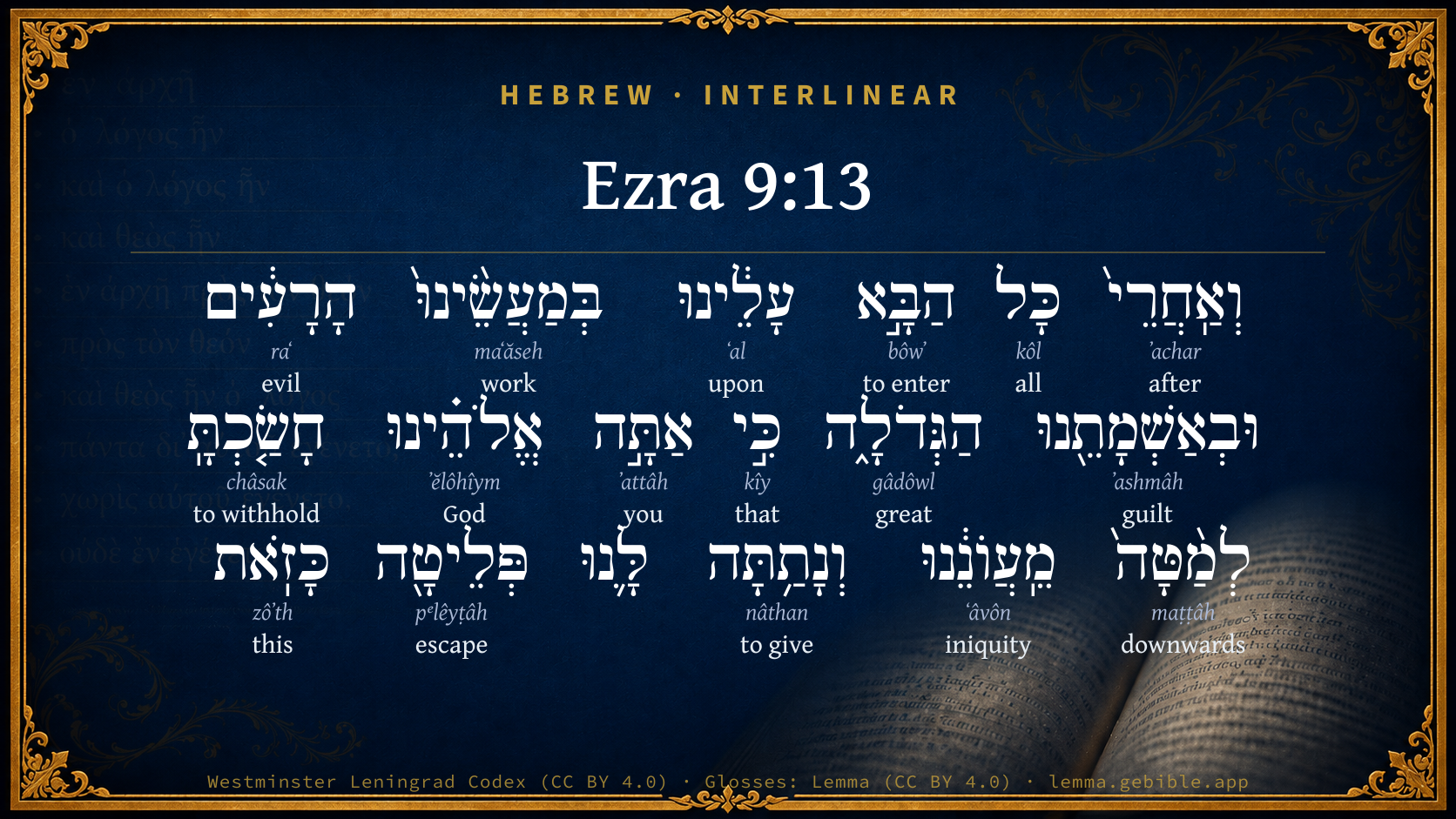
Hebrew (Westminster Leningrad Codex) Ezra 9:13 appears in the Hebrew Old Testament. The text above is from the Westminster Leningrad Codex. Each word links to its Strong’s number, a concise gloss, and parsing drawn from the Open Scriptures Hebrew Bible morphology. Click any word for its full Brown-Driver-Briggs (BDB) entry.
Download image
Cite this verse

Ezra 9:13 (World English Bible). Public Domain. Lemma interlinear Bible study tool, https://lemma.gebible.app/v/ezra/9/13.

Show BibTeX & RIS
BibTeX
RIS
English Translation
After all that is come on us for our evil deeds, and for our great guilt, seeing that you our God have punished us less than our iniquities deserve, and have given us such a remnant,
World English Bible · Public Domain
Download a study sheet

One document with this verse’s original text, its word-by-word gloss line, the meaning frame, cross-references with their text, attributed commentary, and full source and license credits — printable, and it pastes into notes with its structure intact.

This verse Autodidact and up

Study sheet (.html) Plain text (.txt)

A passage Seminary Student

Up to 50 verses in one chapter. A passage sheet keeps up to 6 commentary sources and 12 cross-references per verse, in the order this page ranks them, and says so on the sheet whenever that leaves anything out. Ask for a single verse and you get the Autodidact verse sheet above.

Everything on this page stays free to read, with no account — the sheet is a download of what is already on screen, not access to it.

Want to remove ads? Support Godless Engineer
Compare translations 3

The same verse in 3 English versions, stacked beneath the original-language interlinear above. Click any original word for its lexicon entry.

Each is an independent rendering of the whole verse — the interlinear is not word-aligned to these translations.

Highlighted words mark where these versions differ — a whole-verse word diff, not a word-by-word alignment.

  • World English Bible Public Domain
    After all that is come on us for our evil deeds, and for our great guilt, seeing that you our God have punished us less than our iniquities deserve, and have given us such a remnant,
  • King James Version Public Domain
    And after all that is come upon us for our evil deeds, and for our great trespass, seeing that thou our God hast punished us less than our iniquities deserve, and hast given us such deliverance as this;
  • unfoldingWord Literal Text CC BY-SA 4.0
    Yet after all that has come upon us because of our evil deeds and because of our great guilt (although you, our God, you have restrained it to lower than our iniquities, and you have given to us a survival such as this),

unfoldingWord Literal Text — © unfoldingWord, licensed CC BY-SA 4.0. Word-aligned USFM3 via Door43 (git.door43.org/unfoldingWord/en_ult).

Versions to compare (up to 4)

3 of 4 selected

Show all 18 translations

Every available English version of this verse, each an independent rendering of the whole verse.

  • World English Bible Public Domain
    After all that is come on us for our evil deeds, and for our great guilt, seeing that you our God have punished us less than our iniquities deserve, and have given us such a remnant,
  • Berean Standard Bible Public Domain
    After all that has come upon us because of our evil deeds and our great guilt (though You, our God, have punished us less than our iniquities deserve and have given us such a remnant as this),
  • Majority Standard Bible Public Domain
    After all that has come upon us because of our evil deeds and our great guilt (though You, our God, have punished us less than our iniquities deserve and have given us such a remnant as this),
  • King James Version Public Domain
    And after all that is come upon us for our evil deeds, and for our great trespass, seeing that thou our God hast punished us less than our iniquities deserve, and hast given us such deliverance as this;
  • American Standard Version (1901) Public Domain
    And after all that is come upon us for our evil deeds, and for our great guilt, seeing that thou our God hast punished us less than our iniquities deserve, and hast given us such a remnant,
  • Revised Version (1885) Public Domain
    And after all that is come upon us for our evil deeds, and for our great guilt, seeing that thou our God hast punished us less than our iniquities deserve, and hast given us such a remnant,
  • Geneva Bible (1599) Public Domain
    And after all that is come vpon vs for our euill deedes, and for our great trespasses, (seeing that thou our God hast stayed vs from being beneath for our iniquities, and hast giuen vs such deliuerance)
  • Douay-Rheims (1899) Public Domain
    And after all that is come upon us, for our most wicked deeds, and our great sin, seeing that thou our God hast saved us from our iniquity, and hast given us a deliverance as at this day,
  • Young's Literal Translation Public Domain
    `And after all that hath come upon us for our evil works, and for our great guilt (for Thou, O our God, hast kept back of the rod from our iniquities, and hast given to us an escape like this),
  • Literal Standard Version CC BY-SA 4.0
    And after all that has come on us for our evil works, and for our great guilt (for You, O our God, have kept back of the rod from our iniquities, and have given to us an escape like this),
  • Unlocked Literal Bible CC BY-SA 4.0
    Yet after everything that came on us for our evil practices and our great guilt—since you, our God, have held back what our iniquities deserve and left us survivors—
  • unfoldingWord Literal Text CC BY-SA 4.0
    Yet after all that has come upon us because of our evil deeds and because of our great guilt (although you, our God, you have restrained it to lower than our iniquities, and you have given to us a survival such as this),
  • Darby Bible Public Domain
    And after all that is come upon us for our evil deeds and for our great trespass, seeing that thou our God hast punished us less than our iniquities [deserve], and hast given us such deliverance as this,
  • World Messianic Bible Public Domain
    “After all that has come on us for our evil deeds and for our great guilt, since you, our God, have punished us less than our iniquities deserve, and have given us such a remnant,
  • Webster's Bible Public Domain
    And after all that hath come upon us for our evil deeds, and for our great trespass, seeing that thou our God hast punished us less than our iniquities deserve, and hast given us such deliverance as this;
  • Free Bible Version CC BY-SA 4.0
    Now that we are receiving all this punishment because of our sinful actions and our terrible guilt—though you, our God, have not punished us as much as our sins deserve, and have still given us this remnant —
  • Bible in Basic English Public Domain
    And after everything which has come on us because of our evil-doing and our great sin, and seeing that the punishment which you, O God, have given us, is less than the measure of our sins, and that you have kept from death those of us who are here;
  • JPS Tanakh (1917) Public Domain
    And after all that is come upon us for our evil deeds, and for our great guilt, seeing that Thou our God hast punished us less than our iniquities deserve, and hast given us such a remnant,

Literal Standard Version (2020), Covenant Press — licensed CC BY-SA 4.0. Text via the HelloAO Bible API (eBible.org). Unlocked Literal Bible (unfoldingWord) — licensed CC BY-SA 4.0. Text via the HelloAO Bible API (eBible.org). unfoldingWord Literal Text — © unfoldingWord, licensed CC BY-SA 4.0. Word-aligned USFM3 via Door43 (git.door43.org/unfoldingWord/en_ult). Free Bible Version, Dr. Jonathan Gallagher — licensed CC BY-SA 4.0. Text via the HelloAO Bible API (eBible.org).

Word by word

More ways to search: Search by grammar → Find every occurrence → Compare this word →

Practice this passage: Drill this verse → Learn its vocabulary →

וּבְאַשְׁמָתֵ֖נוּ
ʼashmâh
H819
“and · in/at · guilt · our”
Conjunction + Preposition + Noun, Common, Feminine, Singular, Construct + Suffix, Personal, 1st Person, Common, Plural
Part of Speech
Conjunction + Preposition + Noun
Type
Common
Gender
Feminine
Number
Singular
State
Construct
Full BDB Definition

Origin: from H817

TWOT: 180c

guiltiness, guilt, offense, sin, wrong-doing - doing wrong, committing a trespass or offense - becoming guilty, guilt - bringing a guilt-offering
  1. וְאַֽחֲרֵי֙ ʼachar H310 “and · after” Conjunction + Preposition
  2. כָּל kôl H3605 “all of” Noun, Common, Masculine, Singular, Construct
  3. הַבָּ֣א bôwʼ H935 “the · entering” Particle, Definite Article + Verb, Qal, Participle Active, Masculine, Singular, Absolute
  4. עָלֵ֔ינוּ ʻal H5921 “upon · us” Preposition + Suffix, Personal, 1st Person, Common, Plural
  5. בְּמַעֲשֵׂ֨ינוּ֙ maʻăseh H4639 “in/at · works · our” Preposition + Noun, Common, Masculine, Plural, Construct + Suffix, Personal, 1st Person, Common, Plural
  6. הָרָעִ֔ים raʻ H7451 “the · evil” Particle, Definite Article + Adjective, Adjective, Masculine, Plural, Absolute
  7. הַגְּדֹלָ֑ה gâdôwl H1419 “the · great” Particle, Definite Article + Adjective, Adjective, Feminine, Singular, Absolute
  8. כִּ֣י kîy H3588 “that” Conjunction
  9. אַתָּ֣ה ʼattâh H859 “you” Pronoun, Personal, 2nd Person, Masculine, Singular
  10. אֱלֹהֵ֗ינוּ ʼĕlôhîym H430 “God(s) · our” Noun, Common, Masculine, Plural, Construct + Suffix, Personal, 1st Person, Common, Plural
  11. חָשַׂ֤כְתָּֽ châsak H2820 “to withhold” Verb, Qal, Perfect, 2nd Person, Masculine, Singular
  12. לְמַ֨טָּה֙ maṭṭâh H4295 “to/for · downwards” Preposition + Adverb
  13. מֵֽעֲוֺנֵ֔נוּ ʻâvôn H5771 “from · iniquity · our” Preposition + Noun, Common, Both, Singular, Construct + Suffix, Personal, 1st Person, Common, Plural
  14. וְנָתַ֥תָּה nâthan H5414 “and · to give” Conjunction + Verb, Qal, Perfect, 2nd Person, Masculine, Singular
  15. פְּלֵיטָ֖ה pᵉlêyṭâh H6413 “escape” Noun, Common, Feminine, Singular, Absolute
  16. כָּזֹֽאת zôʼth H2063 “like/as · this” Preposition + Pronoun, Demonstrative, Feminine, Singular

About this verse

These counts appear in no published source. They are computed here, from the morphology-tagged text and Lemma’s own curated glosses. What Lemma adds →

18
words
17
distinct lemmas
Historical
section

Notable vocabulary

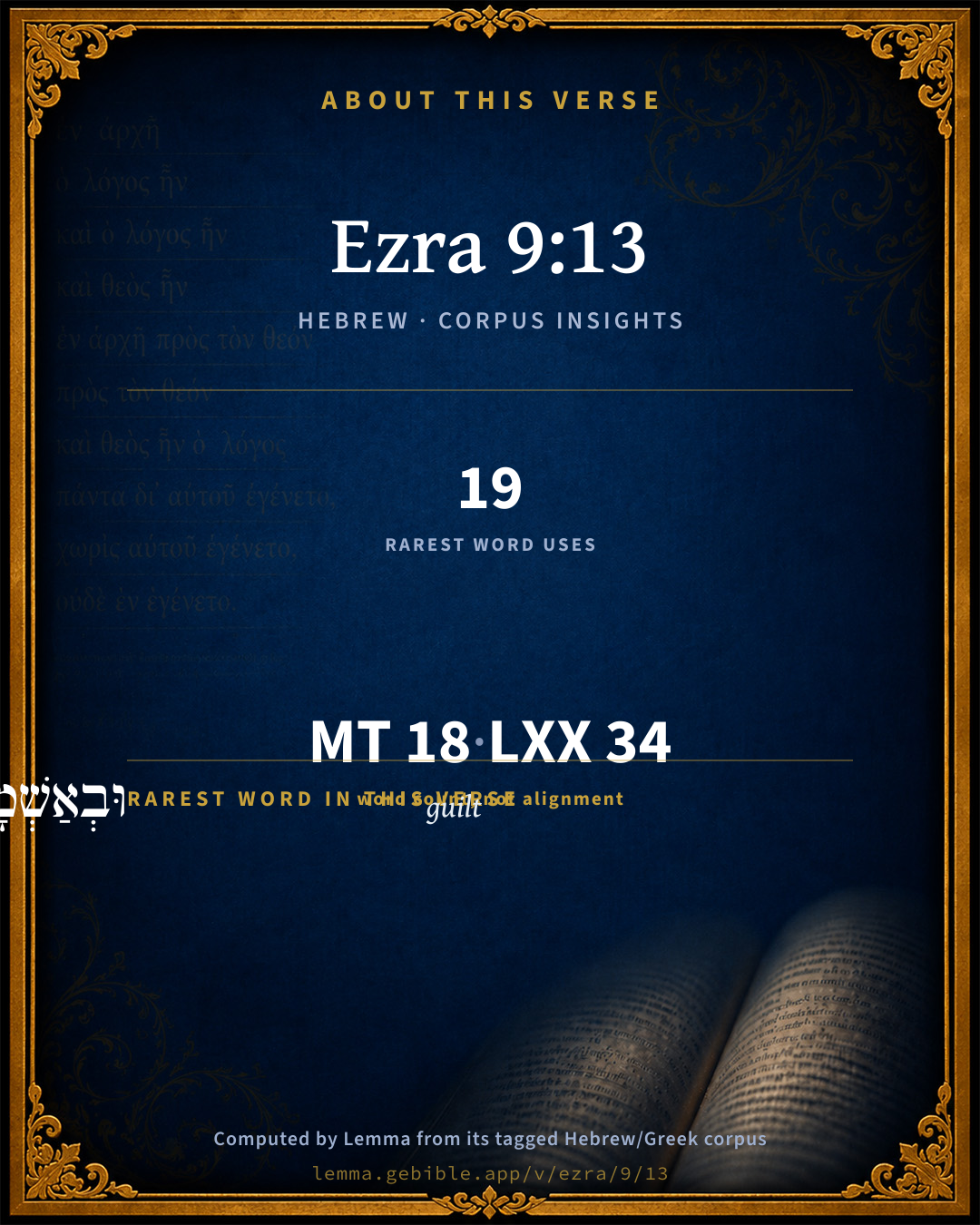
The rarest word here is וּבְאַשְׁמָתֵ֖נוּ guilt H819 — appearing just 19 times in the whole Hebrew Bible.

Shared distinctive vocabulary

וּבְאַשְׁמָתֵ֖נוּ guilt H819 occurs in 17 verses of the Hebrew Bible. Also found in:

Grammatical profile

  • 3 verbs
  • 6 nouns
  • 2 adjectives
  • 2 pronouns
  • 3 prepositions
  • 1 conjunction
  • 1 adverb

Verb forms

  • הַבָּ֣א Qal · Participle Active
  • חָשַׂ֤כְתָּֽ Qal · Perfect
  • וְנָתַ֥תָּה Qal · Perfect

Hebrew & Septuagint length

In English translation the verse runs 36 words from the Hebrew and 39 from the Septuagint (LXX English) — closely comparable.

A rough comparison of the two English renderings, which tokenize alike — not a word-level alignment.

Word counts can differ between the Hebrew and the Greek without any difference in meaning — e.g. the Hebrew direct-object marker אֵת has no separate Greek word, and Greek often adds the article ὁ.

In the original languages it is 18 Hebrew tokens and 34 Greek tokens — but the two are counted differently (Hebrew bundles its prefixes and suffixes into one token; the Greek is in lemma form), so that isn’t a like-for-like length.

Cross-references

10

Topical passages linked to Ezra 9:13 in the Treasury of Scripture Knowledge — connected by theme and wording, ordered by reader-vote popularity; previews shown in the World English Bible.

  • Psalms 103:10 He has not dealt with us according to our sins, Nor repaid us for our iniquities.
  • Lamentations 3:22 [It is of] Yahweh's loving kindnesses that we are not consumed, because his compassion doesn't fail.
  • Lamentations 3:39–40 Why does a living man complain, a man for the punishment of his sins?
  • Job 11:6 That he would show you the secrets of wisdom! For true wisdom has two sides. Know therefore that God exacts of you less than your iniquity deserves.
  • Ezra 9:6–8 and I said, my God, I am ashamed and blush to lift up my face to you, my God; for our iniquities are increased over our head, and our guiltiness is grown up to the heavens.
  • Nehemiah 9:32 Now therefore, our God, the great, the mighty, and the awesome God, who keep covenant and loving kindness, don't let all the travail seem little before you, that has come on us, on our kings, on our princes, and on our priests, and on our prophets, and on our fathers, and on all your people, since the time of the kings of Assyria to this day.
  • Psalms 106:45–46 He remembered for them his covenant, And repented according to the multitude of his loving kindnesses.
  • Ezekiel 24:13–14 In your filthiness is lewdness: because I have cleansed you and you weren't cleansed, you shall not be cleansed from your filthiness any more, until I have caused my wrath toward you to rest.
  • Habakkuk 3:2 Yahweh, I have heard of your fame. I stand in awe of your deeds, Yahweh. Renew your work in the midst of the years. In the midst of the years make it known. In wrath, you remember mercy.
  • Galatians 3:4 Did you suffer so many things in vain, if it is indeed in vain?

Cross-references courtesy of OpenBible.info (CC BY 4.0).

Hebrew and Greek witnesses Masoretic Hebrew ↔ Greek Septuagint

The same verse in the two great witnesses to the Old Testament, shown verse-for-verse.

These are two independent witnesses, not word-aligned to each other, and the Septuagint is shown in lemma (dictionary) form.

Hebrew Ezra 9:13 Masoretic · Westminster Leningrad Codex

וְאַֽחֲרֵי֙ כָּל הַבָּ֣א עָלֵ֔ינוּ בְּמַעֲשֵׂ֨ינוּ֙ הָרָעִ֔ים וּבְאַשְׁמָתֵ֖נוּ הַגְּדֹלָ֑ה כִּ֣י אַתָּ֣ה אֱלֹהֵ֗ינוּ חָשַׂ֤כְתָּֽ לְמַ֨טָּה֙ מֵֽעֲוֺנֵ֔נוּ וְנָתַ֥תָּה לָּ֛נוּ פְּלֵיטָ֖ה כָּזֹֽאת

After all that is come on us for our evil deeds, and for our great guilt, seeing that you our God have punished us less than our iniquities deserve, and have given us such a remnant,

World English Bible · Public Domain

Greek LXX Ezra 9:13 Septuagint · lemma form

καί μετά πᾶς ὁ ἔρχομαι ἐπί ἐγώ ἐν ποίημα ἐγώ ὁ πονηρός καί ἐν πλημμέλεια ἐγώ ὁ μέγας ὅτι οὐ εἰμί ὡς ὁ θεός ἐγώ ὅτι κουφίζω ἐγώ ὁ ἀνομία καί δίδωμι ἐγώ σωτηρία

And after all that is come upon us because of our evil deeds, and our great trespass, it is clear that there is none such as our God, for you have lightly visited our iniquities, and given us deliverance;

LXX2012 (modern English Septuagint) · Public Domain

In the Septuagint this is one book — Esdras B (2 Esdras): Ezra is chapters 1–10, Nehemiah 11–23.

On this verse, The Cambridge Bible for Schools and Colleges discusses the Septuagint’s reading. Read the note in Commentary ↓

Hebrew: Westminster Leningrad Codex (CC BY 4.0). Greek: Septuagint (public domain); English from LXX2012 (modern English Septuagint) (Public Domain). How the Septuagint differs from the Hebrew →

Commentary

Notes on Ezra 9:13 from classic Christian and Jewish commentators (each source and its license shown beneath its notes). The classic Christian expositions comment on the surrounding passage and are grouped to its opening verse, so a note may address several verses; the Jewish commentaries on the Tanakh (Rashi and others) are per-verse, so they appear only where the commentator wrote on this verse.

Lemma curates 59 commentaries, every one of them public domain or Creative Commons licensed, each selected and text-cleaned for this edition rather than reprinted as found. About our sources →

Trapp's Complete Commentary

John Trapp

Ezr 9:13 And after all that is come upon us for our evil deeds, and for our great trespass, seeing that thou our God hast punished us less than our iniquities [deserve], and hast given us [such] deliverance as this;

Ver. 13. And after all that is come upon us] Affliction, like foul weather, cometh before it is sent for; yet not but of God’s sending; and then it is ever either probational, as Job’s; or cautional, as Paul’s prick in the flesh; or penal, for chastisement of some way of wickedness, as here.

For our evil deeds] These he thanketh (as well be might) for all their sufferings: sin is the mother of misery, and hales hell at the heels of it.

Seeing that thou our God] Our God still, and this is the sixth time that he hath so styled him in this holy prayer, besides three times My God. These are speeches of faith, and refer to the covenant, that pabulum fidei, food of faith. When ye stand and pray, believe; when ye humble and tremble before God, keep up your faith still. Nihil retinet qui fidem amisit, lose that and lose all (Seneca). Take away the iniquity of thy servants, saith David, 2Sa 24:10. It is as if he should say, I am thy servant, Lord, still, though an unworthy one. And to prove himself so, he addeth, for I have done very foolishly. I confess it, Lord, that thou mayest cover it. Homo agnoscit, Deus ignoscit. This he believes, and speeds: when Judas confessing (but in addition despairing) misses of mercy.

Hast punished us less than our iniquities deserve] Heb. Hast withheld beneath our iniquities. The just hire of the least sin is death in the largest sense, Rom 6:23. What then might God do to us for our many and mighty sins, or rather, what might he not do, and that most justly! How great is his mercy which maketh him say, Jerusalem hath received at God’s hand double for all her sins, Isa 40:1-2. Too much, saith God there; too little, saith Ezra here; and yet how sweetly and beautifully doth this kind of contradiction become both!

And hast given us such deliverance as this] A fruit of free mercy, and calls hard for duty. God’s blessings are binders; and every new deliverance calls for new obedience, Servati sumus ut serviamus. We have been served so that we may serve.

John Trapp, A Commentary or Exposition upon All the Books of the Old and New Testament (1647–1656) — public domain. Text from a community e-Sword module.

Joseph Benson's Commentary

Ezr 9:13-14. After all that is come upon us for our evil deeds — After all our sore sufferings for our sins. Seeing thou hast punished us less than our iniquities deserve — After all thy favours shown us in the mitigation of thy judgments. And hast given us such deliverance as this — So full, so sudden, so unexpected and amazing, not only to our enemies, but also to ourselves. Should we again break thy commandments, &c. — Was this a fit and just requital of all thy kindnesses? Was this thy end and design in these actions? Wilt thou take this well at our hands? That there should be no remnant nor escaping — Can we reasonably expect any thing from thee less than utter ruin?

Joseph Benson's Commentary on the Old and New Testaments (1811–1818) — public domain. Text from a community e-Sword module.

Geneva Bible (1599)

Geneva Bible translators

Hast not utterly cast us down and destroyed us for our sins, Deut. 28:13.

Geneva Bible (1599) marginal notes — public domain. Text via Bolls.life.

Adam Clarke's Commentary

Verse 13. Hast punished us less than our iniquities] Great, numerous, and oppressive as our calamities have been, yet merely as temporal punishments, they have been much less than our provocations have deserved.

Adam Clarke's Commentary on the Bible (1810–1826) — public domain. Text from a community e-Sword/MySword module.

The Cambridge Bible for Schools and Colleges

gen. ed. J. J. S. Perowne

13. great trespass] R.V. great guilt. Cf. on Ezr_9:7. Not an isolated offence, but the condition of deep obligation for sin.

seeing that thou … hast, &c.] According to this rendering, Ezra asks as it were in grief and dismay, ‘After all that is past, shall we take advantage of God’s mercy to sin yet once more and offend against His majesty?’ Another rendering, more difficult but quite admissible, translates the conjunction ‘seeing that’ (ki), as the mark of an exclamation. ‘After all that has happened, to think that God should have so spared us!—shall we then provoke Him again by our disobedience?’

hast punished us less than our iniquities deserve] The words in the original are difficult. Literally, ‘hast kept back, downward, from our sins’. Some have rendered ‘hast as it were held back, and kept down from rising to view, many of (partitive) our sins’. Others, ‘hast spared beneath our sins’, i.e. thy mercy has been out of all proportion greater than our sins, has as it were gone deeper than our iniquities. The R.V. gives the general sense. The LXX. ἐκούφισας ἡμῶν τὰς ἀνομίας and Vulg. ‘liberasti nos de iniquitate nostra’ are paraphrastic.

such deliverance as this] R.V. such a remnant. The same word as in Ezr_9:8.

13–14. Great as have been our punishments in the past, they have been less than we deserved. Now that we have sinned yet again, what do we deserve but extermination?

The Cambridge Bible for Schools and Colleges (gen. ed. J. J. S. Perowne; Cambridge University Press, 1878–1918) — public domain. Text from a community e-Sword module.

John Gill's Exposition

And after all that is come upon us for our evil deeds, and for our great trespass,.... As famine, sword, pestilence, and captivity, for their idolatries and other heinous sins:

seeing that our God hast punished us less than our iniquities deserve; for they deserved eternal punishment, whereas it was temporal punishment that was inflicted, and this moderate, and now stopped; the sense is, according to Aben Ezra,"thou hast refrained from writing some of our sins in the book of remembrance, and thou hast let them down below in the earth, according to the sense of thou wilt cast all their sins into the depths of the sea;''but Jarchi better,"thou hast refrained thyself from exacting of us all our sins, and hast exacted of us beneath our sins (or less than they deserve), and hast not taken vengeance on us according to all our sins:"

and hast given us such deliverance as this; from captivity, which they now enjoyed.

John Gill's Exposition of the Whole Bible (1746–1763) — public domain (CC PDM 1.0). Text via the HelloAO Bible API.

Albert Barnes' Notes on the Bible

Deliverance - Or, “remnant,” as in Ezr 9:8.

Albert Barnes' Notes on the Bible (1834–1885) — public domain. Text from a community e-Sword/MySword module.

Haydock's Catholic Bible Commentary

Saved us. Protestants, "hast punished us less than our iniquities deserve and hast given us such deliverance as this." Septuagint, "hast made our transgressions light," (Haydock) not weighing them with rigid severity. (Calmet)

George Leo Haydock (1774–1849), Haydock's Catholic Family Bible and Commentary, 1859 edition — public domain. Excludes Psalms (Douay-Rheims chapter numbering differs from Protestant) and Deuterocanonical books (Catholic canon only).

Matthew Poole's English Annotations

After all our sore sufferings for our sins, and after all thy favour showed to us in the mitigation of thy judgments.

Such deliverance as this; so full, so sudden, and unexpected, and amazing, not only to our enemies, but also to ourselves.

Matthew Poole's English Annotations on the Holy Bible (1683–1685) — public domain. Text from a community e-Sword/MySword module.

The Pulpit Commentary

Vers. 13, 14. After all that is come upon us, etc. After the punishments that we have suffered, the loss of our independence, of our temple, and our city, the long and weary period of captivity and servitude in a foreign land, which should have bent our stubborn spirits to obedience; and after the mercy shown us in the fact that thou hast punished us less than our iniquities deserved, and given us a deliverance, or rather a residue, such as this, which should have stirred us up to gratitude and love, should we again break thy commandments, and fall away, what can we expect but final abandonment, complete and entire destruction? If neither severity nor kindness avail anything, what can God do more? must he not view our case as hopeless, and so make an end of us altogether? (Compare Isa_5:1-7; Luk_13:6-9)

The Pulpit Commentary (1880–1919), ed. H.D.M. Spence-Jones & Joseph S. Exell — public domain. Text from a community e-Sword module.

unfoldingWord translationNotes

Door43 World Missions Community

for our evil practices and our great guilt

The abstract nouns "practices" and "guilt" can be translated as a noun and an adjective, respectively. AT: "because of the bad things we did and because we were so guilty" (See: Abstract Nouns)

have held back what our iniquities deserve and left us survivors

"would be just if you killed us all, but you have not punished us and instead left some of us alive"

should we again break your commandments and make ... people?

This can be translated as a statement. AT: "it is very wrong that some of us have broken your commandments and made ... people." (See: Rhetorical Question)

Will you not be angry ... escape?

This can be translated as a statement. AT: "I am afraid that you will be angry ... escape." (See: Rhetorical Question)

translationWords

evil

guilt

command

anger

unfoldingWord translationNotes — © Distant Shores Media and the Door43 World Missions Community, licensed CC BY-SA 4.0. Source: git.door43.org/Door43/en_tn.

Rashi

Rabbi Shlomo Yitzchaki (Rashi)

And after all that has come upon us after all the calamity that has befallen us because of our evil deeds.

You have punished less You have held back from our iniquities until below them [i.e., less than them], for our iniquity was lessened by the expiation effected by our exile. We may also interpret it in this manner: You held Yourself back from collecting from us all our iniquity, and You collected from us below [less than] the iniquities, and You requited us according to all our sins.

Rashi on the Tanakh — English translations: “The Judaica Press complete Tanach with Rashi, translated by A. J. Rosenberg” (CC BY 4.0); “Pentateuch with Rashi's commentary by M. Rosenbaum and A.M. Silbermann, 1929-1934” (public domain); “The Metsudah Tanach series, Lakewood, N.J” (CC BY 4.0); and “The Book of Joshua, Metsudah Publications, 1997” (CC BY 4.0). Text via Sefaria.

Lesson kit

Teaching starters — assembled from the data on this page, not authored interpretation. Every prompt links to the verse data it draws on. Edit before teaching.

Ezra, in the Historical, opens this verse with 18 words (17 distinct Hebrew lemmas). Its most distinctive word is ʼashmâh (“guilt”). A historical commentator’s framing appears above. Read the whole chapter for the surrounding context.

Discussion questions

  1. What does “guilt” (ʼashmâh) contribute to the verse as a whole?
  2. How does Leviticus 4:3, which shares the word «guilt», read alongside this verse?
  3. The translations on this page render this verse differently — a whole-verse word diff, not a word-by-word alignment. What might account for the different wordings?
  4. «הַבָּ֣א» is a Qal Participle Active verb. How does that grammatical form shape the action described?
  5. Compare how Trapp's Complete Commentary and Joseph Benson's Commentary read this verse. Where do they agree or differ?

Things to notice

Reading settings

Reading text

Shown beneath each verse's original-language words.

Old Testament
Old Testament edition

Read the OT as the Masoretic Hebrew (MT) or the Greek Septuagint (LXX).

English shown for the Greek Septuagint (in the Hebrew ↔ Greek comparison).

Comparing translations? Open the Compare panel on any verse page to stack up to four side by side.