Deuteronomy 31:30

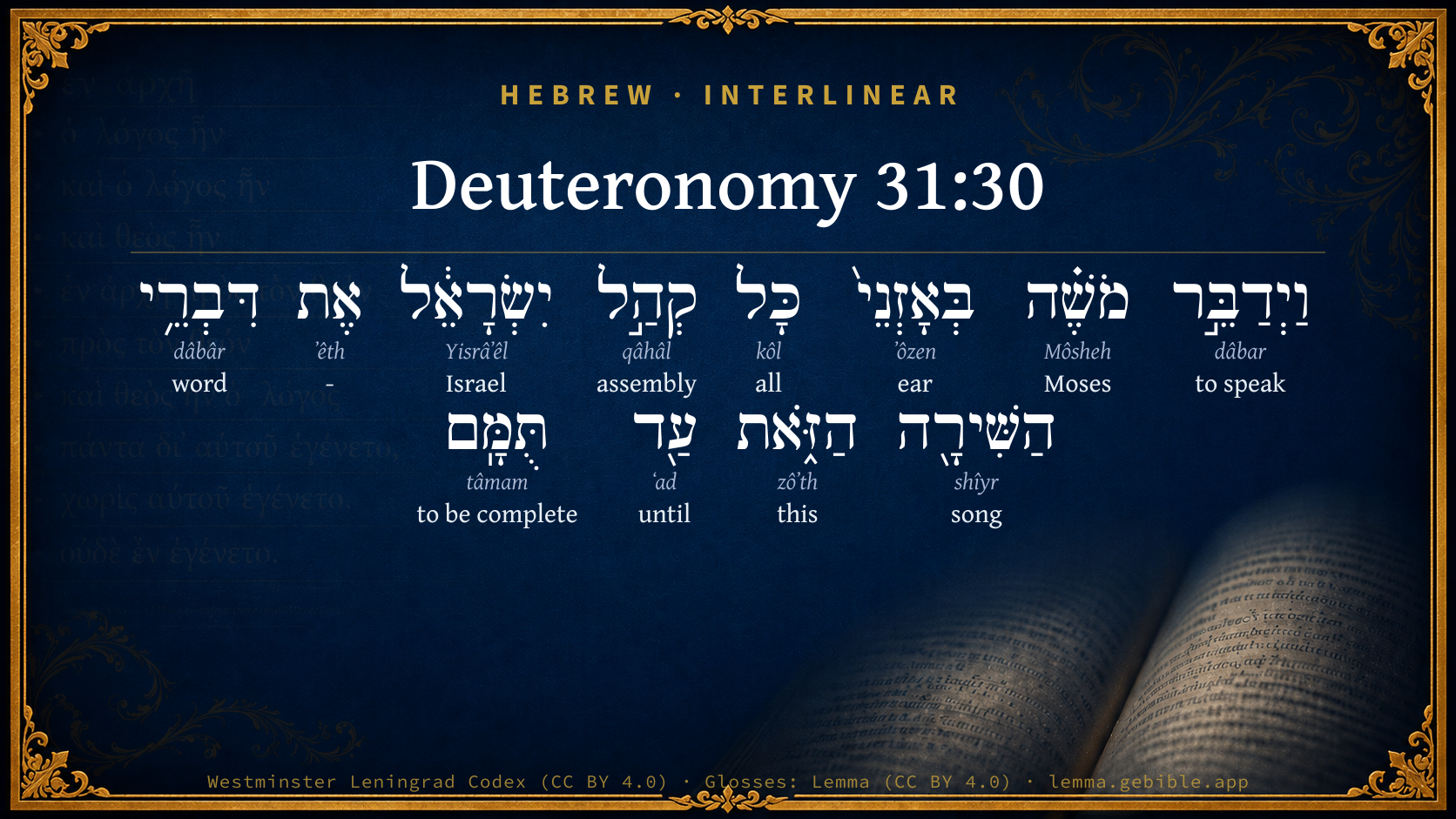
Hebrew (Westminster Leningrad Codex) Deuteronomy 31:30 appears in the Hebrew Old Testament. The text above is from the Westminster Leningrad Codex. Each word links to its Strong’s number, a concise gloss, and parsing drawn from the Open Scriptures Hebrew Bible morphology. Click any word for its full Brown-Driver-Briggs (BDB) entry.
Download image
Cite this verse

Deuteronomy 31:30 (World English Bible). Public Domain. Lemma interlinear Bible study tool, https://lemma.gebible.app/v/deuteronomy/31/30.

Show BibTeX & RIS
BibTeX
RIS
English Translation
Moses spoke in the ears of all the assembly of Israel the words of this song, until they were finished.
World English Bible · Public Domain
Download a study sheet

One document with this verse’s original text, its word-by-word gloss line, the meaning frame, cross-references with their text, attributed commentary, and full source and license credits — printable, and it pastes into notes with its structure intact.

This verse Autodidact and up

Study sheet (.html) Plain text (.txt)

A passage Seminary Student

Up to 50 verses in one chapter. A passage sheet keeps up to 6 commentary sources and 12 cross-references per verse, in the order this page ranks them, and says so on the sheet whenever that leaves anything out. Ask for a single verse and you get the Autodidact verse sheet above.

Everything on this page stays free to read, with no account — the sheet is a download of what is already on screen, not access to it.

Want to remove ads? Support Godless Engineer
Compare translations 3

The same verse in 3 English versions, stacked beneath the original-language interlinear above. Click any original word for its lexicon entry.

Each is an independent rendering of the whole verse — the interlinear is not word-aligned to these translations.

Highlighted words mark where these versions differ — a whole-verse word diff, not a word-by-word alignment.

  • World English Bible Public Domain
    Moses spoke in the ears of all the assembly of Israel the words of this song, until they were finished.
  • King James Version Public Domain
    And Moses spake in the ears of all the congregation of Israel the words of this song, until they were ended.
  • unfoldingWord Literal Text CC BY-SA 4.0
    And Moses spoke in the ears of all the assembly of Israel the words of this song until finished.

unfoldingWord Literal Text — © unfoldingWord, licensed CC BY-SA 4.0. Word-aligned USFM3 via Door43 (git.door43.org/unfoldingWord/en_ult).

Versions to compare (up to 4)

3 of 4 selected

Show all 18 translations

Every available English version of this verse, each an independent rendering of the whole verse.

  • World English Bible Public Domain
    Moses spoke in the ears of all the assembly of Israel the words of this song, until they were finished.
  • Berean Standard Bible Public Domain
    Then Moses recited aloud to the whole assembly of Israel the words of this song from beginning to end:
  • Majority Standard Bible Public Domain
    Then Moses recited aloud to the whole assembly of Israel the words of this song from beginning to end:
  • King James Version Public Domain
    And Moses spake in the ears of all the congregation of Israel the words of this song, until they were ended.
  • American Standard Version (1901) Public Domain
    And Moses spake in the ears of all the assembly of Israel the words of this song, until they were finished.
  • Revised Version (1885) Public Domain
    And Moses spake in the ears of all the assembly of Israel the words of this song, until they were finished.
  • Geneva Bible (1599) Public Domain
    Thus Moses spake in the audience of all the congregation of Israel the wordes of this song, vntill he had ended them.
  • Douay-Rheims (1899) Public Domain
    Moses therefore spoke, in the hearing of the whole assembly of Israel, the words of this canticle, and finished it even to the end,
  • Young's Literal Translation Public Domain
    And Moses speaketh in the ears of all the assembly of Israel the words of this song, till their completion: --
  • Literal Standard Version CC BY-SA 4.0
    And Moses speaks the words of this song in the ears of all the assembly of Israel, until their completion:
  • Unlocked Literal Bible CC BY-SA 4.0
    Moses recited in the ears of all the assembly of Israel the words of this song until they were finished.
  • unfoldingWord Literal Text CC BY-SA 4.0
    And Moses spoke in the ears of all the assembly of Israel the words of this song until finished.
  • Darby Bible Public Domain
    And Moses spoke in the ears of the whole congregation of Israel the words of this song, until their conclusion.
  • World Messianic Bible Public Domain
    Moses spoke in the ears of all the assembly of Israel the words of this song, until they were finished.
  • Webster's Bible Public Domain
    And Moses spoke in the ears of all the congregation of Israel the words of this song until they were ended.
  • Free Bible Version CC BY-SA 4.0
    Then Moses recited all the words of this song as the Israelites listened.
  • Bible in Basic English Public Domain
    Then in the hearing of all the meeting of Israel, Moses said the words of this song, to the end.
  • JPS Tanakh (1917) Public Domain
    And Moses spoke in the ears of all the assembly of Israel the words of this song, until they were finished:

Literal Standard Version (2020), Covenant Press — licensed CC BY-SA 4.0. Text via the HelloAO Bible API (eBible.org). Unlocked Literal Bible (unfoldingWord) — licensed CC BY-SA 4.0. Text via the HelloAO Bible API (eBible.org). unfoldingWord Literal Text — © unfoldingWord, licensed CC BY-SA 4.0. Word-aligned USFM3 via Door43 (git.door43.org/unfoldingWord/en_ult). Free Bible Version, Dr. Jonathan Gallagher — licensed CC BY-SA 4.0. Text via the HelloAO Bible API (eBible.org).

Word by word

More ways to search: Search by grammar → Find every occurrence → Compare this word →

Practice this passage: Drill this verse → Learn its vocabulary →

תֻּמָּֽם
tâmam
H8552
“to be complete · them”
Verb, Qal, Infinitive Construct + Suffix, Personal, 3rd Person, Masculine, Plural
Part of Speech
Verb
Stem
Qal
Form
Infinitive Construct
Full BDB Definition

Origin: a primitive root

TWOT: 2522

to be complete, be finished, be at an end - (Qal) - to be finished, be completed - completely, wholly, entirely (as auxiliary with verb) - to be finished, come to an end, cease - to be complete (of number) - to be consumed, be exhausted, be spent - to be finished, be consumed, be destroyed - to be complete, be sound, be unimpaired, be upright - to complete, finish - to be completely crossed over - (Niphal) to be consumed - (Hiphil) - to finish, complete, perfect - to finish, cease doing, leave off doing - to complete, sum up, make whole - to destroy (uncleanness) - to make sound - (Hithpael) to deal in integrity, act uprightly

  1. וַיְדַבֵּ֣ר dâbar H1696 “and · to speak” Conjunction + Verb, Piel, Sequential Imperfect, 3rd Person, Masculine, Singular
  2. מֹשֶׁ֗ה Môsheh H4872 “Moses” Noun, Proper
  3. בְּאָזְנֵי֙ ʼôzen H241 “in/at · ears of” Preposition + Noun, Common, Feminine, Dual, Construct
  4. כָּל kôl H3605 “all of” Noun, Common, Masculine, Singular, Construct
  5. קְהַ֣ל qâhâl H6951 “assembly of” Noun, Common, Masculine, Singular, Construct
  6. יִשְׂרָאֵ֔ל Yisrâʼêl H3478 “Israel” Noun, Proper
  7. אֶת ʼêth H853 “-” Particle, Direct Object
  8. דִּבְרֵ֥י dâbâr H1697 “words of” Noun, Common, Masculine, Plural, Construct
  9. הַשִּׁירָ֖ה shîyr H7892 “the · song” Particle, Definite Article + Noun, Common, Both, Singular, Absolute
  10. הַזֹּ֑את zôʼth H2063 “the · this” Particle, Definite Article + Pronoun, Demonstrative, Feminine, Singular
  11. עַ֖ד ʻad H5704 “until” Preposition

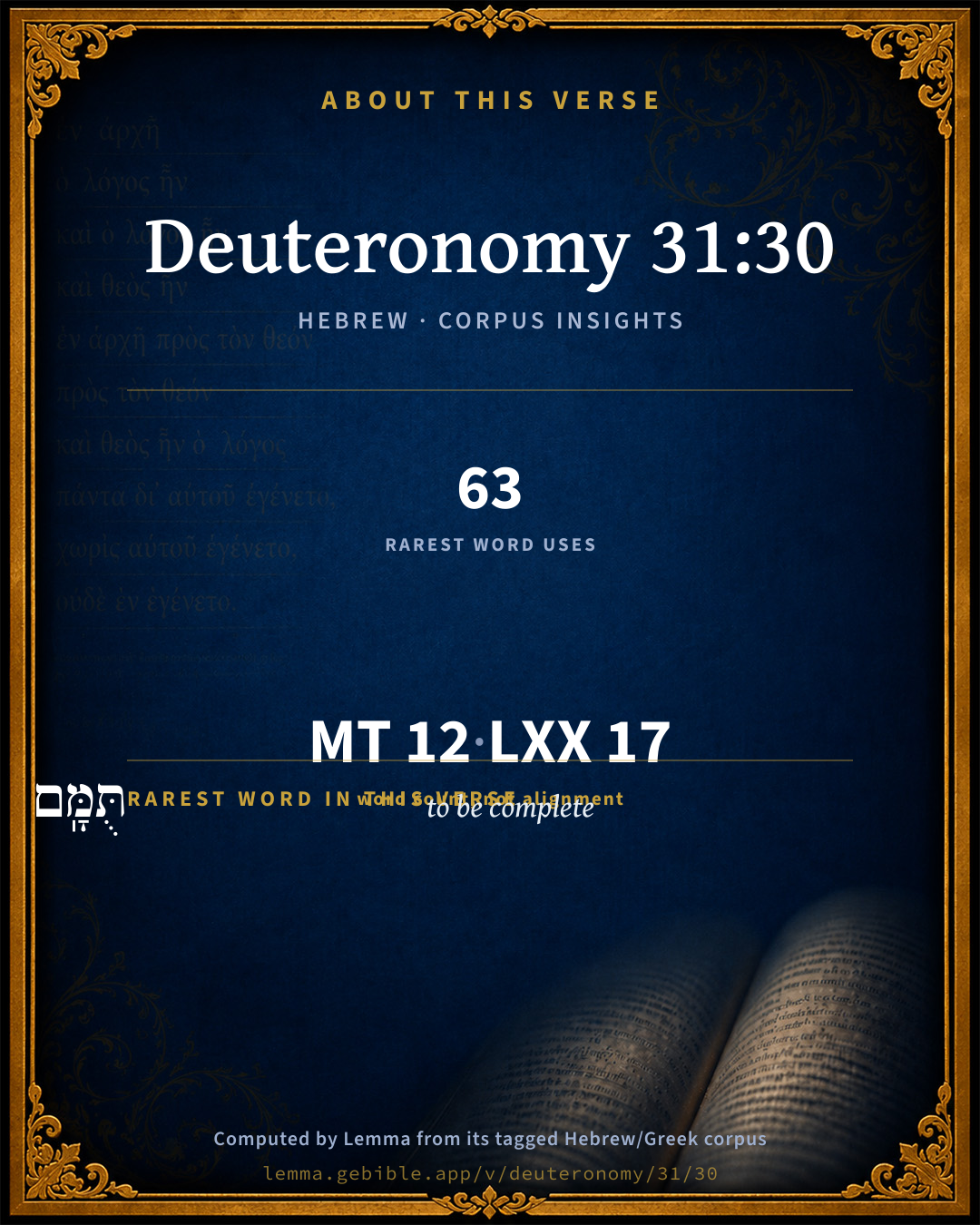
About this verse

These counts appear in no published source. They are computed here, from the morphology-tagged text and Lemma’s own curated glosses. What Lemma adds →

12
words
12
distinct lemmas
Pentateuch
section

Grammatical profile

  • 2 verbs
  • 7 nouns
  • 1 pronoun
  • 1 preposition
  • 1 particle

Verb forms

  • וַיְדַבֵּ֣ר Piel · Sequential Imperfect
  • תֻּמָּֽם Qal · Infinitive Construct

Hebrew & Septuagint length

In the original languages it is 12 Hebrew tokens and 17 Greek tokens — but the two are counted differently (Hebrew bundles its prefixes and suffixes into one token; the Greek is in lemma form), so that isn’t a like-for-like length.

Cross-references

5

Topical passages linked to Deuteronomy 31:30 in the Treasury of Scripture Knowledge — connected by theme and wording, ordered by reader-vote popularity; previews shown in the World English Bible.

  • Deuteronomy 4:5 Behold, I have taught you statutes and ordinances, even as Yahweh my God commanded me, that you should do so in the midst of the land where you go in to possess it.
  • John 12:49 For I spoke not from myself, but the Father who sent me, he gave me a commandment, what I should say, and what I should speak.
  • Hebrews 3:2 who was faithful to him who appointed him, as also was Moses in all his house.
  • Acts 20:27 for I didn't shrink from declaring to you the whole counsel of God.
  • Hebrews 3:5 Moses indeed was faithful in all his house as a servant, for a testimony of those things which were afterward to be spoken,

Cross-references courtesy of OpenBible.info (CC BY 4.0).

Hebrew and Greek witnesses Masoretic Hebrew ↔ Greek Septuagint

The same verse in the two great witnesses to the Old Testament, shown verse-for-verse.

These are two independent witnesses, not word-aligned to each other, and the Septuagint is shown in lemma (dictionary) form.

Hebrew Deuteronomy 31:30 Masoretic · Westminster Leningrad Codex

וַיְדַבֵּ֣ר מֹשֶׁ֗ה בְּאָזְנֵי֙ כָּל קְהַ֣ל יִשְׂרָאֵ֔ל אֶת דִּבְרֵ֥י הַשִּׁירָ֖ה הַזֹּ֑את עַ֖ד תֻּמָּֽם

Moses spoke in the ears of all the assembly of Israel the words of this song, until they were finished.

World English Bible · Public Domain

Greek LXX Deuteronomy 31:30 Septuagint · lemma form

καί λαλέω μωυσῆς εἰς ὁ οὖς πᾶς ἐκκλησία ἰσραήλ ὁ ῥῆμα ὁ ᾠδή οὗτος ἕως εἰς τέλος

No English rendering of this Greek verse — the small residue in the structurally divergent books.

Hebrew: Westminster Leningrad Codex (CC BY 4.0). Greek: Septuagint (public domain); English from a public-domain English Septuagint. How the Septuagint differs from the Hebrew →

Targum (Aramaic paraphrase)

2

The Targum is the ancient Jewish Aramaic paraphrase of the Hebrew Scriptures — an interpretive translation, not the Hebrew text itself. Onkelos (literal) and Pseudo-Jonathan (expansive) render the Torah, and Jonathan the Prophets. Coverage is partial: where no permissively-licensed English translation exists for a verse, only the Aramaic is shown. This is verse-level text, not a word-by-word alignment to the Hebrew.

  1. Targum Onkelos Torah (Genesis–Deuteronomy)
    וּמַלִיל מֹשֶׁה קֳדָם כָּל קְהָלָא דְיִשְׂרָאֵל יָת פִּתְגָמֵי תּוּשְׁבַּחְתָּא הָדָא עַד דִשְׁלִימוּ

    (no public-domain English translation for this verse)

    Targum Onkelos — Aramaic: “Onkelos Genesis” (public domain); “Onkelos Exodus” (public domain); “Onkelos Leviticus” (public domain); “Onkelos Numbers” (public domain); “Onkelos Deuteronomy” (public domain). English: “Sefaria Community Translation” (CC0 1.0 (public-domain dedication)); “J.W. Etheridge. The Targums of Onkelos and Jonathan Ben Uzziel on the Pentateuch. London: Longmans, Green, 1862” (public domain). Text via Sefaria.

  2. Targum Pseudo-Jonathan Torah (Genesis–Deuteronomy)
    וּמַלֵיל משֶׁה בְּמִשְׁמַע כָּל קְהָלָא דְיִשְרָאֵל יַת כָּל פִּתְגָמֵי שִׁבְחָא הָדָא עַד דִי שְׁלִימוּ

    And Mosheh spake in the hearing of all the congregation of Israel the words of this hymn until they were ended.

    Targum Pseudo-Jonathan — Aramaic: “Targum Jonathan on Genesis” (public domain); “Targum Jonathan on Exodus” (public domain); “Targum Jonathan on Leviticus” (public domain); “Targum Jonathan on Numbers” (public domain); “Targum Jonathan on Deuteronomy” (public domain). English: “The Targum of Jonathan ben Uzziel, trans. J. W. Etheridge, London, 1862” (public domain). Text via Sefaria.

Commentary

Notes on Deuteronomy 31:30 from classic Christian and Jewish commentators (each source and its license shown beneath its notes). The classic Christian expositions comment on the surrounding passage and are grouped to its opening verse, so a note may address several verses; the Jewish commentaries on the Tanakh (Rashi and others) are per-verse, so they appear only where the commentator wrote on this verse.

Lemma curates 59 commentaries, every one of them public domain or Creative Commons licensed, each selected and text-cleaned for this edition rather than reprinted as found. About our sources →

Keil & Delitzsch

C. F. Keil & F. Delitzsch

Deu 31:30 forms the introduction to the rehearsal of the ode.

Keil & Delitzsch — Biblical Commentary on the Old Testament (1861–1891) — public domain (CC PDM 1.0). Text via the HelloAO Bible API. (Old Testament only.)

Tyndale Open Study Notes

Tyndale Open Resources

31:30–32:47 In ancient times, the validity of a treaty arrangement between individuals or nations was secured by both parties’ vows. Israel’s promise was in the song of witness that Moses composed under divine inspiration (31:19-22). When Israel sang the song (presumably as part of a regular covenant-renewal ceremony; 31:21), they invoked upon themselves the covenant’s judgments and reminded themselves of its promises.

Tyndale Open Study Notes — © Tyndale Open Resources, licensed CC BY-SA 4.0. Text via the HelloAO Bible API.

Ellicott's Commentary for English Readers

(30) And Moses spake . . . the words of this song.—The exodus of Israel begins and ends with a song of Moses. The song of Exodus 15 is usually referred to as the “Song of Moses,” and is thought to be intended in Rev_15:3-4. But there is a remarkable resemblance between Rev_15:3 and Deu_32:3-4, which see.

A Bible Commentary for English Readers, edited by Charles John Ellicott (1878–1897) — public domain. Text from a community e-Sword module.

The Cambridge Bible for Schools and Colleges

gen. ed. J. J. S. Perowne

30. Editor’s Title to the Song

30. all the assembly of Israel] See on Deu_5:22.

the words … finished] See on Deu_31:24. This v. is no doubt from the hand of an editor; see below.

The Cambridge Bible for Schools and Colleges (gen. ed. J. J. S. Perowne; Cambridge University Press, 1878–1918) — public domain. Text from a community e-Sword module.

unfoldingWord translationNotes

Door43 World Missions Community

Moses recited in the ears of all the assembly of Israel

Here "ears" refers to the whole person. AT: "Moses recited to all the people of Israel" (See: Synecdoche)

recited

Possible meanings are 1) "sang" or 2) "spoke."

the words of this song

You can make clear the understood information. AT: "the words of the song that Yahweh taught him" (See: Ellipsis)

translationWords

Moses

assembly

Israel

word

unfoldingWord translationNotes — © Distant Shores Media and the Door43 World Missions Community, licensed CC BY-SA 4.0. Source: git.door43.org/Door43/en_tn.

Lesson kit

Teaching starters — assembled from the data on this page, not authored interpretation. Every prompt links to the verse data it draws on. Edit before teaching.

Deuteronomy, in the Pentateuch, opens this verse with 12 words (12 distinct Hebrew lemmas). Its most distinctive word is tâmam (“to be complete”). A historical commentator’s framing appears above. Read the whole chapter for the surrounding context.

Discussion questions

  1. How does “to be complete” (tâmam) shape what this verse is saying?
  2. Deuteronomy 4:5 shares this passage’s theme. How do the two illuminate each other?
  3. The translations on this page render this verse differently — a whole-verse word diff, not a word-by-word alignment. What might account for the different wordings?
  4. The verb «וַיְדַבֵּ֣ר» is Piel Sequential Imperfect. How does its form color the action?
  5. Reading how Keil & Delitzsch and Tyndale Open Study Notes read this verse, where do the two commentators agree and where do they part?

Things to notice

Reading settings

Reading text

Shown beneath each verse's original-language words.

Old Testament
Old Testament edition

Read the OT as the Masoretic Hebrew (MT) or the Greek Septuagint (LXX).

English shown for the Greek Septuagint (in the Hebrew ↔ Greek comparison).

Comparing translations? Open the Compare panel on any verse page to stack up to four side by side.