
Joshua 13:23

Hebrew (Westminster Leningrad Codex) Joshua 13:23 appears in the Hebrew Old Testament. The text above is from the Westminster Leningrad Codex. Each word links to its Strong’s number, a concise gloss, and parsing drawn from the Open Scriptures Hebrew Bible morphology. Click any word for its full Brown-Driver-Briggs (BDB) entry.
Download image
Cite this verse

Joshua 13:23 (World English Bible). Public Domain. Lemma interlinear Bible study tool, https://lemma.gebible.app/v/joshua/13/23.

Show BibTeX & RIS
BibTeX
RIS
English Translation
The border of the children of Reuben was the Jordan, and the border [of it]. This was the inheritance of the children of Reuben according to their families, the cities and the villages of it.
World English Bible · Public Domain
Download a study sheet

One document with this verse’s original text, its word-by-word gloss line, the meaning frame, cross-references with their text, attributed commentary, and full source and license credits — printable, and it pastes into notes with its structure intact.

This verse Autodidact and up

Study sheet (.html) Plain text (.txt)

A passage Seminary Student

Up to 50 verses in one chapter. A passage sheet keeps up to 6 commentary sources and 12 cross-references per verse, in the order this page ranks them, and says so on the sheet whenever that leaves anything out. Ask for a single verse and you get the Autodidact verse sheet above.

Everything on this page stays free to read, with no account — the sheet is a download of what is already on screen, not access to it.

Want to remove ads? Support Godless Engineer
Compare translations 3

The same verse in 3 English versions, stacked beneath the original-language interlinear above. Click any original word for its lexicon entry.

Each is an independent rendering of the whole verse — the interlinear is not word-aligned to these translations.

Highlighted words mark where these versions differ — a whole-verse word diff, not a word-by-word alignment.

  • World English Bible Public Domain
    The border of the children of Reuben was the Jordan, and the border [of it]. This was the inheritance of the children of Reuben according to their families, the cities and the villages of it.
  • King James Version Public Domain
    And the border of the children of Reuben was Jordan, and the border thereof. This was the inheritance of the children of Reuben after their families, the cities and the villages thereof.
  • unfoldingWord Literal Text CC BY-SA 4.0
    And the border of the sons of Reuben was the Jordan and its border. This the inheritance of the sons of Reuben according to their clans, the cities, and their villages.

unfoldingWord Literal Text — © unfoldingWord, licensed CC BY-SA 4.0. Word-aligned USFM3 via Door43 (git.door43.org/unfoldingWord/en_ult).

Versions to compare (up to 4)

3 of 4 selected

Show all 18 translations

Every available English version of this verse, each an independent rendering of the whole verse.

  • World English Bible Public Domain
    The border of the children of Reuben was the Jordan, and the border [of it]. This was the inheritance of the children of Reuben according to their families, the cities and the villages of it.
  • Berean Standard Bible Public Domain
    And the border of the Reubenites was the bank of the Jordan. This was the inheritance of the clans of the Reubenites, including the cities and villages.
  • Majority Standard Bible Public Domain
    And the border of the Reubenites was the bank of the Jordan. This was the inheritance of the clans of the Reubenites, including the cities and villages.
  • King James Version Public Domain
    And the border of the children of Reuben was Jordan, and the border thereof. This was the inheritance of the children of Reuben after their families, the cities and the villages thereof.
  • American Standard Version (1901) Public Domain
    And the border of the children of Reuben was the Jordan, and the border `thereof'. This was the inheritance of the children of Reuben according to their families, the cities and the villages thereof.
  • Revised Version (1885) Public Domain
    And the border of the children of Reuben was Jordan, and the border thereof. This was the inheritance of the children of Reuben according to their families, the cities and the villages thereof.
  • Geneva Bible (1599) Public Domain
    And the border of the children of Reuben was Iorden with the coastes. This was the inheritance of the children of Reuben according to their families, with the cities and their villages.
  • Douay-Rheims (1899) Public Domain
    And the river Jordan was the herder of the children of Ruben. This is the possession of the Rubenites, by their kindreds, of cities and villages.
  • Young's Literal Translation Public Domain
    And the border of the sons of Reuben is the Jordan, and `its' border; this `is' the inheritance of the sons of Reuben, for their families, the cities and their villages.
  • Literal Standard Version CC BY-SA 4.0
    And the border of the sons of Reuben is the Jordan, and [its] border; this [is] the inheritance of the sons of Reuben, for their families, the cities and their villages.
  • Unlocked Literal Bible CC BY-SA 4.0
    The border of the tribe of Reuben is the Jordan River; this is their boundary. This was the inheritance of the tribe of Reuben, given to each of their clans, with their cities and villages.
  • unfoldingWord Literal Text CC BY-SA 4.0
    And the border of the sons of Reuben was the Jordan and its border. This the inheritance of the sons of Reuben according to their clans, the cities, and their villages.
  • Darby Bible Public Domain
    And the border of the children of Reuben was the Jordan, and [its] border. This is the inheritance of the children of Reuben according to their families, the cities and their hamlets.
  • World Messianic Bible Public Domain
    The border of the children of Reuben was the bank of the Jordan. This was the inheritance of the children of Reuben according to their families, the cities and its villages.
  • Webster's Bible Public Domain
    And the border of the children of Reuben was Jordan, and its border. This was the inheritance of the children of Reuben after their families, the cities and their villages.
  • Free Bible Version CC BY-SA 4.0
    The Jordan was the boundary for the tribe of Reuben. This was the land, the towns and the villages, allotted to the tribe of Reuben, by families.
  • Bible in Basic English Public Domain
    And the limit of the children of Reuben was the edge of Jordan. This was the heritage of the children of Reuben by their families, with its towns and its unwalled places.
  • JPS Tanakh (1917) Public Domain
    And as for the border of the children of Reuben, the Jordan was their border. This was the inheritance of the children of Reuben according to their families, the cities and the villages thereof.

Literal Standard Version (2020), Covenant Press — licensed CC BY-SA 4.0. Text via the HelloAO Bible API (eBible.org). Unlocked Literal Bible (unfoldingWord) — licensed CC BY-SA 4.0. Text via the HelloAO Bible API (eBible.org). unfoldingWord Literal Text — © unfoldingWord, licensed CC BY-SA 4.0. Word-aligned USFM3 via Door43 (git.door43.org/unfoldingWord/en_ult). Free Bible Version, Dr. Jonathan Gallagher — licensed CC BY-SA 4.0. Text via the HelloAO Bible API (eBible.org).

Word by word

More ways to search: Search by grammar → Find every occurrence → Compare this word →

Practice this passage: Drill this verse → Learn its vocabulary →

רְאוּבֵ֔ן
Rᵉʼûwbên
H7205
“Reuben”
Noun, Proper
Part of Speech
Noun
Type
Proper
Full BDB Definition

Origin: from the imperative of H7200 and H1121

TWOT: None

Reuben = "behold a son" - the eldest son of Jacob by Leah - the tribe descended from Reuben - the territory inhabited by the tribe of Reuben
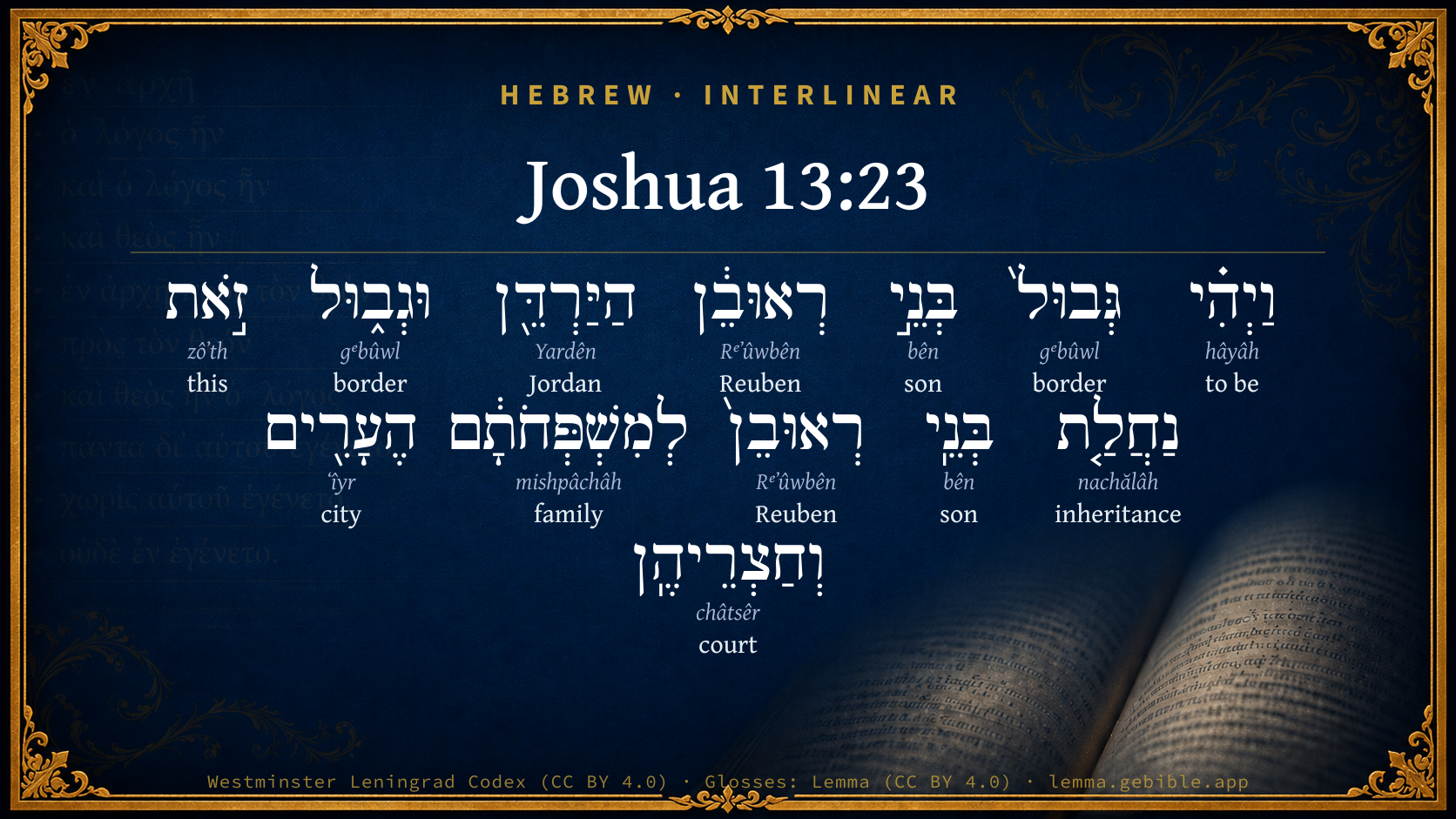
  1. וַיְהִ֗י hâyâh H1961 “and · to be” Conjunction + Verb, Qal, Sequential Imperfect, 3rd Person, Masculine, Singular
  2. גְּבוּל֙ gᵉbûwl H1366 “border of” Noun, Common, Masculine, Singular, Construct
  3. בְּנֵ֣י bên H1121 “sons of” Noun, Common, Masculine, Plural, Construct
  4. הַיַּרְדֵּ֖ן Yardên H3383 “the · Jordan” Particle, Definite Article + Noun, Proper
  5. וּגְב֑וּל gᵉbûwl H1366 “and · border” Conjunction + Noun, Common, Masculine, Singular, Absolute
  6. זֹ֣את zôʼth H2063 “this” Pronoun, Demonstrative, Feminine, Singular
  7. נַחֲלַ֤ת nachălâh H5159 “inheritance of” Noun, Common, Feminine, Singular, Construct
  8. בְּנֵֽי bên H1121 “sons of” Noun, Common, Masculine, Plural, Construct
  9. רְאוּבֵן֙ Rᵉʼûwbên H7205 “Reuben” Noun, Proper
  10. לְמִשְׁפְּחֹתָ֔ם mishpâchâh H4940 “to/for · families · their” Preposition + Noun, Common, Feminine, Plural, Construct + Suffix, Personal, 3rd Person, Masculine, Plural
  11. הֶעָרִ֖ים ʻîyr H5892 “the · cities” Particle, Definite Article + Noun, Common, Feminine, Plural, Absolute
  12. וְחַצְרֵיהֶֽן châtsêr H2691 “and · courts · their” Conjunction + Noun, Common, Both, Plural, Construct + Suffix, Personal, 3rd Person, Feminine, Plural

About this verse

These counts appear in no published source. They are computed here, from the morphology-tagged text and Lemma’s own curated glosses. What Lemma adds →

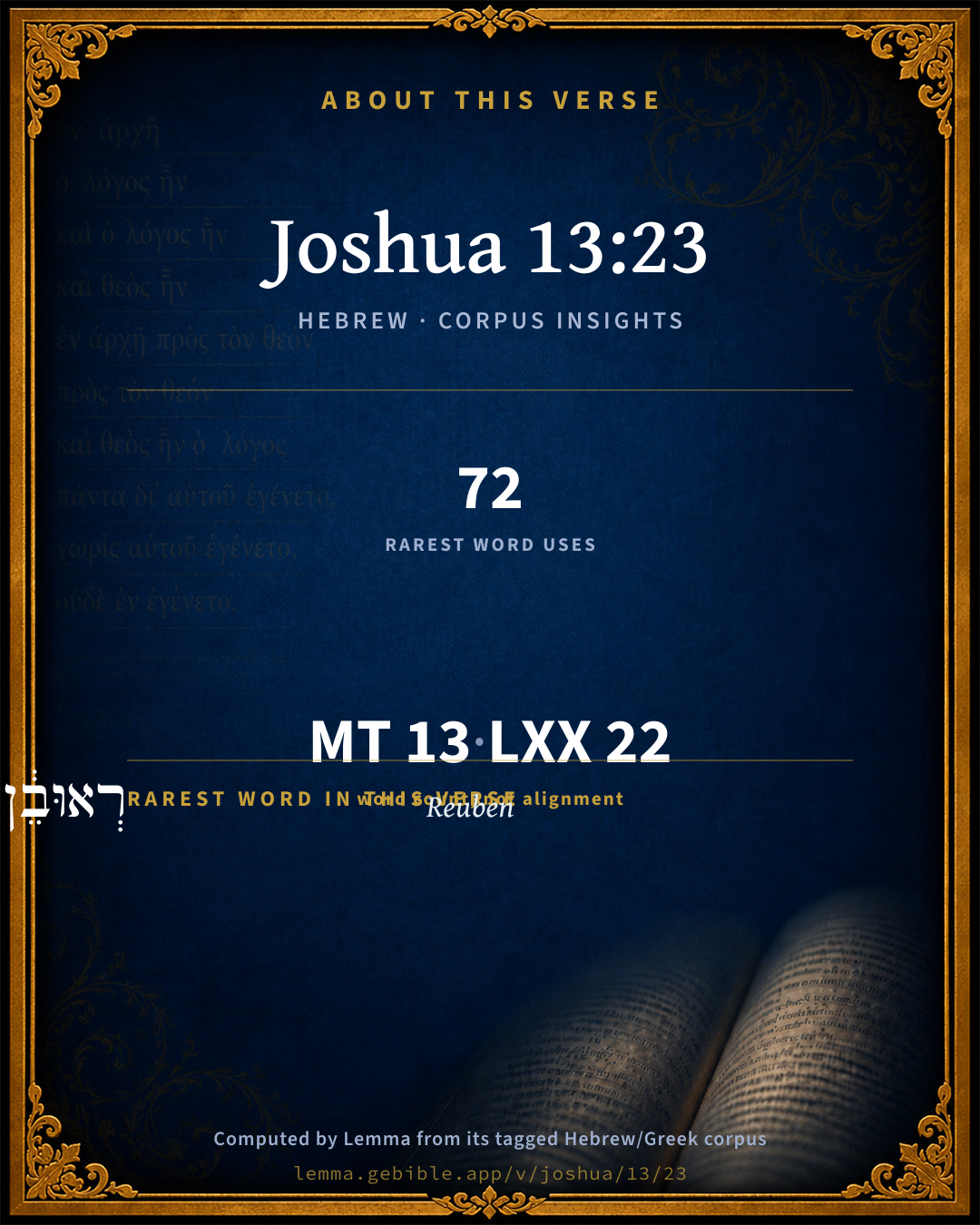
13
words
10
distinct lemmas
Historical
section

Grammatical profile

  • 1 verb
  • 11 nouns
  • 1 pronoun

Verb forms

  • וַיְהִ֗י Qal · Sequential Imperfect

Repetition

Words recur within this verse — often emphatic in Hebrew:

  • גְּבוּל֙ border H1366 ×2
  • בְּנֵ֣י son H1121 ×2
  • רְאוּבֵ֔ן Reuben H7205 ×2

Hebrew & Septuagint length

In English translation the verse runs 35 words from the Hebrew and 30 from the Septuagint (LXX English) — closely comparable.

A rough comparison of the two English renderings, which tokenize alike — not a word-level alignment.

Word counts can differ between the Hebrew and the Greek without any difference in meaning — e.g. the Hebrew direct-object marker אֵת has no separate Greek word, and Greek often adds the article ὁ.

In the original languages it is 13 Hebrew tokens and 22 Greek tokens — but the two are counted differently (Hebrew bundles its prefixes and suffixes into one token; the Greek is in lemma form), so that isn’t a like-for-like length.

Hebrew and Greek witnesses Masoretic Hebrew ↔ Greek Septuagint

The same verse in the two great witnesses to the Old Testament, shown verse-for-verse.

These are two independent witnesses, not word-aligned to each other, and the Septuagint is shown in lemma (dictionary) form.

Hebrew Joshua 13:23 Masoretic · Westminster Leningrad Codex

וַיְהִ֗י גְּבוּל֙ בְּנֵ֣י רְאוּבֵ֔ן הַיַּרְדֵּ֖ן וּגְב֑וּל זֹ֣את נַחֲלַ֤ת בְּנֵֽי רְאוּבֵן֙ לְמִשְׁפְּחֹתָ֔ם הֶעָרִ֖ים וְחַצְרֵיהֶֽן

The border of the children of Reuben was the Jordan, and the border [of it]. This was the inheritance of the children of Reuben according to their families, the cities and the villages of it.

World English Bible · Public Domain

Greek LXX Joshua 13:23 Septuagint · lemma form

γίγνομαι δέ ὁ ὅριον ρουβην ἰορδάνης ὅριον οὗτος ὁ κληρονομία υἱός ρουβην κατά δῆμος αὐτός ὁ πόλις αὐτός καί ὁ ἔπαυλις αὐτός

And the borders of Ruben were—even Jordan was the boundary; this is the inheritance of the children of Ruben according to their families, these were their cities and their villages.

LXX2012 (modern English Septuagint) · Public Domain

On this verse, The Pulpit Commentary discusses the Septuagint’s reading. Read the note in Commentary ↓

Hebrew: Westminster Leningrad Codex (CC BY 4.0). Greek: Septuagint (public domain); English from LXX2012 (modern English Septuagint) (Public Domain). How the Septuagint differs from the Hebrew →

Targum (Aramaic paraphrase)

1

The Targum is the ancient Jewish Aramaic paraphrase of the Hebrew Scriptures — an interpretive translation, not the Hebrew text itself. Onkelos (literal) and Pseudo-Jonathan (expansive) render the Torah, and Jonathan the Prophets. Coverage is partial: where no permissively-licensed English translation exists for a verse, only the Aramaic is shown. This is verse-level text, not a word-by-word alignment to the Hebrew.

  1. Targum Jonathan Prophets (Joshua–Malachi)
    וַהֲוָה תְּחוּם בְּנֵי רְאוּבֵן יַרְדְנָא וּתְחוּמֵיהּ דָא אַחֲסָנַת בְּנֵי רְאוּבֵן לְזַרְעֲיַתְהוֹן קִרְוַיָא וּפַצְחֵיהֶן:

    (no public-domain English translation for this verse)

    Targum Jonathan — Aramaic: “Mikraot Gedolot” (public domain). English: “Sefaria Community Translation” (CC0 1.0 (public-domain dedication)); “London "Chaldee Paraphrase," 1871” (public domain). Text via Sefaria.

Commentary

Notes on Joshua 13:23 from classic Christian and Jewish commentators (each source and its license shown beneath its notes). The classic Christian expositions comment on the surrounding passage and are grouped to its opening verse, so a note may address several verses; the Jewish commentaries on the Tanakh (Rashi and others) are per-verse, so they appear only where the commentator wrote on this verse.

Lemma curates 59 commentaries, every one of them public domain or Creative Commons licensed, each selected and text-cleaned for this edition rather than reprinted as found. About our sources →

Trapp's Complete Commentary

John Trapp

Jos 13:23 And the border of the children of Reuben was Jordan, and the border [thereof]. This [was] the inheritance of the children of Reuben after their families, the cities and the villages thereof.

Ver. 23. {See Trapp on "Jos 13:18"}

John Trapp, A Commentary or Exposition upon All the Books of the Old and New Testament (1647–1656) — public domain. Text from a community e-Sword module.

Adam Clarke's Commentary

Verse 23. The cities and the villages] By villages, חצרים chatserim, it is likely that moveable villages or tents are meant, such as are in use among the Bedouin Arabs; places where they were accustomed to feed and pen their cattle.

Adam Clarke's Commentary on the Bible (1810–1826) — public domain. Text from a community e-Sword/MySword module.

The Cambridge Bible for Schools and Colleges

gen. ed. J. J. S. Perowne

23. was Jordan] i.e. “the boundary of the children of Reuben was the Jordan and adjoining land.” Comp. Num_34:6; Deu_3:16-17.

the villages thereof] = “farm premises,” not enclosed, like a city, with walls. Thus the boundaries of the tribe of Reuben were, (a) On the West, the Dead Sea; (b) on the South, the country of Moab; (c) on the East, the kingdom of Ammon; (d) on the North, the Arnon, or the Wady Mojeb. Here the tribe settled, “preferring pasturage to agriculture.” His subsequent history fulfils the prophecy of Jacob. “Unstable (or swelling) as water” (Gen_49:4), he vanishes away into a mere Arabian tribe; “his men are few” (Deu_33:6); it is all he can do “to live and not die.” The only events of the subsequent history of the tribe are (a) the multiplication of “their cattle in the land of Gilead;” (b) their wars with the Bedouin “sons of Hagar” (1Ch_5:10); (c) their spoils “of camels fifty thousand, and of sheep two hundred and fifty thousand, and of asses two thousand” (1Ch_5:21). In the chief struggle of the nation Reuben never took part. No judge, no prophet, no hero of the tribe is handed down to us. See Stanley’s Lectures, 1. 218.

The Cambridge Bible for Schools and Colleges (gen. ed. J. J. S. Perowne; Cambridge University Press, 1878–1918) — public domain. Text from a community e-Sword module.

John Gill's Exposition

And Moses gave inheritance unto the tribe of Gad,.... On the other side Jordan, as he did to Reuben:

even unto the children of Gad, according to their families: according to the number and largeness of them, dividing to each their part and portion.

John Gill's Exposition of the Whole Bible (1746–1763) — public domain (CC PDM 1.0). Text via the HelloAO Bible API.

Matthew Poole's English Annotations

And the border thereof, i.e. those cities or places which bordered upon Jordan. Compare Num 34:6.

Matthew Poole's English Annotations on the Holy Bible (1683–1685) — public domain. Text from a community e-Sword/MySword module.

Whedon's Commentary on the Bible

Daniel D. Whedon

23. This was the inheritance of… Reuben — The tribe of Reuben never did excel. Compare Gen_49:4. They were never noted for mighty deeds, and their indifference in the war with Sisera, when the mighty ones went up to battle and they “abode among the sheepfolds to hear the bleatings of the flocks,” is properly satirized in the song of Deborah.

Jdg_5:16, note. Their territory was overrun by the army of Tiglath-pileser, and they were carried away captive into upper Mesopotamia. 1Ch_5:26. Then their depopulated cities and country were repossessed by their ancient owners, the Moabites, and hence it is that we find so many cities of Reuben afterwards in possession of the Moabites.

Daniel D. Whedon (gen. ed.), Commentary on the Old and New Testaments (1874–1909) — public domain. Text from a community e-Sword module.

The Pulpit Commentary

And the border thereof. These words have been omitted in the Vulgate, which does not understand them. The LXX translates, "And the borders of Reuben were the Jordan-border." This seems to be the meaning of the original. The phrase often occurs, as in Jos_15:12 Num_34:6. Knobel"s explanation is probably the correct one, that the phrase means to refer to the natural boundary marked out by the river or sea and its banks. "The boundary of the children of Reuben was Jordan and the natural boundary thus formed." As Dean Stanley reminds us in his "Lectures on the Jewish Church," Reuben, as predicted by Jacob and, (Gen_49:4) sank at once into insignificance. No ruler, no judge arose from this tribe and its territory. Villages. Hebrew yrexj, LXX epauleiv , Vulgate viculi. The original meaning is a piece of ground enclosed by a hedge or wall. Here it would mean, either with Gesenins and Keil, farm hamlets , or perhaps clearings of cultivated ground, which in Palestine would naturally be enclosed in some way, to prevent the ravages of wild beasts. In the primitive villages of Servia, where wild beasts are not entirely extirpated, not only are all the homesteads enclosed, but a fence is placed across the road, and removed when a vehicle has to pass through.

Or perhaps the primitive Jewish community was similar to the primitive Teutonic community as described by Marshall in his "Elementary and Practical Treatise on Landed Property," published in 1804, who described the early distribution of land in this country as follows: "Round the village lay a few small enclosures for rearing young stock. Further a field the best land for arable purposes was chosen, and divided into three parts, for the necessary, rotation of fallow, wheat or rye, and spring crops. The meadows near the water courses were set aside for the growth of fodder for the cattle or for pasturage for milch cows, etc. The irreclaimable lands were left for what we now call "common" uses for fuel, and the inferior pasturage." These arrangements are found to exist in India. (see Sir H. Maine, "Village Communities," sec. 4). But there, as in Palestine, the necessity for water was the cause of important modifications. Since the word is used to denote the court

(1) of a prison, Jer_32:2;

(2) of a palace, 1Ki_7:8;

(3) of a private house, 2Sa_17:18;

(4) of the temple in numberless places,

and as it is used of the enclosure of a nomadic camp, (Gen_25:16, where our version has towns; perhaps Deu_2:23, where our version has Hazerim, following the LXX which, however, alters the word to the more usual Hazeroth and the Vulgate; Isa_42:11, with which compare the expression tents of Kedar, Psa_120:5) the translation villages can hardly be the correct one here or elsewhere (see also ver. 28).

The Pulpit Commentary (1880–1919), ed. H.D.M. Spence-Jones & Joseph S. Exell — public domain. Text from a community e-Sword module.

John Wesley's Explanatory Notes

The border thereof - That is, those cities or places which bordered upon Jordan.

John Wesley, Explanatory Notes Upon the Whole Bible (1754–1765) — public domain. Text via the GEBible commentary corpus.

Keil & Delitzsch

C. F. Keil & F. Delitzsch

"And (this) was the boundary of the sons of Reuben, the Jordan and its territory," i.e., the Jordan, or rather land adjoining it. The meaning is, that the territory of Reuben, viz., with the places mentioned last (Jos 13:20), reached to the territory of the Jordan; for so far as the principal part was concerned, it was on the east of the Dead Sea, as it only reached from the Arnon to Heshbon, i.e., up to the latitude of the northern extremity of the Dead Sea. "The towns and their villages." חצר, farm premises, used, as in Lev 25:31, to denote places not enclosed by a wall.

Keil & Delitzsch — Biblical Commentary on the Old Testament (1861–1891) — public domain (CC PDM 1.0). Text via the HelloAO Bible API. (Old Testament only.)

Lesson kit

Teaching starters — assembled from the data on this page, not authored interpretation. Every prompt links to the verse data it draws on. Edit before teaching.

Joshua, in the Historical, opens this verse with 13 words (10 distinct Hebrew lemmas). Its most distinctive word is Rᵉʼûwbên (“Reuben”). A historical commentator’s framing appears above. Read the whole chapter for the surrounding context.

Discussion questions

  1. How does “Reuben” (Rᵉʼûwbên) shape what this verse is saying?
  2. What does the repetition of “border” (2× in this one verse) do in this verse?
  3. The translations on this page render this verse differently — a whole-verse word diff, not a word-by-word alignment. What might account for the different wordings?
  4. «וַיְהִ֗י» is a Qal Sequential Imperfect verb. How does that grammatical form shape the action described?
  5. Compare how Trapp's Complete Commentary and Adam Clarke's Commentary read this verse. Where do they agree or differ?

Things to notice

Reading settings

Reading text

Shown beneath each verse's original-language words.

Old Testament
Old Testament edition

Read the OT as the Masoretic Hebrew (MT) or the Greek Septuagint (LXX).

English shown for the Greek Septuagint (in the Hebrew ↔ Greek comparison).

Comparing translations? Open the Compare panel on any verse page to stack up to four side by side.