
Deuteronomy 28:58

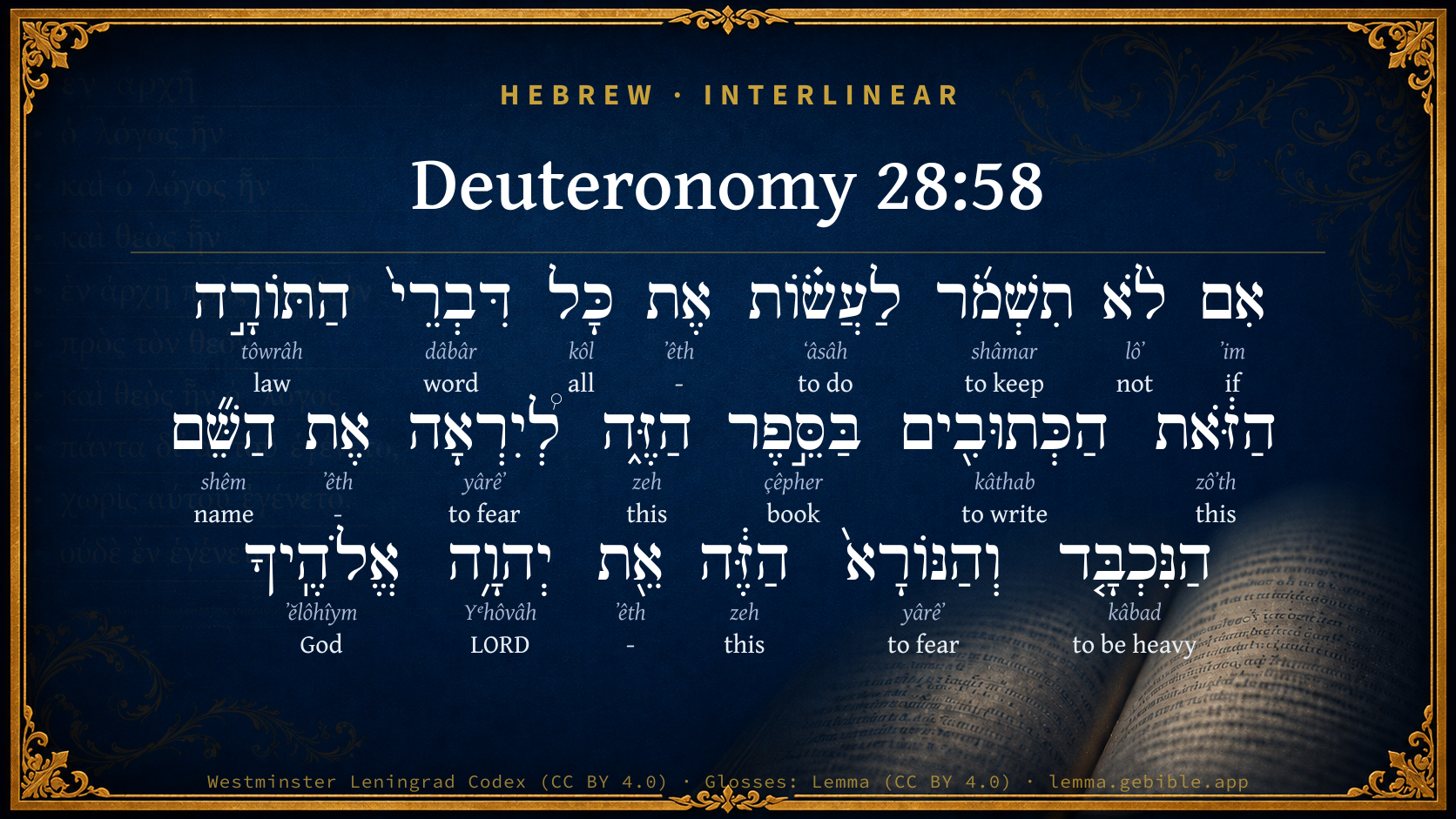
Hebrew (Westminster Leningrad Codex) Deuteronomy 28:58 appears in the Hebrew Old Testament. The text above is from the Westminster Leningrad Codex. Each word links to its Strong’s number, a concise gloss, and parsing drawn from the Open Scriptures Hebrew Bible morphology. Click any word for its full Brown-Driver-Briggs (BDB) entry.
Download image
Cite this verse

Deuteronomy 28:58 (World English Bible). Public Domain. Lemma interlinear Bible study tool, https://lemma.gebible.app/v/deuteronomy/28/58.

Show BibTeX & RIS
BibTeX
RIS
English Translation
If you will not observe to do all the words of this law that are written in this book, that you may fear this glorious and fearful name, YAHWEH YOUR GOD;
World English Bible · Public Domain
Download a study sheet

One document with this verse’s original text, its word-by-word gloss line, the meaning frame, cross-references with their text, attributed commentary, and full source and license credits — printable, and it pastes into notes with its structure intact.

This verse Autodidact and up

Study sheet (.html) Plain text (.txt)

A passage Seminary Student

Up to 50 verses in one chapter. A passage sheet keeps up to 6 commentary sources and 12 cross-references per verse, in the order this page ranks them, and says so on the sheet whenever that leaves anything out. Ask for a single verse and you get the Autodidact verse sheet above.

Everything on this page stays free to read, with no account — the sheet is a download of what is already on screen, not access to it.

Want to remove ads? Support Godless Engineer
Compare translations 3

The same verse in 3 English versions, stacked beneath the original-language interlinear above. Click any original word for its lexicon entry.

Each is an independent rendering of the whole verse — the interlinear is not word-aligned to these translations.

Highlighted words mark where these versions differ — a whole-verse word diff, not a word-by-word alignment.

  • World English Bible Public Domain
    If you will not observe to do all the words of this law that are written in this book, that you may fear this glorious and fearful name, YAHWEH YOUR GOD;
  • King James Version Public Domain
    If thou wilt not observe to do all the words of this law that are written in this book, that thou mayest fear this glorious and fearful name, THE LORD THY GOD;
  • unfoldingWord Literal Text CC BY-SA 4.0
    If you do not keep doing all the words of this law that are written in this book, to fear this glorious and feared name, Yahweh your God,

unfoldingWord Literal Text — © unfoldingWord, licensed CC BY-SA 4.0. Word-aligned USFM3 via Door43 (git.door43.org/unfoldingWord/en_ult).

Versions to compare (up to 4)

3 of 4 selected

Show all 18 translations

Every available English version of this verse, each an independent rendering of the whole verse.

  • World English Bible Public Domain
    If you will not observe to do all the words of this law that are written in this book, that you may fear this glorious and fearful name, YAHWEH YOUR GOD;
  • Berean Standard Bible Public Domain
    If you are not careful to observe all the words of this law which are written in this book, that you may fear this glorious and awesome name—the LORD your God—
  • Majority Standard Bible Public Domain
    If you are not careful to observe all the words of this law which are written in this book, that you may fear this glorious and awesome name—the LORD your God—
  • King James Version Public Domain
    If thou wilt not observe to do all the words of this law that are written in this book, that thou mayest fear this glorious and fearful name, THE LORD THY GOD;
  • American Standard Version (1901) Public Domain
    If thou wilt not observe to do all the words of this law that are written in this book, that thou mayest fear this glorious and fearful name, JEHOVAH THY GOD;
  • Revised Version (1885) Public Domain
    If thou wilt not observe to do all the words of this law that are written in this book, that thou mayest fear this glorious and fearful name, THE LORD THY GOD;
  • Geneva Bible (1599) Public Domain
    If thou wilt not keepe and doe all the wordes of the Lawe (that are written in this booke) and feare this glorious and feareful name The Lord Thy God,
  • Douay-Rheims (1899) Public Domain
    If thou wilt not keep, and fulfil all the words of this law, that are written in this volume, and fear his glorious and terrible name: that is, The Lord thy God:
  • Young's Literal Translation Public Domain
    `If thou dost not observe to do all the words of this law which are written in this book, to fear this honoured and fearful name -- Jehovah thy God --
  • Literal Standard Version CC BY-SA 4.0
    If you do not observe to do all the words of this law which are written in this scroll, to fear this honored and fearful Name—your God YHWH—
  • Unlocked Literal Bible CC BY-SA 4.0
    If you do not keep all the words of this law that are written in this book, so as to honor this glorious and fearful name, Yahweh your God,
  • unfoldingWord Literal Text CC BY-SA 4.0
    If you do not keep doing all the words of this law that are written in this book, to fear this glorious and feared name, Yahweh your God,
  • Darby Bible Public Domain
    If thou wilt not take heed to do all the words of this law that are written in this book, to fear this glorious and fearful name, JEHOVAH THY GOD;
  • World Messianic Bible Public Domain
    If you will not observe to do all the words of this law that are written in this book, that you may fear this glorious and fearful name, THE LORD your God,
  • Webster's Bible Public Domain
    If thou wilt not observe to do all the words of this law that are written in this book, that thou mayest fear this glorious and fearful name, THE LORD THY GOD;
  • Free Bible Version CC BY-SA 4.0
    If you don't carefully observe all these laws written down in this book so that you may show respect for this glorious and awesome Lord your God,
  • Bible in Basic English Public Domain
    If you will not take care to do all the words of this law, recorded in this book, honouring that name of glory and of fear, THE LORD YOUR GOD;
  • JPS Tanakh (1917) Public Domain
    If thou wilt not observe to do all the words of this law that are written in this book, that thou mayest fear this glorious and awful Name, the LORD thy God;

Literal Standard Version (2020), Covenant Press — licensed CC BY-SA 4.0. Text via the HelloAO Bible API (eBible.org). Unlocked Literal Bible (unfoldingWord) — licensed CC BY-SA 4.0. Text via the HelloAO Bible API (eBible.org). unfoldingWord Literal Text — © unfoldingWord, licensed CC BY-SA 4.0. Word-aligned USFM3 via Door43 (git.door43.org/unfoldingWord/en_ult). Free Bible Version, Dr. Jonathan Gallagher — licensed CC BY-SA 4.0. Text via the HelloAO Bible API (eBible.org).

Word by word

More ways to search: Search by grammar → Find every occurrence → Compare this word →

Practice this passage: Drill this verse → Learn its vocabulary →

הַנִּכְבָּ֤ד
kâbad
H3513
“the · being heavy”
Particle, Definite Article + Verb, Niphal, Participle Active, Masculine, Singular, Absolute
Part of Speech
Particle + Verb
Stem
Niphal
Form
Participle Active
Gender
Masculine
Number
Singular
State
Absolute
Full BDB Definition

Origin: a primitive root

TWOT: 943

to be heavy, be weighty, be grievous, be hard, be rich, be honourable, be glorious, be burdensome, be honoured - (Qal) - to be heavy - to be heavy, be insensible, be dull - to be honoured - (Niphal) - to be made heavy, be honoured, enjoy honour, be made abundant - to get oneself glory or honour, gain glory - (Piel) - to make heavy, make dull, make insensible - to make honourable, honour, glorify - (Pual) to be made honourable, be honoured - (Hiphil) - to make heavy - to make heavy, make dull, make unresponsive - to cause to be honoured - (Hithpael) - to make oneself heavy, make oneself dense, make oneself numerous - to honour oneself
  1. אִם ʼim H518 “if” Conjunction
  2. לֹ֨א lôʼ H3808 “not” Particle, Negative
  3. תִשְׁמֹ֜ר shâmar H8104 “to keep” Verb, Qal, Imperfect, 2nd Person, Masculine, Singular
  4. לַעֲשׂ֗וֹת ʻâsâh H6213 “to do” Preposition + Verb, Qal, Infinitive Construct
  5. אֶת ʼêth H853 “-” Particle, Direct Object
  6. כָּל kôl H3605 “all of” Noun, Common, Masculine, Singular, Construct
  7. דִּבְרֵי֙ dâbâr H1697 “words of” Noun, Common, Masculine, Plural, Construct
  8. הַתּוֹרָ֣ה tôwrâh H8451 “the · law” Particle, Definite Article + Noun, Common, Feminine, Singular, Absolute
  9. הַזֹּ֔את zôʼth H2063 “the · this” Particle, Definite Article + Pronoun, Demonstrative, Feminine, Singular
  10. הַכְּתוּבִ֖ים kâthab H3789 “the · written” Particle, Definite Article + Verb, Qal, Participle Passive, Masculine, Plural, Absolute
  11. בַּסֵּ֣פֶר çêpher H5612 “in/at the · book” Preposition, Determined + Noun, Common, Masculine, Singular, Absolute
  12. הַזֶּ֑ה zeh H2088 “the · this” Particle, Definite Article + Pronoun, Demonstrative, Masculine, Singular
  13. לְ֠יִרְאָה yârêʼ H3372 “to fear” Preposition + Verb, Qal, Infinitive Construct
  14. אֶת ʼêth H853 “-” Particle, Direct Object
  15. הַשֵּׁ֞ם shêm H8034 “the · name” Particle, Definite Article + Noun, Common, Masculine, Singular, Absolute
  16. וְהַנּוֹרָא֙ yârêʼ H3372 “and · the · fearing” Conjunction + Particle, Definite Article + Verb, Niphal, Participle Active, Masculine, Singular, Absolute
  17. הַזֶּ֔ה zeh H2088 “the · this” Particle, Definite Article + Pronoun, Demonstrative, Masculine, Singular
  18. אֵ֖ת ʼêth H853 “-” Particle, Direct Object
  19. יְהוָ֥ה Yᵉhôvâh H3068 “LORD” Noun, Proper
  20. אֱלֹהֶֽיךָ ʼĕlôhîym H430 “God(s) · your” Noun, Common, Masculine, Plural, Construct + Suffix, Personal, 2nd Person, Masculine, Singular

About this verse

These counts appear in no published source. They are computed here, from the morphology-tagged text and Lemma’s own curated glosses. What Lemma adds →

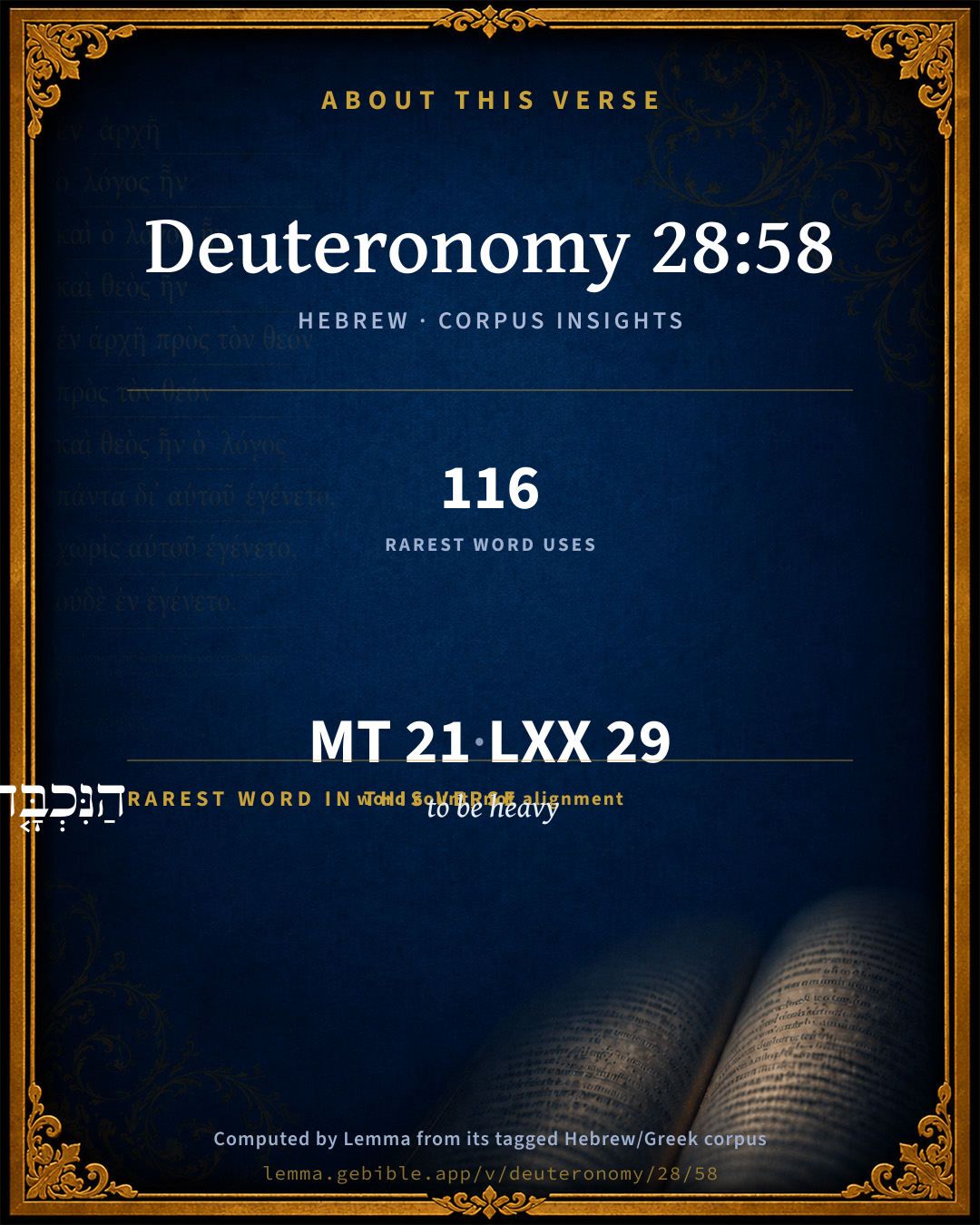
21
words
17
distinct lemmas
Pentateuch
section

Grammatical profile

  • 6 verbs
  • 7 nouns
  • 3 pronouns
  • 1 conjunction
  • 4 particles

Verb forms

  • תִשְׁמֹ֜ר Qal · Imperfect
  • לַעֲשׂ֗וֹת Qal · Infinitive Construct
  • הַכְּתוּבִ֖ים Qal · Participle Passive
  • לְ֠יִרְאָה Qal · Infinitive Construct
  • הַנִּכְבָּ֤ד Niphal · Participle Active
  • וְהַנּוֹרָא֙ Niphal · Participle Active

Repetition

Words recur within this verse — often emphatic in Hebrew:

  • לְ֠יִרְאָה to fear H3372 ×2
  • הַזֶּ֑ה this H2088 ×2

Hebrew & Septuagint length

In English translation the verse runs 31 words from the Hebrew and 31 from the Septuagint (LXX English) — the same length.

A rough comparison of the two English renderings, which tokenize alike — not a word-level alignment.

Word counts can differ between the Hebrew and the Greek without any difference in meaning — e.g. the Hebrew direct-object marker אֵת has no separate Greek word, and Greek often adds the article ὁ.

In the original languages it is 21 Hebrew tokens and 29 Greek tokens — but the two are counted differently (Hebrew bundles its prefixes and suffixes into one token; the Greek is in lemma form), so that isn’t a like-for-like length.

Cross-references

20

Topical passages linked to Deuteronomy 28:58 in the Treasury of Scripture Knowledge — connected by theme and wording, ordered by reader-vote popularity; previews shown in the World English Bible.

  • Isaiah 42:8 I am Yahweh, that is my name; and my glory will I not give to another, neither my praise to engraved images.
  • Exodus 3:14–15 God said to Moses, "I AM WHO I AM," and he said, "You shall tell the children of Israel this: "I AM has sent me to you."
  • Exodus 6:2–3 God spoke to Moses, and said to him, "I am Yahweh;
  • Exodus 20:2 "I am Yahweh your God, who brought you out of the land of Egypt, out of the house of bondage.
  • Exodus 34:5–7 Yahweh descended in the cloud, and stood with him there, and proclaimed the name of Yahweh.
  • Leviticus 26:14–15 "'But if you will not listen to me, and will not do all these commandments;
  • Deuteronomy 6:13 You shall fear Yahweh your God; and him shall you serve, and shall swear by his name.
  • Deuteronomy 28:15 But it shall come to pass, if you will not listen to the voice of Yahweh your God, to observe to do all his commandments and his statutes which I command you this day, that all these curses shall come on you, and overtake you.
  • Nehemiah 9:5 Then the Levites, Jeshua, and Kadmiel, Bani, Hashabneiah, Sherebiah, Hodiah, Shebaniah, [and] Pethahiah, said, Stand up and bless Yahweh your God from everlasting to everlasting; and blessed be your glorious name, which is exalted above all blessing and praise.
  • Psalms 50:7 "Hear, my people, and I will speak; Israel, and I will testify against you. I am God, your God.
  • Psalms 72:19 Blessed be his glorious name forever! Let the whole earth be filled with his glory! Amen and amen.
  • Psalms 83:18 That they may know that you alone, whose name is Yahweh, Are the Most High over all the earth.
  • Isaiah 41:10 Don't you be afraid, for I am with you; don't be dismayed, for I am your God; I will strengthen you; yes, I will help you; yes, I will uphold you with the right hand of my righteousness.
  • Jeremiah 5:12 They have denied Yahweh, and said, It is not he; neither shall evil come on us; neither shall we see sword nor famine:
  • Jeremiah 7:9–10 Will you steal, murder, and commit adultery, and swear falsely, and burn incense to Baal, and walk after other gods that you have not known,
  • Jeremiah 7:26–28 yet they didn't listen to me, nor inclined their ear, but made their neck stiff: they did worse than their fathers.
  • Malachi 1:14 "But the deceiver is cursed, who has in his flock a male, and vows, and sacrifices to the Lord a blemished thing; for I am a great King," says Yahweh of hosts, "and my name is awesome among the nations."
  • Matthew 10:28 Don't be afraid of those who kill the body, but are not able to kill the soul. Rather, fear him who is able to destroy both soul and body in Gehenna.
  • Hebrews 10:30–31 For we know him who said, "Vengeance belongs to me," says the Lord, "I will repay." Again, "The Lord will judge his people."
  • Hebrews 12:28–29 Therefore, receiving a Kingdom that can't be shaken, let us have grace, through which we serve God acceptably, with reverence and awe,

Cross-references courtesy of OpenBible.info (CC BY 4.0).

Hebrew and Greek witnesses Masoretic Hebrew ↔ Greek Septuagint

The same verse in the two great witnesses to the Old Testament, shown verse-for-verse.

These are two independent witnesses, not word-aligned to each other, and the Septuagint is shown in lemma (dictionary) form.

Hebrew Deuteronomy 28:58 Masoretic · Westminster Leningrad Codex

אִם לֹ֨א תִשְׁמֹ֜ר לַעֲשׂ֗וֹת אֶת כָּל דִּבְרֵי֙ הַתּוֹרָ֣ה הַזֹּ֔את הַכְּתוּבִ֖ים בַּסֵּ֣פֶר הַזֶּ֑ה לְ֠יִרְאָה אֶת הַשֵּׁ֞ם הַנִּכְבָּ֤ד וְהַנּוֹרָא֙ הַזֶּ֔ה אֵ֖ת יְהוָ֥ה אֱלֹהֶֽיךָ

If you will not observe to do all the words of this law that are written in this book, that you may fear this glorious and fearful name, YAHWEH YOUR GOD;

World English Bible · Public Domain

Greek LXX Deuteronomy 28:58 Septuagint · lemma form

ἐάν μή εἰςἀκούω ποιέω πᾶς ὁ ῥῆμα ὁ νόμος οὗτος ὁ γράφω ἐν ὁ βιβλίον οὗτος φοβέω ὁ ὄνομα ὁ ἔντιμος καί ὁ θαυμαστός οὗτος κύριος ὁ θεός σύ

If you will not listen to do all the words of this law, which have been written in this book, to fear this glorious and wonderful name, the Lord your God;

LXX2012 (modern English Septuagint) · Public Domain

Hebrew: Westminster Leningrad Codex (CC BY 4.0). Greek: Septuagint (public domain); English from LXX2012 (modern English Septuagint) (Public Domain). How the Septuagint differs from the Hebrew →

Targum (Aramaic paraphrase)

2

The Targum is the ancient Jewish Aramaic paraphrase of the Hebrew Scriptures — an interpretive translation, not the Hebrew text itself. Onkelos (literal) and Pseudo-Jonathan (expansive) render the Torah, and Jonathan the Prophets. Coverage is partial: where no permissively-licensed English translation exists for a verse, only the Aramaic is shown. This is verse-level text, not a word-by-word alignment to the Hebrew.

  1. Targum Onkelos Torah (Genesis–Deuteronomy)
    אִם לָא תִטַר לְּמֶעְבַּד יָת כָּל פִּתְגָמֵי אוֹרַיְתָא הָדָא דִכְתִיבִין בְּסִפְרָא הָדֵין לְמִדְחַל יָת שְׁמָא יַקִירָא וּדְחִילָא הָדֵין יָת יְיָ אֱלָהָךְ

    (no public-domain English translation for this verse)

    Targum Onkelos — Aramaic: “Onkelos Genesis” (public domain); “Onkelos Exodus” (public domain); “Onkelos Leviticus” (public domain); “Onkelos Numbers” (public domain); “Onkelos Deuteronomy” (public domain). English: “Sefaria Community Translation” (CC0 1.0 (public-domain dedication)); “J.W. Etheridge. The Targums of Onkelos and Jonathan Ben Uzziel on the Pentateuch. London: Longmans, Green, 1862” (public domain). Text via Sefaria.

  2. Targum Pseudo-Jonathan Torah (Genesis–Deuteronomy)
    אִין לָא תִנְטְרוּן לְמֶעֱבַד יַת כָּל פִּקוּדַיָיא דְאוֹרַיְיתָא הָדָא דִכְתִיבִין בְּסִפְרָא הָדֵין לְמִדְחַל יַת שְׁמָא יַקִירָא וּדְחִילָא הָדֵין יַת יְיָ אֱלָהָכוֹן

    If you observe not to perform all the commands of this law written in this book, to reverence this glorious and fearful Name, The Lord your God,

    Targum Pseudo-Jonathan — Aramaic: “Targum Jonathan on Genesis” (public domain); “Targum Jonathan on Exodus” (public domain); “Targum Jonathan on Leviticus” (public domain); “Targum Jonathan on Numbers” (public domain); “Targum Jonathan on Deuteronomy” (public domain). English: “The Targum of Jonathan ben Uzziel, trans. J. W. Etheridge, London, 1862” (public domain). Text via Sefaria.

Commentary

Notes on Deuteronomy 28:58 from classic Christian and Jewish commentators (each source and its license shown beneath its notes). The classic Christian expositions comment on the surrounding passage and are grouped to its opening verse, so a note may address several verses; the Jewish commentaries on the Tanakh (Rashi and others) are per-verse, so they appear only where the commentator wrote on this verse.

Lemma curates 59 commentaries, every one of them public domain or Creative Commons licensed, each selected and text-cleaned for this edition rather than reprinted as found. About our sources →

The Cambridge Bible for Schools and Colleges

gen. ed. J. J. S. Perowne

58. observe to do] See on Deu_28:1.

all the words of this law] Heb. of this Tôrah, see on Deu_1:5, Deu_31:9. In Deu_17:19, Deu_29:29 (28), Deu_31:12, Deu_32:46, with the same, or a similar, formula preceding; also in Deu_27:3; Deu_27:8; Deu_27:26.

that are written in this book] Cp. Deu_28:61, Deu_17:18, Deu_29:20 f., Deu_29:27 (Deu_29:19 f., Deu_29:26), Deu_30:10. The Law, therefore, was already written down. As pointed out in the note on Deu_17:18, such a statement may well have belonged to the original D, discovered in the Temple in 621; but it is not compatible with the other representation, hitherto prevalent, that the exhortations and laws were spoken by Moses, nor with the statement in Deu_31:9, that he wrote the law when this discourse was finished. As Driver says, this v. ‘betrays the fact that Deuteronomy was from the first a written book.’

fear this glorious and fearful name] Cp. Neh_9:5, Psa_72:19, 1Ch_29:13, Isa_63:12. In J, Exo_33:18 God’s glory is parallel to His Name. For fear this name see Mic_6:9 (on one reading), Mal_4:2, Isa_59:19, Psa_61:5 (6). Cp. Lev_24:11. This list (containing as it does Mic_6:9) is not sufficient to prove, as Berth, suggests, a late date for our passage.

58–68. Still Further Development of the Curses

After a fresh statement of the condition on which they will be inflicted, viz. Israel’s disobedience to the law (Deu_28:58), diseases are again threatened with the sore diminution of the people (Deu_28:59-62); and their banishment is predicted and utter despair (Deu_28:63-67). God shall bring them again to Egypt, where when they seek to sell themselves no man shall buy them (Deu_28:68).—In the substance of this section there is nothing incompatible with a pre-exilic date or with the ideas and principles of D. But some of the phraseology may possibly be post-exilic.

The Cambridge Bible for Schools and Colleges (gen. ed. J. J. S. Perowne; Cambridge University Press, 1878–1918) — public domain. Text from a community e-Sword module.

Trapp's Complete Commentary

John Trapp

Deu 28:58 If thou wilt not observe to do all the words of this law that are written in this book, that thou mayest fear this glorious and fearful name, THE LORD THY GOD;

Ver. 58. This glorious and fearful name.] That Nomen maiestativum, as Bernard calleth it. The wiser sort of heathens acknowledged, Augustius esse de Deo sentiendum, quam ut nomen et imaginem eius passim ac temere usurpemus, that higher thoughts must be taken of God, than lightly and profanely to make use of his name, which no man may presume in a sudden unmannerliness to blurt out. {a} When they would swear by their Jupiter, they would break off their oath with a Mα τον, as those that only durst to owe the rest to their thoughts. The Greeks and Romans both worshipped the same Jupiter, but the Romans are therefore better thought of, because they ever thought and spake more reverently of him than the Greeks; as may be seen in Homer and Virgil. The Egyptians so honoured their Mercurius Trismegistus, that they held it not lawful to pronounce his name commonly and rashly. Tat, the son of this Trismegist, flourished in Egypt about the time that Moses wrote his Deuteronomy, as saith Eusebius.

{a} Hinc Pythagoricum illud, εν δακτυλιω Yεον εικονα μη περιφερεια - Suidas.

John Trapp, A Commentary or Exposition upon All the Books of the Old and New Testament (1647–1656) — public domain. Text from a community e-Sword module.

Tyndale Open Study Notes

Tyndale Open Resources

28:58 The context suggests that all the words of instruction (literally all the words of this torah) refers to the entire book of Deuteronomy, in which lists of blessings and curses were a major part (see 27:3). • If you do not fear the . . . name—i.e., do not fear God himself (see study note on 7:21).

Tyndale Open Study Notes — © Tyndale Open Resources, licensed CC BY-SA 4.0. Text via the HelloAO Bible API.

Geneva Bible (1599)

Geneva Bible translators

For he that offendeth in one, is guilty of all, James 2:10.

Geneva Bible (1599) marginal notes — public domain. Text via Bolls.life.

Ellicott's Commentary for English Readers

(58, 59) See Note on Deu_25:2-3.

This glorious and fearful name, the Lord thy God.—The first Note of the Decalogue is here referred to, as the great curse of the Law draws to its close. It is no light matter when the Almighty says to any people or to any person, “I am Jehovah thy God.” They who are His must obey Him, love Him, and acknowledge Him. He will not be mocked. Never did He in all history “assay to go and take Him a nation” from the midst of other nations as he took Israel. Hence these tremendous consequences.

Of long continuance.—Eighteen hundred years have they lasted, and seem to be breaking out afresh now (1882) as though they were in full force. “To chastise thee permanently is their mission” (Rashi).

A Bible Commentary for English Readers, edited by Charles John Ellicott (1878–1897) — public domain. Text from a community e-Sword module.

John Gill's Exposition

And ye shall be left few in number,.... There were but very few left in the land of Judea by Nebuchadnezzar's general when Jerusalem was taken by him; and these were of the poorer sort, and were left for vinedressers and husbandmen, Jer 39:10; and how much they were reduced by the Romans will appear by the accounts Josephus gives of those that were slain, and made prisoners by them: he says (i),"there were 1,100,000 slain at the siege of Jerusalem and by the war, and 97,000 made prisoners;''and it is computed that 1,240,490 were destroyed in Jerusalem and other parts of the nation (k); and it is also said by their historian (l), that of those that were transported from Jerusalem and other parts of Palestine into Spain, scarce a thousandth part remained and that an infinite number were slain in France and Germany; and though their number equalled those that came out of Egypt, yet scarce five thousand of them were left:

whereas ye were as the stars of heaven for multitude; and, as it is sometimes said, as the sand of the sea, as was promised to Abraham, Gen 15:5; and was fulfilled in the days of Solomon Kg1 4:20,

because thou wouldest not obey the voice of the Lord thy God; in his law, and by his prophets; and especially by the voice of the true Messiah, in his everlasting Gospel; of whom it is said, "today if ye will hear his voice"; &c. Heb 3:7.

(i) De Bello Jud. l. 6. c. 9. sect. 3. (k) See Dr. Newton (Bp. of Bristol) on Prophecies, vol. 1. Dissert. 7. sect. 6. p. 186. (l) Shebet Judah, sect. 49. p. 316.

John Gill's Exposition of the Whole Bible (1746–1763) — public domain (CC PDM 1.0). Text via the HelloAO Bible API.

Matthew Poole's English Annotations

Name, i. e. thing or person, to wit, this glorious God. Names are oft put for things, as 1Ki 5:3; Psa 20:1; 95:1; Act 4:12; Eph 1:21; and for persons, as Act 1:15; Rev 3:4.

Matthew Poole's English Annotations on the Holy Bible (1683–1685) — public domain. Text from a community e-Sword/MySword module.

Whedon's Commentary on the Bible

Daniel D. Whedon

58. If thou wilt not observe to do, etc. — Calamity upon calamity, judgment upon judgment. The full measure of the divine indignation will be poured out upon the people. They will be dispossessed of their inheritance and dispersed among the nations.

In this book — This may be understood as referring to all the recorded commandments.

Daniel D. Whedon (gen. ed.), Commentary on the Old and New Testaments (1874–1909) — public domain. Text from a community e-Sword module.

The Pulpit Commentary

Vers. 58-68. Fifth group. Even these fearful calamities would not be the consummation of their punishment. If they should be obstinate in their rebellion; if they would not observe to do all that the Law delivered by Moses enjoined on them if they ceased to reverence and obey Jehovah, their God; then should come upon them the curse in full measure, and long-continued chastisement should show how grievous had been their sin.

This book. Not the Book of Deuteronomy, which was not then written, but the Book of the Law, the Torah, delivered by Moses to Israel from God; and of which he had been, in his addresses to the people, recapitulating some of the principal points (cf. vers. 60, 61). That thou mayest fear, etc. It was not mere outward observance of the Law, not the mere "doing" of what was enjoined that was required, but the doing of it heartily and sincerely in the fear of the Lord, in the fear of him who had revealed himself to them by the glorious and awful Name, Jehovah, their God. (cf. Lev_24:11)

The Pulpit Commentary (1880–1919), ed. H.D.M. Spence-Jones & Joseph S. Exell — public domain. Text from a community e-Sword module.

Scofield Reference Notes

C. I. Scofield

fear

(See Scofield "Psa 19:9").

The Scofield Reference Bible (1917 edition), notes by C. I. Scofield — public domain. Text from a community e-Sword module.

unfoldingWord translationNotes

Door43 World Missions Community

General Information:

Moses speaks to the Israelites as if they were one man, so the words "you" and "your" here are singular. (See: Forms of You)

that are written

This can be stated in active form. AT: "that I have written" (See: Active or Passive)

this glorious and fearful name, Yahweh your God

Here the metonym "name" refers to Yahweh himself. AT: "Yahweh your God who is glorious and awesome" (See: Metonymy)

Yahweh will make your plagues terrible, and those of your descendants

"Yahweh will send terrible plagues on you and your descendants" or "Yahweh will make sure that you and your descendants suffer from terrible plagues"

translationWords

word

law

written

honor

glory

fear

plague

descend

unfoldingWord translationNotes — © Distant Shores Media and the Door43 World Missions Community, licensed CC BY-SA 4.0. Source: git.door43.org/Door43/en_tn.

Lesson kit

Teaching starters — assembled from the data on this page, not authored interpretation. Every prompt links to the verse data it draws on. Edit before teaching.

Deuteronomy, in the Pentateuch, opens this verse with 21 words (17 distinct Hebrew lemmas). Its most distinctive word is kâbad (“to be heavy”). A historical commentator’s framing appears above. Read the whole chapter for the surrounding context.

Discussion questions

  1. The word kâbad carries the sense “to be heavy.” How does it shape the verse?
  2. Isaiah 42:8 shares this passage’s theme. How do the two illuminate each other?
  3. “to fear” occurs 2× in this one verse. What is the effect of the repetition?
  4. The translations on this page render this verse differently — a whole-verse word diff, not a word-by-word alignment. What might account for the different wordings?
  5. The verb «תִשְׁמֹ֜ר» is Qal Imperfect. How does its form color the action?
  6. Reading how The Cambridge Bible for Schools and Colleges and Trapp's Complete Commentary read this verse, where do the two commentators agree and where do they part?

Things to notice

Reading settings

Reading text

Shown beneath each verse's original-language words.

Old Testament
Old Testament edition

Read the OT as the Masoretic Hebrew (MT) or the Greek Septuagint (LXX).

English shown for the Greek Septuagint (in the Hebrew ↔ Greek comparison).

Comparing translations? Open the Compare panel on any verse page to stack up to four side by side.