Joshua 9:20

Hebrew (Westminster Leningrad Codex) Joshua 9:20 appears in the Hebrew Old Testament. The text above is from the Westminster Leningrad Codex. Each word links to its Strong’s number, a concise gloss, and parsing drawn from the Open Scriptures Hebrew Bible morphology. Click any word for its full Brown-Driver-Briggs (BDB) entry.
Download image
Cite this verse

Joshua 9:20 (World English Bible). Public Domain. Lemma interlinear Bible study tool, https://lemma.gebible.app/v/joshua/9/20.

Show BibTeX & RIS
BibTeX
RIS
English Translation
This we will do to them, and let them live; lest wrath be on us, because of the oath which we swore to them.
World English Bible · Public Domain
Download a study sheet

One document with this verse’s original text, its word-by-word gloss line, the meaning frame, cross-references with their text, attributed commentary, and full source and license credits — printable, and it pastes into notes with its structure intact.

This verse Autodidact and up

Study sheet (.html) Plain text (.txt)

A passage Seminary Student

Up to 50 verses in one chapter. A passage sheet keeps up to 6 commentary sources and 12 cross-references per verse, in the order this page ranks them, and says so on the sheet whenever that leaves anything out. Ask for a single verse and you get the Autodidact verse sheet above.

Everything on this page stays free to read, with no account — the sheet is a download of what is already on screen, not access to it.

Want to remove ads? Support Godless Engineer
Compare translations 3

The same verse in 3 English versions, stacked beneath the original-language interlinear above. Click any original word for its lexicon entry.

Each is an independent rendering of the whole verse — the interlinear is not word-aligned to these translations.

Highlighted words mark where these versions differ — a whole-verse word diff, not a word-by-word alignment.

  • World English Bible Public Domain
    This we will do to them, and let them live; lest wrath be on us, because of the oath which we swore to them.
  • King James Version Public Domain
    This we will do to them; we will even let them live, lest wrath be upon us, because of the oath which we sware unto them.
  • unfoldingWord Literal Text CC BY-SA 4.0
    We will do this to them and let them live so wrath will not be on us because of the oath that we swore to them.”

unfoldingWord Literal Text — © unfoldingWord, licensed CC BY-SA 4.0. Word-aligned USFM3 via Door43 (git.door43.org/unfoldingWord/en_ult).

Versions to compare (up to 4)

3 of 4 selected

Show all 18 translations

Every available English version of this verse, each an independent rendering of the whole verse.

  • World English Bible Public Domain
    This we will do to them, and let them live; lest wrath be on us, because of the oath which we swore to them.
  • Berean Standard Bible Public Domain
    This is how we will treat them: We will let them live, so that no wrath will fall on us because of the oath we swore to them.”
  • Majority Standard Bible Public Domain
    This is how we will treat them: We will let them live, so that no wrath will fall on us because of the oath we swore to them.”
  • King James Version Public Domain
    This we will do to them; we will even let them live, lest wrath be upon us, because of the oath which we sware unto them.
  • American Standard Version (1901) Public Domain
    This we will do to them, and let them live; lest wrath be upon us, because of the oath which we sware unto them.
  • Revised Version (1885) Public Domain
    This we will do to them, and let them live; lest wrath be upon us, because of the oath which we sware unto them.
  • Geneva Bible (1599) Public Domain
    But this we wil doe to them, and let them liue, least the wrath be vpon vs because of the othe which we sware vnto them.
  • Douay-Rheims (1899) Public Domain
    But this we mill do to them: Let their lives be saved, lest the wrath of the Lord be stirred up against us, if we should be forsworn.
  • Young's Literal Translation Public Domain
    this we do to them, and have kept them alive, and wrath is not upon us, because of the oath which we have sworn to them.'
  • Literal Standard Version CC BY-SA 4.0
    we do this to them, and have kept them alive, and wrath is not on us, because of the oath which we have sworn to them.”
  • Unlocked Literal Bible CC BY-SA 4.0
    This is what we will do to them: To avoid any wrath that may come on us because of the oath we swore to them, we will let them live.”
  • unfoldingWord Literal Text CC BY-SA 4.0
    We will do this to them and let them live so wrath will not be on us because of the oath that we swore to them.”
  • Darby Bible Public Domain
    This we will do to them, and let them live, lest wrath come upon us, because of the oath which we swore unto them.
  • World Messianic Bible Public Domain
    We will do this to them, and let them live; lest wrath be on us, because of the oath which we swore to them.”
  • Webster's Bible Public Domain
    This we will do to them; we will even let them live, lest wrath be upon us, because of the oath which we swore to them.
  • Free Bible Version CC BY-SA 4.0
    So this is what we're going to do to them. We'll let them live, so that we won't be punished for breaking the oath that we swore to them.”
  • Bible in Basic English Public Domain
    This is what we will do to them: we will not put them to death, for fear that wrath may come on us because of our oath to them.
  • JPS Tanakh (1917) Public Domain
    This we will do to them, and let them live; lest wrath be upon us, because of the oath which we swore unto them.'

Literal Standard Version (2020), Covenant Press — licensed CC BY-SA 4.0. Text via the HelloAO Bible API (eBible.org). Unlocked Literal Bible (unfoldingWord) — licensed CC BY-SA 4.0. Text via the HelloAO Bible API (eBible.org). unfoldingWord Literal Text — © unfoldingWord, licensed CC BY-SA 4.0. Word-aligned USFM3 via Door43 (git.door43.org/unfoldingWord/en_ult). Free Bible Version, Dr. Jonathan Gallagher — licensed CC BY-SA 4.0. Text via the HelloAO Bible API (eBible.org).

Word by word

More ways to search: Search by grammar → Find every occurrence → Compare this word →

Practice this passage: Drill this verse → Learn its vocabulary →

קֶ֔צֶף
qetseph
H7110
“wrath”
Noun, Common, Masculine, Singular, Absolute
Part of Speech
Noun
Type
Common
Gender
Masculine
Number
Singular
State
Absolute
Full BDB Definition

Origin: from H7107

TWOT: 2058a , 2059b

wrath, anger - of God - of man - splinter, twig, broken twig - meaning dubious
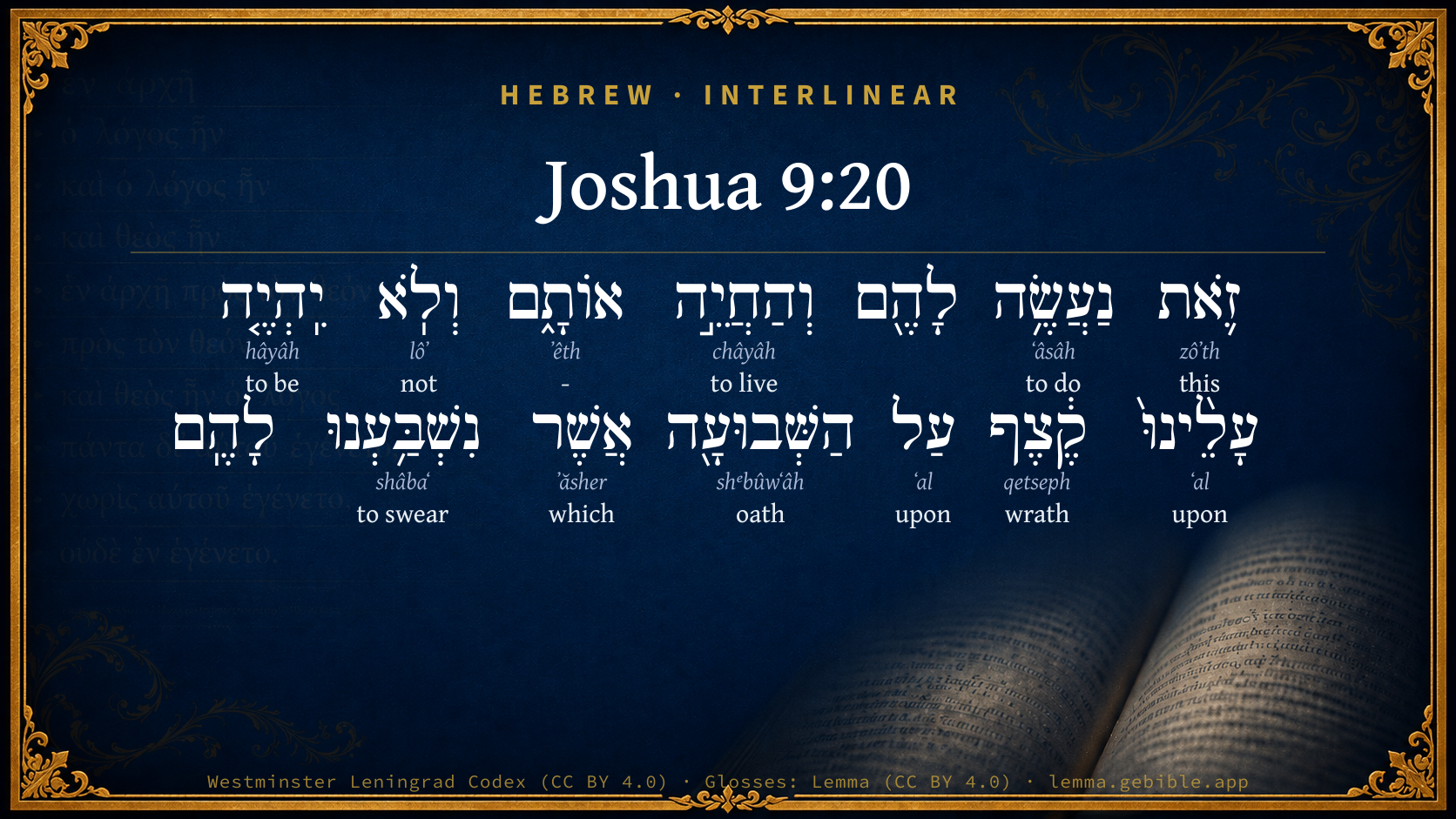
  1. זֹ֛את zôʼth H2063 “this” Pronoun, Demonstrative, Feminine, Singular
  2. נַעֲשֶׂ֥ה ʻâsâh H6213 “to do” Verb, Qal, Imperfect, 1st Person, Common, Plural
  3. וְהַחֲיֵ֣ה châyâh H2421 “and · to live” Conjunction + Verb, Hiphil, Infinitive Absolute
  4. אוֹתָ֑ם ʼêth H853 “- · them” Particle, Direct Object + Suffix, Personal, 3rd Person, Masculine, Plural
  5. וְלֹֽא lôʼ H3808 “and · not” Conjunction + Particle, Negative
  6. יִֽהְיֶ֤ה hâyâh H1961 “to be” Verb, Qal, Imperfect, 3rd Person, Masculine, Singular
  7. עָלֵ֨ינוּ֙ ʻal H5921 “upon · us” Preposition + Suffix, Personal, 1st Person, Common, Plural
  8. עַל ʻal H5921 “upon” Preposition
  9. הַשְּׁבוּעָ֖ה shᵉbûwʻâh H7621 “the · oath” Particle, Definite Article + Noun, Common, Feminine, Singular, Absolute
  10. אֲשֶׁר ʼăsher H834 “which” Particle, Relative
  11. נִשְׁבַּ֥עְנוּ shâbaʻ H7650 “to swear” Verb, Niphal, Perfect, 1st Person, Common, Plural

About this verse

These counts appear in no published source. They are computed here, from the morphology-tagged text and Lemma’s own curated glosses. What Lemma adds →

14
words
11
distinct lemmas
Historical
section

Shared distinctive vocabulary

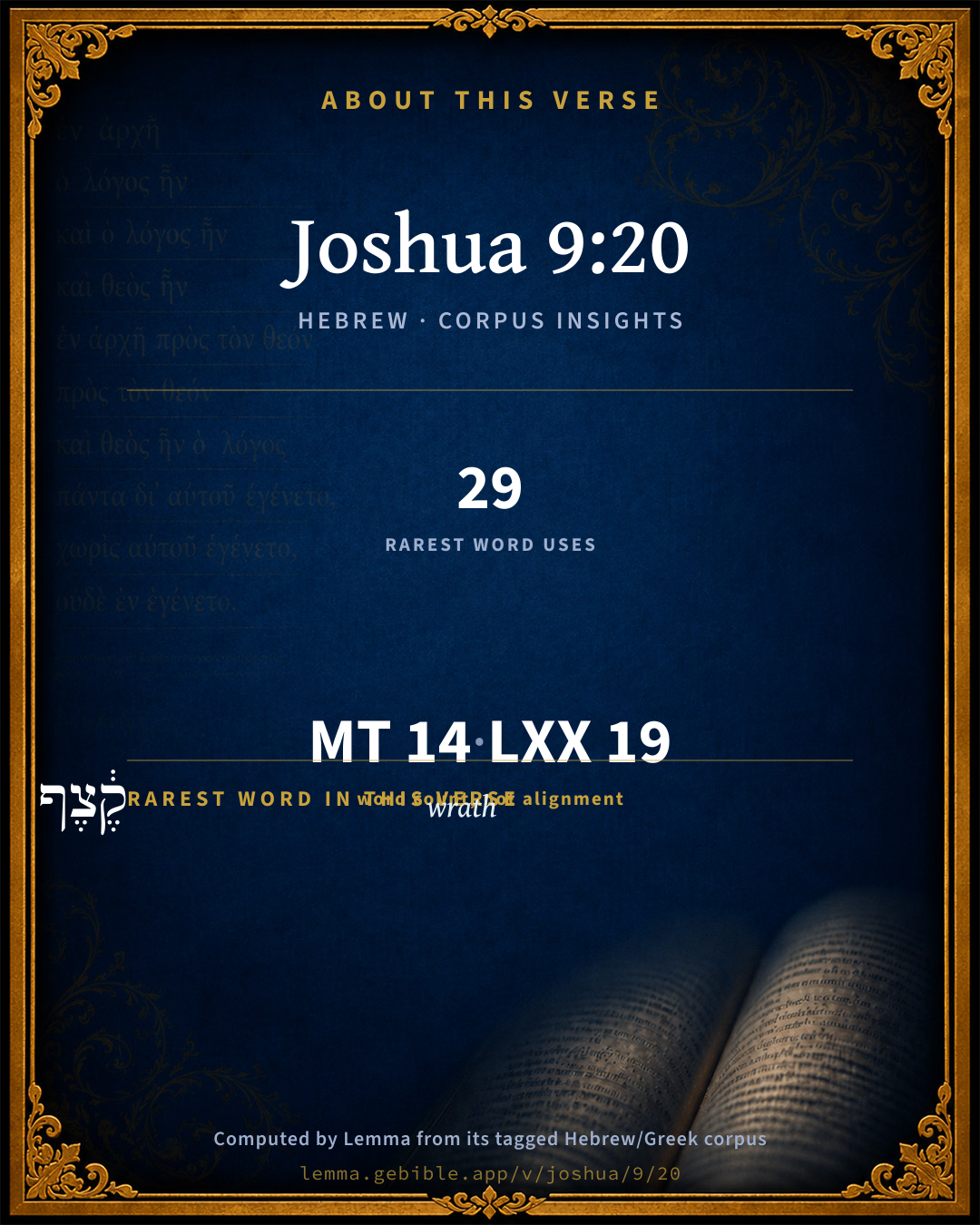
קֶ֔צֶף wrath H7110 occurs in 29 verses of the Hebrew Bible. Also found in:

Grammatical profile

  • 4 verbs
  • 2 nouns
  • 1 pronoun
  • 4 prepositions
  • 3 particles

Verb forms

  • נַעֲשֶׂ֥ה Qal · Imperfect
  • וְהַחֲיֵ֣ה Hiphil · Infinitive Absolute
  • יִֽהְיֶ֤ה Qal · Imperfect
  • נִשְׁבַּ֥עְנוּ Niphal · Perfect

Repetition

A word recurs within this verse — often emphatic in Hebrew:

  • עָלֵ֨ינוּ֙ upon H5921 ×2

Hebrew & Septuagint length

In English translation the verse runs 24 words from the Hebrew and 30 from the Septuagint (LXX English) — closely comparable.

A rough comparison of the two English renderings, which tokenize alike — not a word-level alignment.

Word counts can differ between the Hebrew and the Greek without any difference in meaning — e.g. the Hebrew direct-object marker אֵת has no separate Greek word, and Greek often adds the article ὁ.

In the original languages it is 14 Hebrew tokens and 19 Greek tokens — but the two are counted differently (Hebrew bundles its prefixes and suffixes into one token; the Greek is in lemma form), so that isn’t a like-for-like length.

Cross-references

8

Topical passages linked to Joshua 9:20 in the Treasury of Scripture Knowledge — connected by theme and wording, ordered by reader-vote popularity; previews shown in the World English Bible.

  • Proverbs 20:25 It is a snare to a man to make a rash dedication, Then later to consider his vows.
  • Ezekiel 17:12–21 Say now to the rebellious house, Don't you know what these things mean? tell them, Behold, the king of Babylon came to Jerusalem, and took the king of it, and the princes of it, and brought them to him to Babylon:
  • Malachi 3:5 I will come near to you to judgment; and I will be a swift witness against the sorcerers, and against the adulterers, and against the perjurers, and against those who oppress the hireling in his wages, the widow, and the fatherless, and who deprive the foreigner of justice, and don't fear me," says Yahweh of Hosts.
  • 2 Samuel 21:1–6 There was a famine in the days of David three years, year after year; and David sought the face of Yahweh. Yahweh said, It is for Saul, and for his bloody house, because he put to death the Gibeonites.
  • 2 Chronicles 36:13 He also rebelled against king Nebuchadnezzar, who had made him swear by God: but he stiffened his neck, and hardened his heart against turning to Yahweh, the God of Israel.
  • Zechariah 5:3–4 Then he said to me, "This is the curse that goes out over the surface of the whole land; for everyone who steals shall be cut off according to it on the one side; and everyone who swears falsely shall be cut off according to it on the other side.
  • Romans 1:31 without understanding, covenant-breakers, without natural affection, unforgiving, unmerciful;
  • 1 Timothy 1:10 for the sexually immoral, for homosexuals, for slave-traders, for liars, for perjurers, and for any other thing contrary to the sound doctrine;

Cross-references courtesy of OpenBible.info (CC BY 4.0).

Hebrew and Greek witnesses Masoretic Hebrew ↔ Greek Septuagint

The same verse in the two great witnesses to the Old Testament, shown verse-for-verse.

These are two independent witnesses, not word-aligned to each other, and the Septuagint is shown in lemma (dictionary) form.

Hebrew Joshua 9:20 Masoretic · Westminster Leningrad Codex

זֹ֛את נַעֲשֶׂ֥ה לָהֶ֖ם וְהַחֲיֵ֣ה אוֹתָ֑ם וְלֹֽא יִֽהְיֶ֤ה עָלֵ֨ינוּ֙ קֶ֔צֶף עַל הַשְּׁבוּעָ֖ה אֲשֶׁר נִשְׁבַּ֥עְנוּ לָהֶֽם

This we will do to them, and let them live; lest wrath be on us, because of the oath which we swore to them.

World English Bible · Public Domain

Greek LXX Joshua 9:20 Septuagint · lemma form

οὗτος ποιέω ζωγρέω αὐτός καί περιποιέω αὐτός καί οὐ εἰμί κατά ἐγώ ὀργή διά ὁ ὅρκος ὅς ὄμνυμι αὐτός

This we will do; take them alive, and we will preserve them: so there shall not be wrath against us by reason of the oath which we swore to them.

LXX2012 (modern English Septuagint) · Public Domain

On this verse, The Pulpit Commentary discusses the Septuagint’s reading. Read the note in Commentary ↓

Hebrew: Westminster Leningrad Codex (CC BY 4.0). Greek: Septuagint (public domain); English from LXX2012 (modern English Septuagint) (Public Domain). How the Septuagint differs from the Hebrew →

Targum (Aramaic paraphrase)

1

The Targum is the ancient Jewish Aramaic paraphrase of the Hebrew Scriptures — an interpretive translation, not the Hebrew text itself. Onkelos (literal) and Pseudo-Jonathan (expansive) render the Torah, and Jonathan the Prophets. Coverage is partial: where no permissively-licensed English translation exists for a verse, only the Aramaic is shown. This is verse-level text, not a word-by-word alignment to the Hebrew.

  1. Targum Jonathan Prophets (Joshua–Malachi)
    דָא נַעֲבֵּיד לְהוֹן וּנְקַיֵם יַתְהוֹן וְלָא יְהֵי עֲלָנָא רֻגְזָא עַל קְיָמָא דִי קַיָימְנָא לְהוֹן:

    (no public-domain English translation for this verse)

    Targum Jonathan — Aramaic: “Mikraot Gedolot” (public domain). English: “Sefaria Community Translation” (CC0 1.0 (public-domain dedication)); “London "Chaldee Paraphrase," 1871” (public domain). Text via Sefaria.

Commentary

Notes on Joshua 9:20 from classic Christian and Jewish commentators (each source and its license shown beneath its notes). The classic Christian expositions comment on the surrounding passage and are grouped to its opening verse, so a note may address several verses; the Jewish commentaries on the Tanakh (Rashi and others) are per-verse, so they appear only where the commentator wrote on this verse.

Lemma curates 59 commentaries, every one of them public domain or Creative Commons licensed, each selected and text-cleaned for this edition rather than reprinted as found. About our sources →

Trapp's Complete Commentary

John Trapp

Jos 9:20 This we will do to them; we will even let them live, lest wrath be upon us, because of the oath which we sware unto them.

Ver. 20. Lest wrath be upon us.] In the twelve tables at Rome it was written, Periurii, poena divina, exitium; humans, dedecus." God punisheth perjury with destruction, men with disgrace. Tissaphernes the Persian being overcome by Agesilaus, desired a truce, and had it, both parties swearing to observe it. This Agesilaus did with great care, but not Tissaphernes. Agesilaus comforted himself and his army with this, that the Persian by his perjury would both provoke God and offend men, and should fare accordingly. {a}

{a} Nepos, in Vita Agesil.

John Trapp, A Commentary or Exposition upon All the Books of the Old and New Testament (1647–1656) — public domain. Text from a community e-Sword module.

Geneva Bible (1599)

Geneva Bible translators

This doth not establish rash oaths, but showeth God’s mercy toward his, which would not punish them for their fault.

Geneva Bible (1599) marginal notes — public domain. Text via Bolls.life.

John Calvin's Commentaries

20. This we will do to them, etc. Although, according to agreement, they give the Gibeonites their lives, they ratify the whole covenant only in part. For while the Gibeonites were entitled to be made perfectly secure, they are deprived of liberty, which is dearer than life. From this we infer that Joshua and the others had, as in a case of doubt and perplexity, devised a kind of middle course, so as not to make the oath altogether void. The principal object of this device was to appease the multitude: at the same time, while they were indignant at having been imposed upon by the Gibeonites, they punished the fraud, and did not allow impunity to increase their derision. It was a harsh condition, in this arrangement, that the Gibeonites were not only doomed to servile labors but withdrawn from their homes, to lead a vagrant and wandering life. The office of scullions imposed on them was no less mean than laborious, but the worst, of all was to hew wood and draw water, wherever God should be pleased to station the ark.

John Calvin's Commentaries (1540-1563) — public domain. Text from the Calvin Translation Society English edition (1840s-50s) via the Christian Classics Ethereal Library (ccel.org). Calvin's coverage is partial (roughly two-thirds of the Bible); uncommented books and verses are honest gaps, never fabricated. The 19th-century editor's footnotes and remarks are omitted so the notes are faithfully Calvin's own voice.

John Gill's Exposition

This we will do to them,.... Either this favour we will show them, preserving their lives, next mentioned, or this punishment we will inflict on them, making them hewers of wood, and drawers of water; which though not mentioned directly, was what was upon their minds, and in their design to propose, only they were extremely desirous of sparing their lives, which they repeat:

we will even let them live; this by all means must be done, their lives must not be taken away as the rest of the Canaanites:

lest wrath come upon us, because of the oath which we sware unto them; that is, lest the wrath of God come upon us princes, and upon the whole community, for perjury, a breach of the third command, Exo 20:7, a sin highly displeasing to God; since an oath is made not only in his presence, and before him as a witness, who is appealed unto, but in his name, and is often severely threatened, and sorely punished; and as even the breach of this oath was several hundreds of years after, in the times of David, Sa2 21:1. The Vulgate Latin version therefore reads the words, "lest the wrath of the Lord come upon us": but Abarbinel observes, that it may be understood of the wrath of Israel; for the words may be rendered, "and there shall not be wrath upon us, because of the oath": there need be none, there is no occasion for it, since this was agreed upon on all hands, that the Gibeonites should be let to live; and since it was an act of kindness and goodness, and especially they would have no reason to be angry and wrathful with them, when they heard them out, what they had further to propose to them, to make them their servants, though they spared their lives.

John Gill's Exposition of the Whole Bible (1746–1763) — public domain (CC PDM 1.0). Text via the HelloAO Bible API.

Whedon's Commentary on the Bible

Daniel D. Whedon

20. Lest wrath be upon us — By neglecting to consult God they had brought themselves into a state of moral perplexity. They were in a strait between their oath and the plain command of God, strengthened by the murmurs of the people.

Daniel D. Whedon (gen. ed.), Commentary on the Old and New Testaments (1874–1909) — public domain. Text from a community e-Sword module.

The Pulpit Commentary

Lest wrath be upon us. The original is not quite so strong: "and wrath will not be upon us (kai ouk estai kay hmwn orgh , LXX).

The Pulpit Commentary (1880–1919), ed. H.D.M. Spence-Jones & Joseph S. Exell — public domain. Text from a community e-Sword module.

unfoldingWord translationNotes

Door43 World Missions Community

the Gibeonites became cutters of wood and drawers of water

"the Gibeonites became woodcutters and water carriers"

translationWords

wrath

oath

Gibeon

Israel

unfoldingWord translationNotes — © Distant Shores Media and the Door43 World Missions Community, licensed CC BY-SA 4.0. Source: git.door43.org/Door43/en_tn.

Lesson kit

Teaching starters — assembled from the data on this page, not authored interpretation. Every prompt links to the verse data it draws on. Edit before teaching.

Joshua, in the Historical, opens this verse with 14 words (11 distinct Hebrew lemmas). Its most distinctive word is qetseph (“wrath”). A historical commentator’s framing appears above. Read the whole chapter for the surrounding context.

Discussion questions

  1. How does “wrath” (qetseph) shape what this verse is saying?
  2. How does Numbers 1:53, which shares the word «wrath», read alongside this verse?
  3. What does the repetition of “upon” (2× in this one verse) do in this verse?
  4. The translations on this page render this verse differently — a whole-verse word diff, not a word-by-word alignment. What might account for the different wordings?
  5. «נַעֲשֶׂ֥ה» is a Qal Imperfect verb. How does that grammatical form shape the action described?
  6. Compare how Trapp's Complete Commentary and Geneva Bible (1599) read this verse. Where do they agree or differ?

Things to notice

Reading settings

Reading text

Shown beneath each verse's original-language words.

Old Testament
Old Testament edition

Read the OT as the Masoretic Hebrew (MT) or the Greek Septuagint (LXX).

English shown for the Greek Septuagint (in the Hebrew ↔ Greek comparison).

Comparing translations? Open the Compare panel on any verse page to stack up to four side by side.