
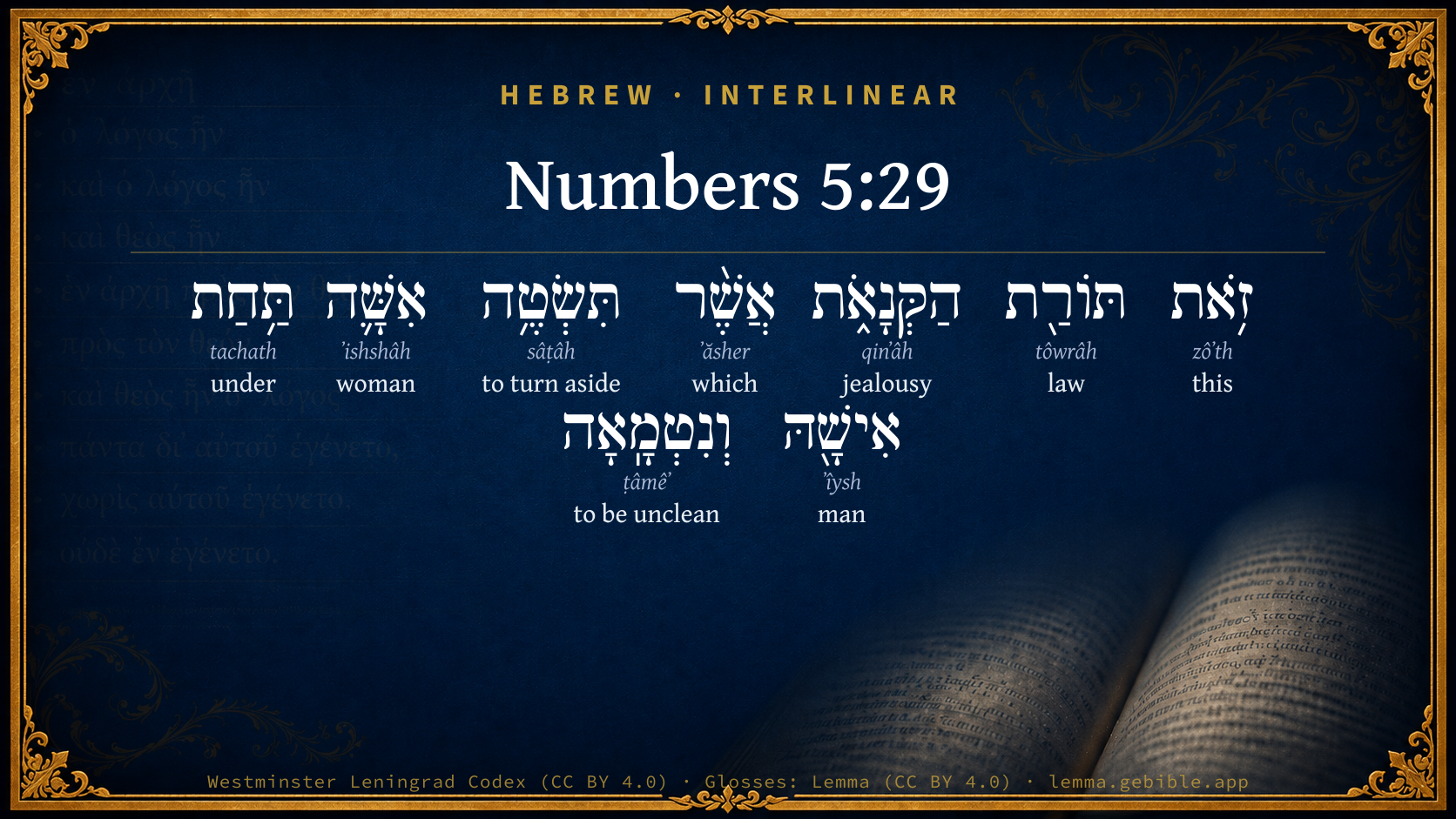
Numbers 5:29

Hebrew (Westminster Leningrad Codex) Numbers 5:29 appears in the Hebrew Old Testament. The text above is from the Westminster Leningrad Codex. Each word links to its Strong’s number, a concise gloss, and parsing drawn from the Open Scriptures Hebrew Bible morphology. Click any word for its full Brown-Driver-Briggs (BDB) entry.
Download image
Cite this verse

Numbers 5:29 (World English Bible). Public Domain. Lemma interlinear Bible study tool, https://lemma.gebible.app/v/numbers/5/29.

Show BibTeX & RIS
BibTeX
RIS
English Translation
"This is the law of jealousy, when a wife, being under her husband, goes astray, and is defiled;
World English Bible · Public Domain
Download a study sheet

One document with this verse’s original text, its word-by-word gloss line, the meaning frame, cross-references with their text, attributed commentary, and full source and license credits — printable, and it pastes into notes with its structure intact.

This verse Autodidact and up

Study sheet (.html) Plain text (.txt)

A passage Seminary Student

Up to 50 verses in one chapter. A passage sheet keeps up to 6 commentary sources and 12 cross-references per verse, in the order this page ranks them, and says so on the sheet whenever that leaves anything out. Ask for a single verse and you get the Autodidact verse sheet above.

Everything on this page stays free to read, with no account — the sheet is a download of what is already on screen, not access to it.

Want to remove ads? Support Godless Engineer
Compare translations 3

The same verse in 3 English versions, stacked beneath the original-language interlinear above. Click any original word for its lexicon entry.

Each is an independent rendering of the whole verse — the interlinear is not word-aligned to these translations.

Highlighted words mark where these versions differ — a whole-verse word diff, not a word-by-word alignment.

  • World English Bible Public Domain
    "This is the law of jealousy, when a wife, being under her husband, goes astray, and is defiled;
  • King James Version Public Domain
    This is the law of jealousies, when a wife goeth aside to another instead of her husband, and is defiled;
  • unfoldingWord Literal Text CC BY-SA 4.0
    This the law of jealousy when a woman turns aside under her husband and is made unclean,

unfoldingWord Literal Text — © unfoldingWord, licensed CC BY-SA 4.0. Word-aligned USFM3 via Door43 (git.door43.org/unfoldingWord/en_ult).

Versions to compare (up to 4)

3 of 4 selected

Show all 18 translations

Every available English version of this verse, each an independent rendering of the whole verse.

  • World English Bible Public Domain
    "This is the law of jealousy, when a wife, being under her husband, goes astray, and is defiled;
  • Berean Standard Bible Public Domain
    This is the law of jealousy when a wife goes astray and defiles herself while under her husband’s authority,
  • Majority Standard Bible Public Domain
    This is the law of jealousy when a wife goes astray and defiles herself while under her husband’s authority,
  • King James Version Public Domain
    This is the law of jealousies, when a wife goeth aside to another instead of her husband, and is defiled;
  • American Standard Version (1901) Public Domain
    This is the law of jealousy, when a wife, being under her husband, goeth aside, and is defiled;
  • Revised Version (1885) Public Domain
    This is the law of jealousy, when a wife, being under her husband, goeth aside, and is defiled;
  • Geneva Bible (1599) Public Domain
    This is the law of ielousie, when a wife turneth from her husband and is defiled,
  • Douay-Rheims (1899) Public Domain
    This is the law of jealousy. If a woman hath gone aside from her husband, and be defiled,
  • Young's Literal Translation Public Domain
    `This `is' the law of jealousies, when a wife turneth aside under her husband, and hath been defiled,
  • Literal Standard Version CC BY-SA 4.0
    This [is] the law of jealousies when a wife turns aside under her husband and has been defiled,
  • Unlocked Literal Bible CC BY-SA 4.0
    This is the law of jealousy. It is the law for a woman who strays away from her husband and is defiled.
  • unfoldingWord Literal Text CC BY-SA 4.0
    This the law of jealousy when a woman turns aside under her husband and is made unclean,
  • Darby Bible Public Domain
    This is the law of jealousies, when a wife goeth astray to another instead of her husband and is defiled,
  • World Messianic Bible Public Domain
    “‘This is the law of jealousy, when a wife, being under her husband, goes astray, and is defiled,
  • Webster's Bible Public Domain
    This is the law of jealousies, when a wife goeth astray to another instead of her husband, and is defiled;
  • Free Bible Version CC BY-SA 4.0
    This is the rule to follow in cases of jealousy when a wife has an affair and makes herself unclean while married to her husband,
  • Bible in Basic English Public Domain
    This is the law for testing a wife who goes with another in place of her husband and becomes unclean;
  • JPS Tanakh (1917) Public Domain
    This is the law of jealousy, when a wife, being under her husband, goeth aside, and is defiled;

Literal Standard Version (2020), Covenant Press — licensed CC BY-SA 4.0. Text via the HelloAO Bible API (eBible.org). Unlocked Literal Bible (unfoldingWord) — licensed CC BY-SA 4.0. Text via the HelloAO Bible API (eBible.org). unfoldingWord Literal Text — © unfoldingWord, licensed CC BY-SA 4.0. Word-aligned USFM3 via Door43 (git.door43.org/unfoldingWord/en_ult). Free Bible Version, Dr. Jonathan Gallagher — licensed CC BY-SA 4.0. Text via the HelloAO Bible API (eBible.org).

Word by word

More ways to search: Search by grammar → Find every occurrence → Compare this word →

Practice this passage: Drill this verse → Learn its vocabulary →

About this verse

These counts appear in no published source. They are computed here, from the morphology-tagged text and Lemma’s own curated glosses. What Lemma adds →

9
words
9
distinct lemmas
Pentateuch
section

Notable vocabulary

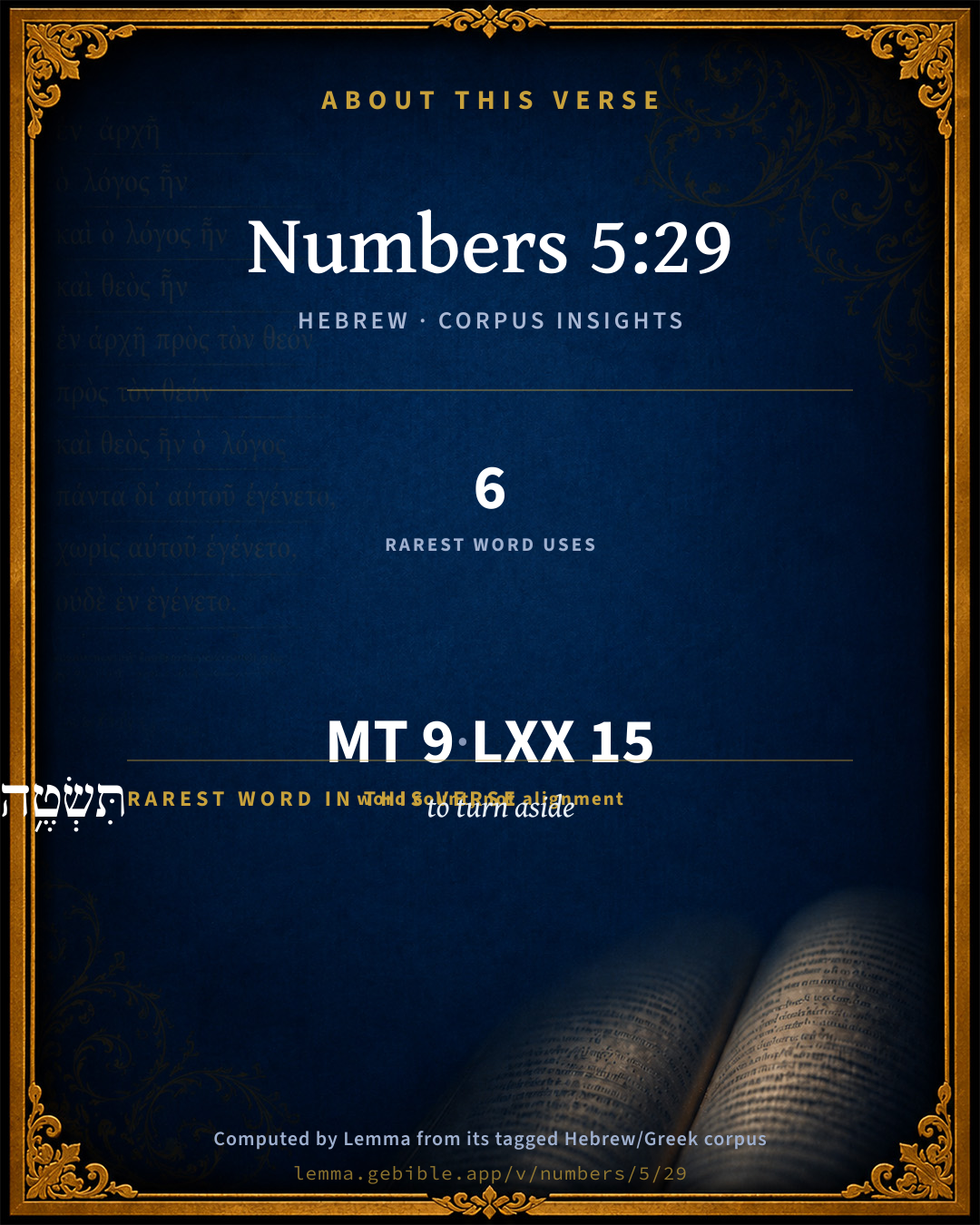
The rarest word here is תִּשְׂטֶ֥ה to turn aside H7847 — appearing just 6 times in the whole Hebrew Bible.

Shared distinctive vocabulary

תִּשְׂטֶ֥ה to turn aside H7847 occurs in 6 verses of the Hebrew Bible. Also found in:

Grammatical profile

  • 2 verbs
  • 4 nouns
  • 1 pronoun
  • 1 preposition
  • 1 particle

Verb forms

  • תִּשְׂטֶ֥ה Qal · Imperfect
  • וְנִטְמָֽאָה Niphal · Sequential Perfect

Hebrew & Septuagint length

In English translation the verse runs 18 words from the Hebrew and 17 from the Septuagint (LXX English) — closely comparable.

A rough comparison of the two English renderings, which tokenize alike — not a word-level alignment.

Word counts can differ between the Hebrew and the Greek without any difference in meaning — e.g. the Hebrew direct-object marker אֵת has no separate Greek word, and Greek often adds the article ὁ.

In the original languages it is 9 Hebrew tokens and 15 Greek tokens — but the two are counted differently (Hebrew bundles its prefixes and suffixes into one token; the Greek is in lemma form), so that isn’t a like-for-like length.

Cross-references

9

Topical passages linked to Numbers 5:29 in the Treasury of Scripture Knowledge — connected by theme and wording, ordered by reader-vote popularity; previews shown in the World English Bible.

  • Numbers 5:19 The priest shall cause her to swear, and shall tell the woman, 'If no man has lain with you, and if you haven't gone aside to uncleanness, being under your husband, be free from this water of bitterness that brings a curse.
  • Numbers 5:12 "Speak to the children of Israel, and tell them: If any man's wife goes astray, and is unfaithful to him,
  • Leviticus 7:11 "'This is the law of the sacrifice of peace offerings, which one shall offer to Yahweh.
  • Leviticus 11:46 "'This is the law of the animal, and of the bird, and of every living creature that moves in the waters, and of every creature that creeps on the earth,
  • Leviticus 13:59 This is the law of the plague of mildew in a garment of wool or linen, either in the warp, or the woof, or in anything of skin, to pronounce it clean, or to pronounce it unclean.
  • Leviticus 14:54–57 This is the law for any plague of leprosy, and for an itch,
  • Leviticus 15:32–33 This is the law of him who has a discharge, and of him who has an emission of semen, so that he is unclean thereby;
  • Numbers 5:15 then the man shall bring his wife to the priest, and shall bring her offering for her: the tenth part of an ephah of barley meal. He shall pour no oil on it, nor put frankincense on it, for it is a meal offering of jealousy, a meal offering of memorial, bringing iniquity to memory.
  • Isaiah 5:7–8 For the vineyard of Yahweh of Hosts is the house of Israel, And the men of Judah his pleasant plant: And he looked for justice, but, behold, oppression; For righteousness, but, behold, a cry of distress.

Cross-references courtesy of OpenBible.info (CC BY 4.0).

Hebrew and Greek witnesses Masoretic Hebrew ↔ Greek Septuagint

The same verse in the two great witnesses to the Old Testament, shown verse-for-verse.

These are two independent witnesses, not word-aligned to each other, and the Septuagint is shown in lemma (dictionary) form.

Hebrew Numbers 5:29 Masoretic · Westminster Leningrad Codex

זֹ֥את תּוֹרַ֖ת הַקְּנָאֹ֑ת אֲשֶׁ֨ר תִּשְׂטֶ֥ה אִשָּׁ֛ה תַּ֥חַת אִישָׁ֖הּ וְנִטְמָֽאָה

"This is the law of jealousy, when a wife, being under her husband, goes astray, and is defiled;

World English Bible · Public Domain

Greek LXX Numbers 5:29 Septuagint · lemma form

οὗτος ὁ νόμος ὁ ζηλοτυπία ὅς ἐάν παραβαίνω ὁ γυνή ὑπό ἀνήρ εἰμί καί μιαίνω

This is the law of jealousy, wherein a married woman should happen to transgress, and be defiled;

LXX2012 (modern English Septuagint) · Public Domain

Hebrew: Westminster Leningrad Codex (CC BY 4.0). Greek: Septuagint (public domain); English from LXX2012 (modern English Septuagint) (Public Domain). How the Septuagint differs from the Hebrew →

Targum (Aramaic paraphrase)

2

The Targum is the ancient Jewish Aramaic paraphrase of the Hebrew Scriptures — an interpretive translation, not the Hebrew text itself. Onkelos (literal) and Pseudo-Jonathan (expansive) render the Torah, and Jonathan the Prophets. Coverage is partial: where no permissively-licensed English translation exists for a verse, only the Aramaic is shown. This is verse-level text, not a word-by-word alignment to the Hebrew.

  1. Targum Onkelos Torah (Genesis–Deuteronomy)
    דָא אוֹרַיְתָא דְקִנְאָתָא דִי תִסְטֵי אִתְּתָא בַּר מִבַּעֲלַהּ וְתִסְתָּאָב

    (no public-domain English translation for this verse)

    Targum Onkelos — Aramaic: “Onkelos Genesis” (public domain); “Onkelos Exodus” (public domain); “Onkelos Leviticus” (public domain); “Onkelos Numbers” (public domain); “Onkelos Deuteronomy” (public domain). English: “Sefaria Community Translation” (CC0 1.0 (public-domain dedication)); “J.W. Etheridge. The Targums of Onkelos and Jonathan Ben Uzziel on the Pentateuch. London: Longmans, Green, 1862” (public domain). Text via Sefaria.

  2. Targum Pseudo-Jonathan Torah (Genesis–Deuteronomy)
    דָא אַחְוָיַת אוֹרַיְיתָא קִנְאָתָא דְתִסְטֵי אִתְּתָא בַּר מִן רְשׁוּתָא דְבַעֲלָהּ וְתִסְתָּאֵב בְּתַּשְׁמִישׁ דְעָרִיס

    This is the declaration of the law of jealousy, when a woman hath fallen away from the right of her husband, and become defiled by adultery;

    Targum Pseudo-Jonathan — Aramaic: “Targum Jonathan on Genesis” (public domain); “Targum Jonathan on Exodus” (public domain); “Targum Jonathan on Leviticus” (public domain); “Targum Jonathan on Numbers” (public domain); “Targum Jonathan on Deuteronomy” (public domain). English: “The Targum of Jonathan ben Uzziel, trans. J. W. Etheridge, London, 1862” (public domain). Text via Sefaria.

Commentary

Notes on Numbers 5:29 from classic Christian and Jewish commentators (each source and its license shown beneath its notes). The classic Christian expositions comment on the surrounding passage and are grouped to its opening verse, so a note may address several verses; the Jewish commentaries on the Tanakh (Rashi and others) are per-verse, so they appear only where the commentator wrote on this verse.

Lemma curates 59 commentaries, every one of them public domain or Creative Commons licensed, each selected and text-cleaned for this edition rather than reprinted as found. About our sources →

Joseph Benson's Commentary

Num 5:29. This is the law of jealousy — “It is not to be wondered,” says Grotius, “if God, among his own people, produced a miraculous effect for the detection of a crime most heinous, and very difficult to be proved. Indeed history abounds with examples of the direful effects of jealousy, not only to private persons and families, but to whole states and kingdoms; the design, therefore, of this institution was to prevent these evils, by appointing a method whereby injured innocence might be cleared, and every shameful breach of conjugal fidelity brought to condign punishment. By this solemn and awful decision of Providence, jealous husbands were restrained from cruel outrages against their wives, and wives were preserved in their duty out of dread of punishment.”

Joseph Benson's Commentary on the Old and New Testaments (1811–1818) — public domain. Text from a community e-Sword module.

Tyndale Open Study Notes

Tyndale Open Resources

5:29-31 As the trial by ordeal is summarized and justified, it is clear that a husband’s questions about his wife’s guilt or innocence did not burden him with any guilt. We might raise the question of a double standard, but it was very common for ancient laws to draw attention to the woman’s failure in the matter of adultery. However, Israel’s legal system provided for the punishment of both parties to an affair (as in Lev 20:10; Deut 22:21-22).

Tyndale Open Study Notes — © Tyndale Open Resources, licensed CC BY-SA 4.0. Text via the HelloAO Bible API.

Jamieson, Fausset & Brown

Robert Jamieson, A. R. Fausset & David Brown

This is the law of jealousies--Adultery discovered and proved was punished with death. But strongly suspected cases would occur, and this law made provision for the conviction of the guilty person. It was, however, not a trial conducted according to the forms of judicial process, but an ordeal through which a suspected adulteress was made to go--the ceremony being of that terrifying nature, that, on the known principles of human nature, guilt or innocence could not fail to appear. From the earliest times, the jealousy of Eastern people has established ordeals for the detection and punishment of suspected unchastity in wives. The practice was deep-rooted as well as universal. And it has been thought, that the Israelites being strongly biassed in favor of such usages, this law of jealousies "was incorporated among the other institutions of the Mosaic economy, in order to free it from the idolatrous rites which the heathens had blended with it." Viewed in this light, its sanction by divine authority in a corrected and improved form exhibits a proof at once of the wisdom and condescension of God.

Next: Numbers Chapter 6

Jamieson, Fausset & Brown — Commentary Critical and Explanatory on the Whole Bible (1871) — public domain (CC PDM 1.0). Text via the HelloAO Bible API.

Adam Clarke's Commentary

Verse 29. This is the law of jealousies] And this is the most singular law in the whole Pentateuch: a law that seems to have been copied by almost all the nations of the earth, whether civilized or barbarian, as we find that similar modes of trial for suspected offences were used when complete evidence was wanting to convict; and where it was expected that the object of their worship would interfere for the sake of justice, in order that the guilty should be brought to punishment, and the innocent be cleared. For general information on this head see at the end of this chapter. See Clarke on Nu 5:31.

Adam Clarke's Commentary on the Bible (1810–1826) — public domain. Text from a community e-Sword/MySword module.

John Gill's Exposition

This is the law of jealousies,.... Which was appointed by God to deter wives from adultery, and preserve the people of Israel, the worshippers of him, from having a spurious brood among them; and to keep husbands from being cruel to their wives they might be jealous of, and to protect virtue and innocence, and to detect lewdness committed in the most secret manner; whereby God gave proof of his omniscience, that he had knowledge of the most private acts of uncleanness, and was the avenger of all such. The reasons why such a law was not made equally in favour of women, as of men, are supposed to be these: because of the greater authority of the man over the woman, which would seem to be lessened, if such a power was granted her; because marriage was not so much hurt, or so much damage came to families by the adultery of men, as of women; because women are more apt to be suspicious than men, and in those times more prone to adultery, through their eager desire of children, that they might not lie under reproach (o):

when a wife goeth aside to another instead of her husband, and is defiled; is suspected of going aside to another man, and is supposed to be defiled by him.

(o) Vid. Salden. ut supra, (Otia, l. 1. Exercitat. 6.) sect. 19.

John Gill's Exposition of the Whole Bible (1746–1763) — public domain (CC PDM 1.0). Text via the HelloAO Bible API.

The Pulpit Commentary

This is the law of jealousies. A law prescribed by God, and yet in substance borrowed from half civilized heathens; a practice closely akin to yet prevalent superstitious, and yet receiving not only the toleration of Moses, but the direct sanction of God; an ordeal which emphatically claimed to be infallibly operative through supernatural agencies, yet amongst other nations obviously lending itself to collusion and fraud, as does the trial by red water practiced by the tribes of West Africa. In order to justify heavenly wisdom herein, we must frankly admit, to begin with

(1) That it was founded upon the superstitious notion that immaterial virtue can be imparted to physical elements. The holiness of the gathered dust and the awfulness of the written curses were both supposed to be held in solution by the water of jealousy. The record does not say as much, but the whole ordeal proceeds on this supposition, which would undoubtedly be the popular one.

(2) That it was only fitted for a very rude and comparatively barbarous state of society. The Talmud states that the use of it ceased forty years before the destruction of Jerusalem (if so, during our Lord"s earthly lifetime); but it may be held certain that it ceased long before indeed there is no recorded instance of its use. It was essentially an ordeal, although one Divinely regulated, and as such would have been morally impossible and highly undesirable in any age but one of blind and uninquiring faith. And we find the justification of it exactly in the fact that it was given to a generation which believed much and knew little; which had a profound belief in magic, and no knowledge of natural philosophy. It was ever the wisdom of God, as revealed in the sacred volume, to take men as they were, and to utilize the superstitious notions which could not at once be destroyed, or the imperfect moral ideas which could not at once be reformed, by making them work for righteousness and peace. It is, above all, the wisdom of God not to destroy the imperfect, but to regulate it and restrain its abuses, and so impress it into his service, until he has educated his people for something higher. Everybody knows the extreme violence of jealousy amongst an uncivilized people, and the widespread misery and crime to which it leads. It may safely be affirmed that any ordeal which should leave no place for jealousy, because no room for uncertainty, would be a blessing to a people rude enough and ignorant enough to believe in it. Ordeals arc established in a certain stage of civilization because they are wanted, and are on the whole useful, as long as they remain in harmony with popular ideas. They are, however, always liable to two dangers.

(1) They occasionally fail, and are known to have failed, and so fall into disrepute.

(2) They always lend themselves readily to collusion or priestcraft. The trial of jealousy being adopted, as it was, into a system really Divine, and being based upon the knowledge and power of God himself, secured all the benefits of an ordeal and escaped all its dangers. It is probable enough that the awful side of it was never really called into play. No guilty woman would dare to challenge so directly a visitation so dreadful, as long as she retained any faith or any superstition. Before the time came when any Jewish woman had discarded both, the increasing facilities of divorce had provided another and easier escape from matrimonial troubles.

The Pulpit Commentary (1880–1919), ed. H.D.M. Spence-Jones & Joseph S. Exell — public domain. Text from a community e-Sword module.

unfoldingWord translationNotes

Door43 World Missions Community

the law of jealousy

"the law for dealing with jealousy"

who strays away from her husband

The words "strays away" is an idiom that means "to be unfaithful." AT: "who is unfaithful to her husband" (See: Idiom)

is defiled

This can be stated in active form. AT: "defiles herself" (See: Active or Passive)

a spirit of jealousy

This phrase refers to the man's attitude and emotions of jealousy. See how you translated this in Numbers 5:14. AT: "who is jealous" (See: Metonymy)

when he is jealous of his wife

This is an idiom that means that he suspects that his wife has been unfaithful to him by sleeping with another man. AT: "and suspects that his wife has been unfaithful to him" or "and suspects that his wife has slept with another man" (See: Idiom)

before Yahweh

"in the presence of Yahweh"

translationWords

law, laws

astray

spirit

priest

unfoldingWord translationNotes — © Distant Shores Media and the Door43 World Missions Community, licensed CC BY-SA 4.0. Source: git.door43.org/Door43/en_tn.

Lesson kit

Teaching starters — assembled from the data on this page, not authored interpretation. Every prompt links to the verse data it draws on. Edit before teaching.

Numbers, in the Pentateuch, opens this verse with 9 words (9 distinct Hebrew lemmas). Its most distinctive word is sâṭâh (“to turn aside”). A historical commentator’s framing appears above. Read the whole chapter for the surrounding context.

Discussion questions

  1. How does “to turn aside” (sâṭâh) shape what this verse is saying?
  2. Numbers 5:12 shares the word «to turn aside» with this verse. How do the two illuminate each other?
  3. These translations render this verse differently; the difference is in the English rendering, not the original. What questions does that raise?
  4. The verb «תִּשְׂטֶ֥ה» is Qal Imperfect. How does its form color the action?
  5. Reading how Joseph Benson's Commentary and Tyndale Open Study Notes read this verse, where do the two commentators agree and where do they part?

Things to notice

Reading settings

Reading text

Shown beneath each verse's original-language words.

Old Testament
Old Testament edition

Read the OT as the Masoretic Hebrew (MT) or the Greek Septuagint (LXX).

English shown for the Greek Septuagint (in the Hebrew ↔ Greek comparison).

Comparing translations? Open the Compare panel on any verse page to stack up to four side by side.