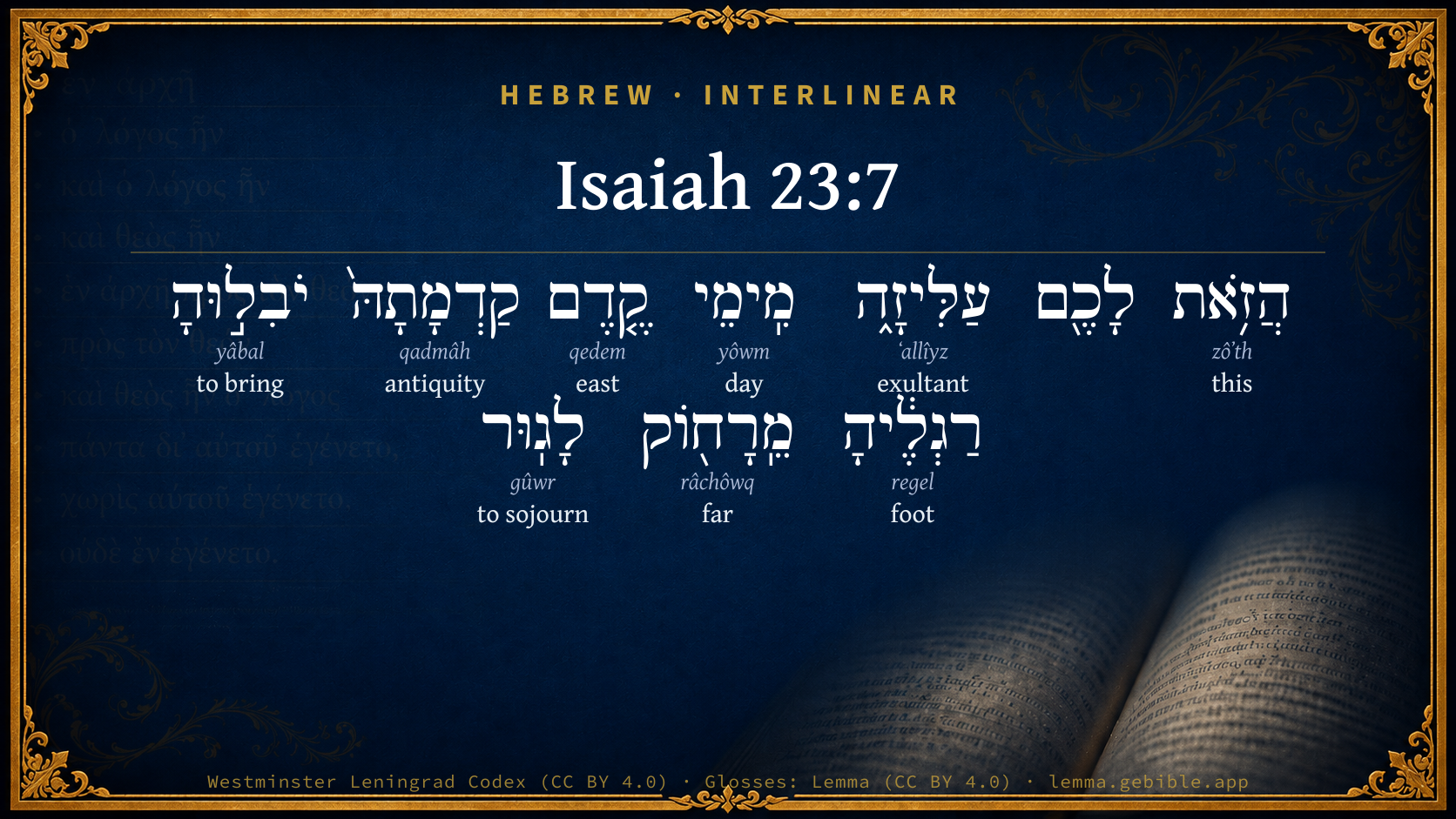
Isaiah 23:7

Hebrew (Westminster Leningrad Codex) Isaiah 23:7 appears in the Hebrew Old Testament. The text above is from the Westminster Leningrad Codex. Each word links to its Strong’s number, a concise gloss, and parsing drawn from the Open Scriptures Hebrew Bible morphology. Click any word for its full Brown-Driver-Briggs (BDB) entry.
Download image
Cite this verse

Isaiah 23:7 (World English Bible). Public Domain. Lemma interlinear Bible study tool, https://lemma.gebible.app/v/isaiah/23/7.

Show BibTeX & RIS
BibTeX
RIS
English Translation
Is this your joyous [city], whose antiquity is of ancient days, whose feet carried her afar off to sojourn?
World English Bible · Public Domain
Download a study sheet

One document with this verse’s original text, its word-by-word gloss line, the meaning frame, cross-references with their text, attributed commentary, and full source and license credits — printable, and it pastes into notes with its structure intact.

This verse Autodidact and up

Study sheet (.html) Plain text (.txt)

A passage Seminary Student

Up to 50 verses in one chapter. A passage sheet keeps up to 6 commentary sources and 12 cross-references per verse, in the order this page ranks them, and says so on the sheet whenever that leaves anything out. Ask for a single verse and you get the Autodidact verse sheet above.

Everything on this page stays free to read, with no account — the sheet is a download of what is already on screen, not access to it.

Want to remove ads? Support Godless Engineer
Compare translations 3

The same verse in 3 English versions, stacked beneath the original-language interlinear above. Click any original word for its lexicon entry.

Each is an independent rendering of the whole verse — the interlinear is not word-aligned to these translations.

Highlighted words mark where these versions differ — a whole-verse word diff, not a word-by-word alignment.

  • World English Bible Public Domain
    Is this your joyous [city], whose antiquity is of ancient days, whose feet carried her afar off to sojourn?
  • King James Version Public Domain
    Is this your joyous city, whose antiquity is of ancient days? her own feet shall carry her afar off to sojourn.
  • unfoldingWord Literal Text CC BY-SA 4.0
    this the exultant to you, its origin from days of antiquity? Its feet carried it far away to sojourn.

unfoldingWord Literal Text — © unfoldingWord, licensed CC BY-SA 4.0. Word-aligned USFM3 via Door43 (git.door43.org/unfoldingWord/en_ult).

Versions to compare (up to 4)

3 of 4 selected

Show all 18 translations

Every available English version of this verse, each an independent rendering of the whole verse.

  • World English Bible Public Domain
    Is this your joyous [city], whose antiquity is of ancient days, whose feet carried her afar off to sojourn?
  • Berean Standard Bible Public Domain
    Is this your jubilant city, whose origin is from antiquity, whose feet have taken her to settle far away?
  • Majority Standard Bible Public Domain
    Is this your jubilant city, whose origin is from antiquity, whose feet have taken her to settle far away?
  • King James Version Public Domain
    Is this your joyous city, whose antiquity is of ancient days? her own feet shall carry her afar off to sojourn.
  • American Standard Version (1901) Public Domain
    Is this your joyous `city', whose antiquity is of ancient days, whose feet carried her afar off to sojourn?
  • Revised Version (1885) Public Domain
    Is this your joyous city, whose antiquity is of ancient days, whose feet carried her afar off to sojourn?
  • Geneva Bible (1599) Public Domain
    Is not this that your glorious citie? her antiquitie is of ancient daies: her owne feete shall leade her afarre off to be a soiourner.
  • Douay-Rheims (1899) Public Domain
    Is not this your city, which gloried from of old in her antiquity? her feet shall carry her afar off to sojourn.
  • Young's Literal Translation Public Domain
    Is this your exulting one? From the days of old `is' her antiquity, Carry her do her own feet afar off to sojourn.
  • Literal Standard Version CC BY-SA 4.0
    Is this your exulting one? Her antiquity [is] from the days of old, || Her own feet carry her far off to sojourn.
  • Unlocked Literal Bible CC BY-SA 4.0
    Has this happened to you, the joyful city, whose origin is from ancient times, whose feet carried her far away to foreign places to settle?
  • unfoldingWord Literal Text CC BY-SA 4.0
    this the exultant to you, its origin from days of antiquity? Its feet carried it far away to sojourn.
  • Darby Bible Public Domain
    Is this your joyous [city], whose antiquity is of ancient days? Her feet shall carry her afar off to sojourn.
  • World Messianic Bible Public Domain
    Is this your joyous city, whose antiquity is of ancient days, whose feet carried her far away to travel?
  • Webster's Bible Public Domain
    Is this your joyous city, whose antiquity is of ancient days? her own feet shall carry her far off to sojourn.
  • Free Bible Version CC BY-SA 4.0
    Is this really your triumphant city, whose beginnings are from the distant past, who has sent out people to colonize faraway places?
  • Bible in Basic English Public Domain
    Is this the town which was full of joy, whose start goes back to times long past, whose wanderings took her into far-off countries?
  • JPS Tanakh (1917) Public Domain
    Is this your joyous city, whose feet in antiquity, in ancient days, carried her afar off to sojourn?

Literal Standard Version (2020), Covenant Press — licensed CC BY-SA 4.0. Text via the HelloAO Bible API (eBible.org). Unlocked Literal Bible (unfoldingWord) — licensed CC BY-SA 4.0. Text via the HelloAO Bible API (eBible.org). unfoldingWord Literal Text — © unfoldingWord, licensed CC BY-SA 4.0. Word-aligned USFM3 via Door43 (git.door43.org/unfoldingWord/en_ult). Free Bible Version, Dr. Jonathan Gallagher — licensed CC BY-SA 4.0. Text via the HelloAO Bible API (eBible.org).

Word by word

More ways to search: Search by grammar → Find every occurrence → Compare this word →

Practice this passage: Drill this verse → Learn its vocabulary →

קַדְמָתָהּ֙
qadmâh
H6927
“antiquity · her”
Noun, Common, Feminine, Singular, Construct + Suffix, Personal, 3rd Person, Feminine, Singular
Part of Speech
Noun
Type
Common
Gender
Feminine
Number
Singular
State
Construct
Full BDB Definition

Origin: from H6923

TWOT: 1988c

antiquity, former state or estate or situation, before, origin - antiquity, beginning, origin - former state or situation - before
  1. הֲזֹ֥את zôʼth H2063 “this” Particle, Interrogative + Pronoun, Demonstrative, Feminine, Singular
  2. עַלִּיזָ֑ה ʻallîyz H5947 “exultant” Adjective, Adjective, Feminine, Singular, Absolute
  3. מִֽימֵי yôwm H3117 “from · days of” Preposition + Noun, Common, Masculine, Plural, Construct
  4. קֶ֤דֶם qedem H6924 “east” Noun, Common, Masculine, Singular, Absolute
  5. יֹבִל֣וּהָ yâbal H2986 “to bring · her” Verb, Hiphil, Imperfect, 3rd Person, Masculine, Plural + Suffix, Personal, 3rd Person, Feminine, Singular
  6. רַגְלֶ֔יהָ regel H7272 “feet · her” Noun, Common, Feminine, Dual, Construct + Suffix, Personal, 3rd Person, Feminine, Singular
  7. מֵֽרָח֖וֹק râchôwq H7350 “from · far” Preposition + Adjective, Adjective, Masculine, Singular, Absolute
  8. לָגֽוּר gûwr H1481 “to sojourn” Preposition + Verb, Qal, Infinitive Construct

About this verse

These counts appear in no published source. They are computed here, from the morphology-tagged text and Lemma’s own curated glosses. What Lemma adds →

10
words
9
distinct lemmas
Prophets
section

Notable vocabulary

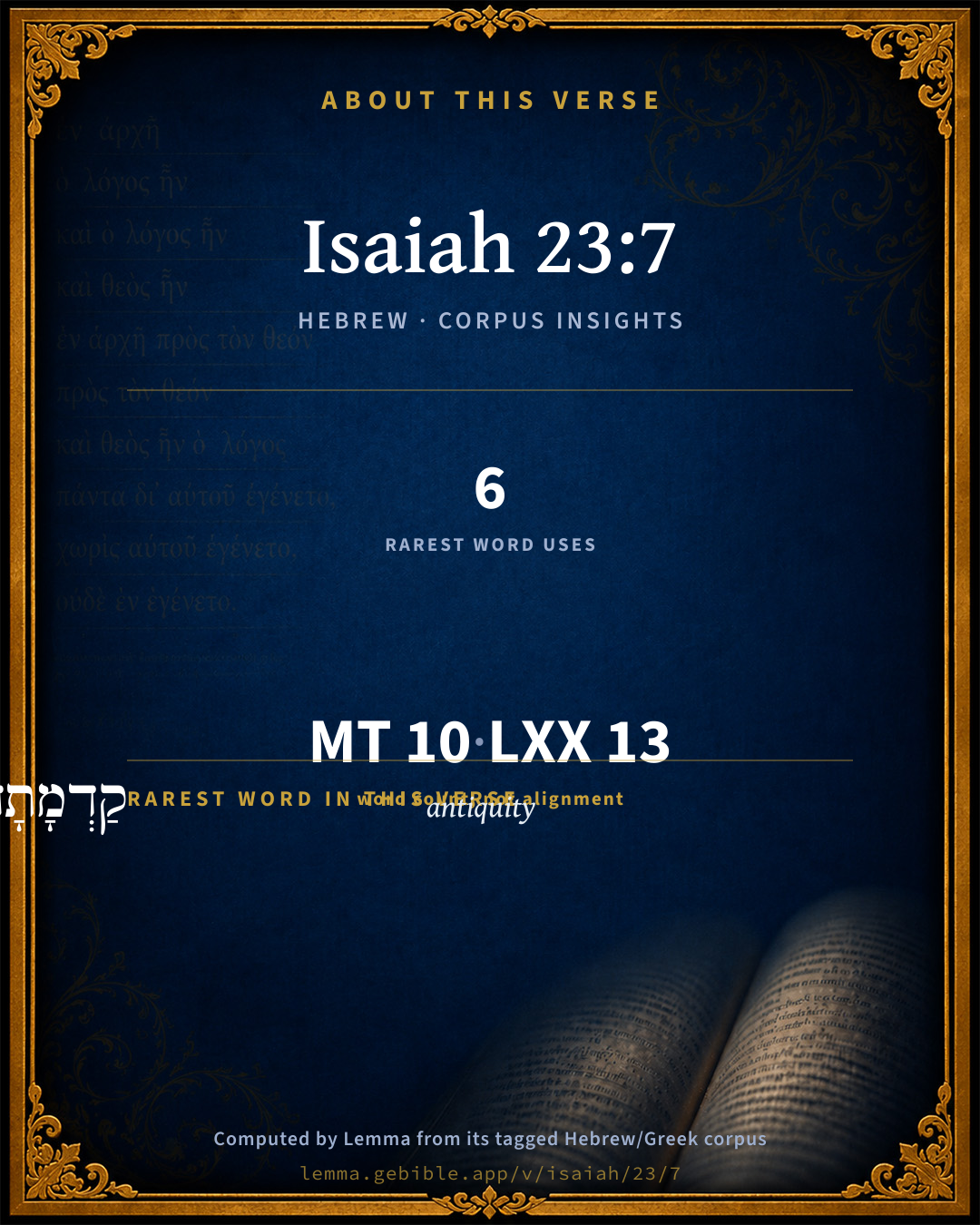
The rarest word here is קַדְמָתָהּ֙ antiquity H6927 — appearing just 6 times in the whole Hebrew Bible.

Shared distinctive vocabulary

קַדְמָתָהּ֙ antiquity H6927 occurs in 4 verses of the Hebrew Bible. Also found in:

Grammatical profile

  • 2 verbs
  • 4 nouns
  • 2 adjectives
  • 1 pronoun
  • 1 preposition

Verb forms

  • יֹבִל֣וּהָ Hiphil · Imperfect
  • לָגֽוּר Qal · Infinitive Construct

Hebrew & Septuagint length

In English translation the verse runs 19 words from the Hebrew and 13 from the Septuagint (LXX English) — the Septuagint runs noticeably shorter here. See the side-by-side →

A rough comparison of the two English renderings, which tokenize alike — not a word-level alignment.

Word counts can differ between the Hebrew and the Greek without any difference in meaning — e.g. the Hebrew direct-object marker אֵת has no separate Greek word, and Greek often adds the article ὁ.

In the original languages it is 10 Hebrew tokens and 13 Greek tokens — but the two are counted differently (Hebrew bundles its prefixes and suffixes into one token; the Greek is in lemma form), so that isn’t a like-for-like length.

Cross-references

5

Topical passages linked to Isaiah 23:7 in the Treasury of Scripture Knowledge — connected by theme and wording, ordered by reader-vote popularity; previews shown in the World English Bible.

  • Isaiah 22:2 You that are full of shouting, a tumultuous city, a joyous town; your slain are not slain with the sword, neither are they dead in battle.
  • Joshua 19:29 and the border turned to Ramah, and to the fortified city of Tyre; and the border turned to Hosah; and the goings out of it were at the sea by the region of Achzib;
  • Ecclesiastes 10:7 I have seen servants on horses, and princes walking like servants on the earth.
  • Isaiah 32:13 On the land of my people shall come up thorns and briers; yes, on all the houses of joy in the joyous city.
  • Isaiah 47:1–2 Come down, and sit in the dust, virgin daughter of Babylon; sit on the ground without a throne, daughter of the Chaldeans: for you shall no more be called tender and delicate.

Cross-references courtesy of OpenBible.info (CC BY 4.0).

Hebrew and Greek witnesses Masoretic Hebrew ↔ Greek Septuagint

The same verse in the two great witnesses to the Old Testament, shown verse-for-verse.

Here the Septuagint runs noticeably shorter than the Hebrew — LXX2012 (modern English Septuagint) 13 words vs World English Bible 19. A rough length comparison of the two English translations, not a word-level alignment — read both below.

These are two independent witnesses, not word-aligned to each other, and the Septuagint is shown in lemma (dictionary) form.

Hebrew Isaiah 23:7 Masoretic · Westminster Leningrad Codex

הֲזֹ֥את לָכֶ֖ם עַלִּיזָ֑ה מִֽימֵי קֶ֤דֶם קַדְמָתָהּ֙ יֹבִל֣וּהָ רַגְלֶ֔יהָ מֵֽרָח֖וֹק לָגֽוּר

Is this your joyous [city], whose antiquity is of ancient days, whose feet carried her afar off to sojourn?

World English Bible · Public Domain

Greek LXX Isaiah 23:7 Septuagint · lemma form

οὐ οὗτος εἰμί σύ ὁ ὕβρις ὁ ἀπό ἀρχή πρίν ἤ παραδίδωμι αὐτός

Was not this your pride from the beginning, before she was given up?

LXX2012 (modern English Septuagint) · Public Domain

Hebrew: Westminster Leningrad Codex (CC BY 4.0). Greek: Septuagint (public domain); English from LXX2012 (modern English Septuagint) (Public Domain). How the Septuagint differs from the Hebrew →

Targum (Aramaic paraphrase)

1

The Targum is the ancient Jewish Aramaic paraphrase of the Hebrew Scriptures — an interpretive translation, not the Hebrew text itself. Onkelos (literal) and Pseudo-Jonathan (expansive) render the Torah, and Jonathan the Prophets. Coverage is partial: where no permissively-licensed English translation exists for a verse, only the Aramaic is shown. This is verse-level text, not a word-by-word alignment to the Hebrew.

  1. Targum Jonathan Prophets (Joshua–Malachi)
    הֲהָדָא לְכוֹן תַּקִיפְתָּא צוֹר מִיוֹמֵי קֶדֶם מִלְקָדְמִין הֲווֹ מַיְתָן לָהּ תַּקְרוּבְתָּא מֵאֲרַע רְחִיקָא כְדוֹ לְאִתּוֹתָבָא הָא גַלְיָא:

    Is this your strong city, Tyre, of ancient days? In olden time they were bringing her gifts from a distant land; behold, now she is removed to sojourn afar off!

    Targum Jonathan — Aramaic: “Mikraot Gedolot” (public domain). English: “Sefaria Community Translation” (CC0 1.0 (public-domain dedication)); “London "Chaldee Paraphrase," 1871” (public domain). Text via Sefaria.

Commentary

Notes on Isaiah 23:7 from classic Christian and Jewish commentators (each source and its license shown beneath its notes). The classic Christian expositions comment on the surrounding passage and are grouped to its opening verse, so a note may address several verses; the Jewish commentaries on the Tanakh (Rashi and others) are per-verse, so they appear only where the commentator wrote on this verse.

Lemma curates 59 commentaries, every one of them public domain or Creative Commons licensed, each selected and text-cleaned for this edition rather than reprinted as found. About our sources →

Trapp's Complete Commentary

John Trapp

Isa 23:7 [Is] this your joyous [city], whose antiquity [is] of ancient days? her own feet shall carry her afar off to sojourn.

Ver. 7. Is this your joyous city?] q.d., So ye were wont to hold her, and to boast of her; but now it is somewhat otherwise. Cities die as well as men, {a} saith one. They also have their times and their turns, their rise and their ruin. Hic immoremur parum et pedem figamus oportet. Let this be duly considered, and an "abiding city" sought. {Heb 12:14} The wicked may revel in this world, the godly only rejoice.

Whose antiquity is of ancient days.] Palaetyre, or the old town especially: and this was a piece of her silly glory;

“ Urbs fur ills Tyros priscis quae condita saeclis,

Innumerosque suo repetens ab Agenore soles,

Aeternos demens spe praesumebat honores. ”

{a} ’Lποθνησκουσι και αι πολεις ωσπες οι ανθρωποι.

John Trapp, A Commentary or Exposition upon All the Books of the Old and New Testament (1647–1656) — public domain. Text from a community e-Sword module.

Jamieson, Fausset & Brown

Robert Jamieson, A. R. Fausset & David Brown

Is this silent ruin all that is left of your once joyous city (Isa 23:12)?

antiquity--The Tyrian priests boasted in HERODOTUS' time that their city had already existed 2300 years: an exaggeration, but still implying that it was ancient even then.

her own feet--walking on foot as captives to an enemy's land.

Jamieson, Fausset & Brown — Commentary Critical and Explanatory on the Whole Bible (1871) — public domain (CC PDM 1.0). Text via the HelloAO Bible API.

Adam Clarke's Commentary

Verse 7. Whose antiquity is of ancient days - "Whose antiquity is of the earliest date"] Justin, in the passage above quoted, had dated the building of Tyre at a certain number of years before the taking of Troy; but the number is lost in the present copies. Tyre, though not so old as Sidon, was yet of very high antiquity: it was a strong city even in the time of Joshua. It is called עיר מבצר צר ir mibtsar tsor, "the city of the fortress of Sor," Jos 19:29. Interpreters raise difficulties in regard to this passage, and will not allow it to have been so ancient; with what good reason I do not see, for it is called by the same name, "the fortress of Sor," in the history of David, 2Sa 24:7, and the circumstances of the history determine the place to be the very same. See on Isa 23:1.

Whose antiquity is of ancient days, may refer to Palaetyrus, or Old Tyre.

Her own feet shall carry her afar off to sojourn.] This may belong to the new or insular Tyre; her own feet, that is, her own inhabitants, shall carry her - shall transport the city, from the continent to the island. "But the text says it shall be carried far off, and the new city was founded only half a mile distant from the other." I answer, מרחוק merachok does not always signify a great distance, but distance or interval in general; for in Jos 3:4 רחוק rachok is used to express the space between the camp and the ark, which we know to have been only two thousand cubits. Some refer the sojourning afar off to the extent of the commercial voyages undertaken by the Tyrians and their foreign connexions.

Adam Clarke's Commentary on the Bible (1810–1826) — public domain. Text from a community e-Sword/MySword module.

Ellicott's Commentary for English Readers

(7) Is this your joyous city . . .?—Tyre was, as has been said, of later origin than Zidon, but was the oldest of the daughter cities. Josephus (Ant. viii. 3. 1) fixes the date of its foundation at 240 years before Solomon.

Her own feet shall carry her.—The English version (tenable grammatically) points to the wanderings of exile. Another rendering, her feet are wont to carry her . . . is also legitimate, and fits in better with the context, which paints the past glory of Tyre in contrast with her coming calamities. So taken, the words point to her numerous colonies, of which Carthage was the chief.

A Bible Commentary for English Readers, edited by Charles John Ellicott (1878–1897) — public domain. Text from a community e-Sword module.

The Cambridge Bible for Schools and Colleges

gen. ed. J. J. S. Perowne

7. The reference is of course to Tyre, the principal subject of the prophecy.

whose antiquity … days] Next to Zidon, Tyre was regarded as the most ancient city of Phœnicia. Her priests claimed for their temple the fabulous antiquity of 2300 years in the time of Herodotus (II. 44); Josephus dates the city’s foundation 240 years before the building of Solomon’s Temple (Ant. viii. 3, 1).

her own feet shall carry her …] Render: whose feet used to carry her.… The reference is not to the future captivity or flight of the Tyrians (for which the expressions are unsuitable) but to the long journeys and residence in foreign parts of her enterprising merchants.

The Cambridge Bible for Schools and Colleges (gen. ed. J. J. S. Perowne; Cambridge University Press, 1878–1918) — public domain. Text from a community e-Sword module.

John Gill's Exposition

Is this your joyous city?.... Which the other day looked so gay, brisk, and cheerful, through the number of its inhabitants, largeness of trade, fullness of provisions, and pleasures of every kind; and now distressed and desolate, and no voice of joy and gladness heard in it:

whose antiquity is of ancient days; the most ancient city in Phoenicia, excepting Zidon, as Strabo (w) says; and it was in being in the days of Joshua, Jos 19:29 if the words there are rightly rendered; and if so, Josephus must be mistaken, unless he speaks of insular Tyre, when he says (x), that from the building of Tyre to the building of the temple (of Solomon) were two hundred and forty years, which must fall very short of the times of Joshua; such (y) seem to be nearer the truth, who make Agenor, the father of Cadmus, to be the builder of this city, who lived about the times of Joshua. The Tyrians indeed boasted of a still greater antiquity, and to which boasts perhaps reference is here had; for one of the priests of Tyre told Herodotus (z) that their city had been inhabited two thousand three hundred years; and Herodotus lived in the times of Artaxerxes and Xerxes, about the year of the world 3500. According to Sanchoniatho (a), it was inhabited by Hypsuranius, who first built cottages of rushes, &c. in it; but these things are beyond all credit; however, certain it is that it was a very ancient city; it had the name of Palaetyrus, or old Tyre:

her own feet shall carry her afar off to sojourn; the sense is, that though the Tyrians had lived very delicately, and in great affluence, while their city was flourishing, yet now they should be very coarsely and roughly used; they should not ride on horses, or be drawn in carriages, but should be obliged to walk on foot, and be led or driven into a foreign country, Assyria or Chaldea, or to some province or provinces belonging to that empire; where they should be, not as inhabitants, but as sojourners and strangers; and should be used, not as freemen, but as captives and slaves. Grotius, by "her feet", understands the feet of her ships, sails and oars, and mariners themselves, by means of which she got into distant places, for safety; and so it is reported in history (b), that the Tyrians being long besieged by Nebuchadnezzar, and having no hopes of being delivered, prepared a convenient number of ships, abandoned their city, transported themselves, wives, children, and riches, and sailed from thence to Cyprus, Carthage, and other maritime cities of their tributaries, or confederates; so that the Babylonians, when they took the city, found little or nothing in it; see Eze 29:18 though the words will bear another sense, being, according to the accents, to be read in connection with the preceding clauses, thus, "Is this the joyous city? from the first days of her antiquity her feet brought unto her inhabitants from afar to sojourn"; that is, by her labour and pains, by her journeys and voyages for the sake of merchandise, which may be meant by her feet, she brought a great number of persons to sojourn in her (c).

(w) Geograph. l. 16. p. 520. (x) Antiqu. l. 8. c. 3. sect. 1. (y) Curtius, l. 4. c. 4. (z) Herodot. l. 2. c. 44. (a) Apud Euseb. Prepar. Evangel. l. 1. p. 35. (b) See Sir Walter Raleigh's History of the World: l. 2. c. 7. sect. 3. p. 198. (c) Reinbeck. de Accent. Heb. p. 399.

John Gill's Exposition of the Whole Bible (1746–1763) — public domain (CC PDM 1.0). Text via the HelloAO Bible API.

Albert Barnes' Notes on the Bible

Is this your joyous city - Is this the city that was just now so full of happiness, of revelry, of business, of gaiety, of rejoicing? (see the note at Isa 22:2)

Whose antiquity is of ancient days - Strabo (xvi. 756) says, ‘After Sidon, Tyre, a splendid and most ancient city, is to be compared in greatness, beauty, and antiquity, with Sidon.’ Curtius (Hist. Alex. iv. 4) says, ‘The city was taken, distinguished both by its antiquity, and its great variety of fortune.’ Arrian (ii. 16) says, that ‘the Temple of Hercules at Tyre was the most ancient of those which the memory of people have preserved.’ And Herodotus (ii. 44) says, that in a conversation which he had with the priest of that temple, he informed him that it had then existed for 2300 years. Josephus, indeed, says (Ant. viii. 3. 1) that Tyre was built but 240 years before the temple was built by Solomon - but this was probably a mistake. Justin (xviii. 3) says that Tyre was founded in the year of the destruction of Troy. Its very high antiquity cannot be doubted.

Her own feet shall carry her afar off - Grotius supposes that by feet here, the ‘feet of ships’ are intended, that is, their sails and oars. But the expression is designed evidently to stand in contrast with Isa 23:6, and to denote that a part of the inhabitants would go by land into captivity. Probably many of them were taken prisoners by Nebuchadnezzar; and perhaps many of them, when the city was besieged, found opportunity to escape and flee by land to a distant place of safety.

Albert Barnes' Notes on the Bible (1834–1885) — public domain. Text from a community e-Sword/MySword module.

Haydock's Catholic Bible Commentary

Sojourn. Many fled, others were made captives.

George Leo Haydock (1774–1849), Haydock's Catholic Family Bible and Commentary, 1859 edition — public domain. Excludes Psalms (Douay-Rheims chapter numbering differs from Protestant) and Deuterocanonical books (Catholic canon only).

Matthew Poole's English Annotations

Is this your joyous city, that formerly lived in so much pomp, and pleasure, and security? Whose antiquity is of ancient days; being built before Joshua’s time, as is manifest from Jos 19:29. Her own feet shall carry her; whereas before, like a delicate lady, she would not set the sole of her foot to the ground, as the expression is, Deu 28:56, but used to be carried in stately chariots, or magnificent vessels.

To sojourn; to seek for new habitations. For as some of the Tyrians were taken and carried captive into Chaldea, and other places, so others fled by sea into several parts of the world, Carthage, and divers other towns of the Midland Sea, as is recorded by ancient historians.

Matthew Poole's English Annotations on the Holy Bible (1683–1685) — public domain. Text from a community e-Sword/MySword module.

Whedon's Commentary on the Bible

Daniel D. Whedon

7. Joyous city… ancient days — The question form here is from poetic fervour. Joyousness is supposed to imply luxury, recklessness, and pride of antiquity. Undisturbed prosperity for many years made them exultant and even arrogant.

Feet… carry — Tropically, cities are sometimes called mothers, and Tyre is presented here as wandering (by means of ships) to her far-off children. For history of the Phoenicians see Smith’s Bible Dictionary, Kenrick, Renan, and others.

Daniel D. Whedon (gen. ed.), Commentary on the Old and New Testaments (1874–1909) — public domain. Text from a community e-Sword module.

The Pulpit Commentary

Is this your joyous city? literally, your joyous one; i.e. Can this wretched heap of ruins be the rich and joyous Tyre? Whose antiquity is of ancient days. Though regarded as less ancient than Zidon (Justin, 18:3), Tyro nevertheless claimed a very remote antiquity. Herodotus was told (about B.C. 450) that its temple of Hercules (Melkarth) had been built two thousand three hundred years previously (Herod., 2:44). Q. Curtius makes the city to have been founded by Agenor, the father of Cadmus, who was supposed to have lived three hundred years before the Trojan War ("Vit. Alex.," 4:4). It must be noted, however, on the other hand, that there is no mention at all of Tyro in Homer, and none in Scripture until the time of Joshua, (Jos_19:29) about B.C. 1300. Her own feet shall carry her afar off to sojourn (so Lowth, Rosenm Gesenius, Ewald, Kay). Others render the passage, "whose feet were wont to carry her afar off to sojourn." In the one case the coming flight and exile, in the other the past commercial enterprise of the city, is pointed at.

The Pulpit Commentary (1880–1919), ed. H.D.M. Spence-Jones & Joseph S. Exell — public domain. Text from a community e-Sword module.

John Wesley's Explanatory Notes

Antiquity - Being built before Joshua's time, Josh. xix, 29. Her feet - Whereas before, like a delicate lady, she would not set her foot to the ground, but used to be carried in stately chariots. To sojourn - To seek for new habitations.

John Wesley, Explanatory Notes Upon the Whole Bible (1754–1765) — public domain. Text via the GEBible commentary corpus.

J. A. Alexander on Isaiah

Joseph Addison Alexander

“Is this your joyous city (literally, is this to you a joyous one?) from the days of old is her antiquity; her feet shall carry her afar of to sojourn.” Most writers understand the last clause as applying, either to the flight of the Tyrians to their colonies, or to their being carried into exile.

Joseph Addison Alexander, The Prophecies of Isaiah (1846–1847; New York: Scribner, 1870–1878) — public domain. Text from a community e-Sword module.

Rashi

Rabbi Shlomo Yitzchaki (Rashi)

Is this your joyful [city] It has fallen before you, and he will say to you, “Is this the city that was joyful in your eyes, that from ancient times was joyful; whose feet now carry her afar to seek for herself a resting place?”

Rashi on the Tanakh — English translations: “The Judaica Press complete Tanach with Rashi, translated by A. J. Rosenberg” (CC BY 4.0); “Pentateuch with Rashi's commentary by M. Rosenbaum and A.M. Silbermann, 1929-1934” (public domain); “The Metsudah Tanach series, Lakewood, N.J” (CC BY 4.0); and “The Book of Joshua, Metsudah Publications, 1997” (CC BY 4.0). Text via Sefaria.

Ibn Ezra

Rabbi Abraham ibn Ezra

Is this your joyous city, etc. Is this Tyre, that was a rejoicing to you—Comp. a rejoicing to the whole land (Ps. 48:3)—that old Tyre, that must now see her people go far away into captivity.

Ibn Ezra on the Tanakh — English translations: “Sefaria Community Translation” (CC0 1.0 (public-domain dedication)); “Yalkut, Sifsei Chachomim Chumash, Metsudah Publications, 2009” (CC BY 4.0); and “Commentary of Ibn Ezra on Isaiah - trans. by M. Friedlander, 1873” (public domain). Text via Sefaria.

Lesson kit

Teaching starters — assembled from the data on this page, not authored interpretation. Every prompt links to the verse data it draws on. Edit before teaching.

Isaiah, in the Prophets, opens this verse with 10 words (9 distinct Hebrew lemmas). Its most distinctive word is qadmâh (“antiquity”). The Greek Septuagint runs shorter here. A historical commentator’s framing appears above. Read the whole chapter for the surrounding context.

Discussion questions

  1. What does “antiquity” (qadmâh) contribute to the verse as a whole?
  2. How does Psalms 129:6, which shares the word «antiquity», read alongside this verse?
  3. The Septuagint runs shorter here than the Hebrew. What might account for the difference?
  4. These translations render this verse differently. What is at stake in choosing one wording over another?
  5. «יֹבִל֣וּהָ» is a Hiphil Imperfect verb. How does that grammatical form shape the action described?
  6. Compare how Trapp's Complete Commentary and Jamieson, Fausset & Brown read this verse. Where do they agree or differ?

Things to notice

Reading settings

Reading text

Shown beneath each verse's original-language words.

Old Testament
Old Testament edition

Read the OT as the Masoretic Hebrew (MT) or the Greek Septuagint (LXX).

English shown for the Greek Septuagint (in the Hebrew ↔ Greek comparison).

Comparing translations? Open the Compare panel on any verse page to stack up to four side by side.