
Joshua 23:15

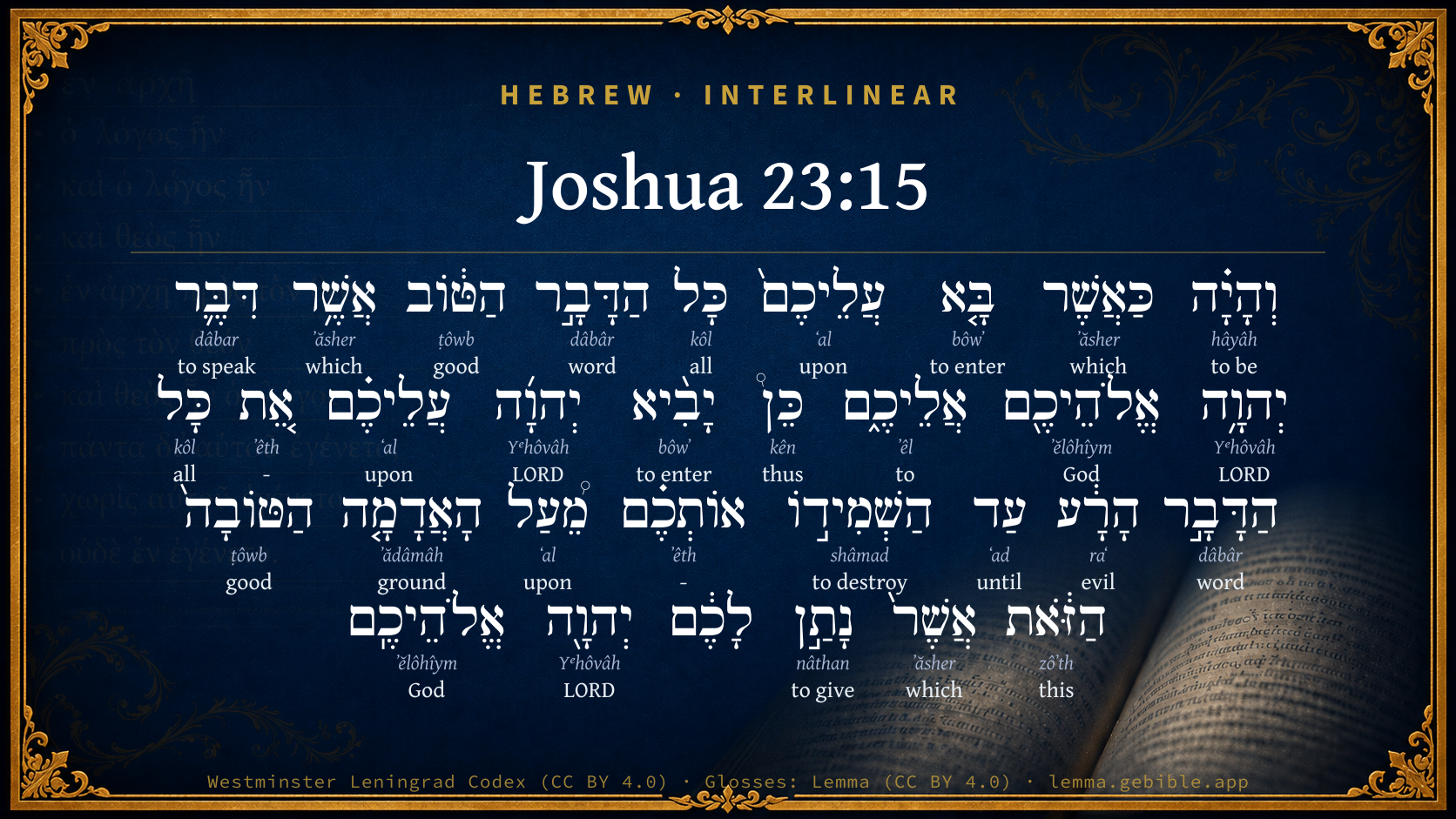
Hebrew (Westminster Leningrad Codex) Joshua 23:15 appears in the Hebrew Old Testament. The text above is from the Westminster Leningrad Codex. Each word links to its Strong’s number, a concise gloss, and parsing drawn from the Open Scriptures Hebrew Bible morphology. Click any word for its full Brown-Driver-Briggs (BDB) entry.
Download image
Cite this verse

Joshua 23:15 (World English Bible). Public Domain. Lemma interlinear Bible study tool, https://lemma.gebible.app/v/joshua/23/15.

Show BibTeX & RIS
BibTeX
RIS
English Translation
It shall happen, that as all the good things are come on you of which Yahweh your God spoke to you, so will Yahweh bring on you all the evil things, until he have destroyed you from off this good land which Yahweh your God has given you.
World English Bible · Public Domain
Download a study sheet

One document with this verse’s original text, its word-by-word gloss line, the meaning frame, cross-references with their text, attributed commentary, and full source and license credits — printable, and it pastes into notes with its structure intact.

This verse Autodidact and up

Study sheet (.html) Plain text (.txt)

A passage Seminary Student

Up to 50 verses in one chapter. A passage sheet keeps up to 6 commentary sources and 12 cross-references per verse, in the order this page ranks them, and says so on the sheet whenever that leaves anything out. Ask for a single verse and you get the Autodidact verse sheet above.

Everything on this page stays free to read, with no account — the sheet is a download of what is already on screen, not access to it.

Want to remove ads? Support Godless Engineer
Compare translations 3

The same verse in 3 English versions, stacked beneath the original-language interlinear above. Click any original word for its lexicon entry.

Each is an independent rendering of the whole verse — the interlinear is not word-aligned to these translations.

Highlighted words mark where these versions differ — a whole-verse word diff, not a word-by-word alignment.

  • World English Bible Public Domain
    It shall happen, that as all the good things are come on you of which Yahweh your God spoke to you, so will Yahweh bring on you all the evil things, until he have destroyed you from off this good land which Yahweh your God has given you.
  • King James Version Public Domain
    Therefore it shall come to pass, that as all good things are come upon you, which the LORD your God promised you; so shall the LORD bring upon you all evil things, until he have destroyed you from off this good land which the LORD your God hath given you.
  • unfoldingWord Literal Text CC BY-SA 4.0
    And it will happen, just as all of the good word that Yahweh your God spoke to you has come upon you, thus Yahweh will bring upon you all of the evil word until he has destroyed you from upon this good ground that Yahweh your God has given to you.

unfoldingWord Literal Text — © unfoldingWord, licensed CC BY-SA 4.0. Word-aligned USFM3 via Door43 (git.door43.org/unfoldingWord/en_ult).

Versions to compare (up to 4)

3 of 4 selected

Show all 18 translations

Every available English version of this verse, each an independent rendering of the whole verse.

  • World English Bible Public Domain
    It shall happen, that as all the good things are come on you of which Yahweh your God spoke to you, so will Yahweh bring on you all the evil things, until he have destroyed you from off this good land which Yahweh your God has given you.
  • Berean Standard Bible Public Domain
    But just as every good thing the LORD your God promised you has come to pass, likewise the LORD will bring upon you the calamity He has threatened, until He has destroyed you from this good land He has given you.
  • Majority Standard Bible Public Domain
    But just as every good thing the LORD your God promised you has come to pass, likewise the LORD will bring upon you the calamity He has threatened, until He has destroyed you from this good land He has given you.
  • King James Version Public Domain
    Therefore it shall come to pass, that as all good things are come upon you, which the LORD your God promised you; so shall the LORD bring upon you all evil things, until he have destroyed you from off this good land which the LORD your God hath given you.
  • American Standard Version (1901) Public Domain
    And it shall come to pass, that as all the good things are come upon you of which Jehovah your God spake unto you, so will Jehovah bring upon you all the evil things, until he have destroyed you from off this good land which Jehovah your God hath given you.
  • Revised Version (1885) Public Domain
    And it shall come to pass, that as all the good things are come upon you of which the LORD your God spake unto you, so shall the LORD bring upon you all the evil things, until he have destroyed you from off this good land which the LORD your God hath given you.
  • Geneva Bible (1599) Public Domain
    Therefore as all good things are come vpon you, which the Lord your God promised you, so shall the Lord bring vpon you euery euill thing, vntill he haue destroyed you out of this good land, which ye Lord your God hath giue you.
  • Douay-Rheims (1899) Public Domain
    Therefore as he hath fulfilled in deed, what he promised, and all things prosperous have come: so Will he bring upon you all the evils he hath threatened, till he take you away and destroy you from off this excellent land, which he hath given you,
  • Young's Literal Translation Public Domain
    `And it hath been, as there hath come upon you all the good thing which Jehovah your God hath spoken unto you, so doth Jehovah bring upon you the whole of the evil thing, till His destroying you from off this good ground which Jehovah your God hath given to you;
  • Literal Standard Version CC BY-SA 4.0
    And it has been, as there has come on you all the good thing which your God YHWH has spoken to you, so YHWH brings on you the whole of the evil thing, until His destroying you from off this good ground which your God YHWH has given to you;
  • Unlocked Literal Bible CC BY-SA 4.0
    But just as every word Yahweh your God promised you has been fulfilled, so Yahweh will bring on you all the evil things until he has destroyed you from this good land that Yahweh your God has given you.
  • unfoldingWord Literal Text CC BY-SA 4.0
    And it will happen, just as all of the good word that Yahweh your God spoke to you has come upon you, thus Yahweh will bring upon you all of the evil word until he has destroyed you from upon this good ground that Yahweh your God has given to you.
  • Darby Bible Public Domain
    But it shall come to pass, that as every good word hath been fulfilled to you, that Jehovah your God spoke to you, so will Jehovah bring upon you every evil word, until he have destroyed you from off this good land which Jehovah your God hath given you;
  • World Messianic Bible Public Domain
    It shall happen that as all the good things have come on you of which the LORD your God spoke to you, so the LORD will bring on you all the evil things, until he has destroyed you from off this good land which the LORD your God has given you,
  • Webster's Bible Public Domain
    Therefore it shall come to pass, that as all good things are come upon you, which the LORD your God promised you; so shall the LORD bring upon you all evil things, until he hath destroyed you from off this good land which the LORD your God hath given you.
  • Free Bible Version CC BY-SA 4.0
    But in the same way that you received all the good things that the Lord your God promised, the Lord will bring on you all the bad things he has threatened until you're completely wiped out from this good land the Lord your God has given to you.
  • Bible in Basic English Public Domain
    And you will see that, as all the good things which the Lord your God undertook to do for you, have come to you, so the Lord will send down on you all the evil things till he has made your destruction complete, and you are cut off from the good land which the Lord your God has given you.
  • JPS Tanakh (1917) Public Domain
    And it shall come to pass, that as all the good things are come upon you of which the LORD your God spoke unto you, so shall the LORD bring upon you all the evil things, until He have destroyed you from off this good land which the LORD your God hath given you.

Literal Standard Version (2020), Covenant Press — licensed CC BY-SA 4.0. Text via the HelloAO Bible API (eBible.org). Unlocked Literal Bible (unfoldingWord) — licensed CC BY-SA 4.0. Text via the HelloAO Bible API (eBible.org). unfoldingWord Literal Text — © unfoldingWord, licensed CC BY-SA 4.0. Word-aligned USFM3 via Door43 (git.door43.org/unfoldingWord/en_ult). Free Bible Version, Dr. Jonathan Gallagher — licensed CC BY-SA 4.0. Text via the HelloAO Bible API (eBible.org).

Word by word

More ways to search: Search by grammar → Find every occurrence → Compare this word →

Practice this passage: Drill this verse → Learn its vocabulary →

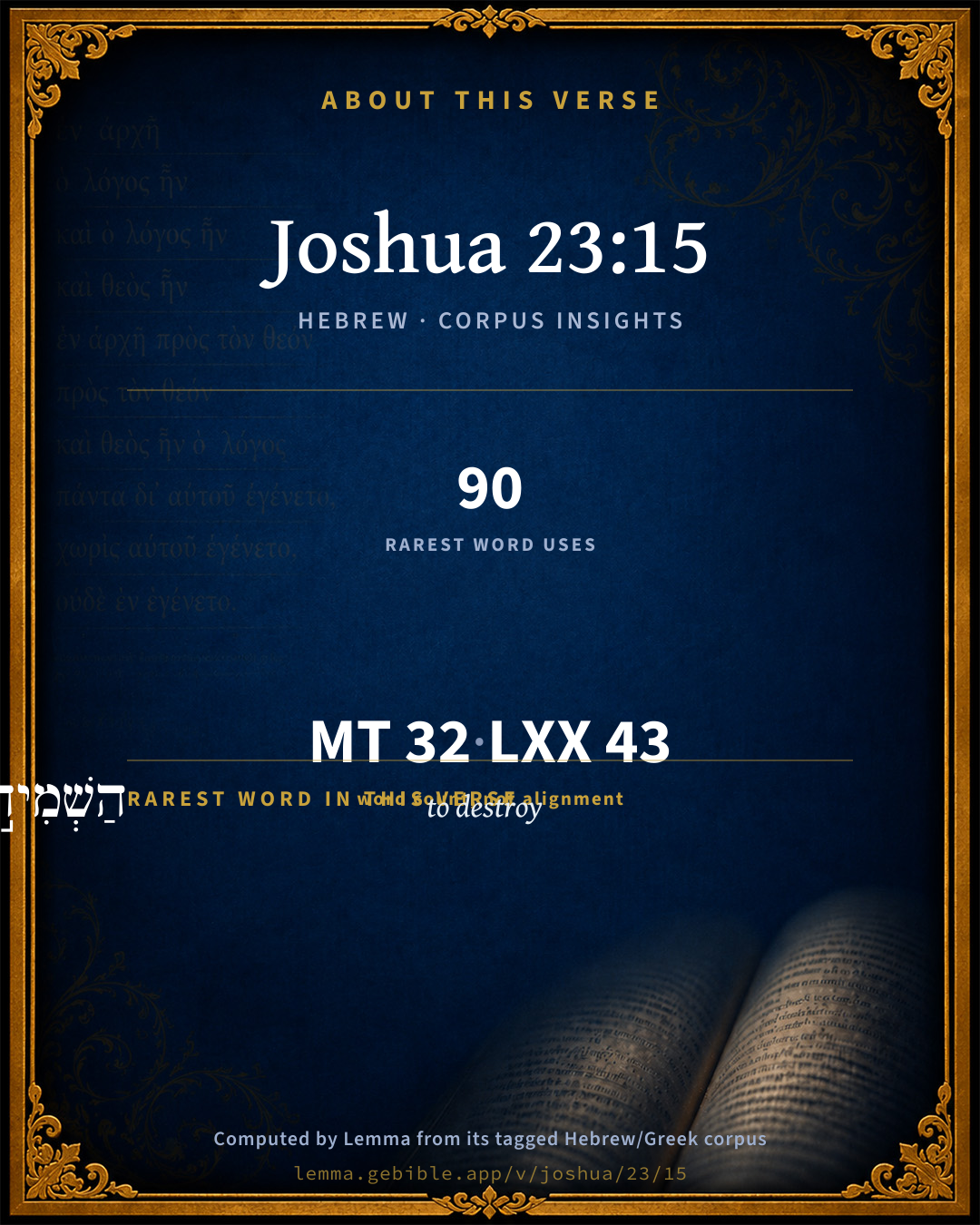
הַשְׁמִיד֣וֹ
shâmad
H8045
“to destroy · him”
Verb, Hiphil, Infinitive Construct + Suffix, Personal, 3rd Person, Masculine, Singular
Part of Speech
Verb
Stem
Hiphil
Form
Infinitive Construct
Full BDB Definition

Origin: a primitive root

TWOT: 2406

to destroy, exterminate, be destroyed, be exterminated - (Niphal) - to be annihilated, be exterminated - to be destroyed, be devastated - (Hiphil) - to annihilate, exterminate - to destroy
  1. וְהָיָ֗ה hâyâh H1961 “and · to be” Conjunction + Verb, Qal, Sequential Perfect, 3rd Person, Masculine, Singular
  2. כַּאֲשֶׁר ʼăsher H834 “like/as · which” Preposition + Particle, Relative
  3. בָּ֤א bôwʼ H935 “to enter” Verb, Qal, Perfect, 3rd Person, Masculine, Singular
  4. עֲלֵיכֶם֙ ʻal H5921 “upon · you” Preposition + Suffix, Personal, 2nd Person, Masculine, Plural
  5. כָּל kôl H3605 “all of” Noun, Common, Masculine, Singular, Construct
  6. הַדָּבָ֣ר dâbâr H1697 “the · word” Particle, Definite Article + Noun, Common, Masculine, Singular, Absolute
  7. הַטּ֔וֹב ṭôwb H2896 “the · good” Particle, Definite Article + Adjective, Adjective, Masculine, Singular, Absolute
  8. אֲשֶׁ֥ר ʼăsher H834 “which” Particle, Relative
  9. דִּבֶּ֛ר dâbar H1696 “to speak” Verb, Piel, Perfect, 3rd Person, Masculine, Singular
  10. יְהוָ֥ה Yᵉhôvâh H3068 “LORD” Noun, Proper
  11. אֱלֹהֵיכֶ֖ם ʼĕlôhîym H430 “God(s) · your” Noun, Common, Masculine, Plural, Construct + Suffix, Personal, 2nd Person, Masculine, Plural
  12. אֲלֵיכֶ֑ם ʼêl H413 “to · you” Preposition + Suffix, Personal, 2nd Person, Masculine, Plural
  13. כֵּן֩ kên H3651 “thus” Particle, Demonstrative
  14. יָבִ֨יא bôwʼ H935 “to enter” Verb, Hiphil, Imperfect, 3rd Person, Masculine, Singular
  15. יְהוָ֜ה Yᵉhôvâh H3068 “LORD” Noun, Proper
  16. עֲלֵיכֶ֗ם ʻal H5921 “upon · you” Preposition + Suffix, Personal, 2nd Person, Masculine, Plural
  17. אֵ֚ת ʼêth H853 “-” Particle, Direct Object
  18. כָּל kôl H3605 “all of” Noun, Common, Masculine, Singular, Construct
  19. הַדָּבָ֣ר dâbâr H1697 “the · word” Particle, Definite Article + Noun, Common, Masculine, Singular, Absolute
  20. הָרָ֔ע raʻ H7451 “the · evil” Particle, Definite Article + Adjective, Adjective, Masculine, Singular, Absolute
  21. עַד ʻad H5704 “until” Preposition
  22. אוֹתְכֶ֗ם ʼêth H853 “- · you” Particle, Direct Object + Suffix, Personal, 2nd Person, Masculine, Plural
  23. מֵ֠עַל ʻal H5921 “from · upon” Preposition + Preposition
  24. הָאֲדָמָ֤ה ʼădâmâh H127 “the · ground” Particle, Definite Article + Noun, Common, Feminine, Singular, Absolute
  25. הַטּוֹבָה֙ ṭôwb H2896 “the · good” Particle, Definite Article + Adjective, Adjective, Feminine, Singular, Absolute
  26. הַזֹּ֔את zôʼth H2063 “the · this” Particle, Definite Article + Pronoun, Demonstrative, Feminine, Singular
  27. אֲשֶׁר֙ ʼăsher H834 “which” Particle, Relative
  28. נָתַ֣ן nâthan H5414 “to give” Verb, Qal, Perfect, 3rd Person, Masculine, Singular
  29. יְהוָ֖ה Yᵉhôvâh H3068 “LORD” Noun, Proper
  30. אֱלֹהֵיכֶֽם ʼĕlôhîym H430 “God(s) · your” Noun, Common, Masculine, Plural, Construct + Suffix, Personal, 2nd Person, Masculine, Plural

About this verse

These counts appear in no published source. They are computed here, from the morphology-tagged text and Lemma’s own curated glosses. What Lemma adds →

32
words
19
distinct lemmas
Historical
section

Grammatical profile

  • 6 verbs
  • 10 nouns
  • 3 adjectives
  • 1 pronoun
  • 6 prepositions
  • 6 particles

Verb forms

  • וְהָיָ֗ה Qal · Sequential Perfect
  • בָּ֤א Qal · Perfect
  • דִּבֶּ֛ר Piel · Perfect
  • יָבִ֨יא Hiphil · Imperfect
  • הַשְׁמִיד֣וֹ Hiphil · Infinitive Construct
  • נָתַ֣ן Qal · Perfect

Repetition

Words recur within this verse — often emphatic in Hebrew:

  • עֲלֵיכֶם֙ upon H5921 ×3
  • יְהוָ֥ה LORD H3068 ×3
  • בָּ֤א to enter H935 ×2
  • כָּל all H3605 ×2
  • הַדָּבָ֣ר word H1697 ×2
  • הַטּ֔וֹב good H2896 ×2
  • אֱלֹהֵיכֶ֖ם God H430 ×2
  • כַּאֲשֶׁר which H834 ×3

Hebrew & Septuagint length

In English translation the verse runs 48 words from the Hebrew and 45 from the Septuagint (LXX English) — closely comparable.

A rough comparison of the two English renderings, which tokenize alike — not a word-level alignment.

Word counts can differ between the Hebrew and the Greek without any difference in meaning — e.g. the Hebrew direct-object marker אֵת has no separate Greek word, and Greek often adds the article ὁ.

In the original languages it is 32 Hebrew tokens and 43 Greek tokens — but the two are counted differently (Hebrew bundles its prefixes and suffixes into one token; the Greek is in lemma form), so that isn’t a like-for-like length.

Cross-references

11

Topical passages linked to Joshua 23:15 in the Treasury of Scripture Knowledge — connected by theme and wording, ordered by reader-vote popularity; previews shown in the World English Bible.

  • Deuteronomy 28:15–68 But it shall come to pass, if you will not listen to the voice of Yahweh your God, to observe to do all his commandments and his statutes which I command you this day, that all these curses shall come on you, and overtake you.
  • Leviticus 26:14–46 "'But if you will not listen to me, and will not do all these commandments;
  • Judges 3:8 Therefore the anger of Yahweh was kindled against Israel, and he sold them into the hand of Cushan Rishathaim king of Mesopotamia: and the children of Israel served Cushan Rishathaim eight years.
  • Judges 4:1–2 The children of Israel again did that which was evil in the sight of Yahweh, when Ehud was dead.
  • Judges 6:1 The children of Israel did that which was evil in the sight of Yahweh: and Yahweh delivered them into the hand of Midian seven years.
  • Judges 10:6–7 The children of Israel again did that which was evil in the sight of Yahweh, and served the Baals, and the Ashtaroth, and the gods of Syria, and the gods of Sidon, and the gods of Moab, and the gods of the children of Ammon, and the gods of the Philistines; and they forsook Yahweh, and didn't serve him.
  • Judges 13:1 The children of Israel again did that which was evil in the sight of Yahweh; and Yahweh delivered them into the hand of the Philistines forty years.
  • 2 Chronicles 36:16–17 but they mocked the messengers of God, and despised his words, and scoffed at his prophets, until the wrath of Yahweh arose against his people, until there was no remedy.
  • Luke 21:22–24 For these are days of vengeance, that all things which are written may be fulfilled.
  • 1 Thessalonians 2:16 forbidding us to speak to the Gentiles that they may be saved; to fill up their sins always. But wrath has come on them to the uttermost.
  • Judges 3:12 The children of Israel again did that which was evil in the sight of Yahweh: and Yahweh strengthened Eglon the king of Moab against Israel, because they had done that which was evil in the sight of Yahweh.

Cross-references courtesy of OpenBible.info (CC BY 4.0).

Hebrew and Greek witnesses Masoretic Hebrew ↔ Greek Septuagint

The same verse in the two great witnesses to the Old Testament, shown verse-for-verse.

These are two independent witnesses, not word-aligned to each other, and the Septuagint is shown in lemma (dictionary) form.

Hebrew Joshua 23:15 Masoretic · Westminster Leningrad Codex

וְהָיָ֗ה כַּאֲשֶׁר בָּ֤א עֲלֵיכֶם֙ כָּל הַדָּבָ֣ר הַטּ֔וֹב אֲשֶׁ֥ר דִּבֶּ֛ר יְהוָ֥ה אֱלֹהֵיכֶ֖ם אֲלֵיכֶ֑ם כֵּן֩ יָבִ֨יא יְהוָ֜ה עֲלֵיכֶ֗ם אֵ֚ת כָּל הַדָּבָ֣ר הָרָ֔ע עַד הַשְׁמִיד֣וֹ אוֹתְכֶ֗ם מֵ֠עַל הָאֲדָמָ֤ה הַטּוֹבָה֙ הַזֹּ֔את אֲשֶׁר֙ נָתַ֣ן לָכֶ֔ם יְהוָ֖ה אֱלֹהֵיכֶֽם

It shall happen, that as all the good things are come on you of which Yahweh your God spoke to you, so will Yahweh bring on you all the evil things, until he have destroyed you from off this good land which Yahweh your God has given you.

World English Bible · Public Domain

Greek LXX Joshua 23:15 Septuagint · lemma form

καί εἰμί ὅς τρόπος ἥκω ἐπί σύ πᾶς ὁ ῥῆμα ὁ καλός ὅς λαλέω κύριος πρός σύ οὕτως ἐπιἄγω κύριος ὁ θεός ἐπί σύ πᾶς ὁ ῥῆμα ὁ πονηρός ἕως ἄν ἐκὀλεθρεύω σύ ἀπό ὁ γῆ ὁ ἀγαθός οὗτος ὅς δίδωμι κύριος σύ

And it shall come to pass, that as all the good things are come upon us which the Lord God will bring upon you all the evil things, until he shall have destroyed you from off this good land, which the Lord has given you,

LXX2012 (modern English Septuagint) · Public Domain

Hebrew: Westminster Leningrad Codex (CC BY 4.0). Greek: Septuagint (public domain); English from LXX2012 (modern English Septuagint) (Public Domain). How the Septuagint differs from the Hebrew →

Targum (Aramaic paraphrase)

1

The Targum is the ancient Jewish Aramaic paraphrase of the Hebrew Scriptures — an interpretive translation, not the Hebrew text itself. Onkelos (literal) and Pseudo-Jonathan (expansive) render the Torah, and Jonathan the Prophets. Coverage is partial: where no permissively-licensed English translation exists for a verse, only the Aramaic is shown. This is verse-level text, not a word-by-word alignment to the Hebrew.

  1. Targum Jonathan Prophets (Joshua–Malachi)
    וִיהֵי כְּמָא דְאִתְקַיָמוּ עֲלֵיכוֹן כָּל פִּתְגָמַיָא תַקְנַיָא דִי מַלֵיל יְיָ אֱלָהָכוֹן עֲלֵיכוֹן כֵּן יַיְתֵי יְיָ עֲלֵיכוֹן יַת כָּל פִּתְגָמַיָא בִּישַׁיָא עַד דִישֵׁיצֵי יַתְכוֹן מֵעַל אַרְעָא טַבְתָא הָדָא דִי יְהַב לְכוֹן יְיָ אֱלָהָכוֹן:

    (no public-domain English translation for this verse)

    Targum Jonathan — Aramaic: “Mikraot Gedolot” (public domain). English: “Sefaria Community Translation” (CC0 1.0 (public-domain dedication)); “London "Chaldee Paraphrase," 1871” (public domain). Text via Sefaria.

Commentary

Notes on Joshua 23:15 from classic Christian and Jewish commentators (each source and its license shown beneath its notes). The classic Christian expositions comment on the surrounding passage and are grouped to its opening verse, so a note may address several verses; the Jewish commentaries on the Tanakh (Rashi and others) are per-verse, so they appear only where the commentator wrote on this verse.

Lemma curates 59 commentaries, every one of them public domain or Creative Commons licensed, each selected and text-cleaned for this edition rather than reprinted as found. About our sources →

Trapp's Complete Commentary

John Trapp

Jos 23:15 Therefore it shall come to pass, [that] as all good things are come upon you, which the LORD your God promised you; so shall the LORD bring upon you all evil things, until he have destroyed you from off this good land which the LORD your God hath given you.

Ver. 15. So shall the Lord bring upon you all evil things.] To the sweetness of the promises he fitly adjoineth the tartness of the menaces. Sour and sweet make the best sauce: promises and threatenings mingled serve to keep the heart in the best temper.

John Trapp, A Commentary or Exposition upon All the Books of the Old and New Testament (1647–1656) — public domain. Text from a community e-Sword module.

Joseph Benson's Commentary

Jos 23:15. Bring upon you all evil things — According to what Moses had predicted at large, Leviticus 26. and Deuteronomy 28. For God’s faithfulness is no less visible in fulfilling his threatenings than his promises. Indeed the accomplishment of his promises is a pledge that he will also fulfil his threatenings, both of them standing on the same ground, the truth of God.

Joseph Benson's Commentary on the Old and New Testaments (1811–1818) — public domain. Text from a community e-Sword module.

Tyndale Open Study Notes

Tyndale Open Resources

23:15-16 God had blessed the Israelites, and he would also certainly judge them if they turned away from him. Joshua’s warning against apostasy was prophetic; Israel did turn away, and God did not drive out the remaining Canaanites (Judg 2:20-23).

Tyndale Open Study Notes — © Tyndale Open Resources, licensed CC BY-SA 4.0. Text via the HelloAO Bible API.

Geneva Bible (1599)

Geneva Bible translators

Or, threatenings, as Josh. 24:20.

Or, promises.

Geneva Bible (1599) marginal notes — public domain. Text via Bolls.life.

Adam Clarke's Commentary

Verse 15. So shall the Lord bring upon you all evil things] His faithfulness in fulfilling his promises is a proof that he will as faithfully accomplish his threatenings, for the veracity of God is equally pledged for both.

Adam Clarke's Commentary on the Bible (1810–1826) — public domain. Text from a community e-Sword/MySword module.

Ellicott's Commentary for English Readers

(15) As all good things are come upon you . . . so shall . . . all evil things.—Comp. Deu_8:19-20, and Deu_30:17-18, and Deuteronomy 28 throughout.

The above exhortations are upon matters that lie within the province of the ruler. The law must be forgotten if the magistrates will not enforce it. Marriages and treaties and public worship are matters under the control of the law. What the rulers will not tolerate, the people will find it hard to maintain.

A Bible Commentary for English Readers, edited by Charles John Ellicott (1878–1897) — public domain. Text from a community e-Sword module.

The Cambridge Bible for Schools and Colleges

gen. ed. J. J. S. Perowne

15. it shall come to pass] He reiterates his solemn warning against backsliding, and recalls to their minds the promises and threats contained in the last address of Moses to the people.

all evil things] “whateuer thing of yuelis he manaasside;” Wyclif. Comp. Lev_26:14-39; Deu_28:15-68; Deu_29:14-28; Deu_30:1-15. The sublimity of the denunciations of the Hebrew lawgiver contained in these passages “surpasses anything in the oratory or the poetry of the whole world. Nature is exhausted in furnishing terrific images; nothing, excepting the real horrors of the Jewish history—the miseries of their sieges, the cruelty, the contempt, the oppressions, the persecutions, which, for ages, this scattered and despised and detested nation have endured—can approach the tremendous maledictions which warned them against the violation of their Law.” Milman’s History of the Jews, i. 211.

The Cambridge Bible for Schools and Colleges (gen. ed. J. J. S. Perowne; Cambridge University Press, 1878–1918) — public domain. Text from a community e-Sword module.

John Gill's Exposition

Therefore it shall come to pass, that as all the good things are come upon you which the Lord hath promised you,.... Of which there was full proof, and it could not be denied:

so shall the Lord bring upon you all evil things; calamities and distresses, by his sore judgments of famine, sword, pestilence, evil beasts, and captivity, in case of disobedience to his commands:

until he have destroyed you from off this good land which the Lord your God hath given you; for as he is faithful to his promises, so to his threatenings; and from his punctual performance of the one may be argued and expected the sure fulfilment of the other, and which has been abundantly verified in that people; see Lev 26:1 and the notes there.

John Gill's Exposition of the Whole Bible (1746–1763) — public domain (CC PDM 1.0). Text via the HelloAO Bible API.

Matthew Poole's English Annotations

The accomplishment of God’s promises is a pledge or assurance that he will also fulfil his threatenings; both of them depending upon the same ground, the faithfulness of God.

Matthew Poole's English Annotations on the Holy Bible (1683–1685) — public domain. Text from a community e-Sword/MySword module.

Whedon's Commentary on the Bible

Daniel D. Whedon

15. As all good… so all evil things — The threatenings are as sure as the promises; both alike are grounded on the divine veracity. The sophistry which would explain away the former must destroy the latter. “The pillars of heaven are no firmer than the foundations of hell.” — Whedon. These words of Joshua are of universal application. They belong to all peoples and to all generations. Before each individual of the human race there lies the path of obedience, ending in the promises, and the path of disobedience, ending in the threatenings of the Almighty. “Knowing therefore the terrors of the Lord, we persuade men.”

Daniel D. Whedon (gen. ed.), Commentary on the Old and New Testaments (1874–1909) — public domain. Text from a community e-Sword module.

The Pulpit Commentary

All good things. Literally, all the good word. That is to say, the prophecies of good had been fulfilled. Joshua uses this as an argument that the evil also will not fail to follow, if Israel provoke God to inflict it. But the memory of these words, and of the great deeds of Jehovah, faded quickly from their minds. And then, like the people of the earth before the flood, like the men of Sodom before it was destroyed, and like many other people since, they turned a deaf ear to the prophecies of evil which faithful souls foresaw and foretold. The warnings of the prophets are but a variation upon the predictions of Moses in Lev_26:14-33 Deu_28:15-68 Deu_29:14-28, and of Joshua, here addressed to a generation who had brought some of the predicted evil upon themselves, and would not see that by refusing to listen, they would bring upon themselves yet more. How terribly have these predictions been fulfilled! First, the Babylonish captivity; then the disorders and anarchy in a territory which the Jewish people inhabited, but which they were not strong enough to rule; then the siege of and destruction of Jerusalem under Titus with its accompanying horrors. Then the dispersion of the Jews among all the nations, the barbarous and inhuman persecutions they met with in the Middle Ages from priest and monarch alike: the Inquisition in Spain, the contempt and hatred which continued to be felt for them among more enlightened nations, as evidenced in Marlowe"s "Jew of Malta," and Shakespeare"s "Merchant of Venice," in the days of our own Queen Elizabeth. Only in our own age has a brighter day begun to dawn on them, and three thousand years of oppression, relieved only by the brief glories of David and his dynasty, are beginning to be compensated by a share in the world"s rewards and honours. All evil things. Literally, all the evil word; or thing; every evil thing, that is, which had been foretold.

HOMILIES BY W.F. ADENEY Ver. 15. Threats as true as promises.

There are those who deny God"s threats of punishment the same validity which they ascribe to His promises of blessing. Joshua here ascribes equal certainty to both.

I GOD MUST BE TRUE TO HIS THREATS. God desires to bless, and He can only punish reluctantly, since His nature is love. Hence it might appear that He would not be so true to His threats as to His promises. But, on the other hand, note:

(1) To threaten without intending to execute would be deceitful; God is true and must be faithful to His word.

(2) It would be cruel; a merciful God would not terrify us with groundless alarms.

(3) It would be ineffectual; the emptiness of the threat would be ultimately discovered, and then the delusion would cease to be a terror and become a mockery.

(4) Punishment is ordained not to satisfy vengeance, but to establish justice and to vindicate and restore righteousness. It is a good sent for good ends, and to refrain from it would be a mark of weakness, not of mercy.

II THE APPARENT UNCERTAINTY OF GOD"S THREATS ADMITS OF EXPLANATION.

(1) They are conditional. The punishment does not always come because the conditions of the threat are altered. Repentance and faith in Christ are conditions on which God exercises mercy and refrains from executing His threat. The turning from evil is declared to be an alteration of circumstances which makes the threat no longer to apply. (Eze_33:19) The force of gravitation is not suspended when we arrest the motion of a falling body. The law is not frustrated by the counteraction of the gospel.

(2) Threats are often misunderstood. The Church has added monstrous physical horrors to the threats of the Bible, against which men revolt. It is not our interpretation of the threat, but God"s meaning, that will be fulfilled.

(3) Threats apply to the future; because God is long suffering, men refuse to believe that He is just. The delay of punishment is no ground for disbelieving in the reality of it.

(4) Threats are unpleasant; many persons will not entertain unpleasant ideas. Yet a fact is not the less true because it does not please us.

III THE APPLICATION OF GOD"S THREATS SHOULD BE SERIOUSLY CONSIDERED.

(1) It is dangerous to neglect them. We do not improve our health by ignoring the opinion of a physician simply because this is unfavorable. If the Divine warnings are true, they are terribly true, and no soul should be at rest till it has found safety in Christ.

(2) It is foolish to despair. Why are these threats recorded in the Bible? Surely not simply to torture us! If they were inevitable it would be most merciful to conceal our doom from us till the last moment. But they are warnings. The very fact that they are recorded implies that the evil they describe may be avoided. The threat is true, but it is conditional. Therefore let us flee the danger by escaping to the refuge which God has provided. W.F.A. (Rom_8:1)

The Pulpit Commentary (1880–1919), ed. H.D.M. Spence-Jones & Joseph S. Exell — public domain. Text from a community e-Sword module.

John Wesley's Explanatory Notes

Evil things - The accomplishment of God's promise is a pledge that he will also fulfil his threatnings; both of them depending upon the same ground, the faithfulness of God.

John Wesley, Explanatory Notes Upon the Whole Bible (1754–1765) — public domain. Text via the GEBible commentary corpus.

Lesson kit

Teaching starters — assembled from the data on this page, not authored interpretation. Every prompt links to the verse data it draws on. Edit before teaching.

Joshua, in the Historical, opens this verse with 32 words (19 distinct Hebrew lemmas). Its most distinctive word is shâmad (“to destroy”). A historical commentator’s framing appears above. Read the whole chapter for the surrounding context.

Discussion questions

  1. The word shâmad carries the sense “to destroy.” How does it shape the verse?
  2. How does Deuteronomy 28:15–68, which shares this passage’s theme, read alongside this verse?
  3. What does the repetition of “upon” (3× in this one verse) do in this verse?
  4. These translations render this verse differently. What is at stake in choosing one wording over another?
  5. «וְהָיָ֗ה» is a Qal Sequential Perfect verb. How does that grammatical form shape the action described?
  6. Compare how Trapp's Complete Commentary and Joseph Benson's Commentary read this verse. Where do they agree or differ?

Things to notice

Reading settings

Reading text

Shown beneath each verse's original-language words.

Old Testament
Old Testament edition

Read the OT as the Masoretic Hebrew (MT) or the Greek Septuagint (LXX).

English shown for the Greek Septuagint (in the Hebrew ↔ Greek comparison).

Comparing translations? Open the Compare panel on any verse page to stack up to four side by side.