
Genesis 24:5

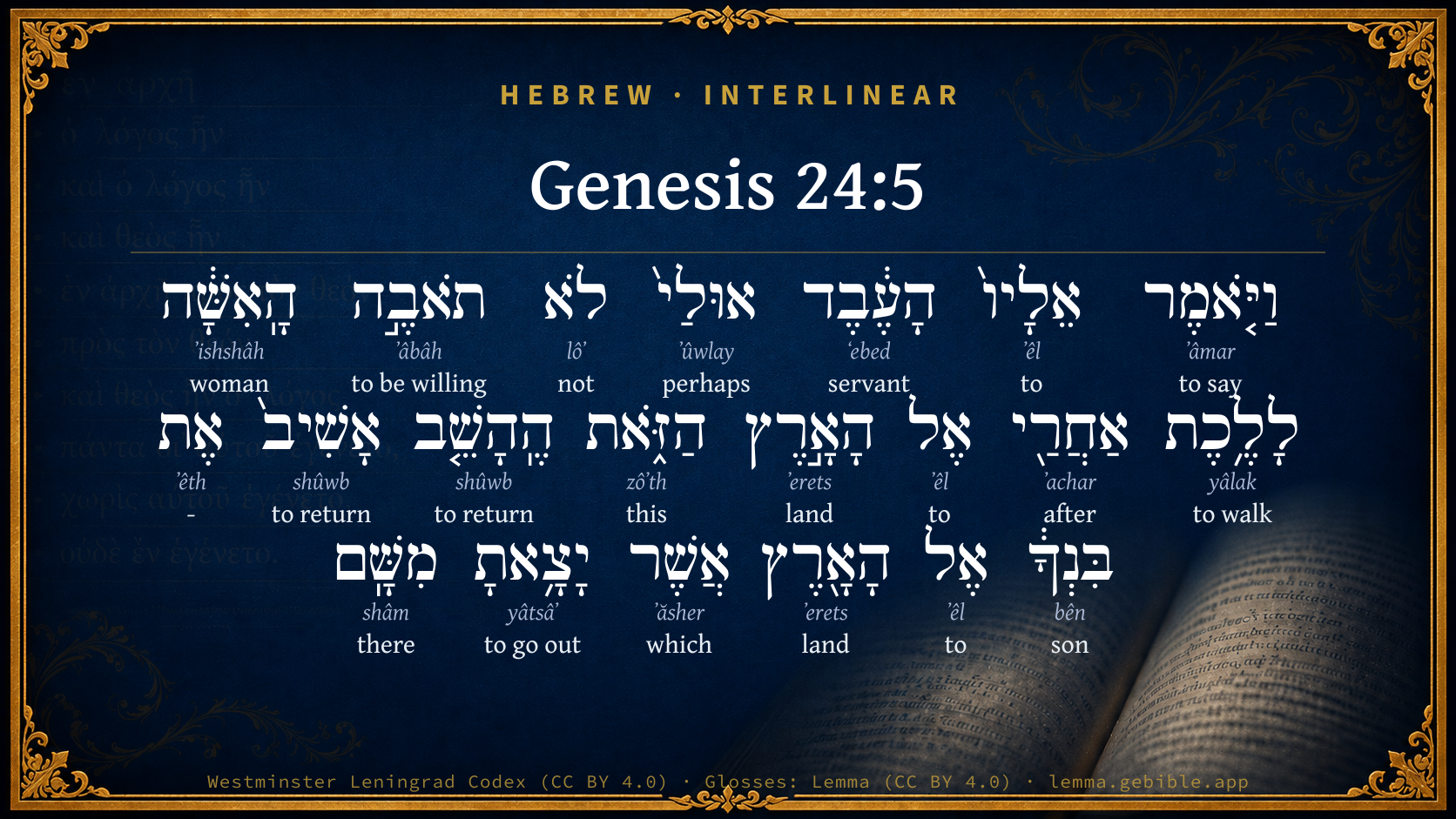
Hebrew (Westminster Leningrad Codex) Genesis 24:5 appears in the Hebrew Old Testament. The text above is from the Westminster Leningrad Codex. Each word links to its Strong’s number, a concise gloss, and parsing drawn from the Open Scriptures Hebrew Bible morphology. Click any word for its full Brown-Driver-Briggs (BDB) entry.
Download image
Cite this verse

Genesis 24:5 (World English Bible). Public Domain. Lemma interlinear Bible study tool, https://lemma.gebible.app/v/genesis/24/5.

Show BibTeX & RIS
BibTeX
RIS
English Translation
The servant said to him, "What if the woman isn't willing to follow me to this land? Must I bring your son again to the land you came from?"
World English Bible · Public Domain
Highlights
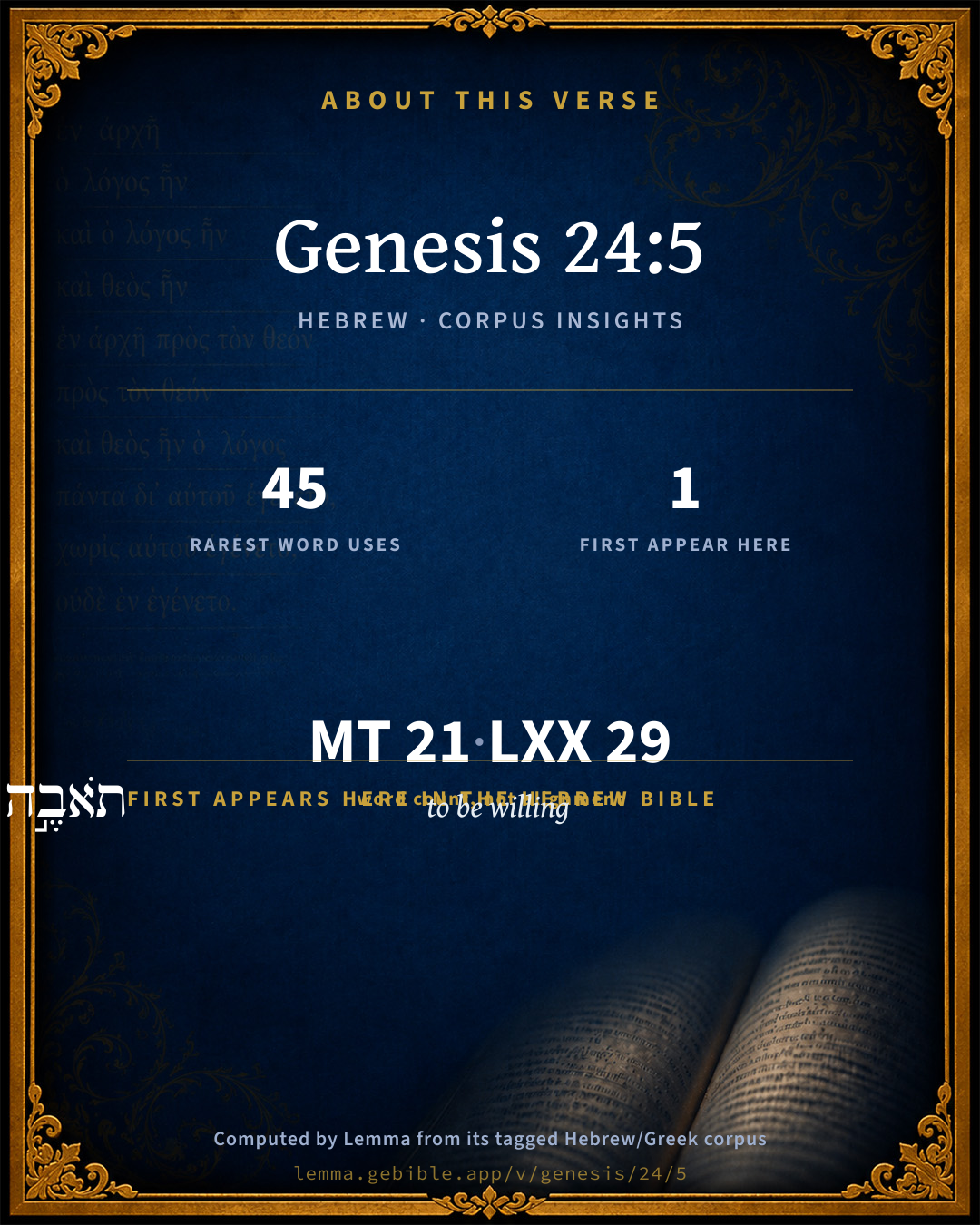
  • 1 first appearance in the Hebrew Bible
Full analysis ↓
Download a study sheet

One document with this verse’s original text, its word-by-word gloss line, the meaning frame, cross-references with their text, attributed commentary, and full source and license credits — printable, and it pastes into notes with its structure intact.

This verse Autodidact and up

Study sheet (.html) Plain text (.txt)

A passage Seminary Student

Up to 50 verses in one chapter. A passage sheet keeps up to 6 commentary sources and 12 cross-references per verse, in the order this page ranks them, and says so on the sheet whenever that leaves anything out. Ask for a single verse and you get the Autodidact verse sheet above.

Everything on this page stays free to read, with no account — the sheet is a download of what is already on screen, not access to it.

Want to remove ads? Support Godless Engineer
Compare translations 3

The same verse in 3 English versions, stacked beneath the original-language interlinear above. Click any original word for its lexicon entry.

Each is an independent rendering of the whole verse — the interlinear is not word-aligned to these translations.

Highlighted words mark where these versions differ — a whole-verse word diff, not a word-by-word alignment.

  • World English Bible Public Domain
    The servant said to him, "What if the woman isn't willing to follow me to this land? Must I bring your son again to the land you came from?"
  • King James Version Public Domain
    And the servant said unto him, Peradventure the woman will not be willing to follow me unto this land: must I needs bring thy son again unto the land from whence thou camest?
  • unfoldingWord Literal Text CC BY-SA 4.0
    Then the servant said to him, “Suppose the woman is not willing to come with me to this land? Should I take your son back to the country that you came from?”

unfoldingWord Literal Text — © unfoldingWord, licensed CC BY-SA 4.0. Word-aligned USFM3 via Door43 (git.door43.org/unfoldingWord/en_ult).

Versions to compare (up to 4)

3 of 4 selected

Show all 18 translations

Every available English version of this verse, each an independent rendering of the whole verse.

  • World English Bible Public Domain
    The servant said to him, "What if the woman isn't willing to follow me to this land? Must I bring your son again to the land you came from?"
  • Berean Standard Bible Public Domain
    The servant asked him, “What if the woman is unwilling to follow me to this land? Shall I then take your son back to the land from which you came?”
  • Majority Standard Bible Public Domain
    The servant asked him, “What if the woman is unwilling to follow me to this land? Shall I then take your son back to the land from which you came?”
  • King James Version Public Domain
    And the servant said unto him, Peradventure the woman will not be willing to follow me unto this land: must I needs bring thy son again unto the land from whence thou camest?
  • American Standard Version (1901) Public Domain
    And the servant said unto him, Peradventure the woman will not be willing to follow me unto this land. Must I needs bring thy son again unto the land from whence thou camest?
  • Revised Version (1885) Public Domain
    And the servant said unto him, Peradventure the woman will not be willing to follow me unto this land: must I needs bring thy son again unto the land from whence thou camest?
  • Geneva Bible (1599) Public Domain
    And the seruant saide to him, What if the woman will not come with me to this land? shall I bring thy sonne againe vnto the lande from whence thou camest?
  • Douay-Rheims (1899) Public Domain
    The servant answered: If the woman will not come with me into this land, must I bring thy son back again to the place, from whence thou camest out?
  • Young's Literal Translation Public Domain
    And the servant saith unto him, `It may be the woman is not willing to come after me unto this land; do I at all cause thy son to turn back unto the land from whence thou camest out?'
  • Literal Standard Version CC BY-SA 4.0
    And the servant says to him, “It may be the woman is not willing to come after me to this land; do I at all cause your son to return to the land from where you came out?”
  • Unlocked Literal Bible CC BY-SA 4.0
    The servant said to him, “What if the woman will not be willing to follow me to this land? Must I take your son back to the land from which you came?”
  • unfoldingWord Literal Text CC BY-SA 4.0
    Then the servant said to him, “Suppose the woman is not willing to come with me to this land? Should I take your son back to the country that you came from?”
  • Darby Bible Public Domain
    And the servant said to him, Perhaps the woman will not be willing to follow me to this land: must I, then, bring thy son again in any case to the land from which thou hast removed?
  • World Messianic Bible Public Domain
    The servant said to him, “What if the woman isn’t willing to follow me to this land? Must I bring your son again to the land you came from?”
  • Webster's Bible Public Domain
    And the servant said to him, It may be the woman will not be willing to follow me to this land: must I needs bring thy son again to the land from whence thou camest?
  • Free Bible Version CC BY-SA 4.0
    “What if the woman refuses to come back with me to this country?” the servant asked. “Should I take your son back to the country you came from?”
  • Bible in Basic English Public Domain
    And the servant said, If by chance the woman will not come with me into this land, am I to take your son back again to the land from which you came?
  • JPS Tanakh (1917) Public Domain
    And the servant said unto him: 'Peradventure the woman will not be willing to follow me unto this land; must I needs bring thy son back unto the land from whence thou camest?'

Literal Standard Version (2020), Covenant Press — licensed CC BY-SA 4.0. Text via the HelloAO Bible API (eBible.org). Unlocked Literal Bible (unfoldingWord) — licensed CC BY-SA 4.0. Text via the HelloAO Bible API (eBible.org). unfoldingWord Literal Text — © unfoldingWord, licensed CC BY-SA 4.0. Word-aligned USFM3 via Door43 (git.door43.org/unfoldingWord/en_ult). Free Bible Version, Dr. Jonathan Gallagher — licensed CC BY-SA 4.0. Text via the HelloAO Bible API (eBible.org).

Word by word

More ways to search: Search by grammar → Find every occurrence → Compare this word →

Practice this passage: Drill this verse → Learn its vocabulary →

אוּלַי֙
ʼûwlay
H194
“perhaps”
Adverb
Part of Speech
Adverb
Full BDB Definition

Origin: from H176

TWOT: 46

perhaps, peradventure - if peradventure - unless - suppose
  1. וַיֹּ֤אמֶר ʼâmar H559 “and · to say” Conjunction + Verb, Qal, Sequential Imperfect, 3rd Person, Masculine, Singular
  2. אֵלָיו֙ ʼêl H413 “to · him” Preposition + Suffix, Personal, 3rd Person, Masculine, Singular
  3. הָעֶ֔בֶד ʻebed H5650 “the · servant” Particle, Definite Article + Noun, Common, Masculine, Singular, Absolute
  4. לֹא lôʼ H3808 “not” Particle, Negative
  5. תֹאבֶ֣ה ʼâbâh H14 “to be willing” Verb, Qal, Imperfect, 3rd Person, Feminine, Singular
  6. הָֽאִשָּׁ֔ה ʼishshâh H802 “the · woman” Particle, Definite Article + Noun, Common, Feminine, Singular, Absolute
  7. לָלֶ֥כֶת yâlak H3212 “to walk” Preposition + Verb, Qal, Infinitive Construct
  8. אַחֲרַ֖י ʼachar H310 “after · me” Preposition + Suffix, Personal, 1st Person, Common, Singular
  9. אֶל ʼêl H413 “to” Preposition
  10. הָאָ֣רֶץ ʼerets H776 “the · land” Particle, Definite Article + Noun, Common, Both, Singular, Absolute
  11. הַזֹּ֑את zôʼth H2063 “the · this” Particle, Definite Article + Pronoun, Demonstrative, Feminine, Singular
  12. הֶֽהָשֵׁ֤ב shûwb H7725 “to return” Particle, Interrogative + Verb, Hiphil, Infinitive Absolute
  13. אָשִׁיב֙ shûwb H7725 “to return” Verb, Hiphil, Imperfect, 1st Person, Common, Singular
  14. אֶת ʼêth H853 “-” Particle, Direct Object
  15. בִּנְךָ֔ bên H1121 “son · your” Noun, Common, Masculine, Singular, Construct + Suffix, Personal, 2nd Person, Masculine, Singular
  16. אֶל ʼêl H413 “to” Preposition
  17. הָאָ֖רֶץ ʼerets H776 “the · land” Particle, Definite Article + Noun, Common, Both, Singular, Absolute
  18. אֲשֶׁר ʼăsher H834 “which” Particle, Relative
  19. יָצָ֥אתָ yâtsâʼ H3318 “to go out” Verb, Qal, Perfect, 2nd Person, Masculine, Singular
  20. מִשָּֽׁם shâm H8033 “from · there” Preposition + Adverb

About this verse

These counts appear in no published source. They are computed here, from the morphology-tagged text and Lemma’s own curated glosses. What Lemma adds →

21
words
17
distinct lemmas
Pentateuch
section

First appearance in Scripture

This word makes its first canonical appearance in the Hebrew Bible here:

  • תֹאבֶ֣ה to be willing H14

Shared distinctive vocabulary

אוּלַי֙ perhaps H194 occurs in 44 verses of the Hebrew Bible. Also found in:

Grammatical profile

  • 6 verbs
  • 5 nouns
  • 1 pronoun
  • 4 prepositions
  • 2 adverbs
  • 3 particles

Verb forms

  • וַיֹּ֤אמֶר Qal · Sequential Imperfect
  • תֹאבֶ֣ה Qal · Imperfect
  • לָלֶ֥כֶת Qal · Infinitive Construct
  • הֶֽהָשֵׁ֤ב Hiphil · Infinitive Absolute
  • אָשִׁיב֙ Hiphil · Imperfect
  • יָצָ֥אתָ Qal · Perfect

Repetition

Words recur within this verse — often emphatic in Hebrew:

  • הָאָ֣רֶץ land H776 ×2
  • הֶֽהָשֵׁ֤ב to return H7725 ×2
  • אֵלָיו֙ to H413 ×3

Hebrew & Septuagint length

In English translation the verse runs 29 words from the Hebrew and 34 from the Septuagint (LXX English) — closely comparable.

A rough comparison of the two English renderings, which tokenize alike — not a word-level alignment.

Word counts can differ between the Hebrew and the Greek without any difference in meaning — e.g. the Hebrew direct-object marker אֵת has no separate Greek word, and Greek often adds the article ὁ.

In the original languages it is 21 Hebrew tokens and 29 Greek tokens — but the two are counted differently (Hebrew bundles its prefixes and suffixes into one token; the Greek is in lemma form), so that isn’t a like-for-like length.

Cross-references

5

Topical passages linked to Genesis 24:5 in the Treasury of Scripture Knowledge — connected by theme and wording, ordered by reader-vote popularity; previews shown in the World English Bible.

  • Jeremiah 4:2 and you shall swear, As Yahweh lives, in truth, in justice, and in righteousness; and the nations shall bless themselves in him, and in him shall they glory.
  • Genesis 24:58 They called Rebekah, and said to her, "Will you go with this man?" She said, "I will go."
  • Exodus 9:2 For if you refuse to let them go, and hold them still,
  • Exodus 20:7 "You shall not take the name of Yahweh your God in vain, for Yahweh will not hold him guiltless who takes his name in vain.
  • Proverbs 13:16 Every prudent man acts from knowledge, But a fool exposes folly.

Cross-references courtesy of OpenBible.info (CC BY 4.0).

Hebrew and Greek witnesses Masoretic Hebrew ↔ Greek Septuagint

The same verse in the two great witnesses to the Old Testament, shown verse-for-verse.

These are two independent witnesses, not word-aligned to each other, and the Septuagint is shown in lemma (dictionary) form.

Hebrew Genesis 24:5 Masoretic · Westminster Leningrad Codex

וַיֹּ֤אמֶר אֵלָיו֙ הָעֶ֔בֶד אוּלַי֙ לֹא תֹאבֶ֣ה הָֽאִשָּׁ֔ה לָלֶ֥כֶת אַחֲרַ֖י אֶל הָאָ֣רֶץ הַזֹּ֑את הֶֽהָשֵׁ֤ב אָשִׁיב֙ אֶת בִּנְךָ֔ אֶל הָאָ֖רֶץ אֲשֶׁר יָצָ֥אתָ מִשָּֽׁם

The servant said to him, "What if the woman isn't willing to follow me to this land? Must I bring your son again to the land you came from?"

World English Bible · Public Domain

Greek LXX Genesis 24:5 Septuagint · lemma form

εἶπον δέ πρός αὐτός ὁ παῖς μήποτε οὐ βούλομαι ὁ γυνή πορεύομαι μετά ἐγώ ὀπίσω εἰς ὁ γῆ οὗτος ἀποστρέφω ὁ υἱός σύ εἰς ὁ γῆ ὅθεν ἐκἔρχομαι ἐκεῖθεν

And the servant said to him, Shall I carry back your son to the land whence you came forth, if haply the woman should not be willing to return with me to this land?

LXX2012 (modern English Septuagint) · Public Domain

Hebrew: Westminster Leningrad Codex (CC BY 4.0). Greek: Septuagint (public domain); English from LXX2012 (modern English Septuagint) (Public Domain). How the Septuagint differs from the Hebrew →

Targum (Aramaic paraphrase)

2

The Targum is the ancient Jewish Aramaic paraphrase of the Hebrew Scriptures — an interpretive translation, not the Hebrew text itself. Onkelos (literal) and Pseudo-Jonathan (expansive) render the Torah, and Jonathan the Prophets. Coverage is partial: where no permissively-licensed English translation exists for a verse, only the Aramaic is shown. This is verse-level text, not a word-by-word alignment to the Hebrew.

  1. Targum Onkelos Torah (Genesis–Deuteronomy)
    וַאֲמַר לֵהּ עַבְדָא מָאִים לָא תֵיבֵי אִתְּתָא לְמֵיתֵי בַתְרַי לְאַרְעָא הָדָא הַאֲתָבָא אָתֵיב יָת בְּרָךְ לְאַרְעָא דִּי נְפַקְתָּא מִתַּמָּן

    (no public-domain English translation for this verse)

    Targum Onkelos — Aramaic: “Onkelos Genesis” (public domain); “Onkelos Exodus” (public domain); “Onkelos Leviticus” (public domain); “Onkelos Numbers” (public domain); “Onkelos Deuteronomy” (public domain). English: “Sefaria Community Translation” (CC0 1.0 (public-domain dedication)); “J.W. Etheridge. The Targums of Onkelos and Jonathan Ben Uzziel on the Pentateuch. London: Longmans, Green, 1862” (public domain). Text via Sefaria.

  2. Targum Pseudo-Jonathan Torah (Genesis–Deuteronomy)
    וַאֲמַר לֵיהּ עַבְדָא מָאִים לֵית צְבוּת אִתְּתָא לְמֵיתֵי בַּתְרַיי לְאַרְעָא הָדָא הַאֲתָבָא אָתֵיב יַת בְּרָךְ לְאַרְעָא דִי נְפַקְתָּא מִתַּמָן

    And the domestic said to him, suppose the woman may not be willing to come after me to this land; shall I, returning make thy son return to the land from whence thou camest?

    Targum Pseudo-Jonathan — Aramaic: “Targum Jonathan on Genesis” (public domain); “Targum Jonathan on Exodus” (public domain); “Targum Jonathan on Leviticus” (public domain); “Targum Jonathan on Numbers” (public domain); “Targum Jonathan on Deuteronomy” (public domain). English: “The Targum of Jonathan ben Uzziel, trans. J. W. Etheridge, London, 1862” (public domain). Text via Sefaria.

Commentary

Notes on Genesis 24:5 from classic Christian and Jewish commentators (each source and its license shown beneath its notes). The classic Christian expositions comment on the surrounding passage and are grouped to its opening verse, so a note may address several verses; the Jewish commentaries on the Tanakh (Rashi and others) are per-verse, so they appear only where the commentator wrote on this verse.

Lemma curates 59 commentaries, every one of them public domain or Creative Commons licensed, each selected and text-cleaned for this edition rather than reprinted as found. About our sources →

Trapp's Complete Commentary

John Trapp

Gen 24:5 And the servant said unto him, Peradventure the woman will not be willing to follow me unto this land: must I needs bring thy son again unto the land from whence thou camest?

Ver. 5. Peradventure the woman, &c.] He swears cautiously, he doth not rashly rush upon his oath; he swears not in jest, but in judgment. So must we, {Jer 4:2} duly considering the conditions and circumstances; as the nature of an oath, the matter whereabout, the person by whom, and before whom, the time, the place, our calling, and warrant thereunto. "Be not rash"; {Ecc 5:2} the best that can come of that is repentance, that fair and happy daughter of an ugly and odious mother. {a} Swear not in heat and choler, as David did when he was going against Nabal; but soon after blessed Abigail for better counsel. Swear not in jest, lest you go to hell in earnest. {Jas 5:12} Swear not petty oaths, those civilised compliments, and interjections of common talk, Faith and truth, &c. Thou must not swear by thy hairs, thou canst not make one of them white or black; much less by faith and truth, that is more worth than hairs. Remember that large roll, ten yards long, and five yards broad, full of curses against the swearer. {Zec 5:2} And it rests upon his house, where he thinks himself most secure. When we are called to take a lawful oath, we must be reverently affected (as this good servant in the text), according to the excellency of the duty, and greatness of the person, whom we attest and invocate. The ancient form of taking and imposing an oath was, "Give glory to God". {Jos 7:19 Joh 9:24} And he that took the oath was said to "confess to God". {Isa 45:23 Rom 14:11} Therefore also St Paul, in swearing, useth a word of attention, and saith "Behold," I speak it "before God". {Gal 1:20} Louis the French king was taken prisoner by Meletisaka the Sultan; and conditions of peace being concluded between them, for more assurance thereof, the Sultan offered to swear, if he failed in performance of anything, to renounce his Mohammed; requiring likewise of the king to swear, if he failed in anything that he had promised, to deny his Christ to be God: which profane oath the king detesting, and wishing rather to die than to give the same, the Sultan wondering at his constancy, took his word without any oath at all, and so published the league. {b} As on the other side, King John of England, being overcome in his barons’ wars, when he sent ambassadors to the monarch of Morocco for aid, offering to swear fidelity to him, and to receive the law of Mohammed, he grew into such a dislike of our king, that ever after he abhorred the mention of him. {c}

{a} εχθρου πατρος φιλτατον τεκνον; as the Romans, in Plutarch, said of Pompey.

{b} Turk. Hist.

{c} Heyl., Geog., p. 714.

John Trapp, A Commentary or Exposition upon All the Books of the Old and New Testament (1647–1656) — public domain. Text from a community e-Sword module.

Adam Clarke's Commentary

Verse 5. Peradventure the woman will not be willing] We may see, says Calmet, by this and other passages of Scripture, Jos 9:18, what the sentiments of the ancients were relative to an oath. They believed they were bound precisely by what was spoken, and had no liberty to interpret the intentions of those to whom the oath was made.

Adam Clarke's Commentary on the Bible (1810–1826) — public domain. Text from a community e-Sword/MySword module.

John Calvin's Commentaries

5. And the servant said unto him. Since he raises no objection respecting Isaac, we may conjecture that he was so fully persuaded of his integrity as to have no doubt of his acquiescence in his father’s will. We must also admire the religious scrupulosity of the man, seeing he does not rashly take an oath. What pertained to the faithful and diligent discharge of his own duty he might lawfully promise, under the sanction of an oath; but since the completion of the affair depended on the will of others, he properly and wisely adduces this exception, “Peradventure the woman will not be willing to follow me.”

John Calvin's Commentaries (1540-1563) — public domain. Text from the Calvin Translation Society English edition (1840s-50s) via the Christian Classics Ethereal Library (ccel.org). Calvin's coverage is partial (roughly two-thirds of the Bible); uncommented books and verses are honest gaps, never fabricated. The 19th-century editor's footnotes and remarks are omitted so the notes are faithfully Calvin's own voice.

The Cambridge Bible for Schools and Colleges

gen. ed. J. J. S. Perowne

5. bring … again] Here and in Gen_24:6; Gen_24:8 and Gen_22:5 the word “again” is used for “back.” Abraham’s tone is that of a man who is on his death-bed.

The Cambridge Bible for Schools and Colleges (gen. ed. J. J. S. Perowne; Cambridge University Press, 1878–1918) — public domain. Text from a community e-Sword module.

John Gill's Exposition

And the servant said unto him,.... Before he would take the oath, being cautious of it, and desirous of knowing how far it reached, and what it would or would not oblige him to, which was prudently done:

peradventure the woman will not be to follow me into this land; supposing this should be the case, as it is not unlikely that the woman would object to coming along with him to the land of Canaan, and insist upon Isaac's coming into her country, and dwelling there, what must then be done?

must I needs bring thy son again unto the land from whence thou camest? that is, must I agree with the woman on these terms, and promise that Isaac shall come and dwell with her in Mesopotamia? Now there was good reason for the servant's putting this question, since he was neither ignorant of the call of Abraham out of that laud, no more to return to it, nor of the promise of the land of Canaan to him and his posterity: and as for bringing Isaac "again", where he never had been in person, this may be accounted for by his being in the loins of Abraham when he was there, and came from thence, as Levi is said to be in his loins when he paid tithes to Melchizedek, and to pay them in him, Heb 7:9; and in like manner he might be said to be brought again, or return to Abraham's country, should he ever go there, as all the seed of Abraham are said in the fourth generation to come to Canaan again, though they had none of them been in person there before, Gen 15:16; besides, as Drusius observes, to bring again, or return, signifies sometimes only to bring on, or to go to some certain place, see Rut 1:10; however, the justness of the expression is confirmed by Abraham's answer in the next words.

John Gill's Exposition of the Whole Bible (1746–1763) — public domain (CC PDM 1.0). Text via the HelloAO Bible API.

Haydock's Catholic Bible Commentary

If the woman. Thus he shews his religious respect for an oath; and will not depend on his own explanation of the sense of it. (Calmet)

George Leo Haydock (1774–1849), Haydock's Catholic Family Bible and Commentary, 1859 edition — public domain. Excludes Psalms (Douay-Rheims chapter numbering differs from Protestant) and Deuterocanonical books (Catholic canon only).

Matthew Poole's English Annotations

Note here the prudence and piety of this good man, who, before he would take an oath, doth diligently inquire into the nature and conditions of it, and expressly mentioneth that exception which might seem to be of course supposed in it.

Matthew Poole's English Annotations on the Holy Bible (1683–1685) — public domain. Text from a community e-Sword/MySword module.

Whedon's Commentary on the Bible

Daniel D. Whedon

5. The servant said — He was cautious and far-sighted, and before taking on himself so solemn an oath he will have an understanding about all contingencies.

Daniel D. Whedon (gen. ed.), Commentary on the Old and New Testaments (1874–1909) — public domain. Text from a community e-Sword module.

The Pulpit Commentary

And the servant said unto him (not having the same faith as his master), Peradventure (with perhaps a secret conviction that he ought to say, "Of a surety") the woman will not be willing to follow me unto this land. Prima, facie it was a natural and reasonable hypothesis that the bride elect should demur to undertake a long and arduous journey to marry a husband she had never seen; accordingly, the ancient messenger desires to understand whether he might not be at liberty to act upon the other alternative. Must I needs bring thy son again unto the land from whence thou camest? In reply to which the patriarch solemnly interdicts him from attempting to seduce his son, under any pretext whatever, to leave the land of promise.

The Pulpit Commentary (1880–1919), ed. H.D.M. Spence-Jones & Joseph S. Exell — public domain. Text from a community e-Sword module.

Keil & Delitzsch

C. F. Keil & F. Delitzsch

Before taking the oath, the servant asks whether, in case no woman of their kindred would follow him to Canaan, Isaac was to be conducted to the land of his fathers. But Abraham rejected the proposal, because Jehovah took him from his father's house, and had promised him the land of Canaan for a possession. He also discharged the servant, if that should be the case, from the oath which he had taken, in the assurance that the Lord through His angel would bring a wife to his son from thence.

Keil & Delitzsch — Biblical Commentary on the Old Testament (1861–1891) — public domain (CC PDM 1.0). Text via the HelloAO Bible API. (Old Testament only.)

unfoldingWord translationNotes

Door43 World Missions Community

What if

"What should I do if"

will not be willing to follow me

"will not follow me" or "refuses to come back with me"

Must I take your son back to the land from which you came

"Should I take you son to live in the land from which you came"

Make sure that you do not take my son back there

The phrase "Make sure" emphasizes the command that follows. "Be careful not to take my son back there" or "You definitely must not take my son there"

who took me from my father's house

Here "house" stands for the people in his family. AT: "who took me from my father and the rest of my family" (See: Metonymy)

promised me with a solemn oath

"swore an oath to me"

saying, 'To your offspring I will give this land,'

This is a quotation within a quotation. It can be stated as an indirect quotation. AT: "saying that he would give this land to my offspring" (See: Quotes Within Quotes and Direct and Indirect Quotations)

he will send his angel

The words "he" and "his" refer to Yahweh.

translationWords

servant

Yahweh

God

heaven

promise

oath

offspring

angel

unfoldingWord translationNotes — © Distant Shores Media and the Door43 World Missions Community, licensed CC BY-SA 4.0. Source: git.door43.org/Door43/en_tn.

Ramban (Nachmanides)

Rabbi Moshe ben Nachman (Ramban / Nachmanides)

PERADVENTURE THE WOMAN WILL NOT BE WILLING. The meaning [of the definite article in the word ha’ishah] is that it refers to “the woman to whom I will speak of all the women there”, or it may mean the woman who is fit for Isaac.

Ramban (Nachmanides) on the Tanakh — English translation: “Commentary on the Torah by Ramban (Nachmanides). Translated and annotated by Charles B. Chavel. New York, Shilo Pub. House, 1971-1976” (CC BY 4.0). Text via Sefaria.

Radak

Rabbi David Kimhi (Radak)

?ויאמר...ההשב אשיב, supposing that by the time I return from my mission you will no longer be alive, tell me if I should bring your son back there in the event that the girl I select refuses to move here? Even though Yitzchok was not present during this discussion, Eliezer calls his potential migration to Aram Naharayim a השבה, “return,” as he refers to Avraham who had left that region, not to Yitzchok who had never been there in the first place.

Radak on the Tanakh — English translations: “Sefaria Community Translation” (CC0 1.0 (public-domain dedication)); “Eliyahu Munk, HaChut Hameshulash” (CC BY 4.0); “Rabbi Mike Feuer, Jerusalem Anthology” (CC BY 4.0); and “R. David Kimhi on the first book of Psalms, Translated by R.G. Finch, London, 1919” (public domain). Text via Sefaria.

Lesson kit

Teaching starters — assembled from the data on this page, not authored interpretation. Every prompt links to the verse data it draws on. Edit before teaching.

Genesis, in the Pentateuch, opens this verse with 21 words (17 distinct Hebrew lemmas). Its most distinctive word is ʼûwlay (“perhaps”). A historical commentator’s framing appears above. Read the whole chapter for the surrounding context.

Discussion questions

  1. How does “perhaps” (ʼûwlay) shape what this verse is saying?
  2. This is the first place “to be willing” appears in Scripture (first appears here). What does its debut here establish?
  3. How does Genesis 16:2, which shares the word «perhaps», read alongside this verse?
  4. What does the repetition of “land” (2× in this one verse) do in this verse?
  5. These translations render this verse differently. What is at stake in choosing one wording over another?
  6. «וַיֹּ֤אמֶר» is a Qal Sequential Imperfect verb. How does that grammatical form shape the action described?
  7. Compare how Trapp's Complete Commentary and Adam Clarke's Commentary read this verse. Where do they agree or differ?

Things to notice

Reading settings

Reading text

Shown beneath each verse's original-language words.

Old Testament
Old Testament edition

Read the OT as the Masoretic Hebrew (MT) or the Greek Septuagint (LXX).

English shown for the Greek Septuagint (in the Hebrew ↔ Greek comparison).

Comparing translations? Open the Compare panel on any verse page to stack up to four side by side.