
Deuteronomy 17:4

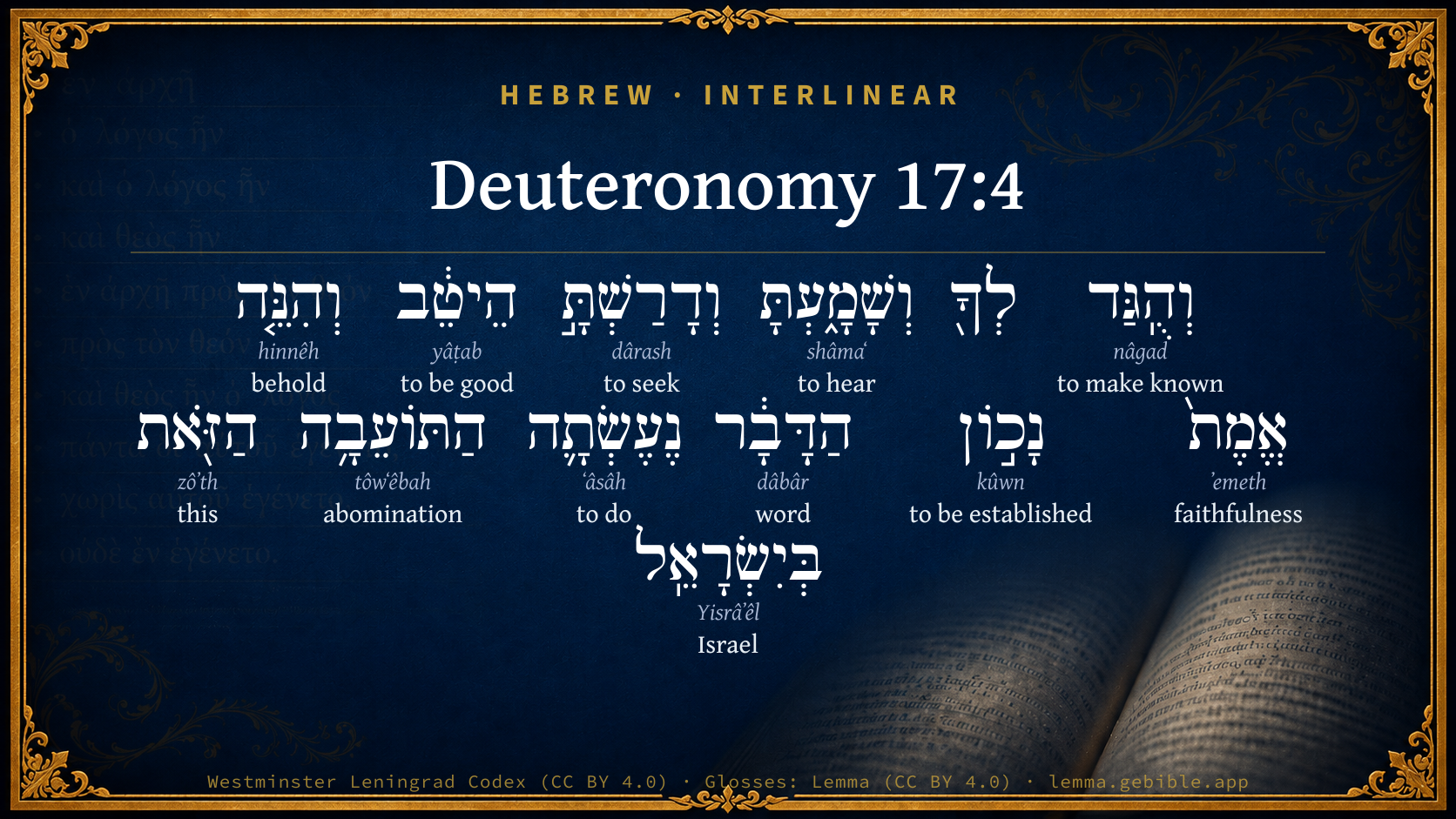
Hebrew (Westminster Leningrad Codex) Deuteronomy 17:4 appears in the Hebrew Old Testament. The text above is from the Westminster Leningrad Codex. Each word links to its Strong’s number, a concise gloss, and parsing drawn from the Open Scriptures Hebrew Bible morphology. Click any word for its full Brown-Driver-Briggs (BDB) entry.
Download image
Cite this verse

Deuteronomy 17:4 (World English Bible). Public Domain. Lemma interlinear Bible study tool, https://lemma.gebible.app/v/deuteronomy/17/4.

Show BibTeX & RIS
BibTeX
RIS
English Translation
and it be told you, and you have heard of it, then shall you inquire diligently; and, behold, if it be true, and the thing certain, that such abomination is done in Israel,
World English Bible · Public Domain
Download a study sheet

One document with this verse’s original text, its word-by-word gloss line, the meaning frame, cross-references with their text, attributed commentary, and full source and license credits — printable, and it pastes into notes with its structure intact.

This verse Autodidact and up

Study sheet (.html) Plain text (.txt)

A passage Seminary Student

Up to 50 verses in one chapter. A passage sheet keeps up to 6 commentary sources and 12 cross-references per verse, in the order this page ranks them, and says so on the sheet whenever that leaves anything out. Ask for a single verse and you get the Autodidact verse sheet above.

Everything on this page stays free to read, with no account — the sheet is a download of what is already on screen, not access to it.

Want to remove ads? Support Godless Engineer
Compare translations 3

The same verse in 3 English versions, stacked beneath the original-language interlinear above. Click any original word for its lexicon entry.

Each is an independent rendering of the whole verse — the interlinear is not word-aligned to these translations.

Highlighted words mark where these versions differ — a whole-verse word diff, not a word-by-word alignment.

  • World English Bible Public Domain
    and it be told you, and you have heard of it, then shall you inquire diligently; and, behold, if it be true, and the thing certain, that such abomination is done in Israel,
  • King James Version Public Domain
    And it be told thee, and thou hast heard of it, and inquired diligently, and, behold, it be true, and the thing certain, that such abomination is wrought in Israel:
  • unfoldingWord Literal Text CC BY-SA 4.0
    and is told to you, and you listen, and you investigate thoroughly, and behold, the matter an established truth, this abomination has been done in Israel,

unfoldingWord Literal Text — © unfoldingWord, licensed CC BY-SA 4.0. Word-aligned USFM3 via Door43 (git.door43.org/unfoldingWord/en_ult).

Versions to compare (up to 4)

3 of 4 selected

Show all 18 translations

Every available English version of this verse, each an independent rendering of the whole verse.

  • World English Bible Public Domain
    and it be told you, and you have heard of it, then shall you inquire diligently; and, behold, if it be true, and the thing certain, that such abomination is done in Israel,
  • Berean Standard Bible Public Domain
    and if it is reported and you hear about it, you must investigate it thoroughly. If the report is true and such an abomination has happened in Israel,
  • Majority Standard Bible Public Domain
    and if it is reported and you hear about it, you must investigate it thoroughly. If the report is true and such an abomination has happened in Israel,
  • King James Version Public Domain
    And it be told thee, and thou hast heard of it, and inquired diligently, and, behold, it be true, and the thing certain, that such abomination is wrought in Israel:
  • American Standard Version (1901) Public Domain
    and it be told thee, and thou hast heard of it, then shalt thou inquire diligently; and, behold, if it be true, and the thing certain, that such abomination is wrought in Israel,
  • Revised Version (1885) Public Domain
    and it be told thee, and thou hast heard of it, then shalt thou inquire diligently, and, behold, if it be true, and the thing certain, that such abomination is wrought in Israel;
  • Geneva Bible (1599) Public Domain
    And it be tolde vnto thee, and thou hast heard it, then shalt thou inquire diligently: and if it be true, and the thing certaine, that such abomination is wrought in Israel,
  • Douay-Rheims (1899) Public Domain
    And this is told thee, and hearing it thou hast inquired diligently, and found it to be true, and that the abomination is committed in Israel:
  • Young's Literal Translation Public Domain
    and it hath been declared to thee, and thou hast heard, and hast searched diligently, and lo, truth; the thing is established; this abomination hath been done in Israel --
  • Literal Standard Version CC BY-SA 4.0
    and it has been declared to you, and you have heard, and have searched diligently, and behold, [if] truth, the thing is established; this abomination has been done in Israel—
  • Unlocked Literal Bible CC BY-SA 4.0
    and if you are told about this, or if you have heard of it, then you must make a careful investigation. If it is true and certain that such an abomination has been done in Israel, this is what you should do.
  • unfoldingWord Literal Text CC BY-SA 4.0
    and is told to you, and you listen, and you investigate thoroughly, and behold, the matter an established truth, this abomination has been done in Israel,
  • Darby Bible Public Domain
    and it be told thee, and thou hearest of it; then thou shalt make thorough inquiry, and if it be truth [and] the thing be certain, that this abomination hath been wrought in Israel,
  • World Messianic Bible Public Domain
    and you are told, and you have heard of it, then you shall inquire diligently. Behold, if it is true, and the thing certain, that such abomination is done in Israel,
  • Webster's Bible Public Domain
    And it shall be told thee, and thou hast heard of it, and inquired diligently, and behold, it is true, and the thing certain, that such abomination is wrought in Israel:
  • Free Bible Version CC BY-SA 4.0
    If you hear such a report, you need to make a full investigation. If you find out that the report is true, and that such an awful sin has been committed in Israel,
  • Bible in Basic English Public Domain
    If word of this comes to your ears, then let this thing be looked into with care, and if there is no doubt that it is true, and such evil has been done in Israel;
  • JPS Tanakh (1917) Public Domain
    and it be told thee, and thou hear it, then shalt thou inquire diligently, and, behold, if it be true, and the thing certain, that such abomination is wrought in Israel;

Literal Standard Version (2020), Covenant Press — licensed CC BY-SA 4.0. Text via the HelloAO Bible API (eBible.org). Unlocked Literal Bible (unfoldingWord) — licensed CC BY-SA 4.0. Text via the HelloAO Bible API (eBible.org). unfoldingWord Literal Text — © unfoldingWord, licensed CC BY-SA 4.0. Word-aligned USFM3 via Door43 (git.door43.org/unfoldingWord/en_ult). Free Bible Version, Dr. Jonathan Gallagher — licensed CC BY-SA 4.0. Text via the HelloAO Bible API (eBible.org).

Word by word

More ways to search: Search by grammar → Find every occurrence → Compare this word →

Practice this passage: Drill this verse → Learn its vocabulary →

הֵיטֵ֔ב
yâṭab
H3190
“to be good”
Verb, Hiphil, Infinitive Absolute
Part of Speech
Verb
Stem
Hiphil
Form
Infinitive Absolute
Full BDB Definition

Origin: a primitive root

TWOT: 863

to be good, be pleasing, be well, be glad - (Qal) - to be glad, be joyful - to be well placed - to be well for, be well with, go well with - to be pleasing, be pleasing to - (Hiphil) - to make glad, rejoice - to do good to, deal well with - to do well, do thoroughly - to make a thing good or right or beautiful - to do well, do right
  1. וְהֻֽגַּד nâgad H5046 “and · to make known” Conjunction + Verb, Hophal, Sequential Perfect, 3rd Person, Masculine, Singular
  2. וְשָׁמָ֑עְתָּ shâmaʻ H8085 “and · to hear” Conjunction + Verb, Qal, Sequential Perfect, 2nd Person, Masculine, Singular
  3. וְדָרַשְׁתָּ֣ dârash H1875 “and · to seek” Conjunction + Verb, Qal, Sequential Perfect, 2nd Person, Masculine, Singular
  4. וְהִנֵּ֤ה hinnêh H2009 “and · behold” Conjunction + Particle, Demonstrative
  5. אֱמֶת֙ ʼemeth H571 “faithfulness” Noun, Common, Feminine, Singular, Absolute
  6. נָכ֣וֹן kûwn H3559 “being established” Verb, Niphal, Participle Active, Masculine, Singular, Absolute
  7. הַדָּבָ֔ר dâbâr H1697 “the · word” Particle, Definite Article + Noun, Common, Masculine, Singular, Absolute
  8. נֶעֶשְׂתָ֛ה ʻâsâh H6213 “to do” Verb, Niphal, Perfect, 3rd Person, Feminine, Singular
  9. הַתּוֹעֵבָ֥ה tôwʻêbah H8441 “the · abomination” Particle, Definite Article + Noun, Common, Feminine, Singular, Absolute
  10. הַזֹּ֖את zôʼth H2063 “the · this” Particle, Definite Article + Pronoun, Demonstrative, Feminine, Singular
  11. בְּיִשְׂרָאֵֽל Yisrâʼêl H3478 “in/at · Israel” Preposition + Noun, Proper

About this verse

These counts appear in no published source. They are computed here, from the morphology-tagged text and Lemma’s own curated glosses. What Lemma adds →

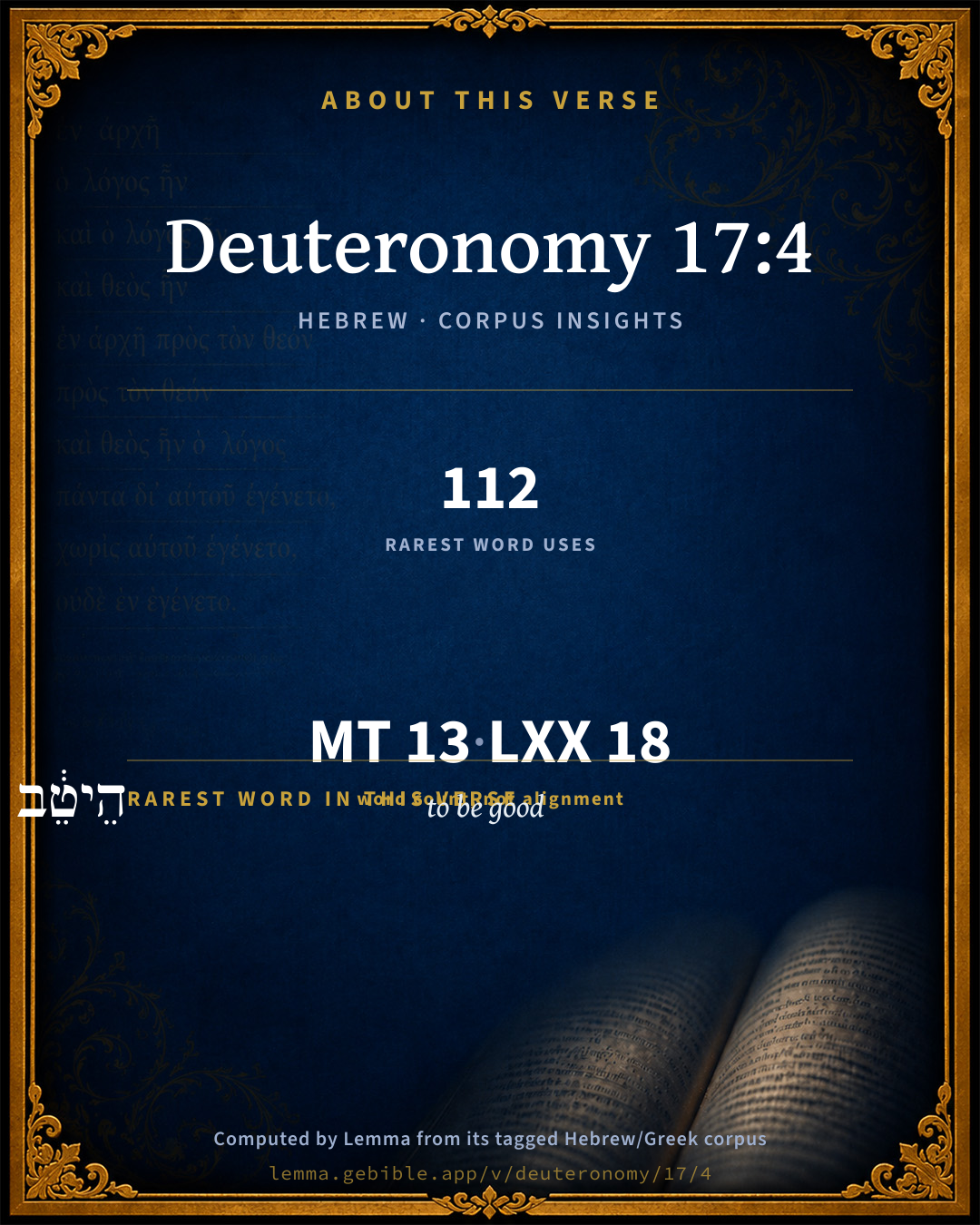
13
words
12
distinct lemmas
Pentateuch
section

Grammatical profile

  • 6 verbs
  • 4 nouns
  • 1 pronoun
  • 1 preposition
  • 1 particle

Verb forms

  • וְהֻֽגַּד Hophal · Sequential Perfect
  • וְשָׁמָ֑עְתָּ Qal · Sequential Perfect
  • וְדָרַשְׁתָּ֣ Qal · Sequential Perfect
  • הֵיטֵ֔ב Hiphil · Infinitive Absolute
  • נָכ֣וֹן Niphal · Participle Active
  • נֶעֶשְׂתָ֛ה Niphal · Perfect

Hebrew & Septuagint length

In English translation the verse runs 33 words from the Hebrew and 25 from the Septuagint (LXX English) — closely comparable.

A rough comparison of the two English renderings, which tokenize alike — not a word-level alignment.

Word counts can differ between the Hebrew and the Greek without any difference in meaning — e.g. the Hebrew direct-object marker אֵת has no separate Greek word, and Greek often adds the article ὁ.

In the original languages it is 13 Hebrew tokens and 18 Greek tokens — but the two are counted differently (Hebrew bundles its prefixes and suffixes into one token; the Greek is in lemma form), so that isn’t a like-for-like length.

Cross-references

4

Topical passages linked to Deuteronomy 17:4 in the Treasury of Scripture Knowledge — connected by theme and wording, ordered by reader-vote popularity; previews shown in the World English Bible.

  • Deuteronomy 13:12–14 If you shall hear tell concerning one of your cities, which Yahweh your God gives you to dwell there, saying,
  • Deuteronomy 19:18 and the judges shall make diligent inquisition: and, behold, if the witness is a false witness, and has testified falsely against his brother;
  • John 7:51 "Does our law judge a man, unless it first hears from him personally and knows what he does?"
  • Proverbs 25:2 It is the glory of God to conceal a thing, But the glory of kings is to search out a matter.

Cross-references courtesy of OpenBible.info (CC BY 4.0).

Hebrew and Greek witnesses Masoretic Hebrew ↔ Greek Septuagint

The same verse in the two great witnesses to the Old Testament, shown verse-for-verse.

These are two independent witnesses, not word-aligned to each other, and the Septuagint is shown in lemma (dictionary) form.

Hebrew Deuteronomy 17:4 Masoretic · Westminster Leningrad Codex

וְהֻֽגַּד לְךָ֖ וְשָׁמָ֑עְתָּ וְדָרַשְׁתָּ֣ הֵיטֵ֔ב וְהִנֵּ֤ה אֱמֶת֙ נָכ֣וֹן הַדָּבָ֔ר נֶעֶשְׂתָ֛ה הַתּוֹעֵבָ֥ה הַזֹּ֖את בְּיִשְׂרָאֵֽל

and it be told you, and you have heard of it, then shall you inquire diligently; and, behold, if it be true, and the thing certain, that such abomination is done in Israel,

World English Bible · Public Domain

Greek LXX Deuteronomy 17:4 Septuagint · lemma form

καί ἀναἀγγέλλω σύ καί ἐκζητέω σφόδρα καί ἰδού ἀληθῶς γίγνομαι ὁ ῥῆμα γίγνομαι ὁ βδέλυγμα οὗτος ἐν ἰσραήλ

and it be told you, and you shall have enquired diligently, and, behold, the thing really took place, this abomination has been done in Israel;

LXX2012 (modern English Septuagint) · Public Domain

Hebrew: Westminster Leningrad Codex (CC BY 4.0). Greek: Septuagint (public domain); English from LXX2012 (modern English Septuagint) (Public Domain). How the Septuagint differs from the Hebrew →

Targum (Aramaic paraphrase)

2

The Targum is the ancient Jewish Aramaic paraphrase of the Hebrew Scriptures — an interpretive translation, not the Hebrew text itself. Onkelos (literal) and Pseudo-Jonathan (expansive) render the Torah, and Jonathan the Prophets. Coverage is partial: where no permissively-licensed English translation exists for a verse, only the Aramaic is shown. This is verse-level text, not a word-by-word alignment to the Hebrew.

  1. Targum Onkelos Torah (Genesis–Deuteronomy)
    וְיִתְחַוֵי לָךְ וְתִשְׁמַע וְתִתְבַּע יָאוּת וְהָא קֻשְׁטָא כֵּוַן פִּתְגָמָא אִתְעֲבִידַת תּוֹעֶבְתָּא הָדָא בְּיִשְׂרָאֵל

    (no public-domain English translation for this verse)

    Targum Onkelos — Aramaic: “Onkelos Genesis” (public domain); “Onkelos Exodus” (public domain); “Onkelos Leviticus” (public domain); “Onkelos Numbers” (public domain); “Onkelos Deuteronomy” (public domain). English: “Sefaria Community Translation” (CC0 1.0 (public-domain dedication)); “J.W. Etheridge. The Targums of Onkelos and Jonathan Ben Uzziel on the Pentateuch. London: Longmans, Green, 1862” (public domain). Text via Sefaria.

  2. Targum Pseudo-Jonathan Torah (Genesis–Deuteronomy)
    וְאִתְחַוָא לְכוֹן וְתִשְׁמְעוּן וְתִיתְבְּעוּן יַת סַהֲדַיָא טַבְאוּת וְהָא קוּשְׁטָא כֵּיוַן פִּתְגָמָא אִתְעֲבִידַת תּוֹעֵבְתָּא הָדָא בֵּינֵיכוֹן

    and it be told you, and you hear and make inquiry by witnesses fairly; and, behold, if this word be true and certain, that such abomination is wrought among you,

    Targum Pseudo-Jonathan — Aramaic: “Targum Jonathan on Genesis” (public domain); “Targum Jonathan on Exodus” (public domain); “Targum Jonathan on Leviticus” (public domain); “Targum Jonathan on Numbers” (public domain); “Targum Jonathan on Deuteronomy” (public domain). English: “The Targum of Jonathan ben Uzziel, trans. J. W. Etheridge, London, 1862” (public domain). Text via Sefaria.

Commentary

Notes on Deuteronomy 17:4 from classic Christian and Jewish commentators (each source and its license shown beneath its notes). The classic Christian expositions comment on the surrounding passage and are grouped to its opening verse, so a note may address several verses; the Jewish commentaries on the Tanakh (Rashi and others) are per-verse, so they appear only where the commentator wrote on this verse.

Lemma curates 59 commentaries, every one of them public domain or Creative Commons licensed, each selected and text-cleaned for this edition rather than reprinted as found. About our sources →

Trapp's Complete Commentary

John Trapp

Deu 17:4 And it be told thee, and thou hast heard [of it], and enquired diligently, and, behold, [it be] true, [and] the thing certain, [that] such abomination is wrought in Israel:

Ver. 4. And it be told thee.] {See Trapp on "Deu 13:12"}

And inquired diligently.] Men must be "swift to hear, slow to speak," that is, to censure, or pass sentence. Amongst the Athenians an indictment of any crime was but αιτια: the evidence and conviction made it ελεγχος: the sentence αδικημα. Athanasius passeth for a sacrilegious person, a profane wretch, a bloody persecutor, a blasphemer of God, &c., and was so condemned before he was heard by fourscore bishops in that Pseudosynodus Sardicensis. Sunt quidem in Ecclesia Catholica plurimi mali; sed ex haereticis, nullus est bonus, says Bellarmine: There be many bad men Papists, but not one good to be found among Protestants. The Catholics follow the Bible, saith Hill {a} in his "Quartern of Reasons," but the Protestants force the Bible to follow them; yea, their condemnation is so expressly set down in their own Bibles, saith another Popeling, and is so clear to all the world, that nothing more needs hereto, than that they know to read, and have their eyes in their heads at the opening of their Bible. {b} By the shooting of which bolt, you may easily guess at the archer.

{a} Reas. viii. p. 41.

{b} Gagge, Of the New Gospel: Pref. to Reader.

John Trapp, A Commentary or Exposition upon All the Books of the Old and New Testament (1647–1656) — public domain. Text from a community e-Sword module.

Tyndale Open Study Notes

Tyndale Open Resources

17:4 Anything offensive to the Lord could be called a detestable thing (see 7:25; 12:31; 13:14).

Tyndale Open Study Notes — © Tyndale Open Resources, licensed CC BY-SA 4.0. Text via the HelloAO Bible API.

Adam Clarke's Commentary

Verse 4. If it be told thee] In a private way by any confidential person. And thou hast heard of it; so that it appears to be notorious, very likely to be true, and publicly scandalous. And hast inquired diligently - sought to find out the truth of the report by the most careful examination of persons reporting, circumstances of the case, &c. And, behold, it be true - the report is not founded on vague rumour, hearsay, or malice. And the thing certain - substantiated by the fullest evidence. Then shalt thou bring forth that man, De 17:5. As the charge of idolatry was the most solemn and awful that could be brought against an Israelite, because it affected his life, therefore God required that the charge should be substantiated by the most unequivocal facts, and the most competent witnesses. Hence all the precautions mentioned in the fourth verse must be carefully used, in order to arrive at so affecting and so awful a truth.

Adam Clarke's Commentary on the Bible (1810–1826) — public domain. Text from a community e-Sword/MySword module.

The Cambridge Bible for Schools and Colleges

gen. ed. J. J. S. Perowne

4. and it be told thee, and thou hast heard] Similarly Deu_13:12 (13).

shalt thou inquire, etc.] So, but with additions, Deu_13:14 (15), q.v.

The Cambridge Bible for Schools and Colleges (gen. ed. J. J. S. Perowne; Cambridge University Press, 1878–1918) — public domain. Text from a community e-Sword module.

John Gill's Exposition

And it be told thee, and thou hast heard of it, and inquired diligently,.... A report of this kind was not to be neglected; though it was not to be concluded upon as certain by hearsay, it was to be looked into, and the persons that brought it thoroughly examined; so the Targum of Jonathan,"and inquired the witnesses well,''what proof and evidence they could give of the fact, who the persons were, when and where, and in what manner the sin was committed:

and, behold, it be true, and the thing certain; upon examining the witnesses the case is plain and out of all question:

that such abomination is wrought in Israel; to do it in any country was abominable, but much more so in the land of Israel, among the professing people of God, who had the knowledge of the true God, and had had so many proofs of his deity, his power and providence, as well as received so many favours and blessings from him, and had such laws and statutes given them as no other people had.

John Gill's Exposition of the Whole Bible (1746–1763) — public domain (CC PDM 1.0). Text via the HelloAO Bible API.

Matthew Poole's English Annotations

Told thee by any person, thou shalt not slight so much as a rumour or flying report of so gross a crime.

Inquired diligently, by sending messengers, examining witnesses, &c.

Matthew Poole's English Annotations on the Holy Bible (1683–1685) — public domain. Text from a community e-Sword/MySword module.

The Pulpit Commentary

Vers. 4-8. Criminal procedure.

I THE RIGHT OF THE CRIMINAL TO A PAIR AND PULL TRIAL. The right is asserted in the Law of Moses as strenuously as it could be anywhere. However abhorrent his crime, the criminal had every protection against unjust treatment which the Law could afford him. He must be formally impeached, tried before judges, and legally convicted under stringent conditions of proof. The evidence of one witness, however apparently conclusive, was not to be accepted as sufficient. A second must confirm it. The principle is a plain dictate of justice. Suspicion, rumor, dislike of the individual, or even moral certainty of his guilt, form no sufficient ground for condemnation. He is entitled to demand that his crime be proved under legal forms. A person really guilty may thus occasionally escape, but better this should happen than that the innocent should suffer. Lessons:

1. The rule of criminal jurisprudence should be the rule of our private thoughts, and of our expressed opinions about others. We are entitled to hold no man guilty of deeds for which we have not explicit proof.

2. While moral certainty of guilt may be created by proof which would not warrant judicial condemnation, we should beware of admitting as proof that which at the most only seems to tell against the person under suspicion.

3. Where no better ground exists for unfavorable judgment than vague, unsifted rumor, or the dislikes and prejudices with which a person is regarded, it is the grossest unfairness, and often great cruelty to the person concerned, to entertain evil reports, or even to allow them in the slightest degree to influence us.

4. Where opportunity for investigating reports to the discredit of another does not exist, or where we have no call to undertake such investigation, our duty is not to judge at all. (Mat_7:1) The utmost we should do is to exercise caution.

II THE GRAVE RESPONSIBILITY WHICH RESTS ON WITNESSES. This was well brought out by requiring that the hands of the witnesses should be first upon the condemned person to put him to death. We may note:

1. That those who prefer serious accusations against others, ought to be prepared publicly to substantiate them. Were this more insisted on than it is, it would quash in the birth not a few malicious accusations.

2. That blood-guiltiness rests on those who, by false testimony, whether borne publicly or in private, effect another"s ruin. J.O.

The Pulpit Commentary (1880–1919), ed. H.D.M. Spence-Jones & Joseph S. Exell — public domain. Text from a community e-Sword module.

Rashi

Rabbi Shlomo Yitzchaki (Rashi)

נכון [AND, BEHOLD, IT BE TRUE, AND THE THING BE] CERTAIN — i.e. the evidence of the witnesses is in agreement (מְכֻוָּן‎)

Rashi on the Tanakh — English translations: “The Judaica Press complete Tanach with Rashi, translated by A. J. Rosenberg” (CC BY 4.0); “Pentateuch with Rashi's commentary by M. Rosenbaum and A.M. Silbermann, 1929-1934” (public domain); “The Metsudah Tanach series, Lakewood, N.J” (CC BY 4.0); and “The Book of Joshua, Metsudah Publications, 1997” (CC BY 4.0). Text via Sefaria.

Lesson kit

Teaching starters — assembled from the data on this page, not authored interpretation. Every prompt links to the verse data it draws on. Edit before teaching.

Deuteronomy, in the Pentateuch, opens this verse with 13 words (12 distinct Hebrew lemmas). Its most distinctive word is yâṭab (“to be good”). A historical commentator’s framing appears above. Read the whole chapter for the surrounding context.

Discussion questions

  1. The word yâṭab carries the sense “to be good.” How does it shape the verse?
  2. How does Deuteronomy 13:12–14, which shares this passage’s theme, read alongside this verse?
  3. These translations render this verse differently. What is at stake in choosing one wording over another?
  4. «וְהֻֽגַּד» is a Hophal Sequential Perfect verb. How does that grammatical form shape the action described?
  5. Compare how Trapp's Complete Commentary and Tyndale Open Study Notes read this verse. Where do they agree or differ?

Things to notice

Reading settings

Reading text

Shown beneath each verse's original-language words.

Old Testament
Old Testament edition

Read the OT as the Masoretic Hebrew (MT) or the Greek Septuagint (LXX).

English shown for the Greek Septuagint (in the Hebrew ↔ Greek comparison).

Comparing translations? Open the Compare panel on any verse page to stack up to four side by side.