
Deuteronomy 3:12

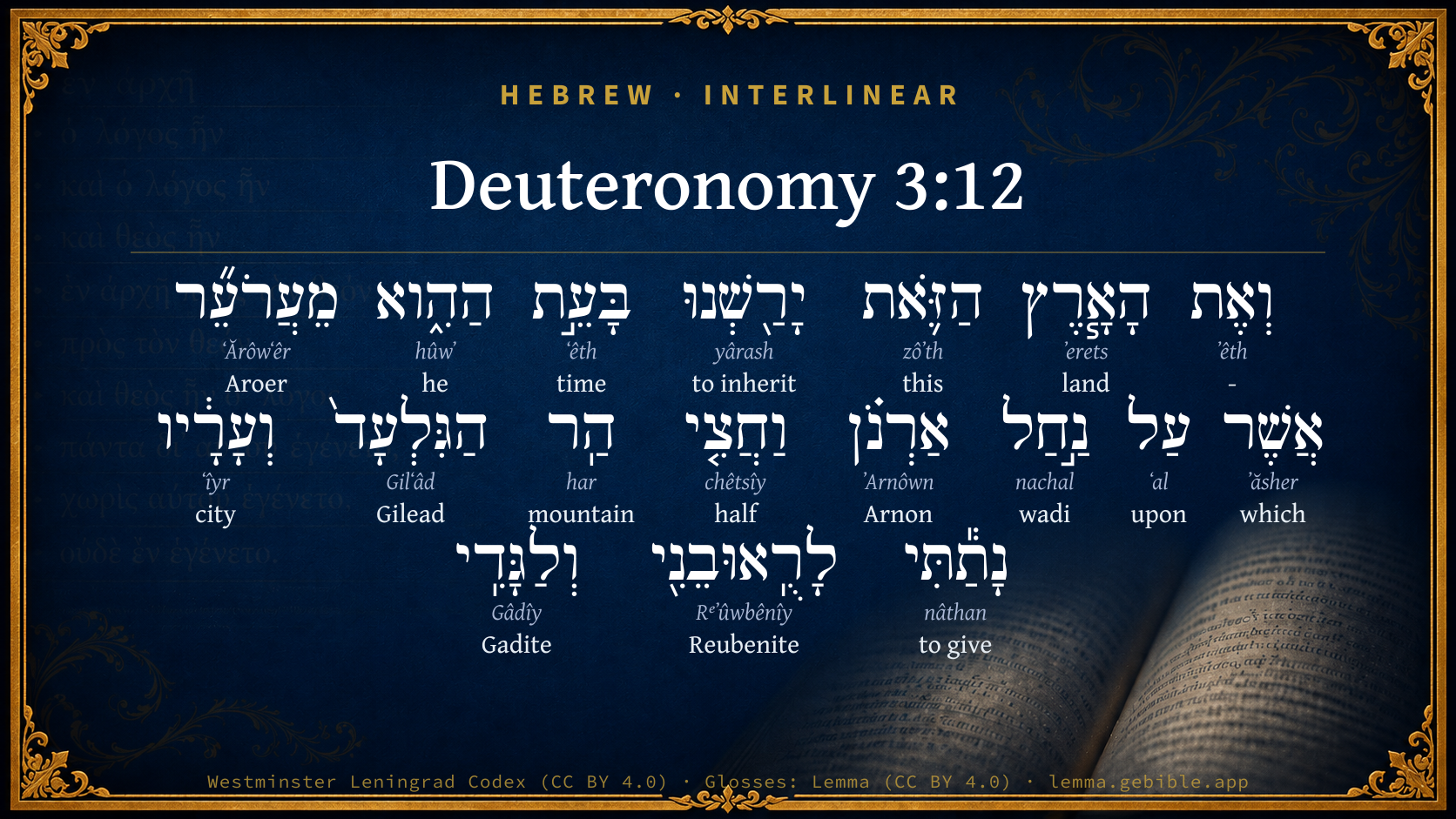
Hebrew (Westminster Leningrad Codex) Deuteronomy 3:12 appears in the Hebrew Old Testament. The text above is from the Westminster Leningrad Codex. Each word links to its Strong’s number, a concise gloss, and parsing drawn from the Open Scriptures Hebrew Bible morphology. Click any word for its full Brown-Driver-Briggs (BDB) entry.
Download image
Cite this verse

Deuteronomy 3:12 (World English Bible). Public Domain. Lemma interlinear Bible study tool, https://lemma.gebible.app/v/deuteronomy/3/12.

Show BibTeX & RIS
BibTeX
RIS
English Translation
This land we took in possession at that time: from Aroer, which is by the valley of the Arnon, and half the hill-country of Gilead, and the cities of it, gave I to the Reubenites and to the Gadites:
World English Bible · Public Domain
Download a study sheet

One document with this verse’s original text, its word-by-word gloss line, the meaning frame, cross-references with their text, attributed commentary, and full source and license credits — printable, and it pastes into notes with its structure intact.

This verse Autodidact and up

Study sheet (.html) Plain text (.txt)

A passage Seminary Student

Up to 50 verses in one chapter. A passage sheet keeps up to 6 commentary sources and 12 cross-references per verse, in the order this page ranks them, and says so on the sheet whenever that leaves anything out. Ask for a single verse and you get the Autodidact verse sheet above.

Everything on this page stays free to read, with no account — the sheet is a download of what is already on screen, not access to it.

Want to remove ads? Support Godless Engineer
Compare translations 3

The same verse in 3 English versions, stacked beneath the original-language interlinear above. Click any original word for its lexicon entry.

Each is an independent rendering of the whole verse — the interlinear is not word-aligned to these translations.

Highlighted words mark where these versions differ — a whole-verse word diff, not a word-by-word alignment.

  • World English Bible Public Domain
    This land we took in possession at that time: from Aroer, which is by the valley of the Arnon, and half the hill-country of Gilead, and the cities of it, gave I to the Reubenites and to the Gadites:
  • King James Version Public Domain
    And this land, which we possessed at that time, from Aroer, which is by the river Arnon, and half mount Gilead, and the cities thereof, gave I unto the Reubenites and to the Gadites.
  • unfoldingWord Literal Text CC BY-SA 4.0
    “And we took in possession this land at that time, from Aroer, that by the wadi of Arnon, and half the hill of Gilead, and its cities, I gave to the Reubenites and to the Gadites.

unfoldingWord Literal Text — © unfoldingWord, licensed CC BY-SA 4.0. Word-aligned USFM3 via Door43 (git.door43.org/unfoldingWord/en_ult).

Versions to compare (up to 4)

3 of 4 selected

Show all 18 translations

Every available English version of this verse, each an independent rendering of the whole verse.

  • World English Bible Public Domain
    This land we took in possession at that time: from Aroer, which is by the valley of the Arnon, and half the hill-country of Gilead, and the cities of it, gave I to the Reubenites and to the Gadites:
  • Berean Standard Bible Public Domain
    So at that time we took possession of this land. To the Reubenites and Gadites I gave the land beyond Aroer along the Arnon Valley, and half the hill country of Gilead, along with its cities.
  • Majority Standard Bible Public Domain
    So at that time we took possession of this land. To the Reubenites and Gadites I gave the land beyond Aroer along the Arnon Valley, and half the hill country of Gilead, along with its cities.
  • King James Version Public Domain
    And this land, which we possessed at that time, from Aroer, which is by the river Arnon, and half mount Gilead, and the cities thereof, gave I unto the Reubenites and to the Gadites.
  • American Standard Version (1901) Public Domain
    And this land we took in possession at that time: from Aroer, which is by the valley of the Arnon, and half the hill-country of Gilead, and the cities thereof, gave I unto the Reubenites and to the Gadites:
  • Revised Version (1885) Public Domain
    And this land we took in possession at that time: from Aroer, which is by the valley of Arnon, and half the hill country of Gilead, and the cities thereof, gave I unto the Reubenites and to the Gadites:
  • Geneva Bible (1599) Public Domain
    And this land which we possessed at that time, from Aroer, which is by the riuer of Arnon, and halfe mount Gilead, and the cities thereof, gaue I vnto the Reubenites and Gadites.
  • Douay-Rheims (1899) Public Domain
    And we possessed the land at that time from Aroer, which is upon the bank of the torrent Amen, unto the half of mount Galaad: and I gave the cities thereof to Ruben and Gad.
  • Young's Literal Translation Public Domain
    `And this land we have possessed, at that time; from Aroer, which `is' by the brook Arnon, and the half of mount Gilead, and its cities, I have given to the Reubenite, and to the Gadite;
  • Literal Standard Version CC BY-SA 4.0
    And this land, [which] we had possessed at that time, from Aroer, which [is] by the Brook of Arnon, and the half of Mount Gilead and its cities, I have given to the Reubenite and to the Gadite;
  • Unlocked Literal Bible CC BY-SA 4.0
    “This land that we took in possession at that time—from Aroer, that is by the Valley of the Arnon, and half the hill country of Gilead, and its cities—I gave to the Reubenites and to the Gadites.
  • unfoldingWord Literal Text CC BY-SA 4.0
    “And we took in possession this land at that time, from Aroer, that by the wadi of Arnon, and half the hill of Gilead, and its cities, I gave to the Reubenites and to the Gadites.
  • Darby Bible Public Domain
    And this land we took in possession at that time. From Aroer, which is by the river Arnon, and the half of mount Gilead, and its cities, I gave to the Reubenites and to the Gadites;
  • World Messianic Bible Public Domain
    This land we took in possession at that time: from Aroer, which is by the valley of the Arnon, and half the hill country of Gilead with its cities, I gave to the Reubenites and to the Gadites;
  • Webster's Bible Public Domain
    And this land, which we possessed at that time, from Aroer, which is by the river Arnon, and half mount Gilead, and its cities, I gave to the Reubenites and to the Gadites.
  • Free Bible Version CC BY-SA 4.0
    This is when we took over the land. I assigned to the tribes of Reuben and Gad the land to the north of the town of Aroer in the Arnon Valley, and half the hill country of Gilead, together with its towns.
  • Bible in Basic English Public Domain
    And this land which we took at that time, from Aroer by the valley of the Arnon, and half the hill-country of Gilead with its towns, I gave to the Reubenites and the Gadites.
  • JPS Tanakh (1917) Public Domain
    And this land we took in possession at that time; from Aroer, which is by the valley of Arnon, and half the hill-country of Gilead, and the cities thereof, gave I unto the Reubenites and to the Gadites;

Literal Standard Version (2020), Covenant Press — licensed CC BY-SA 4.0. Text via the HelloAO Bible API (eBible.org). Unlocked Literal Bible (unfoldingWord) — licensed CC BY-SA 4.0. Text via the HelloAO Bible API (eBible.org). unfoldingWord Literal Text — © unfoldingWord, licensed CC BY-SA 4.0. Word-aligned USFM3 via Door43 (git.door43.org/unfoldingWord/en_ult). Free Bible Version, Dr. Jonathan Gallagher — licensed CC BY-SA 4.0. Text via the HelloAO Bible API (eBible.org).

Word by word

More ways to search: Search by grammar → Find every occurrence → Compare this word →

Practice this passage: Drill this verse → Learn its vocabulary →

מֵעֲרֹעֵ֞ר
ʻĂrôwʻêr
H6177
“from · Aroer”
Preposition + Noun, Proper
Part of Speech
Preposition + Noun
Type
Proper
Full BDB Definition

Origin: the same as H6176

TWOT: None

Aroer = "ruins" - a city on the north bank of the river Arnon, the southern point of the territory of Sihon the king of the Amorites and later of Reuben; modern 'Arair' - a city in Ammon near the Jabbok belonging to Gad - a town in southern Judah
  1. וְאֶת ʼêth H853 “and · -” Conjunction + Particle, Direct Object
  2. הָאָ֧רֶץ ʼerets H776 “the · land” Particle, Definite Article + Noun, Common, Both, Singular, Absolute
  3. הַזֹּ֛את zôʼth H2063 “the · this” Particle, Definite Article + Pronoun, Demonstrative, Feminine, Singular
  4. יָרַ֖שְׁנוּ yârash H3423 “to inherit” Verb, Qal, Perfect, 1st Person, Common, Plural
  5. בָּעֵ֣ת ʻêth H6256 “in/at the · time” Preposition, Determined + Noun, Common, Both, Singular, Absolute
  6. הַהִ֑וא hûwʼ H1931 “the · he” Particle, Definite Article + Pronoun, Personal, 3rd Person, Feminine, Singular
  7. אֲשֶׁר ʼăsher H834 “which” Particle, Relative
  8. עַל ʻal H5921 “upon” Preposition
  9. נַ֣חַל nachal H5158 “wadi of” Noun, Common, Masculine, Singular, Construct
  10. אַרְנֹ֗ן ʼArnôwn H769 “Arnon” Noun, Proper
  11. וַחֲצִ֤י chêtsîy H2677 “and · half of” Conjunction + Noun, Common, Masculine, Singular, Construct
  12. הַֽר har H2022 “mountain of” Noun, Common, Masculine, Singular, Construct
  13. הַגִּלְעָד֙ Gilʻâd H1568 “the · Gilead” Particle, Definite Article + Noun, Proper
  14. וְעָרָ֔יו ʻîyr H5892 “and · cities · his” Conjunction + Noun, Common, Feminine, Plural, Construct + Suffix, Personal, 3rd Person, Masculine, Singular
  15. נָתַ֕תִּי nâthan H5414 “to give” Verb, Qal, Perfect, 1st Person, Common, Singular
  16. לָרֻֽאוּבֵנִ֖י Rᵉʼûwbênîy H7206 “to/for the · Reubenite” Preposition, Determined + Noun, Gentilic, Masculine, Singular, Absolute
  17. וְלַגָּדִֽי Gâdîy H1425 “and · to/for the · Gadite” Conjunction + Preposition, Determined + Noun, Gentilic, Masculine, Singular, Absolute

About this verse

These counts appear in no published source. They are computed here, from the morphology-tagged text and Lemma’s own curated glosses. What Lemma adds →

18
words
18
distinct lemmas
Pentateuch
section

Notable vocabulary

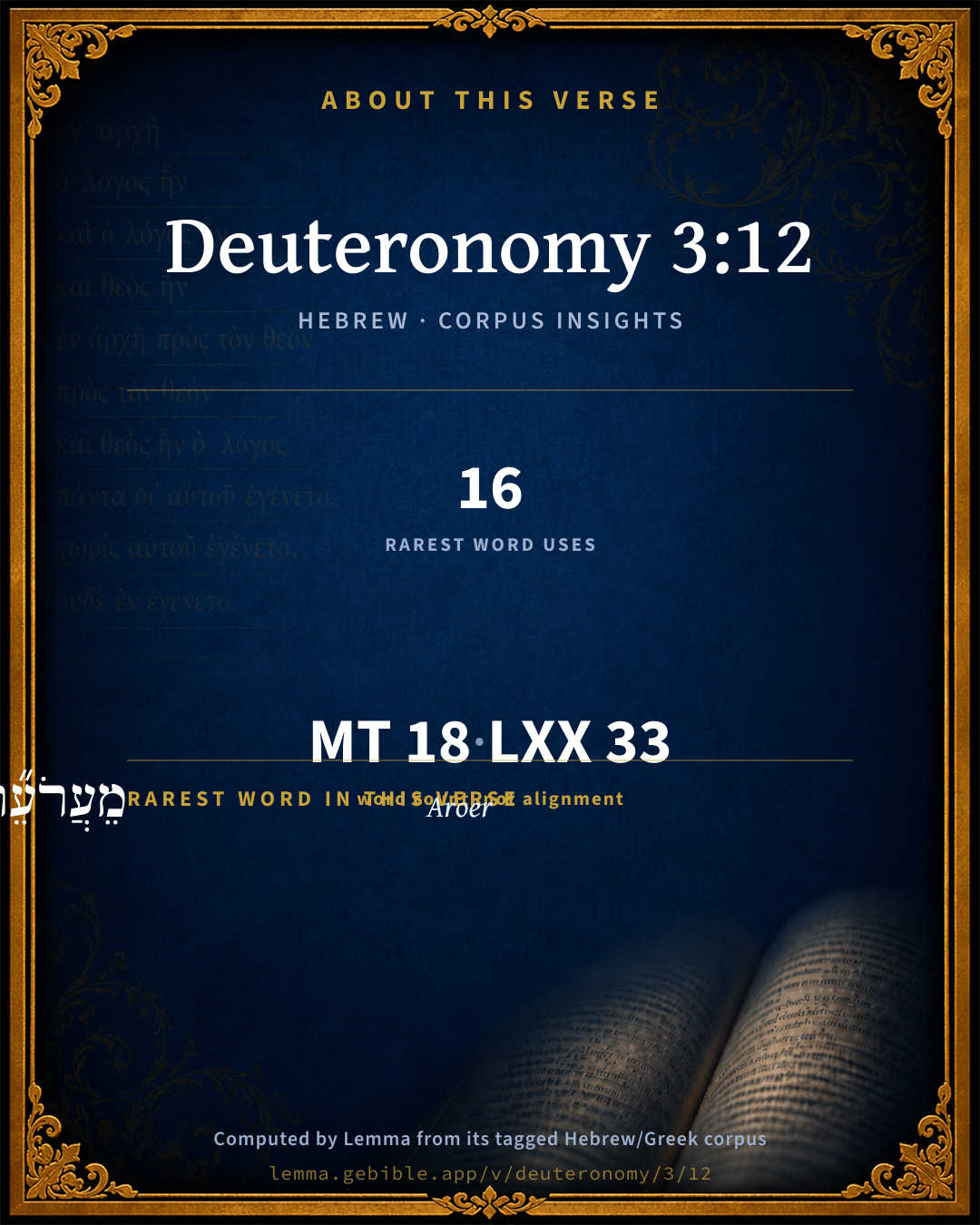
The rarest word here is מֵעֲרֹעֵ֞ר Aroer H6177 — appearing just 16 times in the whole Hebrew Bible.

Shared distinctive vocabulary

מֵעֲרֹעֵ֞ר Aroer H6177 occurs in 16 verses of the Hebrew Bible. Also found in:

Grammatical profile

  • 2 verbs
  • 11 nouns
  • 2 pronouns
  • 1 preposition
  • 2 particles

Verb forms

  • יָרַ֖שְׁנוּ Qal · Perfect
  • נָתַ֕תִּי Qal · Perfect

Hebrew & Septuagint length

In English translation the verse runs 39 words from the Hebrew and 35 from the Septuagint (LXX English) — closely comparable.

A rough comparison of the two English renderings, which tokenize alike — not a word-level alignment.

Word counts can differ between the Hebrew and the Greek without any difference in meaning — e.g. the Hebrew direct-object marker אֵת has no separate Greek word, and Greek often adds the article ὁ.

In the original languages it is 18 Hebrew tokens and 33 Greek tokens — but the two are counted differently (Hebrew bundles its prefixes and suffixes into one token; the Greek is in lemma form), so that isn’t a like-for-like length.

Cross-references

6

Topical passages linked to Deuteronomy 3:12 in the Treasury of Scripture Knowledge — connected by theme and wording, ordered by reader-vote popularity; previews shown in the World English Bible.

  • Deuteronomy 2:36 From Aroer, which is on the edge of the valley of the Arnon, and [from] the city that is in the valley, even to Gilead, there was not a city too high for us; Yahweh our God delivered up all before us:
  • Numbers 32:32–38 We will pass over armed before Yahweh into the land of Canaan, and the possession of our inheritance [shall remain] with us beyond the Jordan.
  • Deuteronomy 4:48 from Aroer, which is on the edge of the valley of the Arnon, even to Mount Sion (the same is Hermon),
  • Joshua 12:2–6 Sihon king of the Amorites, who lived in Heshbon, and ruled from Aroer, which is on the edge of the valley of the Arnon, and [the city that is in] the middle of the valley, and half Gilead, even to the river Jabbok, the border of the children of Ammon;
  • Joshua 13:8–28 With him the Reubenites and the Gadites received their inheritance, which Moses gave them, beyond the Jordan eastward, even as Moses the servant of Yahweh gave them:
  • 2 Kings 10:33 from the Jordan eastward, all the land of Gilead, the Gadites, and the Reubenites, and the Manassites, from Aroer, which is by the valley of the Arnon, even Gilead and Bashan.

Cross-references courtesy of OpenBible.info (CC BY 4.0).

Hebrew and Greek witnesses Masoretic Hebrew ↔ Greek Septuagint

The same verse in the two great witnesses to the Old Testament, shown verse-for-verse.

These are two independent witnesses, not word-aligned to each other, and the Septuagint is shown in lemma (dictionary) form.

Hebrew Deuteronomy 3:12 Masoretic · Westminster Leningrad Codex

וְאֶת הָאָ֧רֶץ הַזֹּ֛את יָרַ֖שְׁנוּ בָּעֵ֣ת הַהִ֑וא מֵעֲרֹעֵ֞ר אֲשֶׁר עַל נַ֣חַל אַרְנֹ֗ן וַחֲצִ֤י הַֽר הַגִּלְעָד֙ וְעָרָ֔יו נָתַ֕תִּי לָרֻֽאוּבֵנִ֖י וְלַגָּדִֽי

This land we took in possession at that time: from Aroer, which is by the valley of the Arnon, and half the hill-country of Gilead, and the cities of it, gave I to the Reubenites and to the Gadites:

World English Bible · Public Domain

Greek LXX Deuteronomy 3:12 Septuagint · lemma form

καί ὁ γῆ ἐκεῖνος κληρονομέω ἐν ὁ καιρός ἐκεῖνος ἀπό αροηρ ὅς εἰμί ἐπί ὁ χεῖλος χειμάρρους αρνων καί ὁ ἥμισυς ὄρος γαλαάδ καί ὁ πόλις αὐτός δίδωμι ὁ ρουβην καί ὁ γαδ

And we inherited that land at that time from Aroer, which is by the border of the torrent Arnon, and half the mount of Galaad; and I gave his cities to Ruben and to Gad.

LXX2012 (modern English Septuagint) · Public Domain

Hebrew: Westminster Leningrad Codex (CC BY 4.0). Greek: Septuagint (public domain); English from LXX2012 (modern English Septuagint) (Public Domain). How the Septuagint differs from the Hebrew →

Targum (Aramaic paraphrase)

2

The Targum is the ancient Jewish Aramaic paraphrase of the Hebrew Scriptures — an interpretive translation, not the Hebrew text itself. Onkelos (literal) and Pseudo-Jonathan (expansive) render the Torah, and Jonathan the Prophets. Coverage is partial: where no permissively-licensed English translation exists for a verse, only the Aramaic is shown. This is verse-level text, not a word-by-word alignment to the Hebrew.

  1. Targum Onkelos Torah (Genesis–Deuteronomy)
    וְיָת אַרְעָא הָדָא יְרִיתְנָא בְּעִדָנָא הַהִיא מֵעֲרֹעֵר דִי עַל נַחֲלָא דְאַרְנֹן וּפַלְגוּת טּוּרָא דְגִלְעָד וְקִרְווֹהִי יְהָבִית לְשִׁבְטָא דִרְאוּבֵן וּלְשִׁבְטָא דְגָד

    (no public-domain English translation for this verse)

    Targum Onkelos — Aramaic: “Onkelos Genesis” (public domain); “Onkelos Exodus” (public domain); “Onkelos Leviticus” (public domain); “Onkelos Numbers” (public domain); “Onkelos Deuteronomy” (public domain). English: “Sefaria Community Translation” (CC0 1.0 (public-domain dedication)); “J.W. Etheridge. The Targums of Onkelos and Jonathan Ben Uzziel on the Pentateuch. London: Longmans, Green, 1862” (public domain). Text via Sefaria.

  2. Targum Pseudo-Jonathan Torah (Genesis–Deuteronomy)
    וְיַת אַרְעָא הֲדָא יְרִיתְנָא בְּעִידָנָא הַהִיא מֵעֲרוֹעֵר וְעַד כֵּיף נַחֲלָא וּפַלְגוּת טַוְורָא דְגִלְעָד וְקִירְוֵיהּ יְהָבִין לְשֵׁבֶט רְאוּבֵן וּלְשֵׁבֶט גָּד

    And this land which we took in possession at that time, from Aroer unto the border of the river, and half of Mount Gilead, and the cities, I have given to the tribe of Reuben and Gad;

    Targum Pseudo-Jonathan — Aramaic: “Targum Jonathan on Genesis” (public domain); “Targum Jonathan on Exodus” (public domain); “Targum Jonathan on Leviticus” (public domain); “Targum Jonathan on Numbers” (public domain); “Targum Jonathan on Deuteronomy” (public domain). English: “The Targum of Jonathan ben Uzziel, trans. J. W. Etheridge, London, 1862” (public domain). Text via Sefaria.

Commentary

Notes on Deuteronomy 3:12 from classic Christian and Jewish commentators (each source and its license shown beneath its notes). The classic Christian expositions comment on the surrounding passage and are grouped to its opening verse, so a note may address several verses; the Jewish commentaries on the Tanakh (Rashi and others) are per-verse, so they appear only where the commentator wrote on this verse.

Lemma curates 59 commentaries, every one of them public domain or Creative Commons licensed, each selected and text-cleaned for this edition rather than reprinted as found. About our sources →

Whedon's Commentary on the Bible

Daniel D. Whedon

DIVISION OF THE LAND THAT WAS CONQUERED, Deu_3:12-20.

The territory taken on the east of the Jordan was given to the tribes of Reuben and Gad and to the half tribe of Manasseh. The southern part, from Aroer in the valley of Arnon, and Gilead as far as the Jabbok, to the Reubenites and Gadites; the northern part of Gilead, with Bashan — that is, the Argob — to the half tribe of Manasseh.

Daniel D. Whedon (gen. ed.), Commentary on the Old and New Testaments (1874–1909) — public domain. Text from a community e-Sword module.

Tyndale Open Study Notes

Tyndale Open Resources

3:12-20 See Num 32.

3:12 The tribes of Reuben and Gad had asked Moses to let them settle east of the Jordan rather than in Canaan, and he allowed them to do so (Num 32:1-5). • Aroer: See study note on Deut 2:36.

Tyndale Open Study Notes — © Tyndale Open Resources, licensed CC BY-SA 4.0. Text via the HelloAO Bible API.

Matthew Henry's Commentary

Having shown how this country which they were now in was conquered, in these verses he shows how it was settled upon the Reubenites, Gadites, and half the tribe of Manasseh, which we had the story of before, Num. 32. Here is the rehearsal. 1. Moses specifies the particular parts of the country that were allotted to each tribe, especially the distribution of the lot to the half tribe of Manasseh, the subdividing of which tribe is observable. Joseph was divided into Ephraim and Manasseh; Manasseh was divided into one half on the one side Jordan and the other half on the other side: that on the east side Jordan was again divided into two great families, which had their several allotments: Jair, Deu 3:14, Machir, Deu 3:15. And perhaps Jacob's prediction of the smallness of that tribe was now accomplished in these divisions and subdivisions. Observe that Bashan is here called the land of the giants, because it had been in their possession, but Og was the last of them. These giants, it seems, had lost their country, and were rooted out of it sooner than any of their neighbours; for those who, presuming upon their strength and stature, had their hand against every man, had every man's hand against them, and went down slain to the pit, though they were the terror of the mighty in the land of the living. 2. He repeats the condition of the grant which they had already agreed to, Deu 3:18-20. That they should send a strong detachment over Jordan to lead the van in the conquest of Canaan, who should not return to their families, at least not to settle (though for a time they might retire thither into winter quarters, at the end of a campaign), till they had seen their brethren in as full possession of their respective allotments as they themselves were now in of theirs. They must hereby be taught not to look at their own things only, but at the things of others, Phi 2:4. It ill becomes an Israelite to be selfish, and to prefer any private interest before the public welfare. When we are rest we should desire to see our brethren at rest too, and should be ready to do what we can towards it; for we are not born for ourselves, but are members one of another. A good man cannot rejoice much in the comforts of his family unless withal he sees peace upon Israel, Psa 128:6.

Matthew Henry's Commentary on the Whole Bible (1708–1710) — public domain (CC PDM 1.0). Text via the HelloAO Bible API.

Jamieson, Fausset & Brown

Robert Jamieson, A. R. Fausset & David Brown

this land, which we possessed at that time, from Aroer . . . gave I unto the Reubenites and to the Gadites--The whole territory occupied by Sihon was parcelled out among the pastoral tribes of Reuben and Gad. It extended from the north bank of the Arnon to the south half of mount Gilead--a small mountain ridge, now called Djelaad, about six or seven miles south of the Jabbok, and eight miles in length. The northern portion of Gilead and the rich pasture lands of Bashan--a large province, consisting, with the exception of a few bleak and rocky spots, of strong and fertile soil--was assigned to the half-tribe of Manasseh.

Jamieson, Fausset & Brown — Commentary Critical and Explanatory on the Whole Bible (1871) — public domain (CC PDM 1.0). Text via the HelloAO Bible API.

The Cambridge Bible for Schools and Colleges

gen. ed. J. J. S. Perowne

12. And this land we took] The discourse resumed from Deu_3:10; a more exact definition of the same lands.

from Aroer … by the valley of Arnon] 13 MSS and some Versions read on the lip of A., as in Deu_2:36.

half … Gilead] As far as the Jabboḳ; to Re’uben and Gad. P, Num_32:1 ff.: land of Ya‘zer and Gile‘ad.

The Cambridge Bible for Schools and Colleges (gen. ed. J. J. S. Perowne; Cambridge University Press, 1878–1918) — public domain. Text from a community e-Sword module.

John Gill's Exposition

And this land, which we possessed at that time,.... Or took possession of, having conquered it; for it still remained in their possession:

from Aroer, which is by the river Arnon: on the borders of Moab, from thence as far as Gilead was the land which was taken from Sihon king of Heshbon, Deu 2:36.

and half Mount Gilead, and the cities thereof: which were taken from Og king of Bashan, Deu 3:10.

gave I unto the Reubenites, and to the Gadites; at their request, on certain conditions to be performed by them, afterwards repeated.

John Gill's Exposition of the Whole Bible (1746–1763) — public domain (CC PDM 1.0). Text via the HelloAO Bible API.

Haydock's Catholic Bible Commentary

Galaad. Moses comprises under this name all the conquered country. (Calmet)

George Leo Haydock (1774–1849), Haydock's Catholic Family Bible and Commentary, 1859 edition — public domain. Excludes Psalms (Douay-Rheims chapter numbering differs from Protestant) and Deuterocanonical books (Catholic canon only).

The Pulpit Commentary

Distribution of the conquered land. The countries thus conquered by the Israelites were assigned by Moses to the tribes of Reuben and Gad and the half tribe of Manasseh. The southern portion, from Aroer, in the valley of the Amen, to the Jabbok, with its towns, (see Jos_12:15-20) was assigned to the Reubenites and the Gadites; and the northern portion, from the Jabbok, comprehending, with Gilead, the whole of Bashan, or Argob, to the half tribe of Manasseh.

Vers. 12-20. Distribution of territory.

I CONQUERED TERRITORY IS NOT TO BE LEFT UNOCCUPIED. This is a sound principle. Has a vice been conquered? replace it by a contrary virtue. Has a soul been converted? set it to Christian work. Has a new district or a portion of heathenism been won for Christ? plant it with Christian agencies, industries, and institutions. Replace bad books by good ones; sinful amusements by such as are healthful; pernicious customs by pure forms of social life. Unoccupied territory will soon fall back into the hands of the enemy.

II CONQUERED TERRITORY IS TO BE WISELY DISTRIBUTED. The distribution of the conquered districts suggests to us how, in the occupation of the fields of service which God gives her, the Church should study order, peace, and the attainment of the higher ends of possession, by wise arrangements. There should be no clashing or confusion of spheres in the kingdom of Christ. We have illustrations of the violation of this rule in the occupation of limited districts by a great number of rival Churches, often working in antagonism to each other; in the appointment of individuals to posts for which they are unsuited; in the confusion arising from workers not knowing their own departments of service, or not keeping to it when known. Whereas here:

1. Each had his portion carefully defined.

2. Respect was had to the talents and callings of those who were to occupy. "A place for cattle," "much cattle". (Num_32:1; cf. ver. 19)

3. Individuals had their own conquests secured to them (ver. 14). A man"s spiritual conquests are always secured to himself his conquests over himself; and they are his greatest possessions. True also of conquests for Christ in conversions. (1Th_2:19) Should be a principle recognized in the work of the Church.

III CONQUERED TERRITORY IS HELD ON CONDITION OF ASSISTANCE TO OTHERS. (Vers. 18-21.)

1. Each branch of the Church is to assist the others.

2. It holds its privileges on this condition.

3. The rest of all is needful to the perfect rest of any. J.O. (Heb_11:40)

The Pulpit Commentary (1880–1919), ed. H.D.M. Spence-Jones & Joseph S. Exell — public domain. Text from a community e-Sword module.

Keil & Delitzsch

C. F. Keil & F. Delitzsch

Review of the Distribution of the Conquered Land. - The land which the Israelites had taken belonging to these two kingdoms was given by Moses to the two tribes and a half for their possession, viz., the southern portion from Aroer in the Arnon valley (see at Num 32:34), and half Gilead (as far as the Jabbok: see at Deu 3:10) with its towns, which are enumerated in Jos 13:15-20 and Jos 13:24-28, to the Reubenites and Gadites; and the northern half of Gilead, with the whole of Bashan (i.e., all the region of Argob: see at Deu 3:4, and Num 32:33), to the half-tribe of Manasseh. לכל־הבּשׁן, "as for all Bashan," is in apposition to "all the region of Argob," and the ל simply serves to connect it; for "all the region of Argob" was not merely one portion of Bashan, but was identical with "all Bashan," so far as it belonged to the kingdom of Og (see at v. 4). All this region passed for a land of giants. הקּרא, to be called, i.e., to be, and to be recognised as being.

Keil & Delitzsch — Biblical Commentary on the Old Testament (1861–1891) — public domain (CC PDM 1.0). Text via the HelloAO Bible API. (Old Testament only.)

Kretzmann's Popular Commentary

Paul E. Kretzmann

The Division of the Country

v. 12. And this land which we possessed at that time, from Aroer, which is by the river Arnon, and half Mount Gilead, and the cities thereof, gave I unto the Reubenites and to the Gadites. Their territory thus extended from the Arnon to the Jabbok.

v. 13. And the rest of Gilead, the northern half, and all Bashan, being the kingdom of Og, gave I unto the half tribe of Manasseh; all the region of Argob, with all Bashan, which was called the land of giants. Cf Num 32:33.

v. 14. Jair, the son of Manasseh, took all the country of Argob unto the coasts of Geshuri and Maachathi, the inhabitants of two small kingdoms in the foothills of Mount Hermon, still independent at the time of David, 2Sa 3:3; 2Sa 10:6; and called them after his own name, Bashan-havoth-jair, unto this day. Num 32:41.

v. 15. And I gave Gilead, the northern half, unto Machir.

v. 16. And unto the Reubenites and unto the Gadites I gave from Gilead even unto the river Arnon half the valley, the eastern half of the Jordan Valley, and the border even unto the river Jabbok, which is the border of the children of Ammon; for their country was to the northeast of the Reubenites and the Gadites;

v. 17. the plain also, the lowlands along the Jordan, and Jordan, to the middle of the stream, and the coast thereof, from Chinnereth, afterward the Sea of Galilee, even unto the sea of the plain, even the Salt Sea, under Ashdoth-pisgah eastward, which was a hill with springs near the place where the Arnon flows into the Dead Sea.

v. 18. And I commanded you at that time, saying (these words are addressed to the two and one half tribes which were to occupy the region east of the Jordan), The Lord, your God, hath given you this land to possess it; ye shall pass over armed before your brethren, the children of Israel, all that are meet for the war, not all those of military age and ability, but a select number, 40,000 going with the army of Israel and 60,000 remaining for the protection of the cities and herds, Num 32:20-32; Jos 4:12-13.

v. 19. But your wives and your little ones and your cattle (for I know that ye have much cattle) shall abide in your cities which I have given you,

v. 20. until the Lord have given rest unto your brethren, as well as unto you, and until they also possess the land which the Lord, your God, hath given them beyond Jordan, on the west side; and then shall ye return, every man unto his possession which I have given you, Jos 22:4. True brotherly love demands that we bear one another’s burden.

Paul E. Kretzmann, Popular Commentary of the Bible (1921–1924) — public domain. Text from a community e-Sword module.

unfoldingWord translationNotes

Door43 World Missions Community

General Information:

Moses continues reminding the people of what happened in the past.

Aroer

See how you translated the name of this town in Deuteronomy 2:36.

the Valley of the Arnon

See how you translated these words in Deuteronomy 2:24.

the region of Argob

See how you translated these words in Deuteronomy 3:4.

The same territory is called the land of Rephaim

The writer begins to present background information about the land that the people of Israel captured. If your language has a way of showing that what follows is background information, you should use it here. (See: Background Information)

Rephaim

See how you translated the name of this land in Deuteronomy 2:11.

translationWords

possess

Gilead

Reuben

Gad

Bashan

kingdom

tribe

Manasseh

unfoldingWord translationNotes — © Distant Shores Media and the Door43 World Missions Community, licensed CC BY-SA 4.0. Source: git.door43.org/Door43/en_tn.

Rashi

Rabbi Shlomo Yitzchaki (Rashi)

ואת הארץ הזאת AND THIS LAND mentioned above (v. 8), "from the brook of Arnon to Mount Hermon", ירשנו בעת ההוא WE POSSESSED AT THAT TIME.

מערער אשר על נחל ארנן FROM AROER, WHICH IS BY THE BROOK ARNON — this must not be connected with the first part of this verse (defining הארץ הזאת) but with its conclusion — with נתתי לראבני ולגדי I GAVE TO THE REUBENITES AND TO THE GADITES; however, as respects possession (taking by conquest) that was "[from the brook of Arnon] to Mount Hermon" (v. 8).

Rashi on the Tanakh — English translations: “The Judaica Press complete Tanach with Rashi, translated by A. J. Rosenberg” (CC BY 4.0); “Pentateuch with Rashi's commentary by M. Rosenbaum and A.M. Silbermann, 1929-1934” (public domain); “The Metsudah Tanach series, Lakewood, N.J” (CC BY 4.0); and “The Book of Joshua, Metsudah Publications, 1997” (CC BY 4.0). Text via Sefaria.

Ramban (Nachmanides)

Rabbi Moshe ben Nachman (Ramban / Nachmanides)

AND THIS LAND — “this land mentioned above, from the brook of Arnon unto Mount Hermon — WE TOOK IN POSSESSION AT THAT TIME. FROM AROER, WHICH IS BY THE BROOK ARNON — this is not connected with the beginning of the verse [defining this land] but with the end thereof: I gave unto the Reubenites and unto the Gadites. But as regards the possession, it was unto Mount Hermon.” This is Rashi’s language. The correct interpretation appears to me to be that the verse is stating: “and this land ‘which’ we took in possession at that time [I allocated in the following way]: from Aroer [etc.] I gave unto the Reubenites.” So also is the verse, and thou shalt let them know the way they shall walk therein [means “the way ‘which’ they shall walk therein”]. There are many similar cases.

Ramban (Nachmanides) on the Tanakh — English translation: “Commentary on the Torah by Ramban (Nachmanides). Translated and annotated by Charles B. Chavel. New York, Shilo Pub. House, 1971-1976” (CC BY 4.0). Text via Sefaria.

Lesson kit

Teaching starters — assembled from the data on this page, not authored interpretation. Every prompt links to the verse data it draws on. Edit before teaching.

Deuteronomy, in the Pentateuch, opens this verse with 18 words (18 distinct Hebrew lemmas). Its most distinctive word is ʻĂrôwʻêr (“Aroer”). A historical commentator’s framing appears above. Read the whole chapter for the surrounding context.

Discussion questions

  1. What does “Aroer” (ʻĂrôwʻêr) contribute to the verse as a whole?
  2. How does Numbers 32:34, which shares the word «Aroer», read alongside this verse?
  3. These translations render this verse differently; the difference is in the English rendering, not the original. What questions does that raise?
  4. «יָרַ֖שְׁנוּ» is a Qal Perfect verb. How does that grammatical form shape the action described?
  5. Compare how Whedon's Commentary on the Bible and Tyndale Open Study Notes read this verse. Where do they agree or differ?

Things to notice

Reading settings

Reading text

Shown beneath each verse's original-language words.

Old Testament
Old Testament edition

Read the OT as the Masoretic Hebrew (MT) or the Greek Septuagint (LXX).

English shown for the Greek Septuagint (in the Hebrew ↔ Greek comparison).

Comparing translations? Open the Compare panel on any verse page to stack up to four side by side.