
Exodus 13:10

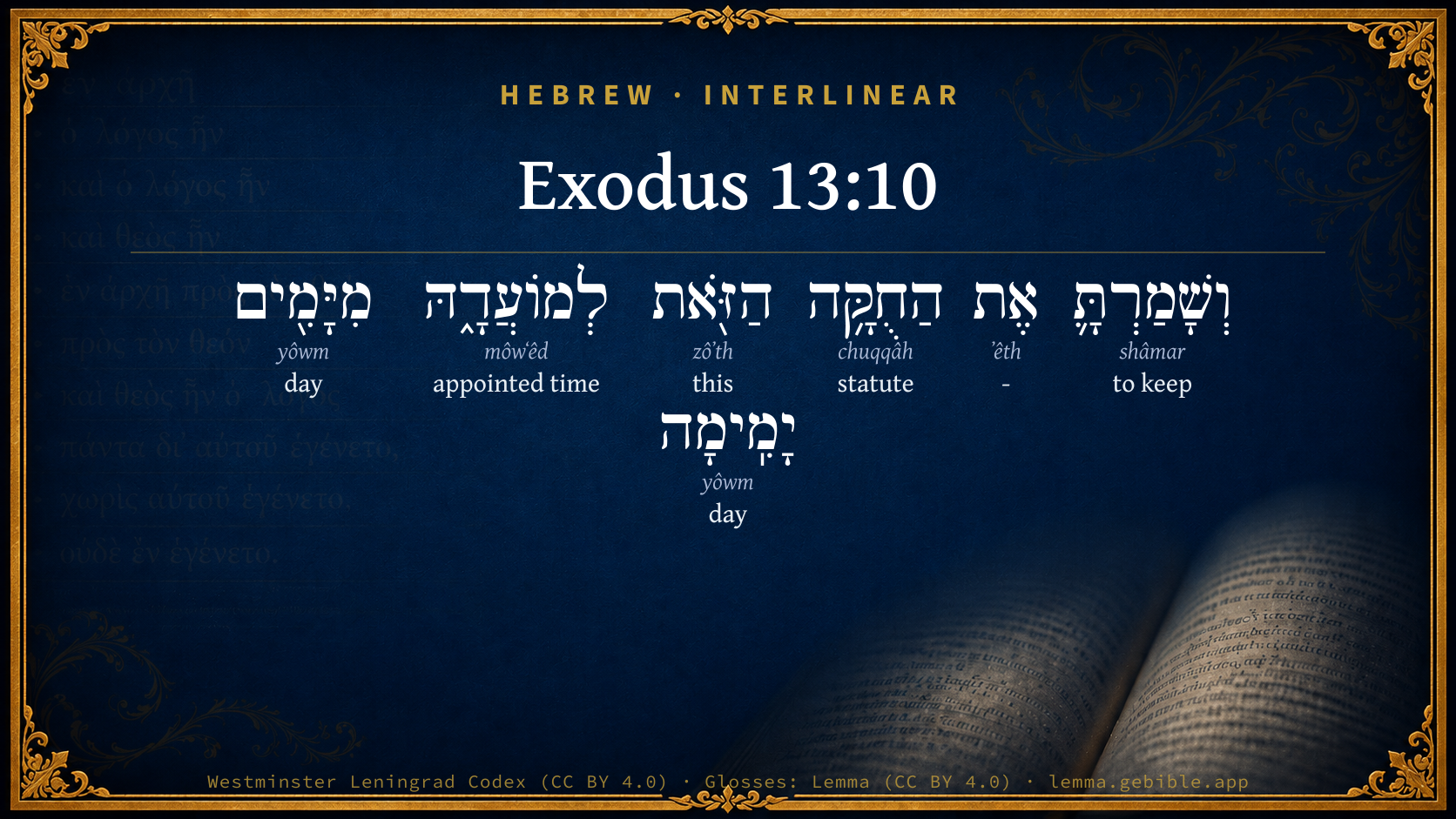
Hebrew (Westminster Leningrad Codex) Exodus 13:10 appears in the Hebrew Old Testament. The text above is from the Westminster Leningrad Codex. Each word links to its Strong’s number, a concise gloss, and parsing drawn from the Open Scriptures Hebrew Bible morphology. Click any word for its full Brown-Driver-Briggs (BDB) entry.
Download image
Cite this verse

Exodus 13:10 (World English Bible). Public Domain. Lemma interlinear Bible study tool, https://lemma.gebible.app/v/exodus/13/10.

Show BibTeX & RIS
BibTeX
RIS
English Translation
You shall therefore keep this ordinance in its season from year to year.
World English Bible · Public Domain
Download a study sheet

One document with this verse’s original text, its word-by-word gloss line, the meaning frame, cross-references with their text, attributed commentary, and full source and license credits — printable, and it pastes into notes with its structure intact.

This verse Autodidact and up

Study sheet (.html) Plain text (.txt)

A passage Seminary Student

Up to 50 verses in one chapter. A passage sheet keeps up to 6 commentary sources and 12 cross-references per verse, in the order this page ranks them, and says so on the sheet whenever that leaves anything out. Ask for a single verse and you get the Autodidact verse sheet above.

Everything on this page stays free to read, with no account — the sheet is a download of what is already on screen, not access to it.

Want to remove ads? Support Godless Engineer
Compare translations 3

The same verse in 3 English versions, stacked beneath the original-language interlinear above. Click any original word for its lexicon entry.

Each is an independent rendering of the whole verse — the interlinear is not word-aligned to these translations.

Highlighted words mark where these versions differ — a whole-verse word diff, not a word-by-word alignment.

  • World English Bible Public Domain
    You shall therefore keep this ordinance in its season from year to year.
  • King James Version Public Domain
    Thou shalt therefore keep this ordinance in his season from year to year.
  • unfoldingWord Literal Text CC BY-SA 4.0
    And you shall keep this statute at its appointed time from days to days.

unfoldingWord Literal Text — © unfoldingWord, licensed CC BY-SA 4.0. Word-aligned USFM3 via Door43 (git.door43.org/unfoldingWord/en_ult).

Versions to compare (up to 4)

3 of 4 selected

Show all 18 translations

Every available English version of this verse, each an independent rendering of the whole verse.

  • World English Bible Public Domain
    You shall therefore keep this ordinance in its season from year to year.
  • Berean Standard Bible Public Domain
    Therefore you shall keep this statute at the appointed time year after year.
  • Majority Standard Bible Public Domain
    Therefore you shall keep this statute at the appointed time year after year.
  • King James Version Public Domain
    Thou shalt therefore keep this ordinance in his season from year to year.
  • American Standard Version (1901) Public Domain
    Thou shalt therefore keep this ordinance in its season from year to year.
  • Revised Version (1885) Public Domain
    Thou shalt therefore keep this ordinance in its season from year to year.
  • Geneva Bible (1599) Public Domain
    Keepe therefore this ordinance in his season appoynted from yeere to yeere.
  • Douay-Rheims (1899) Public Domain
    Thou shalt keep this observance at the set time from days to days.
  • Young's Literal Translation Public Domain
    and thou hast kept this statute at its appointed season from days to days.
  • Literal Standard Version CC BY-SA 4.0
    and you have kept this statute at its appointed time from days to days.
  • Unlocked Literal Bible CC BY-SA 4.0
    Therefore you must keep this law at its appointed time from year to year.
  • unfoldingWord Literal Text CC BY-SA 4.0
    And you shall keep this statute at its appointed time from days to days.
  • Darby Bible Public Domain
    And thou shalt keep this ordinance at its set time from year to year.
  • World Messianic Bible Public Domain
    You shall therefore keep this ordinance in its season from year to year.
  • Webster's Bible Public Domain
    Thou shalt therefore keep this ordinance in its season from year to year.
  • Free Bible Version CC BY-SA 4.0
    That's why you are to observe this ceremony at the proper time every year.
  • Bible in Basic English Public Domain
    So let this order be kept, at the right time, from year to year.
  • JPS Tanakh (1917) Public Domain
    Thou shalt therefore keep this ordinance in its season from year to year.

Literal Standard Version (2020), Covenant Press — licensed CC BY-SA 4.0. Text via the HelloAO Bible API (eBible.org). Unlocked Literal Bible (unfoldingWord) — licensed CC BY-SA 4.0. Text via the HelloAO Bible API (eBible.org). unfoldingWord Literal Text — © unfoldingWord, licensed CC BY-SA 4.0. Word-aligned USFM3 via Door43 (git.door43.org/unfoldingWord/en_ult). Free Bible Version, Dr. Jonathan Gallagher — licensed CC BY-SA 4.0. Text via the HelloAO Bible API (eBible.org).

Word by word

More ways to search: Search by grammar → Find every occurrence → Compare this word →

Practice this passage: Drill this verse → Learn its vocabulary →

About this verse

These counts appear in no published source. They are computed here, from the morphology-tagged text and Lemma’s own curated glosses. What Lemma adds →

7
words
6
distinct lemmas
Pentateuch
section

Grammatical profile

  • 1 verb
  • 4 nouns
  • 1 pronoun
  • 1 particle

Verb forms

  • וְשָׁמַרְתָּ֛ Qal · Sequential Perfect

Repetition

A word recurs within this verse — often emphatic in Hebrew:

  • מִיָּמִ֖ים day H3117 ×2

Hebrew & Septuagint length

In English translation the verse runs 13 words from the Hebrew and 16 from the Septuagint (LXX English) — closely comparable.

A rough comparison of the two English renderings, which tokenize alike — not a word-level alignment.

Word counts can differ between the Hebrew and the Greek without any difference in meaning — e.g. the Hebrew direct-object marker אֵת has no separate Greek word, and Greek often adds the article ὁ.

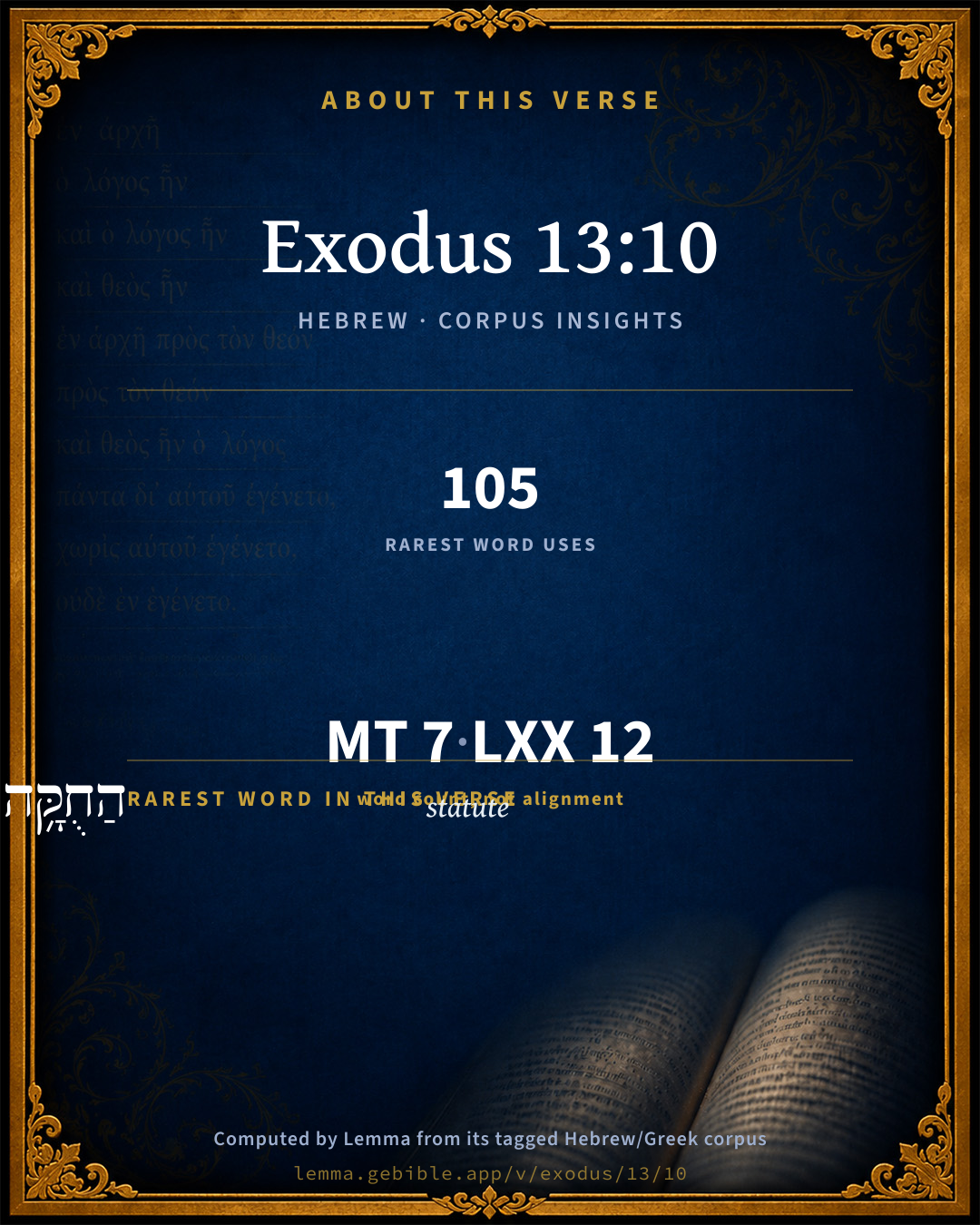
In the original languages it is 7 Hebrew tokens and 12 Greek tokens — but the two are counted differently (Hebrew bundles its prefixes and suffixes into one token; the Greek is in lemma form), so that isn’t a like-for-like length.

Cross-references

5

Topical passages linked to Exodus 13:10 in the Treasury of Scripture Knowledge — connected by theme and wording, ordered by reader-vote popularity; previews shown in the World English Bible.

  • Exodus 12:14 This day shall be to you for a memorial, and you shall keep it a feast to Yahweh: throughout your generations you shall keep it a feast by an ordinance forever.
  • Exodus 12:24–25 You shall observe this thing for an ordinance to you and to your sons forever.
  • Exodus 23:15 You shall observe the feast of unleavened bread. Seven days you shall eat unleavened bread, as I commanded you, at the time appointed in the month Abib (for in it you came out from Egypt), and no one shall appear before me empty.
  • Leviticus 23:6 On the fifteenth day of the same month is the feast of unleavened bread to Yahweh. Seven days you shall eat unleavened bread.
  • Deuteronomy 16:3–4 You shall eat no leavened bread with it; seven days shall you eat unleavened bread therewith, even the bread of affliction; for you came forth out of the land of Egypt in haste: that you may remember the day when you came forth out of the land of Egypt all the days of your life.

Cross-references courtesy of OpenBible.info (CC BY 4.0).

Hebrew and Greek witnesses Masoretic Hebrew ↔ Greek Septuagint

The same verse in the two great witnesses to the Old Testament, shown verse-for-verse.

These are two independent witnesses, not word-aligned to each other, and the Septuagint is shown in lemma (dictionary) form.

Hebrew Exodus 13:10 Masoretic · Westminster Leningrad Codex

וְשָׁמַרְתָּ֛ אֶת הַחֻקָּ֥ה הַזֹּ֖את לְמוֹעֲדָ֑הּ מִיָּמִ֖ים יָמִֽימָה

You shall therefore keep this ordinance in its season from year to year.

World English Bible · Public Domain

Greek LXX Exodus 13:10 Septuagint · lemma form

καί φυλάσσω ὁ νόμος οὗτος κατά καιρός ὥρα ἀπό ἡμέρα εἰς ἡμέρα

And preserve you⌃ this law according to the times of the seasons, from year to year.

LXX2012 (modern English Septuagint) · Public Domain

Hebrew: Westminster Leningrad Codex (CC BY 4.0). Greek: Septuagint (public domain); English from LXX2012 (modern English Septuagint) (Public Domain). How the Septuagint differs from the Hebrew →

Targum (Aramaic paraphrase)

2

The Targum is the ancient Jewish Aramaic paraphrase of the Hebrew Scriptures — an interpretive translation, not the Hebrew text itself. Onkelos (literal) and Pseudo-Jonathan (expansive) render the Torah, and Jonathan the Prophets. Coverage is partial: where no permissively-licensed English translation exists for a verse, only the Aramaic is shown. This is verse-level text, not a word-by-word alignment to the Hebrew.

  1. Targum Onkelos Torah (Genesis–Deuteronomy)
    וְתִטַּר יָת קְיָמָא הָדָא לְזִמְנַהּ מִזְמַן לִזְמָן:

    (no public-domain English translation for this verse)

    Targum Onkelos — Aramaic: “Onkelos Genesis” (public domain); “Onkelos Exodus” (public domain); “Onkelos Leviticus” (public domain); “Onkelos Numbers” (public domain); “Onkelos Deuteronomy” (public domain). English: “Sefaria Community Translation” (CC0 1.0 (public-domain dedication)); “J.W. Etheridge. The Targums of Onkelos and Jonathan Ben Uzziel on the Pentateuch. London: Longmans, Green, 1862” (public domain). Text via Sefaria.

  2. Targum Pseudo-Jonathan Torah (Genesis–Deuteronomy)
    וְתִנְטוֹר יַת קְיָימָא הָדָא דִתְפִילֵי לְזִימְנָא דְחָזֵי לָהּ בְּיוֹמֵי עוֹבָדָא וְלָא בְּשַׁבַּיָיא וּבְמוֹעֲדַיָא וּבִימָמָא וְלָא בְּלֵילְיָא

    Thou shalt therefore keep this statute of the Tephillin in the season to which it belongs, on work days, not on sabbaths or solemnities; and by day, not by night.

    Targum Pseudo-Jonathan — Aramaic: “Targum Jonathan on Genesis” (public domain); “Targum Jonathan on Exodus” (public domain); “Targum Jonathan on Leviticus” (public domain); “Targum Jonathan on Numbers” (public domain); “Targum Jonathan on Deuteronomy” (public domain). English: “The Targum of Jonathan ben Uzziel, trans. J. W. Etheridge, London, 1862” (public domain). Text via Sefaria.

Commentary

Notes on Exodus 13:10 from classic Christian and Jewish commentators (each source and its license shown beneath its notes). The classic Christian expositions comment on the surrounding passage and are grouped to its opening verse, so a note may address several verses; the Jewish commentaries on the Tanakh (Rashi and others) are per-verse, so they appear only where the commentator wrote on this verse.

Lemma curates 59 commentaries, every one of them public domain or Creative Commons licensed, each selected and text-cleaned for this edition rather than reprinted as found. About our sources →

Trapp's Complete Commentary

John Trapp

Exo 13:10 Thou shalt therefore keep this ordinance in his season from year to year.

Ver. 10. From year to year.] The Chaldee hath it, From time to time. We have the Lord’s Supper, that sweet ordinance wherein Christ "kisseth us with the kisses of his lips," and giveth us a privy seal of his love, much oftener: yet not so oft as the primitive Christians, who had it weekly: whence it was called Panis hebdomadarias. Yea, Basil tells us, that they ate the Lord’s Supper three or four times a week - viz., on Wednesdays, Fridays, and Lord’s-days: but that was a time of persecution.

John Trapp, A Commentary or Exposition upon All the Books of the Old and New Testament (1647–1656) — public domain. Text from a community e-Sword module.

The Cambridge Bible for Schools and Colleges

gen. ed. J. J. S. Perowne

10. Thou shalt therefore keep] Heb. And thou shalt keep.

in its season] in the month of Abib (v. 4); cf. Exo_23:15, where the same Hebrew word is rendered ‘in the time appointed of the month of Abib.’

from year to year] מימים ימימה: so Jdg_11:40; Jdg_21:19, 1Sa_Exo_1:3; 1Sa_2:19†.

(b) 11–16. Firstborn males, both of man and beast, to belong to Jehovah. The firstling of an ass is to be either redeemed by a lamb or killed; the firstborn of men are also to be redeemed: other firstling were sacrificed to Jehovah. Like vv. 3–10, an older law of J (v. 12f., cf. Exo_34:19 f.) in a parenetic setting. ‘The passage is related to v. 1f. (P) as vv. 3–10 (J) are related to Exo_12:14-20 (P), and Exo_12:21-27 (J) to Exo_12:2-13 (P)’ (Di.).

The Cambridge Bible for Schools and Colleges (gen. ed. J. J. S. Perowne; Cambridge University Press, 1878–1918) — public domain. Text from a community e-Sword module.

John Gill's Exposition

Thou shall therefore keep the ordinance in his season,.... Not the ordinance of the phylacteries, as the Targum of Jonathan, but the ordinance of unleavened bread:

from year to year; every year successively, so long as in force, even unto the coming of the Messiah. It is in the Hebrew text, "from days to days" (c); that is, either year after year, as we understand it; or else the sense is, that the feast of unleavened bread, when the season was come for keeping it, was to be observed every day for seven days running.

(c) "a diebus in dies", V. L. Montanus, Munster, Vatablus, Drusius.

John Gill's Exposition of the Whole Bible (1746–1763) — public domain (CC PDM 1.0). Text via the HelloAO Bible API.

Matthew Poole's English Annotations

Heb. From days to days. But days in the Hebrew tongue are oft put for a complete year. Of which see Gen 4:3; Lev 25:29; Amo 4:4.

Matthew Poole's English Annotations on the Holy Bible (1683–1685) — public domain. Text from a community e-Sword/MySword module.

The Pulpit Commentary

This ordinance. The ordinance of unleavened bread. See Exo_12:14, Exo_12:24.

HOMILIES BY G.A. GOODHART Ver. 10-12:42. Remember.

Utmost pains taken that the day should be honoured and remembered.

(1) The month in which it occurred became the beginning of months.

(2) A special ordinance as to the first-born pointed back continually to the event celebrated (vers. 11-13).

(3) The annual feast was specially devised to keep it in memory (vers. 14, etc.). Why all this?

I REASON OF OBSERVANCE. It commemorated:

1. A great judgment. Nine plagues had passed; the members of each successive trial following one another at shorter intervals and with increasing severity. Illustration, siege of town. Besiegers draw parallels closer and closer, each time sounding summons to surrender. Every summons disregarded; at length word given for the assault. God laying siege to Egypt, now preparing for the assault (cf. generally Am 4). "Therefore, prepare to meet thy God". (Exo_11:4) "I will go out;" the representatives stand aside that the arm of Jehovah may be recognised. Fourteenth of month; midnight. God accompanied by the angel of vengeance. Picture result palace, dungeon, stables, fields, temples, streets. The judgment was upon Egypt and her gods.

2. A great deliverance.

(1) From death. God the judge is impartial. If Egypt has sinned, so also Israel. Three plagues shared by both, both now threatened by self-same danger. Israel, however, trusting God, may escape by obedience. Lamb chosen four days earlier. Slain that afternoon at sundown. Light of full moon shows blood streaks on lintels and doorposts of houses in Goshen; inside, people prepared for departure, feeding on lamb. Midnight: Is it imagination that rush and quiver of unseen wings? The shadow of the wings of God shelter each blood-stained door, whilst the angel of vengeance passes over, sparing those whom God protects.

(2) From slavery. Wailing throughout Egypt. Midnight message, "Go, get ye gone." At once families gather to standards of their tribes. Soon one great army, harnessed and equipped, laden with spoils of Egypt, the Israelites march forth from the land of their captivity. The time fulfilled to the day, (Exo_12:41) when their hour is come their God is ready.

3. A great exhibition of Divine power. Not a mere judgment or a mere deliverance, but judgment by a personal judge, deliverance by a personal deliverer.

(1) The Egyptians needed to learn who Jehovah was. The Israelites had not done much to make him respected; rather had brought his name into disrepute as the patron of a slavish multitude. Must cause his own name to be hallowed. (cf. Eze_36:20-23)

(2) Israel needed to learn that Jehovah was the deliverer a God faithful to his promises, yet who could not endure sin. Moses and Aaron his instruments, but the victory due only to his right hand and his holy arm.

II USE OF THE OBSERVANCE. By communicating the judgment and the deliverance, it was calculated to keep men mindful of the judge and the deliverer, and to prompt respect for his law. (Exo_13:9) Commemorations are an aid to memory, reminding of past events, and recalling associations connected with them. Mere observance as an end in itself, bondage; (cf. Gal_4:9, Gal_4:10) as a means to an end, helpful and necessary. The Pharisee makes a virtue of observance; the right thing is to draw virtue from it. See what this observance taught:

1. God is long-suffering, but the day of vengeance comes at length. The help to memory, as to what he had done, was a help to conviction as to what he might do.

2. God will not clear the guilty, yet his mercy doth endure for ever. Evenwith the help, how often were these truths forgotten; (cf. Psa_106:7-13, etc.) would any have remembered them without it?

Apply. Life, which forms the memory of the future, grows out of memory of the past. A good memory is a help to good living. What helps do you use to prompt memory? The marked bill, the birthday text-book, the diary all these helpful; above all, the day, the anniversary, if we use it rightly.Commemorations are but sign-posts pointing to that which is commemorated; use them as such, follow out their indications. So, remembering past mercies, faith will be strengthened and hope sustained. G.

The Pulpit Commentary (1880–1919), ed. H.D.M. Spence-Jones & Joseph S. Exell — public domain. Text from a community e-Sword module.

Rashi

Rabbi Shlomo Yitzchaki (Rashi)

מימים ימימה means FROM YEAR TO YEAR (ימים frequently signifies a year) (Menachot 36b).

Rashi on the Tanakh — English translations: “The Judaica Press complete Tanach with Rashi, translated by A. J. Rosenberg” (CC BY 4.0); “Pentateuch with Rashi's commentary by M. Rosenbaum and A.M. Silbermann, 1929-1934” (public domain); “The Metsudah Tanach series, Lakewood, N.J” (CC BY 4.0); and “The Book of Joshua, Metsudah Publications, 1997” (CC BY 4.0). Text via Sefaria.

Lesson kit

Teaching starters — assembled from the data on this page, not authored interpretation. Every prompt links to the verse data it draws on. Edit before teaching.

Exodus, in the Pentateuch, opens this verse with 7 words (6 distinct Hebrew lemmas). Its most distinctive word is chuqqâh (“statute”). A historical commentator’s framing appears above. Read the whole chapter for the surrounding context.

Discussion questions

  1. How does “statute” (chuqqâh) shape what this verse is saying?
  2. How does Exodus 12:14, which shares this passage’s theme, read alongside this verse?
  3. What does the repetition of “day” (2× in this one verse) do in this verse?
  4. The translations on this page render this verse differently — a whole-verse word diff, not a word-by-word alignment. What might account for the different wordings?
  5. «וְשָׁמַרְתָּ֛» is a Qal Sequential Perfect verb. How does that grammatical form shape the action described?
  6. Compare how Trapp's Complete Commentary and The Cambridge Bible for Schools and Colleges read this verse. Where do they agree or differ?

Things to notice

Reading settings

Reading text

Shown beneath each verse's original-language words.

Old Testament
Old Testament edition

Read the OT as the Masoretic Hebrew (MT) or the Greek Septuagint (LXX).

English shown for the Greek Septuagint (in the Hebrew ↔ Greek comparison).

Comparing translations? Open the Compare panel on any verse page to stack up to four side by side.