
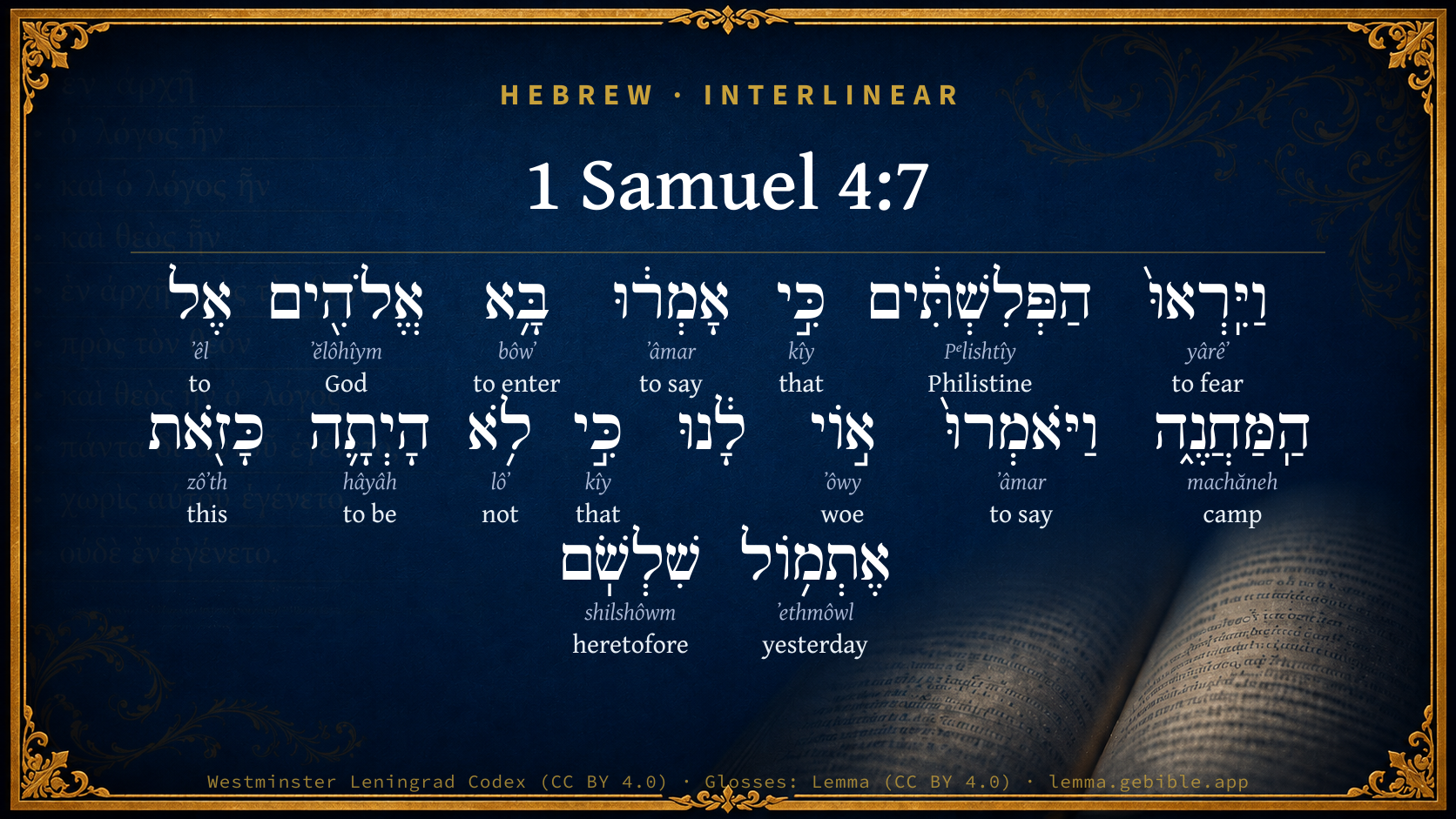
1 Samuel 4:7

Hebrew (Westminster Leningrad Codex) 1 Samuel 4:7 appears in the Hebrew Old Testament. The text above is from the Westminster Leningrad Codex. Each word links to its Strong’s number, a concise gloss, and parsing drawn from the Open Scriptures Hebrew Bible morphology. Click any word for its full Brown-Driver-Briggs (BDB) entry.
Download image
Cite this verse

1 Samuel 4:7 (World English Bible). Public Domain. Lemma interlinear Bible study tool, https://lemma.gebible.app/v/1-samuel/4/7.

Show BibTeX & RIS
BibTeX
RIS
English Translation
The Philistines were afraid, for they said, God is come into the camp. They said, Woe to us! for there has not been such a thing heretofore.
World English Bible · Public Domain
Highlights Full analysis ↓
Download a study sheet

One document with this verse’s original text, its word-by-word gloss line, the meaning frame, cross-references with their text, attributed commentary, and full source and license credits — printable, and it pastes into notes with its structure intact.

This verse Autodidact and up

Study sheet (.html) Plain text (.txt)

A passage Seminary Student

Up to 50 verses in one chapter. A passage sheet keeps up to 6 commentary sources and 12 cross-references per verse, in the order this page ranks them, and says so on the sheet whenever that leaves anything out. Ask for a single verse and you get the Autodidact verse sheet above.

Everything on this page stays free to read, with no account — the sheet is a download of what is already on screen, not access to it.

Want to remove ads? Support Godless Engineer
Compare translations 3

The same verse in 3 English versions, stacked beneath the original-language interlinear above. Click any original word for its lexicon entry.

Each is an independent rendering of the whole verse — the interlinear is not word-aligned to these translations.

Highlighted words mark where these versions differ — a whole-verse word diff, not a word-by-word alignment.

  • World English Bible Public Domain
    The Philistines were afraid, for they said, God is come into the camp. They said, Woe to us! for there has not been such a thing heretofore.
  • King James Version Public Domain
    And the Philistines were afraid, for they said, God is come into the camp. And they said, Woe unto us! for there hath not been such a thing heretofore.
  • unfoldingWord Literal Text CC BY-SA 4.0
    And the Philistines feared, for they said, “A god has come into the camp!” And they said, “Woe to us! For it was not like this yesterday the third day!

unfoldingWord Literal Text — © unfoldingWord, licensed CC BY-SA 4.0. Word-aligned USFM3 via Door43 (git.door43.org/unfoldingWord/en_ult).

Versions to compare (up to 4)

3 of 4 selected

Show all 18 translations

Every available English version of this verse, each an independent rendering of the whole verse.

  • World English Bible Public Domain
    The Philistines were afraid, for they said, God is come into the camp. They said, Woe to us! for there has not been such a thing heretofore.
  • Berean Standard Bible Public Domain
    the Philistines were afraid. “The gods have entered their camp!” they said. “Woe to us, for nothing like this has happened before.
  • Majority Standard Bible Public Domain
    the Philistines were afraid. “The gods have entered their camp!” they said. “Woe to us, for nothing like this has happened before.
  • King James Version Public Domain
    And the Philistines were afraid, for they said, God is come into the camp. And they said, Woe unto us! for there hath not been such a thing heretofore.
  • American Standard Version (1901) Public Domain
    And the Philistines were afraid, for they said, God is come into the camp. And they said, Woe unto us! for there hath not been such a thing heretofore.
  • Revised Version (1885) Public Domain
    And the Philistines were afraid, for they said, God is come into the camp. And they said, Woe unto us! for there hath not been such a thing heretofore.
  • Geneva Bible (1599) Public Domain
    And the Philistims were afraide, and saide, God is come into the hoste: therefore saide they, Wo vnto vs: for it hath not bene so heretofore.
  • Douay-Rheims (1899) Public Domain
    And the Philistines were afraid, saying: God is come into the camp. And sighing, they said:
  • Young's Literal Translation Public Domain
    And the Philistines are afraid, for they said, `God hath come in unto the camp;' and they say, `Wo to us, for there hath not been like this heretofore.
  • Literal Standard Version CC BY-SA 4.0
    And the Philistines are afraid, for they said, “God has come into the camp”; and they say, “Woe to us, for there has been nothing like this before.
  • Unlocked Literal Bible CC BY-SA 4.0
    The Philistines were afraid; they said, “A god has come into the camp.” They said, “Woe to us! Nothing like this has happened before!
  • unfoldingWord Literal Text CC BY-SA 4.0
    And the Philistines feared, for they said, “A god has come into the camp!” And they said, “Woe to us! For it was not like this yesterday the third day!
  • Darby Bible Public Domain
    And the Philistines were afraid, for they said, God is come into the camp. And they said, Woe unto us! for there has not been such a thing heretofore.
  • World Messianic Bible Public Domain
    The Philistines were afraid, for they said, “God has come into the camp.” They said, “Woe to us! For there has not been such a thing before.
  • Webster's Bible Public Domain
    And the Philistines were afraid, for they said, God hath come into the camp. And they said, Woe to us! for there hath not been such a thing heretofore.
  • Free Bible Version CC BY-SA 4.0
    the Philistines were afraid. “A god has arrived in the camp,” they said. “We're in trouble, for nothing like this has happened before.
  • Bible in Basic English Public Domain
    And the Philistines, full of fear, said, God has come into their tents. And they said, Trouble is ours! for never before has such a thing been seen.
  • JPS Tanakh (1917) Public Domain
    And the Philistines were afraid, for they said: 'God is come into the camp.' And they said: 'Woe unto us! for there was not such a thing yesterday and the day before.

Literal Standard Version (2020), Covenant Press — licensed CC BY-SA 4.0. Text via the HelloAO Bible API (eBible.org). Unlocked Literal Bible (unfoldingWord) — licensed CC BY-SA 4.0. Text via the HelloAO Bible API (eBible.org). unfoldingWord Literal Text — © unfoldingWord, licensed CC BY-SA 4.0. Word-aligned USFM3 via Door43 (git.door43.org/unfoldingWord/en_ult). Free Bible Version, Dr. Jonathan Gallagher — licensed CC BY-SA 4.0. Text via the HelloAO Bible API (eBible.org).

Word by word

More ways to search: Search by grammar → Find every occurrence → Compare this word →

Practice this passage: Drill this verse → Learn its vocabulary →

אֶתְמ֥וֹל
ʼethmôwl
H865
“yesterday”
Noun, Common, Masculine, Singular, Absolute
Part of Speech
Noun
Type
Common
Gender
Masculine
Number
Singular
State
Absolute
Full BDB Definition

Origin: probably from H853 or H854 and H4136

TWOT: 2521

yesterday, recently, formerly - yesterday - formerly (figuratively) - from yesterday, already (in phrase) - (TWOT +) before, before that time, before the time, heretofore, of late, of old, these days, time(s) past
  1. וַיִּֽרְאוּ֙ yârêʼ H3372 “and · to fear” Conjunction + Verb, Qal, Sequential Imperfect, 3rd Person, Masculine, Plural
  2. הַפְּלִשְׁתִּ֔ים Pᵉlishtîy H6430 “the · Philistines” Particle, Definite Article + Noun, Gentilic, Masculine, Plural, Absolute
  3. כִּ֣י kîy H3588 “that” Conjunction
  4. אָמְר֔וּ ʼâmar H559 “to say” Verb, Qal, Perfect, 3rd Person, Common, Plural
  5. בָּ֥א bôwʼ H935 “to enter” Verb, Qal, Perfect, 3rd Person, Masculine, Singular
  6. אֱלֹהִ֖ים ʼĕlôhîym H430 “God(s)” Noun, Common, Masculine, Plural, Absolute
  7. אֶל ʼêl H413 “to” Preposition
  8. הַֽמַּחֲנֶ֑ה machăneh H4264 “the · camp” Particle, Definite Article + Noun, Common, Both, Singular, Absolute
  9. וַיֹּאמְרוּ֙ ʼâmar H559 “and · to say” Conjunction + Verb, Qal, Sequential Imperfect, 3rd Person, Masculine, Plural
  10. א֣וֹי ʼôwy H188 “woe” Particle, Interjection
  11. כִּ֣י kîy H3588 “that” Conjunction
  12. לֹ֥א lôʼ H3808 “not” Particle, Negative
  13. הָיְתָ֛ה hâyâh H1961 “to be” Verb, Qal, Perfect, 3rd Person, Feminine, Singular
  14. כָּזֹ֖את zôʼth H2063 “like/as · this” Preposition + Pronoun, Demonstrative, Feminine, Singular
  15. שִׁלְשֹֽׁם shilshôwm H8032 “heretofore” Noun, Common, Masculine, Singular, Absolute

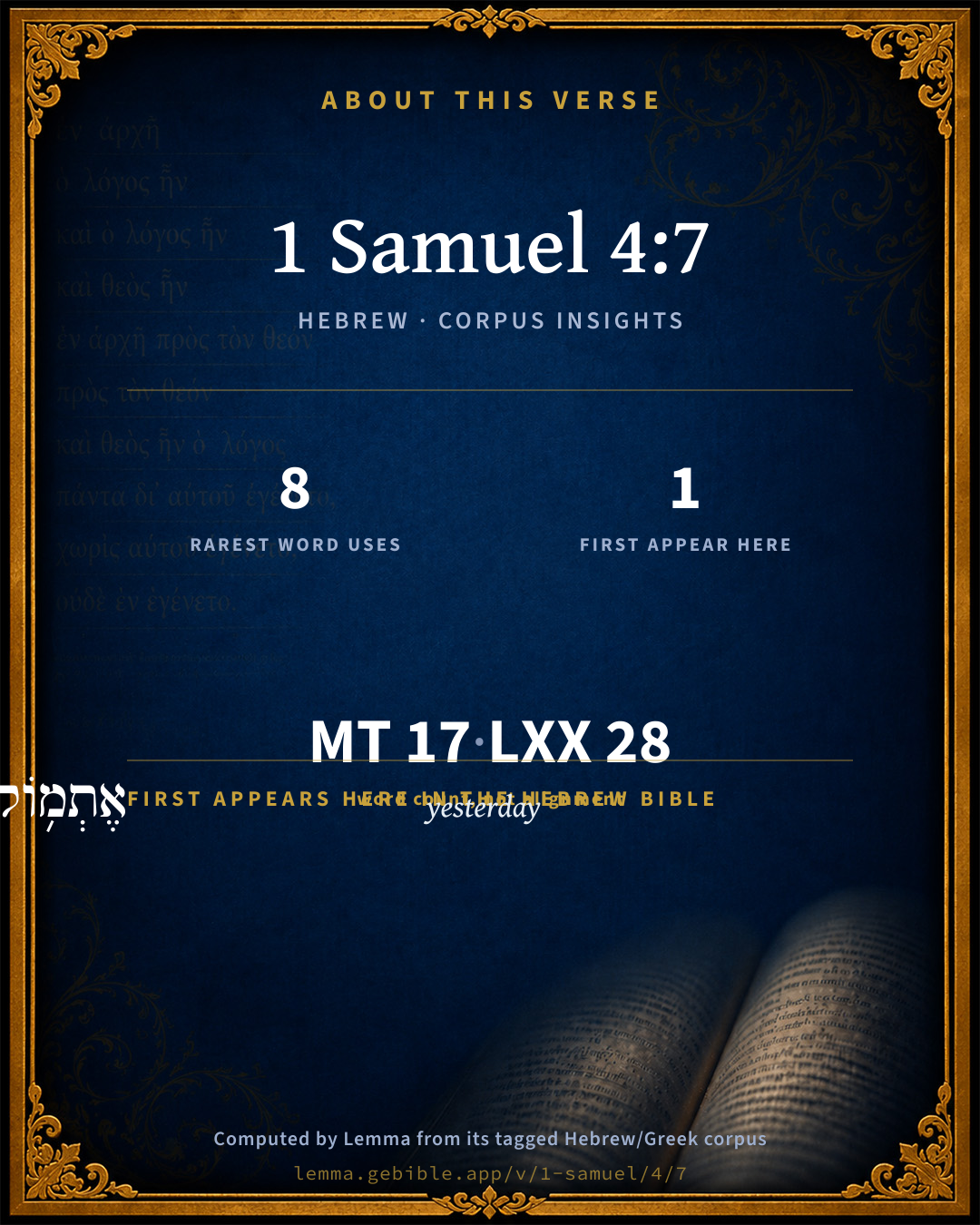
About this verse

These counts appear in no published source. They are computed here, from the morphology-tagged text and Lemma’s own curated glosses. What Lemma adds →

17
words
14
distinct lemmas
Historical
section

Notable vocabulary

The rarest word here is אֶתְמ֥וֹל yesterday H865 — appearing just 8 times in the whole Hebrew Bible.

First appearance in Scripture

This word makes its first canonical appearance in the Hebrew Bible here:

  • אֶתְמ֥וֹל yesterday H865

Shared distinctive vocabulary

אֶתְמ֥וֹל yesterday H865 occurs in 8 verses of the Hebrew Bible. Also found in:

Grammatical profile

  • 5 verbs
  • 5 nouns
  • 1 pronoun
  • 2 prepositions
  • 2 conjunctions
  • 2 particles

Verb forms

  • וַיִּֽרְאוּ֙ Qal · Sequential Imperfect
  • אָמְר֔וּ Qal · Perfect
  • בָּ֥א Qal · Perfect
  • וַיֹּאמְרוּ֙ Qal · Sequential Imperfect
  • הָיְתָ֛ה Qal · Perfect

Repetition

Words recur within this verse — often emphatic in Hebrew:

  • אָמְר֔וּ to say H559 ×2
  • כִּ֣י that H3588 ×2

Hebrew & Septuagint length

In English translation the verse runs 27 words from the Hebrew and 18 from the Septuagint (LXX English) — the Septuagint runs noticeably shorter here. See the side-by-side →

A rough comparison of the two English renderings, which tokenize alike — not a word-level alignment.

Word counts can differ between the Hebrew and the Greek without any difference in meaning — e.g. the Hebrew direct-object marker אֵת has no separate Greek word, and Greek often adds the article ὁ.

In the original languages it is 17 Hebrew tokens and 28 Greek tokens — but the two are counted differently (Hebrew bundles its prefixes and suffixes into one token; the Greek is in lemma form), so that isn’t a like-for-like length.

Cross-references

3

Topical passages linked to 1 Samuel 4:7 in the Treasury of Scripture Knowledge — connected by theme and wording, ordered by reader-vote popularity; previews shown in the World English Bible.

  • Exodus 14:25 He took off their chariot wheels, and they drove them heavily; so that the Egyptians said, "Let's flee from the face of Israel, for Yahweh fights for them against the Egyptians!"
  • Exodus 15:14–16 The peoples have heard. They tremble. Pangs have taken hold on the inhabitants of Philistia.
  • Deuteronomy 32:30 How should one chase a thousand, Two put ten thousand to flight, Except their Rock had sold them, Yahweh had delivered them up?

Cross-references courtesy of OpenBible.info (CC BY 4.0).

Hebrew and Greek witnesses Masoretic Hebrew ↔ Greek Septuagint

The same verse in the two great witnesses to the Old Testament, shown verse-for-verse.

Here the Septuagint runs noticeably shorter than the Hebrew — LXX2012 (modern English Septuagint) 18 words vs World English Bible 27. A rough length comparison of the two English translations, not a word-level alignment — read both below.

These are two independent witnesses, not word-aligned to each other, and the Septuagint is shown in lemma (dictionary) form.

Hebrew 1 Samuel 4:7 Masoretic · Westminster Leningrad Codex

וַיִּֽרְאוּ֙ הַפְּלִשְׁתִּ֔ים כִּ֣י אָמְר֔וּ בָּ֥א אֱלֹהִ֖ים אֶל הַֽמַּחֲנֶ֑ה וַיֹּאמְרוּ֙ א֣וֹי לָ֔נוּ כִּ֣י לֹ֥א הָיְתָ֛ה כָּזֹ֖את אֶתְמ֥וֹל שִׁלְשֹֽׁם

The Philistines were afraid, for they said, God is come into the camp. They said, Woe to us! for there has not been such a thing heretofore.

World English Bible · Public Domain

Greek LXX 1 Samuel 4:7 Septuagint · lemma form

καί φοβέω ὁ ἀλλόφυλος καί εἶπον οὗτος ὁ θεός ἥκω πρός αὐτός εἰς ὁ παρεμβολή οὐαί ἐγώ ἐκαἱρέω ἐγώ κύριος σήμερον ὅτι οὐ γίγνομαι τοιοῦτος χθές καί τρίτος

And the Philistines feared, and said, These are the Gods that are come to them into the camp.

LXX2012 (modern English Septuagint) · Public Domain

On this verse, Haydock's Catholic Bible Commentary discusses the Septuagint’s reading. Read the note in Commentary ↓

Hebrew: Westminster Leningrad Codex (CC BY 4.0). Greek: Septuagint (public domain); English from LXX2012 (modern English Septuagint) (Public Domain). How the Septuagint differs from the Hebrew →

Targum (Aramaic paraphrase)

1

The Targum is the ancient Jewish Aramaic paraphrase of the Hebrew Scriptures — an interpretive translation, not the Hebrew text itself. Onkelos (literal) and Pseudo-Jonathan (expansive) render the Torah, and Jonathan the Prophets. Coverage is partial: where no permissively-licensed English translation exists for a verse, only the Aramaic is shown. This is verse-level text, not a word-by-word alignment to the Hebrew.

  1. Targum Jonathan Prophets (Joshua–Malachi)
    וּדְחִילוּ פְּלִשְׁתָּאֵי אֲרֵי אֲמַרוּ אֲתָא אֲרוֹנָא דַייָ לְמַשְׁרִיתָא וַאֲמַרוּ וַי לָנָא אֲרֵי לָא הֲוַת כַּהֲדָא מֵאִיתְמְלֵי וּמִדְקָדָמוֹהִי:

    (no public-domain English translation for this verse)

    Targum Jonathan — Aramaic: “Mikraot Gedolot” (public domain). English: “Sefaria Community Translation” (CC0 1.0 (public-domain dedication)); “London "Chaldee Paraphrase," 1871” (public domain). Text via Sefaria.

Commentary

Notes on 1 Samuel 4:7 from classic Christian and Jewish commentators (each source and its license shown beneath its notes). The classic Christian expositions comment on the surrounding passage and are grouped to its opening verse, so a note may address several verses; the Jewish commentaries on the Tanakh (Rashi and others) are per-verse, so they appear only where the commentator wrote on this verse.

Lemma curates 59 commentaries, every one of them public domain or Creative Commons licensed, each selected and text-cleaned for this edition rather than reprinted as found. About our sources →

Trapp's Complete Commentary

John Trapp

1Sa 4:7 And the Philistines were afraid, for they said, God is come into the camp. And they said, Woe unto us! for there hath not been such a thing heretofore.

Ver. 7. And the Philistines were afraid.] But without cause; for God - who as Josephus well saith, was greater than the ark - was their enemy. The ark also was brought into the camp without any pomp or due reverence, and by the hands of those ungodly priests that were now come into the field to fetch their bane, as had been foretold in 1Sa 2:34.

For there hath not been such a thing heretofore.] Not that they knew of; but such a thing there had been before at the siege of Jericho, and in that expedition against the Midianites. {Num 31:6} So after this (1Sa 14:18 2Sa 11:11) David sent the ark into Joab’s camp before Rabbah; though at another time, when he fled from Absalom, he sent back the ark to Jerusalem, {2Sa 15:25} as knowing that God could as well save without it.

John Trapp, A Commentary or Exposition upon All the Books of the Old and New Testament (1647–1656) — public domain. Text from a community e-Sword module.

The Biblical Illustrator

Joseph S. Exell

1Sa_4:7

And the Philistines were afraid, for they said, God is come into the camp.

Is God in the camp?

I. Consider the great mistake which both Israelites and the Philistines made. The Israelites, instead of seeking to God himself, went to Shiloh to fetch the ark of the covenant. Before they had won any victory, the sight of the ark made them boastful and confident. The Philistines fell into an error of a different kind, for they were frightened without any real cause. They said, God is come into the camp; whereas God had not come at all. It was only the ark with the cherubim upon it; God was not there.

1. The mistake they made was just this they mistook the visible for the invisible. It has pleased God, even in our holy faith, to give us some external symbols--water, and bread, and wine. They are so simple, that it does seem at first sight, as if men could never have made them objects of worship, or used them as instruments of a kind of witchcraft. One would have thought that these symbols would only have been like windows of agate and gates of carbuncle, through which men would behold the Saviour and draw near to Him. Instead thereof, some have neither looked through the windows nor passed through the gates, but they have ascribed to the gates and the windows that which is only to be found in Him who is behind them both. It is sad, indeed, when the symbol takes the place of the Saviour.

2. These Israelites fell into another mistake, which is also often made today: they preferred office to character. In their distress, instead of calling upon God, they sent for Hophni and Phinehas. If the blind lead the blind, both shall fall into the ditch. The blind man may wear a band on his arm to show that he is a certificated guide; but will you be saved from the ditch simply because he belongs to the order of guides, and has his certificate with him? Be not led away by any such vain notion.

3. But these people who faced the Philistines made another mistake: they confounded enthusiasm with faith. When they saw the ark they shouted so that the earth rang again. These are the kind of people I like, says one, people that can shout. If that is all you want, why do you not go among the bulls of Bashan, and make your home in the midst of them? They can make more noise than any mortal man can make. These Israelites shouted, but there was nothing in their noise, any more than there is in their modern imitators. If the ejaculation comes from your heart, I would not ask you to restrain it. God forbid that we should judge any mans worship! But do not be so foolish as to suppose that because there is loud noise there must also be faith. Faith is a still water, it floweth deep. True faith in God may express itself with leaping and with shouting; and it is a happy thing when it does: but it can also sit still before the Lord, and that perhaps is a happier thing still. Praise can sit silent on the lip, and yet be heard in heaven. There is a passion of the heart too deep for words.

4. Another mistake these people made that day was this: they valued, novelty above Scriptural order. The Philistines were afraid, for they said, God is come into the camp. And they said, Woe unto us l for there hath not been such a thing heretofore. The Israelites probably made the same mistake, fixing their hope on this new method of fighting the Philistines, which they hoped would bring them victory. We are all so apt to think that the new plan of going to work will be much more effective than those that have become familiar; but it is not so. It is generally a mistake to exchange old lamps for new. There hath not been such a thing heretofore. There is a glamour about the novelty which misleads us, and we are liable to think the newer is the truer. If there has not been such a thing heretofore, some people will take to it at once for that very reason. Oh, says the man who is given to change, that is the thing for me! But it is probably not the thing for a true-hearted and intelligent Christian, for if there hath not been such a thing heretofore, it is difficult to explain, if the thing be a good one, why the Holy Ghost, who has been with the people of God since Pentecost, and who came to lead us into all truth, has not led the Church of God to this before. If your new discovery is the mind of God, where has Holy Scripture been all these centuries? The mistake made on that battlefield is a mistake which nowadays is frequently imitated. It assumes many forms.

5. We fall into their error when we confound ritual and spirituality.

6. We fall into the same blunder that the Israelites and Philistines made if we consider orthodoxy to be salvation. We have secured much that is worth keeping when we have, intellectually and intelligently, laid hold on that divinely-revealed truth, the gospel of the grace of God but we have not obtained everything even then. Remember it was a beautiful tomb in which the dead Christ was laid; but he left it, and there was nothing there but grave clothes after He had gone; and, in like manner, the best-constructed system of theology, if it has not Christ in it, and if he who holds it be not himself spiritually alive, is nothing more than a tomb in which are trappings for the dead. It is nothing better than a gilded ark, without the presence of God; and although you may shout, and say, God is come into the camp, it will not be so.

7. We fall into the same error if we regard routine as security, and think that, because we have often done a thing, and have not suffered for it, therefore it will be always well with us. We are all such creatures of habit that, at length, our repeated actions seem to be natural and right. Because sentence against their evil works is not executed speedily, therefore the heart of the sons of men is fully set in them to do evil. But though Pompeii may slumber long at the foot of Vesuvius, at length it is overwhelmed. It behoves every one of us to try our ways, and specially to call in question things which have become a sort of second nature to us.

II. Having considered the great mistake these people made, I will draw your attention, in the second place, to the great truth of which their mistake was a caricature. God does come to the camp of His people, and His presence is the great power of His church. I will briefly sketch the scene that takes place when God comes into the camp.

1. Then, the truth of the gospel becomes vital.

2. When God comes into the camp, new life is put into prayer.

3. By the presence of God in the camp fresh energy is thrown into service.

4. When God comes into the camp, His presence convinces unbelievers.

5. The presence of God, moreover, comforts mourners.

6. When God is in the camp, His presence infuses daring into faith. Feeble men begin to grow vigorous, young men dream dreams, and old men see visions. Many begin to plot and plan something for Jesus which, in their timid days, they would never have thought of attempting. Others reach a height of consecration that seems to verge on imprudence.

7. The fact of God being in the camp cannot be hidden, for in a delightful way it distils joy into worship.

III. Let us try to learn the great lessons which this incident teaches us.

1. The first lesson is that which I have been insisting upon all through: the necessity of the Divine presence.

2. Learn, next, that we should do all we can to obtain the presence of God in the camp.

3. When God does come to us, we should seek by all means to retain his presence. How can this boon be secured? (C. H. Spurgeon.)

The Biblical Illustrator, edited by Joseph S. Exell (c. 1880s–1900s) — public domain. Text from a community e-Sword module.

Joseph Benson's Commentary

1Sa 4:7. God is come into the camp — Thus these ignorant idolaters termed the mere symbol of God’s presence God, imagining, no doubt, that the Israelites worshipped it. They said, Wo unto us — The name of the God of Israel was formidable even to those that worshipped other gods, and some apprehensions even the infidels had of the danger of contending with him. And, indeed, those are in a woful condition who have God against them. There hath not been such a thing heretofore — Not in our times; for the fore-mentioned removals of the ark were before it came to Shiloh. And in all the battles which they or their neighbours had fought with the Israelites, they had never heard of such a thing as this. They thought, therefore, that it must produce some extraordinary effects.

Joseph Benson's Commentary on the Old and New Testaments (1811–1818) — public domain. Text from a community e-Sword module.

unfoldingWord translationNotes

Door43 World Missions Community

they said ... They said

"they said to themselves ... They said to each other" or "they said to each other ... They said to each other." The second clause clearly refers to what the Philistines said to each other. The first clause probably refers to what they thought, though it could also refer to what they said to each other. If possible, avoid stating who was spoken to.

A god has come

The Philistines worshiped many gods, so they probably believed that one of those gods, or one whom they did not worship, had come into the camp. Another possible meaning is that they were speaking the proper name of the God of Israel: "Yahweh has come." Because 1Sa 4:8 speaks of "gods," some translations read, "Gods have come," that is, "It is gods who have come." (See: Pronouns)

Who will protect us from the strength of these mighty gods?

This rhetorical question is an expression of deep fear. It can be written as a statement. AT: "There is no one who can protect us from these mighty gods." (See: Rhetorical Question)

these mighty gods ... the gods who attacked

Because the word "god" (or "God") in 1Sa 4:7 is singular, many translations read "this mighty god ... the god who attacked," referring to any one of many possible gods, or "this mighty God ... the God who attacked," using the proper name of the God of Israel. (See: Pronouns)

be men

This is an idiom. AT: "be strong and fight" (See: Idiom)

translationWords

fear

woe

might

Egypt

plague

desert

servant

unfoldingWord translationNotes — © Distant Shores Media and the Door43 World Missions Community, licensed CC BY-SA 4.0. Source: git.door43.org/Door43/en_tn.

Geneva Bible (1599)

Geneva Bible translators

Before we fought against men, and now God is come to fight against us.

Geneva Bible (1599) marginal notes — public domain. Text via Bolls.life.

Adam Clarke's Commentary

Verse 7. God is come into the camp.] They took for granted, as did the Israelites, that his presence was inseparable from his ark or shrine.

Adam Clarke's Commentary on the Bible (1810–1826) — public domain. Text from a community e-Sword/MySword module.

Ellicott's Commentary for English Readers

(7) God is come into the camp.—The joy manifested by the Israelites at the arrival of the Ark from the sanctuary made the Philistines suspect that their enemies’ God was now present with the defeated army.

The city of Aphek, near to which the camp of Israel was pitched, was close to the western entrance of the Pass of Beth-horon. The two defeats of Israel are termed in this Commentary the Battles of Aphek. The name of Eben-ezer, by which the scene was known in after days, was only given to the locality some twenty years later, on the occasion of the victory of Samuel near the same spot.

Philistines and Israelites, then, were equally superstitious in their belief both supposing that Deity was in some way connected with the lifeless gold and wood of the symbol Ark and Cherubim. But the Philistines had some excuse for their fears. Tradition was, no doubt, current among the old inhabitants of Canaan how this sacred Ark had been carried before the conquering armies of Israel in many a battle and siege in those bygone days, when the strange shepherd hordes under Joshua had. first invaded and taken possession of their beautiful land. The next verse explains more clearly some of the reasons for their fear.

A Bible Commentary for English Readers, edited by Charles John Ellicott (1878–1897) — public domain. Text from a community e-Sword module.

John Gill's Exposition

And the Philistines were afraid,.... When the spies returned, and reported to them the reason of the shouting:

for they said, God is come into the camp; into the camp of Israel, because the ark represented him, and was the symbol of his presence; and these Heathens might take the ark itself for an idol of the Israelites; the Targum is,"the ark of God is come"

and they said, woe unto us; it is all over with us, destruction and ruin will be our case, victory will go on their side now their God is among them:

for there hath not been such a thing heretofore; if by this they meant that the ark had never been in the camp of Israel before, they were mistaken; and it is no great wonder they should, being not so well acquainted with the affairs of Israel, and their customs; or rather, it was not so yesterday, or three days ago, when they were defeated; there was no shouting then: or the state of the war is altered; before we fought with the men of Israel, but now we must fight with the God of Israel also.

John Gill's Exposition of the Whole Bible (1746–1763) — public domain (CC PDM 1.0). Text via the HelloAO Bible API.

Haydock's Catholic Bible Commentary

God: "Elohim." Septuagint, "these gods." They speak of the true God according to their false ideas. (Calmet) --- Sighing. Septuagint, "deliver us, O Lord, this day."

George Leo Haydock (1774–1849), Haydock's Catholic Family Bible and Commentary, 1859 edition — public domain. Excludes Psalms (Douay-Rheims chapter numbering differs from Protestant) and Deuterocanonical books (Catholic canon only).

Matthew Poole's English Annotations

God is come, to wit, in and with his ark; or they give the name of God to the ark, before which he was worshipped, as they used to do to the images of their false gods. There hath not been such a thing heretofore; not to our knowledge, or not in our times; for the forementioned removals of the ark were before it came to Shiloh.

Matthew Poole's English Annotations on the Holy Bible (1683–1685) — public domain. Text from a community e-Sword/MySword module.

John Wesley's Explanatory Notes

Heretofore - Not in our times; for the fore-mentioned removals of the ark were before it came to Shiloh.

John Wesley, Explanatory Notes Upon the Whole Bible (1754–1765) — public domain. Text via the GEBible commentary corpus.

Lesson kit

Teaching starters — assembled from the data on this page, not authored interpretation. Every prompt links to the verse data it draws on. Edit before teaching.

1 Samuel, in the Historical, opens this verse with 17 words (14 distinct Hebrew lemmas). Its most distinctive word is ʼethmôwl (“yesterday”). The Greek Septuagint runs shorter here. A historical commentator’s framing appears above. Read the whole chapter for the surrounding context.

Discussion questions

  1. The word ʼethmôwl carries the sense “yesterday.” How does it shape the verse?
  2. This is the first place “yesterday” appears in Scripture (first appears here). What does its debut here establish?
  3. How does 1 Samuel 10:11, which shares the word «yesterday», read alongside this verse?
  4. What does the repetition of “to say” (2× in this one verse) do in this verse?
  5. The Septuagint runs shorter here than the Hebrew. What might account for the difference?
  6. These translations render this verse differently. What is at stake in choosing one wording over another?
  7. «וַיִּֽרְאוּ֙» is a Qal Sequential Imperfect verb. How does that grammatical form shape the action described?
  8. Compare how Trapp's Complete Commentary and The Biblical Illustrator read this verse. Where do they agree or differ?

Things to notice

Reading settings

Reading text

Shown beneath each verse's original-language words.

Old Testament
Old Testament edition

Read the OT as the Masoretic Hebrew (MT) or the Greek Septuagint (LXX).

English shown for the Greek Septuagint (in the Hebrew ↔ Greek comparison).

Comparing translations? Open the Compare panel on any verse page to stack up to four side by side.