
Exodus 12:26

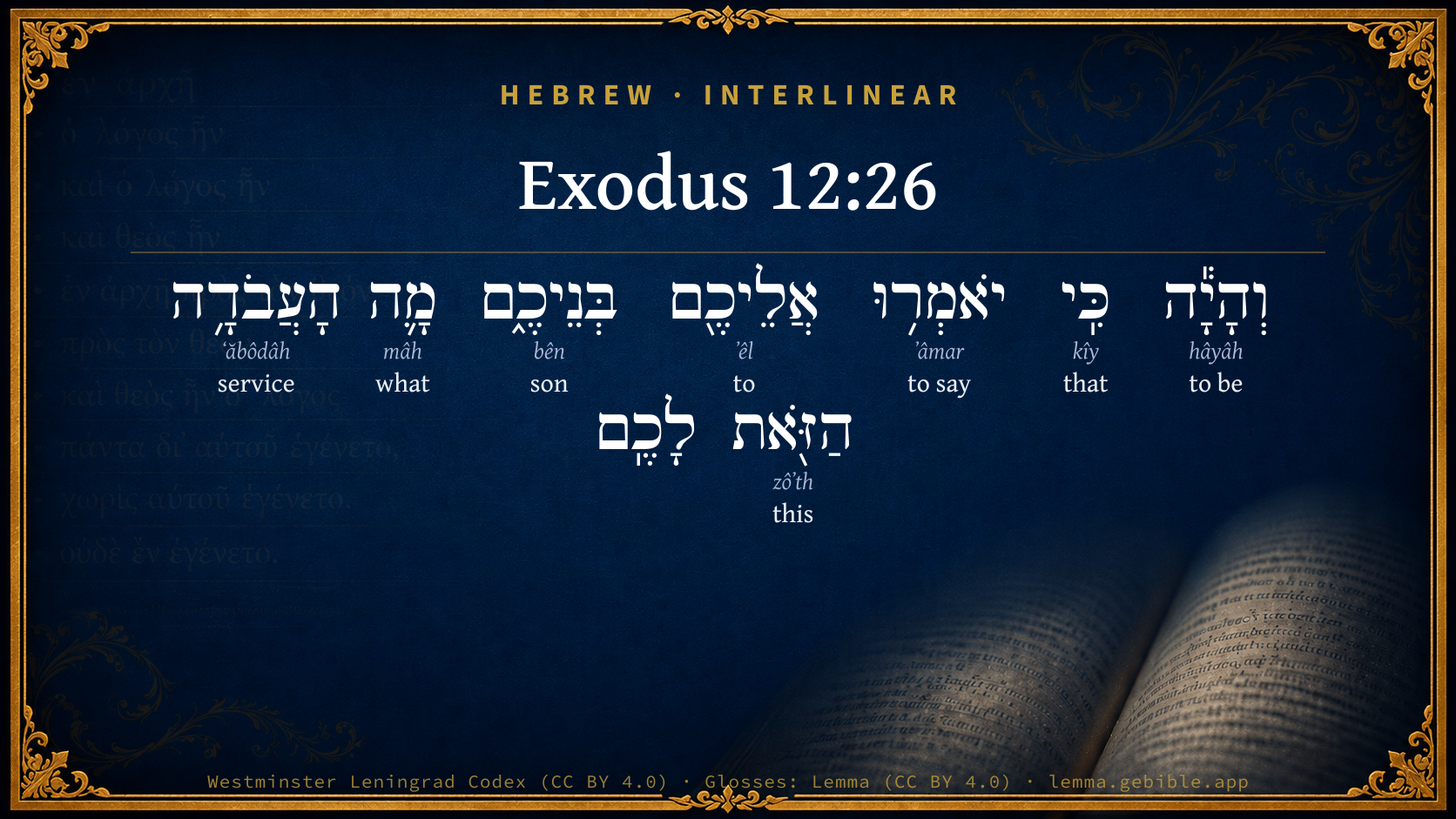
Hebrew (Westminster Leningrad Codex) Exodus 12:26 appears in the Hebrew Old Testament. The text above is from the Westminster Leningrad Codex. Each word links to its Strong’s number, a concise gloss, and parsing drawn from the Open Scriptures Hebrew Bible morphology. Click any word for its full Brown-Driver-Briggs (BDB) entry.
Download image
Cite this verse

Exodus 12:26 (World English Bible). Public Domain. Lemma interlinear Bible study tool, https://lemma.gebible.app/v/exodus/12/26.

Show BibTeX & RIS
BibTeX
RIS
English Translation
It will happen, when your children ask you, 'What do you mean by this service?'
World English Bible · Public Domain
Download a study sheet

One document with this verse’s original text, its word-by-word gloss line, the meaning frame, cross-references with their text, attributed commentary, and full source and license credits — printable, and it pastes into notes with its structure intact.

This verse Autodidact and up

Study sheet (.html) Plain text (.txt)

A passage Seminary Student

Up to 50 verses in one chapter. A passage sheet keeps up to 6 commentary sources and 12 cross-references per verse, in the order this page ranks them, and says so on the sheet whenever that leaves anything out. Ask for a single verse and you get the Autodidact verse sheet above.

Everything on this page stays free to read, with no account — the sheet is a download of what is already on screen, not access to it.

Want to remove ads? Support Godless Engineer
Compare translations 3

The same verse in 3 English versions, stacked beneath the original-language interlinear above. Click any original word for its lexicon entry.

Each is an independent rendering of the whole verse — the interlinear is not word-aligned to these translations.

Highlighted words mark where these versions differ — a whole-verse word diff, not a word-by-word alignment.

  • World English Bible Public Domain
    It will happen, when your children ask you, 'What do you mean by this service?'
  • King James Version Public Domain
    And it shall come to pass, when your children shall say unto you, What mean ye by this service?
  • unfoldingWord Literal Text CC BY-SA 4.0
    And it will happen, when your sons are saying to you, ‘What is this service to you?’

unfoldingWord Literal Text — © unfoldingWord, licensed CC BY-SA 4.0. Word-aligned USFM3 via Door43 (git.door43.org/unfoldingWord/en_ult).

Versions to compare (up to 4)

3 of 4 selected

Show all 18 translations

Every available English version of this verse, each an independent rendering of the whole verse.

  • World English Bible Public Domain
    It will happen, when your children ask you, 'What do you mean by this service?'
  • Berean Standard Bible Public Domain
    When your children ask you, ‘What does this service mean to you?’
  • Majority Standard Bible Public Domain
    When your children ask you, ‘What does this service mean to you?’
  • King James Version Public Domain
    And it shall come to pass, when your children shall say unto you, What mean ye by this service?
  • American Standard Version (1901) Public Domain
    And it shall come to pass, when your children shall say unto you, What mean ye by this service?
  • Revised Version (1885) Public Domain
    And it shall come to pass, when your children shall say unto you, What mean ye by this service?
  • Geneva Bible (1599) Public Domain
    And when your children aske you, What seruice is this ye keepe?
  • Douay-Rheims (1899) Public Domain
    And when your children shall say to you: What is the meaning of this service?
  • Young's Literal Translation Public Domain
    and it hath come to pass when your sons say unto you, What `is' this service ye have?
  • Literal Standard Version CC BY-SA 4.0
    and it has come to pass, when your sons say to you, What [is] this service you have?
  • Unlocked Literal Bible CC BY-SA 4.0
    When your children ask you, 'What does this act of worship mean?'
  • unfoldingWord Literal Text CC BY-SA 4.0
    And it will happen, when your sons are saying to you, ‘What is this service to you?’
  • Darby Bible Public Domain
    And it shall come to pass, when your children shall say to you, What mean ye by this service?
  • World Messianic Bible Public Domain
    It will happen, when your children ask you, ‘What do you mean by this service?’
  • Webster's Bible Public Domain
    And it shall come to pass, when your children shall say to you, What mean you by this service?
  • Free Bible Version CC BY-SA 4.0
    When your children come and ask you, ‘Why is this ceremony important to you?’
  • Bible in Basic English Public Domain
    And when your children say to you, What is the reason of this act of worship?
  • JPS Tanakh (1917) Public Domain
    And it shall come to pass, when your children shall say unto you: What mean ye by this service?

Literal Standard Version (2020), Covenant Press — licensed CC BY-SA 4.0. Text via the HelloAO Bible API (eBible.org). Unlocked Literal Bible (unfoldingWord) — licensed CC BY-SA 4.0. Text via the HelloAO Bible API (eBible.org). unfoldingWord Literal Text — © unfoldingWord, licensed CC BY-SA 4.0. Word-aligned USFM3 via Door43 (git.door43.org/unfoldingWord/en_ult). Free Bible Version, Dr. Jonathan Gallagher — licensed CC BY-SA 4.0. Text via the HelloAO Bible API (eBible.org).

Word by word

More ways to search: Search by grammar → Find every occurrence → Compare this word →

Practice this passage: Drill this verse → Learn its vocabulary →

הָעֲבֹדָ֥ה
ʻăbôdâh
H5656
“the · service”
Particle, Definite Article + Noun, Common, Feminine, Singular, Absolute
Part of Speech
Particle + Noun
Type
Common
Gender
Feminine
Number
Singular
State
Absolute
Full BDB Definition

Origin: from H5647

TWOT: 1553c

labour, service - labour, work - labour (of servant or slave) - labour, service (of captives or subjects) - service (of God)
  1. וְהָיָ֕ה hâyâh H1961 “and · to be” Conjunction + Verb, Qal, Sequential Perfect, 3rd Person, Masculine, Singular
  2. כִּֽי kîy H3588 “that” Conjunction
  3. יֹאמְר֥וּ ʼâmar H559 “to say” Verb, Qal, Imperfect, 3rd Person, Masculine, Plural
  4. אֲלֵיכֶ֖ם ʼêl H413 “to · you” Preposition + Suffix, Personal, 2nd Person, Masculine, Plural
  5. בְּנֵיכֶ֑ם bên H1121 “sons · your” Noun, Common, Masculine, Plural, Construct + Suffix, Personal, 2nd Person, Masculine, Plural
  6. מָ֛ה mâh H4100 “what” Particle, Interrogative
  7. הַזֹּ֖את zôʼth H2063 “the · this” Particle, Definite Article + Pronoun, Demonstrative, Feminine, Singular

About this verse

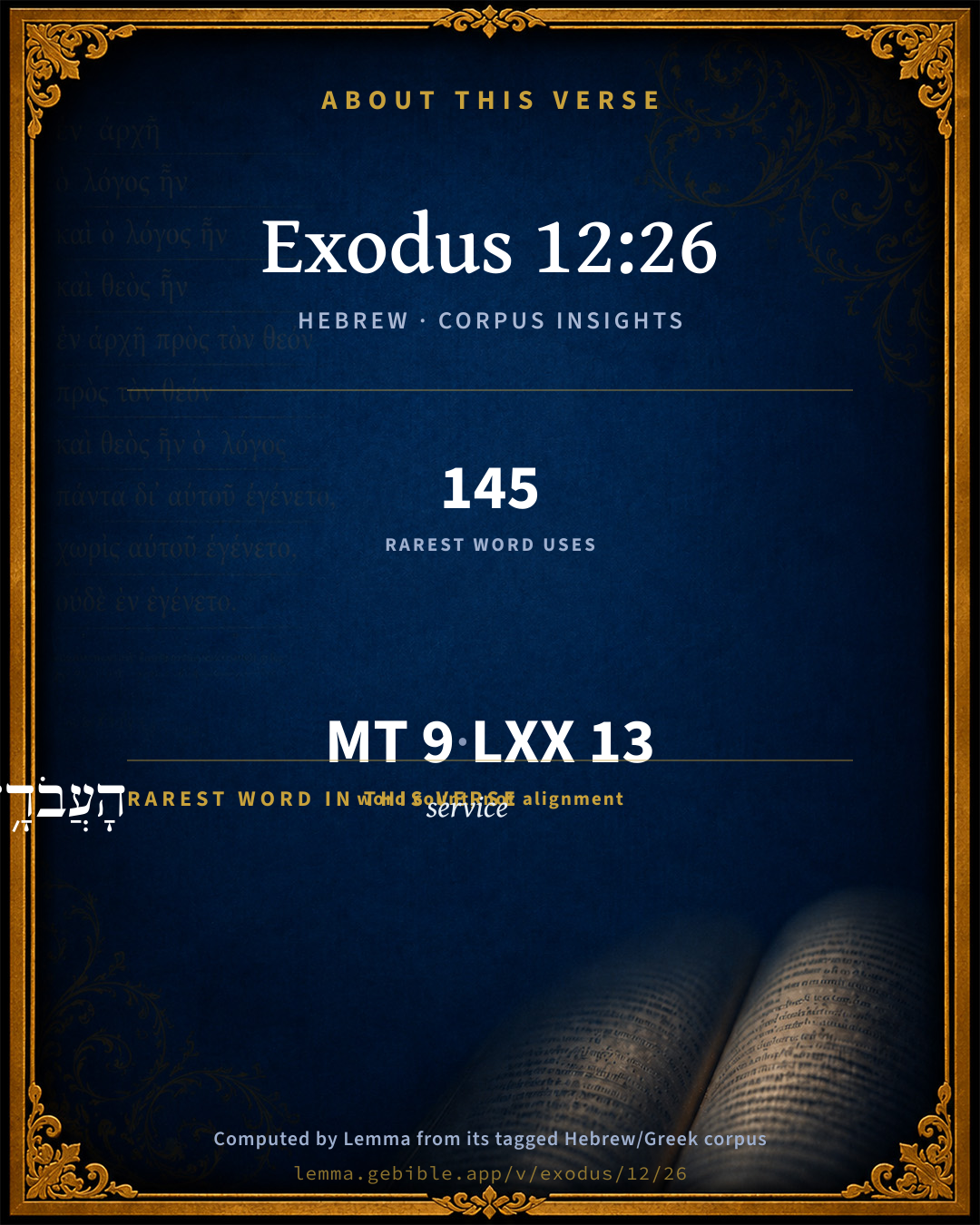
These counts appear in no published source. They are computed here, from the morphology-tagged text and Lemma’s own curated glosses. What Lemma adds →

9
words
8
distinct lemmas
Pentateuch
section

Grammatical profile

  • 2 verbs
  • 2 nouns
  • 1 pronoun
  • 2 prepositions
  • 1 conjunction
  • 1 particle

Verb forms

  • וְהָיָ֕ה Qal · Sequential Perfect
  • יֹאמְר֥וּ Qal · Imperfect

Hebrew & Septuagint length

In English translation the verse runs 15 words from the Hebrew and 16 from the Septuagint (LXX English) — closely comparable.

A rough comparison of the two English renderings, which tokenize alike — not a word-level alignment.

Word counts can differ between the Hebrew and the Greek without any difference in meaning — e.g. the Hebrew direct-object marker אֵת has no separate Greek word, and Greek often adds the article ὁ.

In the original languages it is 9 Hebrew tokens and 13 Greek tokens — but the two are counted differently (Hebrew bundles its prefixes and suffixes into one token; the Greek is in lemma form), so that isn’t a like-for-like length.

Cross-references

13

Topical passages linked to Exodus 12:26 in the Treasury of Scripture Knowledge — connected by theme and wording, ordered by reader-vote popularity; previews shown in the World English Bible.

  • Exodus 13:14–15 It shall be, when your son asks you in time to come, saying, 'What is this?' that you shall tell him, 'By strength of hand Yahweh brought us out from Egypt, from the house of bondage;
  • Deuteronomy 32:7 Remember the days of old, Consider the years of many generations: Ask your father, and he will show you; Your elders, and they will tell you.
  • Psalms 145:4 One generation will commend your works to another, And will declare your mighty acts.
  • Joshua 4:6–7 that this may be a sign among you, that when your children ask in time to come, saying, What do you mean by these stones?
  • Joshua 4:21–24 He spoke to the children of Israel, saying, When your children shall ask their fathers in time to come, saying, What mean these stones?
  • Psalms 78:3–6 Which we have heard and known, And our fathers have told us.
  • Isaiah 38:19 The living, the living, he shall praise you, as I do this day: The father to the children shall make known your truth.
  • Ephesians 6:4 You fathers, don't provoke your children to wrath, but nurture them in the discipline and instruction of the Lord.
  • Exodus 10:2 and that you may tell in the hearing of your son, and of your son's son, what things I have done to Egypt, and my signs which I have done among them; that you may know that I am Yahweh."
  • Exodus 13:8–9 You shall tell your son in that day, saying, 'It is because of that which Yahweh did for me when I came forth out of Egypt.'
  • Exodus 13:22 the pillar of cloud by day, and the pillar of fire by night, didn't depart from before the people.
  • Deuteronomy 6:7 and you shall teach them diligently to your children, and shall talk of them when you sit in your house, and when you walk by the way, and when you lie down, and when you rise up.
  • Deuteronomy 11:19 You shall teach them your children, talking of them, when you sit in your house, and when you walk by the way, and when you lie down, and when you rise up.

Cross-references courtesy of OpenBible.info (CC BY 4.0).

Hebrew and Greek witnesses Masoretic Hebrew ↔ Greek Septuagint

The same verse in the two great witnesses to the Old Testament, shown verse-for-verse.

These are two independent witnesses, not word-aligned to each other, and the Septuagint is shown in lemma (dictionary) form.

Hebrew Exodus 12:26 Masoretic · Westminster Leningrad Codex

וְהָיָ֕ה כִּֽי יֹאמְר֥וּ אֲלֵיכֶ֖ם בְּנֵיכֶ֑ם מָ֛ה הָעֲבֹדָ֥ה הַזֹּ֖את לָכֶֽם

It will happen, when your children ask you, 'What do you mean by this service?'

World English Bible · Public Domain

Greek LXX Exodus 12:26 Septuagint · lemma form

καί εἰμί ἐάν λέγω πρός σύ ὁ υἱός σύ τίς ὁ λατρεία οὗτος

And it shall come to pass, if your sons say to you, What is this service?

LXX2012 (modern English Septuagint) · Public Domain

Hebrew: Westminster Leningrad Codex (CC BY 4.0). Greek: Septuagint (public domain); English from LXX2012 (modern English Septuagint) (Public Domain). How the Septuagint differs from the Hebrew →

Targum (Aramaic paraphrase)

2

The Targum is the ancient Jewish Aramaic paraphrase of the Hebrew Scriptures — an interpretive translation, not the Hebrew text itself. Onkelos (literal) and Pseudo-Jonathan (expansive) render the Torah, and Jonathan the Prophets. Coverage is partial: where no permissively-licensed English translation exists for a verse, only the Aramaic is shown. This is verse-level text, not a word-by-word alignment to the Hebrew.

  1. Targum Onkelos Torah (Genesis–Deuteronomy)
    וִיהֵי אֲרֵי יֵימְרוּן לְכוֹן בְּנֵיכוֹן מָא פָּלְחָנָא הָדֵין לְכוֹן:

    (no public-domain English translation for this verse)

    Targum Onkelos — Aramaic: “Onkelos Genesis” (public domain); “Onkelos Exodus” (public domain); “Onkelos Leviticus” (public domain); “Onkelos Numbers” (public domain); “Onkelos Deuteronomy” (public domain). English: “Sefaria Community Translation” (CC0 1.0 (public-domain dedication)); “J.W. Etheridge. The Targums of Onkelos and Jonathan Ben Uzziel on the Pentateuch. London: Longmans, Green, 1862” (public domain). Text via Sefaria.

  2. Targum Pseudo-Jonathan Torah (Genesis–Deuteronomy)
    וִיהֵי אֲרוּם יֵימְרוּן לְכוֹן בְּנֵיכוֹן בְּזִמְנָא הַהוּא מַה פּוּלְחָנָא הָדָא לְכוֹן

    And it shall be that when at that time your children shall say to you, What is this your service?

    Targum Pseudo-Jonathan — Aramaic: “Targum Jonathan on Genesis” (public domain); “Targum Jonathan on Exodus” (public domain); “Targum Jonathan on Leviticus” (public domain); “Targum Jonathan on Numbers” (public domain); “Targum Jonathan on Deuteronomy” (public domain). English: “The Targum of Jonathan ben Uzziel, trans. J. W. Etheridge, London, 1862” (public domain). Text via Sefaria.

Commentary

Notes on Exodus 12:26 from classic Christian and Jewish commentators (each source and its license shown beneath its notes). The classic Christian expositions comment on the surrounding passage and are grouped to its opening verse, so a note may address several verses; the Jewish commentaries on the Tanakh (Rashi and others) are per-verse, so they appear only where the commentator wrote on this verse.

Lemma curates 59 commentaries, every one of them public domain or Creative Commons licensed, each selected and text-cleaned for this edition rather than reprinted as found. About our sources →

Trapp's Complete Commentary

John Trapp

Exo 12:26 And it shall come to pass, when your children shall say unto you, What mean ye by this service?

Ver. 26. When your children.] Children are to be carefully catechised and informed. {Eph 6:4} {See Trapp on "Eph 6:4"} Luther scorned not to profess himself discipulura catechism, a catechism scholar.

John Trapp, A Commentary or Exposition upon All the Books of the Old and New Testament (1647–1656) — public domain. Text from a community e-Sword module.

Tyndale Open Study Notes

Tyndale Open Resources

12:26-27 In the future, the Passover celebration would be a memorial reminding future generations of Israelites of God’s grace in providing them a way of escape from death. For more than 3,000 years the Jewish people have celebrated this great formative event in their history.

Tyndale Open Study Notes — © Tyndale Open Resources, licensed CC BY-SA 4.0. Text via the HelloAO Bible API.

Jamieson, Fausset & Brown

Robert Jamieson, A. R. Fausset & David Brown

when your children shall say, . . . What mean ye by this service--Independently of some observances which were not afterwards repeated, the usages practised at this yearly commemorative feast were so peculiar that the curiosity of the young would be stimulated, and thus parents had an excellent opportunity, which they were enjoined to embrace, for instructing each rising generation in the origin and leading facts of the national faith.

Jamieson, Fausset & Brown — Commentary Critical and Explanatory on the Whole Bible (1871) — public domain (CC PDM 1.0). Text via the HelloAO Bible API.

Adam Clarke's Commentary

Verse 26. What mean ye by this service?] The establishment of this service annually was a very wise provision to keep up in remembrance this wonderful deliverance. From the remotest antiquity the institution of feasts, games, c., has been used to keep up the memory of past grand events. Hence God instituted the Sabbath, to keep up the remembrance of the creation and the passover to keep up the remembrance of the deliverance from Egypt. All the other feasts were instituted on similar reasons. The Jews never took their sons to the tabernacle or temple till they were twelve years of age, nor suffered them to eat of the flesh of any victim till they had themselves offered a sacrifice at the temple, which they were not permitted to do before the twelfth year of their age. It was at this age that Joseph and Mary took our blessed Lord to the temple, probably for the first time, to offer his sacrifice. See Calmet.

Adam Clarke's Commentary on the Bible (1810–1826) — public domain. Text from a community e-Sword/MySword module.

John Gill's Exposition

And the children of Israel went away,.... The elders of the people, Exo 12:21 they departed to their several tribes and families at Goshen and elsewhere:

and did as the Lord commanded Moses and Aaron, so did they; they took a lamb on the tenth day, and kept it till the fourteenth, on which day they slew it, and roasted it with fire, and ate it with unleavened bread and bitter herbs.

John Gill's Exposition of the Whole Bible (1746–1763) — public domain (CC PDM 1.0). Text via the HelloAO Bible API.

Matthew Poole's English Annotations

Or, part of Divine worship. God expects this even from the Jewish children, and much more from Christian men, that they should inquire and understand what is said or done in the public worship or service of God, and therefore not to rest in dumb signs, whereof they neither inquire nor know the meaning, or in the service of God in a language which they understand not.

Matthew Poole's English Annotations on the Holy Bible (1683–1685) — public domain. Text from a community e-Sword/MySword module.

The Pulpit Commentary

When your children shall say unto you, what mean ye by this service. Apparently, Moses adds these injunctions by his own sole authority. He assumes that curiosity will be aroused by the strange and peculiar features of the Paschal ceremony, and that each generation in succession will wish to know its meaning and origin.

Vers. 26, 27. The obligation of men to teach the true meaning of rites and ceremonies to their children.

The rites and ceremonies of a religion are liable to be misunderstood in two ways.

1. They may be regarded as unimportant, trifling, nay, even as superstitious a weight and an encumbrance on true vital religion. Or,

2. They may be assigned more importance than is their due; considered tobe that in which religion mainly consists, believed to have an inherent power and efficacy which is far from belonging to them. Men are prone to extremes; and most persons are naturally inclined either unduly to exalt, or unduly to depreciate religious ceremonies. Of the two evils, undue depreciation would seem to be the worse, for the following reason:

I UNDUE DEPRECIATION OF CEREMONIES

(a) tends to make them of little service to men when they actually take part in them, since they neither prepare themselves properly beforehand, so as to derive from them the benefit they might, nor enter into them with much heart at the time of their occurrence, nor help their effect by devout meditation upon them afterwards.

(b) It causes an infrequent participation in the ceremonies by the depreciators, who, expecting but little benefit in the future, and being conscious of but little benefit in the past, allow small obstacles to prevent their attendance at services which they do not value.

(c) In extreme cases, it produces either complete abstention from, or sometimes actual abrogation of the rite, whereby advantages are forfeited on the part of whole sections of believers which would otherwise have been enjoyed by them. Thus the Society of Friends loses the benefit of both sacraments, with sad results to the spiritual life of numbers.

II UNDUE EXALTATION OF CEREMONIES has the advantage of at any rate retaining them in use, so that their benefit is not wholly lost. It often, however, greatly lessens the benefit

(a) by exaggerated and superstitious views of its nature, and

(b) by the attribution of the benefit to the mere formal participation in the rite irrespective of the participator"s preparation, attention, and devoutness at the time. Further, it is apt to produce such a reliance on the ceremonies as is unfavourable to practical efforts at improving the moral character and making advances towards Christian perfection. Careful instruction in the true nature and value of ceremonial observances is thus of the highest importance; and parents should perhaps scarcely wait till their children "ask the meaning" of public worship, baptism, confirmation, the Lord"s supper, etc., before enlightening them on the true nature and value of each. In so doing, it will always be of use to set forth the historical origin of each usage, to show when and how it arose, and to draw attention to what Scripture says on the subject. Men"s private views are various, and may be mistaken, but the Scriptures cannot but be true; and a knowledge of what is contained in the Bible with respect to each Christian rite or ceremony will be an excellent basis for the formation of a sound and healthy opinion on the subject when, in the course of time, the different views of different sections of believers come to be known.

Ver. 26, 27. What mean ye by this service?

Apply to the Lord"s Supper.

I A QUESTION TO BE PUT BY THE COMMUNICANT TO HIMSELF. Qualification for the Lord"s table includes "knowledge to discern the Lord"s body," as well as "faith to feed upon him.

II A QUESTION LIKELY TO BE PUT TO THE COMMUNICANT By HIS CHILDREN.

1. The children are presumed to be spectators of the ordinance. It is well that children should be present during the administration of the sacraments. It awakens their interest. It leads them to inquire.

2. The ordinance is fitted to attract attention. An external interest attachesto it. It appeals to the senses. The symbolic acts and movements prompt to inquiry.

3. It furnishes an excellent opportunity for imparting instruction. Children will attend to an explanation of the sacraments, who will pay little attention to a book or a sermon. The symbolism of the ordinance aids instruction; makes it vivid and impressive.

III A QUESTION WHICH THE CHRISTIAN PARENT SHOULD BE ABLE TO ANSWER TO HIS CHILDREN. It is a sad matter when a parent is incapable of sitting down, and instructing his children in the meaning of the sacramental symbol. It betrays something worse than ignorance; not improbably, a total want of spiritual religion.

IV THE ANSWER TO THIS QUESTION INVOLVES A STATEMENT OF THE GREATEST VERITIES OF OUR FAITH. The Jew had to answer to his child is the sacrifice, of the Lord"s passover," etc. (ver. 27). The Christian has to answer, "It is the memorial of our Lord"s death, in atonement for our sins." He has to tell

1. How we were in guilt and danger.

2. How, for the love wherewith he loved us, Christ gave himself up to thedeath for our redemption.

3. How, for his sake, we are forgiven and accepted.

4. How the ungodly world has still God"s wrath resting upon it. It iswonderful to reflect how simply, yet how perfectly, God has provided for the handing down of a testimony to these great truths in the ordinance of the Lord"s Supper. The pulpit may fail to preach the doctrine of atonement; Rationalistic and Unitarian teachers may deny it; but as often as the Lord"s Supper is observed, on the model of the New Testament, the truth is anew proclaimed in unmistakable symbols. To give a child a satisfactory explanation of the Lord"s Supper, embodying the words of institution, would be almost of necessity, to preach a sermon on the atonement. J.O.

HOMILIES BY D. YOUNG Vers. 26-27. The children"s question in Canaan.

I IT WAS A QUESTION TO BE EXPECTED. The service was one to provoke curiosity. It was not some daily action of the household, of which the children learned the meaning and purpose almost unconsciously. The grinding of the corn, the kneading of the dough, in a very short time explained themselves. But when as the beginning of the year drew round, it brought with it these special observances, the slaying and eating of the lamb and the seven days of unleavened bread, there was everything to make a child ask, "What is this being done for?" God makes one thing to fit into another. He institutes services of such a kind, with such elements of novelty and impressiveness in them, that the children make it easier for them to be instructed in the things that belong to his will. And what was true concerning this passover service, is also true, more or less, concerning all that is revealed in the Scriptures. The great facts of Divine revelation are such as to provoke curiosity, even in a child"s mind. If it be true that the Scriptures are given to guide us all the way through life, then what is more reasonable to expect than that God will have placed much in them to stir up attention and inquiry from those who are just at the beginning of life?

II HENCE THIS WAS A QUESTION TO BE ENCOURAGED. Every advantage was to be taken of childish curiosity. Inquisitive children are often reckoned a nuisance, and told to be quiet; yet such a policy as this, though it may save trouble in the present, may lead to a great deal more trouble in the future. A stupid child who never asks questions, is to be reckoned an object of pity and a source of peril. God has always in mind how to make each generation better instructed than the one going before; more obedient to him, and more serviceable for his purposes. The temptation of the grown people in Israel was to undervalue what was going on in the minds of their children. Remember how Mary and Joseph suffered through their want of forethought on this point. The God who watches human beings all the way from the cradle to the grave knows well how children, even very little children, have their own thoughts about things; and he wanted the people to give them every encouragement and information. One question wisely answered leads to the asking of other questions. Thus, by the continuance of an inquiring mood in the mind, and thus only, is profitable information to be given. Information is not to be poured into the mind as into a bucket; it must be taken as food, with appetite, and digestive and assimilating power. Thus if the question were not asked, if, while the passover preparations were being made, a child stood by in stolid unconcern, or ran away heedlessly to play, such conduct would fill a wise parent with solicitude. He would look upon it as being even more serious than a failure of physical health. He would do all he could by timely suggestions to bring the question forth. Ingenuity and patience may do much to bring curiosity into action, and if the question were not asked it would have to be assumed. The narrative of the passover was a most important one for every Israelite child to hear and remember; and if only the narrative was begun, it might soon excite the requisite and much desired interest.

III IT WAS A QUESTION WHICH GAVE GREAT SCOPE FOR USEFULNESS TO THE CHILDREN IN THE ANSWERING OF IT. God, indeed, directs how it is to be answered; but of course, it is not meant that there was to be a formal, parrot-like confinement to these words. What, for instance, could be more gratifying to the children, who in after times asked this question, than to begin by pointing out to them, how God himself expected them to ask this question? Then the words he had directed Moses to provide for an answer, might be repeated. But it would have been a poor spiritless answer, unpleasing to God, and profitless to the children, if it had stopped with the bare utterance of the words in ver. 27. There was room for much to be said, that would very peculiarly impress the mind of a thoughtful child. It might be reminded that whereas, now, little children were born in the freedom of Canaan, some among their forefathers had been born in the bondage of Egypt. It might be told of that Pharaoh who had threatened the men children with destruction. In particular, the story of the infant Moses might be told. So now, in those parts of the world where the idols are abolished, and former idolaters are gathered round the throne of grace for Christian worship, an opportunity is given for explaining to the children, in how much better a state, and with how much better surroundings they are brought up. "What mean ye by this service?" was a question which could be answered in form, and yet with such absence of heart, as utterly to chill and thwart the eager inquirer. Whereas, if it were only answered with evident care, with amplitude of detail, with loving desire to interest and satisfy, then the child thus favoured, would be laid under great obligations to be thankful in feeling, and devoted in service. A question of this sort gave great opportunity. Happy those who could seize the opportunity at once, and use it to the full.

IV IT WAS A QUESTION WHICH CAME TO CALL EVERY ISRAELITE, AT THE ANNUAL OBSERVANCE OF THE PASSOVER, TO A CAREFUL CONSIDERATION OF HIS OWN FEELINGS WITH RESPECT TO IT. It was a question which helped to guard against formality. A little child may render a great service, without knowing it, even to a grown man. God can send the little ones, to test, to rebuke, to warn, to stir out of lethargy. "What mean ye by this service?" How is the Israelite of the grown generation to answer this question? He may tell the child what the service is intended for, the historical facts out of which it arose, and the Divine appointments concerning it; but after all, this is no real answer to the question. It may be an answer to satisfy the inquiring child, and yet leave the person who has to give it, with a barbed arrow in his memory and conscience. Notice the precise terms of the question. What mean ye by this service? How should the child ask in any other terms? It looks and sees the parents doing something new and strange; and to them it naturally looks for explanation and guidance. The question is not simply, "Why is this thing being done?" but "Why are you doing it, and what do you mean by it?" It became only too possible in the lapse of ages, to go through this service in a cold, mechanical, utterly unprofitable way. Not so, we may be sure, was it observed the first time in Egypt, on the night of deliverance. Then all was excitement, novelty, and overflowing emotion. Be it ours, in considering all outward and visible acts in connection with religion, all symbolic and commemorative institutions, to ask ourselves in great closeness and candour of personal self-application, "What mean we by this service?" Do we mean anything at all, and if so, what is it that we mean? To answer this is not easy: it is not meant to be easy. Perhaps one great reason why there are such marked and unabated differences of opinion with respect to Baptism and the Lord"s Supper is, that we have never sufficiently considered the question, "What mean ye by these services?" It is hard work to be quit of mere superstition, mere clinging to outward observances as matters of custom, tradition, and respectability. It is very certain that to this question of the children, put in all its particular emphasis, only too many fathers in Israel would have been forced to reply, "We do this thing because our fathers did it." Remember that forms are, in themselves, nothing to the invisible, spiritual God. Their value is as containing, protecting and expressing what we have to present. That which pleased Jehovah and profited Israel was not the outward passover service, but the intelligence, the perceptions, the gratitude, the aspirations, and the hopes that lay behind it. Y.

The Pulpit Commentary (1880–1919), ed. H.D.M. Spence-Jones & Joseph S. Exell — public domain. Text from a community e-Sword module.

unfoldingWord translationNotes

Door43 World Missions Community

He set our households free

This means that Yahweh spared the Israelites' firstborn sons. AT: "He did not kill the firstborn sons in our houses" (See: Assumed Knowledge and Implicit Information)

as Yahweh had commanded Moses and Aaron

"everything that Yahweh told Moses and Aaron to do"

translationWords

children

worship

sacrifice

Yahweh

Passover

Israel

Egypt

household

free

bow

command

Moses

Aaron

unfoldingWord translationNotes — © Distant Shores Media and the Door43 World Missions Community, licensed CC BY-SA 4.0. Source: git.door43.org/Door43/en_tn.

Lesson kit

Teaching starters — assembled from the data on this page, not authored interpretation. Every prompt links to the verse data it draws on. Edit before teaching.

Exodus, in the Pentateuch, opens this verse with 9 words (8 distinct Hebrew lemmas). Its most distinctive word is ʻăbôdâh (“service”). A historical commentator’s framing appears above. Read the whole chapter for the surrounding context.

Discussion questions

  1. The word ʻăbôdâh carries the sense “service.” How does it shape the verse?
  2. How does Exodus 13:14–15, which shares this passage’s theme, read alongside this verse?
  3. These translations render this verse differently. What is at stake in choosing one wording over another?
  4. «וְהָיָ֕ה» is a Qal Sequential Perfect verb. How does that grammatical form shape the action described?
  5. Compare how Trapp's Complete Commentary and Tyndale Open Study Notes read this verse. Where do they agree or differ?

Things to notice

Reading settings

Reading text

Shown beneath each verse's original-language words.

Old Testament
Old Testament edition

Read the OT as the Masoretic Hebrew (MT) or the Greek Septuagint (LXX).

English shown for the Greek Septuagint (in the Hebrew ↔ Greek comparison).

Comparing translations? Open the Compare panel on any verse page to stack up to four side by side.