
Joshua 3:10

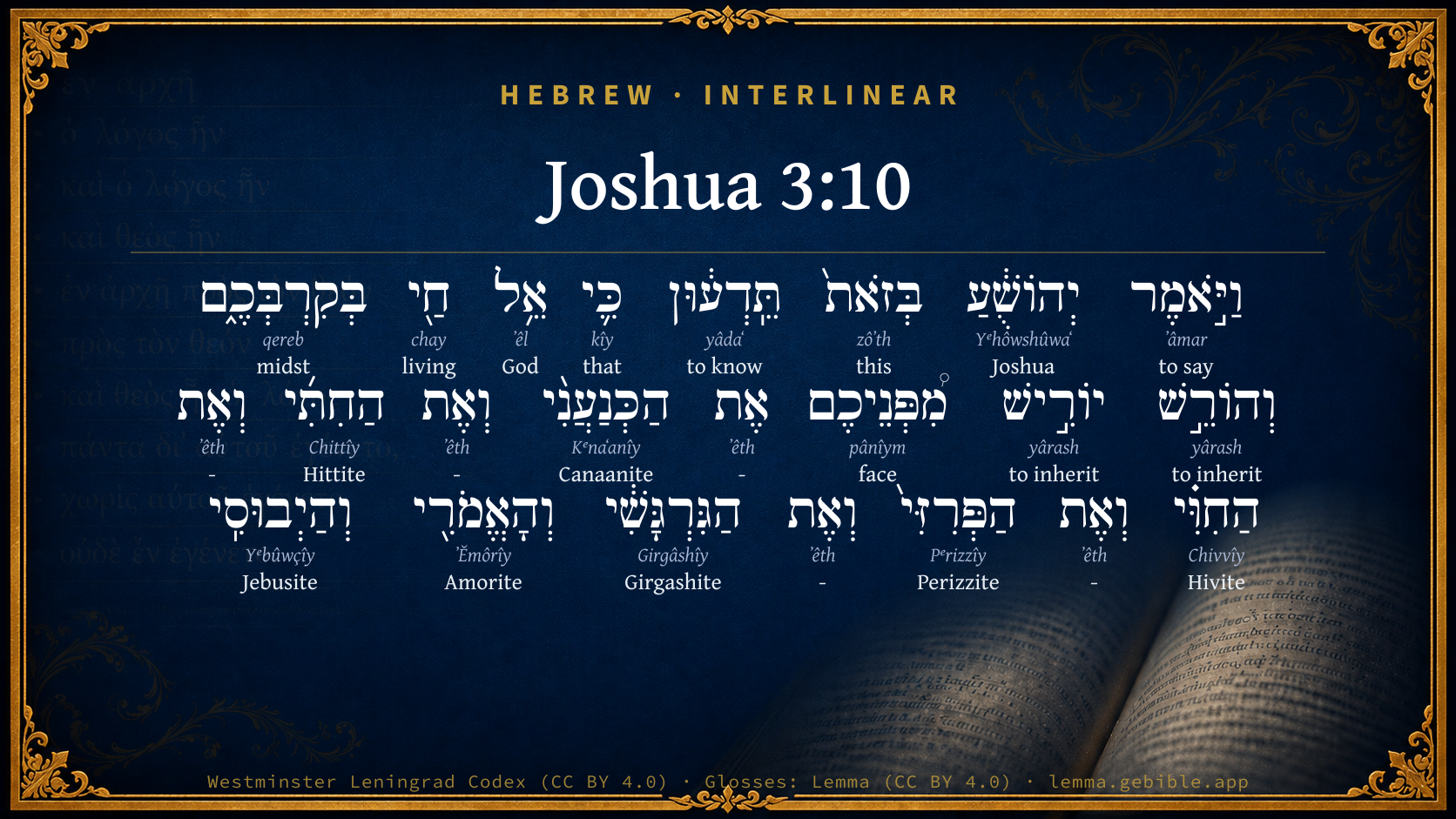
Hebrew (Westminster Leningrad Codex) Joshua 3:10 appears in the Hebrew Old Testament. The text above is from the Westminster Leningrad Codex. Each word links to its Strong’s number, a concise gloss, and parsing drawn from the Open Scriptures Hebrew Bible morphology. Click any word for its full Brown-Driver-Briggs (BDB) entry.
Download image
Cite this verse

Joshua 3:10 (World English Bible). Public Domain. Lemma interlinear Bible study tool, https://lemma.gebible.app/v/joshua/3/10.

Show BibTeX & RIS
BibTeX
RIS
English Translation
Joshua said, Hereby you shall know that the living God is among you, and that he will without fail drive out from before you the Canaanite, and the Hittite, and the Hivite, and the Perizzite, and the Girgashite, and the Amorite, and the Jebusite.
World English Bible · Public Domain
Download a study sheet

One document with this verse’s original text, its word-by-word gloss line, the meaning frame, cross-references with their text, attributed commentary, and full source and license credits — printable, and it pastes into notes with its structure intact.

This verse Autodidact and up

Study sheet (.html) Plain text (.txt)

A passage Seminary Student

Up to 50 verses in one chapter. A passage sheet keeps up to 6 commentary sources and 12 cross-references per verse, in the order this page ranks them, and says so on the sheet whenever that leaves anything out. Ask for a single verse and you get the Autodidact verse sheet above.

Everything on this page stays free to read, with no account — the sheet is a download of what is already on screen, not access to it.

Want to remove ads? Support Godless Engineer
Compare translations 3

The same verse in 3 English versions, stacked beneath the original-language interlinear above. Click any original word for its lexicon entry.

Each is an independent rendering of the whole verse — the interlinear is not word-aligned to these translations.

Highlighted words mark where these versions differ — a whole-verse word diff, not a word-by-word alignment.

  • World English Bible Public Domain
    Joshua said, Hereby you shall know that the living God is among you, and that he will without fail drive out from before you the Canaanite, and the Hittite, and the Hivite, and the Perizzite, and the Girgashite, and the Amorite, and the Jebusite.
  • King James Version Public Domain
    And Joshua said, Hereby ye shall know that the living God is among you, and that he will without fail drive out from before you the Canaanites, and the Hittites, and the Hivites, and the Perizzites, and the Girgashites, and the Amorites, and the Jebusites.
  • unfoldingWord Literal Text CC BY-SA 4.0
    And Joshua said, “By this you will know that the living God in your midst and dispossessing, he will dispossess from your face the Canaanite and the Hittite and the Hivite and the Perizzite and the Girgashite and the Amorite and the Jebusite.

unfoldingWord Literal Text — © unfoldingWord, licensed CC BY-SA 4.0. Word-aligned USFM3 via Door43 (git.door43.org/unfoldingWord/en_ult).

Versions to compare (up to 4)

3 of 4 selected

Show all 18 translations

Every available English version of this verse, each an independent rendering of the whole verse.

  • World English Bible Public Domain
    Joshua said, Hereby you shall know that the living God is among you, and that he will without fail drive out from before you the Canaanite, and the Hittite, and the Hivite, and the Perizzite, and the Girgashite, and the Amorite, and the Jebusite.
  • Berean Standard Bible Public Domain
    He continued, “This is how you will know that the living God is among you and that He will surely drive out before you the Canaanites, Hittites, Hivites, Perizzites, Girgashites, Amorites, and Jebusites.
  • Majority Standard Bible Public Domain
    He continued, “This is how you will know that the living God is among you and that He will surely drive out before you the Canaanites, Hittites, Hivites, Perizzites, Girgashites, Amorites, and Jebusites.
  • King James Version Public Domain
    And Joshua said, Hereby ye shall know that the living God is among you, and that he will without fail drive out from before you the Canaanites, and the Hittites, and the Hivites, and the Perizzites, and the Girgashites, and the Amorites, and the Jebusites.
  • American Standard Version (1901) Public Domain
    And Joshua said, Hereby ye shall know that the living God is among you, and that he will without fail drive out from before you the Canaanite, and the Hittite, and the Hivite, and the Perizzite, and the Girgashite, and the Amorite, and the Jebusite.
  • Revised Version (1885) Public Domain
    And Joshua said, Hereby ye shall know that the living God is among you, and that he will without fail drive out from before you the Canaanite, and the Hittite, and the Hivite, and the Perizzite, and the Girgashite, and the Amorite, and the Jebusite.
  • Geneva Bible (1599) Public Domain
    And Ioshua said, Hereby ye shall know that the liuing God is among you, and that he will certainely cast out before you the Canaanites, and the Hittites, and the Hiuites, and the Perizzites, and the Girgashites, and the Amorites, and the Iebusites.
  • Douay-Rheims (1899) Public Domain
    And again he said: By this you shall know that the Lord the living God is in the midst of you, and that he shall destroy before your sight the Chanaanite and the Hethite, the Hevite and the Pherezite, the Gergesite also and the Jebusite, and the Amorrhite.
  • Young's Literal Translation Public Domain
    and Joshua saith, `By this ye know that the living God `is' in your midst, and He doth certainly dispossess from before you the Canaanite, and the Hittite, and the Hivite, and the Perizzite, and the Girgashite, and the Amorite, and the Jebusite:
  • Literal Standard Version CC BY-SA 4.0
    and Joshua says, “By this you know that the living God [is] in your midst, and He certainly dispossesses from before you the Canaanite, and the Hittite, and the Hivite, and the Perizzite, and the Girgashite, and the Amorite, and the Jebusite:
  • Unlocked Literal Bible CC BY-SA 4.0
    By this you will know that the living God is among you and will drive out from before you the Canaanites, the Hittites, the Hivites, the Perizzites, the Girgashites, the Amorites, and the Jebusites.
  • unfoldingWord Literal Text CC BY-SA 4.0
    And Joshua said, “By this you will know that the living God in your midst and dispossessing, he will dispossess from your face the Canaanite and the Hittite and the Hivite and the Perizzite and the Girgashite and the Amorite and the Jebusite.
  • Darby Bible Public Domain
    And Joshua said, Hereby shall ye know that the living ùGod is in your midst, and [that] he will without fail dispossess from before you the Canaanites, and the Hittites, and the Hivites, and the Perizzites, and the Girgashites, and the Amorites, and the Jebusites.
  • World Messianic Bible Public Domain
    Joshua said, “By this you shall know that the living God is among you, and that he will without fail drive the Canaanite, the Hittite, the Hivite, the Perizzite, the Girgashite, the Amorite, and the Jebusite out from before you.
  • Webster's Bible Public Domain
    And Joshua said, By this ye shall know that the living God is among you, and that he will without fail drive out from before you the Canaanites, and the Hittites, and the Hivites, and the Perizzites, and the Girgashites, and the Amorites, and the Jebusites.
  • Free Bible Version CC BY-SA 4.0
    This is how you will know that the living God is right here with you,” he told them. “You can be sure that he will drive out before you the Canaanites, Hittites, Hivites, Perizzites, Girgashites, Amorites, and Jebusites.
  • Bible in Basic English Public Domain
    And Joshua said, By this you will see that the living God is among you, and that he will certainly send out from before you the Canaanite and the Hittite and the Hivite and the Perizzite and the Girgashite and the Amorite and the Jebusite.
  • JPS Tanakh (1917) Public Domain
    And Joshua said: 'Hereby ye shall know that the living God is among you, and that He will without fail drive out from before you the Canaanite, and the Hittite, and the Hivite, and the Perizzite, and the Girgashite, and the Amorite, and the Jebusite.

Literal Standard Version (2020), Covenant Press — licensed CC BY-SA 4.0. Text via the HelloAO Bible API (eBible.org). Unlocked Literal Bible (unfoldingWord) — licensed CC BY-SA 4.0. Text via the HelloAO Bible API (eBible.org). unfoldingWord Literal Text — © unfoldingWord, licensed CC BY-SA 4.0. Word-aligned USFM3 via Door43 (git.door43.org/unfoldingWord/en_ult). Free Bible Version, Dr. Jonathan Gallagher — licensed CC BY-SA 4.0. Text via the HelloAO Bible API (eBible.org).

Word by word

More ways to search: Search by grammar → Find every occurrence → Compare this word →

Practice this passage: Drill this verse → Learn its vocabulary →

הַגִּרְגָּשִׁ֔י
Girgâshîy
H1622
“the · Girgashite”
Particle, Definite Article + Noun, Gentilic, Masculine, Singular, Absolute
Part of Speech
Particle + Noun
Type
Gentilic
Gender
Masculine
Number
Singular
State
Absolute
Full BDB Definition

Origin: patrial from an unused name [of uncertain derivation]

TWOT: None

Girgashite or Girgasite = "dwelling on a clayey soil" - descendants of Canaan and one of the nations living east of the sea of Galilee when the Israelites entered the promised land
  1. וַיֹּ֣אמֶר ʼâmar H559 “and · to say” Conjunction + Verb, Qal, Sequential Imperfect, 3rd Person, Masculine, Singular
  2. יְהוֹשֻׁ֔עַ Yᵉhôwshûwaʻ H3091 “Joshua” Noun, Proper
  3. בְּזֹאת֙ zôʼth H2063 “in/at · this” Preposition + Pronoun, Demonstrative, Feminine, Singular
  4. תֵּֽדְע֔וּן yâdaʻ H3045 “to know” Verb, Qal, Imperfect, 2nd Person, Masculine, Plural + Suffix, n
  5. כִּ֛י kîy H3588 “that” Conjunction
  6. אֵ֥ל ʼêl H410 “God” Noun, Common, Masculine, Singular, Absolute
  7. חַ֖י chay H2416 “living” Adjective, Adjective, Masculine, Singular, Absolute
  8. בְּקִרְבְּכֶ֑ם qereb H7130 “in/at · midst · your” Preposition + Noun, Common, Masculine, Singular, Construct + Suffix, Personal, 2nd Person, Masculine, Plural
  9. וְהוֹרֵ֣שׁ yârash H3423 “and · to inherit” Conjunction + Verb, Hiphil, Infinitive Absolute
  10. יוֹרִ֣ישׁ yârash H3423 “to inherit” Verb, Hiphil, Imperfect, 3rd Person, Masculine, Singular
  11. מִ֠פְּנֵיכֶם pânîym H6440 “from · face(s) · your” Preposition + Noun, Common, Both, Plural, Construct + Suffix, Personal, 2nd Person, Masculine, Plural
  12. אֶת ʼêth H853 “-” Particle, Direct Object
  13. הַכְּנַעֲנִ֨י Kᵉnaʻanîy H3669 “the · Canaanite” Particle, Definite Article + Noun, Gentilic, Masculine, Singular, Absolute
  14. וְאֶת ʼêth H853 “and · -” Conjunction + Particle, Direct Object
  15. הַחִתִּ֜י Chittîy H2850 “the · Hittite” Particle, Definite Article + Noun, Gentilic, Masculine, Singular, Absolute
  16. וְאֶת ʼêth H853 “and · -” Conjunction + Particle, Direct Object
  17. הַחִוִּ֗י Chivvîy H2340 “the · Hivite” Particle, Definite Article + Noun, Gentilic, Masculine, Singular, Absolute
  18. וְאֶת ʼêth H853 “and · -” Conjunction + Particle, Direct Object
  19. הַפְּרִזִּי֙ Pᵉrizzîy H6522 “the · Perizzite” Particle, Definite Article + Noun, Gentilic, Masculine, Singular, Absolute
  20. וְאֶת ʼêth H853 “and · -” Conjunction + Particle, Direct Object
  21. וְהָאֱמֹרִ֖י ʼĔmôrîy H567 “and · the · Amorite” Conjunction + Particle, Definite Article + Noun, Gentilic, Masculine, Singular, Absolute
  22. וְהַיְבוּסִֽי Yᵉbûwçîy H2983 “and · the · Jebusite” Conjunction + Particle, Definite Article + Noun, Gentilic, Masculine, Singular, Absolute

About this verse

These counts appear in no published source. They are computed here, from the morphology-tagged text and Lemma’s own curated glosses. What Lemma adds →

23
words
18
distinct lemmas
Historical
section

Notable vocabulary

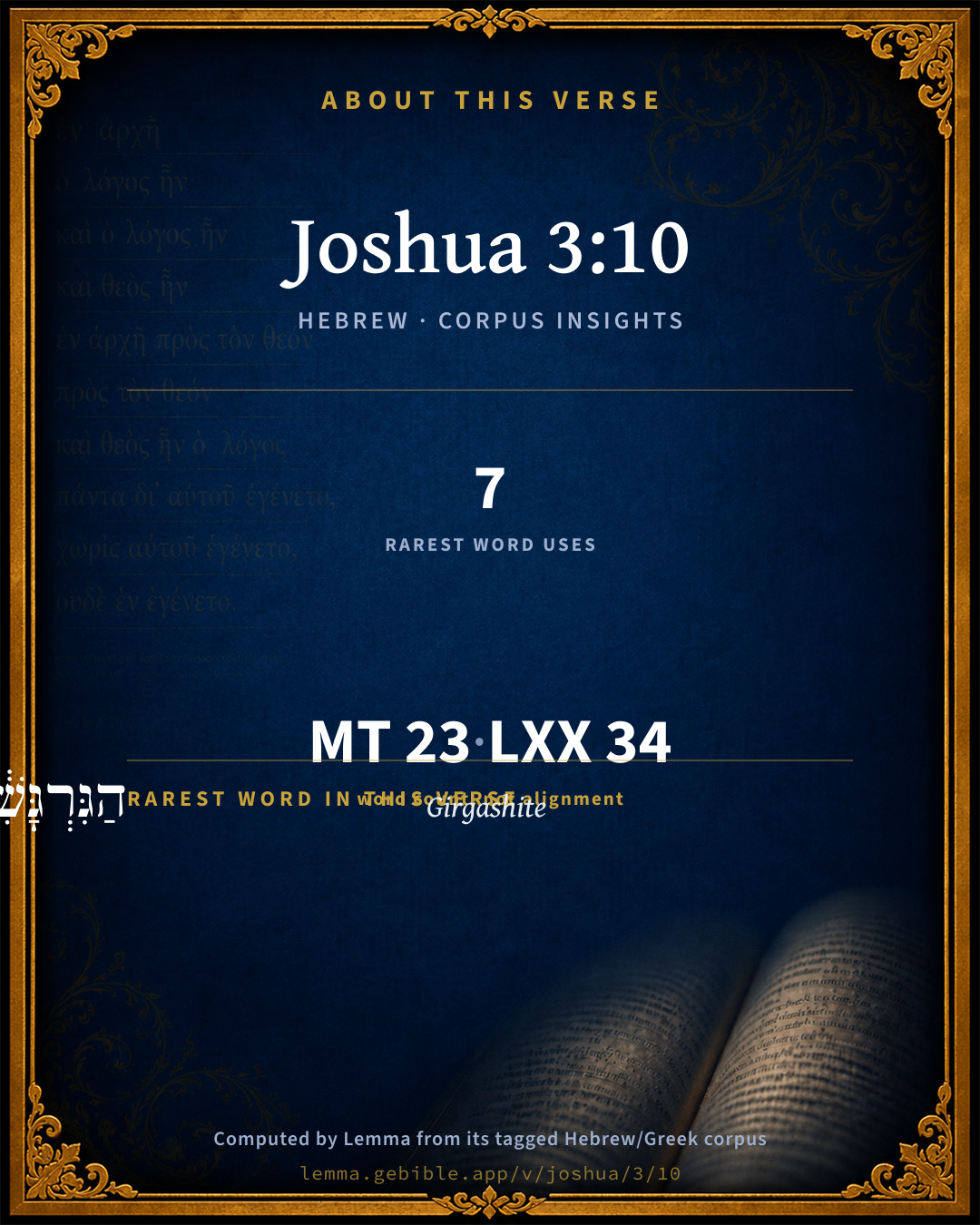
The rarest word here is הַגִּרְגָּשִׁ֔י Girgashite H1622 — appearing just 7 times in the whole Hebrew Bible.

Shared distinctive vocabulary

הַגִּרְגָּשִׁ֔י Girgashite H1622 occurs in 7 verses of the Hebrew Bible. Also found in:

Grammatical profile

  • 4 verbs
  • 11 nouns
  • 1 adjective
  • 1 pronoun
  • 1 conjunction
  • 5 particles

Verb forms

  • וַיֹּ֣אמֶר Qal · Sequential Imperfect
  • תֵּֽדְע֔וּן Qal · Imperfect
  • וְהוֹרֵ֣שׁ Hiphil · Infinitive Absolute
  • יוֹרִ֣ישׁ Hiphil · Imperfect

Repetition

A word recurs within this verse — often emphatic in Hebrew:

  • וְהוֹרֵ֣שׁ to inherit H3423 ×2

Hebrew & Septuagint length

In English translation the verse runs 44 words from the Hebrew and 38 from the Septuagint (LXX English) — closely comparable.

A rough comparison of the two English renderings, which tokenize alike — not a word-level alignment.

Word counts can differ between the Hebrew and the Greek without any difference in meaning — e.g. the Hebrew direct-object marker אֵת has no separate Greek word, and Greek often adds the article ὁ.

In the original languages it is 23 Hebrew tokens and 34 Greek tokens — but the two are counted differently (Hebrew bundles its prefixes and suffixes into one token; the Greek is in lemma form), so that isn’t a like-for-like length.

Cross-references

26

Topical passages linked to Joshua 3:10 in the Treasury of Scripture Knowledge — connected by theme and wording, ordered by reader-vote popularity; previews shown in the World English Bible.

  • Deuteronomy 7:1 When Yahweh your God shall bring you into the land where you go to possess it, and shall cast out many nations before you, the Hittite, and the Girgashite, and the Amorite, and the Canaanite, and the Perizzite, and the Hivite, and the Jebusite, seven nations greater and mightier than you;
  • Exodus 33:2 I will send an angel before you; and I will drive out the Canaanite, the Amorite, and the Hittite, and the Perizzite, the Hivite, and the Jebusite:
  • Psalms 44:2–3 You drove out the nations with your hand, But you planted them. You afflicted the peoples, But you spread them abroad.
  • 1 Samuel 17:26 David spoke to the men who stood by him, saying, What shall be done to the man who kills this Philistine, and takes away the reproach from Israel? for who is this uncircumcised Philistine, that he should defy the armies of the living God?
  • Hebrews 10:31 It is a fearful thing to fall into the hands of the living God.
  • Exodus 3:8 I have come down to deliver them out of the hand of the Egyptians, and to bring them up out of that land to a good and large land, to a land flowing with milk and honey; to the place of the Canaanite, the Hittite, the Amorite, the Perizzite, the Hivite, and the Jebusite.
  • Exodus 23:27–30 I will send my terror before you, and will confuse all the people to whom you come, and I will make all your enemies turn their backs to you.
  • Deuteronomy 31:17 Then my anger shall be kindled against them in that day, and I will forsake them, and I will hide my face from them, and they shall be devoured, and many evils and troubles shall come on them; so that they will say in that day, Haven't these evils come on us because our God is not among us?
  • Joshua 22:31 Phinehas the son of Eleazar the priest said to the children of Reuben, and to the children of Gad, and to the children of Manasseh, This day we know that Yahweh is in the midst of us, because you have not committed this trespass against Yahweh: now have you delivered the children of Israel out of the hand of Yahweh.
  • Judges 6:12–13 The angel of Yahweh appeared to him, and said to him, Yahweh is with you, you mighty man of valor.
  • 2 Kings 19:4 It may be Yahweh your God will hear all the words of Rabshakeh, whom the king of Assyria his master has sent to defy the living God, and will rebuke the words which Yahweh your God has heard. Therefore lift up your prayer for the remnant that is left.
  • Jeremiah 10:10 But Yahweh is the true God; he is the living God, and an everlasting King: at his wrath the earth trembles, and the nations are not able to abide his indignation.
  • Deuteronomy 5:26 For who is there of all flesh, that has heard the voice of the living God speaking out of the midst of the fire, as we have, and lived?
  • 1 Kings 18:36–37 It happened at the time of the offering of the [evening] offering, that Elijah the prophet came near, and said, Yahweh, the God of Abraham, of Isaac, and of Israel, let it be known this day that you are God in Israel, and that I am your servant, and that I have done all these things at your word.
  • Psalms 9:16 Yahweh has made himself known. He has executed judgment. The wicked is snared by the work of his own hands. Meditation. Selah.
  • Hosea 1:10 Yet the number of the children of Israel will be as the sand of the sea, which can't be measured nor numbered; and it will come to pass that, in the place where it was said to them, 'You are not my people,' they will be called 'sons of the living God.'
  • 1 Thessalonians 1:9 For they themselves report concerning us what kind of a reception we had from you; and how you turned to God from idols, to serve a living and true God,
  • Exodus 17:7 He called the name of the place Massah, and Meribah, because the children of Israel quarreled, and because they tested Yahweh, saying, "Is Yahweh among us, or not?"
  • Joshua 21:45 There failed not anything of any good thing which Yahweh had spoken to the house of Israel; all came to pass.
  • 1 Kings 22:28 Micaiah said, If you return at all in peace, Yahweh has not spoken by me. He said, Hear, you peoples, all of you.
  • Isaiah 7:14 Therefore the Lord himself will give you a sign. Behold, the virgin will conceive, and bear a son, and shall call his name Immanuel.
  • Matthew 16:16 Simon Peter answered, "You are the Christ, the Son of the living God."
  • 2 Corinthians 13:2–3 I have said beforehand, and I do say beforehand, as when I was present the second time, so now, being absent, I write to those who have sinned before now, and to all the rest, that, if I come again, I will not spare;
  • Genesis 15:15–18 But you will go to your fathers in peace. You will be buried in a good old age.
  • Numbers 15:28–30 The priest shall make atonement for the soul who errs, when he sins unwittingly, before Yahweh, to make atonement for him; and he shall be forgiven.
  • John 6:69 We have come to believe and know that you are the Christ, the Son of the living God."

Cross-references courtesy of OpenBible.info (CC BY 4.0).

Hebrew and Greek witnesses Masoretic Hebrew ↔ Greek Septuagint

The same verse in the two great witnesses to the Old Testament, shown verse-for-verse.

These are two independent witnesses, not word-aligned to each other, and the Septuagint is shown in lemma (dictionary) form.

Hebrew Joshua 3:10 Masoretic · Westminster Leningrad Codex

וַיֹּ֣אמֶר יְהוֹשֻׁ֔עַ בְּזֹאת֙ תֵּֽדְע֔וּן כִּ֛י אֵ֥ל חַ֖י בְּקִרְבְּכֶ֑ם וְהוֹרֵ֣שׁ יוֹרִ֣ישׁ מִ֠פְּנֵיכֶם אֶת הַכְּנַעֲנִ֨י וְאֶת הַחִתִּ֜י וְאֶת הַחִוִּ֗י וְאֶת הַפְּרִזִּי֙ וְאֶת הַגִּרְגָּשִׁ֔י וְהָאֱמֹרִ֖י וְהַיְבוּסִֽי

Joshua said, Hereby you shall know that the living God is among you, and that he will without fail drive out from before you the Canaanite, and the Hittite, and the Hivite, and the Perizzite, and the Girgashite, and the Amorite, and the Jebusite.

World English Bible · Public Domain

Greek LXX Joshua 3:10 Septuagint · lemma form

ἐν οὗτος γιγνώσκω ὅτι θεός ζάω ἐν σύ καί ὀλεθρεύω ὀλεθρεύω ἀπό πρόσωπον ἐγώ ὁ χαναναῖος καί ὁ χετταῖος καί ὁ φερεζαῖος καί ὁ ευαῖος καί ὁ ἀμορραῖος καί ὁ γεργεσαῖος καί ὁ ιεβουσαῖος

Hereby you⌃ shall know that the living God is among you, and will utterly destroy from before our face the Chananite, and the Chettite and Pherezite, and the Evite, and the Amorite, and the Gergesite, and the Jebusite.

LXX2012 (modern English Septuagint) · Public Domain

On this verse, Whedon's Commentary on the Bible discusses the Septuagint’s reading. Read the note in Commentary ↓

Hebrew: Westminster Leningrad Codex (CC BY 4.0). Greek: Septuagint (public domain); English from LXX2012 (modern English Septuagint) (Public Domain). How the Septuagint differs from the Hebrew →

Targum (Aramaic paraphrase)

1

The Targum is the ancient Jewish Aramaic paraphrase of the Hebrew Scriptures — an interpretive translation, not the Hebrew text itself. Onkelos (literal) and Pseudo-Jonathan (expansive) render the Torah, and Jonathan the Prophets. Coverage is partial: where no permissively-licensed English translation exists for a verse, only the Aramaic is shown. This is verse-level text, not a word-by-word alignment to the Hebrew.

  1. Targum Jonathan Prophets (Joshua–Malachi)
    וַאֲמַר יְהוֹשֻׁעַ בְּדָא תֵדְעוּן אֲרֵי אֱלָהּ קַיָם אִתְרְעֵי לְאַשְׁרָאָה שְׁכִנְתֵּיהּ בְּינֵיכוֹן וּתְרָכָא יְתָרֵךְ מִן קָדָמֵיכוֹן יַת כְּנַעֲנָאֵי וְיַת חִתָּאֵי וְיַת חִוָאֵי וְיַת פְּרִיזָאֵי וְיַת גִרְגְשָׁאֵי וֶאֱמוֹרָאֵי וִיבוּסָאֵי:

    (no public-domain English translation for this verse)

    Targum Jonathan — Aramaic: “Mikraot Gedolot” (public domain). English: “Sefaria Community Translation” (CC0 1.0 (public-domain dedication)); “London "Chaldee Paraphrase," 1871” (public domain). Text via Sefaria.

Commentary

Notes on Joshua 3:10 from classic Christian and Jewish commentators (each source and its license shown beneath its notes). The classic Christian expositions comment on the surrounding passage and are grouped to its opening verse, so a note may address several verses; the Jewish commentaries on the Tanakh (Rashi and others) are per-verse, so they appear only where the commentator wrote on this verse.

Lemma curates 59 commentaries, every one of them public domain or Creative Commons licensed, each selected and text-cleaned for this edition rather than reprinted as found. About our sources →

Trapp's Complete Commentary

John Trapp

Jos 3:10 And Joshua said, Hereby ye shall know that the living God [is] among you, and [that] he will without fail drive out from before you the Canaanites, and the Hittites, and the Hivites, and the Perizzites, and the Girgashites, and the Amorites, and the Jebusites.

Ver. 10. Hereby ye shall know that the living God.] "Living" and "giving," as 1Ti 6:17. "Trust in the living God, who giveth us all things richly to enjoy."

The Canaanites, and the Hittites, &c.] To these seven were those ten nations {Gen 15:19} reduced, belike, either by mixture, or diminution of some of them.

John Trapp, A Commentary or Exposition upon All the Books of the Old and New Testament (1647–1656) — public domain. Text from a community e-Sword module.

Tyndale Open Study Notes

Tyndale Open Resources

3:10 Today you will know: The Israelites who were adults when Moses led Israel out of Egypt had died. The people now entering Canaan with Joshua had taken their place. The events about to unfold would signify God’s presence with them and demonstrate his intention to fulfill his promises. • In Canaan, the Israelites would be living among pagan neighbors and might be tempted to join them in worshiping their gods and goddesses. None of these false gods were worthy of worship. By contrast, the Lord is the living God, and he was present among the Israelites. • The Canaanites and Amorites were distinct peoples, but their names sometimes indicated all the pre-Israelite peoples of Canaan. The Hittites were related to the earlier Hittite Empire of Asia Minor that controlled much of Canaan. The Jebusites were from the city-state of Jerusalem, which Israel did not conquer fully until David’s time. Little is known about the other three groups.

Tyndale Open Study Notes — © Tyndale Open Resources, licensed CC BY-SA 4.0. Text via the HelloAO Bible API.

Geneva Bible (1599)

Geneva Bible translators

By this miracle in dividing the water.

Geneva Bible (1599) marginal notes — public domain. Text via Bolls.life.

Adam Clarke's Commentary

Verse 10. Hereby ye shall know that the living God is among you] The Israelites were apt to be discouraged, and to faint at even the appearance of danger; it was necessary, therefore, that they should have the fullest assurance of the presence and assistance of God in the important enterprise on which they were now entering. They are to combat idolaters, who have nothing to trust in and help them but gods of wood, stone, and metal: whereas they are to have the living God in the midst of them - HE who is the author of life and of being - who can give, or take it away, at his pleasure; and who by this miracle proved that he had undertaken to guide and defend them: and Joshua makes this manifestation of God the proof that he will drive out the Hittites, Hivites, &c, before them.

With regard to the situation of each of these nations in the land of Canaan, Calmet remarks, that those called CANAANITES chiefly inhabited what is called Phoenicia, the environs of Tyre and Sidon: the HITTITES occupied the mountains, southward of the promised land: the HIVITES dwelt by Ebal and Gerizim, Sichem and Gibeon, towards the mountains of Hermon: the PERIZZITES were probably not a distinct nation or tribe, but rather villagers, scattered through the country in general: the GIRGASHITES possessed the country beyond the Jordan, towards the lake of Gennesareth: the JEBUSITES possessed Jerusalem: and the AMORITES occupied the mountainous country in the vicinity of the western part of the Dead Sea, and also that part of the land of Moab which the Israelites conquered from Sihon and Og.

Adam Clarke's Commentary on the Bible (1810–1826) — public domain. Text from a community e-Sword/MySword module.

John Calvin's Commentaries

10. Hereby you shall know, etc He makes the power of the miracle extend further than to the entrance of the land, and deservedly; for merely to open up a passage into a hostile territory, from which there was afterwards no retreat, would have been nothing else than exposure to death. For either entangled among straits, and in an unknown region, they would easily have been destroyed, or they would have perished, worn out by hunger and the absolute want of all things. Joshua therefore declares before hand, that when God would restore the river to its course, it would just be as if he were stretching forth his hand to rout all the inhabitants of the land; and that the manifestation of his power given in the passage of the Jordan, would be a sure presage of the victory which they would obtain over all the nations.

He says, Hence shall you know that the Lord is present with you; to what end? Not only to plant your feet in the land of Canaan, but also to give you full possession of it. For surely when mention is made of the overthrow of the nations, an ultimate, free, and peaceful possession is implied. Therefore, as the Lord by dividing the river clearly showed that his power resided with the Israelites, so the people must on their part have conceived hopes of perpetual assistance, as much as if they had already seen their enemies worsted and lying prostrate before them.

For God does not abandon the work of his hands midway, leaving it maimed and unfinished. (Psalm 138:8) When he leads his people unto the promised inheritance, he makes a dry passage for them by cutting off the course of the Jordan. How perverse then would it have been for the Israelites to stop short at that momentary act, instead of feeling confident in all time to come, until quiet possession of the land were actually obtained! Let us learn then from this example, prudently to combine the different acts of divine goodness relating to our final salvation, so that a happy commencement may cherish and keep alive in our minds the hope of an equally happy termination.

When Joshua says that the people will know the presence of God from the miracle, he indirectly upbraids them with their distrust, as the mere promise of God ought to have sufficed for a full assurance, and our faith, unless founded solely on this promise, must be continually wavering. But although faith ought properly to recline on the truth of God alone, it does not follow that experimental knowledge may not act as a secondary support to its weakness, and give subsidiary aid to its confirmation. For that which God promises to us in word he seals by act, and as often as he exhibits to us manifestations of his grace and might, he intends them to be so many confirmations of what he has spoken, and so many helps tending to suppress all our doubts.

John Calvin's Commentaries (1540-1563) — public domain. Text from the Calvin Translation Society English edition (1840s-50s) via the Christian Classics Ethereal Library (ccel.org). Calvin's coverage is partial (roughly two-thirds of the Bible); uncommented books and verses are honest gaps, never fabricated. The 19th-century editor's footnotes and remarks are omitted so the notes are faithfully Calvin's own voice.

The Cambridge Bible for Schools and Colleges

gen. ed. J. J. S. Perowne

10. the living God] Comp. Deu_5:26, “For who is there of all flesh, that hath heard the voice of the living God?” This title is applied to God to indicate that He is not dead, like the “lying vanities” of heathenism (Lev_19:4; Deu_32:21; Jon_2:8), but the source of all life.

the Canaanites] Seven nations are here enumerated, as also, though in varying order, in Deu_7:1; Jos_9:1; Jos_11:3; Jos_24:11.

(i) The Canaanites (Deu_1:7), or “Lowlanders” properly so called, occupied (a) the sea-coast as far north as Dan; (b) a considerable portion of the plain of Esdraelon; and (c) of the Valley of the Jordan (Num_13:29).

(ii) The Hittites, descended from Heth, the second son of Canaan, and settled in the time of Abraham in and round Hebron (Gen_23:19; Gen_25:9), then called Kirjath-Arba. At that time the tribe was as yet but small and not important enough to be noticed beside the “Canaanite” and the “Perizzite.” Afterwards they acquired greater strength, and took their place as equal allies with the other nations.

(iii) The Hivites are omitted (a) in the first enumeration of the nations, who, at the time of the call of Abraham, occupied the Promised Land (Gen_15:19-21); (b) in the report of the spies (Num_13:29). We first hear of them when Jacob returned to Canaan (Gen_34:2). A peaceful and commercial people (Gen_34:10; Gen_34:23; Gen_34:28-29), they were mainly located “under Hermon, in the land of Mizpeh” (Jos_11:3), in “mount Lebanon, from mount Baal-hermon unto the entering in of Hamath” (Jdg_3:3; 2Sa_24:7).

(iv) The Perizzites, which word is thought to denote “rustics,” “dwellers in the open, unwalled towns,” were located partly in the south (Jdg_1:4-5), partly in the forest country “on the western flanks of mount Carmel.”

(v) The Girgashites are conjectured to have been a large family of the Hivites, as they are omitted in nine out of the ten places in which the nations or families of Canaan are mentioned, while in the tenth they are mentioned and the Hivites omitted. They are supposed to have been settled in that part of the country which lay to the east of the Lake of Gennesareth.

(vi) The Amorites, or “Mountaineers,” occupied (Gen_14:7) the barren heights west of the Dead Sea, and stretched west to Hebron (Gen_13:18; Gen_14:13); thence, tempted probably by the high tablelands on the east, they crossed the Jordan, and occupied the country from the Arnon to the Jabbok (Num_21:13; Num_21:26). In the genealogical table of Genesis 10 “the Amorite” is given as the fourth son of Canaan.

(vii) The Jebusites are uniformly placed last in the formula, by which the Promised Land is often designated. They were a mountain tribe, and occupied the strong fortress of Jebus (Jerusalem).

The Cambridge Bible for Schools and Colleges (gen. ed. J. J. S. Perowne; Cambridge University Press, 1878–1918) — public domain. Text from a community e-Sword module.

John Gill's Exposition

And Joshua said,.... To the people as follows:

hereby ye shall know that the living God is among you; who has life in and of himself, and is the author of life to all his creatures; and is so called in opposition to the lifeless idols of the Gentiles: and it may be, as Abarbinel observes, to suggest to them, that though Moses was dead, the Lord lived, and lives for evermore; and by the following miracle of dividing the waters of Jordan, it would be a plain case that the Lord was yet among them, to protect and defend them, deliver and save them:

and that he will without fail drive out from before you the Canaanites, and the Hittites, and the Hivites, and the Perizzites, and the Girgashites, and the Amorites, and the Jebusites; all the seven nations are mentioned, even the Girgashites, who are sometimes omitted, to assure them of the expulsion of them all, to make way for their entire possession of the land of Canaan, as had been promised them.

John Gill's Exposition of the Whole Bible (1746–1763) — public domain (CC PDM 1.0). Text via the HelloAO Bible API.

Albert Barnes' Notes on the Bible

The living God - Compare the marginal reference. The gods of the pagan are “dead idols.” On the names of the seven nations, see Gen 10:16, etc., note.

Albert Barnes' Notes on the Bible (1834–1885) — public domain. Text from a community e-Sword/MySword module.

Haydock's Catholic Bible Commentary

Living God, in opposition to the idols of the Gentiles, who were dead men, or at least incapable of affording any assistance to their votaries. Josue gives the people two signs of the divine protection, the destruction of the devoted nations, and the miraculous division of the Jordan, or rather the latter prodigy would be an earnest of the former event; and all, both friends and enemies, might be convinced, that the Lord was with his people, and their present leader, as he had been with Moses. No miracle could have been more suitable for the occasion, none more convincing or useful. (Calmet) --- It would naturally inspire the Israelites with confidence, at the revival of the miracles wrought 40 years before, when their fathers and some of themselves had passed the Red Sea, in a similar manner. At the same time, it would fill the Chanaanites with still greater dismay and teach them that all resistance would prove fruitless. Some have wondered that they did not oppose the passage of the Israelites on this occasion. But it is a greater matter of surprise that they should have ventured on the dangerous expedient of encountering them in war, after what they had seen and heard. It can be attributed to nothing but their infatuation, and that blindness with which God punished them, that they might draw on a more speedy and merited destruction for their crimes. (Haydock) --- Destroy. Hebrew. "dispossess, or drive out before you the Chanaanite," &c. These seven nations comprised the ten which are mentioned, Genesis xv. 19. The Chanaanite occupied the countries chiefly about Tyre, while the Hethite dwelt in the southern part of Palestine. The Hevite possessed Mount Hermon, Garizim, &c. The Pherezite were not perhaps a separate people, but employed in cultivating the country. The Gergesite were fixed to the east of the lake of Genesareth, the Jebusite at Jerusalem, and the Amorrhite about the Dead Sea. (Calmet) --- But they were often mixed with one another, so that their limits cannot be ascertained with any degree of precision. (Haydock)

George Leo Haydock (1774–1849), Haydock's Catholic Family Bible and Commentary, 1859 edition — public domain. Excludes Psalms (Douay-Rheims chapter numbering differs from Protestant) and Deuterocanonical books (Catholic canon only).

Matthew Poole's English Annotations

Hereby ye shall know, to wit, by experience and sensible evidence.

The living God; not a dull, dead, senseless, and unactive god, such as the gods of the nations are; but a God of life, and power, and activity, to watch over you, and work for you.

Is among you; is present with you to strengthen and help you, as the phrase signifies, Exo 17:7; Deu 31:17; Jos 22:31.

Matthew Poole's English Annotations on the Holy Bible (1683–1685) — public domain. Text from a community e-Sword/MySword module.

Whedon's Commentary on the Bible

Daniel D. Whedon

10. The living God is among you — The adjective living is here and elsewhere applied to God in the sense of true, in opposition to the false pagan gods; and also in the sense of efficient, in opposition to the dead idols of the heathen world. In Psa_106:28, the heathen are spoken of as eating the sacrifices of the dead — that is, dead idol gods. Jeremiah (Jer_10:3-10) gives a detailed account of the process of manufacturing an idol, and then, in striking contrast, sets forth Jehovah as the living God. We may also with equal truth affirm that the attribute living signifies the providential care of the personal God, instead of the blind, impersonal force, the nondescript agency, which, entombed in matter, is indifferent to the wants and progress of men. The design of Joshua is to inspire faith and courage in the hearts of his people. Hence he represents to them that God will demonstrate by a series of astonishing miracles that he dwells not in serene repose, careless of their good, but that he is alive to their interests, and will overrule the laws of nature to secure their triumph.

Without fail drive out — A strong promise, yet not unconditional. When man fails, God refuses. See notes on Jos_1:4-6.

Seven tribes are now enumerated, who shall, by the faithful co-operation of Israel with Jehovah, be driven from the Land of Promise. All of these tribes are of the same stock as the Phenicians. “It is startling to be reminded that the detested and accursed race, as it appears in the books of Joshua and Judges, is the same as that to which from Greece we look back as the parent of letters, of commerce, of civilization.” — Stanley. See note on Act_8:40. Their character, as portrayed by Gentile writers, coincides substantially with that delineated by the Scriptures — their dusky complexion, their southern origin, their preservation of monarchical, federal, and aristocratic institutions, their superiority to surrounding nations in social arts, and their human sacrifices, licentious orgies, and multitudes of gods. In Gen_15:19-21, ten nations are mentioned, whose land was promised to the seed of Abraham. It is impossible at present to tell the exact location of all these tribes. Some of them seem to have become divided, and, like the tribes of Dan and Manasseh in Israel, become settled in different parts of the land. The Canaanites were, strictly speaking, the lowlanders, who inhabited the lower tracts of Palestine, on the sea-coast and western bank of the Jordan. Num_13:29. But this term is often used in a wider sense, including all the tribes west of the Jordan and in Phenicia deriving their descent from Canaan. Gen_10:15-18.

Hittites — Or, Chittites. Of these Abraham purchased Machpelah, (Gen_23:10,) and among them Esau married two wives. Gen_26:34. See note on Jos_1:4.

Hivites — Or, the Chivite. The Hebrew name is always in the singular. This tribe dwelt at the foot of Hermon, (Jos_11:3,) and “in mount Lebanon, from mount Baal-hermon unto the entering in of Hamath.” (Jdg_3:3;) also at Gibeon (Jos_9:7; Jos_11:19) and at Shechem. Gen_34:2. Gesenius and Furst explain the name as villagers. [Ewald explains it as mid-landers, and supposes that “they loved peaceful occupations and trading pursuits in well-ordered communities and fortified cities, and located themselves principally in districts the most suitable for peaceful civil life, and such as have from the earliest times possessed the most flourishing inland cities.”]

Perizzites — Hebrews, rustics or countrymen. They inhabited the mountainous regions subsequently allotted to Judah and Ephraim, a part of which was afterwards called Samaria. Jos_11:13; Jos_17:15. They were engaged in agricultural pursuits. Hence in a wider sense the term Perizzites sometimes includes all the agricultural Canaanites, in distinction from those engaged in trade and commerce.

[

Girgashites — The residence of this tribe is not distinctly specified in the Old Testament. Eusebius affirms that they dwelt east of the Jordan, and many writers incline to locate them east of lake Gennesaret. For here, according to Mat_8:28, lay “the country of the Gergesenes,” identical with the name of this tribe, as given in the Septuagint and Vulgate versions.]

Amorites — The mountaineers; the largest, most powerful, and wide-spread tribe of all. Therefore their name is sometimes taken in a wide sense, to include all the Canaanitish tribes, as in Jos_24:18. A part of them dwelt in the mountainous tract afterwards allotted to Judah, and were subject to five kings. Jos_10:5. Another part had possession of the region east of the Jordan, between the Arnon and the Jabbok. See note on Jos_2:10. The Jebusites inhabited the city and neighbouring mountains of Jebus — ancient Jerusalem. They were not expelled from the city till the time of David. 2Sa_5:6; 2Sa_5:8.

Daniel D. Whedon (gen. ed.), Commentary on the Old and New Testaments (1874–1909) — public domain. Text from a community e-Sword module.

The Pulpit Commentary

That the living God. Rather, perhaps, that a living God, i.e. , that you hare not with you some idol of wood or stone, or some deified hero, long since passed out of your reach, but a living, working, ever present God, who shows by His acts that your faith in Him is not vain. The phrase is a very common one as applied to God in the Old Testament. In the New, Christ is frequently referred to as the source of life. Is among you. The original is stronger, in the midst of you. The Canaanites. The descendants of Canaan, the son of Ham. (Gen_9:18) The word which signifies "low" is by some supposed to signify the same as lowlanders, because the Canaanites inhabited the less mountainous portions of Palestine, by the sea, (Num_13:29 Jos_5:1) and by the side of Jordan. (Num_13:29) According to Ewald, their territory extended along the west bank of the Jordan as far as the Mediterranean Sea. Canaan has also been held to signify bowed down, depressed. (see Gen_9:25) But St. Augustine, in his exposition of the Epistle to the Romans (sec. 13), says that the country folk of the neighbourhood of Carthage, a Phoenician colony, as the name Punic implies, called themselves Canani, which they would hardly have done were the name a badge of servitude. Whether we are to attach much importance to this statement or not, it is certainly a remarkable coincidence. The story told by Procopius ("DeBello Vandalico, 2:10; see also Suidas, s.v. canaan ) of two pillars of white stone near Tangier, with the inscription in Phoenician, "We are those who fled from the face of the robber Joshua, the son of Nun," is obviously not to be depended upon. Even if the inscription existed it was not likely to be of ancient date And as Kenrick remarks ("Phoenicia," p. 67), those who erected the pillars were not likely

(1) to represent themselves as fugitives, and

(2) to speak of Joshua as the "son of Nun.

He further remarks that, while the oldest genuine Phoenician inscription is not more than four hundred years before Christ, this, if genuine, must have been erected nearly a thousand years earlier still; and he further observes on the impossibility of its having been deciphered by the scholars of Justinian"s day. The stow, no doubt, had its origin in the Rabbinical tradition, mentioned by Jarchi in his Commentary, as well as by Kimchi, that Joshua grote three letters to the Canaanites before invading Palestine: the first inviting them to make peace; the second, on their refusal, proclaiming war; the third, to those who feared the wrath of Jehovah, warning them to depart to Africa advice which, Jarchi adds, was actually taken by a great many. Concerning these seven nations more will be found in the Introduction. (see also Gen_10:15-18 Gen_15:19-21 Exo_3:8, Exo_3:17, dec.) That a Hebrew signification is found for Phoenician words need not surprise us. The descendants of Ham, when "dwelling in the tents of Shem," might have formed for themselves a similar language. But that the Aramaic, which was spoken throughout Syria and Palestine, was closely similar to the Hebrew, we have overwhelming evidence. Not only is there clear proof that Abraham and the Canaanites spoke the same language, not only are all the ancient names of places and persons of Hebrew origin, but even the Carthaginian language is pronounced by Jerome, a competent judge, to be cognate to the Hebrew (see Havernick, Introduction, see. 21). The Hittites. The Hittites (Hebrew, Chittim) were out of all proportion the principal tribe in Palestine at this time, as we have already seen. (Jos_1:4) They were the descendantsof Heth or Chet, (Gen_10:15) who dwelt in the neighbourhood of Hebron in the days of Abraham. (Gen_23:19 Gen_25:9) At that time they do not appear to have attained the importance which they afterwards reached, (Gen_12:6 Gen_13:7 Gen_34:30) though this is perhaps not altogether a safe inference. (cf. Jud_1:4, 5) For the mention of the Canaanites in Gen_12:6 without the Perizzite might lead to a similar inference with regard to the relative importance of these two tribes, whereas in the other two passages they appear on a level. Be this as it may, we find the Hittites occupying a prominent position in Canaan at this time, not only in the Book of Joshua, but on the Egyptian monuments, "Before the exodus the Kheta had become the terrible rivals of Egypt, and had mingled their genealogy with that of the renowned Pharaohs of the nineteeth dynasty" (Tomkins"s "Studies on the Times of Abraham," p. 89). It is worthy of remark, however, that on the Egyptian monuments their leaders are spoken of as chieftains (see note on Jos_9:3, and "Records of the Past," 2:67-78). In later times they had attained to regal government. (1Ki_10:29 2Ki_7:6 2Ch_1:17) It is, however, possible that the proud monarch of Egypt would not admit the petty kings of the Hittites to an equality with himself. (see also note on Jos_1:4) Moses connects the Chittim, (Num_24:24 Isa_23:1 Eze_27:6) or the inhabitants of Cyprus, with the Hittites. Since these words were written an able article appeared in The Times of Jan. 23rd, 1880, on the Hittite Empire. Carchemish, on the Euphrates, and Kadesh, or the Holy City, on the Orontes, appear to have been the chief centres of the Hittite power. They were "powerful enough to threaten Assyria on the one hand and Egypt on the other, and to carry the arts and culture of the Euphrates to the Euxine and Aegean seas." Professor F. W. Newman, finding no mention of their existence in profane histories, came to the usual conclusion of his school, that where the Bible mentioned persons or nations and profane history did not, it was quite clear that such persons or nations never existed. The cases of Sargon and the Hittites may perhaps induce critics of this school to be a little less hasty henceforth in dismissing the statements of Scripture. The site of ancient Carchemish has lately been discovered on the western bank of the Euphrates. The Hivites, or rather Hivrites. The name of this tribe is not found in the first enumeration of the nations of Canaan, (Gen_15:19-21) but we find the name in the list of Canaan"s descendants in Gen_10:17 and 1Ch_1:15. Shechem, the prince of the city of that name, was a Hivite, (Gen_34:2) though some copies of the LXX read Horite for Hivite without authority. The Hivites then (Gen_34:10-21) seem, as afterwards in the case of the Gibeonites, to have been a peaceful, commercial race. The character of the Shechemites afterwards seems to have been unwarlike. At least they were neither very spirited nor successful in their military enterprises, as the narrative in Judges 9 shows. The voluptuous beauty of the place, testified to by so many modern travellers, such as Robinson, Vandevelde, etc., falls in well with the character of the inhabitants. A colony of Hivites seem to have dwelt in the north, in the highlands beneath Mount Hermon, a country to which the name of Mizpeh, or watchtower, seems to have been given, no doubt from its elevation. This must not, however, be confounded with Mizpeh in the land of Benjamin. (see Jos_11:3) In 2Sa_24:7 they appear to have been found in the neighbourhood of Tyre, though this is by no means clear. The derivation of the word is uncertain. Ewald would explain it "midlander;" Gesenius explains it by "village," from hwh to live, breathe. That hWj signifies a town or village we may learn from Num_32:41 Deu_3:14 Jos_13:30 Jud_1:10:4 1Ki_4:13. The mention of their city so early as the time of Jacob, the description given of their character in that narrative, and the characteristic astuteness of the Gibeonites as well as their unwarlike conduct, would lead to the conclusion that they dwelt in settled habitations, not nomadic encampments, and that they gained their living chiefly by commerce. We ought not to quit the subject without the remark that all we learn from Scripture concerning the Hivites is remarkably consistent, and bears testimony to the scrupulous accuracy of the writers. The Perizzites. The word Perizzite signifies countryman, as distinguished from the dwellers in houses. Thus the word signifies "unwalled," or "open," in Deu_3:5 1Sa_6:18, and in the Keri of Est_9:19. Perhaps the reason of the omission of their name in Genesis 10 and 1Chronicles 1 may justify the supposition that they were of no particular tribe, but were a collection of men from every tribe engaged in agricultural pursuits. Redslob (see art. in "Dictionary of the Bible") suggests that the Hawoth (Jos_13:30) were pastoral, the Perazoth agricultural villages. This is to a certain extent borne out by the fact that Hawoth signifies "living places," and Perazoth" places spread out," as well as by the fact that the trans-Jordanic tribes were specially pastoral in their habits. Passages such as 2Sa_5:20, 2Sa_6:8 1Ch_14:11 Isa_28:21 are cited as illustrative of this word, but erroneously, for in the Hebrew the letter is Tzade, and not Zain, as here. Ritter regards the word as analogous to Pharisee, from pharash, to separate, and regards them as nomad tribes. But the authority of Ewald and Gesenius must outweigh his. The Girgashites. They are not mentioned in Scripture, save in Jos_24:11 Gen_15:21 Deu_7:1. They were therefore no doubt a small tribe, in. habiting, it has been supposed, the country of Gergesa or Gerasa (as some editions read in Mat_8:28) upon the lake of Genne-sareth. But this was on the other side of Jordan. If therefore there be any connection between Gergesa or Gerasa and the Girgashites, there must have been a small settlement of them on the eastern side of the lake of Gennesareth. The Amorites. These were the most powerful of the Canaanitish peoples. (see Amo_2:9) They not only inhabited the mountains, (Num_13:29 Jos_11:3) but crossed the Jordan and wrested the country from Arnon to Jabbok out of the hands of the Moabites, (Num_21:13, Num_21:24, Num_21:26) and dwelt there until dispossessed by Moses. In Gen_14:9 we find them west of Jordan, near Engedi, on the shores of the Dead Sea. Thence crossing Jordan they seem to have spread eastward. They are found in the Shephelah, on the borders of Dan, (Jud 1:34) and even in the mountain district near Ajalon. But (ver. 35) they seem to have been driven out of Judah, and to have occupied a small portion of the Arabah south of the Dead Sea. (cf. Jos_15:3) Ewald, as well as Gesenius, regards the word Amorite as signifying highlander, and he quotes Isa_17:9, where Amir signifies the highest part of anything, as of a tree. So the Syriac Amori signifies a hero, and the Arabic Emir signifies a ruler. With this we may compare the term Ameer of Afghanistan, no doubt derived from a similar root. See also Isa_17:6, and the Hithpahel of rma in Psa_94:4, with the meaning to exalt one"s self. Shechem, though a Hivite settlement, is spoken of by Jacob (Gen_48:22) as an Amorite city, and in Jos_10:6 the sovereigns of Jerusalem and the neighbour cities are spoken of as Amorite monarchs. This would suggest that the words applied to the inhabitants were to a great extent convertible terms, just as we apply the term Celt, Gael, Highlander indiscriminately to the inhabitants of the north of Scotland, Dutchman and Hollander to the inhabitants of Holland, and as Scotus and Erigena were both applied to Irishmen up to the 10th century. The Jebusites were in possession of the central highlands around Jerusalem, their stronghold. They retained possession of this until David dislodged them. (2Sa_5:6-8. See note on Jos_10:1)

The Pulpit Commentary (1880–1919), ed. H.D.M. Spence-Jones & Joseph S. Exell — public domain. Text from a community e-Sword module.

John Wesley's Explanatory Notes

Ye shall know - By experience and sensible evidence. The living God - Not a dull, dead, senseless God, such as the gods of the nations are; but a God of life, and power, and activity to watch over you, and work for you. Among you - Is present with you to strengthen and help you.

John Wesley, Explanatory Notes Upon the Whole Bible (1754–1765) — public domain. Text via the GEBible commentary corpus.

Rashi

Rabbi Shlomo Yitzchaki (Rashi)

With this you will know. By virtue of actually seeing that all of you are compressed here.

Rashi on the Tanakh — English translations: “The Judaica Press complete Tanach with Rashi, translated by A. J. Rosenberg” (CC BY 4.0); “Pentateuch with Rashi's commentary by M. Rosenbaum and A.M. Silbermann, 1929-1934” (public domain); “The Metsudah Tanach series, Lakewood, N.J” (CC BY 4.0); and “The Book of Joshua, Metsudah Publications, 1997” (CC BY 4.0). Text via Sefaria.

Lesson kit

Teaching starters — assembled from the data on this page, not authored interpretation. Every prompt links to the verse data it draws on. Edit before teaching.

Joshua, in the Historical, opens this verse with 23 words (18 distinct Hebrew lemmas). Its most distinctive word is Girgâshîy (“Girgashite”). A historical commentator’s framing appears above. Read the whole chapter for the surrounding context.

Discussion questions

  1. The word Girgâshîy carries the sense “Girgashite.” How does it shape the verse?
  2. Genesis 10:16 shares the word «Girgashite» with this verse. How do the two illuminate each other?
  3. “to inherit” occurs 2× in this one verse. What is the effect of the repetition?
  4. These translations render this verse differently; the difference is in the English rendering, not the original. What questions does that raise?
  5. The verb «וַיֹּ֣אמֶר» is Qal Sequential Imperfect. How does its form color the action?
  6. Reading how Trapp's Complete Commentary and Tyndale Open Study Notes read this verse, where do the two commentators agree and where do they part?

Things to notice

Reading settings

Reading text

Shown beneath each verse's original-language words.

Old Testament
Old Testament edition

Read the OT as the Masoretic Hebrew (MT) or the Greek Septuagint (LXX).

English shown for the Greek Septuagint (in the Hebrew ↔ Greek comparison).

Comparing translations? Open the Compare panel on any verse page to stack up to four side by side.