
Deuteronomy 17:19

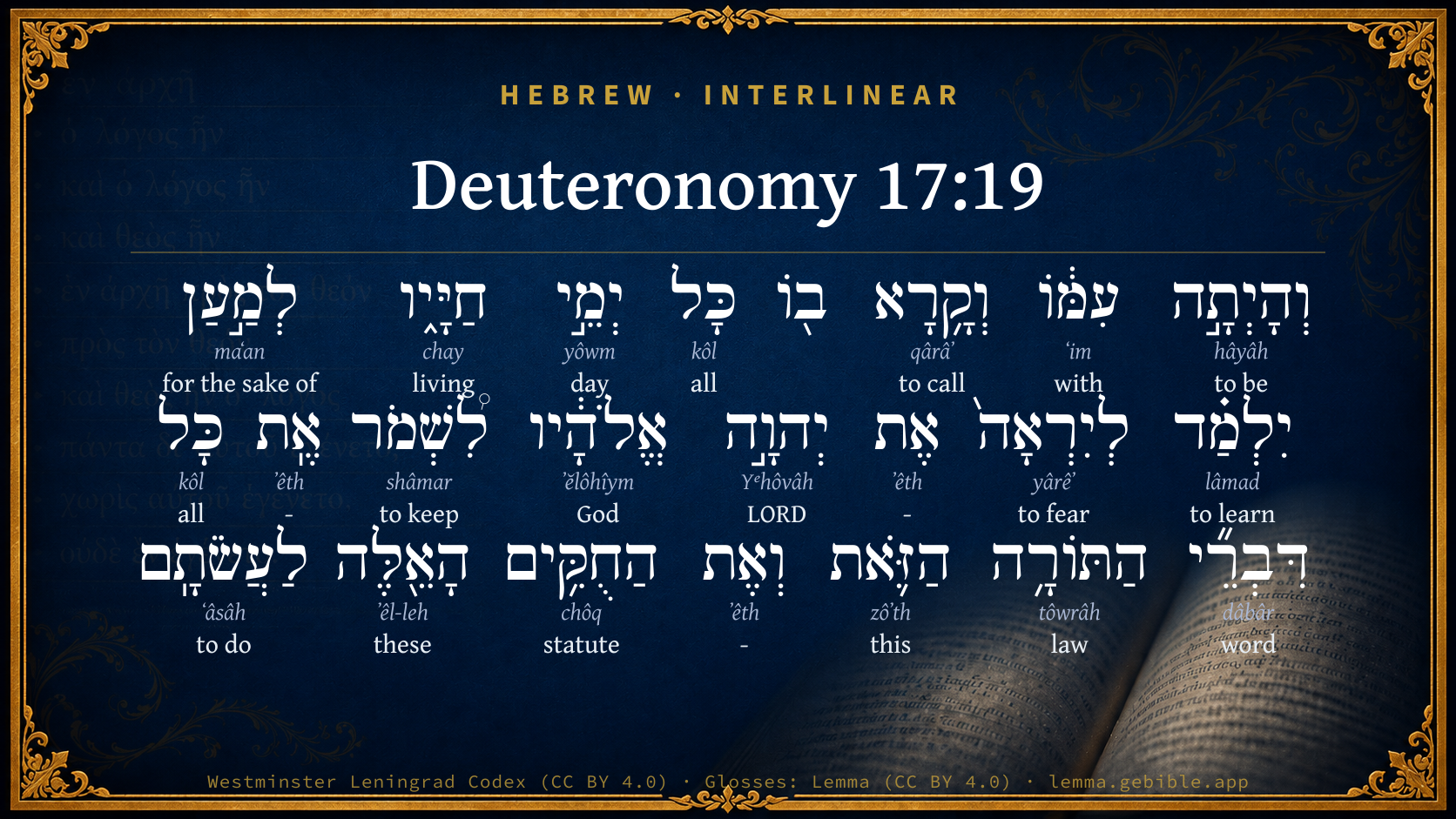
Hebrew (Westminster Leningrad Codex) Deuteronomy 17:19 appears in the Hebrew Old Testament. The text above is from the Westminster Leningrad Codex. Each word links to its Strong’s number, a concise gloss, and parsing drawn from the Open Scriptures Hebrew Bible morphology. Click any word for its full Brown-Driver-Briggs (BDB) entry.
Download image
Cite this verse

Deuteronomy 17:19 (World English Bible). Public Domain. Lemma interlinear Bible study tool, https://lemma.gebible.app/v/deuteronomy/17/19.

Show BibTeX & RIS
BibTeX
RIS
English Translation
and it shall be with him, and he shall read therein all the days of his life; that he may learn to fear Yahweh his God, to keep all the words of this law and these statutes, to do them;
World English Bible · Public Domain
Download a study sheet

One document with this verse’s original text, its word-by-word gloss line, the meaning frame, cross-references with their text, attributed commentary, and full source and license credits — printable, and it pastes into notes with its structure intact.

This verse Autodidact and up

Study sheet (.html) Plain text (.txt)

A passage Seminary Student

Up to 50 verses in one chapter. A passage sheet keeps up to 6 commentary sources and 12 cross-references per verse, in the order this page ranks them, and says so on the sheet whenever that leaves anything out. Ask for a single verse and you get the Autodidact verse sheet above.

Everything on this page stays free to read, with no account — the sheet is a download of what is already on screen, not access to it.

Want to remove ads? Support Godless Engineer
Compare translations 3

The same verse in 3 English versions, stacked beneath the original-language interlinear above. Click any original word for its lexicon entry.

Each is an independent rendering of the whole verse — the interlinear is not word-aligned to these translations.

Highlighted words mark where these versions differ — a whole-verse word diff, not a word-by-word alignment.

  • World English Bible Public Domain
    and it shall be with him, and he shall read therein all the days of his life; that he may learn to fear Yahweh his God, to keep all the words of this law and these statutes, to do them;
  • King James Version Public Domain
    And it shall be with him, and he shall read therein all the days of his life: that he may learn to fear the LORD his God, to keep all the words of this law and these statutes, to do them:
  • unfoldingWord Literal Text CC BY-SA 4.0
    and it shall be with him, and he shall read it all the days of his life, so that he will learn to fear Yahweh his God, to keep all the words of this law and these statutes, to do them,

unfoldingWord Literal Text — © unfoldingWord, licensed CC BY-SA 4.0. Word-aligned USFM3 via Door43 (git.door43.org/unfoldingWord/en_ult).

Versions to compare (up to 4)

3 of 4 selected

Show all 18 translations

Every available English version of this verse, each an independent rendering of the whole verse.

  • World English Bible Public Domain
    and it shall be with him, and he shall read therein all the days of his life; that he may learn to fear Yahweh his God, to keep all the words of this law and these statutes, to do them;
  • Berean Standard Bible Public Domain
    It is to remain with him, and he is to read from it all the days of his life, so that he may learn to fear the LORD his God by carefully observing all the words of this instruction and these statutes.
  • Majority Standard Bible Public Domain
    It is to remain with him, and he is to read from it all the days of his life, so that he may learn to fear the LORD his God by carefully observing all the words of this instruction and these statutes.
  • King James Version Public Domain
    And it shall be with him, and he shall read therein all the days of his life: that he may learn to fear the LORD his God, to keep all the words of this law and these statutes, to do them:
  • American Standard Version (1901) Public Domain
    and it shall be with him, and he shall read therein all the days of his life; that he may learn to fear Jehovah his God, to keep all the words of this law and these statutes, to do them;
  • Revised Version (1885) Public Domain
    and it shall be with him, and he shall read therein all the days of his life: that he may learn to fear the LORD his God, to keep all the words of this law and these statutes, to do them:
  • Geneva Bible (1599) Public Domain
    And it shall be with him, and he shall reade therein all daies of his life, that he may learne to feare the Lord his God, and to keepe all ye words of this Lawe, and these ordinances for to doe them:
  • Douay-Rheims (1899) Public Domain
    And he shall have it with him, and shall read it all the days of his life, that he may learn to fear the Lord his God, and keep his words and ceremonies, that are commanded in the law;
  • Young's Literal Translation Public Domain
    and it hath been with him, and he hath read in it all days of his life, so that he doth learn to fear Jehovah his God, to keep all the words of this law, and these statutes, to do them;
  • Literal Standard Version CC BY-SA 4.0
    and it has been with him, and he has read in it all [the] days of his life, so that he learns to fear his God YHWH, to keep all the words of this law and these statutes—to do them,
  • Unlocked Literal Bible CC BY-SA 4.0
    The scroll must be with him, and he must read in it all the days of his life, so that he may learn to honor Yahweh his God, so as to keep all the words of this law and these statutes, to observe them.
  • unfoldingWord Literal Text CC BY-SA 4.0
    and it shall be with him, and he shall read it all the days of his life, so that he will learn to fear Yahweh his God, to keep all the words of this law and these statutes, to do them,
  • Darby Bible Public Domain
    and it shall be with him, and he shall read therein all the days of his life; that he may learn to fear Jehovah his God, to keep all the words of this law and these statutes, to do them;
  • World Messianic Bible Public Domain
    It shall be with him, and he shall read from it all the days of his life, that he may learn to fear the LORD his God, to keep all the words of this law and these statutes, to do them;
  • Webster's Bible Public Domain
    And it shall be with him, and he shall read in it all the days of his life: that he may learn to fear the LORD his God, to keep all the words of this law and these statutes, to do them:
  • Free Bible Version CC BY-SA 4.0
    He is to keep it with him, and he is to read from it each day throughout his life, so he may learn to respect the Lord his God by being careful to follow every word of these instructions and regulations.
  • Bible in Basic English Public Domain
    And it is to be with him for his reading all the days of his life, so that he may be trained in the fear of the Lord his God to keep and do all the words of this teaching and these laws:
  • JPS Tanakh (1917) Public Domain
    And it shall be with him, and he shall read therein all the days of his life; that he may learn to fear the LORD his God, to keep all the words of this law and these statutes, to do them;

Literal Standard Version (2020), Covenant Press — licensed CC BY-SA 4.0. Text via the HelloAO Bible API (eBible.org). Unlocked Literal Bible (unfoldingWord) — licensed CC BY-SA 4.0. Text via the HelloAO Bible API (eBible.org). unfoldingWord Literal Text — © unfoldingWord, licensed CC BY-SA 4.0. Word-aligned USFM3 via Door43 (git.door43.org/unfoldingWord/en_ult). Free Bible Version, Dr. Jonathan Gallagher — licensed CC BY-SA 4.0. Text via the HelloAO Bible API (eBible.org).

Word by word

More ways to search: Search by grammar → Find every occurrence → Compare this word →

Practice this passage: Drill this verse → Learn its vocabulary →

יִלְמַ֗ד
lâmad
H3925
“to learn”
Verb, Qal, Imperfect, 3rd Person, Masculine, Singular
Part of Speech
Verb
Stem
Qal
Form
Imperfect
Person
3rd Person
Gender
Masculine
Number
Singular
Full BDB Definition

Origin: a primitive root

TWOT: 1116

to learn. teach, exercise in - (Qal) to learn - (Piel) to teach - (Pual) to be taught, be trained
  1. וְהָיְתָ֣ה hâyâh H1961 “and · to be” Conjunction + Verb, Qal, Sequential Perfect, 3rd Person, Feminine, Singular
  2. עִמּ֔וֹ ʻim H5973 “with · him” Preposition + Suffix, Personal, 3rd Person, Masculine, Singular
  3. וְקָ֥רָא qârâʼ H7121 “and · to call” Conjunction + Verb, Qal, Sequential Perfect, 3rd Person, Masculine, Singular
  4. כָּל kôl H3605 “all of” Noun, Common, Masculine, Singular, Construct
  5. יְמֵ֣י yôwm H3117 “days of” Noun, Common, Masculine, Plural, Construct
  6. חַיָּ֑יו chay H2416 “living things · his” Noun, Common, Masculine, Plural, Construct + Suffix, Personal, 3rd Person, Masculine, Singular
  7. לְמַ֣עַן maʻan H4616 “for the sake of” Preposition
  8. לְיִרְאָה֙ yârêʼ H3372 “to fear” Preposition + Verb, Qal, Infinitive Construct
  9. אֶת ʼêth H853 “-” Particle, Direct Object
  10. יְהוָ֣ה Yᵉhôvâh H3068 “LORD” Noun, Proper
  11. אֱלֹהָ֔יו ʼĕlôhîym H430 “God(s) · his” Noun, Common, Masculine, Plural, Construct + Suffix, Personal, 3rd Person, Masculine, Singular
  12. לִ֠שְׁמֹר shâmar H8104 “to keep” Preposition + Verb, Qal, Infinitive Construct
  13. אֶֽת ʼêth H853 “-” Particle, Direct Object
  14. כָּל kôl H3605 “all of” Noun, Common, Masculine, Singular, Construct
  15. דִּבְרֵ֞י dâbâr H1697 “words of” Noun, Common, Masculine, Plural, Construct
  16. הַתּוֹרָ֥ה tôwrâh H8451 “the · law” Particle, Definite Article + Noun, Common, Feminine, Singular, Absolute
  17. הַזֹּ֛את zôʼth H2063 “the · this” Particle, Definite Article + Pronoun, Demonstrative, Feminine, Singular
  18. וְאֶת ʼêth H853 “and · -” Conjunction + Particle, Direct Object
  19. הַחֻקִּ֥ים chôq H2706 “the · statutes” Particle, Definite Article + Noun, Common, Masculine, Plural, Absolute
  20. הָאֵ֖לֶּה ʼêl-leh H428 “the · these” Particle, Definite Article + Pronoun, Demonstrative, Common, Plural
  21. לַעֲשֹׂתָֽם ʻâsâh H6213 “to do · them” Preposition + Verb, Qal, Infinitive Construct + Suffix, Personal, 3rd Person, Masculine, Plural

About this verse

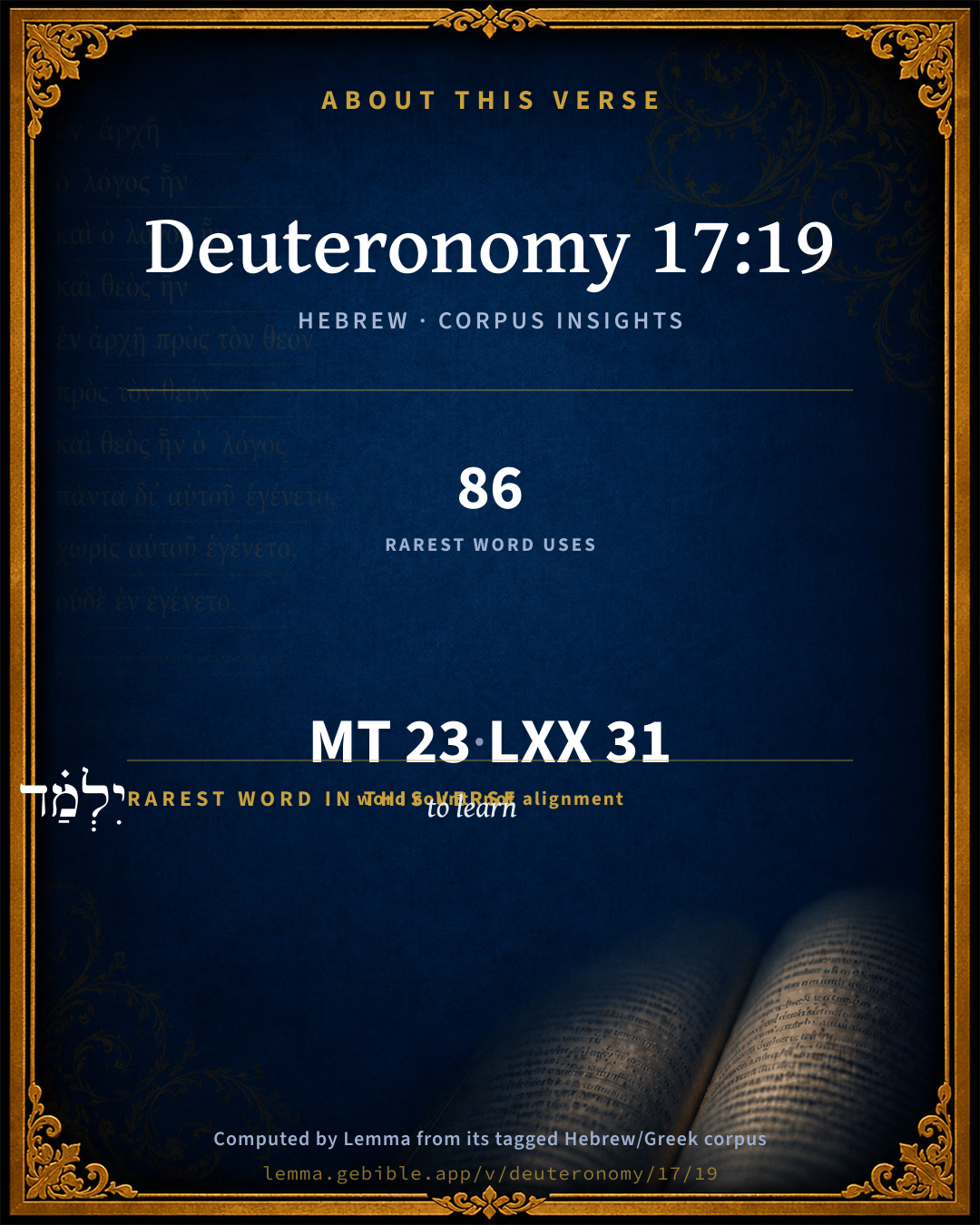
These counts appear in no published source. They are computed here, from the morphology-tagged text and Lemma’s own curated glosses. What Lemma adds →

23
words
19
distinct lemmas
Pentateuch
section

Grammatical profile

  • 6 verbs
  • 9 nouns
  • 2 pronouns
  • 3 prepositions
  • 3 particles

Verb forms

  • וְהָיְתָ֣ה Qal · Sequential Perfect
  • וְקָ֥רָא Qal · Sequential Perfect
  • יִלְמַ֗ד Qal · Imperfect
  • לְיִרְאָה֙ Qal · Infinitive Construct
  • לִ֠שְׁמֹר Qal · Infinitive Construct
  • לַעֲשֹׂתָֽם Qal · Infinitive Construct

Repetition

A word recurs within this verse — often emphatic in Hebrew:

Hebrew & Septuagint length

In English translation the verse runs 40 words from the Hebrew and 39 from the Septuagint (LXX English) — closely comparable.

A rough comparison of the two English renderings, which tokenize alike — not a word-level alignment.

Word counts can differ between the Hebrew and the Greek without any difference in meaning — e.g. the Hebrew direct-object marker אֵת has no separate Greek word, and Greek often adds the article ὁ.

In the original languages it is 23 Hebrew tokens and 31 Greek tokens — but the two are counted differently (Hebrew bundles its prefixes and suffixes into one token; the Greek is in lemma form), so that isn’t a like-for-like length.

Cross-references

8

Topical passages linked to Deuteronomy 17:19 in the Treasury of Scripture Knowledge — connected by theme and wording, ordered by reader-vote popularity; previews shown in the World English Bible.

  • Joshua 1:8 This book of the law shall not depart out of your mouth, but you shall meditate thereon day and night, that you may observe to do according to all that is written therein: for then you shall make your way prosperous, and then you shall have good success.
  • Psalms 119:97–100 How love I your law! It is my meditation all day.
  • Psalms 1:2 But his delight is in Yahweh's law; On his law he meditates day and night.
  • 2 Timothy 3:15–17 From infancy, you have known the sacred writings which are able to make you wise for salvation through faith, which is in Christ Jesus.
  • John 5:39 "You search the Scriptures, because you think that in them you have eternal life; and these are they which testify about me.
  • Deuteronomy 11:18 Therefore shall you lay up these my words in your heart and in your soul; and you shall bind them for a sign on your hand, and they shall be for symbols between your eyes.
  • Deuteronomy 4:10 the day that you stood before Yahweh your God in Horeb, when Yahweh said to me, Assemble me the people, and I will make them hear my words, that they may learn to fear me all the days that they live on the earth, and that they may teach their children.
  • Deuteronomy 6:6–9 These words, which I command you this day, shall be on your heart;

Cross-references courtesy of OpenBible.info (CC BY 4.0).

Hebrew and Greek witnesses Masoretic Hebrew ↔ Greek Septuagint

The same verse in the two great witnesses to the Old Testament, shown verse-for-verse.

These are two independent witnesses, not word-aligned to each other, and the Septuagint is shown in lemma (dictionary) form.

Hebrew Deuteronomy 17:19 Masoretic · Westminster Leningrad Codex

וְהָיְתָ֣ה עִמּ֔וֹ וְקָ֥רָא ב֖וֹ כָּל יְמֵ֣י חַיָּ֑יו לְמַ֣עַן יִלְמַ֗ד לְיִרְאָה֙ אֶת יְהוָ֣ה אֱלֹהָ֔יו לִ֠שְׁמֹר אֶֽת כָּל דִּבְרֵ֞י הַתּוֹרָ֥ה הַזֹּ֛את וְאֶת הַחֻקִּ֥ים הָאֵ֖לֶּה לַעֲשֹׂתָֽם

and it shall be with him, and he shall read therein all the days of his life; that he may learn to fear Yahweh his God, to keep all the words of this law and these statutes, to do them;

World English Bible · Public Domain

Greek LXX Deuteronomy 17:19 Septuagint · lemma form

καί εἰμί μετά αὐτός καί ἀναγιγνώσκω ἐν αὐτός πᾶς ὁ ἡμέρα ὁ ζωή αὐτός ἵνα μανθάνω φοβέω κύριος ὁ θεός αὐτός φυλάσσω πᾶς ὁ ἐντολή οὗτος καί ὁ δικαίωμα οὗτος ποιέω

and it shall be with him, and he shall read in it all the days of his life, that he may learn to fear the Lord your God, and to keep all these commandments, and to observe these ordinances:

LXX2012 (modern English Septuagint) · Public Domain

Hebrew: Westminster Leningrad Codex (CC BY 4.0). Greek: Septuagint (public domain); English from LXX2012 (modern English Septuagint) (Public Domain). How the Septuagint differs from the Hebrew →

Targum (Aramaic paraphrase)

2

The Targum is the ancient Jewish Aramaic paraphrase of the Hebrew Scriptures — an interpretive translation, not the Hebrew text itself. Onkelos (literal) and Pseudo-Jonathan (expansive) render the Torah, and Jonathan the Prophets. Coverage is partial: where no permissively-licensed English translation exists for a verse, only the Aramaic is shown. This is verse-level text, not a word-by-word alignment to the Hebrew.

  1. Targum Onkelos Torah (Genesis–Deuteronomy)
    וּתְהֵי עִמֵהּ וִיהֵי קָרֵי בֵהּ כָּל יוֹמֵי חַיוֹהִי בְּדִיל דְיֵלַף לְמִדְחַל קֳדָם יְיָ אֱלָהֵהּ לְמִטַּר יָת כָּל פִּתְגָמֵי אוֹרַיְתָא הָדָא וְיָת קְיָמַיָא הָאִלֵין לְמֶעְבָּדְהוֹן

    (no public-domain English translation for this verse)

    Targum Onkelos — Aramaic: “Onkelos Genesis” (public domain); “Onkelos Exodus” (public domain); “Onkelos Leviticus” (public domain); “Onkelos Numbers” (public domain); “Onkelos Deuteronomy” (public domain). English: “Sefaria Community Translation” (CC0 1.0 (public-domain dedication)); “J.W. Etheridge. The Targums of Onkelos and Jonathan Ben Uzziel on the Pentateuch. London: Longmans, Green, 1862” (public domain). Text via Sefaria.

  2. Targum Pseudo-Jonathan Torah (Genesis–Deuteronomy)
    וּתְהֵי גַבֵּיהּ וִיהֵי קָרֵי בֵּיהּ כָּל יוֹמֵי חַייוֹי מִן בִּגְלַל דְּיַלִּיף לְמִדְחַל מִן קֳדָם יְיָ אֱלָהֵיהּ לְמִנְטַל יַת כָּל פִּתְגָמֵי אוֹרַיְיתָא הָדָא וְיַת כָּל קְיָימַיָא הָאִלֵּין לְמֶעֱבַדְהוֹן

    and let it be at his side, and he shall read it all the days of his life, that he may learn to fear the Lord his God, to keep all the words of this law, and all these statutes to perform them:

    Targum Pseudo-Jonathan — Aramaic: “Targum Jonathan on Genesis” (public domain); “Targum Jonathan on Exodus” (public domain); “Targum Jonathan on Leviticus” (public domain); “Targum Jonathan on Numbers” (public domain); “Targum Jonathan on Deuteronomy” (public domain). English: “The Targum of Jonathan ben Uzziel, trans. J. W. Etheridge, London, 1862” (public domain). Text via Sefaria.

Commentary

Notes on Deuteronomy 17:19 from classic Christian and Jewish commentators (each source and its license shown beneath its notes). The classic Christian expositions comment on the surrounding passage and are grouped to its opening verse, so a note may address several verses; the Jewish commentaries on the Tanakh (Rashi and others) are per-verse, so they appear only where the commentator wrote on this verse.

Lemma curates 59 commentaries, every one of them public domain or Creative Commons licensed, each selected and text-cleaned for this edition rather than reprinted as found. About our sources →

Trapp's Complete Commentary

John Trapp

Deu 17:19 And it shall be with him, and he shall read therein all the days of his life: that he may learn to fear the LORD his God, to keep all the words of this law and these statutes, to do them:

Ver. 19. And it shall be with him.] As his Vade-mecum, his manual, his running library, the man of his counsel. Luther said, he would not live in Paradise without the Bible, as with it he could easily live in hell itself. {a}

{a} Tom. 4, Oper. Latin., p. 424.

John Trapp, A Commentary or Exposition upon All the Books of the Old and New Testament (1647–1656) — public domain. Text from a community e-Sword module.

Adam Clarke's Commentary

Verse 19. And it shall be with him, &c.] It was the surest way to bring the king to an acquaintance with the Divine law to oblige him to write out a fair copy of it with his own hand, in which he was to read daily. This was essentially necessary, as these laws of God were all permanent, and no Israelitish king could make any new law, the kings of this people being ever considered as only the vice-gerents of Jehovah.

Adam Clarke's Commentary on the Bible (1810–1826) — public domain. Text from a community e-Sword/MySword module.

The Cambridge Bible for Schools and Colleges

gen. ed. J. J. S. Perowne

19. it shall be with him] Jos_1:8.

that he may learn to fear, etc.] See on Deu_4:10, Deu_14:23.

to keep … to do] See on Deu_5:1.

The Cambridge Bible for Schools and Colleges (gen. ed. J. J. S. Perowne; Cambridge University Press, 1878–1918) — public domain. Text from a community e-Sword module.

John Gill's Exposition

And it shall be with him,.... Always, when at home or abroad, sitting on his throne or lying down, or wherever he went, unless in such places where it was not proper to read it, as the Jews observe (o): and he shall read therein all the days of his life; every day of his life; meditate on it night and day, as a good man does, that he might be well versed in it, and know how to govern his people according to it:

that he may learn to, fear the Lord his God; to serve and worship him both internally and externally, he having the fear of God always before his eyes, and on his heart, which the holy law of God directs to and instructs in:

to keep all the words of this law, and these statutes, to do them; not only such as concerned him as a king, but all others that concerned him as a man, a creature subject to the Lord, and as an Israelite belonging to the church and commonwealth of Israel, and so includes all laws, moral, ceremonial, and judicial.

(o) Maimon. Hilchot Melachim, c. 3. sect. 1.

John Gill's Exposition of the Whole Bible (1746–1763) — public domain (CC PDM 1.0). Text via the HelloAO Bible API.

Haydock's Catholic Bible Commentary

Law. Pious Christian emperors and kings have esteemed it their greatest glory and happiness to read and meditate on the holy commandments of God, in order to regulate their conduct, amid the various dangerous occupations of their station. (Haydock) --- Constantine the Great, Charlemagne, St. Stephen of Hungary, Alphonsus I of Spain, were noted for the zeal which they shewed in the particular. Alphonsus of Arragon, had read the Bible, with the Commentaries, 14 times over, and the great Alfred wrote all the New Testament twice over with his own hand. (Calmet) --- He had translated into English Saxon all or most of the Bible before 900, as king Athelstan did about 925. (Encyclopedia Britannica, Bible, &c.) Yet the Catholic Church never condemned this conduct of her children, as Protestants would insinuate. (Cath. Doct. by N. G.)

George Leo Haydock (1774–1849), Haydock's Catholic Family Bible and Commentary, 1859 edition — public domain. Excludes Psalms (Douay-Rheims chapter numbering differs from Protestant) and Deuterocanonical books (Catholic canon only).

Matthew Poole's English Annotations

All the days of his life, i.e. diligently and constantly; neither the greatness of his place, nor the weight and multitude, of his business, shall excuse or hinder him.

Matthew Poole's English Annotations on the Holy Bible (1683–1685) — public domain. Text from a community e-Sword/MySword module.

The Pulpit Commentary

And it shall be with him, etc. It was to be carefully kept by him, but not as a mere sacred deposit or palladium; it was to be constantly with him wherever he was, was to be the object of his continual study, and was to be the directory and guide of his daily life (cf. Jos_1:8; Psa_1:2 Psa_119:15, Psa_119:16, Psa_119:24, Psa_119:97-99, etc.)

The Pulpit Commentary (1880–1919), ed. H.D.M. Spence-Jones & Joseph S. Exell — public domain. Text from a community e-Sword module.

John Wesley's Explanatory Notes

All the days of his life - 'Tis not enough to have Bibles, but we must use them, yea, use them daily. Our souls must have constant meals of that manna, which if well digested, will afford them true nourishment and strength.

John Wesley, Explanatory Notes Upon the Whole Bible (1754–1765) — public domain. Text via the GEBible commentary corpus.

Scofield Reference Notes

C. I. Scofield

fear

(See Scofield "Psa 19:9").

The Scofield Reference Bible (1917 edition), notes by C. I. Scofield — public domain. Text from a community e-Sword module.

Rashi

Rabbi Shlomo Yitzchaki (Rashi)

דברי התורה [ALL] THE WORDS OF [THIS] LAW — Take it as what it literally implies.

Rashi on the Tanakh — English translations: “The Judaica Press complete Tanach with Rashi, translated by A. J. Rosenberg” (CC BY 4.0); “Pentateuch with Rashi's commentary by M. Rosenbaum and A.M. Silbermann, 1929-1934” (public domain); “The Metsudah Tanach series, Lakewood, N.J” (CC BY 4.0); and “The Book of Joshua, Metsudah Publications, 1997” (CC BY 4.0). Text via Sefaria.

Ramban (Nachmanides)

Rabbi Moshe ben Nachman (Ramban / Nachmanides)

V’HAY’THAH’ (AND IT SHALL BE) WITH HIM [“it” refers to] the Torah is feminine [literally: “and she will be”] it must refer to Torah which is also feminine. as mentioned [in the preceding verse]. AND HE SHALL READ ‘BO’ (THEREIN) — “in the book” (“in him”), being masculine, cannot refer to Torah which is feminine. It must refer to the masculine word, sefer (book), in the preceding verse. The verse reads: and he [the king] shall write him a copy of this ‘Torah’ in ‘a book.’ mentioned [in the preceding verse]. And by way of the Truth, [the mystic teachings of the Cabala], ‘v’hay’thah’ (and it shall be) with him means that the Torah itself will be with him, similar to what is said, And the Eternal gave Solomon wisdom, and it is further said, And Solomon sat on the throne of the Eternal as king. ” (Psalms 93:1) [Ramban in his Letter to his son on the Virtue of Humility, Hebrew Ethical Wills, J.P.S., Vol. I, pp. 94-99].

Ramban (Nachmanides) on the Tanakh — English translation: “Commentary on the Torah by Ramban (Nachmanides). Translated and annotated by Charles B. Chavel. New York, Shilo Pub. House, 1971-1976” (CC BY 4.0). Text via Sefaria.

Lesson kit

Teaching starters — assembled from the data on this page, not authored interpretation. Every prompt links to the verse data it draws on. Edit before teaching.

Deuteronomy, in the Pentateuch, opens this verse with 23 words (19 distinct Hebrew lemmas). Its most distinctive word is lâmad (“to learn”). A historical commentator’s framing appears above. Read the whole chapter for the surrounding context.

Discussion questions

  1. How does “to learn” (lâmad) shape what this verse is saying?
  2. How does Joshua 1:8, which shares this passage’s theme, read alongside this verse?
  3. What does the repetition of “all” (2× in this one verse) do in this verse?
  4. The translations on this page render this verse differently — a whole-verse word diff, not a word-by-word alignment. What might account for the different wordings?
  5. «וְהָיְתָ֣ה» is a Qal Sequential Perfect verb. How does that grammatical form shape the action described?
  6. Compare how Trapp's Complete Commentary and Adam Clarke's Commentary read this verse. Where do they agree or differ?

Things to notice

Reading settings

Reading text

Shown beneath each verse's original-language words.

Old Testament
Old Testament edition

Read the OT as the Masoretic Hebrew (MT) or the Greek Septuagint (LXX).

English shown for the Greek Septuagint (in the Hebrew ↔ Greek comparison).

Comparing translations? Open the Compare panel on any verse page to stack up to four side by side.