
Deuteronomy 13:14

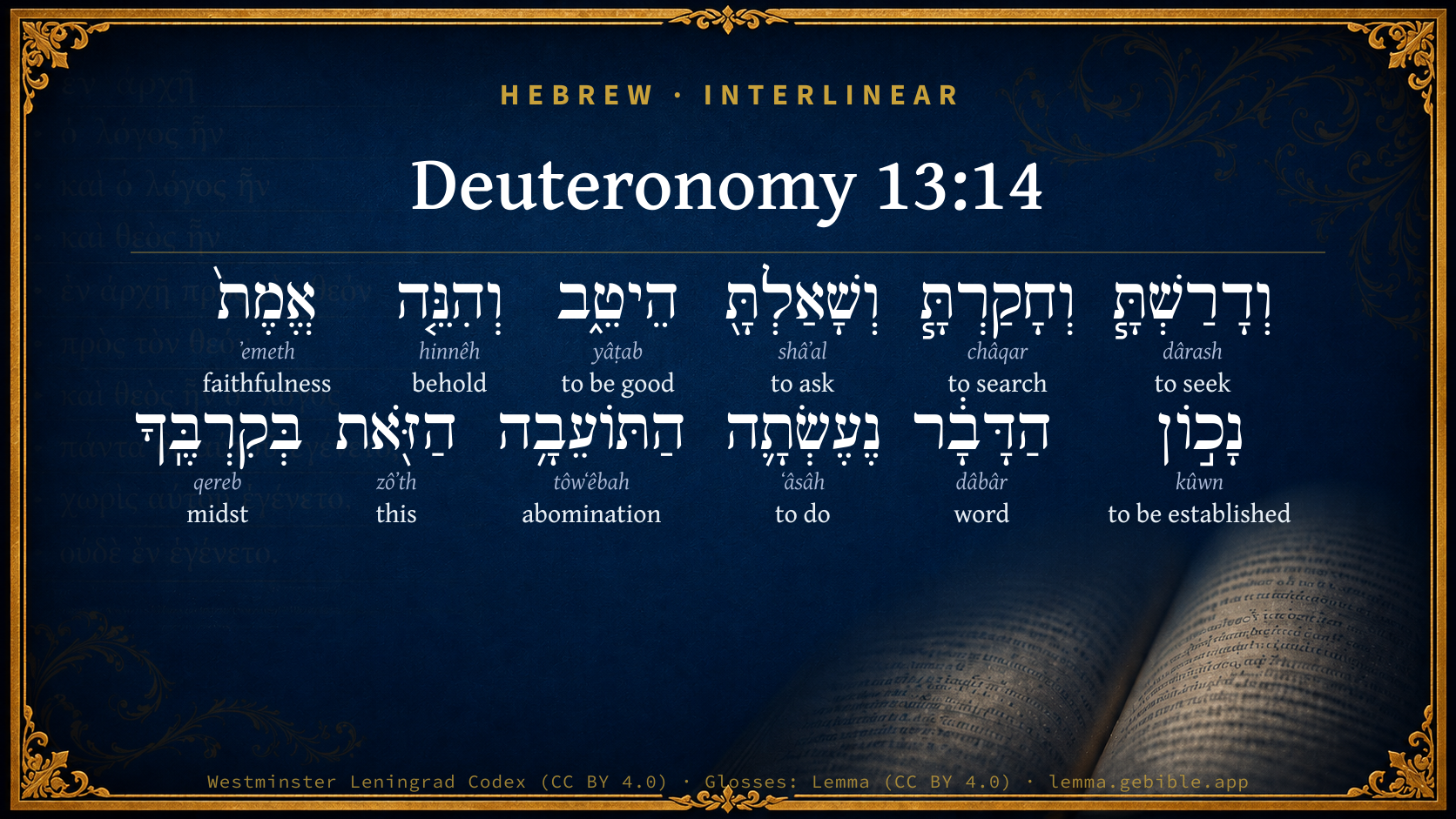
Hebrew (Westminster Leningrad Codex) Deuteronomy 13:14 appears in the Hebrew Old Testament. The text above is from the Westminster Leningrad Codex. Each word links to its Strong’s number, a concise gloss, and parsing drawn from the Open Scriptures Hebrew Bible morphology. Click any word for its full Brown-Driver-Briggs (BDB) entry.
Download image
Cite this verse

Deuteronomy 13:14 (World English Bible). Public Domain. Lemma interlinear Bible study tool, https://lemma.gebible.app/v/deuteronomy/13/14.

Show BibTeX & RIS
BibTeX
RIS
English Translation
then shall you inquire, and make search, and ask diligently; and, behold, if it be truth, and the thing certain, that such abomination is done in the midst of you,
World English Bible · Public Domain
Highlights
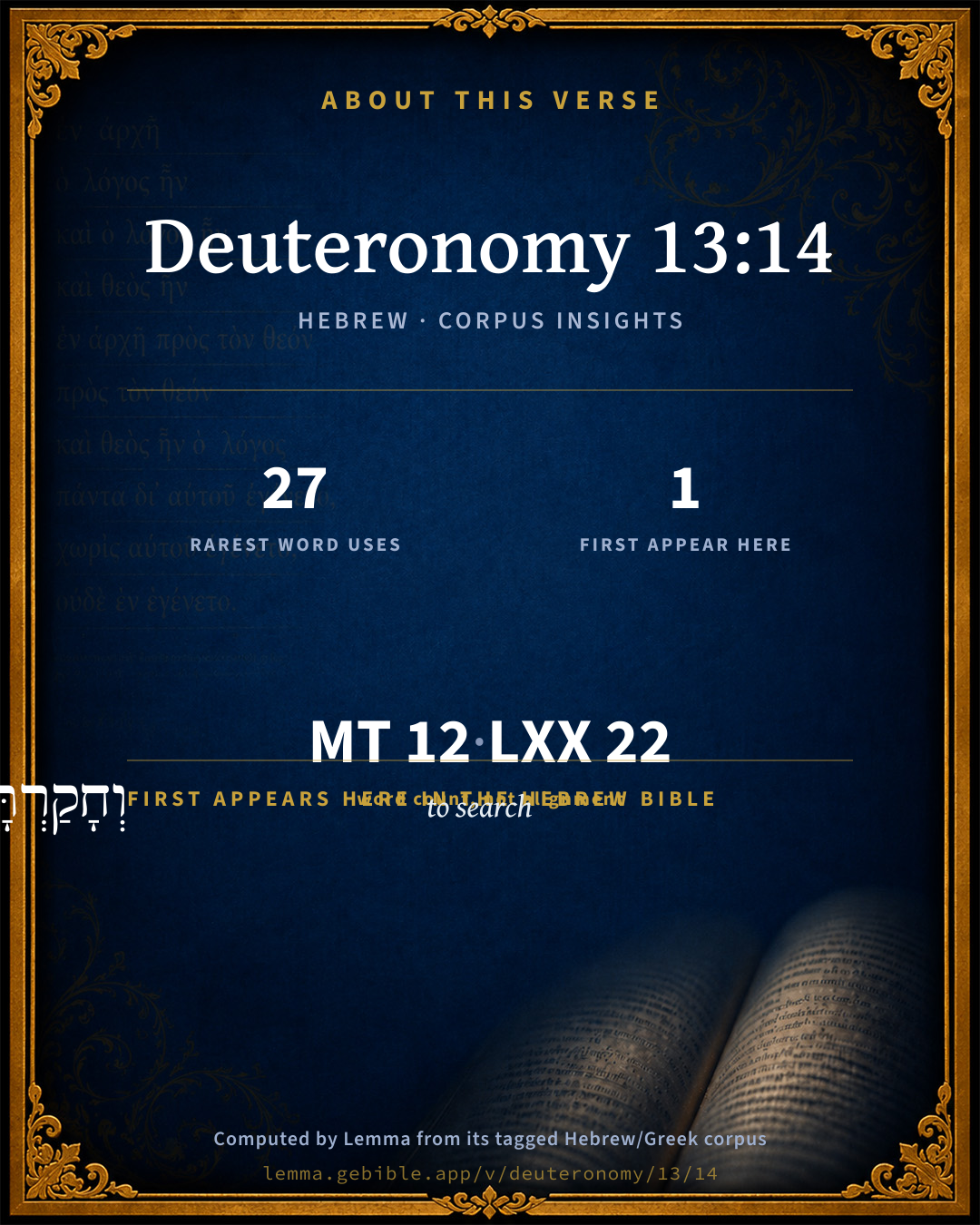
  • 1 first appearance in the Hebrew Bible
Full analysis ↓
Download a study sheet

One document with this verse’s original text, its word-by-word gloss line, the meaning frame, cross-references with their text, attributed commentary, and full source and license credits — printable, and it pastes into notes with its structure intact.

This verse Autodidact and up

Study sheet (.html) Plain text (.txt)

A passage Seminary Student

Up to 50 verses in one chapter. A passage sheet keeps up to 6 commentary sources and 12 cross-references per verse, in the order this page ranks them, and says so on the sheet whenever that leaves anything out. Ask for a single verse and you get the Autodidact verse sheet above.

Everything on this page stays free to read, with no account — the sheet is a download of what is already on screen, not access to it.

Want to remove ads? Support Godless Engineer
Compare translations 3

The same verse in 3 English versions, stacked beneath the original-language interlinear above. Click any original word for its lexicon entry.

Each is an independent rendering of the whole verse — the interlinear is not word-aligned to these translations.

Highlighted words mark where these versions differ — a whole-verse word diff, not a word-by-word alignment.

  • World English Bible Public Domain
    then shall you inquire, and make search, and ask diligently; and, behold, if it be truth, and the thing certain, that such abomination is done in the midst of you,
  • King James Version Public Domain
    Then shalt thou inquire, and make search, and ask diligently; and, behold, if it be truth, and the thing certain, that such abomination is wrought among you;
  • unfoldingWord Literal Text CC BY-SA 4.0
    and you shall investigate and search out and ask thoroughly, and behold, the matter an established truth, this abomination has been done in your midst,

unfoldingWord Literal Text — © unfoldingWord, licensed CC BY-SA 4.0. Word-aligned USFM3 via Door43 (git.door43.org/unfoldingWord/en_ult).

Versions to compare (up to 4)

3 of 4 selected

Show all 18 translations

Every available English version of this verse, each an independent rendering of the whole verse.

  • World English Bible Public Domain
    then shall you inquire, and make search, and ask diligently; and, behold, if it be truth, and the thing certain, that such abomination is done in the midst of you,
  • Berean Standard Bible Public Domain
    then you must inquire, investigate, and interrogate thoroughly. And if it is established with certainty that this abomination has been committed among you,
  • Majority Standard Bible Public Domain
    then you must inquire, investigate, and interrogate thoroughly. And if it is established with certainty that this abomination has been committed among you,
  • King James Version Public Domain
    Then shalt thou inquire, and make search, and ask diligently; and, behold, if it be truth, and the thing certain, that such abomination is wrought among you;
  • American Standard Version (1901) Public Domain
    then shalt thou inquire, and make search, and ask diligently; and, behold, if it be truth, and the thing certain, that such abomination is wrought in the midst of thee,
  • Revised Version (1885) Public Domain
    then shalt thou inquire, and make search, and ask diligently; and, behold, if it be truth, and the thing certain, that such abomination is wrought in the midst of thee;
  • Geneva Bible (1599) Public Domain
    Then thou shalt seeke, and make searche and enquire diligently: and if it be true, and the thing certaine, that such abomination is wrought among you,
  • Douay-Rheims (1899) Public Domain
    Inquire carefully and diligently, the truth of the thing by looking well into it, and if thou find that which is said to be certain, and that this abomination hath been really committed,
  • Young's Literal Translation Public Domain
    and thou hast enquired, and searched, and asked diligently, and lo, truth; the thing is established; this abomination hath been done in thy midst:
  • Literal Standard Version CC BY-SA 4.0
    then you have inquired, and searched, and asked diligently, and behold, [if] truth, the thing is established; this abomination has been done in your midst—
  • Unlocked Literal Bible CC BY-SA 4.0
    Then you will examine the evidence, make search, and investigate it thoroughly. When you discover that it is true and certain that such an abominable thing has been done among you, then you will take action.
  • unfoldingWord Literal Text CC BY-SA 4.0
    and you shall investigate and search out and ask thoroughly, and behold, the matter an established truth, this abomination has been done in your midst,
  • Darby Bible Public Domain
    then shalt thou inquire, and make search, and ask diligently; and if it be truth, [and] the thing be certain, that this abomination hath happened in the midst of thee,
  • World Messianic Bible Public Domain
    then you shall inquire, investigate, and ask diligently. Behold, if it is true, and the thing certain, that such abomination was done among you,
  • Webster's Bible Public Domain
    Then shalt thou inquire, and make search, and ask diligently; and behold, if it is truth, and the thing certain, that such abomination is wrought among you;
  • Free Bible Version CC BY-SA 4.0
    If this does happen you need to make a full investigation, inquiring about the facts and interrogating witnesses. If it's proved beyond doubt that this awful sin has actually been committed among you,
  • Bible in Basic English Public Domain
    Then let a full search be made, and let questions be put with care; and if it is true and certain that such a disgusting thing has been done among you;
  • JPS Tanakh (1917) Public Domain
    (13-15) then shalt thou inquire, and make search, and ask diligently; and, behold, if it be truth, and the thing certain, that such abomination is wrought in the midst of thee;

Literal Standard Version (2020), Covenant Press — licensed CC BY-SA 4.0. Text via the HelloAO Bible API (eBible.org). Unlocked Literal Bible (unfoldingWord) — licensed CC BY-SA 4.0. Text via the HelloAO Bible API (eBible.org). unfoldingWord Literal Text — © unfoldingWord, licensed CC BY-SA 4.0. Word-aligned USFM3 via Door43 (git.door43.org/unfoldingWord/en_ult). Free Bible Version, Dr. Jonathan Gallagher — licensed CC BY-SA 4.0. Text via the HelloAO Bible API (eBible.org).

Word by word

More ways to search: Search by grammar → Find every occurrence → Compare this word →

Practice this passage: Drill this verse → Learn its vocabulary →

וְחָקַרְתָּ֧
châqar
H2713
“and · to search”
Conjunction + Verb, Qal, Sequential Perfect, 2nd Person, Masculine, Singular
Part of Speech
Conjunction + Verb
Stem
Qal
Form
Sequential Perfect
Person
2nd Person
Gender
Masculine
Number
Singular
Full BDB Definition

Origin: a primitive root

TWOT: 729

to search, search for, search out, examine, investigate - (Qal) - to search (for) - to search through, explore - to examine thoroughly - (Niphal) - to be searched out, be found out, be ascertained, be examined - (Piel) to search out, seek out
  1. וְדָרַשְׁתָּ֧ dârash H1875 “and · to seek” Conjunction + Verb, Qal, Sequential Perfect, 2nd Person, Masculine, Singular
  2. וְשָׁאַלְתָּ֖ shâʼal H7592 “and · to ask” Conjunction + Verb, Qal, Sequential Perfect, 2nd Person, Masculine, Singular
  3. הֵיטֵ֑ב yâṭab H3190 “to be good” Verb, Hiphil, Infinitive Absolute
  4. וְהִנֵּ֤ה hinnêh H2009 “and · behold” Conjunction + Particle, Demonstrative
  5. אֱמֶת֙ ʼemeth H571 “faithfulness” Noun, Common, Feminine, Singular, Absolute
  6. נָכ֣וֹן kûwn H3559 “being established” Verb, Niphal, Participle Active, Masculine, Singular, Absolute
  7. הַדָּבָ֔ר dâbâr H1697 “the · word” Particle, Definite Article + Noun, Common, Masculine, Singular, Absolute
  8. נֶעֶשְׂתָ֛ה ʻâsâh H6213 “to do” Verb, Niphal, Perfect, 3rd Person, Feminine, Singular
  9. הַתּוֹעֵבָ֥ה tôwʻêbah H8441 “the · abomination” Particle, Definite Article + Noun, Common, Feminine, Singular, Absolute
  10. הַזֹּ֖את zôʼth H2063 “the · this” Particle, Definite Article + Pronoun, Demonstrative, Feminine, Singular
  11. בְּקִרְבֶּֽךָ qereb H7130 “in/at · midst · your” Preposition + Noun, Common, Masculine, Singular, Construct + Suffix, Personal, 2nd Person, Masculine, Singular

About this verse

These counts appear in no published source. They are computed here, from the morphology-tagged text and Lemma’s own curated glosses. What Lemma adds →

12
words
12
distinct lemmas
Pentateuch
section

First appearance in Scripture

This word makes its first canonical appearance in the Hebrew Bible here:

  • וְחָקַרְתָּ֧ to search H2713

Shared distinctive vocabulary

וְחָקַרְתָּ֧ to search H2713 occurs in 26 verses of the Hebrew Bible. Also found in:

Grammatical profile

  • 6 verbs
  • 4 nouns
  • 1 pronoun
  • 1 particle

Verb forms

  • וְדָרַשְׁתָּ֧ Qal · Sequential Perfect
  • וְחָקַרְתָּ֧ Qal · Sequential Perfect
  • וְשָׁאַלְתָּ֖ Qal · Sequential Perfect
  • הֵיטֵ֑ב Hiphil · Infinitive Absolute
  • נָכ֣וֹן Niphal · Participle Active
  • נֶעֶשְׂתָ֛ה Niphal · Perfect

Hebrew & Septuagint length

In English translation the verse runs 30 words from the Hebrew and 25 from the Septuagint (LXX English) — closely comparable.

A rough comparison of the two English renderings, which tokenize alike — not a word-level alignment.

Word counts can differ between the Hebrew and the Greek without any difference in meaning — e.g. the Hebrew direct-object marker אֵת has no separate Greek word, and Greek often adds the article ὁ.

In the original languages it is 12 Hebrew tokens and 22 Greek tokens — but the two are counted differently (Hebrew bundles its prefixes and suffixes into one token; the Greek is in lemma form), so that isn’t a like-for-like length.

Cross-references

6

Topical passages linked to Deuteronomy 13:14 in the Treasury of Scripture Knowledge — connected by theme and wording, ordered by reader-vote popularity; previews shown in the World English Bible.

  • Deuteronomy 17:4 and it be told you, and you have heard of it, then shall you inquire diligently; and, behold, if it be true, and the thing certain, that such abomination is done in Israel,
  • Isaiah 11:3–4 His delight shall be in the fear of Yahweh; and he shall not judge after the sight of his eyes, neither decide after the hearing of his ears;
  • John 7:24 Don't judge according to appearance, but judge righteous judgment."
  • 1 Timothy 5:19 Don't receive an accusation against an elder, except at the word of two or three witnesses.
  • Numbers 35:30 Whoever kills any person, the murderer shall be slain at the mouth of witnesses: but one witness shall not testify against any person that he die.
  • Deuteronomy 10:18 He does execute justice for the fatherless and widow, and loves the foreigner, in giving him food and clothing.

Cross-references courtesy of OpenBible.info (CC BY 4.0).

Hebrew and Greek witnesses Masoretic Hebrew ↔ Greek Septuagint

The same verse in the two great witnesses to the Old Testament, shown verse-for-verse.

These are two independent witnesses, not word-aligned to each other, and the Septuagint is shown in lemma (dictionary) form.

Hebrew Deuteronomy 13:14 Masoretic · Westminster Leningrad Codex

וְדָרַשְׁתָּ֧ וְחָקַרְתָּ֧ וְשָׁאַלְתָּ֖ הֵיטֵ֑ב וְהִנֵּ֤ה אֱמֶת֙ נָכ֣וֹן הַדָּבָ֔ר נֶעֶשְׂתָ֛ה הַתּוֹעֵבָ֥ה הַזֹּ֖את בְּקִרְבֶּֽךָ

then shall you inquire, and make search, and ask diligently; and, behold, if it be truth, and the thing certain, that such abomination is done in the midst of you,

World English Bible · Public Domain

Greek LXX Deuteronomy 13:14 Septuagint · lemma form

ἐκἔρχομαι ἀνήρ παράνομος ἐκ σύ καί ἀποἵστημι πᾶς ὁ καταοἰκέω ὁ πόλις αὐτός λέγω πορεύομαι καί λατρεύω θεός ἕτερος ὅς οὐ οἶδα

then you shall enquire and ask, and search diligently, and behold, if the thing is clearly true, and this abomination has taken place among you,

LXX2012 (modern English Septuagint) · Public Domain

Hebrew: Westminster Leningrad Codex (CC BY 4.0). Greek: Septuagint (public domain); English from LXX2012 (modern English Septuagint) (Public Domain). How the Septuagint differs from the Hebrew →

Targum (Aramaic paraphrase)

2

The Targum is the ancient Jewish Aramaic paraphrase of the Hebrew Scriptures — an interpretive translation, not the Hebrew text itself. Onkelos (literal) and Pseudo-Jonathan (expansive) render the Torah, and Jonathan the Prophets. Coverage is partial: where no permissively-licensed English translation exists for a verse, only the Aramaic is shown. This is verse-level text, not a word-by-word alignment to the Hebrew.

  1. Targum Onkelos Torah (Genesis–Deuteronomy)
    נְפָקוּ גֻבְרִין בְּנֵי רִשְׁעָא מִבֵּינָךְ וְאַטְעָיוּ יָת יָתְבֵי קַרְתְּהוֹן לְמֵימָר נְהַךְ וְנִפְלַח לְטַעֲוַת עַמְמַיָא דִי לָא יְדַעְתּוּן

    (no public-domain English translation for this verse)

    Targum Onkelos — Aramaic: “Onkelos Genesis” (public domain); “Onkelos Exodus” (public domain); “Onkelos Leviticus” (public domain); “Onkelos Numbers” (public domain); “Onkelos Deuteronomy” (public domain). English: “Sefaria Community Translation” (CC0 1.0 (public-domain dedication)); “J.W. Etheridge. The Targums of Onkelos and Jonathan Ben Uzziel on the Pentateuch. London: Longmans, Green, 1862” (public domain). Text via Sefaria.

  2. Targum Pseudo-Jonathan Torah (Genesis–Deuteronomy)
    נְפָקוּ גּוּבְרִין זְדָנִין מֵאוּלְפָנָא דַיְיָ אֱלָהָכוֹן דְּחַכִּימַיָא דְּבֵינֵיכוֹן וְאַטְעִין יַת יַתְבֵי קַרְתֵּיהוֹן לְמֵימָר נְהַךְ וְנִפְלַח לְטַעֲוַות עַמְמַיָא דְלָא חַכִּימְתּוּן

    that (certain) men of pride are drawing back from the doctrine of the Lord your God, or that even sages of your rabbins have gone forth and led away the inhabitants of their city, saying, Let us go and worship the gods of the nations which you have not known:

    Targum Pseudo-Jonathan — Aramaic: “Targum Jonathan on Genesis” (public domain); “Targum Jonathan on Exodus” (public domain); “Targum Jonathan on Leviticus” (public domain); “Targum Jonathan on Numbers” (public domain); “Targum Jonathan on Deuteronomy” (public domain). English: “The Targum of Jonathan ben Uzziel, trans. J. W. Etheridge, London, 1862” (public domain). Text via Sefaria.

Commentary

Notes on Deuteronomy 13:14 from classic Christian and Jewish commentators (each source and its license shown beneath its notes). The classic Christian expositions comment on the surrounding passage and are grouped to its opening verse, so a note may address several verses; the Jewish commentaries on the Tanakh (Rashi and others) are per-verse, so they appear only where the commentator wrote on this verse.

Lemma curates 59 commentaries, every one of them public domain or Creative Commons licensed, each selected and text-cleaned for this edition rather than reprinted as found. About our sources →

Joseph Benson's Commentary

Deu 13:14. Then thou shalt inquire — This is meant of the magistrate, to whose office this properly belonged, and of whom he continues to speak in the same manner, thou, Deu 13:15 and Deu 13:16. The Jewish writers say, the defection of a city was to be tried by the great sanhedrim. If it appeared that they were thrust away to idolatry, they were to send two learned men to admonish them. If they repented, all was well; if not, all Israel was to go up and execute this sentence. Though we do not find this law put in execution, in all the history of the Jewish Church, yet, for neglecting the execution of it on inferior cities, God himself, by the army of the Chaldeans, executed it on Jerusalem, the head city, which was utterly destroyed, and lay in ruins for seventy years.

Joseph Benson's Commentary on the Old and New Testaments (1811–1818) — public domain. Text from a community e-Sword module.

Tyndale Open Study Notes

Tyndale Open Resources

13:14 A detestable act is any deed or even thought that is offensive to God (see study notes on 7:25-26; 12:31).

Tyndale Open Study Notes — © Tyndale Open Resources, licensed CC BY-SA 4.0. Text via the HelloAO Bible API.

Geneva Bible (1599)

Geneva Bible translators

Which art appointed to see faults punished.

Geneva Bible (1599) marginal notes — public domain. Text via Bolls.life.

Jamieson, Fausset & Brown

Robert Jamieson, A. R. Fausset & David Brown

Then shalt thou inquire--that is, the magistrate, to whom it officially belonged to make the necessary investigation. In the event of the report proving true, the most summary proceedings were to be commenced against the apostate inhabitants. The law in this chapter has been represented as stern and sanguinary, but it was in accordance with the national constitution of Israel. God being their King, idolatry was treason, and a city turned to idols put itself into a state, and incurred the punishment, of rebellion.

Jamieson, Fausset & Brown — Commentary Critical and Explanatory on the Whole Bible (1871) — public domain (CC PDM 1.0). Text via the HelloAO Bible API.

John Gill's Exposition

Then shalt thou inquire, make search, and ask diligently,.... That is, of the witnesses, as the Targum of Jonathan; and this is a case that is only taken into consideration and judged of by the great sanhedrim, or that of seventy one, at Jerusalem (o); and the method they took was this, when it fell under their cognizance: the great sanhedrim send and inquire and search till they know clearly that the whole city, or the greater part of it, are thrust away, and are turned to idolatry; after that they send two disciples of the wise men to admonish them and bring them back; if they return and repent, it is well, but if they continue in their folly, the sanhedrim order all Israel to go up against them to war, and they besiege them, and set themselves in battle array against them, until the city be broken up; and when it is broken up, immediately they set up many courts of judicature, and they judge them; and against whomsoever two witnesses come that he served idols, after they have admonished him they separate him; if all the worshippers be the fewest, they stone them, and the rest of the city are delivered; if they are found the greater number, they bring them to the great sanhedrim, and finish their judgment there, and they slay all those that have served with the sword:

and, behold, if it be truth, and the thing certain; that such wicked men have risen and have prevailed upon the inhabitants of the city where they live, to leave the worship of the true God, and go into idolatry, when there is full proof of this, and it is past all question that

such abomination is wrought among you; as idolatry is, which is an abomination to God, and ought to be so to all mankind, and especially to a people that profess his name.

(o) Maimon. Obede Cochabim, c. 4. sect. 3. 6.

John Gill's Exposition of the Whole Bible (1746–1763) — public domain (CC PDM 1.0). Text via the HelloAO Bible API.

Matthew Poole's English Annotations

Then shalt thou inquire: this is meant of the magistrate, to whose office this properly belongs, and of whom he continues to speak in the same manner, thou, Deu 13:15,16.

Matthew Poole's English Annotations on the Holy Bible (1683–1685) — public domain. Text from a community e-Sword/MySword module.

The Pulpit Commentary

Vers. 14, 15. After due inquiry, if it was found that such a thing had really been done in any of their cities, the extreme penalty was to be inflicted on the city and all its inhabitants all were to be destroyed. Smite... with the edge of the sword; literally, with the mouth of the sword, as biting and devouring like a ravenous beast a phrase for utter destruction.

The Pulpit Commentary (1880–1919), ed. H.D.M. Spence-Jones & Joseph S. Exell — public domain. Text from a community e-Sword module.

John Wesley's Explanatory Notes

Inquire - This is, meant of the magistrate, to whose office this properly belongs, and of whom he continues to speak in the same manner, thou, ver. 15, 16. The Jewish writers say, the defection of a city is to be tried by the great sanhedrim. If it appear, that they are thrust away to idolatry, they send two learned men, to admonish them. If they repent, all is well: is not, all Israel must go up and execute this sentence. Tho' we do not find this law put in execution, in all the history of the Jewish church, yet for neglecting the execution of it on inferior cities, God himself by the army of the Chaldeans, executed it on Jerusalem, the head city, which was utterly destroyed, and lay in ruins for seventy years.

John Wesley, Explanatory Notes Upon the Whole Bible (1754–1765) — public domain. Text via the GEBible commentary corpus.

Rashi

Rabbi Shlomo Yitzchaki (Rashi)

אנשים CERTAIN MEN — but not women (Sifrei Devarim 93:1).

בני בליעל. WORTHLESS PERSONS — people that have thrown off the yoke of the Omnipresent (the word is taken in the sense of בְּלִי עוֹל, without a yoke) (Sifrei Devarim 93:2).

ישבי עירם THE INHABITANTS OF THEIR CITY — but not the inhabitants of another city (Sifrei Devarim 93:4). From here they (our Rabbis) derived what they said, “A town is not treated as an עיר הנדחת (i.e. does not come under the category of a “condemned city” which according to vv. 16—17 must be utterly destroyed) unless it be men who lead them (the inhabitants) astray, and unless its seducers be of its midst (inhabitants of that city) (Sanhedrin 111b).

Rashi on the Tanakh — English translations: “The Judaica Press complete Tanach with Rashi, translated by A. J. Rosenberg” (CC BY 4.0); “Pentateuch with Rashi's commentary by M. Rosenbaum and A.M. Silbermann, 1929-1934” (public domain); “The Metsudah Tanach series, Lakewood, N.J” (CC BY 4.0); and “The Book of Joshua, Metsudah Publications, 1997” (CC BY 4.0). Text via Sefaria.

Lesson kit

Teaching starters — assembled from the data on this page, not authored interpretation. Every prompt links to the verse data it draws on. Edit before teaching.

Deuteronomy, in the Pentateuch, opens this verse with 12 words (12 distinct Hebrew lemmas). Its most distinctive word is châqar (“to search”). A historical commentator’s framing appears above. Read the whole chapter for the surrounding context.

Discussion questions

  1. What does “to search” (châqar) contribute to the verse as a whole?
  2. The word “to search” first appears here in Scripture. What is being introduced at this debut?
  3. Judges 18:2 shares the word «to search» with this verse. How do the two illuminate each other?
  4. These translations render this verse differently. What is at stake in choosing one wording over another?
  5. The verb «וְדָרַשְׁתָּ֧» is Qal Sequential Perfect. How does its form color the action?
  6. Reading how Joseph Benson's Commentary and Tyndale Open Study Notes read this verse, where do the two commentators agree and where do they part?

Things to notice

Reading settings

Reading text

Shown beneath each verse's original-language words.

Old Testament
Old Testament edition

Read the OT as the Masoretic Hebrew (MT) or the Greek Septuagint (LXX).

English shown for the Greek Septuagint (in the Hebrew ↔ Greek comparison).

Comparing translations? Open the Compare panel on any verse page to stack up to four side by side.