Ezekiel 16:29

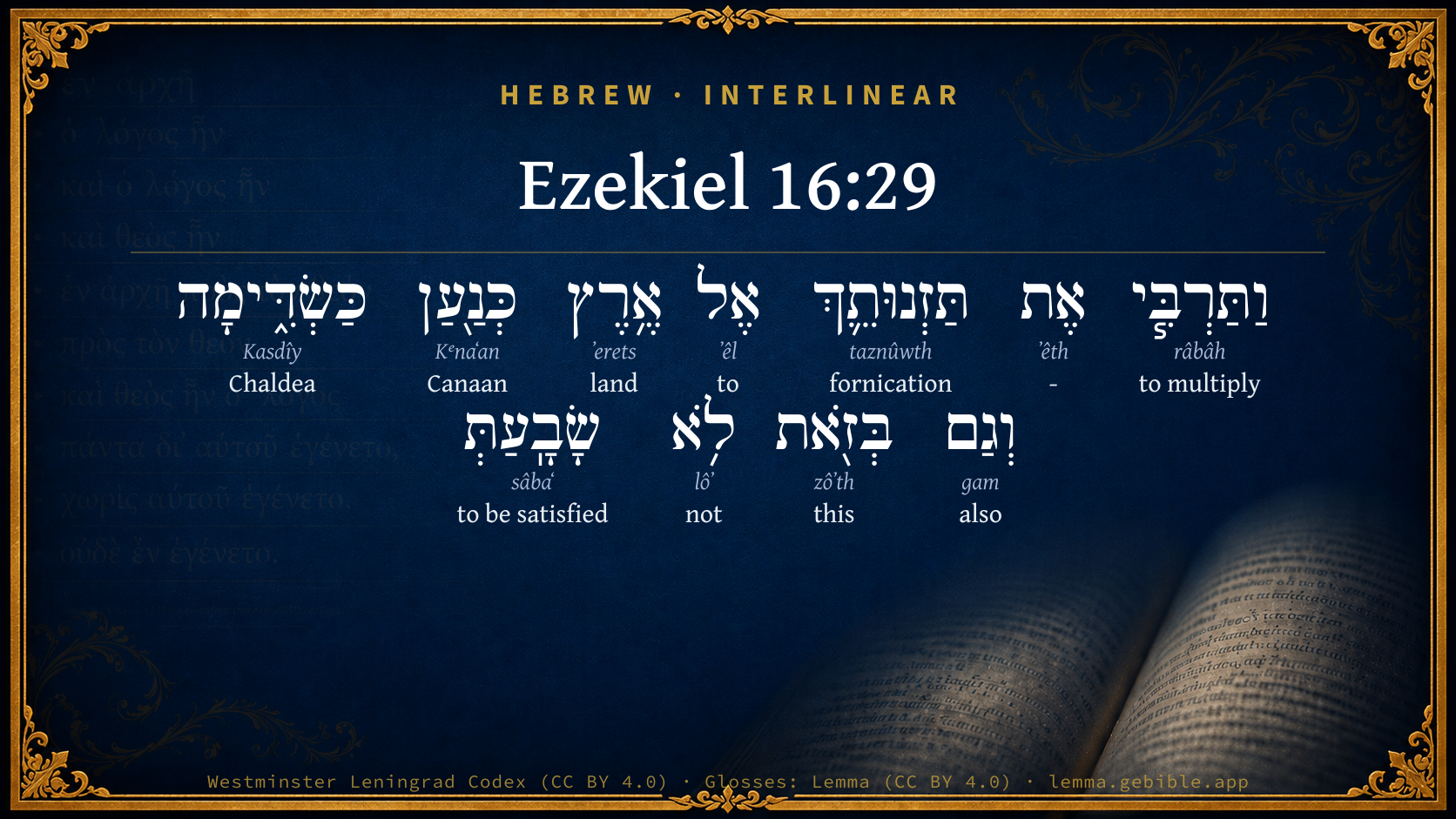
Hebrew (Westminster Leningrad Codex) Ezekiel 16:29 appears in the Hebrew Old Testament. The text above is from the Westminster Leningrad Codex. Each word links to its Strong’s number, a concise gloss, and parsing drawn from the Open Scriptures Hebrew Bible morphology. Click any word for its full Brown-Driver-Briggs (BDB) entry.
Download image
Cite this verse

Ezekiel 16:29 (World English Bible). Public Domain. Lemma interlinear Bible study tool, https://lemma.gebible.app/v/ezekiel/16/29.

Show BibTeX & RIS
BibTeX
RIS
English Translation
You have moreover multiplied your prostitution to the land of merchants, to Chaldea; and yet you weren't satisfied with this.
World English Bible · Public Domain
Download a study sheet

One document with this verse’s original text, its word-by-word gloss line, the meaning frame, cross-references with their text, attributed commentary, and full source and license credits — printable, and it pastes into notes with its structure intact.

This verse Autodidact and up

Study sheet (.html) Plain text (.txt)

A passage Seminary Student

Up to 50 verses in one chapter. A passage sheet keeps up to 6 commentary sources and 12 cross-references per verse, in the order this page ranks them, and says so on the sheet whenever that leaves anything out. Ask for a single verse and you get the Autodidact verse sheet above.

Everything on this page stays free to read, with no account — the sheet is a download of what is already on screen, not access to it.

Want to remove ads? Support Godless Engineer
Compare translations 3

The same verse in 3 English versions, stacked beneath the original-language interlinear above. Click any original word for its lexicon entry.

Each is an independent rendering of the whole verse — the interlinear is not word-aligned to these translations.

Highlighted words mark where these versions differ — a whole-verse word diff, not a word-by-word alignment.

  • World English Bible Public Domain
    You have moreover multiplied your prostitution to the land of merchants, to Chaldea; and yet you weren't satisfied with this.
  • King James Version Public Domain
    Thou hast moreover multiplied thy fornication in the land of Canaan unto Chaldea; and yet thou wast not satisfied therewith.
  • unfoldingWord Literal Text CC BY-SA 4.0
    You performed many more acts of prostitution in the land of the merchants of Chaldea, and even this did not satisfy you.

unfoldingWord Literal Text — © unfoldingWord, licensed CC BY-SA 4.0. Word-aligned USFM3 via Door43 (git.door43.org/unfoldingWord/en_ult).

Versions to compare (up to 4)

3 of 4 selected

Show all 18 translations

Every available English version of this verse, each an independent rendering of the whole verse.

  • World English Bible Public Domain
    You have moreover multiplied your prostitution to the land of merchants, to Chaldea; and yet you weren't satisfied with this.
  • Berean Standard Bible Public Domain
    So you extended your promiscuity to Chaldea, the land of merchants—but even with this you were not satisfied!
  • Majority Standard Bible Public Domain
    So you extended your promiscuity to Chaldea, the land of merchants—but even with this you were not satisfied!
  • King James Version Public Domain
    Thou hast moreover multiplied thy fornication in the land of Canaan unto Chaldea; and yet thou wast not satisfied therewith.
  • American Standard Version (1901) Public Domain
    Thou hast moreover multiplied thy whoredom unto the land of traffic, unto Chaldea; and yet thou wast not satisfied herewith.
  • Revised Version (1885) Public Domain
    Thou hast moreover multiplied thy whoredom in the land of Canaan, unto Chaldea; and yet thou wast not satisfied herewith.
  • Geneva Bible (1599) Public Domain
    Thou hast moreouer multiplied thy fornication from the land of Canaan vnto Caldea, and yet thou wast not satisfied herewith.
  • Douay-Rheims (1899) Public Domain
    Thou hast also multiplied thy fornications in the land of Chanaan with the Chaldeans: and neither so wast then satisfied.
  • Young's Literal Translation Public Domain
    And thou dost multiply thy whoredoms On the land of Canaan -- toward Chaldea, And even with this thou hast not been satisfied.
  • Literal Standard Version CC BY-SA 4.0
    And you multiply your whoredoms || On the land of Canaan—toward Chaldea, || And even with this you have not been satisfied.
  • Unlocked Literal Bible CC BY-SA 4.0
    You performed many more acts of prostitution in the land of the merchants of Chaldea, and even this did not satisfy you.
  • unfoldingWord Literal Text CC BY-SA 4.0
    You performed many more acts of prostitution in the land of the merchants of Chaldea, and even this did not satisfy you.
  • Darby Bible Public Domain
    And thou didst multiply thy whoredom with the land of merchants, Chaldea, and yet thou wast not satisfied herewith.
  • World Messianic Bible Public Domain
    You have moreover multiplied your prostitution to the land of merchants, to Kasdimah; and yet you weren’t satisfied with this.
  • Webster's Bible Public Domain
    Thou hast moreover multiplied thy fornication in the land of Canaan to Chaldea; and yet with this thou wast not satisfied.
  • Free Bible Version CC BY-SA 4.0
    So you took your promiscuous behavior to Babylonia, the country of merchants, but even then you weren't satisfied!
  • Bible in Basic English Public Domain
    And you went on in your loose ways, even as far as the land of Chaldaea, and still you had not enough.
  • JPS Tanakh (1917) Public Domain
    Thou hast moreover multiplied thy harlotry with the land of traffic, even with Chaldea; and yet thou didst not have enough herewith.

Literal Standard Version (2020), Covenant Press — licensed CC BY-SA 4.0. Text via the HelloAO Bible API (eBible.org). Unlocked Literal Bible (unfoldingWord) — licensed CC BY-SA 4.0. Text via the HelloAO Bible API (eBible.org). unfoldingWord Literal Text — © unfoldingWord, licensed CC BY-SA 4.0. Word-aligned USFM3 via Door43 (git.door43.org/unfoldingWord/en_ult). Free Bible Version, Dr. Jonathan Gallagher — licensed CC BY-SA 4.0. Text via the HelloAO Bible API (eBible.org).

Word by word

More ways to search: Search by grammar → Find every occurrence → Compare this word →

Practice this passage: Drill this verse → Learn its vocabulary →

תַּזְנוּתֵ֛ךְ
taznûwth
H8457
“fornication · your”
Noun, Common, Feminine, Singular, Construct + Suffix, Personal, 2nd Person, Feminine, Singular
Part of Speech
Noun
Type
Common
Gender
Feminine
Number
Singular
State
Construct
Full BDB Definition

Origin: from H2181

TWOT: 563c

fornication, harlotry
  1. וַתַּרְבִּ֧י râbâh H7235 “and · to multiply” Conjunction + Verb, Hiphil, Sequential Imperfect, 2nd Person, Feminine, Singular
  2. אֶת ʼêth H853 “-” Particle, Direct Object
  3. אֶל ʼêl H413 “to” Preposition
  4. אֶ֥רֶץ ʼerets H776 “land of” Noun, Common, Both, Singular, Construct
  5. כְּנַ֖עַן Kᵉnaʻan H3667 “Canaan” Noun, Proper
  6. כַּשְׂדִּ֑ימָה Kasdîy H3778 “Chaldea · toward” Noun, Proper + Suffix, Demonstrative
  7. וְגַם gam H1571 “and · also” Conjunction + Particle, Accusative
  8. בְּזֹ֖את zôʼth H2063 “in/at · this” Preposition + Pronoun, Demonstrative, Feminine, Singular
  9. לֹ֥א lôʼ H3808 “not” Particle, Negative
  10. שָׂבָֽעַתְּ sâbaʻ H7646 “to be satisfied” Verb, Qal, Perfect, 2nd Person, Feminine, Singular

About this verse

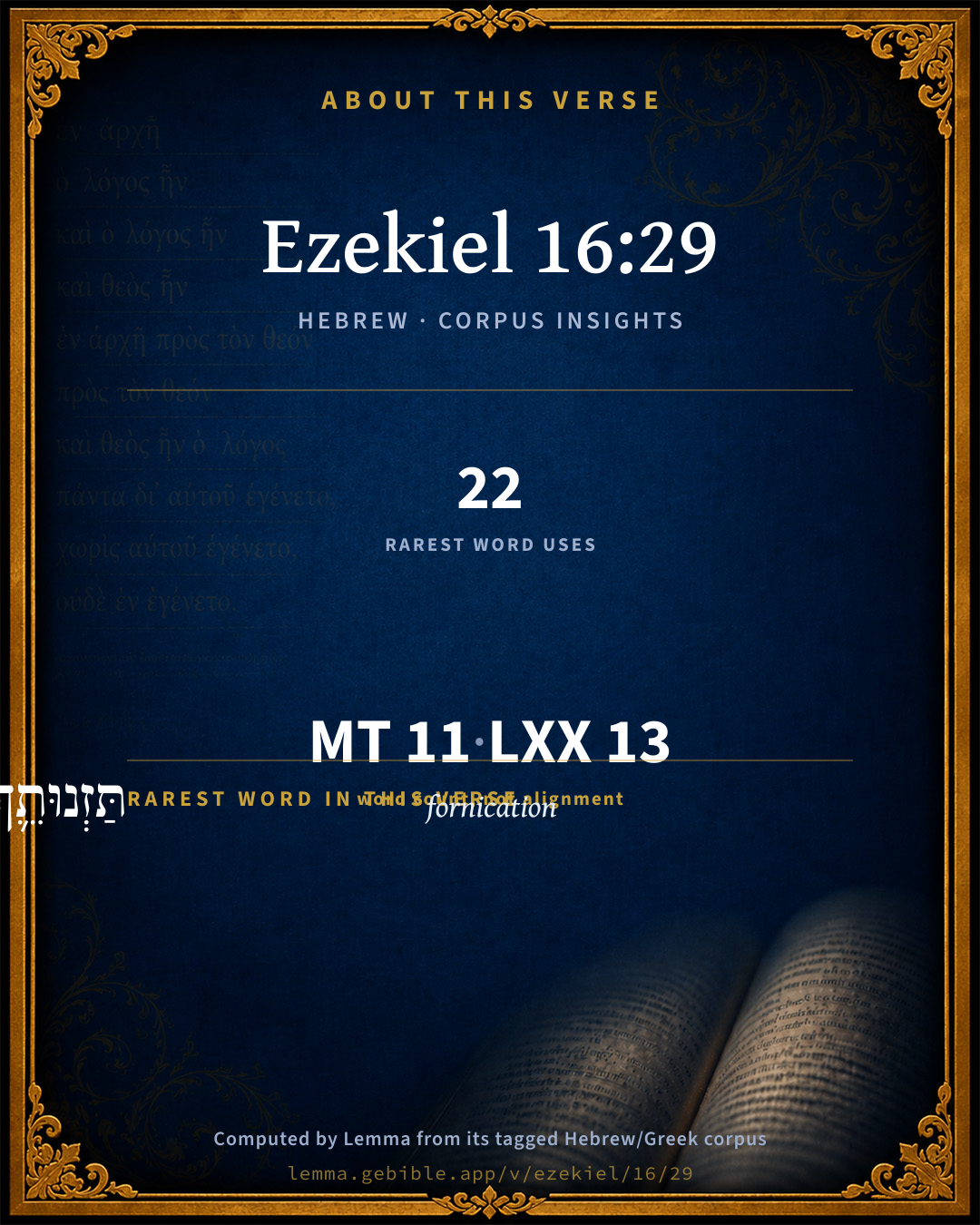
These counts appear in no published source. They are computed here, from the morphology-tagged text and Lemma’s own curated glosses. What Lemma adds →

11
words
11
distinct lemmas
Prophets
section

Notable vocabulary

The rarest word here is תַּזְנוּתֵ֛ךְ fornication H8457 — appearing just 22 times in the whole Hebrew Bible.

Shared distinctive vocabulary

תַּזְנוּתֵ֛ךְ fornication H8457 occurs in 19 verses of the Hebrew Bible. Also found in:

Grammatical profile

  • 2 verbs
  • 4 nouns
  • 1 pronoun
  • 1 preposition
  • 3 particles

Verb forms

  • וַתַּרְבִּ֧י Hiphil · Sequential Imperfect
  • שָׂבָֽעַתְּ Qal · Perfect

Hebrew & Septuagint length

In English translation the verse runs 20 words from the Hebrew and 20 from the Septuagint (LXX English) — the same length.

A rough comparison of the two English renderings, which tokenize alike — not a word-level alignment.

Word counts can differ between the Hebrew and the Greek without any difference in meaning — e.g. the Hebrew direct-object marker אֵת has no separate Greek word, and Greek often adds the article ὁ.

In the original languages it is 11 Hebrew tokens and 13 Greek tokens — but the two are counted differently (Hebrew bundles its prefixes and suffixes into one token; the Greek is in lemma form), so that isn’t a like-for-like length.

Cross-references

4

Topical passages linked to Ezekiel 16:29 in the Treasury of Scripture Knowledge — connected by theme and wording, ordered by reader-vote popularity; previews shown in the World English Bible.

  • Judges 2:12–19 and they forsook Yahweh, the God of their fathers, who brought them out of the land of Egypt, and followed other gods, of the gods of the peoples who were round about them, and bowed themselves down to them: and they provoked Yahweh to anger.
  • 2 Kings 21:9 But they didn't listen: and Manasseh seduced them to do that which is evil more than did the nations whom Yahweh destroyed before the children of Israel.
  • Ezekiel 13:14–23 So will I break down the wall that you have daubed with whitewash, and bring it down to the ground, so that the foundation of it shall be uncovered; and it shall fall, and you shall be consumed in the midst of it: and you shall know that I am Yahweh.
  • Ezekiel 23:14–21 She increased her prostitution; for she saw men portrayed on the wall, the images of the Chaldeans portrayed with vermilion,

Cross-references courtesy of OpenBible.info (CC BY 4.0).

Hebrew and Greek witnesses Masoretic Hebrew ↔ Greek Septuagint

The same verse in the two great witnesses to the Old Testament, shown verse-for-verse.

These are two independent witnesses, not word-aligned to each other, and the Septuagint is shown in lemma (dictionary) form.

Hebrew Ezekiel 16:29 Masoretic · Westminster Leningrad Codex

וַתַּרְבִּ֧י אֶת תַּזְנוּתֵ֛ךְ אֶל אֶ֥רֶץ כְּנַ֖עַן כַּשְׂדִּ֑ימָה וְגַם בְּזֹ֖את לֹ֥א שָׂבָֽעַתְּ

You have moreover multiplied your prostitution to the land of merchants, to Chaldea; and yet you weren't satisfied with this.

World English Bible · Public Domain

Greek LXX Ezekiel 16:29 Septuagint · lemma form

καί πληθύνω ὁ διαθήκη σύ πρός γῆ χαλδαῖος καί οὐδέ ἐν οὗτος ἐνπίμπλημι

And you did multiply your covenants with the land of the Chaldeans; and not even with these was you satisfied.

LXX2012 (modern English Septuagint) · Public Domain

Hebrew: Westminster Leningrad Codex (CC BY 4.0). Greek: Septuagint (public domain); English from LXX2012 (modern English Septuagint) (Public Domain). How the Septuagint differs from the Hebrew →

Targum (Aramaic paraphrase)

1

The Targum is the ancient Jewish Aramaic paraphrase of the Hebrew Scriptures — an interpretive translation, not the Hebrew text itself. Onkelos (literal) and Pseudo-Jonathan (expansive) render the Torah, and Jonathan the Prophets. Coverage is partial: where no permissively-licensed English translation exists for a verse, only the Aramaic is shown. This is verse-level text, not a word-by-word alignment to the Hebrew.

  1. Targum Jonathan Prophets (Joshua–Malachi)
    וְאַסְגֵית יַת טַעֲוָתַיִךְ לְאִתְחַבָּרָא לְעַמָא דִכְנַעַן לִמְהַךְ בְּנִימוּסֵי כַּסְדָאֵי וְאַף בְּדָא לָא יְדַעַתְּ אוֹרַיְתָא:

    (no public-domain English translation for this verse)

    Targum Jonathan — Aramaic: “Mikraot Gedolot” (public domain). English: “Sefaria Community Translation” (CC0 1.0 (public-domain dedication)); “London "Chaldee Paraphrase," 1871” (public domain). Text via Sefaria.

Commentary

Notes on Ezekiel 16:29 from classic Christian and Jewish commentators (each source and its license shown beneath its notes). The classic Christian expositions comment on the surrounding passage and are grouped to its opening verse, so a note may address several verses; the Jewish commentaries on the Tanakh (Rashi and others) are per-verse, so they appear only where the commentator wrote on this verse.

Lemma curates 59 commentaries, every one of them public domain or Creative Commons licensed, each selected and text-cleaned for this edition rather than reprinted as found. About our sources →

Trapp's Complete Commentary

John Trapp

Eze 16:29 Thou hast moreover multiplied thy fornication in the land of Canaan unto Chaldea; and yet thou wast not satisfied herewith.

Ver. 29. In the land of Canaan.] Thou hast lived in my good land, but not by my good laws.

And yet thou wast not satisfied.] See on Eze 16:28.

John Trapp, A Commentary or Exposition upon All the Books of the Old and New Testament (1647–1656) — public domain. Text from a community e-Sword module.

Jamieson, Fausset & Brown

Robert Jamieson, A. R. Fausset & David Brown

multiplied . . . fornication in . . . Canaan unto Chaldea--Thou hast multiplied thy idolatries "in Canaan" by sending "unto Chaldea" to borrow from thence the Chaldean rites, to add to the abominations already practised "in Canaan," before the carrying away of Jehoiachin to Chaldea. The name "Canaan" is used to imply that they had made Judea as much the scene of abominations as it was in the days of the corrupt Canaanites. The land had become utterly Canaanitish (Eze 23:14, &c.).

Jamieson, Fausset & Brown — Commentary Critical and Explanatory on the Whole Bible (1871) — public domain (CC PDM 1.0). Text via the HelloAO Bible API.

John Calvin's Commentaries

Here the Prophet teaches that the Jews were immoderate in their desires, just as if a woman was not satisfied with two or three followers, should wantonly crave after many lovers: such, says the Prophet, was the Jews’ licentiousness. As to his saying, over the land of Canaan in Chaldaea, some think it means, that they heaped up the impure rites of all the nations, and not only defiled themselves with the ancient. idolatries of the nations of Canaan, but imitated the Chaldaeans in their impiety. Others say in Chaldea, which is next to the land of Canaan; but this comment, like the last, is too forced: others take אל, al, comparatively, for “through” the land of Canaan. But I only understand it as a particle expressing likeness, thus, you have multiplied thy pollution’s in Chaldaea just as in the land of Canaan. It is not surprising if they defiled themselves with their neighbors, as the Prophet had formerly said they did with the Egyptians, but when they ran about to a remote region of the world, this indeed was most remarkable. This then seems the real sense, and it reads best, that they increased their defilement in Chaldaea as in the land of Canaan. For if a female meets with a stranger she may act sinfully without so much disgrace, but when she runs about to a distance to seek followers, this proves her most abandoned. I have no doubt that the Prophet here exaggerates the people’s crimes by comparison, since they penetrated even to the Chaldaeans to pollute themselves among them. He says that the Jews were not satisfied even with this, using the same expression as when treating of the Assyrians. The sum of the whole is, that the Jews were seized with such a furious impulse that they manifested no moderation in their wickedness. For they had not revolted from God once only, or in one direction: but wherever occasion offered, they were accustomed to seize it too eagerly, so that they showed in this way that not even a drop of piety remained in their minds. Let us learn then from this passage to put the bridle on cur lusts in time: for when the fire is lighted up, it is not easily extinguished, and the devil is always supplying wood or adding oil to the furnace, as the phrase is. Let us then prevent the evil which is here condemned in the Jews, and let us restrain ourselves, lest the devil seize upon us with insane fury. It follows —

John Calvin's Commentaries (1540-1563) — public domain. Text from the Calvin Translation Society English edition (1840s-50s) via the Christian Classics Ethereal Library (ccel.org). Calvin's coverage is partial (roughly two-thirds of the Bible); uncommented books and verses are honest gaps, never fabricated. The 19th-century editor's footnotes and remarks are omitted so the notes are faithfully Calvin's own voice.

Ellicott's Commentary for English Readers

(29) In the land of Canaan unto Chaldæa.—Canaan was originally the name of only that strip of land between the hills and the sea occupied by the Phœnicians, in other words, the lowlands. Thence it became extended over the whole land. It is thought by some writers to revert here to its original meaning, and be equivalent to the low, flat land. The expression will become clearer if translated, “the Canaan land Chaldaea.” The word, however, bears also the meaning of traffic, commerce (Isa_23:8; Hos_12:7; Zep_1:11), and in this sense is applied to Babylon in Eze_17:4, and this is the better meaning here. The idea will then be that Israel, beginning its idolatries in the actual Canaan, had extended them along with her commercial intercourse on every side, until at last she had carried them even to Chaldæa, the great commercial emporium of the time.

A Bible Commentary for English Readers, edited by Charles John Ellicott (1878–1897) — public domain. Text from a community e-Sword module.

The Cambridge Bible for Schools and Colleges

gen. ed. J. J. S. Perowne

29. Infidelities with the Chaldeans. Past tense is better: didst multiply.

in the land of Canaan] Rather: with (lit. unto) the merchants’ land, even Chaldea. Again ch. Eze_17:4, the land of traffic. With similar contempt Hosea (Eze_12:7) uses the term of Israel. Cf. Pro_31:24; Isa_47:15.

The Cambridge Bible for Schools and Colleges (gen. ed. J. J. S. Perowne; Cambridge University Press, 1878–1918) — public domain. Text from a community e-Sword module.

John Gill's Exposition

How weak is thine heart, saith the Lord God,.... Through sin; and being destitute of the grace of God, and so unable to resist any temptation, or oppose any corruption or lust, but carried away with everyone that offers; indulging every lust, and yet not satisfied; weak as water, unstable, fickle, and inconstant, seeking after new gods, and new kinds of worship. The Targum is,

"how strong is the wickedness of thy heart!''

the stronger the wickedness of the heart, the weaker, the heart is:

seeing thou doest all these things; all the idolatries before mentioned; which was an argument not of her strength, but weakness, and yet of boldness, impudence, and resolution, to have her will:

the work of an imperious whorish woman; a whore, as she is impudent, is imperious, is one that rules and governs. The Targum is, who rules over herself; does what she pleases, will have her will and way, and cannot bear any contradiction; and who rules over others, such as are her gallants, obliging them to do as she commands. Jarchi's note is,

"over whom her imagination (or corruption) rules.''

John Gill's Exposition of the Whole Bible (1746–1763) — public domain (CC PDM 1.0). Text via the HelloAO Bible API.

Albert Barnes' Notes on the Bible

In the land ... - Probably used in the restricted sense of the low lands on the coast of the western sea; occupied by Phoenician colonies. The children of Israel were brought into contact at first with pagans residing within their own borders. Then they extended their contact to foreign nations, trading and forming alliances with Chaldaea, and in so doing were attracted by the idolatries of those with whom they carried on commerce. Some render it: “with the merchants’ land, even with Chaldaea.” Compare Eze 17:4.

Albert Barnes' Notes on the Bible (1834–1885) — public domain. Text from a community e-Sword/MySword module.

Matthew Poole's English Annotations

Multiplied; both increased the number of thy idolatries, and made them greater, in that thou hast adopted the idols of Canaan, and all that between them and the Chaldeans are owned or worshipped.

In the land; the Hebrew may be read

towards as well as

in. The idolatry of the Jews worshipping Canaan’s idols was most intolerable, because God had so fully declared the vileness of it, and his abhorrence thereof, and so strictly charged the Jews to keep themselves from it. How monstrously wicked is it, that in prosperity, and possessing the houses and wealth which thy God gave thee out of the hands of the Canaanites and their idols, thou forgettest God, and worshippest their idols; and in adversity and captivity doest the like, and detest on the idols of thine enemies!

Matthew Poole's English Annotations on the Holy Bible (1683–1685) — public domain. Text from a community e-Sword/MySword module.

The Pulpit Commentary

In the land of Canaan, etc. The words at first seem to give the nearest and furthest points of the intercourse of Israel with foreign nations. I incline, however, with Smend and the margin of the Revised Version, to take Canaan in its secondary sense as "the land of traffick," Chaldea being in apposition with it, (comp. Isa_23:8; Hos_12:7; Zep_1:11) for a like use of the Hebrew word) Chaldea thus comes in its right place as closing the list of the nations with whom the harlot city had been unfaithful.

The Pulpit Commentary (1880–1919), ed. H.D.M. Spence-Jones & Joseph S. Exell — public domain. Text from a community e-Sword module.

Rashi

Rabbi Shlomo Yitzchaki (Rashi)

with the land of Canaan, with the Chaldeans The Chaldeans were not from the land of Canaan, but this is its meaning: You added the images of the Chaldeans to those of the Canaanites, who were near you, and you played the harlot with them. However Jonathan rendered: You increased your harlotries with the Chaldeans and You became like the Canaanites, who were steeped in idolatry, and you increased your gods, joining the people of Canaan who follow the customs of the Chaldeans. But to me it appears that כְּנַעַן is like סוֹחֵר, a merchant, like (Hosea 12:8): “A trafficker (כְּנַעַן) who has deceitful scales in his hand.” He thus calls the land of the Chaldeans the land of the merchants, as it is said [concerning Babylon, too,] (17:4): “and he brought it to the land of merchants (כְּנַעַן), in a city of traffickers he placed it.”

Rashi on the Tanakh — English translations: “The Judaica Press complete Tanach with Rashi, translated by A. J. Rosenberg” (CC BY 4.0); “Pentateuch with Rashi's commentary by M. Rosenbaum and A.M. Silbermann, 1929-1934” (public domain); “The Metsudah Tanach series, Lakewood, N.J” (CC BY 4.0); and “The Book of Joshua, Metsudah Publications, 1997” (CC BY 4.0). Text via Sefaria.

Lesson kit

Teaching starters — assembled from the data on this page, not authored interpretation. Every prompt links to the verse data it draws on. Edit before teaching.

Ezekiel, in the Prophets, opens this verse with 11 words (11 distinct Hebrew lemmas). Its most distinctive word is taznûwth (“fornication”). A historical commentator’s framing appears above. Read the whole chapter for the surrounding context.

Discussion questions

  1. What does “fornication” (taznûwth) contribute to the verse as a whole?
  2. How does Ezekiel 16:15, which shares the word «fornication», read alongside this verse?
  3. These translations render this verse differently; the difference is in the English rendering, not the original. What questions does that raise?
  4. «וַתַּרְבִּ֧י» is a Hiphil Sequential Imperfect verb. How does that grammatical form shape the action described?
  5. Compare how Trapp's Complete Commentary and Jamieson, Fausset & Brown read this verse. Where do they agree or differ?

Things to notice

Reading settings

Reading text

Shown beneath each verse's original-language words.

Old Testament
Old Testament edition

Read the OT as the Masoretic Hebrew (MT) or the Greek Septuagint (LXX).

English shown for the Greek Septuagint (in the Hebrew ↔ Greek comparison).

Comparing translations? Open the Compare panel on any verse page to stack up to four side by side.