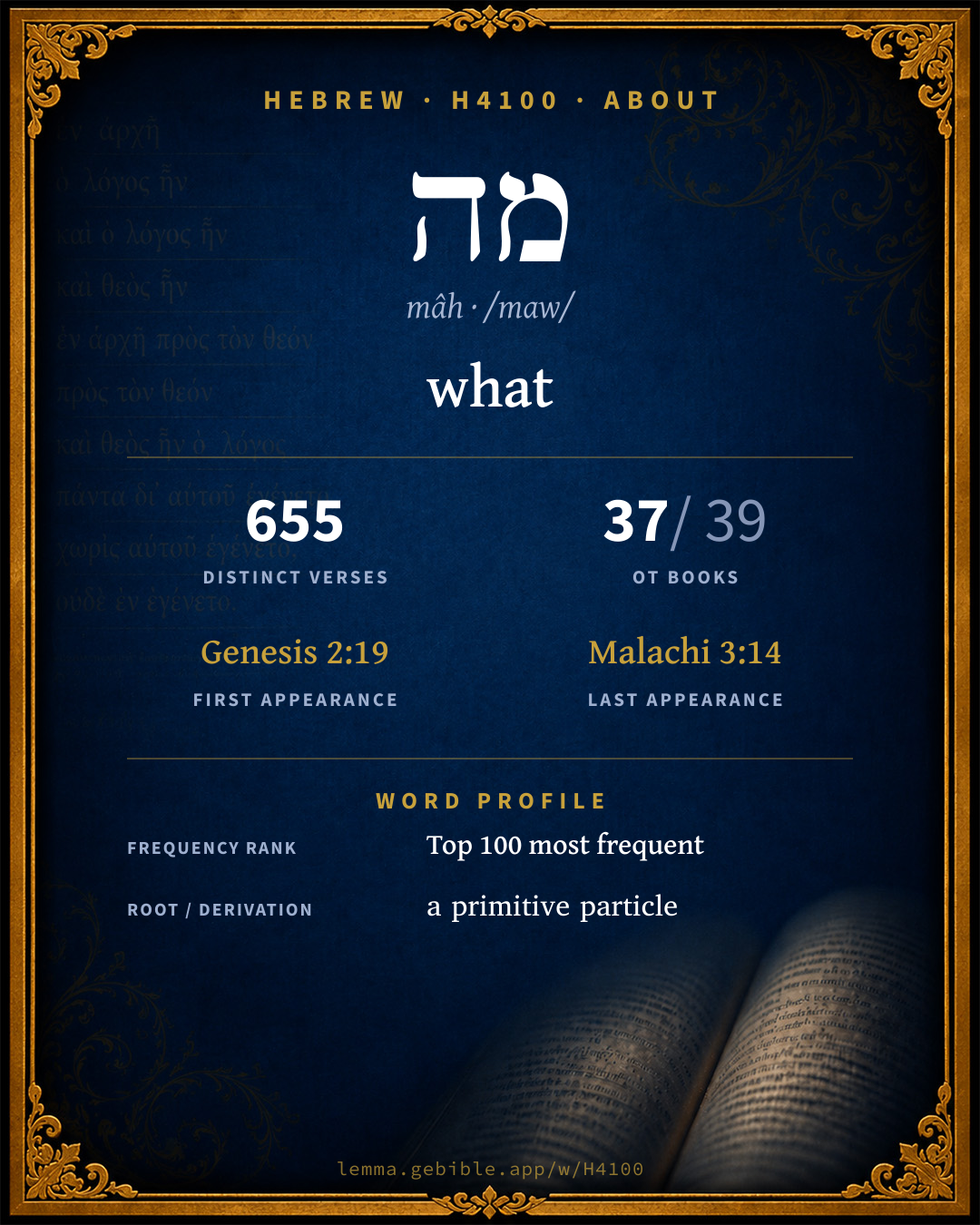
מָה
what
also: how, of what kind fuller range ↓
Full lexicon entry — Brown-Driver-Briggs (BDB)
From Brown-Driver-Briggs (BDB)
Where this word appears
Grammar key — what these labels mean
Part of speech
- Particle
- A short function word — article, negation, interrogative, the sign of the direct object, and the like.
Grammatical forms
- Particle, Interrogative 749 times (100%)
- Pronoun, Relative 1 time (0%)
Parsed forms decoded from the imported morphology (morphhb / Westminster Leningrad Codex — WLC text public domain, morphhb tagging CC BY 4.0), counted across 750 parsed occurrences — not distinct verses.
Page 3 of 4 — showing verses 401–600 of 655 distinct verses where H4100 appears, across 37 books. Click any verse to open its interlinear word-by-word view. Verse text shown in the World English Bible for context — . Each verse’s Hebrew form is shown with its reference; the English is not keyword-highlighted, since the data carries no word-level English alignment. Use “Compare translations” on any verse to read it across multiple English versions. This concordance covers the Hebrew Bible; Septuagint (Greek Old Testament) occurrences are not indexed here.
Job 51 verses
Psalms 57 verses
- Psalms 2:1 לָ֭/מָּה prep + ptcl inter Why do the nations rage, And the peoples plot a vain thing?
- Psalms 3:1 מָֽה ptcl inter Yahweh, how my adversaries have increased! Many are those who rise up against me.
- Psalms 4:2 מֶ֬ה ptcl inter You sons of men, how long shall my glory be turned into dishonor? Will you love vanity, and seek after falsehood? Selah.
- Psalms 8:1 מָֽה ptcl inter Yahweh, our Lord, how majestic is your name in all the earth, Who has set your glory above the heavens!
- Psalms 8:4 מָֽה ptcl inter What is man, that you think of him? The son of man, that you care for him?
- Psalms 8:9 מָֽה ptcl inter Yahweh, our Lord, How majestic is your name in all the earth!
- Psalms 10:1 לָ/מָ֣ה prep + ptcl inter Why do you stand far off, Yahweh? Why do you hide yourself in times of trouble?
- Psalms 10:13 מֶ֤ה ptcl inter Why does the wicked person condemn God, And say in his heart, "God won't call me into account?"
- Psalms 11:3 מַה ptcl inter If the foundations are destroyed, What can the righteous do?
- Psalms 21:1 מַה ptcl inter The king rejoices in your strength, Yahweh! How greatly he rejoices in your salvation!
- Psalms 22:1 לָ/מָ֣ה prep + ptcl inter My God, my God, why have you forsaken me? Why are you so far from helping me, and from the words of my groaning?
- Psalms 30:9 מַה ptcl inter "What profit is there in my destruction, if I go down to the pit? Shall the dust praise you? Shall it declare your truth?
- Psalms 31:19 מָ֤ה ptcl inter Oh how great is your goodness, Which you have laid up for those who fear you, Which you have worked for those who take refuge in you, Before the sons of men!
- Psalms 35:17 כַּ/מָּ֪ה prep + ptcl inter Lord, how long will you look on? Rescue my soul from their destruction, My precious life from the lions.
- Psalms 36:7 מַה ptcl inter How precious is your loving kindness, God! The children of men take refuge under the shadow of your wings.
- Psalms 39:4 מַה מֶה ptcl inter ptcl inter "Yahweh, show me my end, What is the measure of my days. Let me know how frail I am.
- Psalms 39:7 מַה ptcl inter Now, Lord, what do I wait for? My hope is in you.
- Psalms 42:5 מַה ptcl inter Why are you in despair, my soul? Why are you disturbed within me? Hope in God! For I shall still praise him for the saving help of his presence.
- Psalms 42:9 לָ/מָ֪ה לָֽ/מָּה prep + ptcl inter prep + ptcl inter I will ask God, my rock, "Why have you forgotten me? Why do I go mourning because of the oppression of the enemy?"
- Psalms 42:11 מַה וּֽ/מַה ptcl inter conj + ptcl inter Why are you in despair, my soul? Why are you disturbed within me? Hope in God! For I shall still praise him, The saving help of my countenance, and my God.
- Psalms 43:2 לָ/מָ֪ה לָֽ/מָּה prep + ptcl inter prep + ptcl inter For you are the God of my strength. Why have you rejected me? Why do I go mourning because of the oppression of the enemy?
- Psalms 43:5 מַה וּֽ/מַה ptcl inter conj + ptcl inter Why are you in despair, my soul? Why are you disturbed within me? Hope in God! For I shall still praise him: My Savior, my helper, and my God.
- Psalms 44:23 לָ֖/מָּה prep + ptcl inter Wake up! Why do you sleep, Lord? Arise! Don't reject us forever.
- Psalms 44:24 לָֽ/מָּה prep + ptcl inter Why do you hide your face, And forget our affliction and our oppression?
- Psalms 49:5 לָ֣/מָּה prep + ptcl inter Why should I fear in the days of evil, When iniquity at my heels surrounds me?
- Psalms 50:16 מַה ptcl inter But to the wicked God says, "What right do you have to declare my statutes, That you have taken my covenant on your lips,
- Psalms 52:1 מַה ptcl inter Why do you boast of mischief, mighty man? God's loving kindness endures continually.
- Psalms 56:4 מַה ptcl inter In God, I praise his word. In God, I put my trust. I will not be afraid. What can flesh do to me?
- Psalms 56:11 מַה ptcl inter I have put my trust in God. I will not be afraid. What can man do to me?
- Psalms 66:3 מַה ptcl inter Tell God, "How awesome are your deeds! Through the greatness of your power, your enemies submit themselves to you.
- Psalms 68:16 לָ֤/מָּה prep + ptcl inter Why do you look in envy, you rugged mountains, At the mountain where God chooses to reign? Yes, Yahweh will dwell there forever.
- Psalms 74:1 לָ/מָ֣ה prep + ptcl inter God, why have you rejected us forever? Why does your anger smolder against the sheep of your pasture?
- Psalms 74:9 מָֽה ptcl inter We see no miraculous signs. There is no longer any prophet, Neither is there among us anyone who knows how long.
- Psalms 74:11 לָ֤/מָּה prep + ptcl inter Why do you draw back your hand, even your right hand? Take it out of your pocket and consume them!
- Psalms 78:40 כַּ֭/מָּה prep + ptcl inter How often they rebelled against him in the wilderness, And grieved him in the desert!
- Psalms 79:5 מָ֣ה ptcl inter How long, Yahweh? Will you be angry forever? Will your jealousy burn like fire?
- Psalms 79:10 לָ֤/מָּה prep + ptcl inter Why should the nations say, "Where is their God?" Let it be known among the nations, before our eyes, That vengeance for your servants' blood is being poured out.
- Psalms 80:12 לָ֭/מָּה prep + ptcl inter Why have you broken down its walls, So that all those who pass by the way pluck it?
- Psalms 84:1 מַה ptcl inter How lovely are your dwellings, Yahweh of Hosts!
- Psalms 85:8 מַה ptcl inter I will hear what God, Yahweh, will speak, For he will speak peace to his people, his saints; But let them not turn again to folly.
- Psalms 88:14 לָ/מָ֣ה prep + ptcl inter Yahweh, why do you reject my soul? Why do you hide your face from me?
- Psalms 89:46 מָ֣ה ptcl inter How long, Yahweh? Will you hide yourself forever? Will your wrath burn like fire?
- Psalms 89:47 מֶה מַה ptcl inter ptcl inter Remember how short my time is! For what vanity have you created all the children of men!
- Psalms 92:5 מַה ptcl inter How great are your works, Yahweh! Your thoughts are very deep.
- Psalms 104:24 מָֽה ptcl inter Yahweh, how many are your works! In wisdom have you made them all. The earth is full of your riches.
- Psalms 114:5 מַה ptcl inter What was it, you sea, that you fled? You Jordan, that you turned back?
- Psalms 115:2 לָ֭/מָּה prep + ptcl inter Why should the nations say, "Where is their God, now?"
- Psalms 116:12 מָֽה ptcl inter What will I give to Yahweh for all his benefits toward me?
- Psalms 118:6 מַה ptcl inter Yahweh is on my side. I will not be afraid. What can man do to me?
- Psalms 119:9 בַּ/מֶּ֣ה prep + ptcl inter How can a young man keep his way pure? By living according to your word.
- Psalms 119:84 כַּ/מָּ֥ה prep + ptcl inter How many are the days of your servant? When will you execute judgment on those who persecute me?
- Psalms 119:97 מָֽה ptcl inter How love I your law! It is my meditation all day.
- Psalms 119:103 מַה ptcl inter How sweet are your promises to my taste, More than honey to my mouth!
- Psalms 120:3 מַה וּ/מַה ptcl inter conj + ptcl inter What will be given to you, and what will be done more to you, You deceitful tongue?
- Psalms 133:1 מַה וּ/מַה ptcl inter conj + ptcl inter See how good and how pleasant it is For brothers to live together in unity!
- Psalms 139:17 מַה מֶ֥ה ptcl inter ptcl inter How precious to me are your thoughts, God! How vast is the sum of them!
- Psalms 144:3 מָה ptcl inter Yahweh, what is man, that you care for him? Or the son of man, that you think of him?
Proverbs 13 verses
- Proverbs 4:19 בַּ/מֶּ֥ה prep + ptcl inter The way of the wicked is like darkness. They don't know what they stumble over.
- Proverbs 5:20 וְ/לָ֤/מָּה conj + prep + ptcl inter For why should you, my son, be captivated with an adulteress? Why embrace the bosom of another?
- Proverbs 9:13 מָּֽה ptcl inter The foolish woman is loud, Undisciplined, and knows nothing.
- Proverbs 15:23 מַה ptcl inter Joy comes to a man with the reply of his mouth. How good is a word at the right time!
- Proverbs 16:16 מַה ptcl inter How much better it is to get wisdom than gold! Yes, to get understanding is to be chosen rather than silver.
- Proverbs 17:16 לָ/מָּה prep + ptcl inter Why is there money in the hand of a fool to buy wisdom, Seeing he has no understanding?
- Proverbs 20:24 מַה ptcl inter A man's steps are from Yahweh; How then can man understand his way?
- Proverbs 22:27 לָ֥/מָּה prep + ptcl inter If you don't have means to pay, Why should he take away your bed from under you?
- Proverbs 25:8 מַה ptcl inter Don't be hasty in bringing charges to court. What will you do in the end when your neighbor shames you?
- Proverbs 27:1 מַה ptcl inter Don't boast about tomorrow; For you don't know what a day may bring forth.
- Proverbs 30:4 מַה וּ/מַֽה ptcl inter conj + ptcl inter Who has ascended up into heaven, and descended? Who has gathered the wind in his fists? Who has bound the waters in his garment? Who has established all the ends of the earth? What is his name, and what is his son's name, if you know?
- Proverbs 30:13 מָה ptcl inter There is a generation, oh how lofty are their eyes! Their eyelids are lifted up.
- Proverbs 31:2 מַה וּ/מַֽה וּ֝/מֶה ptcl inter conj + ptcl inter conj + ptcl inter "Oh, my son!" Oh, son of my womb! Oh, son of my vows!
Ecclesiastes 25 verses
- Ecclesiastes 1:3 מַה ptcl inter What does man gain from all his labor in which he labors under the sun?
- Ecclesiastes 1:9 מַה וּ/מַה ptcl inter conj + ptcl inter That which has been is that which shall be; and that which has been done is that which shall be done: and there is no new thing under the sun.
- Ecclesiastes 2:2 מַה ptcl inter I said of laughter, "It is foolishness;" and of mirth, "What does it accomplish?"
- Ecclesiastes 2:12 מֶ֣ה ptcl inter I turned myself to consider wisdom, madness, and folly: for what can the king's successor do? Just that which has been done long ago.
- Ecclesiastes 2:15 וְ/לָ֧/מָּה conj + prep + ptcl inter Then said I in my heart, "As it happens to the fool, so will it happen even to me; and why was I then more wise?" Then said I in my heart that this also is vanity.
- Ecclesiastes 2:22 מֶֽה ptcl inter For what has a man of all his labor, and of the striving of his heart, in which he labors under the sun?
- Ecclesiastes 3:9 מַה ptcl inter What profit has he who works in that in which he labors?
- Ecclesiastes 3:15 מַה ptcl inter That which is has been long ago, and that which is to be has been long ago: and God seeks again that which is passed away.
- Ecclesiastes 3:22 בְּ/מֶ֖ה prep + ptcl inter Therefore I saw that there is nothing better, than that a man should rejoice in his works; for that is his portion: for who can bring him to see what will be after him?
- Ecclesiastes 5:6 לָ֣/מָּה prep + ptcl inter Don't allow your mouth to lead you into sin. Don't protest before the messenger that this was a mistake. Why should God be angry at your voice, and destroy the work of your hands?
- Ecclesiastes 5:11 וּ/מַה conj + ptcl inter When goods increase, those who eat them are increased; and what advantage is there to its owner, except to feast on them with his eyes?
- Ecclesiastes 5:16 וּ/מַה conj + ptcl inter This also is a grievous evil, that in all points as he came, so shall he go. And what profit does he have who labors for the wind?
- Ecclesiastes 6:8 מַה מַה ptcl inter ptcl inter For what advantage has the wise more than the fool? What has the poor man, that knows how to walk before the living?
- Ecclesiastes 6:10 מַה ptcl inter Whatever has been, its name was given long ago; and it is known what man is; neither can he contend with him who is mightier than he.
- Ecclesiastes 6:11 מַה ptcl inter For there are many words that create vanity. What does that profit man?
- Ecclesiastes 6:12 מַה מַה ptcl inter ptcl inter For who knows what is good for man in life, all the days of his vain life which he spends like a shadow? For who can tell a man what will be after him under the sun?
- Ecclesiastes 7:10 מֶ֣ה ptcl inter Don't say, "Why were the former days better than these?" For you do not ask wisely about this.
- Ecclesiastes 7:16 לָ֖/מָּה prep + ptcl inter Don't be overly righteous, neither make yourself overly wise. Why should you destroy yourself?
- Ecclesiastes 7:17 לָ֥/מָּה prep + ptcl inter Don't be too wicked, neither be foolish. Why should you die before your time?
- Ecclesiastes 7:24 מַה ptcl inter That which is, is far off and exceedingly deep. Who can find it out?
- Ecclesiastes 8:4 מַֽה ptcl inter for the king's word is supreme. Who can say to him, "What are you doing?"
- Ecclesiastes 8:7 מַה ptcl inter For he doesn't know that which will be; for who can tell him how it will be?
- Ecclesiastes 10:14 מַה ptcl inter A fool also multiplies words. Man doesn't know what will be; and that which will be after him, who can tell him?
- Ecclesiastes 11:2 מַה ptcl inter Give a portion to seven, yes, even to eight; For you don't know what evil will be on the earth.
- Ecclesiastes 11:5 מַה ptcl inter As you don't know what is the way of the wind, Nor how the bones grow in the womb of her who is with child; Even so you don't know the work of God who does all.
Song of Solomon 9 verses
- Song of Solomon 1:7 שַׁ/לָּ/מָ֤ה ptcl rel + prep + ptcl inter Tell me, you whom my soul loves, Where you graze your flock, Where you rest them at noon; For why should I be as one who is veiled Beside the flocks of your companions? Lover
- Song of Solomon 4:10 מַה מַה ptcl inter ptcl inter How beautiful is your love, my sister, my bride! How much better is your love than wine! The fragrance of your perfumes than all manner of spices!
- Song of Solomon 5:8 מַה ptcl inter I adjure you, daughters of Jerusalem, If you find my beloved, That you tell him that I am faint with love. Friends
- Song of Solomon 5:9 מַה מַה ptcl inter ptcl inter How is your beloved better than another beloved, You fairest among women? How is your beloved better than another beloved, That you do so adjure us? Beloved
- Song of Solomon 6:13 מַֽה ptcl inter Return, return, Shulammite! Return, return, that we may gaze at you. Lover Why do you desire to gaze at the Shulammite, As at the dance of Mahanaim?
- Song of Solomon 7:1 מַה ptcl inter How beautiful are your feet in sandals, prince's daughter! Your rounded thighs are like jewels, The work of the hands of a skillful workman.
- Song of Solomon 7:6 מַה וּ/מַה ptcl inter conj + ptcl inter How beautiful and how pleasant are you, Love, for delights!
- Song of Solomon 8:4 מַה וּֽ/מַה ptcl inter conj + ptcl inter I adjure you, daughters of Jerusalem, That you not stir up, nor awaken love, Until it so desires. Friends
- Song of Solomon 8:8 מַֽה ptcl inter We have a little sister. She has no breasts. What shall we do for our sister In the day when she is to be spoken for?
Isaiah 27 verses
- Isaiah 1:5 מֶ֥ה ptcl inter Why should you be beaten more, That you revolt more and more? The whole head is sick, And the whole heart faint.
- Isaiah 1:11 לָ/מָּה prep + ptcl inter "What are the multitude of your sacrifices to me?," says Yahweh. "I have had enough of the burnt offerings of rams, And the fat of fed animals. I don't delight in the blood of bulls, Or of lambs, Or of male goats.
- Isaiah 2:22 בַ/מֶּ֥ה prep + ptcl inter Stop trusting in man, whose breath is in his nostrils; For of what account is he?
- Isaiah 3:15 מַה ptcl inter What do you mean that you crush my people, And grind the face of the poor?" says the Lord, Yahweh of Hosts.
- Isaiah 5:4 מַה ptcl inter What could have been done more to my vineyard, that I have not done in it? Why, when I looked for it to yield grapes, did it yield wild grapes?
- Isaiah 10:3 וּ/מַֽה conj + ptcl inter What will you do in the day of visitation, and in the desolation which shall come from far? to whom will you flee for help? and where will you leave your glory?
- Isaiah 14:32 וּ/מַֽה conj + ptcl inter What then shall one answer the messengers of the nation? That Yahweh has founded Zion, and in her shall the afflicted of his people take refuge.
- Isaiah 19:12 מַה ptcl inter Where then are your wise men? and let them tell you now; and let them know what Yahweh of Hosts has purposed concerning Egypt.
- Isaiah 21:11 מַה מַה ptcl inter ptcl inter The burden of Dumah. One calls to me out of Seir, Watchman, what of the night? Watchman, what of the night?
- Isaiah 22:1 מַה ptcl inter The burden of the valley of vision. What ails you now, that you are wholly gone up to the housetops?
- Isaiah 22:16 מַה ptcl inter "What are you doing here? and who has you here, that you have hewed out a tomb here? Cutting him out a tomb on high, chiseling a habitation for himself in the rock!"
- Isaiah 36:4 מָ֧ה ptcl inter Rabshakeh said to them, Say you now to Hezekiah, Thus says the great king, the king of Assyria, What confidence is this in which you trust?
- Isaiah 38:15 מָֽה ptcl inter What shall I say? he has both spoken to me, and himself has done it: I shall go softly all my years because of the bitterness of my soul.
- Isaiah 38:22 מָ֣ה ptcl inter Hezekiah also had said, What is the sign that I shall go up to the house of Yahweh?
- Isaiah 39:3 מָ֥ה ptcl inter Then came Isaiah the prophet to king Hezekiah, and said to him, What said these men? and from whence came they to you? Hezekiah said, They are come from a far country to me, even from Babylon.
- Isaiah 39:4 מָ֥ה ptcl inter Then said he, What have they seen in your house? Hezekiah answered, All that is in my house have they seen: there is nothing among my treasures that I have not shown them.
- Isaiah 40:6 מָ֣ה ptcl inter The voice of one saying, Cry. One said, What shall I cry? All flesh is grass, and all the glory of it is as the flower of the field.
- Isaiah 40:18 וּ/מַה conj + ptcl inter To whom then will you liken God? or what likeness will you compare to him?
- Isaiah 40:27 לָ֤/מָּה prep + ptcl inter Why say you, Jacob, and speak, Israel, My way is hid from Yahweh, and the justice [due] to me is passed away from my God?
- Isaiah 41:22 מָ֣ה ptcl inter Let them bring forth, and declare to us what shall happen: declare you the former things, what they are, that we may consider them, and know the latter end of them; or show us things to come.
- Isaiah 45:9 מַֽה ptcl inter Woe to him who strives with his Maker--a potsherd among the potsherds of the earth! Shall the clay ask him who fashions it, "What are you making?" or your work, "He has no hands?"
- Isaiah 45:10 מַה מַה ptcl inter ptcl inter Woe to him who says to a father, "What have you become the father of?" or to a woman, "With what do you travail?"
- Isaiah 52:5 מי מַה ptcl inter ptcl inter Now therefore, what do I here, says Yahweh, seeing that my people is taken away for nothing? those who rule over them do howl, says Yahweh, and my name continually all the day is blasphemed.
- Isaiah 52:7 מַה ptcl inter How beautiful on the mountains are the feet of him who brings good news, who publishes peace, who brings good news of good, who publishes salvation, who says to Zion, Your God reigns!
- Isaiah 55:2 לָ֤/מָּה prep + ptcl inter Why do you spend money for that which is not bread? and your labor for that which doesn't satisfy? listen diligently to me, and eat you that which is good, and let your soul delight itself in fatness.
- Isaiah 58:3 לָ֤/מָּה prep + ptcl inter Why have we fasted, [say they], and you don't see? [why] have we afflicted our soul, and you take no knowledge? Behold, in the day of your fast you find [your own] pleasure, and exact all your labors.
- Isaiah 63:17 לָ֣/מָּה prep + ptcl inter O Yahweh, why do you make us to err from your ways, and harden our heart from your fear? Return for your servants' sake, the tribes of your inheritance.
Jeremiah 43 verses
- Jeremiah 1:11 מָה ptcl inter Moreover the word of Yahweh came to me, saying, Jeremiah, what see you? I said, I see a rod of an almond tree.
- Jeremiah 1:13 מָ֥ה ptcl inter The word of Yahweh came to me the second time, saying, What see you? I said, I see a boiling caldron; and the face of it is from the north.
- Jeremiah 2:5 מַה ptcl inter thus says Yahweh, What unrighteousness have your fathers found in me, that they have gone far from me, and have walked after vanity, and are become vain?
- Jeremiah 2:18 מַה וּ/מַה ptcl inter conj + ptcl inter Now what have you to do in the way to Egypt, to drink the waters of the Shihor? or what have you to do in the way to Assyria, to drink the waters of the River?
- Jeremiah 2:23 מֶ֣ה ptcl inter How can you say, I am not defiled, I have not gone after the Baals? see your way in the valley, know what you have done: [you are] a swift dromedary traversing her ways;
- Jeremiah 2:29 לָ֥/מָּה prep + ptcl inter Why will you contend with me? you all have transgressed against me, says Yahweh.
- Jeremiah 2:33 מַה ptcl inter How trimmest you your way to seek love! therefore even the wicked women have you taught your ways.
- Jeremiah 2:36 מַה ptcl inter Why go you about so much to change your way? you shall be ashamed of Egypt also, as you were ashamed of Assyria.
- Jeremiah 4:30 מַֽה ptcl inter You, when you are made desolate, what will you do? Though you clothe yourself with scarlet, though you deck you with ornaments of gold, though you enlarge your eyes with paint, in vain do you make yourself beautiful; [your] lovers despise you, they seek your life.
- Jeremiah 5:15 מַה ptcl inter Behold, I will bring a nation on you from far, house of Israel, says Yahweh: it is a mighty nation, it is an ancient nation, a nation whose language you don't know, neither understand what they say.
- Jeremiah 5:19 מֶ֗ה ptcl inter It shall happen, when you shall say, Why has Yahweh our God done all these things to us? then shall you say to them, Like as you have forsaken me, and served foreign gods in your land, so shall you serve strangers in a land that is not yours.
- Jeremiah 5:31 וּ/מַֽה conj + ptcl inter the prophets prophesy falsely, and the priests bear rule by their means; and my people love to have it so: and what will you do in the end of it?
- Jeremiah 6:20 לָ/מָּה prep + ptcl inter To what purpose comes there to me frankincense from Sheba, and the sweet cane from a far country? your burnt offerings are not acceptable, nor your sacrifices pleasing to me.
- Jeremiah 7:17 מָ֛ה ptcl inter Don't you see what they do in the cities of Judah and in the streets of Jerusalem?
- Jeremiah 8:6 מֶ֣ה ptcl inter I listened and heard, but they didn't speak aright: no man repents him of his wickedness, saying, What have I done? everyone turns to his course, as a horse that rushes headlong in the battle.
- Jeremiah 8:9 מֶ֖ה ptcl inter The wise men are disappointed, they are dismayed and taken: behold, they have rejected the word of Yahweh; and what manner of wisdom is in them?
- Jeremiah 8:14 מָה֙ ptcl inter Why do we sit still? assemble yourselves, and let us enter into the fortified cities, and let us be silent there; for Yahweh our God has put us to silence, and given us water of gall to drink, because we have sinned against Yahweh.
- Jeremiah 9:12 מָה֙ ptcl inter Who is the wise man, that may understand this? and [who is] he to whom the mouth of Yahweh has spoken, that he may declare it? why is the land perished and burned up like a wilderness, so that none passes through?
- Jeremiah 11:15 מֶ֣ה ptcl inter What has my beloved to do in my house, seeing she has worked lewdness [with] many, and the holy flesh is passed from you? when you do evil, then you rejoice.
- Jeremiah 13:21 מַה ptcl inter What will you say, when he shall set over you as head those whom you have yourself taught to be friends to you? shall not sorrows take hold of you, as of a woman in travail?
- Jeremiah 14:8 לָ֤/מָּה prep + ptcl inter You hope of Israel, the Savior of it in the time of trouble, why should you be as a foreigner in the land, and as a wayfaring man who turns aside to stay for a night?
- Jeremiah 14:9 לָ֤/מָּה prep + ptcl inter Why should you be like a scared man, as a mighty man who can't save? yet you, Yahweh, are in the midst of us, and we are called by your name; don't leave us.
- Jeremiah 15:18 לָ֣/מָּה prep + ptcl inter Why is my pain perpetual, and my wound incurable, which refuses to be healed? will you indeed be to me as a deceitful [brook], as waters that fail?
- Jeremiah 16:10 מֶה֩ וּ/מֶ֤ה וּ/מֶ֣ה ptcl inter conj + ptcl inter conj + ptcl inter It shall happen, when you shall show this people all these words, and they shall tell you, Why has Yahweh pronounced all this great evil against us? or what is our iniquity? or what is our sin that we have committed against Yahweh our God?
- Jeremiah 20:18 לָ֤/מָּה prep + ptcl inter Why came I forth out of the womb to see labor and sorrow, that my days should be consumed with shame?
- Jeremiah 22:8 מֶ֨ה ptcl inter Many nations shall pass by this city, and they shall say every man to his neighbor, Why has Yahweh done thus to this great city?
- Jeremiah 22:23 מַה ptcl inter Inhabitant of Lebanon, who makes your nest in the cedars, how greatly to be pitied shall you be when pangs come on you, the pain as of a woman in travail!
- Jeremiah 23:28 מַה ptcl inter The prophet who has a dream, let him tell a dream; and he who has my word, let him speak my word faithfully. What is the straw to the wheat? says Yahweh.
- Jeremiah 23:33 מַה מַה ptcl inter ptcl inter When this people, or the prophet, or a priest, shall ask you, saying, What is the burden of Yahweh? then shall you tell them, What burden! I will cast you off, says Yahweh.
- Jeremiah 23:35 מֶה וּ/מַה ptcl inter conj + ptcl inter Thus shall you say everyone to his neighbor, and everyone to his brother, What has Yahweh answered? and, What has Yahweh spoken?
- Jeremiah 23:37 מֶה וּ/מַה ptcl inter conj + ptcl inter Thus shall you say to the prophet, What has Yahweh answered you? and, What has Yahweh spoken?
- Jeremiah 24:3 מָֽה ptcl inter Then said Yahweh to me, What see you, Jeremiah? I said, Figs; the good figs, very good; and the bad, very bad, that can't be eaten, they are so bad.
- Jeremiah 27:13 לָ֤/מָּה prep + ptcl inter Why will you die, you and your people, by the sword, by the famine, and by the pestilence, as Yahweh has spoken concerning the nation that will not serve the king of Babylon?
- Jeremiah 27:17 לָ֧/מָּה prep + ptcl inter Don't listen to them; serve the king of Babylon, and live: why should this city become a desolation?
- Jeremiah 29:27 לָ֚/מָּה prep + ptcl inter Now therefore, why have you not rebuked Jeremiah of Anathoth, who makes himself a prophet to you,
- Jeremiah 30:15 מַה ptcl inter Why cry you for your hurt? your pain is incurable: for the greatness of your iniquity, because your sins were increased, I have done these things to you.
- Jeremiah 33:24 מָֽה ptcl inter Don't you consider what this people has spoken, saying, The two families which Yahweh did choose, he has cast them off? thus do they despise my people, that they should be no more a nation before them.
- Jeremiah 37:18 מֶה֩ ptcl inter Moreover Jeremiah said to king Zedekiah, Wherein have I sinned against you, or against your servants, or against this people, that you have put me in prison?
- Jeremiah 38:25 מַה וּ/מַה ptcl inter conj + ptcl inter But if the princes hear that I have talked with you, and they come to you, and tell you, Declare to us now what you have said to the king; don't hide it from us, and we will not put you to death; also what the king said to you:
- Jeremiah 40:15 לָ֧/מָּה prep + ptcl inter Then Johanan the son of Kareah spoke to Gedaliah in Mizpah secretly, saying, Please let me go, and I will kill Ishmael the son of Nethaniah, and no man shall know it: why should he take your life, that all the Jews who are gathered to you should be scattered, and the remnant of Judah perish?
- Jeremiah 44:7 לָ/מָה֩ prep + ptcl inter Therefore now thus says Yahweh, the God of hosts, the God of Israel: Why commit you [this] great evil against your own souls, to cut off from you man and woman, infant and suckling, out of the midst of Judah, to leave you none remaining;
- Jeremiah 48:19 מַה ptcl inter Inhabitant of Aroer, stand by the way, and watch: ask him who flees, and her who escapes; say, What has been done?
- Jeremiah 49:4 מַה ptcl inter Why glory you in the valleys, your flowing valley, backsliding daughter? who trusted in her treasures, [saying], Who shall come to me?
Lamentations 4 verses
- Lamentations 2:13 מָֽה מָ֣ה מָ֤ה ptcl inter ptcl inter ptcl inter What shall I testify to you? what shall I liken to you, daughter of Jerusalem? What shall I compare to you, that I may comfort you, virgin daughter of Zion? For your breach is great like the sea: who can heal you?
- Lamentations 3:39 מַה ptcl inter Why does a living man complain, a man for the punishment of his sins?
- Lamentations 5:1 מֶֽה ptcl inter Remember, Yahweh, what has come on us: Look, and see our reproach.
- Lamentations 5:20 לָ֤/מָּה prep + ptcl inter Why do you forget us forever, [And] forsake us so long time?
Ezekiel 16 verses
- Ezekiel 8:6 מָ֣ה ptcl inter He said to me, Son of man, see you what they do? even the great abominations that the house of Israel do commit here, that I should go far off from my sanctuary? but you shall again see yet other great abominations.
- Ezekiel 12:9 מָ֖ה ptcl inter Son of man, has not the house of Israel, the rebellious house, said to you, What do you?
- Ezekiel 12:22 מָֽה ptcl inter Son of man, what is this proverb that you have in the land of Israel, saying, The days are prolonged, and every vision fails?
- Ezekiel 15:2 מַה ptcl inter Son of man, what is the vine tree more than any tree, the vine-branch which is among the trees of the forest?
- Ezekiel 16:30 מָ֤ה ptcl inter How weak is your heart, says the Lord Yahweh, seeing you do all these things, the work of an impudent prostitute;
- Ezekiel 17:12 מָה ptcl inter Say now to the rebellious house, Don't you know what these things mean? tell them, Behold, the king of Babylon came to Jerusalem, and took the king of it, and the princes of it, and brought them to him to Babylon:
- Ezekiel 18:2 מַה ptcl inter What do you mean, that you use this proverb concerning the land of Israel, saying, The fathers have eaten sour grapes, and the children's teeth are set on edge?
- Ezekiel 18:31 וְ/לָ֥/מָּה conj + prep + ptcl inter Cast away from you all your transgressions, in which you have transgressed; and make you a new heart and a new spirit: for why will you die, house of Israel?
- Ezekiel 19:2 מָ֤ה ptcl inter and say, What was your mother? A lioness: she couched among lions, in the midst of the young lions she nourished her cubs.
- Ezekiel 20:29 מָ֣ה ptcl inter Then I said to them, What means the high place whereunto you go? So the name of it is called Bamah to this day.
- Ezekiel 21:7 מָ֖ה ptcl inter It shall be, when they tell you, Why do you sigh? that you shall say, Because of the news, for it comes; and every heart shall melt, and all hands shall be feeble, and every spirit shall faint, and all knees shall be weak as water: behold, it comes, and it shall be done, says the Lord Yahweh.
- Ezekiel 21:13 וּ/מָ֕ה conj + ptcl inter For there is a trial; and what if even the rod that condemns shall be no more? says the Lord Yahweh.
- Ezekiel 24:19 מָה ptcl inter The people said to me, Won't you tell us what these things are to us, that you do so?
- Ezekiel 33:11 וְ/לָ֥/מָּה conj + prep + ptcl inter Tell them, As I live, says the Lord Yahweh, I have no pleasure in the death of the wicked; but that the wicked turn from his way and live: turn you, turn you from your evil ways; for why will you die, house of Israel?
- Ezekiel 33:30 מָ֣ה ptcl inter As for you, son of man, the children of your people talk of you by the walls and in the doors of the houses, and speak one to another, everyone to his brother, saying, Please come and hear what is the word that comes forth from Yahweh.
- Ezekiel 37:18 מָה ptcl inter When the children of your people shall speak to you, saying, Will you not show us what you mean by these?
Daniel 3 verses
- Daniel 1:10 לָ/מָּה֩ prep + ptcl inter The prince of the eunuchs said to Daniel, I fear my lord the king, who has appointed your food and your drink: for why should he see your faces worse looking than the youths who are of your own age? so would you endanger my head with the king.
- Daniel 10:20 לָ/מָּה prep + ptcl inter Then he said, "Do you know why I have come to you? Now I will return to fight with the prince of Persia. When I go forth, behold, the prince of Greece shall come.
- Daniel 12:8 מָ֥ה ptcl inter I heard, but I didn't understand: then said I, my lord, what shall be the issue of these things?
Hosea 5 verses
About this entry
At a glance — auto-summarized from this page’s data, not written by a person. Every figure links to its source below. This summary describes the numbers; it doesn’t interpret them.
“what” is the headline sense of the Hebrew word מה (mâh). It first appears in Genesis 2:19. It turns up in 655 verses across 37 books, one of the most common footprint. It also covers “how” and “of what kind”, alongside “what” — see its full sense range. From the same root come מא, מדוע and מדי. See the sense tree, 655-verse concordance, and the renderings breakdown below.
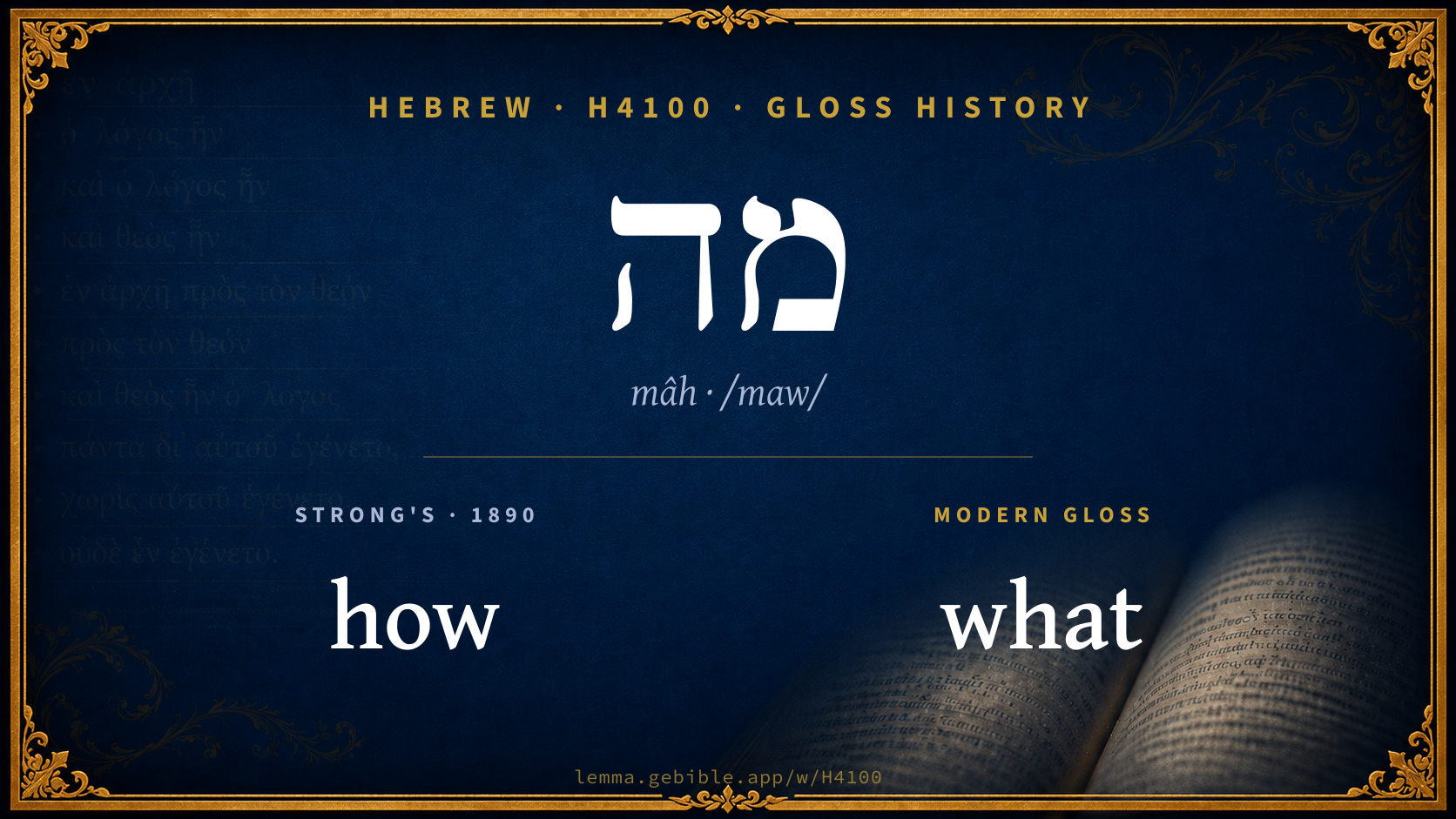
Gloss history
Strong's 1890 vs modern scholarship
About this word
Strong's H4100 catalogs a Hebrew word from the Hebrew Old Testament.
These counts are not copied from any lexicon or concordance. They are computed here, from the morphology-tagged Hebrew Old Testament. What Lemma adds →
- 655
- distinct verses
- The word appears in 655 distinct verses.
- 37 / 39
- OT books
- The word appears in 37 of 39 Old Testament books.
- #66
- by frequency
- Top 100 most frequent Hebrew words (rank 66 of 8,640 Hebrew words by occurrence).
View all 655 occurrences in the concordance →
By section of the Old Testament
By traditional corpus
Conventional, traditional groupings — biblical authorship is debated, so this is a traditional corpus grouping, not an authorship claim. Each share is this word’s portion of its verses in that division of the Hebrew canon. Each figure is a share of the word’s 655 distinct verses.
- Prophets (Nevi'im) 328 verses · 50%
- Writings (Ketuvim) 208 verses · 32%
- Torah (Pentateuch) 119 verses · 18%
How translations render this word
Counts come from each version’s own published word-to-Strong’s tagging or interlinear alignment — an approximate guide to how each version renders this word, not a word-level alignment the data otherwise carries. Because each total is that version’s own tagged count, the per-version totals vary from one another and need not match the appearance or distinct-verse counts above. These counts may also differ from a printed concordance because Lemma counts each distinctly tagged rendering and does not collapse phrase taggings into a single head-word total. This is a fixed set of word-tagged versions (KJV, ASV, BSB, ULT) and does not change with the reading translation you choose elsewhere. Each version’s license is shown beside its name below (and on Sources).
- King James Version: What 5×, How 4×, Wherefore 2×
- American Standard Version: What 4×, How 3×, Wherefore 3×
- Berean Standard Bible: What 342×, Why 196×, How 86×
- unfoldingWord Literal Text: What 413×, Why 195×, How 63×
King James Version Public Domain
Renders H4100 across 26 tagged occurrences — most commonly:
Plus 15 renderings that appear only once — usually multi-word phrases or single function words the recovered tagging swept in, not distinct renderings. Not rendered by a distinct English word in 1 further occurrence.
American Standard Version Public Domain
Renders H4100 across 26 tagged occurrences — most commonly:
Plus 12 renderings that appear only once — usually multi-word phrases or single function words the recovered tagging swept in, not distinct renderings.
Berean Standard Bible Public Domain
Renders H4100 across 704 tagged occurrences — most commonly:
Plus other, less common renderings. Plus 33 renderings that appear only once — usually multi-word phrases or single function words the recovered tagging swept in, not distinct renderings. Not rendered by a distinct English word in 46 further occurrences.
unfoldingWord Literal Text CC BY-SA 4.0
Renders H4100 across 765 tagged occurrences — most commonly:
Plus other, less common renderings. Plus 25 renderings that appear only once — usually multi-word phrases or single function words the recovered tagging swept in, not distinct renderings.
17 senses and sub-senses in the full BDB
What do BDB’s symbols mean?
BDB uses these scholarly abbreviations:
| Symbol | Meaning |
|---|---|
| 𝔊 | the Septuagint (the ancient Greek translation, LXX) |
| 𝔙 | the Vulgate (the Latin translation) |
| 𝔖 | the Syriac version (the Peshitta) |
| 𝔗 | the Targum (the Aramaic translation) |
| ψ | the Psalms |
| √ | root (the underlying root or stem) |
| ‖ | parallel passage (a synonymous or contrasted parallel) |
| † | the dagger: every passage where the word occurs is cited |
The 17 senses and sub-senses the full Brown-Driver-Briggs lexicon distinguishes for this word, in lexicon order (not ranked by frequency), with BDB’s own verbatim wording and sub-sense lettering. Shown in Hebrew script with BDB’s own scholarly abbreviations. The condensed entry is in the Lexicon Entry tab. See also the Forms in the corpus table below.
- 1. interrog. what?
- a. in a direct question, before either verbs or nouns Gn 4:10 מֶה עשׂית what hast thou done? 15:2 מה־תתן־לי what wilt thou give me? Ex 3:13 מַה־שְּׁמוֹ, 12:26; 13:14 and so very often: מַה־הִיא Zc 5:6; מה אלה Zc 1:9; מָה אַתָּה רֹאֶה Je 1:11; Am 7:8 +; Jl 4:14 מה אתם לי; Ju 18:8 מה אתם vid. Comm., v 24 מה לי עוד what have I still? Is 21:11 מה־מלילה what (= how much) of the night (is past)? = as what? (qualem?) Hg 2:3 (cf. מִי Am 7:2); to express surprise, Jb 9:12 who shall say to him, מה תעשׂה what doest thou? 22:13 Ec 8:4; Is 45:9, 10; sq. כִּי, Gn 20:10 מה ראית כי עשׂית what hadst thou in view, that thou hast done, etc.? 31:36 Ex 16:7 וְנַחְנוּ מָה כִּי and what are we, that …? 32:21 Nu 22:28; Hb 2:18, etc. Note in partic.—(a) מָה is followed sometimes by a subst. in appos. (against Arabic usage, which does not permit this: WAG. ii. § 170), so that it becomes virtually an adj.: מַה־בֶּצַע what profit …? Gn 37:26 ψ 30:10 Mal 3:14; Is 40:18 מַה־דְּמוּת, Mal 1:13 ψ 89:48 זְכָר־אֲנִי מֶה חָ֑לֶד (inverted for מַה חֶלֶד אָ֑נִי) remember (of) what (short) duration I am, Ec 1:3; 5:10, 15; 6:8, 11 (Da § 8, R. 2 Köiii. 23 f.); as exclam., ψ 89:48b (?) Jb 26:14. And with the subst. idiom. at the end (in Arabic preceded then by مِنْ: WAG. ii. § 49. 7), 1 S 26:18 ומַה־בידי רעה and what is there in my hand, evil? 20:10 (vid. 3), 2 S 19:29; 24:13; 1 K 12:16; Je 2:5 מה־מצאו אבותיכם בי עָוֶל, Ec 11:2 Est 6:3. (b) מַה־זֶּה what, now? 1 S 10:11, contr. מַזֶּה †Ex 4:2 (זֶה 4 c); Gn 3:13 מַה־זֹּאת עָשִׂיתָ; 12:18; 29:25 מַה־זֹּאת עָשִׂיתָה לִּי; similarly 26:10; 42:28 +, either what, now, hast thou done? or what is this that thou hast done? (vid. זֶה 4 d). (c) מַה־לְּךָ what to thee? i.e. what aileth thee? or what dost thou want? Gn 21:17 מַה־לָּךְ הָגָר; Jos 15:18; 2 S 14:5; 1 K 1:16; 2 K 6:28; Ez 18:2 (accents); sq. כִּי, Ju 18:23 מה־לך כי נזעקת, Gn 20:9 (cf. 1 S 11:5 מה לעם כי יבכו), Is 22:1 מַה־לָּךְ כִּי עָלִית (cf. τί παθὼν τοῦτο ποιεῖς;), ψ 114:5; without כִּי Is 3:15 (cf. Qor 57:8, 10); with a ptcp., Jon 1:6 what is it to thee as a sleeper? (accus.: Da § 70a cites Qor 74:50), Ez 18:2 (if אתם be treated as strengthening לכם). (d) מַה־לְּךָ (לִי) פֹה = what hast thou (have I) here? Ju 18:3; 1 K 19:9; Is 22:16; 52:5. (e) in the genit., Jer 8:9 וְחָכְמַת־מֶה לָהֶם, and wisdom of what (= what kind of wisdom) is theirs? Nu 23:3 (v. infr. 3). e.g. Genesis 4:10
- b. often in an indirect question, as after ראה, Gn 2:19 to see מה־יקרא־לו what he would call it, 37:20 וְנִרְאֶה מה־יהיו חלֹמֹתיו to what his dreams will come, Nu 13:19f.; Hb 2:1; הִכִּיר Gn 31:32; ידע 39:8; Ex 2:4 לדעת מה־יֵּעָשֶׂה לו, 16:15; 32:1; Jb 34:4; שׁמע Nu 9:8 וְאשׁמעה מה־יצוה י׳ (cf. ψ 85:9), 2 S 17:5; פֹּרַשׁ Nu 15:34; שׁאל 1 K 3:5; 2 K 2:9; הֵבִין Jb 6:24; 23:5: Nu 13:18 וראיתם את הארץ מה היא, ψ 39:5 Is 41:22 הראשׁנות מָה הֵנָּה הַגִּידוּ.—In some such cases it approximates in meaning to the simple rel., as Jer 7:17; 33:24; Mi 6:5, 8; Jb 34:33. e.g. Genesis 2:19
- c. = of what kind? (Germ. was für ein …?), with an insinuation of blame, or reproach, or contempt: Gn 37:10 מה החלום הזה what is this dream which thou hast dreamt? 44:15 Jos 22:16 Ju 8:1; 15:11; 20:12 1 S 29:3 מָה הָעִבְרִים האלה, 1 K 9:13 מה הערים האלה אשׁר נתתה לי, 2 K 9:22; 18:19. e.g. Genesis 37:10
- d. מה is often used in questions to which the answer little, or nothing, is expected, and it thus becomes equivalent to a rhetorical negative (cf. הֲ b, מִי f c): (a) Gn 23:15 land worth 400 shekels …, מה היא what is it? (i.e. it is something quite insignificant), 27:37 Ju 8:3 ומה־יכלתי עשׂות ככם, 14:18 Ho 9:5; 10:3 ψ 30:10; 56:5; Jb 15:9; 16:6; 21:21; 22:13, 17; La 2:13; Ct 5:9 מַה־דּוֹדֵךְ מִדּוֹד what is thy beloved (more) than a(nother) beloved? ‖ לא, 1 K 12:16 מַה־לָּנוּ חֵלֶק בְּדָוִד וְלֹא־נַחֲלָה בְּבֶן יִשַׁי (2 S 20:1 אֵין־לָנוּ חֵלֶק וג׳), Jb 16:6. (b) sq. כִּי (כִּי 1 f), Gn 20:9; 37:26 מַה־בֶּצַע כִּי נַהֲרֹג what profit (is it) that we should slay him? Ex 16:7 Nu 16:11 Hb 2:18 2 K 8:13 what is thy servant, the dog, that he should do, etc.? and often in poetry, as ψ 8:5 מָה אנושׁ כי תזכרנו what is man that thou rememberest him? Jb 6:11 מַה־כֹּחִי כִּי אֲיַחֵל, v 11b; 7:17; 15:12f, 14; 16:3; 21:15 + (cf. מִי f b). Hence, (c) in the formula of repudiation, or emphatic denial, (וְלָכֶם) מַה־לִּי וָלָךְ what is there (common) to me and to thee? i.e. what have I to do with thee? †Ju 11:12; 2 S 16:10 מה לי ולכם, 19:23; 1 K 17:18; 2 K 3:13; 2 Ch 35:21; cf. Jos 22:24; 2 K 9:18, 19; rather differently, without וְ, †Je 2:18 מה לך לדרך מ׳ what is there to thee with reference to the way to Egypt? Ho 14:9 מַה־לּוֹ לַעֲצַבִּים, cf. ψ 50:16 (לְסַפֵּר); with את, †Je 23:28 מַה־לַתֶּבֶן אֶת־הַבָּר beside (or in comparison with) the wheat? cf. τί ἐμοὶ (ἡμῖν) καὶ σοί; Mt 8:29 Mk 5:7 Jn 2:4; and Arabic مَا لِى وَلَهُ e.g. Genesis 23:15
- e. = whatsoever (cf. מִי g): (a) Ju 9:48 מה אתם ראיתם עשׂיתי מהרו עשׂו כמוני, lit. what do you see (that) I have done? hasten, and do like me (= whatever ye see, etc.), 2 S 21:4 מה אתם אמרים אעשׂה לכם, Jb 6:24; with the apod. introd. by וְ, 1 S 20:4 מה תאמר נפשׁך ואעשׂה לך; Est 5:3 מַה־ בַּקָּשָׁתֵךְ … וְיִנָּתֵן לָךְ, v 6; 7:2; 9:12; hence in the late and strange idiom of Ch., it sinks twice almost to the rel. what, 1 Ch 15:13 כי לְמַבָּרִאשׁוֹנָה לא אתם because ye were not (employed) for what was at first (on the former occasion), J etc., 2 Ch 30:3 לְמַדַּי according to what was sufficient (= in sufficient numbers), cf. Est 9:26. (b) מַה־שֶּׁ- (late: frequently in Mishn., etc.), whatever, what (cf. מִי אֲשֶׁר, מִי g end): †Ec 1:9 מַה־שֶּׁהָיָה הוּא שֶׁיִּהְיֶה, lit. what is that which hath been? it is that which shall be (= whatever hath been, it is that which shall be), v 9 3:15, 22; 6:10; 7:24; 8:7; 10:14. e.g. Judges 9:48
- 2. Used adverbially:
- a. as an interrogative: (a) how? especially in expressing what is regarded as an impossibility, Gn 44:16 מַה־נִּצְטַדָּ֑ק how shall we justify ourselves? Nu 23:8(×2) 1 S 10:27 מַה־יּשִׁעֵנוּ זֶה, 2 K 4:43; Jb 9:2; 25:4(×2) 31:1 I made a covenant with my eyes, וּמָה אֶתְבּוֹנֵן עַל ב׳ and how should I look upon a maid? (𝔊 οὐ, 𝔙 non), Pr 20:24 וְאָדָם מַה־יָּבִין דַּרְכּוֹ; in an indirect question, Ex 10:26; ψ 39:5 אֵֽדְעָה מֶה־חָדֵל אָ֑נִי; מַה־זֶּה how, now? (in surprise), Gn 27:20 מַה־זֶּה מִהַרְתָּ לִמְצֹא בְּנִי, Ju 18:24; 1 K 21:5; 2 K 1:5. (b) why? Ex 14:15 מַה תִּצְעַק אֵלַי, 17:2(×2) 2 K 6:33; 7:3 ψ 42:6 מַה־תִּשְׁתּוֹחֲחִי עלי, Jb 15:12 +; Ct 8:4 I adjure you מַה־תָּעִירוּ וּמַה־תְּעוֹרֲרוּ, why will ye stir up, etc.? (i.e. do not: ‖ אִם 2:7; 3:5).—The transition from the interrog. to the neg., to which in Heb. there is an approx. (especially 1 K 12:16 [cf. 2 S 20:1] Jb 6:5; 31:1; Ct 5:8; 8:4), is in Arabic complete, مَا being there used constantly in the sense of not (cf. WalkerHbr. xii. 244 ff.; Köiii. 478). e.g. Genesis 44:16
- b. as an exclam., how …! with adjectives and verbs, Gn 28:17 מַה־נּוֹרָא הַמָּקוֹם הַזֶּה how dreadful is this place! 38:29 Nu 24:5 מַה־טֹּבוּ אֹהָלֶיךָ, Is 52:7 ψ 3:2 מה רבו, 8:2 מה אדיר, 21:2; 36:8, etc., Ct 4:10(×2); 7:2; ironically, 2 S 6:20; Je 2:33, 36; Jb 26:2, 3. e.g. Genesis 28:17
- 3. Indef. pron. anything, aught, Nu 23:3 וּדְבַר־מַה־יַּרְאֵנִי וְהִגַּדְתִּי לָ֑ךְ and he will shew me the matter of aught, and I will tell thee (= if he shew me … I will, etc., Dr§ 149), 1 S 19:3 וְרָאִיתִי מָה וִהִגַּדְתִּי לָ֑ךְ = and if I see aught, I will, etc., 20:10 אוֹ מַה־יַּעַנְךָ אָבִיךָ קָשָׁה if perchance thy father shall answer thee aught that is harsh (order, 1 a a), 2 S 18:22 וִיהִי־מָה אָרוּצָה־נָּא but let there happen what may (lit. aught), I will run, v 23 (cf. Jb 13:13 וְיַעֲבֹר עָלַי מָה), v 29 וְלֹא יָדַעְתִּי מָה (cf. Pr 9:13), Pr 25:8. Cf. Köiii. § 65. e.g. Numbers 23:3
- 4. With preps.:
- a. בַּמָּה9, בַּמֶּה19 wherein? Ex 22:26; Ju 16:5; 1 S 14:38 (indirect question; We בְּמִי); and so according to the various senses of בְּ: whereby? Gn 15:8; Ex 33:16; Mal 1:2, 6, 7; 2:17; 3:7–8; wherewith? 1 S 6:2 2 S 21:3 Mi 6:6; by what means? Ju 16:5 וּבַמֶּה נוּכַל לוֹ; at what (worth)? Is 2:22; for what? 2 Ch 7:21 (‖ 1 K 9:8 על־מה). e.g. Exodus 22:26
- b. יַעַן מֶה †Hg 1:9 because of what? e.g. Haggai 1:9
- c. כַּמָּה, כַּמֶּה, proposes the like of what? (Arabic كَمْ, Syriac ܟܡܳܐ ); hence (a) how much? how many? כַּמָּה יְמֵי וגו׳ Gn 47:8; 2 S 19:35; ψ 119:84 Jb 13:23; עַד כַּמֶּה פְעָמִים 1 K 22:16 (= 2 Ch 18:15); כַּמָּה how often? Jb 21:17 (i.e. how seldom!); in an indirect question, how much? Zc 2:6(×2). As an exclamation, Zc 7:3 as I have done זֶה כַמֶּה שָׁנִים now (זֶה 4 i), how many years! ψ 78:40 כַּמָּה how often! (b) for how long? ψ 35:17 כמה תראה, Jb 7:19. e.g. Genesis 47:8
- d. לָ֫מָּה, לָמָ֫ה (לָמָ֫ה mostly before the gutturals א, ה, ע, and י׳ [i.e. אֲדֹנָי], but twice besides, ψ 42:10; 43:2; לָ֫מָּה also occurs before gutt., in five places noted by Mas. on ψ 43:2, viz. 1 S 28:15; 2 S 2:22; 14:31; ψ 49:6 Je 15:18, and before ח †Gn 4:6; 2 S 14:13; 24:3; Ec 2:15), לָ֫מָה †Jb 7:20, לָ֫מֶה †1 S 1:8(×3), for what reason? why? Gn 4:6 למה חרה לך why art thou angry? 24:31, etc.; often strengthened by זֶה (זֶה 4 e), Gn 18:13; 32:30 (= Ju 13:18) למה זה תשׁאל לשׁמי, 33:15; Ex 2:20; 5:22; 17:3, etc., Je 6:20; 20:18 +; Gn 25:22 אם כן למה־זה אנכי if so, why, then, am I? (why do I continue to live?); = to what purpose (sq. לִ pers.), Gn 27:46 למה לי חיים, Is 1:11; Je 6:20 Am 5:18 למה זה לכם יום י׳, Jb 30:2; in an indirect question, 1 S 6:3 Dn 10:20. Note especially (a) in expostulations, Gn 12:18 למה לא הגדת לי why didst thou not tell me, etc.? v 19; 29:25; 31:27; 42:1; 43:6; 1 S 21:15; 22:13; 24:10; ψ 22:2; 44:24, 25; 74:1, 11 + often; (b) with an impf., often deprecating, or introducing rhetorically, the reason why something should, or should not, be done, why should …? 1 S 19:5, 17; 20:8 but to thy father (emph.) למה זה תביאני, why shouldst thou bring me? 20:32 למה יומת מה עשׂה why should he be put to death? 2 S 13:26; 16:9; 20:19; 2 K 14:10, etc.: in such cases, it approximates in meaning to lest (cf. Ph. CIS i. 2, 21 לָםָ יסגרינם אלנם ne tradant eos dii), and is in 𝔊 often rendered by μήποτε, as Gn 27:45 למה אשׁכל why should I be bereaved, etc.? Ex 32:12 למה יאמרו מצרים Ne 6:3 ψ 79:10; 115:2; Ec 7:16, μή, Jer 40:15, ἵνα μή, Gn 47:19; 2 S 2:22; 2 Ch 25:16; Ec 5:5; 7:17, or ὅπως μή, Jo 2:17 (in 1 S 19:17; 2 S 13:26, paraph. by εἰ μή); and, connected with the foreg. sentence by אשׁר, or שֶׁ, in late, or dial., Heb. it actually has that meaning, Dn 1:10 אֲשֶׁר לָמָּה יִרְאֶה lest he see, Ct 1:7 שַׁלָּמָ֫ה אֶהְיֶה lest I become (so in Aramaic דִּי לְמָה Ezr 7:23, דִּילְמָא 𝔗, Syriac ܕܰܠܡܳܐ, both regularly = lest). e.g. Psalms 42:10
- e. עַד־מָה (ψ 4:3 עַד־מֶה) until when? how long? †Nu 24:22 (aposiop.), ψ 4:3; 79:5; 89:47; in indirect qu., ψ 74:9 (cf. עד אנה, עד מתי). e.g. Psalms 4:3
- f. עַל־מָה, and עַל־מֶה, upon what? Jb 38:6; 2 Ch 32:10; upon what ground? wherefore? Nu 22:32 עַל־מָה הִכִּיתָ אֶת־אֲתֹנְךָ, Dt 29:23 (cf. 1 K 9:8; Je 22:8), Is 1:5; Je 8:14; 9:11; 16:10; Ez 21:12; ψ 10:13 Jb 13:14 (probably dittogr. from v 13); על־מה־זה Ne 2:4. In an indirect question, Jb 10:2 הוֹדִיעֻנִי עַל מַה־תְּרִיבֻנִי, Est 4:5 לָדַעַת מַה־זֶּה וְעַל־מַה־זֶּה. e.g. Job 38:6
Senses from the full Brown-Driver-Briggs lexicon (Brown, Driver, Briggs; Oxford 1906 — public domain), digitized via Sefaria, supplemented by the OpenScriptures HebrewLexicon (CC BY 4.0). Full attribution on Sources.
Word origin
rarely מָה־ (e.g. Gn 31:43; Jos 22:16; Ju 8:1), מַה־, מַה·, מֶה, מַ· (†Ex 4:2; Is 3:15; Mal 1:13; 1 Ch 15:13; 2 Ch 30:3), מָ (only in מָהֵם †Ez 8:6 Kt., Qr. מָה הֵם)—on the distinction in the use of these forms, see Ges§ 37—pron. interrog. and indef. what? how? aught; used of things, as מִי of persons (Aramaic ܡܳܐ, מָא, Arabic مَا; prob. apoc. from a longer form with n or nt, Assyrian minû (DlHWB 417 f.), Ethiopic ምንት: ment; cf. WCG 123 ff. Köii. 368):—
— Brown-Driver-Briggs (Oxford 1906, public domain), digitized via Sefaria, supplemented by the OpenScriptures HebrewLexicon (CC BY 4.0). See Sources.
Origin: a primitive particle
Jastrow Dictionary
A second Hebrew/Aramaic lexicon for comparison, covering Aramaic and post-biblical (Talmudic, Targumic, Midrashic) usage that the biblical-Hebrew BDB does not. Matched by lemma rather than by Strong’s number, so a lemma may carry more than one Jastrow headword (shown separately below), and the entries cover usage well beyond the Bible.
מָה
- (b. h.)
- 1. something; anything. Num. R. s. 14; Tanḥ. Ḥayé 3, v. בְּלִימָה.
- 2. what? which? Ḥull. 89ᵃ (play on הא̇מ̇נ̇ם א̇ל̇ם̇, Ps. LVIII, 2) מה א̇ומ̇נ̇תו … כא̇ל̇ם̇ which is the best policy for man in this world? Let him act as if he were mute (keep silence). B. Mets. 63ᵃ, a. e. מה לו הן מה לי דמיהן what are they to me and what their equivalent, i.e. what difference does it make whether the purchased objects or their equivalent be delivered?; Y. Yoma V, 43ᵃ bot. מה ביניהן ומה בין דמיהן. B. Bath. 32ᵇ; 31ᵃ מה (לי) לו לשקר what motive could he have to tell a lie? Ib., a. e. מה לי לשקר במקום עדים וכ׳ we do not apply the principle that we believe a defendant because he has no motive to lie, where witnesses are on hand; a. v. fr.—מה … אף what …?, even so, i.e. as … so. Gitt. 23ᵇ מה אתם … אף וכ׳ as you (Num. XVIII, 28) refers to Israelites, so must your delegate be an Israelite. Sabb. 133ᵇ מה הוא … אף וכ׳ as He is gracious and merciful, so be thou &c.; a. fr.—מה … לא כל שכן, v. כָּל.—מה … אינו דין, v. דִּין II.—מה ל־ … שכן … תאמר what has this to do with …? In this case …, whereas &c., i.e. it is different with … because &c. Kidd. 4ᵇ מה ליבמה שכן … תאמר וכ׳ the case of a Y’bamah is different, because she can neither be acquired by means of a document, whereas this (an ordinary woman) &c.; a. fr.—מָה נַפְשְׁךָ (in Babli mostly: מִמָּה נפשך; abbr. ממ"נ) whatever be thy opinion (from whatever opinion thou start), i.e. whichever side you take, at all events. Y. Ber. I, 2ᵇ מ׳ נ׳ אם וכ׳ at all events (he has offended); if it was day-time when the first stars (on Friday evening) were visible, it was day-time when the first stars (on Sabbath evening) were visible &c.; Sabb. 35ᵇ חייכ חטאת ממ"נ must bring a sin-offering at all events (whether you consider twilight a part of the day or a part of the night). Ib. 34ᵃ (in Chald. dict.) מה נפשך אי וכ׳ whichever side you take, if twilight is day &c. Erub. 10ᵃ גדולה … למה לי ממ"נ אי וכ׳ what reason was there for saying ‘large …’? In either case (it is incorrect), if it be to permit the use of the larger court &c. Ḥull. 29ᵃ ממ"נ אי מחצה וכ׳ in either case (the slaughtering is ritually correct); if you adopt the opinion that an exact half is to be considered as if it were the larger portion &c.; a. v. fr.—Ib. 78ᵇ מה אם נפשך, v. נֶפֶשׁ.—בַּמֶּה a) wherewith? B. Bath. 10ᵇ במה תרום וכ׳ whereby can the horn of Israel be lifted up? Sabb. II, 1; a. fr.—b) in what case? במה דברים אמורים (abbr. בד"א), v. אָמַר I.—לָמָּה wherefore? Ber. 3ᵃ תחלת … סימנא למה לי what need is there for a sign for the beginning of the first watch? M. Kat. 28ᵃ ל׳ נסמכה וכ׳ why is the account of the death of Miriam attached to &c.?; a. fr.—לַמֶּה to what?, whereto? Kidd. 40ᵇ ל׳ צדיקים נמשלים what are the righteous to be compared to?—ל׳ הדבר דומה, v. דָּמָה; a. fr.—V. לָמָה. e.g. Psalms 58:2
- 3. (relat.) which, what. Pes. 88ᵇ מה שקנה עבד וכ׳ whatever the slave acquires belongs to the master. Ber. I, 1 כל מה שאמרו וכ׳ for whatever act the scholars designated the time ‘up to midnight’ &c.; a. v. fr.
מָה ²
- ch. same (v. מָא). Targ. II Sam. XVIII, 23. Targ. Ex. XXXIII, 21; a. v. fr.—Snh. 65ᵇ; Gen. R. s. 11, v. גּוּבְרָא. Y. Ned. VI, end, 40ᵃ מה שבקית תמן what (prominent men) I left there (in Palestine); Y. Snh. I, 19ᵃ top (corr. acc.) [Ib. מה מודע לי, read מאן.]—Y. Gitt. I, 43ᵈ מה אנן קיימין what do we stand at, i.e. what is the case before us? Y. Dem. I, 21ᵈ bot. מה אפשר דר׳ וכ׳ what? is it possible that &c.? i.e. it is impossible that &c.; ib. מה ר׳ ז׳ מיכול וכ׳ it is impossible that R. Z. should eat &c. Y. Sabb. XIV, 14ᶜ מה ביניהון wherein do they differ?, v. בֵּין. Ḥull. 34ᵃ, a. e. מה נפשך, v. preced.; a. v. fr.—מָהִיא = מה היא, how is it? Y. Sabb. l. c.
A Dictionary of the Targumim, the Talmud Babli and Yerushalmi, and the Midrashic Literature (Marcus Jastrow; London, Luzac, 1903) — Public Domain. Digitized via Sefaria. Digitized via Sefaria. Full attribution on Sources.
Forms in the corpus
The 118 distinct written forms H4100 takes in the Hebrew Bible, most frequent first — each parse links to that state’s occurrences in the concordance. Hebrew forms include their vowel points and cantillation, so a single lemma takes many written forms.
| Form | Parsing | Example | Uses |
|---|---|---|---|
| מַה | Particle, Interrogative | Amos 4:13 | 222 |
| וּ/מַה | Particle, Interrogative | Ecclesiastes 1:9 | 40 |
| מָֽה | Particle, Interrogative | Amos 7:8 | 35 |
| לָ֥/מָּה | Particle, Interrogative | Ecclesiastes 7:17 | 28 |
| מָ֣ה | Particle, Interrogative | Deuteronomy 6:20 | 27 |
| לָ֤/מָּה | Particle, Interrogative | Exodus 2:20 | 26 |
| לָ֣/מָּה | Particle, Interrogative | Deuteronomy 5:25 | 22 |
| מָ֥ה | Particle, Interrogative | Daniel 12:8 | 22 |
| מֶ֣ה | Particle, Interrogative | Ecclesiastes 2:12 | 18 |
| מַֽה | Particle, Interrogative | Ecclesiastes 8:4 | 18 |
| מָה | Particle, Interrogative | Ezekiel 17:12 | 17 |
| מֶה | Particle, Interrogative | Exodus 32:1 | 12 |
| מָ֤ה | Particle, Interrogative | Ezekiel 16:30 | 10 |
| לָ/מָּה | Particle, Interrogative | Amos 5:18 | 9 |
| לָ֛/מָּה | Particle, Interrogative | Genesis 44:4 | 8 |
| מָ֖ה | Particle, Interrogative | Ezekiel 12:9 | 8 |
| וּ/מַֽה | Particle, Interrogative | 2 Chronicles 25:9 | 7 |
| לָ֚/מָּה | Particle, Interrogative | Exodus 5:4 | 7 |
| מָ֚ה | Particle, Interrogative | Deuteronomy 10:12 | 7 |
| וּ/מָ֣ה | Particle, Interrogative | Job 31:14 | 6 |
| לָ֧/מָּה | Particle, Interrogative | Exodus 5:15 | 6 |
| מֶ֥ה | Particle, Interrogative | Deuteronomy 29:24 | 6 |
| מֶֽה | Particle, Interrogative | Ecclesiastes 2:22 | 6 |
| מָ֛ה | Particle, Interrogative | Exodus 12:26 | 6 |
| בַּ/מֶּ֖ה | Particle, Interrogative | 1 Samuel 6:2 | 5 |
| וְ/לָ֤/מָּה | Particle, Interrogative | 1 Samuel 6:6 | 5 |
| וְ/לָ֥/מָּה | Particle, Interrogative | Ezekiel 18:31 | 5 |
| וּֽ/מַה | Particle, Interrogative | Job 15:12 | 5 |
| לָ/מָ֤ה | Particle, Interrogative | Exodus 5:22 | 5 |
| לָֽ/מָּה | Particle, Interrogative | 2 Samuel 18:22 | 5 |
| בַּ/מֶּ֣ה | Particle, Interrogative | Exodus 22:27 | 4 |
| לָ/מָ֣ה | Particle, Interrogative | Psalms 10:1 | 4 |
| לָ/מָ֥ה | Particle, Interrogative | Genesis 27:45 | 4 |
| לָ֭/מָּה | Particle, Interrogative | Job 19:22 | 4 |
| מֶ֤ה | Particle, Interrogative | 1 Samuel 20:1 | 4 |
| בַּ/מֶּ֥ה | Particle, Interrogative | Malachi 1:6 | 3 |
| וְ/לָ֖/מָּה | Particle, Interrogative | Genesis 4:6 | 3 |
| וְ/לָ֧/מָּה | Particle, Interrogative | Ecclesiastes 2:15 | 3 |
| וְ/לָ֨/מָּה֙ | Particle, Interrogative | 1 Samuel 9:21 | 3 |
| וּ/מֶ֤ה | Particle, Interrogative | Jeremiah 16:10 | 3 |
| וּ/מָ֥ה | Particle, Interrogative | Esther 9:26 | 3 |
| וּ/מָֽה | Particle, Interrogative | Esther 9:26 | 3 |
| כַּ/מֶּ֥ה | Particle, Interrogative | 1 Kings 22:16 | 3 |
| לָ/מָּה֩ | Particle, Interrogative | Daniel 1:10 | 3 |
| לָ֖/מָּה | Particle, Interrogative | Ecclesiastes 7:16 | 3 |
| מֶ֨ה | Particle, Interrogative | Deuteronomy 29:24 | 3 |
| מָ֔ה | Particle, Interrogative | Exodus 16:7 | 3 |
| מָ֗ה | Particle, Interrogative | 2 Kings 7:3 | 3 |
| מָ֧ה | Particle, Interrogative | 2 Kings 18:19 | 3 |
| מָה֙ | Particle, Interrogative | 2 Chronicles 32:10 | 3 |
| לְ/מַ | Pronoun, Relative | 2 Chronicles 30:3 | 2 |
| בַּ/מָּ֣ה | Particle, Interrogative | Malachi 1:2 | 2 |
| בַּ/מָּ֥ה | Particle, Interrogative | Genesis 15:8 | 2 |
| וְ/לָ/מָ֤ה | Particle, Interrogative | Numbers 20:4 | 2 |
| וְ/לָ/מָּה | Particle, Interrogative | Genesis 25:32 | 2 |
| וְ/לָ֣/מָּה | Particle, Interrogative | Job 10:18 | 2 |
| וּ/מֶ֖ה | Particle, Interrogative | 1 Kings 14:14 | 2 |
| וּ/מֶֽה | Particle, Interrogative | Genesis 20:9 | 2 |
| כַּ֭/מָּה | Particle, Interrogative | Job 7:19 | 2 |
| לָ/מָ֪ה | Particle, Interrogative | Psalms 42:9 | 2 |
The 60 most common forms are shown; 58 rarer forms follow in the full concordance.
Same root — word family
Other BDB entries built from the same root as H4100, grouped by Strong’s listed origin. These share a root / origin per the lexicon — not necessarily a shared meaning. Each links to that word’s own entry.
Derived from this word
- מא mâʼ H3964 what
- מדוע maddûwaʻ H4069 why
- מדי madday H4078 what is enough, sufficiency, enough
- מה mâh H4101 whatever
- מהה mâhahh H4102 to delay
- מי mîy H4310 who
- מן mân H4478 manna
- מתלאה mattᵉlâʼâh H4972 weariness
Proper names from this root
People and places named from this root — a name, not an additional meaning of the word.
Compare all same-root words → Showing 4 of 10 — not the complete family. 1 of the same-root words is a proper name (a person or place). They share a root, not necessarily a meaning.
Septuagint verse parallels
This word appears in 623 verses that also exist in the Greek Old Testament (Septuagint), out of the 655 Hebrew verses it occurs in. You can read those verses in Greek by switching the Old Testament edition to the Septuagint.
Read these verses in the Septuagint
- Genesis 2:19
- Exodus 2:4
- Leviticus 25:20
- Numbers 9:7
- Deuteronomy 5:25
- Joshua 4:6
- Judges 1:14
- Ruth 1:11
- 1 Samuel 1:8
- 2 Samuel 1:4
- 1 Kings 1:16
- 2 Kings 1:5
This is a verse-level parallel only — the same verses exist in both the Hebrew and Greek Old Testaments. No word-level Hebrew↔Greek correspondence is claimed: the data carries no such alignment, so no Greek word is shown as this Hebrew word’s translation. Coverage is not total — the Septuagint omits the deuterocanon and renumbers the Psalms, so some Hebrew verses have no direct Greek parallel.