
Psalms 114:5

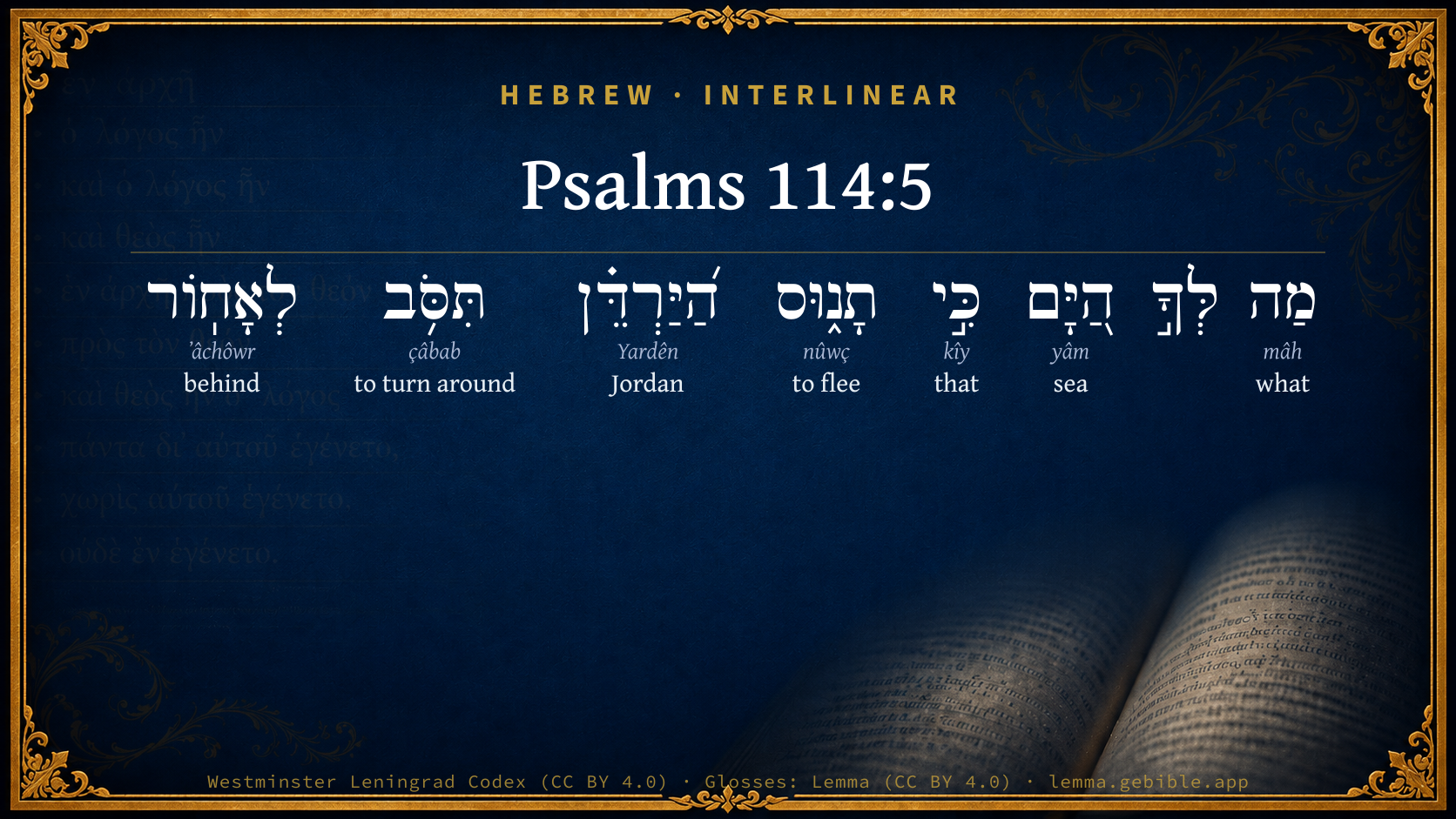
Hebrew (Westminster Leningrad Codex) Psalms 114:5 appears in the Hebrew Old Testament. The text above is from the Westminster Leningrad Codex. Each word links to its Strong’s number, a concise gloss, and parsing drawn from the Open Scriptures Hebrew Bible morphology. Click any word for its full Brown-Driver-Briggs (BDB) entry.
Download image
Cite this verse

Psalms 114:5 (World English Bible). Public Domain. Lemma interlinear Bible study tool, https://lemma.gebible.app/v/psalms/114/5.

Show BibTeX & RIS
BibTeX
RIS
English Translation
What was it, you sea, that you fled? You Jordan, that you turned back?
World English Bible · Public Domain
Download a study sheet

One document with this verse’s original text, its word-by-word gloss line, the meaning frame, cross-references with their text, attributed commentary, and full source and license credits — printable, and it pastes into notes with its structure intact.

This verse Autodidact and up

Study sheet (.html) Plain text (.txt)

A passage Seminary Student

Up to 50 verses in one chapter. A passage sheet keeps up to 6 commentary sources and 12 cross-references per verse, in the order this page ranks them, and says so on the sheet whenever that leaves anything out. Ask for a single verse and you get the Autodidact verse sheet above.

Everything on this page stays free to read, with no account — the sheet is a download of what is already on screen, not access to it.

Want to remove ads? Support Godless Engineer
Compare translations 3

The same verse in 3 English versions, stacked beneath the original-language interlinear above. Click any original word for its lexicon entry.

Each is an independent rendering of the whole verse — the interlinear is not word-aligned to these translations.

Highlighted words mark where these versions differ — a whole-verse word diff, not a word-by-word alignment.

  • World English Bible Public Domain
    What was it, you sea, that you fled? You Jordan, that you turned back?
  • King James Version Public Domain
    What ailed thee, O thou sea, that thou fleddest? thou Jordan, that thou wast driven back?
  • unfoldingWord Literal Text CC BY-SA 4.0
    What to you, sea, that you flee? Jordan, you turn backwards?

unfoldingWord Literal Text — © unfoldingWord, licensed CC BY-SA 4.0. Word-aligned USFM3 via Door43 (git.door43.org/unfoldingWord/en_ult).

Versions to compare (up to 4)

3 of 4 selected

Show all 18 translations

Every available English version of this verse, each an independent rendering of the whole verse.

  • World English Bible Public Domain
    What was it, you sea, that you fled? You Jordan, that you turned back?
  • Berean Standard Bible Public Domain
    Why was it, O sea, that you fled, O Jordan, that you turned back,
  • Majority Standard Bible Public Domain
    Why was it, O sea, that you fled, O Jordan, that you turned back,
  • King James Version Public Domain
    What ailed thee, O thou sea, that thou fleddest? thou Jordan, that thou wast driven back?
  • American Standard Version (1901) Public Domain
    What aileth thee, O thou sea, that thou fleest? Thou Jordan, that thou turnest back?
  • Revised Version (1885) Public Domain
    What aileth thee, O thou sea, that thou fleest? thou Jordan, that thou turnest back?
  • Geneva Bible (1599) Public Domain
    What ailed thee, O Sea, that thou fleddest? O Iorden, why wast thou turned backe?
  • Douay-Rheims (1899) Public Domain
    What ailed thee, O thou sea, that thou didst flee: and thou, O Jordan, that thou wast turned back?
  • Young's Literal Translation Public Domain
    What -- to thee, O sea, that thou fleest? O Jordan, thou turnest back!
  • Literal Standard Version CC BY-SA 4.0
    What is [ailing] you, O sea, that you flee? O Jordan, you turn back!
  • Unlocked Literal Bible CC BY-SA 4.0
    Why did you flee, sea? Jordan, why did you turn back?
  • unfoldingWord Literal Text CC BY-SA 4.0
    What to you, sea, that you flee? Jordan, you turn backwards?
  • Darby Bible Public Domain
    What ailed thee, thou sea, that thou fleddest? thou Jordan, that thou turnedst back?
  • World Messianic Bible Public Domain
    What was it, you sea, that you fled? You Jordan, that you turned back?
  • Webster's Bible Public Domain
    What ailed thee, O thou sea, that thou fleddest? thou Jordan, that thou wast driven back?
  • Free Bible Version CC BY-SA 4.0
    Red Sea—why did you run away? Jordan River—why did you retreat?
  • Bible in Basic English Public Domain
    What was wrong with you, O sea, that you went in flight? O Jordan, that you were turned back?
  • JPS Tanakh (1917) Public Domain
    What aileth thee, O thou sea, that thou fleest? thou Jordan, that thou turnest backward?

Literal Standard Version (2020), Covenant Press — licensed CC BY-SA 4.0. Text via the HelloAO Bible API (eBible.org). Unlocked Literal Bible (unfoldingWord) — licensed CC BY-SA 4.0. Text via the HelloAO Bible API (eBible.org). unfoldingWord Literal Text — © unfoldingWord, licensed CC BY-SA 4.0. Word-aligned USFM3 via Door43 (git.door43.org/unfoldingWord/en_ult). Free Bible Version, Dr. Jonathan Gallagher — licensed CC BY-SA 4.0. Text via the HelloAO Bible API (eBible.org).

Word by word

More ways to search: Search by grammar → Find every occurrence → Compare this word →

Practice this passage: Drill this verse → Learn its vocabulary →

About this verse

These counts appear in no published source. They are computed here, from the morphology-tagged text and Lemma’s own curated glosses. What Lemma adds →

8
words
7
distinct lemmas
Wisdom
section

Shared distinctive vocabulary

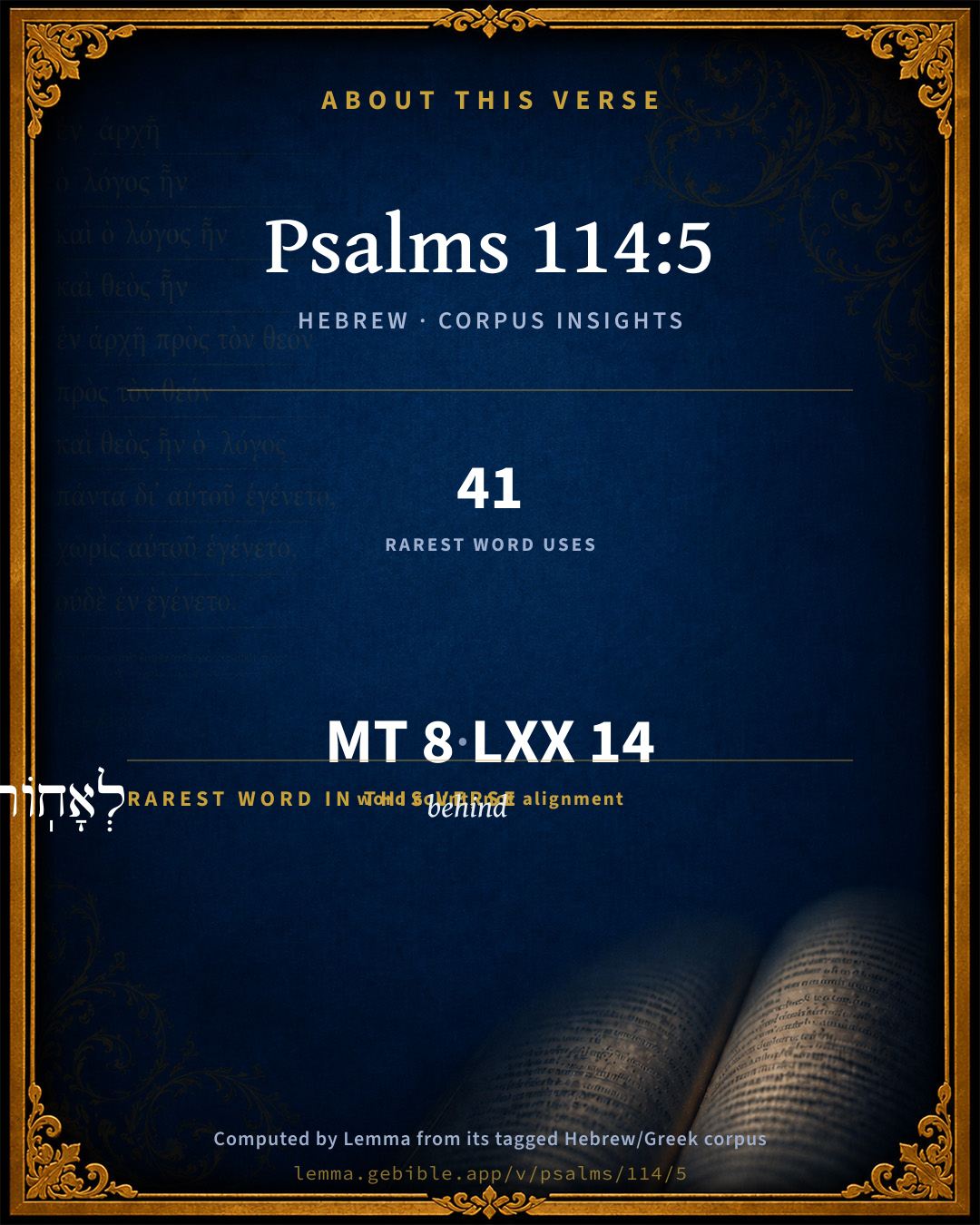
לְאָחֽוֹר behind H268 occurs in 41 verses of the Hebrew Bible. Also found in:

Grammatical profile

  • 2 verbs
  • 3 nouns
  • 1 preposition
  • 1 conjunction
  • 1 particle

Verb forms

  • תָנ֑וּס Qal · Imperfect
  • תִּסֹּ֥ב Qal · Imperfect

Hebrew & Septuagint length

In English translation the verse runs 14 words from the Hebrew and 16 from the Septuagint (LXX English) — closely comparable.

A rough comparison of the two English renderings, which tokenize alike — not a word-level alignment.

Word counts can differ between the Hebrew and the Greek without any difference in meaning — e.g. the Hebrew direct-object marker אֵת has no separate Greek word, and Greek often adds the article ὁ.

In the original languages it is 8 Hebrew tokens and 14 Greek tokens — but the two are counted differently (Hebrew bundles its prefixes and suffixes into one token; the Greek is in lemma form), so that isn’t a like-for-like length.

Cross-references

2

Topical passages linked to Psalms 114:5 in the Treasury of Scripture Knowledge — connected by theme and wording, ordered by reader-vote popularity; previews shown in the World English Bible.

  • Habakkuk 3:8 Was Yahweh displeased with the rivers? Was your anger against the rivers, Or your wrath against the sea, That you rode on your horses, On your chariots of salvation?
  • Jeremiah 47:6–7 You sword of Yahweh, how long will it be before you be quiet? put up yourself into your scabbard; rest, and be still.

Cross-references courtesy of OpenBible.info (CC BY 4.0).

Hebrew and Greek witnesses Masoretic Hebrew ↔ Greek Septuagint

The same verse in the two great witnesses to the Old Testament, shown verse-for-verse.

You’re reading Greek Psalm 113 (Hebrew Psalm 114). The Septuagint counts the superscription, so verse numbers can differ from the Hebrew — chapter-level alignment, not verse-by-verse. Numbering follows Rahlfs.

These are two independent witnesses, not word-aligned to each other, and the Septuagint is shown in lemma (dictionary) form.

Hebrew Psalms 114:5 Masoretic · Westminster Leningrad Codex

מַה לְּךָ֣ הַ֭יָּם כִּ֣י תָנ֑וּס הַ֝יַּרְדֵּ֗ן תִּסֹּ֥ב לְאָחֽוֹר

What was it, you sea, that you fled? You Jordan, that you turned back?

World English Bible · Public Domain

Greek LXX Greek Psalm 113:5 Septuagint · lemma form

τίς σύ εἰμί θάλασσα ὅτι φεύγω καί σύ ιορδάνης ὅτι ἀναχωρέω εἰς ὁ ὀπίσω

What ailed you, O sea, that you fled? and you Jordan, that you were turned back?

LXX2012 (modern English Septuagint) · Public Domain

On this verse, Keil & Delitzsch discusses the Septuagint’s reading. Read the note in Commentary ↓

Hebrew: Westminster Leningrad Codex (CC BY 4.0). Greek: Septuagint (public domain); English from LXX2012 (modern English Septuagint) (Public Domain). How the Septuagint differs from the Hebrew →

Commentary

Notes on Psalms 114:5 from classic Christian and Jewish commentators (each source and its license shown beneath its notes). The classic Christian expositions comment on the surrounding passage and are grouped to its opening verse, so a note may address several verses; the Jewish commentaries on the Tanakh (Rashi and others) are per-verse, so they appear only where the commentator wrote on this verse.

Lemma curates 59 commentaries, every one of them public domain or Creative Commons licensed, each selected and text-cleaned for this edition rather than reprinted as found. About our sources →

Trapp's Complete Commentary

John Trapp

Psa 114:5 What [ailed] thee, O thou sea, that thou fleddest? thou Jordan, [that] thou wast driven back?

Ver. 5. What ailed thee, O thou sea?] Or, what came to thee? can there any natural reason be given, or was it God’s powerful presence only that caused you to run retrograde? Atheists and unbelievers will search the devil’s skull to find out something whereby they may elevate God’s great works, and elude his arguments; as Pharaoh sat not down under the miracle, but sent for the magicians, and hardened his own heart.

John Trapp, A Commentary or Exposition upon All the Books of the Old and New Testament (1647–1656) — public domain. Text from a community e-Sword module.

J. A. Alexander on Psalms

Joseph Addison Alexander

5. (Psa 114:5) What aileth thee, 0 sea, that thou fleest—O Jordan (that) thou turnest back? By a fine poetical apostrophe, the Psalmist, instead of simply stating the cause of these effects, puts the question to the natural objects which thus witnessed and attested the divine presence. The first phrase literally means, what (is) to thee, the nearest approach that the Semitic dialects can make to our expression, what have you, which in some languages, the French for instance, is the usual equivalent to what ails you?

Joseph Addison Alexander, The Psalms Translated and Explained (1850) — public domain. Text from a community e-Sword module.

Adam Clarke's Commentary

Verse 5. What ailed thee, O thou sea] The original is very abrupt; and the prosopopoeia, or personification very fine and expressive: -

What to thee, O sea, that thou fleddest away!

O Jordan, that thou didst roll back!

Ye mountains, that ye leaped like rams!

And ye hills, like the young of the fold!

After these very sublime interrogations, God appears; and the psalmist proceeds as if answering his own questions: -

At the appearance of the Lord, O earth, thou

didst tremble;

At the appearance of the strong God of Jacob.

Converting the rock into a pool of waters;

The granite into water springs.

I know the present Hebrew text reads חולי chuli, "tremble thou," in the imperative; but almost all the Versions understood the word in past tense, and read as if the psalmist was answering his own questions, as stated in the translation above. "Tremble thou, O earth." As if he had said, Thou mayest well tremble, O earth, at the presence of the Lord, at the presence of the God of Jacob.

Adam Clarke's Commentary on the Bible (1810–1826) — public domain. Text from a community e-Sword/MySword module.

John Calvin's Commentaries

5 What ailed thee, O sea! The prophet interrogates the sea, Jordan, and the mountains, in a familiar and poetical strain, as lately he ascribed to them a sense and reverence for God’s power. And, by these similitudes, he very sharply reproves the insensibility of those persons, who do not employ the intelligence which God has given them in the contemplation of his works. The appearance which he tells us the sea assumed, is more than sufficient to condemn their blindness. It could not be dried up, the river Jordan could not roll back its waters, had not God, by his invisible agency, constrained them to render obedience to his command. The words are indeed directed to the sea, the Jordan, and the mountains, but they are more immediately addressed to us, that every one of us, on self-reflection, may carefully and attentively weigh this matter. And, therefore, as often as we meet with these words, let each of us reiterate the sentiment, — “Such a change cannot be attributed to nature, and to subordinate causes, but the hand of God is manifest here.” The figure drawn from the lambs and rams would appear to be inferior to the magnitude of the subject. But it was the prophet’s intention to express in the homeliest way the incredible manner in which God, on these occasions, displayed his power. The stability of the earth being, as it were, founded on the mountains, what connection can they have with rams and lambs, that they should be agitated, skipping hither and thither? In speaking in this homely style, he does not mean to detract from the greatness of the miracle, but more forcibly to engrave these extraordinary tokens of God’s power on the illiterate.

John Calvin's Commentaries (1540-1563) — public domain. Text from the Calvin Translation Society English edition (1840s-50s) via the Christian Classics Ethereal Library (ccel.org). Calvin's coverage is partial (roughly two-thirds of the Bible); uncommented books and verses are honest gaps, never fabricated. The 19th-century editor's footnotes and remarks are omitted so the notes are faithfully Calvin's own voice.

The Cambridge Bible for Schools and Colleges

gen. ed. J. J. S. Perowne

5, 6. The past becomes present to the poet’s mind, and he challenges Nature to explain its behaviour.

The A.V. misses the vividness of the Hebrew tenses. Render:

What aileth thee, thou sea, that thou fleest?

Thou Jordan, that thou turnest back?

Ye mountains, that ye skip like rams?

Ye hills, like young sheep?

The Cambridge Bible for Schools and Colleges (gen. ed. J. J. S. Perowne; Cambridge University Press, 1878–1918) — public domain. Text from a community e-Sword module.

John Gill's Exposition

What ailed thee, O thou sea, that thou fleddest?.... What was the matter with thee? what appeared to thee? what didst thou see? what didst thou feel, which caused thee to flee in such haste?

Thou Jordan, that thou wast driven back? what is the meaning that thou didst not continue to flow as usual? what was it that stopped thy flowing tide? that cut off thy waters? that drove them back as fast or faster than they came?

John Gill's Exposition of the Whole Bible (1746–1763) — public domain (CC PDM 1.0). Text via the HelloAO Bible API.

Albert Barnes' Notes on the Bible

What ailed thee, O thou sea, that thou fleddest?... - literally, “What to thee, O sea,” etc. That is, What influenced thee - what alarmed thee - what put thee into such fear, and caused such consternation? Instead of stating the cause or reason why they were thus thrown into dismay, the psalmist uses the language of surprise, as if these inanimate objects had been smitten with sudden terror, and as if it were proper to ask an explanation from themselves in regard to conduct that seemed so strange.

Albert Barnes' Notes on the Bible (1834–1885) — public domain. Text from a community e-Sword/MySword module.

Matthew Poole's English Annotations

What was the cause of this unusual motion? Such speeches directed to senseless creatures are very frequent, both in Scripture and in other authors, and especially in poetical writings, such as this is.

Matthew Poole's English Annotations on the Holy Bible (1683–1685) — public domain. Text from a community e-Sword/MySword module.

The Treasury of David

Charles H. Spurgeon

Ver. 5. What ailed thee, O thou sea? Wert thou terribly afraid? Did thy strength fail thee? Did thy very heart dry up?

What ailed thee, O thou sea, that thou fleddest? Thou wert neighbour to the power of Pharaoh, but thou didst never fear his hosts; stormy wind could never prevail against thee so as to divide thee in twain; but when the way of the Lord was in thy great waters thou was seized with affright, and thou becamest a fugitive from before him.

Thou Jordan, that thou wast driven back? What ailed thee, O quick descending river? Thy fountains had not dried up, neither had a chasm opened to engulf thee! The near approach of Israel and her God sufficed to make thee retrace thy steps. What aileth all our enemies that they fly when the Lord is on our side? What aileth hell itself that it is utterly routed when Jesus lifts up a standard against it? "Fear took hold upon them there, "for fear of HIM the stoutest hearted did quake, and became as dead men.

Ver. 5.

Fly where thou wilt, O Sea!

And Jordan's current cease!

Jordan, there is no need of thee,

For at God's word, whenever he please,

The rocks shall weep new waters forth instead of these.

Abraham Cowley.

Ver. 5-6. A singular animation and an almost dramatic force are given to the poem by the beautiful apostrophe in verses 5, 6, and the effect of this is heightened in a remarkable degree by the use of the present tenses. The awe and the trembling of nature are a spectacle on which the poet is looking. The parted sea through which Israel walks as on dry land, the rushing Jordan arrested in its course, the granite cliffs of Sinai shaken to their basehe sees it all, and asks in wonder what it means? J. J. Stewart Perowne.

Ver. 5-6. This questioning teaches us that we should ourselves consider and inquire concerning the reason of those things, which we see to have been done in a wondrous way, out of the course of nature. There are signs in the sun, moon, stars, heaven, etc., concerning which Christ has spoken. Let us inquire the reason why they are, that we be not stupid and inaccurate spectators. The things which are done miraculously do speak: and they can give answer why they are done. Nay, rather, portents, signs, earthquakes, extraordinary appearances are loud speaking, and they declare from themselves what they are: namely, that they are prophetic of the anger and future vengeance of God. Such inquiry as this is not prying curiosity, but is pious and useful, working to this end, that we become observant of the judgments of God, with which he visits this world, and yield ourselves to his grace, and so we escape the coming vengeance. Wolfgang Musculus.

Ver. 5-6.

What ails thee, sea, to part,

Thee Jordan, back to start?

Ye mountains, like the rams to leap,

Ye little hills, like sheep? John Keble.

Psalms 114:6*

Charles H. Spurgeon's The Treasury of David (1869–1885) — public domain. Psalms only. Text from a community e-Sword/MySword module.

Whedon's Commentary on the Bible

Daniel D. Whedon

5. O thou sea—The apostrophe is bold and beautiful. For other specimens of this figure see Deu_32:1; 2Sa_1:21

Daniel D. Whedon (gen. ed.), Commentary on the Old and New Testaments (1874–1909) — public domain. Text from a community e-Sword module.

The Pulpit Commentary

Vers. 5, 6. What ailed thee, O thou sea, that thou filledest thou Jordan, that thou wast driven back t. ye mountains, that ye skipped like rams; and ye little hills, like lambs? Most poetically, the psalmist apostrophizes the sea, the Jordan, the mountains, and the lesser hills, inquiring of them for what reason they had forsaken their nature and done such strange things; or rather, addressing them as present, and as if the scenes were being enacted before his eyes, and asking why they are so strangely employed what is causing the commotion and disturbance (see the Revised Version, where the present tense is used throughout the two verses).

The Pulpit Commentary (1880–1919), ed. H.D.M. Spence-Jones & Joseph S. Exell — public domain. Text from a community e-Sword module.

Keil & Delitzsch

C. F. Keil & F. Delitzsch

The poet, when he asks, "What aileth thee, O sea, that thou fleest...?" lives and moves in this olden time as a contemporary, or the present and the olden time as it were flow together to his mind; hence the answer he himself gives to the question propounded takes the form of a triumphant mandate. The Lord, the God of Jacob, thus mighty in wondrous works, it is before whom the earth must tremble. אדון does not take the article because it finds its completion in the following יעקב (אלוהּ); it is the same epizeuxis as in Psa 113:8; Psa 94:3; Psa 96:7, Psa 96:13. ההפכי has the constructive ı̂ out of the genitival relation; and in למעינו in this relation we have the constructive ô, which as a rule occurs only in the genitival combination, with the exception of this passage and בּנו באר, Num 24:3, Num 24:15 (not, however, in Pro 13:4, "his, the sluggard's, soul"), found only in the name for wild animals חיתו־ארץ, which occurs frequently, and first of all in Gen 1:24. The expression calls to mind Psa 107:35. הצּוּר is taken from Exo 17:6; and חלּמישׁ (lxx τὴν ἀκρότομον, that which is rugged, abrupt)

(Note: One usually compares Arab. chlnbûs, chalnabûs the Karaite lexicographer Abraham ben David writes חלמבוס]; but this obsolete word, as a compound from Arab. chls, to be black-grey, and Arab. chnbs, to be hard, may originally signify a hard black-grey stone, whereas חלמישׁ looks like a mingling of the verbal stems Arab. ḥms, to be hard, and Arab. ḥls, to be black-brown (as Arab. jlmûd, a detached block of rock, is of the verbal stems Arab. jld, to be hard, and Arab. jmd, to be massive). In Hauran the doors of the houses and the window-shutters are called Arab. ḥalasat when they consist of a massive slab of dolerite, probably from their blackish hue. Perhaps חלמישׁ is the ancient name for basalt; and in connection with the hardness of this form of rock, which resembles a mass of cast metal, the breaking through of springs is a great miracle. - Wetzstein. For other views vid., on Isa 49:21; Isa 50:7.)

stands, according to Deu 8:15, poetically for סלע, Num 20:11, for it is these two histories of the giving of water to which the poet points back. But why to these in particular? The causing of water to gush forth out of the flinty rock is a practical proof of unlimited omnipotence and of the grace which converts death into life. Let the earth then tremble before the Lord, the God of Jacob. It has already trembled before Him, and before Him let it tremble. For that which He has been He still ever is; and as He came once, He will come again.

Keil & Delitzsch — Biblical Commentary on the Old Testament (1861–1891) — public domain (CC PDM 1.0). Text via the HelloAO Bible API. (Old Testament only.)

unfoldingWord translationNotes

Door43 World Missions Community

General Information:

Verses 5-6 contain four rhetorical questions. The expected answer to each question is found in verse 7, "because of the presence of the Lord." (See: Rhetorical Question)

skip like rams ... skip like lambs

The writer speaks of the mountains and hills as if they are alive. He is probably speaking of an earthquake when he describes their fear at the presence of Yahweh as if they were jumping like rams and lambs. See how you translated similar phrases in Psalms 114:3-4. AT: "shake like jumping rams ... shake like jumping lambs" (See: Personification and Metaphor)

Tremble, earth, before the Lord, at the presence of the God of Jacob

The last two phrases are parallel. The verb may be supplied in the second line. AT: "Tremble, earth, before the Lord, tremble at the presence of the God of Jacob" (See: Parallelism and Ellipsis)

Tremble, earth

Possible meanings are 1) the writer is speaking to the earth as if it were a person and commands it to tremble with fear before God or 2) the word "earth" is a metonym for those who live on the earth. AT: "Tremble, everyone one earth" (See: Personification and Metonymy)

translationWords

earth

lord

God

Jacob

unfoldingWord translationNotes — © Distant Shores Media and the Door43 World Missions Community, licensed CC BY-SA 4.0. Source: git.door43.org/Door43/en_tn.

Lesson kit

Teaching starters — assembled from the data on this page, not authored interpretation. Every prompt links to the verse data it draws on. Edit before teaching.

Psalms, in the Wisdom, opens this verse with 8 words (7 distinct Hebrew lemmas). Its most distinctive word is ʼâchôwr (“behind”). A historical commentator’s framing appears above. Read the whole chapter for the surrounding context.

Discussion questions

  1. The word ʼâchôwr carries the sense “behind.” How does it shape the verse?
  2. How does Genesis 49:17, which shares the word «behind», read alongside this verse?
  3. These translations render this verse differently; the difference is in the English rendering, not the original. What questions does that raise?
  4. «תָנ֑וּס» is a Qal Imperfect verb. How does that grammatical form shape the action described?
  5. Compare how Trapp's Complete Commentary and J. A. Alexander on Psalms read this verse. Where do they agree or differ?

Things to notice

Reading settings

Reading text

Shown beneath each verse's original-language words.

Old Testament
Old Testament edition

Read the OT as the Masoretic Hebrew (MT) or the Greek Septuagint (LXX).

English shown for the Greek Septuagint (in the Hebrew ↔ Greek comparison).

Comparing translations? Open the Compare panel on any verse page to stack up to four side by side.