
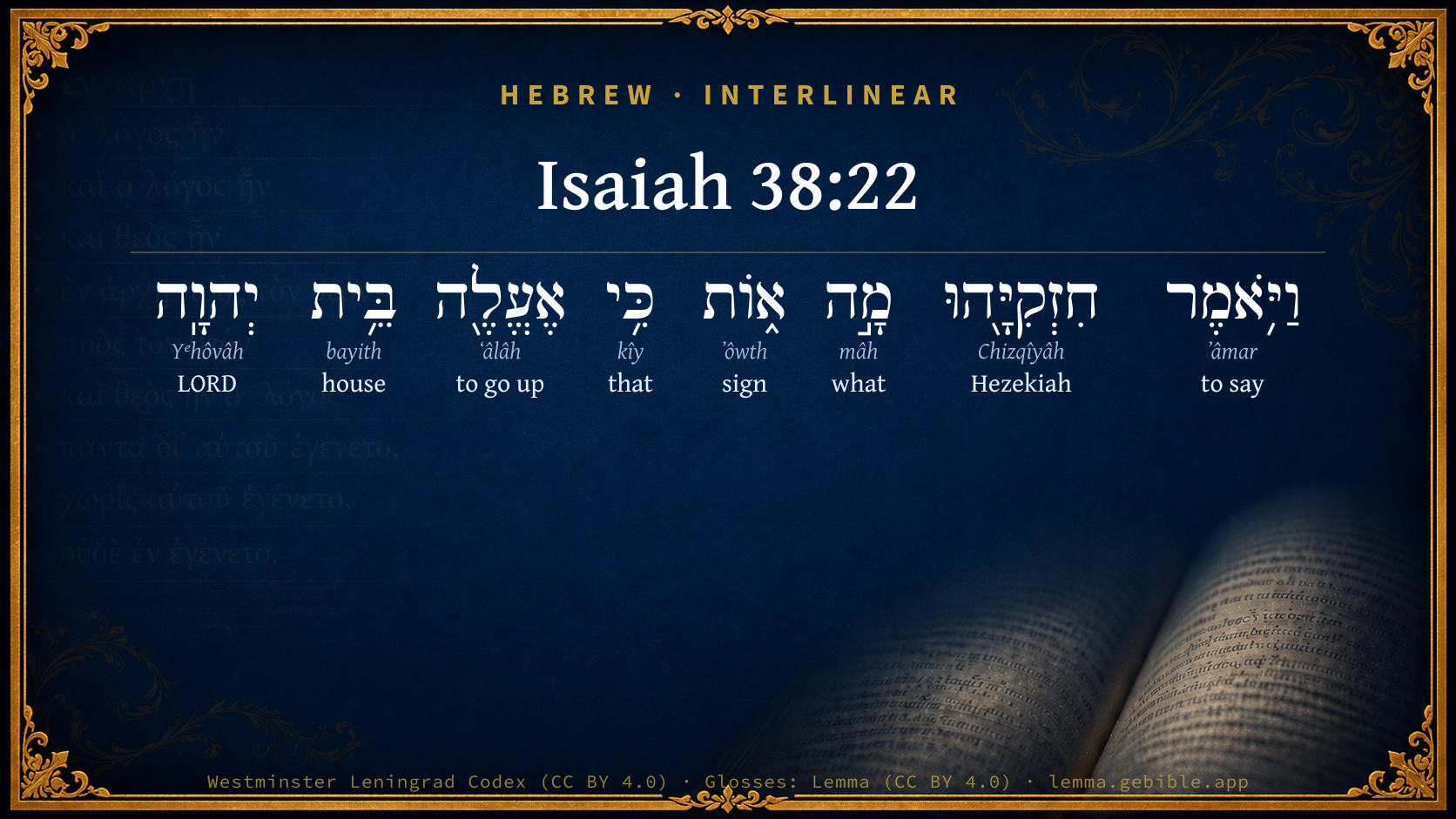
Isaiah 38:22

Hebrew (Westminster Leningrad Codex) Isaiah 38:22 appears in the Hebrew Old Testament. The text above is from the Westminster Leningrad Codex. Each word links to its Strong’s number, a concise gloss, and parsing drawn from the Open Scriptures Hebrew Bible morphology. Click any word for its full Brown-Driver-Briggs (BDB) entry.
Download image
Cite this verse

Isaiah 38:22 (World English Bible). Public Domain. Lemma interlinear Bible study tool, https://lemma.gebible.app/v/isaiah/38/22.

Show BibTeX & RIS
BibTeX
RIS
English Translation
Hezekiah also had said, What is the sign that I shall go up to the house of Yahweh?
World English Bible · Public Domain
Download a study sheet

One document with this verse’s original text, its word-by-word gloss line, the meaning frame, cross-references with their text, attributed commentary, and full source and license credits — printable, and it pastes into notes with its structure intact.

This verse Autodidact and up

Study sheet (.html) Plain text (.txt)

A passage Seminary Student

Up to 50 verses in one chapter. A passage sheet keeps up to 6 commentary sources and 12 cross-references per verse, in the order this page ranks them, and says so on the sheet whenever that leaves anything out. Ask for a single verse and you get the Autodidact verse sheet above.

Everything on this page stays free to read, with no account — the sheet is a download of what is already on screen, not access to it.

Want to remove ads? Support Godless Engineer
Compare translations 3

The same verse in 3 English versions, stacked beneath the original-language interlinear above. Click any original word for its lexicon entry.

Each is an independent rendering of the whole verse — the interlinear is not word-aligned to these translations.

Highlighted words mark where these versions differ — a whole-verse word diff, not a word-by-word alignment.

  • World English Bible Public Domain
    Hezekiah also had said, What is the sign that I shall go up to the house of Yahweh?
  • King James Version Public Domain
    Hezekiah also had said, What is the sign that I shall go up to the house of the LORD?
  • unfoldingWord Literal Text CC BY-SA 4.0
    For Hezekiah had said, “What the sign that I will go up to the house of Yahweh?”

unfoldingWord Literal Text — © unfoldingWord, licensed CC BY-SA 4.0. Word-aligned USFM3 via Door43 (git.door43.org/unfoldingWord/en_ult).

Versions to compare (up to 4)

3 of 4 selected

Show all 18 translations

Every available English version of this verse, each an independent rendering of the whole verse.

  • World English Bible Public Domain
    Hezekiah also had said, What is the sign that I shall go up to the house of Yahweh?
  • Berean Standard Bible Public Domain
    And Hezekiah had asked, “What will be the sign that I will go up to the house of the LORD?”
  • Majority Standard Bible Public Domain
    And Hezekiah had asked, “What will be the sign that I will go up to the house of the LORD?”
  • King James Version Public Domain
    Hezekiah also had said, What is the sign that I shall go up to the house of the LORD?
  • American Standard Version (1901) Public Domain
    Hezekiah also had said, What is the sign that I shall go up to the house of Jehovah?
  • Revised Version (1885) Public Domain
    Hezekiah also had said, What is the sign that I shall go up to the house of the LORD?
  • Geneva Bible (1599) Public Domain
    Also Hezekiah had said, What is ye signe, that I shall goe vp into the House of the Lord?
  • Douay-Rheims (1899) Public Domain
    And Ezechias bed said: What shah be the sign that I shah go up to the house of the Lord?
  • Young's Literal Translation Public Domain
    And Hezekiah saith, `What `is' the sign that I go up to the house of Jehovah!'
  • Literal Standard Version CC BY-SA 4.0
    And Hezekiah says, “What [is] the sign that I go up to the house of YHWH?”
  • Unlocked Literal Bible CC BY-SA 4.0
    Hezekiah also had said, “What will be the sign that I should go up to the house of Yahweh?”
  • unfoldingWord Literal Text CC BY-SA 4.0
    For Hezekiah had said, “What the sign that I will go up to the house of Yahweh?”
  • Darby Bible Public Domain
    And Hezekiah had said, What is the sign that I shall go up into the house of Jehovah?
  • World Messianic Bible Public Domain
    Hezekiah also had said, “What is the sign that I will go up to the LORD’s house?”
  • Webster's Bible Public Domain
    Hezekiah also had said, What is the sign that I shall go up to the house of the LORD?
  • Free Bible Version CC BY-SA 4.0
    Hezekiah had asked, “What is the sign to confirm that I will go to the Lord's Temple?”
  • Bible in Basic English Public Domain
    And Hezekiah said, What is the sign that I will go up to the house of the Lord?
  • JPS Tanakh (1917) Public Domain
    And Hezekiah said. 'What is the sign that I shall go up to the house of the LORD?'

Literal Standard Version (2020), Covenant Press — licensed CC BY-SA 4.0. Text via the HelloAO Bible API (eBible.org). Unlocked Literal Bible (unfoldingWord) — licensed CC BY-SA 4.0. Text via the HelloAO Bible API (eBible.org). unfoldingWord Literal Text — © unfoldingWord, licensed CC BY-SA 4.0. Word-aligned USFM3 via Door43 (git.door43.org/unfoldingWord/en_ult). Free Bible Version, Dr. Jonathan Gallagher — licensed CC BY-SA 4.0. Text via the HelloAO Bible API (eBible.org).

Word by word

More ways to search: Search by grammar → Find every occurrence → Compare this word →

Practice this passage: Drill this verse → Learn its vocabulary →

About this verse

These counts appear in no published source. They are computed here, from the morphology-tagged text and Lemma’s own curated glosses. What Lemma adds →

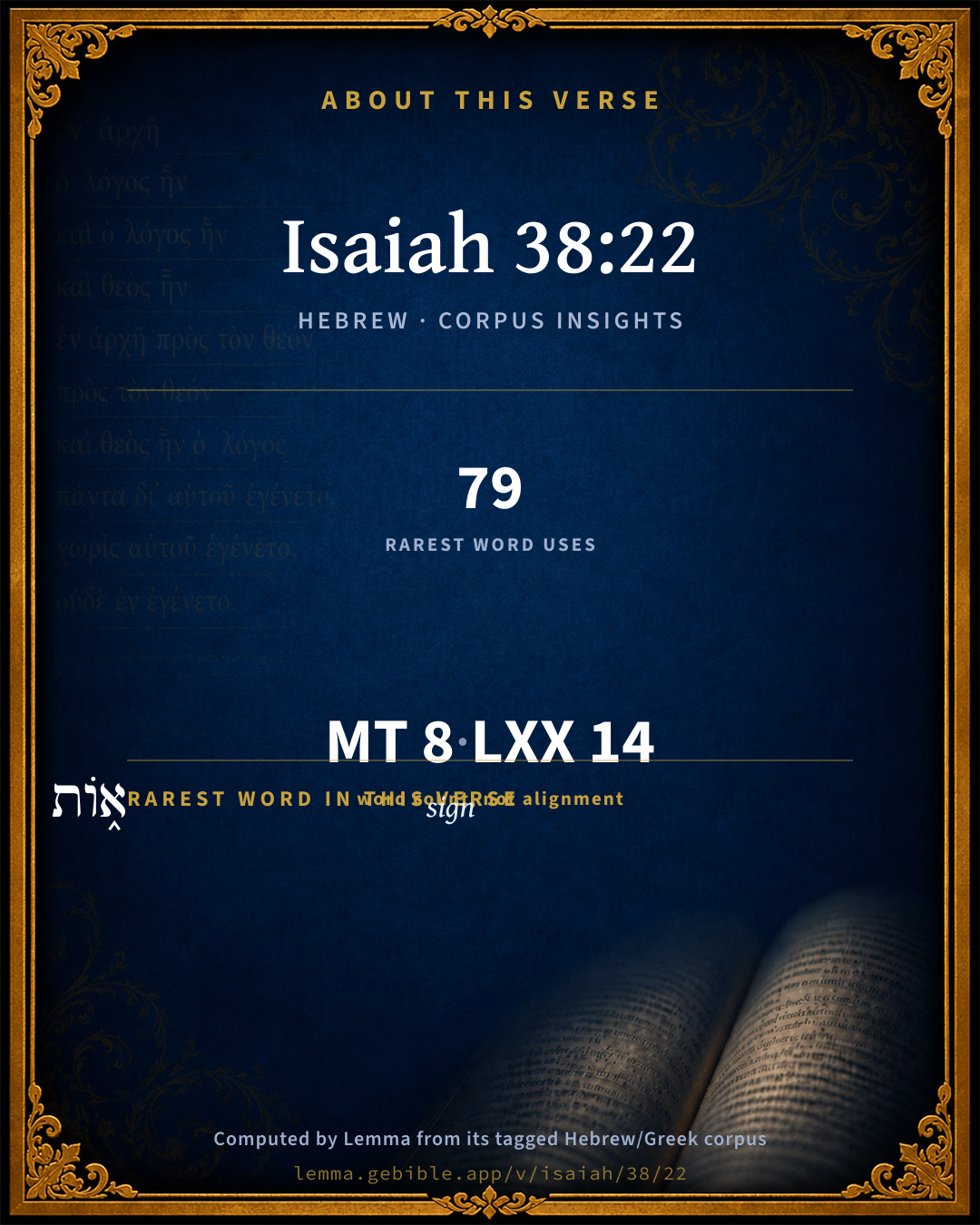
8
words
8
distinct lemmas
Prophets
section

Grammatical profile

  • 2 verbs
  • 4 nouns
  • 1 conjunction
  • 1 particle

Verb forms

  • וַיֹּ֥אמֶר Qal · Sequential Imperfect
  • אֶעֱלֶ֖ה Qal · Imperfect

Hebrew & Septuagint length

In English translation the verse runs 18 words from the Hebrew and 19 from the Septuagint (LXX English) — closely comparable.

A rough comparison of the two English renderings, which tokenize alike — not a word-level alignment.

Word counts can differ between the Hebrew and the Greek without any difference in meaning — e.g. the Hebrew direct-object marker אֵת has no separate Greek word, and Greek often adds the article ὁ.

In the original languages it is 8 Hebrew tokens and 14 Greek tokens — but the two are counted differently (Hebrew bundles its prefixes and suffixes into one token; the Greek is in lemma form), so that isn’t a like-for-like length.

Cross-references

7

Topical passages linked to Isaiah 38:22 in the Treasury of Scripture Knowledge — connected by theme and wording, ordered by reader-vote popularity; previews shown in the World English Bible.

  • 2 Kings 20:8 Hezekiah said to Isaiah, What shall be the sign that Yahweh will heal me, and that I shall go up to the house of Yahweh the third day?
  • Psalms 118:18–19 Yah has punished me severely, But he has not given me over to death.
  • John 5:14 Afterward Jesus found him in the temple, and said to him, "Behold, you are made well. Sin no more, so that nothing worse happens to you."
  • Psalms 42:1–2 As the deer pants for the water brooks, So my soul pants after you, God.
  • Psalms 84:1–2 How lovely are your dwellings, Yahweh of Hosts!
  • Psalms 84:10–12 For a day in your courts is better than a thousand. I would rather be a doorkeeper in the house of my God, Than to dwell in the tents of wickedness.
  • Psalms 122:1 I was glad when they said to me, "Let's go to Yahweh's house!"

Cross-references courtesy of OpenBible.info (CC BY 4.0).

Hebrew and Greek witnesses Masoretic Hebrew ↔ Greek Septuagint

The same verse in the two great witnesses to the Old Testament, shown verse-for-verse.

These are two independent witnesses, not word-aligned to each other, and the Septuagint is shown in lemma (dictionary) form.

Hebrew Isaiah 38:22 Masoretic · Westminster Leningrad Codex

וַיֹּ֥אמֶר חִזְקִיָּ֖הוּ מָ֣ה א֑וֹת כִּ֥י אֶעֱלֶ֖ה בֵּ֥ית יְהוָֽה

Hezekiah also had said, What is the sign that I shall go up to the house of Yahweh?

World English Bible · Public Domain

Greek LXX Isaiah 38:22 Septuagint · lemma form

καί εἶπον εζεκιας οὗτος ὁ σημεῖον ὅτι ἀναβαίνω εἰς ὁ οἶκος κύριος ὁ θεός

And Ezekias said, This is a sign to Ezekias, that I shall go up to the house of God.

LXX2012 (modern English Septuagint) · Public Domain

Hebrew: Westminster Leningrad Codex (CC BY 4.0). Greek: Septuagint (public domain); English from LXX2012 (modern English Septuagint) (Public Domain). How the Septuagint differs from the Hebrew →

Targum (Aramaic paraphrase)

1

The Targum is the ancient Jewish Aramaic paraphrase of the Hebrew Scriptures — an interpretive translation, not the Hebrew text itself. Onkelos (literal) and Pseudo-Jonathan (expansive) render the Torah, and Jonathan the Prophets. Coverage is partial: where no permissively-licensed English translation exists for a verse, only the Aramaic is shown. This is verse-level text, not a word-by-word alignment to the Hebrew.

  1. Targum Jonathan Prophets (Joshua–Malachi)
    וַאֲמַר חִזְקִיָה מָה אָת אֲרֵי אֶסַק לְבֵית מַקְדְשָׁא דַיָי:

    And Hezekiah said, What is the sign that I shall go up to the house of the sanctuary of the Lord?

    Targum Jonathan — Aramaic: “Mikraot Gedolot” (public domain). English: “Sefaria Community Translation” (CC0 1.0 (public-domain dedication)); “London "Chaldee Paraphrase," 1871” (public domain). Text via Sefaria.

Commentary

Notes on Isaiah 38:22 from classic Christian and Jewish commentators (each source and its license shown beneath its notes). The classic Christian expositions comment on the surrounding passage and are grouped to its opening verse, so a note may address several verses; the Jewish commentaries on the Tanakh (Rashi and others) are per-verse, so they appear only where the commentator wrote on this verse.

Lemma curates 59 commentaries, every one of them public domain or Creative Commons licensed, each selected and text-cleaned for this edition rather than reprinted as found. About our sources →

Trapp's Complete Commentary

John Trapp

Isa 38:22 Hezekiah also had said, What [is] the sign that I shall go up to the house of the LORD?

Ver. 22. {See Trapp on "2Ki 20:8"}

John Trapp, A Commentary or Exposition upon All the Books of the Old and New Testament (1647–1656) — public domain. Text from a community e-Sword module.

The Biblical Illustrator

Joseph S. Exell

Isa_38:22

What is the sign that I shall go up to the house of the Lord?

--

Seeking a sign

Real religion is the same in every country and every age. Hence we have so much of the history and experience of the people of God recorded in the Scriptures of truth, that we may compare our experience with theirs. Let us take these words and consider them four ways--

I. AS THE LANGUAGE OF A MAN DESIROUS OF LIFE. There are persons who can talk lightly of death; but it is a solemn thing to die. What was the fortitude of Hume when dying, joking of Charon and his boat, but like whistling aloud to keep his courage up? But we have to observe that death is not always inviting even to a good man.

1. We live under a blessed dispensation; but, though the revelation of Gods will is complete, there are those who are not yet led into all its truths.

2. Sometimes a good mans connections draw him back and attach him still to life. A minister may wish to depart and be with Christ, but he sees a congregation which hang upon his lips; a husband and father may be looking for that blessed hope, and rejoicing in it, but he knows that his death will make the wife a widow and the children fatherless. You talk of self-denial! Who is it that denies himself like that man who is assured of heaven, and yet is willing to forego the blessedness from year to year, who is willing to weep on and war on for the sake of usefulness to others?

3. A good mans evidences of glory are not always clear; this will affect his experience.

4. There may be an event to which the believer may attach some importance, that has not taken place, and which may produce some hesitation in his mind. There was something of this kind, surely, in regard to David; he therefore pleaded for sparing mercy--O spare me, that I may recover strength, before I go hence, and be no more seen. Simeon, too, had the assurance that he should not see death till he had seen the Lords Christ.

5. There is also a constitutional timidity in some. If they are not afraid of death itself, they are afraid of dying. The very apostles wished to enter heaven, if possible, without being unclothed, and therefore said, We that are in this tabernacle do groan, being burdened: not for that we would be unclothed, but clothed upon, that mortality may be swallowed up of life. The fear of death is not sinful. Nature must abhor its own destruction, and if there be anything that can reconcile us to it, it must be supernatural.

II. AS THE LANGUAGE OF A MAN ATTACHED TO THE HOUSE OF GOD: for he does not inquire, What is the sign that I shall ascend my throne? or that I shall give audience to ambassadors, or commands to generals? What is the sign that I shall head my army, or that I shall travel through my country? No, but What is the sign that I shall go up to the house of the Lord? What is it that attaches a good man so much to the house of God?

1. Perhaps tis his birthplace: we refer to his second birth; and if you are not born twice before you die once, it would have been well if you had never been born at all.

2. It is a place of intercourse.

3. It is a place of instruction.

4. It is also a place of devotion. My house shall be called the house of prayer. If Hezekiah loved the house of God before, you may be sure he did not love it less now, having been detained so long from it by sickness. We commonly know best the worth of our mercies by the want of them. How pleasing is the morning after the darkness of the night! How alluring is the spring after the dreary winter! How health is sweetened after the bitterness of pain! and how is liberty endeared by the sufferings of bondage!

III. AS THE LANGUAGE OF A MAN CONCERNED TO SHOW HIS GRATITUDE FOR MERCIES RECEIVED. He wished this, not only for the enjoyment of a privilege, but for the performance of a duty. Having experienced delivering mercy, he knew he ought to praise God, by acknowledging His goodness publicly, and dedicating himself afresh to His glory. So did David Psa_66:13, &c.). This is not always the case. There are many whose only concern when in affliction is to escape from it: whereas, a good man dreads the removal of it, unless it be sanctified, and the end of God be answered in bringing him nearer to Himself. A proper improvement of deliverance from sickness does not lie simply in the offering up of a single thanksgiving: it requires a great deal more than this, which will be mere formality and mockery in the sight of God, unless accompanied with real gratitude, and thankful views and feelings; and unless the actions and the life correspond therewith. Hezekiah had a sad falling off. Hezekiah rendered not again according to the benefit done unto him; for his heart was lifted up.

IV. AS THE LANGUAGE OF A MAN WHOSE FAITH REQUIRES CONFIRMATION. What is the sign that I shall go up to the house of the Lord? Why? Had he not been assured of this by good Isaiah? He ought to have been satisfied. He did not believe it, and he did believe it. Ah, Christians! you know how to explain such an experience as this. (W. Jay, M. A.)

Fear of dying

The excellent Dr. Conyers often said, I am not afraid of death, but I am afraid of dying; I am not afraid of the end, but of the passage. He therefore often said in prayer, O Lord, if it be Thy blessed will, let me die in Thy blessed service! And his wish was granted, for he sank down in the church, and even in the pulpit. (W. Jay, M. A.)

.

The Biblical Illustrator, edited by Joseph S. Exell (c. 1880s–1900s) — public domain. Text from a community e-Sword module.

Tyndale Open Study Notes

Tyndale Open Resources

38:22 Hezekiah could not go to the Temple with an infection (see Lev 13), so going to the Temple signifies restored health.

Tyndale Open Study Notes — © Tyndale Open Resources, licensed CC BY-SA 4.0. Text via the HelloAO Bible API.

Geneva Bible (1599)

Geneva Bible translators

As verse 7.

Geneva Bible (1599) marginal notes — public domain. Text via Bolls.life.

Jamieson, Fausset & Brown

Robert Jamieson, A. R. Fausset & David Brown

house of the Lord--Hence he makes the praises to be sung there prominent in his song (Isa 38:20; Psa 116:12-14, Psa 116:17-19).

Next: Isaiah Chapter 39

Jamieson, Fausset & Brown — Commentary Critical and Explanatory on the Whole Bible (1871) — public domain (CC PDM 1.0). Text via the HelloAO Bible API.

Albert Barnes' Notes on the Bible

Hezekiah also had said - What evidence or proof have I that I shall be restored, and permitted to go to the temple? The miracle on the sun-dial was performed in answer to this request, and as a demonstration that he should yet be permitted to visit the temple of God (see the note at Isa 38:7).

Albert Barnes' Notes on the Bible (1834–1885) — public domain. Text from a community e-Sword/MySword module.

Haydock's Catholic Bible Commentary

Lord. The answer is given, (4 Kings xx. 9.) which seems to evince that this is only an extract. (Calmet) --- The prophet prescribed the medicine, and the king asked for a sign before he sung the canticle. (Worthington)

George Leo Haydock (1774–1849), Haydock's Catholic Family Bible and Commentary, 1859 edition — public domain. Excludes Psalms (Douay-Rheims chapter numbering differs from Protestant) and Deuterocanonical books (Catholic canon only).

Matthew Poole's English Annotations

Hezekiah also had said; or, For Hezekiah had said; had asked a sign, which is here added as the reason why Isaiah said what is related in the foregoing verse, to wit, in answer to Hezekiah’s question.

That I shall go up, within three days, as is more fully related, 2Ki 20:5,8,

to the house of the Lord; for thither he designed in the first place to go, partly that he might pay his vow and thanksgiving. to God, and partly that he might engage the people to praise God with him, and for him.

Matthew Poole's English Annotations on the Holy Bible (1683–1685) — public domain. Text from a community e-Sword/MySword module.

The Pulpit Commentary

Hezekiah also had said; literally, and Hezekiah said. Our translators, both in this verse and at the commencement of ver. 21, have endeavoured to conceal the awkwardness of the nexus, or rather want of nexus , with what precedes, by a modification of the rendering. The true sense is brought out by the proceeding, which is, however, a little arbitrary.

The Pulpit Commentary (1880–1919), ed. H.D.M. Spence-Jones & Joseph S. Exell — public domain. Text from a community e-Sword module.

J. A. Alexander on Isaiah

Joseph Addison Alexander

“And Hezekiah said, What sign that I shall go up (to) the house of Jehovah?” The ellipsis is easily supplied by reading, what sign dost thou give, or what sign is there, or more simply still, what is the sign? The question is more fully given in 2Ki 20:8 as follows. ‘And Hezekiah said to Isaiah, What sign that Jehovah is about to heal me, and that I shall go up, on the third day, to the house of Jehovah?’ The reference is to the promise as recorded in v. 5 of the same chapter. ‘Return and say to Hezekiah the chief of my people, Thus saith Jehovah, the God of David thy father, I have heard thy prayer, I have seen thy tears; behold, I am about to heal thee; on the third day thou shalt go up to the house of Jehovah.’ The last two verses of this chapter in Isaiah are evidently out of their chronological order, and the question has been raised, whether this transposition is to be ascribed to the original writer, and if so how it is to be accounted for. The obvious and simple supposition is that the passage before us is the first draft or original form of Isaiah’s narrative, in which the facts recorded in these two last verses were added by a kind of afterthought, and that in re-writing the account, as a part of the national history, he naturally placed them in their chronological order. It would probably be easy to produce many parallel cases from the correspondence of voluminous letter-writers, or from other cases of repeated composition on the same subject by the same writer.

Joseph Addison Alexander, The Prophecies of Isaiah (1846–1847; New York: Scribner, 1870–1878) — public domain. Text from a community e-Sword module.

Rashi

Rabbi Shlomo Yitzchaki (Rashi)

What a sign How good and how beautiful is this sign which is given to me that I will go up to the house of the Lord!

Rashi on the Tanakh — English translations: “The Judaica Press complete Tanach with Rashi, translated by A. J. Rosenberg” (CC BY 4.0); “Pentateuch with Rashi's commentary by M. Rosenbaum and A.M. Silbermann, 1929-1934” (public domain); “The Metsudah Tanach series, Lakewood, N.J” (CC BY 4.0); and “The Book of Joshua, Metsudah Publications, 1997” (CC BY 4.0). Text via Sefaria.

Ibn Ezra

Rabbi Abraham ibn Ezra

ויאמר חזקיהו Hezekiah also had said before, What is the sign, as mentioned above (38:7)

Ibn Ezra on the Tanakh — English translations: “Sefaria Community Translation” (CC0 1.0 (public-domain dedication)); “Yalkut, Sifsei Chachomim Chumash, Metsudah Publications, 2009” (CC BY 4.0); and “Commentary of Ibn Ezra on Isaiah - trans. by M. Friedlander, 1873” (public domain). Text via Sefaria.

Lesson kit

Teaching starters — assembled from the data on this page, not authored interpretation. Every prompt links to the verse data it draws on. Edit before teaching.

Isaiah, in the Prophets, opens this verse with 8 words (8 distinct Hebrew lemmas). Its most distinctive word is ʼôwth (“sign”). A historical commentator’s framing appears above. Read the whole chapter for the surrounding context.

Discussion questions

  1. The word ʼôwth carries the sense “sign.” How does it shape the verse?
  2. 2 Kings 20:8 shares this passage’s theme. How do the two illuminate each other?
  3. These translations render this verse differently. What is at stake in choosing one wording over another?
  4. The verb «וַיֹּ֥אמֶר» is Qal Sequential Imperfect. How does its form color the action?
  5. Reading how Trapp's Complete Commentary and The Biblical Illustrator read this verse, where do the two commentators agree and where do they part?

Things to notice

Reading settings

Reading text

Shown beneath each verse's original-language words.

Old Testament
Old Testament edition

Read the OT as the Masoretic Hebrew (MT) or the Greek Septuagint (LXX).

English shown for the Greek Septuagint (in the Hebrew ↔ Greek comparison).

Comparing translations? Open the Compare panel on any verse page to stack up to four side by side.