
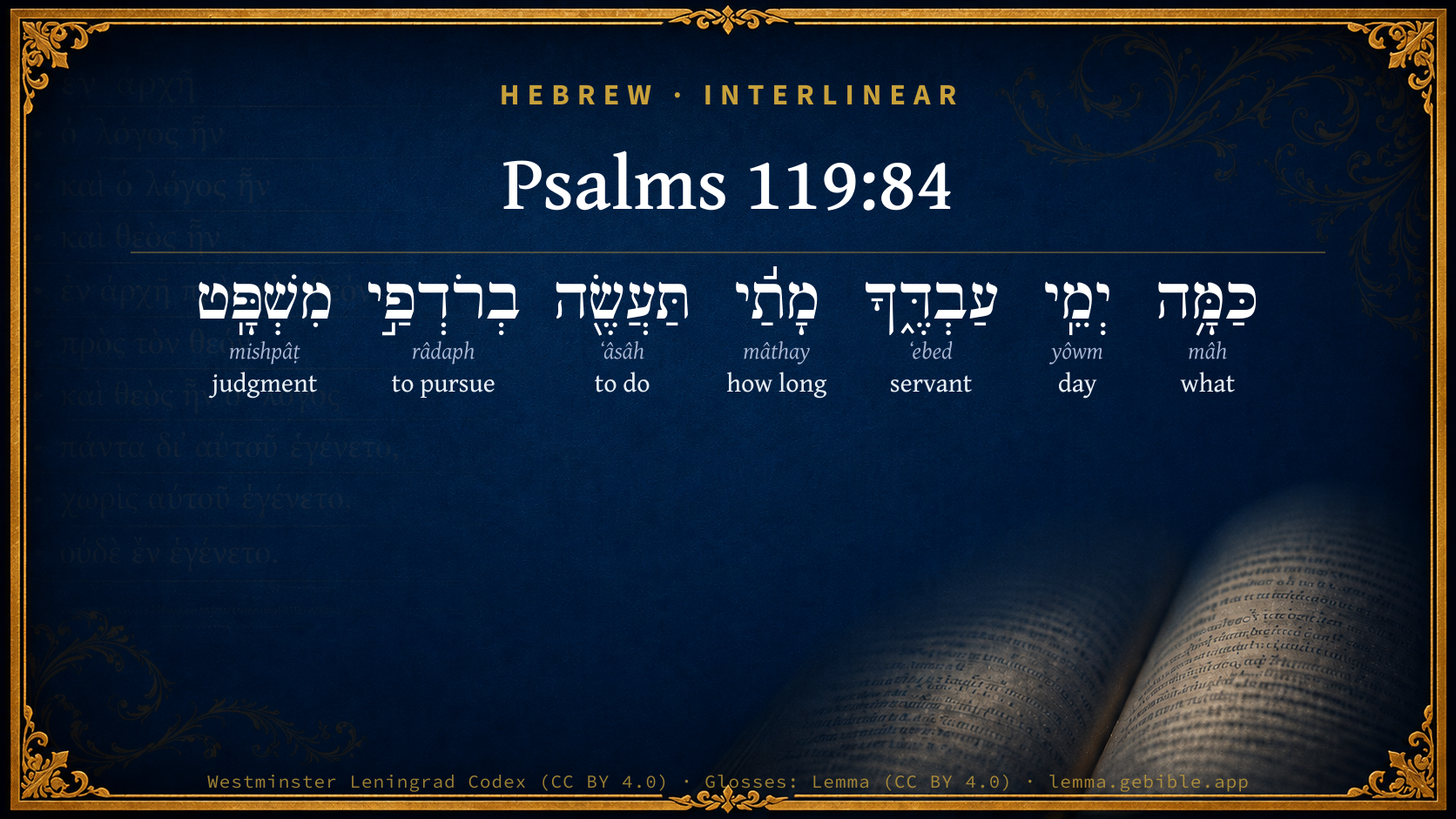
Psalms 119:84

Hebrew (Westminster Leningrad Codex) Psalms 119:84 appears in the Hebrew Old Testament. The text above is from the Westminster Leningrad Codex. Each word links to its Strong’s number, a concise gloss, and parsing drawn from the Open Scriptures Hebrew Bible morphology. Click any word for its full Brown-Driver-Briggs (BDB) entry.
Download image
Cite this verse

Psalms 119:84 (World English Bible). Public Domain. Lemma interlinear Bible study tool, https://lemma.gebible.app/v/psalms/119/84.

Show BibTeX & RIS
BibTeX
RIS
English Translation
How many are the days of your servant? When will you execute judgment on those who persecute me?
World English Bible · Public Domain
Download a study sheet

One document with this verse’s original text, its word-by-word gloss line, the meaning frame, cross-references with their text, attributed commentary, and full source and license credits — printable, and it pastes into notes with its structure intact.

This verse Autodidact and up

Study sheet (.html) Plain text (.txt)

A passage Seminary Student

Up to 50 verses in one chapter. A passage sheet keeps up to 6 commentary sources and 12 cross-references per verse, in the order this page ranks them, and says so on the sheet whenever that leaves anything out. Ask for a single verse and you get the Autodidact verse sheet above.

Everything on this page stays free to read, with no account — the sheet is a download of what is already on screen, not access to it.

Want to remove ads? Support Godless Engineer
Compare translations 3

The same verse in 3 English versions, stacked beneath the original-language interlinear above. Click any original word for its lexicon entry.

Each is an independent rendering of the whole verse — the interlinear is not word-aligned to these translations.

Highlighted words mark where these versions differ — a whole-verse word diff, not a word-by-word alignment.

  • World English Bible Public Domain
    How many are the days of your servant? When will you execute judgment on those who persecute me?
  • King James Version Public Domain
    How many are the days of thy servant? when wilt thou execute judgment on them that persecute me?
  • unfoldingWord Literal Text CC BY-SA 4.0
    How many the days of your servant? When will you act in pursuing justice for me?

unfoldingWord Literal Text — © unfoldingWord, licensed CC BY-SA 4.0. Word-aligned USFM3 via Door43 (git.door43.org/unfoldingWord/en_ult).

Versions to compare (up to 4)

3 of 4 selected

Show all 17 translations

Every available English version of this verse, each an independent rendering of the whole verse.

  • World English Bible Public Domain
    How many are the days of your servant? When will you execute judgment on those who persecute me?
  • Berean Standard Bible Public Domain
    How many days must Your servant wait? When will You execute judgment on my persecutors?
  • Majority Standard Bible Public Domain
    How many days must Your servant wait? When will You execute judgment on my persecutors?
  • King James Version Public Domain
    How many are the days of thy servant? when wilt thou execute judgment on them that persecute me?
  • American Standard Version (1901) Public Domain
    How many are the days of thy servant? When wilt thou execute judgment on them that persecute me?
  • Revised Version (1885) Public Domain
    How many are the days of thy servant? when wilt thou execute judgment on them that persecute me?
  • Geneva Bible (1599) Public Domain
    Howe many are the dayes of thy seruant? When wilt thou execute iudgement on them that persecute me?
  • Young's Literal Translation Public Domain
    How many `are' the days of Thy servant? When dost Thou execute Against my pursuers judgment?
  • Literal Standard Version CC BY-SA 4.0
    How many [are] the days of Your servant? When do You execute judgment || Against my pursuers?
  • Unlocked Literal Bible CC BY-SA 4.0
    How long must your servant endure this; when will you judge those who persecute me?
  • unfoldingWord Literal Text CC BY-SA 4.0
    How many the days of your servant? When will you act in pursuing justice for me?
  • Darby Bible Public Domain
    How many shall be the days of thy servant? when wilt thou execute judgment on them that persecute me?
  • World Messianic Bible Public Domain
    How many are the days of your servant? When will you execute judgment on those who persecute me?
  • Webster's Bible Public Domain
    How many are the days of thy servant? when wilt thou execute judgment on them that persecute me?
  • Free Bible Version CC BY-SA 4.0
    How long do I have to wait before you punish my persecutors?
  • Bible in Basic English Public Domain
    How short is the life of your servant! when will you give your decision against those who are attacking me?
  • JPS Tanakh (1917) Public Domain
    How many are the days of Thy servant? When wilt Thou execute judgment on them that persecute me?

Literal Standard Version (2020), Covenant Press — licensed CC BY-SA 4.0. Text via the HelloAO Bible API (eBible.org). Unlocked Literal Bible (unfoldingWord) — licensed CC BY-SA 4.0. Text via the HelloAO Bible API (eBible.org). unfoldingWord Literal Text — © unfoldingWord, licensed CC BY-SA 4.0. Word-aligned USFM3 via Door43 (git.door43.org/unfoldingWord/en_ult). Free Bible Version, Dr. Jonathan Gallagher — licensed CC BY-SA 4.0. Text via the HelloAO Bible API (eBible.org).

Word by word

More ways to search: Search by grammar → Find every occurrence → Compare this word →

Practice this passage: Drill this verse → Learn its vocabulary →

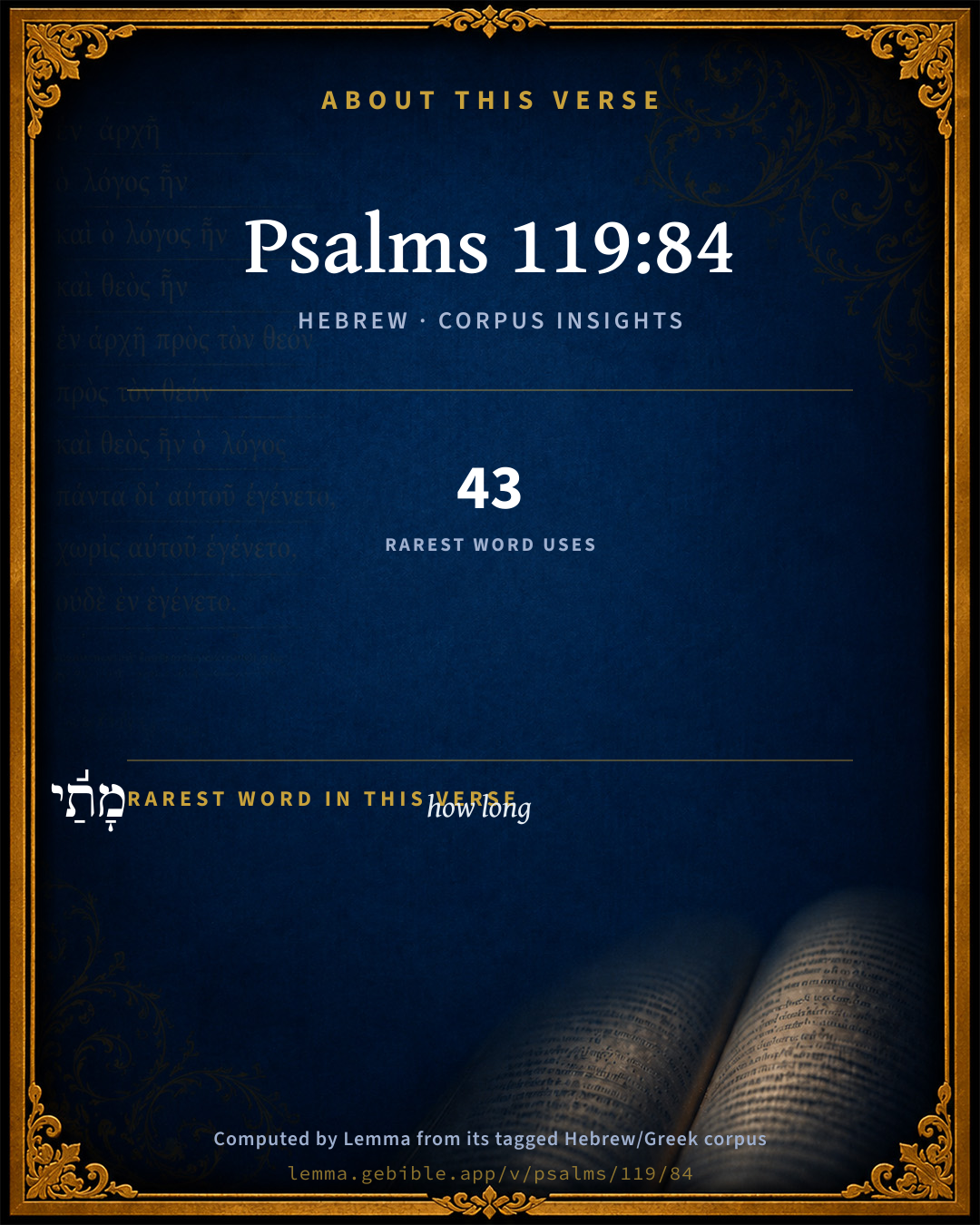
About this verse

These counts appear in no published source. They are computed here, from the morphology-tagged text and Lemma’s own curated glosses. What Lemma adds →

7
words
7
distinct lemmas
Wisdom
section

Shared distinctive vocabulary

מָתַ֬י how long H4970 occurs in 40 verses of the Hebrew Bible. Also found in:

Grammatical profile

  • 2 verbs
  • 3 nouns
  • 2 particles

Verb forms

  • תַּעֲשֶׂ֖ה Qal · Imperfect
  • בְרֹדְפַ֣י Qal · Participle Active

Hebrew & Septuagint length

In English translation the verse runs 18 words from the Hebrew and 20 from the Septuagint (LXX English) — closely comparable.

A rough comparison of the two English renderings, which tokenize alike — not a word-level alignment.

Word counts can differ between the Hebrew and the Greek without any difference in meaning — e.g. the Hebrew direct-object marker אֵת has no separate Greek word, and Greek often adds the article ὁ.

Cross-references

6

Topical passages linked to Psalms 119:84 in the Treasury of Scripture Knowledge — connected by theme and wording, ordered by reader-vote popularity; previews shown in the World English Bible.

  • Psalms 90:12 So teach us to number our days, That we may gain a heart of wisdom.
  • Revelation 6:10–11 They cried with a loud voice, saying, "How long, Master, the holy and true, until you judge and avenge our blood on those who dwell on the earth?"
  • Psalms 7:6 Arise, Yahweh, in your anger. Lift up yourself against the rage of my adversaries. Awake for me. You have commanded judgment.
  • Psalms 39:4–5 "Yahweh, show me my end, What is the measure of my days. Let me know how frail I am.
  • Psalms 89:47–48 Remember how short my time is! For what vanity have you created all the children of men!
  • Job 7:6–8 My days are swifter than a weaver's shuttle, And are spent without hope.

Cross-references courtesy of OpenBible.info (CC BY 4.0).

Hebrew and Greek witnesses Masoretic Hebrew ↔ Greek Septuagint

The same verse in the two great witnesses to the Old Testament, shown verse-for-verse.

You’re reading Greek Psalm 118 (Hebrew Psalm 119). The Septuagint counts the superscription, so verse numbers can differ from the Hebrew — chapter-level alignment, not verse-by-verse. Numbering follows Rahlfs.

These are two independent witnesses, not word-aligned to each other, and the Septuagint is shown in lemma (dictionary) form.

Hebrew Psalms 119:84 Masoretic · Westminster Leningrad Codex

כַּמָּ֥ה יְמֵֽי עַבְדֶּ֑ךָ מָתַ֬י תַּעֲשֶׂ֖ה בְרֹדְפַ֣י מִשְׁפָּֽט

How many are the days of your servant? When will you execute judgment on those who persecute me?

World English Bible · Public Domain

Greek LXX Greek Psalm 118:84 Septuagint · lemma form

πόσος εἰμί ὁ ἡμέρα ὁ δοῦλος σύ πότε ποιέω ἐγώ ἐκ ὁ καταδιώκω ἐγώ κρίσις

How many are the days of your servant? when will you execute judgment for me on them that persecute me?

LXX2012 (modern English Septuagint) · Public Domain

Hebrew: Westminster Leningrad Codex (CC BY 4.0). Greek: Septuagint (public domain); English from LXX2012 (modern English Septuagint) (Public Domain). How the Septuagint differs from the Hebrew →

Commentary

Notes on Psalms 119:84 from classic Christian and Jewish commentators (each source and its license shown beneath its notes). The classic Christian expositions comment on the surrounding passage and are grouped to its opening verse, so a note may address several verses; the Jewish commentaries on the Tanakh (Rashi and others) are per-verse, so they appear only where the commentator wrote on this verse.

Lemma curates 59 commentaries, every one of them public domain or Creative Commons licensed, each selected and text-cleaned for this edition rather than reprinted as found. About our sources →

Trapp's Complete Commentary

John Trapp

Psa 119:84 How many [are] the days of thy servant? when wilt thou execute judgment on them that persecute me?

Ver. 84. How many are the days of thy servant] i.e. Mine evil days, Pro 15:15. All the days of the afflicted are evil; {see Psa 37:12} and these soon seem many to us.

When wilt thou execute judgment, &c.] This is the voice of those martyrs, Rev 6:10-11, who are thereupou willed to have patience, till the number of their brethren is fulfilled.

John Trapp, A Commentary or Exposition upon All the Books of the Old and New Testament (1647–1656) — public domain. Text from a community e-Sword module.

The Biblical Illustrator

Joseph S. Exell

Psa_119:84

How many are the days of Thy servant?

when wilt Thou execute judgment on them that persecute me?

A suggestive question

I. Gods knowledge of the length of mans life. To Him there are no accidental deaths, no premature graves.

II. Mans ignorance of the length of his life. This indicates

1. The goodness of God. Were man to know the exact time of his death, it would paralyze his energies and check his enjoyments.

2. The duty of man--to be always ready, awaiting his summons.

III. The trying element in mans life. The weight of years, the departure of old friends, the narrowing of the region of hope, the want of purpose not only reconcile him to his fate, but create in him a craving for the long rest of the long, long grave. I do not wish to die, says Cicero, but I care not if I were dead. A mans willingness to die is no proof of his religion. (Homilist.)

The Biblical Illustrator, edited by Joseph S. Exell (c. 1880s–1900s) — public domain. Text from a community e-Sword module.

J. A. Alexander on Psalms

Joseph Addison Alexander

84. (Psa 119:84) How many are the days of thy servant? When wilt thou execute upon my persecutors judgment? The shortness of life is indirectly urged as an argument for speedy action. See above, on Psa 39:4; Psa 39:13; Psa 78:39; Psa 89:47-48. Execute judgment, or do justice, as in Psa 9:4.

Joseph Addison Alexander, The Psalms Translated and Explained (1850) — public domain. Text from a community e-Sword module.

Geneva Bible (1599)

Geneva Bible translators

How long wilt thou afflict thy servant.

Geneva Bible (1599) marginal notes — public domain. Text via Bolls.life.

Matthew Henry's Commentary

Here, I. David prays against the instruments of his troubles, that God would make haste to execute judgment on those that persecuted him. He prays not for power to avenge himself (he bore no malice to any), but that God would take to himself the vengeance that belonged to him, and would repay (Rom 12:19), as the God that sits in the throne judging right. There is a day coming, and a great and terrible day it will be, when God will execute judgment on all the proud persecutors of his people, tribulation to those that troubled them; Enoch foretold it (Jde 1:14), whose prophecy perhaps David here had an eye to; and that day we are to look for and pray for the hastening of. Come, Lord Jesus, come quickly. 2. He pleads the long continuance of his trouble: "How many are the days of thy servant? The days of my life are but few" (so some); "therefore let them not all be miserable, and therefore make haste to appear for me against my enemies, before I go hence and shall be seen no more." Or rather, "The days of my affliction are many; thou seest, Lord, how many they be; when wilt thou return in mercy to me? Sometimes, for the elect's sake, the days of trouble are shortened. O let the days of my trouble be shortened; I am thy servant; and therefore, as the eyes of a servant are to the hand of his master, so are mine to thee, until thou have mercy on me."

Matthew Henry's Commentary on the Whole Bible (1708–1710) — public domain (CC PDM 1.0). Text via the HelloAO Bible API.

Adam Clarke's Commentary

Verse 84. How many are the days of thy servants] Dost thou not know that I have few to live, and they are full of trouble?

When wilt thou execute judgment on them that persecute me?] Shall not the pride of the Chaldeans be brought down, the arm of their strength broken, and thy people delivered? In this verse there is none of the ten words used in reference to God's law.

Adam Clarke's Commentary on the Bible (1810–1826) — public domain. Text from a community e-Sword/MySword module.

John Calvin's Commentaries

84. How many are the days of thy servant? etc. Some read these two clauses apart, as if the first were a general complaint of the brevity of human life, such as is to be met with in other psalms, and more frequently in the book of Job; and next, in their opinion, there follows a special prayer of the Psalmist, that God would take vengeance upon his enemies. But I rather prefer joining the two clauses together, and limit both to David’s afflictions; as if it had been said, Lord, how long hast thou determined to abandon thy servant to the will of the ungodly? when wilt thou set thyself in opposition to their cruelty and outrage, in order to take vengeance upon them? The Scriptures often use the word days in this sense; as, for example, “the days of Egypt,” Ezekiel 30:9; “the days of Babylon,” and “the days of Jerusalem,” Psalm 137:7; a word which, in other places, is called “the day of visitation,” Isaiah 10:3. By the use of the plural number, is denoted a certain determinate portion of time, which, in other places, is compared to the “days of an hireling,” Job 14:6; Isaiah 16:14. The Psalmist does not, then, bewail in general the transitory life of man, but he complains that the time of his state of warfare in this world had been too long protracted; and, therefore, he naturally desires that it might be brought to a termination. In expostulating with God about his trouble, he does not do so obstinately, or with a murmuring spirit; but still, in asking how long it will be necessary for him to suffer, he humbly prays that God would not delay to succor him. As to the point of his stirring him up by prayer to execute vengeance, we have elsewhere seen in what sense it was lawful for him to make such a request; namely, because the vengeance which he desired to see was such as is properly suitable to God. It is certain that he had divested himself of all the corrupt affections of the flesh, that he might, with a pure and undisturbed zeal, desire God’s judgment. He, however, in this passage, only wishes in general to be delivered by the hand of God from the wrongs which were inflicted upon him, without adjudging to perdition his adversaries; for he was quite contented, provided God appeared to defend him.

John Calvin's Commentaries (1540-1563) — public domain. Text from the Calvin Translation Society English edition (1840s-50s) via the Christian Classics Ethereal Library (ccel.org). Calvin's coverage is partial (roughly two-thirds of the Bible); uncommented books and verses are honest gaps, never fabricated. The 19th-century editor's footnotes and remarks are omitted so the notes are faithfully Calvin's own voice.

Ellicott's Commentary for English Readers

(84) As in Psa_89:47-48, the psalmist here utters what was the dread of each generation of Israel, a dread lest it should have passed away before the day of deliverance should arrive.

A Bible Commentary for English Readers, edited by Charles John Ellicott (1878–1897) — public domain. Text from a community e-Sword module.

The Cambridge Bible for Schools and Colleges

gen. ed. J. J. S. Perowne

84. How many &c.] Few at the most. The brevity of life is an argument for the speedy punishment of the Psalmist’s persecutors, otherwise he may not live to see God’s justice vindicated. Cp. Psa_89:47; Psa_102:11 ff.

The Cambridge Bible for Schools and Colleges (gen. ed. J. J. S. Perowne; Cambridge University Press, 1878–1918) — public domain. Text from a community e-Sword module.

John Gill's Exposition

Quicken me after thy lovingkindness,.... According to it, and with it; let me have some discoveries of it, and of interest in it; and that will quicken me, revive and comfort me, under all the reproaches, ill usage, and persecutions of men. The love of God shed abroad in the heart comforts and supports under all sorts of afflictions; it quickens the graces of the Spirit, and brings them forth into lively exercise, as faith, hope, and love; and to a diligent and fervent discharge of every duty: it constrains to love the Lord, and live to him, to his glory, in obedience to his will;

so shall I keep the testimony of thy mouth; the word of God, which comes out of his mouth, testifies of him, and of his mind and will; and which is to be received and observed, as being greater than the testimony of men, Jo1 5:9.

John Gill's Exposition of the Whole Bible (1746–1763) — public domain (CC PDM 1.0). Text via the HelloAO Bible API.

Albert Barnes' Notes on the Bible

How many are the days of thy servant? - I cannot hope to live long. I am sinking under my burdens. If I am, therefore, to see the accomplishment of my desires - my deliverance from my enemies and my troubles - it must be soon. This is not a desire to be told how long he was to live, as if it were an object of desire to know this, but it is a method of saying that he could not live long under these circumstances, and therefore he offered this earnest prayer that God would interpose and save him soon.

When wilt thou execute judgment on them that persecute me? - How long shall this be delayed? I look for this; I expect it; I rely on thy promise that it shall be done; but if done so that I shall see it, it must soon be done, for I shall soon sink into the grave. It is a prayer that God would come and do quickly what he felt assured he would do, in delivering him from his foes.

Albert Barnes' Notes on the Bible (1834–1885) — public domain. Text from a community e-Sword/MySword module.

Matthew Poole's English Annotations

The days; either,

1. The days of my life, as the word days is commonly used, Gen 6:3; Job 7:1,6; Psa 39:5,6. I have but a little while to live in the world, give me some respite before I die, and help me speedily, otherwise it will be too late. Or rather,

2. The days of my misery, as the next clause implies, and as days are taken, Psa 37:13; 116:2, and elsewhere. How long, Lord, shall my miseries last? for ever?

Matthew Poole's English Annotations on the Holy Bible (1683–1685) — public domain. Text from a community e-Sword/MySword module.

The Treasury of David

Charles H. Spurgeon

Ver. 84. How many are the days of thy servant? I cannot hope to live long in such a condition, thou must come speedily to my rescue, or I shall die. Shall all my short life be consumed in such destroying sorrows? The brevity of life is a good argument against the length of an affliction. Perhaps the Psalmist means that his days seemed too many when they were spent in such distress. He half wished that they were ended, and therefore he asked in trouble, "How many are the days of thy servant?" Like a hired servant, he had a certain term to serve, and he would not complain; but still the time seemed long because his griefs were so heavy. No one knows the appointed number of our days except the Lord, and therefore to him the appeal is made that he would not prolong them beyond his servant's strength. It cannot be the Lord's mind that his own servant should always be treated so unjustly; there must be an end to it; when would it be?

When wilt thou execute judgment on them that persecute me? He had placed his case in the Lord's hands, and he prayed that sentence might be given and put into execution. He desired nothing but justice, that his character might be cleared and his persecutors silenced. He knew that God would certainly avenge Iris own elect, but the day of rescue tarried, the hours dragged heavily along, and the persecuted one cried day and night for deliverance.

Ver. 84. How many are the days of thy servant? etc. Some read the two clauses apart, as if the first were a general complaint of the brevity of human life, such as is to be met with in other Psalms, and more frequently in the book of Job; and next, in their opinion, there follows a special prayer of the Psalmist that God would take vengeance upon his enemies. But I rather prefer joining the two clauses together, and limit both to David's afflictions; as if it had been said, Lord, how long hast thou determined to abandon thy servant to the will of the ungodly? when wilt thou set thyself in opposition to their cruelty and outrage, in order to take vengeance upon them? The Scriptures often use the word "days" in this sense... By the use of the plural number is denoted a determinate portion of time, which, in other places, is compared to the "days of an hireling": Job 14:6; Isa 16:14. The Psalmist does not, then, bewail in general the transitory life of man, but he complains that the time of his state of warfare in this world had been too long protracted; and, therefore, he naturally desires that it might be brought to a termination. In expostulating with God about his troubles, he does not do so obstinately, or with a murmuring spirit; but still, in asking how long it will be necessary for him to suffer, he humbly prays that God would not delay to succour him. John Calvin.

Ver. 84. When wilt thou execute judgment on them that persecute me? He declares that he does not doubt but that there will be at some period an end to his afflictions, and that there will be a time in which his haters and enemies will be judged and punished. He assumes the fact and therefore enquires the date. Thus in the saints their very impatience of delay does itself prove their confidence of future salvation and deliverance. Wolfgang Musculus.

Ver. 84. When wilt thou execute judgment, etc. This is an ordinary prayer, not against any certain persons, but rather generally against God's enemies and their evil courses. For the Lord executeth judgment upon his children for their conversion, as Paul (Acts 9), and upon the wicked for their confusion. He prayeth against them that belonged not to God, and yet not so much against their persons as their evil causes; and no otherwise against their persons than as they are joined with the evil causes. Thus we may pray for the confusion of God's enemies; otherwise we cannot. R. Greenham.

Ver. 84. In this verse there is none of the ten words used in reference to God's law. Adam Clarke. Is not judgment one of them? C.H.S.

Ver. 84. A solemn question pointing to the shortness of life, the severity of sorrow, the necessity of industry, the nearness of the reward.

Psalms 119:85*

Charles H. Spurgeon's The Treasury of David (1869–1885) — public domain. Psalms only. Text from a community e-Sword/MySword module.

The Pulpit Commentary

How many are the days of thy servant? i.e. How little of my life is left! If thou delayest much longer, my days will all be gone. When writ thou execute judgment on them that persecute me? (see the comment on ver. 82b).

The Pulpit Commentary (1880–1919), ed. H.D.M. Spence-Jones & Joseph S. Exell — public domain. Text from a community e-Sword module.

John Wesley's Explanatory Notes

The days - The days of my life. I have but a little while to live; give me some respite before I die.

John Wesley, Explanatory Notes Upon the Whole Bible (1754–1765) — public domain. Text via the GEBible commentary corpus.

Rashi

Rabbi Shlomo Yitzchaki (Rashi)

When will You execute that I might see it in my days.

Rashi on the Tanakh — English translations: “The Judaica Press complete Tanach with Rashi, translated by A. J. Rosenberg” (CC BY 4.0); “Pentateuch with Rashi's commentary by M. Rosenbaum and A.M. Silbermann, 1929-1934” (public domain); “The Metsudah Tanach series, Lakewood, N.J” (CC BY 4.0); and “The Book of Joshua, Metsudah Publications, 1997” (CC BY 4.0). Text via Sefaria.

Lesson kit

Teaching starters — assembled from the data on this page, not authored interpretation. Every prompt links to the verse data it draws on. Edit before teaching.

Psalms, in the Wisdom, opens this verse with 7 words (7 distinct Hebrew lemmas). Its most distinctive word is mâthay (“how long”). A historical commentator’s framing appears above. Read the whole chapter for the surrounding context.

Discussion questions

  1. The word mâthay carries the sense “how long.” How does it shape the verse?
  2. How does Genesis 30:30, which shares the word «how long», read alongside this verse?
  3. These translations render this verse differently; the difference is in the English rendering, not the original. What questions does that raise?
  4. «תַּעֲשֶׂ֖ה» is a Qal Imperfect verb. How does that grammatical form shape the action described?
  5. Compare how Trapp's Complete Commentary and The Biblical Illustrator read this verse. Where do they agree or differ?

Things to notice

Reading settings

Reading text

Shown beneath each verse's original-language words.

Old Testament
Old Testament edition

Read the OT as the Masoretic Hebrew (MT) or the Greek Septuagint (LXX).

English shown for the Greek Septuagint (in the Hebrew ↔ Greek comparison).

Comparing translations? Open the Compare panel on any verse page to stack up to four side by side.