
Isaiah 39:4

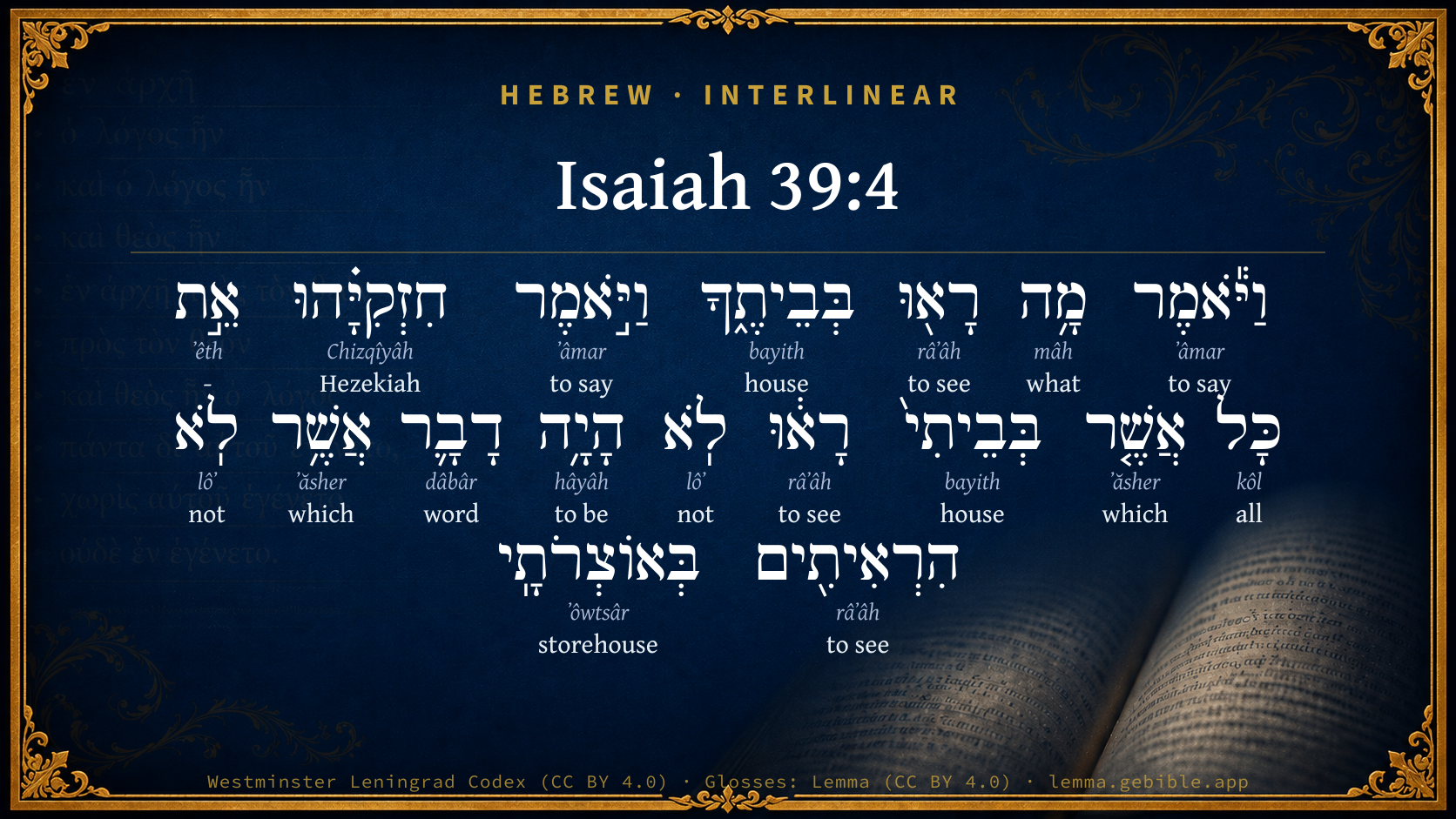
Hebrew (Westminster Leningrad Codex) Isaiah 39:4 appears in the Hebrew Old Testament. The text above is from the Westminster Leningrad Codex. Each word links to its Strong’s number, a concise gloss, and parsing drawn from the Open Scriptures Hebrew Bible morphology. Click any word for its full Brown-Driver-Briggs (BDB) entry.
Download image
Cite this verse

Isaiah 39:4 (World English Bible). Public Domain. Lemma interlinear Bible study tool, https://lemma.gebible.app/v/isaiah/39/4.

Show BibTeX & RIS
BibTeX
RIS
English Translation
Then said he, What have they seen in your house? Hezekiah answered, All that is in my house have they seen: there is nothing among my treasures that I have not shown them.
World English Bible · Public Domain
Download a study sheet

One document with this verse’s original text, its word-by-word gloss line, the meaning frame, cross-references with their text, attributed commentary, and full source and license credits — printable, and it pastes into notes with its structure intact.

This verse Autodidact and up

Study sheet (.html) Plain text (.txt)

A passage Seminary Student

Up to 50 verses in one chapter. A passage sheet keeps up to 6 commentary sources and 12 cross-references per verse, in the order this page ranks them, and says so on the sheet whenever that leaves anything out. Ask for a single verse and you get the Autodidact verse sheet above.

Everything on this page stays free to read, with no account — the sheet is a download of what is already on screen, not access to it.

Want to remove ads? Support Godless Engineer
Compare translations 3

The same verse in 3 English versions, stacked beneath the original-language interlinear above. Click any original word for its lexicon entry.

Each is an independent rendering of the whole verse — the interlinear is not word-aligned to these translations.

Highlighted words mark where these versions differ — a whole-verse word diff, not a word-by-word alignment.

  • World English Bible Public Domain
    Then said he, What have they seen in your house? Hezekiah answered, All that is in my house have they seen: there is nothing among my treasures that I have not shown them.
  • King James Version Public Domain
    Then said he, What have they seen in thine house? And Hezekiah answered, All that is in mine house have they seen: there is nothing among my treasures that I have not shewed them.
  • unfoldingWord Literal Text CC BY-SA 4.0
    And he said, “What did they see in your house?” And Hezekiah said, “They saw everything that in my house. There was not a thing in my treasuries that I did not show them.”

unfoldingWord Literal Text — © unfoldingWord, licensed CC BY-SA 4.0. Word-aligned USFM3 via Door43 (git.door43.org/unfoldingWord/en_ult).

Versions to compare (up to 4)

3 of 4 selected

Show all 18 translations

Every available English version of this verse, each an independent rendering of the whole verse.

  • World English Bible Public Domain
    Then said he, What have they seen in your house? Hezekiah answered, All that is in my house have they seen: there is nothing among my treasures that I have not shown them.
  • Berean Standard Bible Public Domain
    “What have they seen in your palace?” Isaiah asked. “They have seen everything in my palace,” answered Hezekiah. “There is nothing among my treasures that I did not show them.”
  • Majority Standard Bible Public Domain
    “What have they seen in your palace?” Isaiah asked. “They have seen everything in my palace,” answered Hezekiah. “There is nothing among my treasures that I did not show them.”
  • King James Version Public Domain
    Then said he, What have they seen in thine house? And Hezekiah answered, All that is in mine house have they seen: there is nothing among my treasures that I have not shewed them.
  • American Standard Version (1901) Public Domain
    Then said he, What have they seen in thy house? And Hezekiah answered, All that is in my house have they seen: there is nothing among my treasures that I have not showed them.
  • Revised Version (1885) Public Domain
    Then said he, What have they seen in thine house? And Hezekiah answered, All that is in mine house have they seen: there is nothing among my treasures that I have not shewed them.
  • Geneva Bible (1599) Public Domain
    Then saide he, What haue they seene in thine house? And Hezekiah answered, All that is in mine house haue they seene: there is nothing among my treasures, that I haue not shewed them.
  • Douay-Rheims (1899) Public Domain
    And he said: What saw they in thy house? And Ezechias said: All things that are in my house have they seen, there was not any thing which I have not shewn them in my treasures.
  • Young's Literal Translation Public Domain
    And he saith, `What saw they in thy house?' and Hezekiah saith, `All that `is' in my house they saw; there hath not been a thing that I have not shewed them among my treasures.'
  • Literal Standard Version CC BY-SA 4.0
    And he says, “What did they see in your house?” And Hezekiah says, “They saw all that [is] in my house; there has not been a thing that I have not showed them among my treasures.”
  • Unlocked Literal Bible CC BY-SA 4.0
    Isaiah asked, “What have they seen in your house?” Hezekiah answered, “They have seen everything in my house. There is nothing among my valuable things that I have not shown them.”
  • unfoldingWord Literal Text CC BY-SA 4.0
    And he said, “What did they see in your house?” And Hezekiah said, “They saw everything that in my house. There was not a thing in my treasuries that I did not show them.”
  • Darby Bible Public Domain
    And he said, What have they seen in thy house? And Hezekiah said, All that is in my house have they seen: there is nothing among my treasures that I have not shewn them.
  • World Messianic Bible Public Domain
    Then he asked, “What have they seen in your house?” Hezekiah answered, “They have seen all that is in my house. There is nothing among my treasures that I have not shown them.”
  • Webster's Bible Public Domain
    Then said he, What have they seen in thy house? And Hezekiah answered, All that is in my house have they seen: there is nothing among my treasures that I have not showed them.
  • Free Bible Version CC BY-SA 4.0
    “What did they see in your palace?” Isaiah asked. “They saw everything in my palace,” replied Hezekiah. “There wasn't anything in all my storehouses I didn't show them.”
  • Bible in Basic English Public Domain
    And he said, What have they seen in your house? And Hezekiah said in answer, They saw everything in my house: there is nothing among my stores which I did not let them see.
  • JPS Tanakh (1917) Public Domain
    Then said he: 'What have they seen in thy house?' And Hezekiah answered: 'All that is in my house have they seen; there is nothing among my treasures that I have not shown them.'

Literal Standard Version (2020), Covenant Press — licensed CC BY-SA 4.0. Text via the HelloAO Bible API (eBible.org). Unlocked Literal Bible (unfoldingWord) — licensed CC BY-SA 4.0. Text via the HelloAO Bible API (eBible.org). unfoldingWord Literal Text — © unfoldingWord, licensed CC BY-SA 4.0. Word-aligned USFM3 via Door43 (git.door43.org/unfoldingWord/en_ult). Free Bible Version, Dr. Jonathan Gallagher — licensed CC BY-SA 4.0. Text via the HelloAO Bible API (eBible.org).

Word by word

More ways to search: Search by grammar → Find every occurrence → Compare this word →

Practice this passage: Drill this verse → Learn its vocabulary →

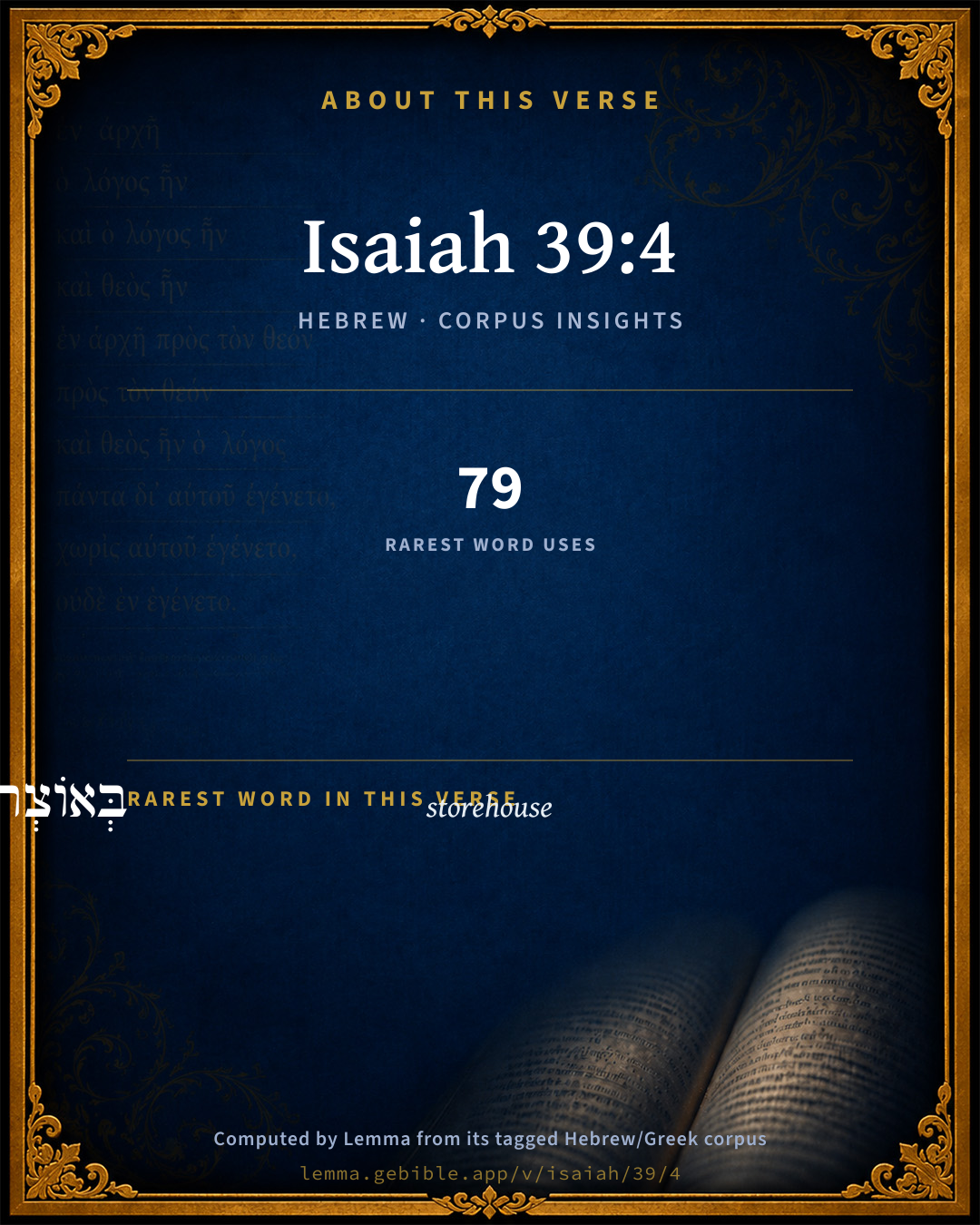
בְּאוֹצְרֹתָֽי
ʼôwtsâr
H214
“in/at · storehouses · my”
Preposition + Noun, Common, Masculine, Plural, Construct + Suffix, Personal, 1st Person, Common, Singular
Part of Speech
Preposition + Noun
Type
Common
Gender
Masculine
Number
Plural
State
Construct
Full BDB Definition

Origin: from H686

TWOT: 154a

treasure, storehouse - treasure (gold, silver, etc) - store, supplies of food or drink - treasure-house, treasury - treasure-house - storehouse, magazine - treasury - magazine of weapons (figuratively of God's armoury) - storehouses (of God for rain, snow, hail, wind, sea)
  1. וַיֹּ֕אמֶר ʼâmar H559 “and · to say” Conjunction + Verb, Qal, Sequential Imperfect, 3rd Person, Masculine, Singular
  2. מָ֥ה mâh H4100 “what” Particle, Interrogative
  3. רָא֖וּ râʼâh H7200 “to see” Verb, Qal, Perfect, 3rd Person, Common, Plural
  4. בְּבֵיתֶ֑ךָ bayith H1004 “in/at · house · your” Preposition + Noun, Common, Masculine, Singular, Construct + Suffix, Personal, 2nd Person, Masculine, Singular
  5. וַיֹּ֣אמֶר ʼâmar H559 “and · to say” Conjunction + Verb, Qal, Sequential Imperfect, 3rd Person, Masculine, Singular
  6. חִזְקִיָּ֗הוּ Chizqîyâh H2396 “Hezekiah” Noun, Proper
  7. אֵ֣ת ʼêth H853 “-” Particle, Direct Object
  8. כָּל kôl H3605 “all of” Noun, Common, Masculine, Singular, Construct
  9. אֲשֶׁ֤ר ʼăsher H834 “which” Particle, Relative
  10. בְּבֵיתִי֙ bayith H1004 “in/at · house · my” Preposition + Noun, Common, Masculine, Singular, Construct + Suffix, Personal, 1st Person, Common, Singular
  11. רָא֔וּ râʼâh H7200 “to see” Verb, Qal, Perfect, 3rd Person, Common, Plural
  12. לֹֽא lôʼ H3808 “not” Particle, Negative
  13. הָיָ֥ה hâyâh H1961 “to be” Verb, Qal, Perfect, 3rd Person, Masculine, Singular
  14. דָבָ֛ר dâbâr H1697 “word” Noun, Common, Masculine, Singular, Absolute
  15. אֲשֶׁ֥ר ʼăsher H834 “which” Particle, Relative
  16. לֹֽא lôʼ H3808 “not” Particle, Negative
  17. הִרְאִיתִ֖ים râʼâh H7200 “to see · them” Verb, Hiphil, Perfect, 1st Person, Common, Singular + Suffix, Personal, 3rd Person, Masculine, Plural

About this verse

These counts appear in no published source. They are computed here, from the morphology-tagged text and Lemma’s own curated glosses. What Lemma adds →

18
words
12
distinct lemmas
Prophets
section

Grammatical profile

  • 6 verbs
  • 6 nouns
  • 6 particles

Verb forms

  • וַיֹּ֕אמֶר Qal · Sequential Imperfect
  • רָא֖וּ Qal · Perfect
  • וַיֹּ֣אמֶר Qal · Sequential Imperfect
  • רָא֔וּ Qal · Perfect
  • הָיָ֥ה Qal · Perfect
  • הִרְאִיתִ֖ים Hiphil · Perfect

Repetition

Words recur within this verse — often emphatic in Hebrew:

  • רָא֖וּ to see H7200 ×3
  • וַיֹּ֕אמֶר to say H559 ×2
  • בְּבֵיתֶ֑ךָ house H1004 ×2
  • אֲשֶׁ֤ר which H834 ×2
  • לֹֽא not H3808 ×2

Hebrew & Septuagint length

In English translation the verse runs 33 words from the Hebrew and 39 from the Septuagint (LXX English) — closely comparable.

A rough comparison of the two English renderings, which tokenize alike — not a word-level alignment.

Word counts can differ between the Hebrew and the Greek without any difference in meaning — e.g. the Hebrew direct-object marker אֵת has no separate Greek word, and Greek often adds the article ὁ.

Cross-references

5

Topical passages linked to Isaiah 39:4 in the Treasury of Scripture Knowledge — connected by theme and wording, ordered by reader-vote popularity; previews shown in the World English Bible.

  • Joshua 7:19 Joshua said to Achan, My son, please give glory to Yahweh, the God of Israel, and make confession to him; and tell me now what you have done; don't hide it from me.
  • Job 31:33 If like Adam I have covered my transgressions, By hiding my iniquity in my heart,
  • Proverbs 23:5 Why do you set your eyes on that which is not? For it certainly sprouts wings like an eagle and flies in the sky.
  • Proverbs 28:13 He who conceals his sins doesn't prosper, But whoever confesses and renounces them finds mercy.
  • 1 John 1:9 If we confess our sins, he is faithful and righteous to forgive us the sins, and to cleanse us from all unrighteousness.

Cross-references courtesy of OpenBible.info (CC BY 4.0).

Hebrew and Greek witnesses Masoretic Hebrew ↔ Greek Septuagint

The same verse in the two great witnesses to the Old Testament, shown verse-for-verse.

These are two independent witnesses, not word-aligned to each other, and the Septuagint is shown in lemma (dictionary) form.

Hebrew Isaiah 39:4 Masoretic · Westminster Leningrad Codex

וַיֹּ֕אמֶר מָ֥ה רָא֖וּ בְּבֵיתֶ֑ךָ וַיֹּ֣אמֶר חִזְקִיָּ֗הוּ אֵ֣ת כָּל אֲשֶׁ֤ר בְּבֵיתִי֙ רָא֔וּ לֹֽא הָיָ֥ה דָבָ֛ר אֲשֶׁ֥ר לֹֽא הִרְאִיתִ֖ים בְּאוֹצְרֹתָֽי

Then said he, What have they seen in your house? Hezekiah answered, All that is in my house have they seen: there is nothing among my treasures that I have not shown them.

World English Bible · Public Domain

Greek LXX Isaiah 39:4 Septuagint · lemma form

καί εἶπον ησαιας τίς ὁράω ἐν ὁ οἶκος σύ καί εἶπον εζεκιας πᾶς ὁ ἐν ὁ οἶκος ἐγώ ὁράω καί οὐ εἰμί ἐν ὁ οἶκος ἐγώ ὅς οὐ ὁράω ἀλλά καί ὁ ἐν ὁ θησαυρός ἐγώ

And Esaias said, What have they seen in your house? and Ezekias said, They have seen everything in my house; and there is nothing in my house which they have not seen: yes, also the possessions in my treasuries.

LXX2012 (modern English Septuagint) · Public Domain

Hebrew: Westminster Leningrad Codex (CC BY 4.0). Greek: Septuagint (public domain); English from LXX2012 (modern English Septuagint) (Public Domain). How the Septuagint differs from the Hebrew →

Targum (Aramaic paraphrase)

1

The Targum is the ancient Jewish Aramaic paraphrase of the Hebrew Scriptures — an interpretive translation, not the Hebrew text itself. Onkelos (literal) and Pseudo-Jonathan (expansive) render the Torah, and Jonathan the Prophets. Coverage is partial: where no permissively-licensed English translation exists for a verse, only the Aramaic is shown. This is verse-level text, not a word-by-word alignment to the Hebrew.

  1. Targum Jonathan Prophets (Joshua–Malachi)
    וַאֲמַר מָה חֲזוֹ בְּבֵיתָךְ וַאֲמַר חִזְקִיָה יַת כָּל דִי בְּבֵיתִי חֲזוֹ לָא הֲוָה מִדָעַם דְלָא אַחְזִיתִינוּן בְּגִנְזָי:

    Then said he, What have they seen in thine house? And Hezekiah answered, All that is in mine house have they seen: there is not anything in my treasures that I have not showed them.

    Targum Jonathan — Aramaic: “Mikraot Gedolot” (public domain). English: “Sefaria Community Translation” (CC0 1.0 (public-domain dedication)); “London "Chaldee Paraphrase," 1871” (public domain). Text via Sefaria.

Commentary

Notes on Isaiah 39:4 from classic Christian and Jewish commentators (each source and its license shown beneath its notes). The classic Christian expositions comment on the surrounding passage and are grouped to its opening verse, so a note may address several verses; the Jewish commentaries on the Tanakh (Rashi and others) are per-verse, so they appear only where the commentator wrote on this verse.

Lemma curates 59 commentaries, every one of them public domain or Creative Commons licensed, each selected and text-cleaned for this edition rather than reprinted as found. About our sources →

The Biblical Illustrator

Joseph S. Exell

Isa_39:4

What have they seen in thine house?

--

The disciple at home

1. The parties of whom the prophets inquired, What have they seen? were Babylonians. Foreigners, aliens from the commonwealth of Israel, ignorant of the true God, and, therefore, parties before whom it was specially important to exhibit nothing which was calculated to bring dishonour upon God. These strangers might have been greatly edified had they remarked a deeply chastened and humble spirit in the king. There is nothing so greatly hinders the propagation of the Christianity of England among foreigners as that practical irreligion which they observe among the English.

2. The subject may suggest to us some general reflections upon the kind of aspect which the house of a professing Christian should present to any stranger as a man of the world. What would such a man naturally expect to see in a Christians house? Clearly that which he looks for in other houses--namely, a general style and conformity with the particular profession orcharacter of the inmates. He would reckon upon finding there, what St. Paul calls the Church that is in thy house--the pervading air of heavenly-mindedness, and the symptoms of devotional exercises in all its sanctified chambers of imagery--the treasures of parental piety, of filial obedience and decorum; a well-ordered household extending its influence and sanction, like the sacred comprehensions of the law of the Sabbath, from the man himself, to his son and daughter, manservant and maidservant, and even cattle and stranger. Night and morning, it would seem to him to be the natural and consistent rule, that the offering of prayer and reading of the Word should be there presented to the God of all the families of the earth. In every room and chamber of the house, the ready Bible should suggest by its silent presence the privilege of secret study of the Holy Scriptures; some good books, to the use of edifying, should strew the tables, like little trophies, in incidental evidence of the triumph of religion in that place; the peace, and cheerfulness, and mutual harmony of Christian influence should breathe its airs from Heaven on every happy, thankful heart; the music of habitual concord should sound, like an AEolian psalm, in every aisle of that homely church; and family love, the instinctive antepast of the universal love of Heaven, should spread the sweet odour of its charity, like Aarons off, from the head of the house down to the very skirts of the living garment with which his blessed heart is clothed. This is what the worldly man should see in the house of the Christian; but, alas! is it always to be seen there?

1. What have they seen in thine house? Have they seen there the spirit of the world, in the shape of expensive apparel, or costly furniture, or ornaments beyond your means or your station in society? A Christian man may adorn his house or apparel his person in moderation with the accustomed decencies of life and even the beautiful things of art, for Christianity is no enemy of taste nor patron of vulgarity. But when a man of the world observes in a Christian professor that inordinate affectation of style and sumptuousness in furniture and dress, which leaves no external mark of difference between him that serveth God and him that serveth Him not, then such a professing Christian may well tremble for the stability of his principles. The ambassadors of the spiritual Babylon are visiting him, and they will have to report to their dark master that there is something to seize in the household of his divided heart. The remark is equally applicable to the humbler classes. Sin is sin, and vanity is vanity, whether it assume a vulgar or a refined shape.

2. What have they seen in thine house? Have they seen the continual eagerness to grasp and hoard up money, the absorption of every abused faculty of the mind and every overstrained energy of the body to extend business, increase capital, and multiply speculations, though at the expense of a neglected soul and a forsaken God? And is this done in the face of better convictions of duty and responsibility? Is the heart becoming hardened as the very metal it grasps so eagerly? There is much in the proper and becoming habits of Christian men which is calculated to aid their success in life, but this success should not be permitted to become a snare to them.

3. What have they seen in thine house? Have they marked the professing disciple of the self-denying religion of Jesus yielding to a habitual fretfulness and irritability at every trifling trial of temper, keeping wife, children, and servants in a perpetual ferment tending to the ultimate exacerbation of every temper in the household? Have they seen the man at one time discoursing in quiet tone and serious terms on the meek and lowly one, who, when He was reviled, reviled not again, at another time terrifying all around him with unrighteous ebullitions of anger? The Babylonians, the strangers, see it, and shake their heads, saying, Deliver me from that mans religion, if it cannot even curb his temper; and thus a stumbling-block is cast in the way, that offends some poor, weak brother for whom Christ died. The children in such a house learn to despise a religion with the remembrance of their early terrors and discomforts; and the servants, or others employed about it, thank God that they have escaped their poor masters supposed hypocrisy, even at the sacrifice of his real Christianity. Whereas if, on the other hand, the irascible spirit were to be seen only to be subdued before them; if its occasional outbreak is timely checked, and obviously striven against, and candidly mourned over, if they mark the man struggling against the buffetings of his infirmity, and honestly and earnestly doing painful violence to his besetment, there is a natural sympathy kindled in their hearts which God may vouchsafe to deepen into the conviction that the religion must be real which could generate such an inward contest, and must be influential, too, which could obtain such I victory.

4. What have they seen in thine house? Have they seen the immoderate banqueting, excess of wine, revellings, and such like?

5. What have they seen in thine house? Perhaps some of you have been mercifully restored from a serious illness: what did those about you see as the effect of your being spared? Did they see a thankful man, a subdued man, a man bearing the spiritual marks of the stripes of the rod of chastisement, more in earnest for God, less inclined to murmur at his lot, to cavil at religious obligations, or depreciate spiritual privileges, or to lower the personal standard of Christian life and conversation? If the world saw this in your house, you have got good yourself and done the world good; if they saw it not, in whatever degree it was not the visible effect upon you, in that proportion you have yourself forfeited the grace of your personal dispensation, missed and abused an ordinance of the Lord, and wronged your brotherhood.

6. And you, heads of families, who make no profession of religion, who have no particular anxieties at stake either way, what have they seen in your houses? Have they marked no family prayer, no godly conversation, no effort with the means of moral and evangelical influence? Have they seen children growing up in carelessness and irreligion, whose parental indulgence provoked that destructive judgment which the real love and tenderness of a timely discipline might have averted? If so, consider, you who have the solemn responsibility of a family of immortal souls laid upon you, how Hezekiahs folly was visited upon his children, and tremble at the prospect of the heartrending anguish you may be laying up in store for yourselves in the spectacle of an ungodly and abandoned household.

7. What have they seen in thine house? Well, no matter what they have seen; be resolved by the grace of God as to what shall be seen for the time to come. (J. B. Owen, M. A.)

The Biblical Illustrator, edited by Joseph S. Exell (c. 1880s–1900s) — public domain. Text from a community e-Sword module.

The Preacher's Complete Homiletical Commentary

Joseph S. Exell (gen. ed.)

HOME LIFE AND INFLUENCE

Isa_39:4. What have they seen in Thy house?

State briefly the circumstances that gave rise to this question. It evidently suggests to Hezekiah that he has not made the best use of the visit of the Babylonians. He might have turned it to greater account than the gratification of his vanity by displaying his treasures. Instead of magnifying the greatness and glory of God, and thus lifting the minds of his visitors to the highest themes, he had only held out a bait to their covetous desires, and tempted them to steal the treasures so vainly displayed. This was to be the result of his folly (Isa_39:6). This is how we miss the great opportunities of our life. There come to us golden seasons when we might bear valuable testimony for God; but we have some petty, personal desires of our own to carry out, and they pass away unimproved. Then comes the prophetic message, borne by our own conscience, that the plan we adopted to gratify our improper desires will only lead us to confusion and unhappiness.

The extent to which Hezekiah came under the censure of God in this matter we shall not now further consider. We shall extend the application of this question to the matter of home life and home influence. So it has a bearing on all of us. “What have they seen in thy house?”

I. It should be seen that our home is the common centre of attraction for all the family (P. D. 1828–1830, 1836).

II. In the home each member of the family should be seen faithfully discharging the duties of his or her relationship to it; husbands, wives, fathers, &c.

III. It should be seen that every Christian gift and grace is carefully cultivated. “For Christ’s sake,” should be the motto of the whole family. In all they do, every member of it should seek to display love such as He manifested when He dwelt among us: His love was patient, magnanimous, sympathetic. This is the way to make the humblest home happy (P. D. 1823, 1834, 1838, 1839).

CLOSING REFLECTIONS.—

1. If we do not thus exhibit Christianity at home, it may be questioned whether we possess it at all (H. E. I. 2994).

2. If others know that there is no practical Christianity displayed by us at home, they will rightly set but little value upon our religious performances abroad.

3. It is from the culture of home life that our hopes are to spring with regard to the national life. In the home lurk the disorders that disturb society. The true way to bring those disorders to an end is to endeavour to make the homes of our land the nurseries of every Christian grace and virtue.

4. Let us aim at the accomplishment of the needful national reforms, by each of us doing what we can to make our own home all that it ought to be.—William Manning.

The Preacher's Complete Homiletical Commentary (gen. ed. Joseph S. Exell; Funk & Wagnalls, c. 1892) — public domain (pre-1929). A full-Bible homiletical/sermon-outline anthology covering 65 of 66 books (2 John is absent from the source module). Text from a community e-Sword module.

Geneva Bible (1599)

Geneva Bible translators

He asketh him of the particulars, to make him understand the craft of the wicked, which he before being overcome with their flattery and blinded with ambition, could not see.

Geneva Bible (1599) marginal notes — public domain. Text via Bolls.life.

Jamieson, Fausset & Brown

Robert Jamieson, A. R. Fausset & David Brown

All--a frank confession of his whole fault; the king submits his conduct to the scrutiny of a subject, because that subject was accredited by God. Contrast Asa (Ch2 16:7-10).

Jamieson, Fausset & Brown — Commentary Critical and Explanatory on the Whole Bible (1871) — public domain (CC PDM 1.0). Text via the HelloAO Bible API.

Ellicott's Commentary for English Readers

(4) What have they seen in thine house?—The question was pressed home. Had the king contented himself with such hospitality as would have satisfied the demands of the code of Eastern ethics? or had he, as the prophet rightly suspected, done more than that, in his vain-glorious hope of figuring among the “great powers” of the East? On the minds of the ambassadors, we may well believe the impression left was like that made on Blucher as he passed through London: that it would be “a grand city to plunder.”

A Bible Commentary for English Readers, edited by Charles John Ellicott (1878–1897) — public domain. Text from a community e-Sword module.

John Gill's Exposition

Then said he, what have they seen in thine house?.... Coming nearer to the point he had in view, and which was the thing that was displeasing to the Lord; not that he had received the ambassadors, and used them in such a manner as persons in such a quality ought to be used; but that he had shown them what he ought not to have done, and especially from such a principle of pride and vanity as he did:

and Hezekiah answered without any reserve, very openly, not suspecting that the prophet was come with a reproof to him, or to blame him, or would blame him for what he had done:

all that is in my house have they seen; the several royal apartments, and the furniture of them:

there is nothing among my treasures that I have not showed them: which were more secret, laid up in cabinets, under lock and key; his gold, silver, jewels, and precious stones, spices, and ointments. Jerom thinks he showed them the furniture and vessels of the temple, though he does not mention them.

John Gill's Exposition of the Whole Bible (1746–1763) — public domain (CC PDM 1.0). Text via the HelloAO Bible API.

Albert Barnes' Notes on the Bible

What have they seen? - It is probable that the fact that Hezekiah had showed them the treasures of his kingdom was known in Jerusalem. Such a fact would be likely to attract attention, and to produce inquiry among the people into the cause.

All that is in mine house - Here was the confessions of a frank, an honest, and a pious man. There was no concealment; no disguise. Hezekiah knew that he was dealing with a man of God - a man too to whom he had been under great obligations. He knew that Isaiah had come commissioned by God, and that it would be in vain to attempt to conceal anything. Nor does he seem to have wished to make any concealment. If he was conscious that what he had done had been improper, he was willing to confess it; and at any rate he was willing that the exact truth should be known. Had Hezekiah been like Ahaz, he might have spurned Isaiah from his presence as presenting improper inquiries. But Hezekiah was accustomed to regard with respect the messengers of God, and he was therefore willing to submit his whole conduct to the divine adjudication and reproof. Piety makes a man willing that all that he has done should be known. It saves him from double-dealing and subterfuges, and a disposition to make vain excuses; and it inclines him to fear God, to respect his ambassadors, and to listen to the voice of eternal truth.

Albert Barnes' Notes on the Bible (1834–1885) — public domain. Text from a community e-Sword/MySword module.

The Pulpit Commentary

What have they seen? Isaiah had, no doubt, heard of what Hezekiah had done (ver. 2); but he wished to have the confession of it from his own mouth before delivering his sentence. Hezekiah tells him the truth, since he is not ashamed of his act, but rather glories in it. He has shown the ambassadors everything, and has thereby made them eager to secure his alliance.

The home, seen though not shown.

No doubt the ambassadors of the King of Babylon saw many things in the palace of Hezekiah which he did not exhibit to them; more things are seen than those which are displayed. It is so in every house; and it may be that the visitor goes away more impressed with some things which no one pointed out to him than with anything to which his attention was called. If any one were to ask him what he has seen in the house, he would mention that which its master had not thought to show him. What would any visitor to our house see, though we did not show it to him?

I ORDER OR DISORDER? The manifest presence of a strong hand keeping every one in order and everything in its place; or the painful absence of it?

II OBEDIENCE OR DISOBEDIENCE? Filial readiness and even eagerness to comply at once with the parents" wish; or the lingering step or even the entire disregard of that desire?

III COURTESY OR DISCOURTESY? Habitually becoming behaviour at the table and the hearth; or the unwise neglect of those smaller observances which minister to the beauty and the sweetness of daily life?

IV LOVE OR INDIFFERENCE, OR POSITIVE DISLIKE? The presence of that warm affection which should bind husband and wife, parent and child, brother and sister, in the bonds of happy and enduring fellowship; or a cold and sad indifference to one another"s well-being; or a still sadder animosity and persecution?

V SELFISHNESS OR SYMPATHY? The confinement of thought and care to the four walls of the home establishment; or a considerate and generous regard for the wants and wishes of neighbours and fellow-citizens?

VI PIETY OR WORLDLINESS? Family worship, and what is better still a prevailing religious tone, as if parents and children all felt that temporal success was a very small thing in comparison with spiritual worth; or the language and habits of an ignoble and degrading worldliness? C.

The Pulpit Commentary (1880–1919), ed. H.D.M. Spence-Jones & Joseph S. Exell — public domain. Text from a community e-Sword module.

J. A. Alexander on Isaiah

Joseph Addison Alexander

“And he said, What have they seen in thy house? And Hezekiah said, All that is in my house have they seen; there is not a thing that I have not showed them in my treasures.” The frankness of the answer here recorded rather shows, that there was no attempt at concealment from the first. It was not until the Prophet questioned him, that Hezekiah became aware of the error which he had committed.

Joseph Addison Alexander, The Prophecies of Isaiah (1846–1847; New York: Scribner, 1870–1878) — public domain. Text from a community e-Sword module.

Lesson kit

Teaching starters — assembled from the data on this page, not authored interpretation. Every prompt links to the verse data it draws on. Edit before teaching.

Isaiah, in the Prophets, opens this verse with 18 words (12 distinct Hebrew lemmas). Its most distinctive word is ʼôwtsâr (“storehouse”). A historical commentator’s framing appears above. Read the whole chapter for the surrounding context.

Discussion questions

  1. The word ʼôwtsâr carries the sense “storehouse.” How does it shape the verse?
  2. How does Joshua 7:19, which shares this passage’s theme, read alongside this verse?
  3. What does the repetition of “to see” (3× in this one verse) do in this verse?
  4. These translations render this verse differently. What is at stake in choosing one wording over another?
  5. «וַיֹּ֕אמֶר» is a Qal Sequential Imperfect verb. How does that grammatical form shape the action described?
  6. Compare how The Biblical Illustrator and The Preacher's Complete Homiletical Commentary read this verse. Where do they agree or differ?

Things to notice

Reading settings

Reading text

Shown beneath each verse's original-language words.

Old Testament
Old Testament edition

Read the OT as the Masoretic Hebrew (MT) or the Greek Septuagint (LXX).

English shown for the Greek Septuagint (in the Hebrew ↔ Greek comparison).

Comparing translations? Open the Compare panel on any verse page to stack up to four side by side.