
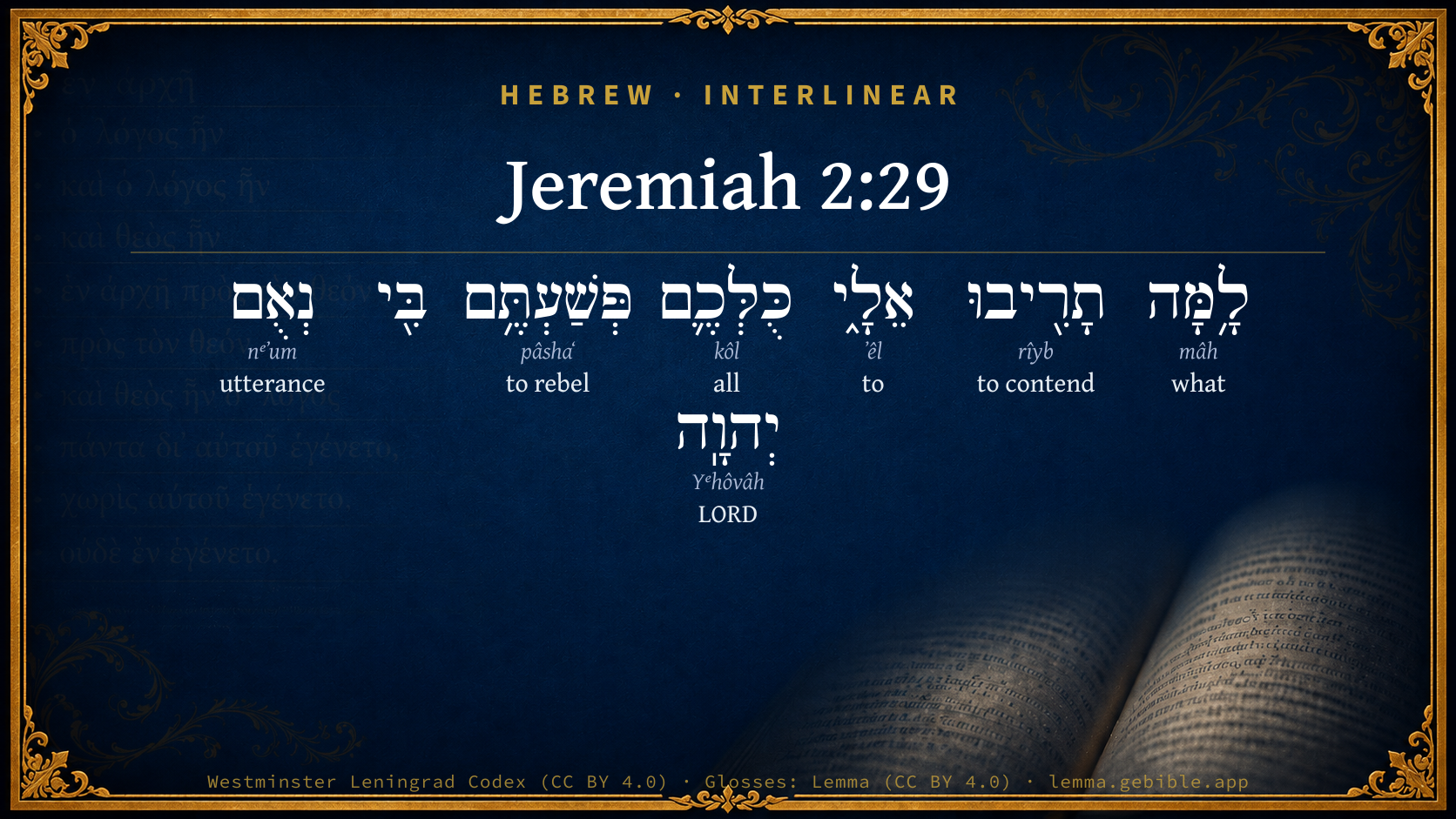
Jeremiah 2:29

Hebrew (Westminster Leningrad Codex) Jeremiah 2:29 appears in the Hebrew Old Testament. The text above is from the Westminster Leningrad Codex. Each word links to its Strong’s number, a concise gloss, and parsing drawn from the Open Scriptures Hebrew Bible morphology. Click any word for its full Brown-Driver-Briggs (BDB) entry.
Download image
Cite this verse

Jeremiah 2:29 (World English Bible). Public Domain. Lemma interlinear Bible study tool, https://lemma.gebible.app/v/jeremiah/2/29.

Show BibTeX & RIS
BibTeX
RIS
English Translation
Why will you contend with me? you all have transgressed against me, says Yahweh.
World English Bible · Public Domain
Download a study sheet

One document with this verse’s original text, its word-by-word gloss line, the meaning frame, cross-references with their text, attributed commentary, and full source and license credits — printable, and it pastes into notes with its structure intact.

This verse Autodidact and up

Study sheet (.html) Plain text (.txt)

A passage Seminary Student

Up to 50 verses in one chapter. A passage sheet keeps up to 6 commentary sources and 12 cross-references per verse, in the order this page ranks them, and says so on the sheet whenever that leaves anything out. Ask for a single verse and you get the Autodidact verse sheet above.

Everything on this page stays free to read, with no account — the sheet is a download of what is already on screen, not access to it.

Want to remove ads? Support Godless Engineer
Compare translations 3

The same verse in 3 English versions, stacked beneath the original-language interlinear above. Click any original word for its lexicon entry.

Each is an independent rendering of the whole verse — the interlinear is not word-aligned to these translations.

Highlighted words mark where these versions differ — a whole-verse word diff, not a word-by-word alignment.

  • World English Bible Public Domain
    Why will you contend with me? you all have transgressed against me, says Yahweh.
  • King James Version Public Domain
    Wherefore will ye plead with me? ye all have transgressed against me, saith the LORD.
  • unfoldingWord Literal Text CC BY-SA 4.0
    Why do you complain to me? All of you have rebelled against me —the declaration of Yahweh.

unfoldingWord Literal Text — © unfoldingWord, licensed CC BY-SA 4.0. Word-aligned USFM3 via Door43 (git.door43.org/unfoldingWord/en_ult).

Versions to compare (up to 4)

3 of 4 selected

Show all 18 translations

Every available English version of this verse, each an independent rendering of the whole verse.

  • World English Bible Public Domain
    Why will you contend with me? you all have transgressed against me, says Yahweh.
  • Berean Standard Bible Public Domain
    Why do you bring a case against Me? You have all rebelled against Me,” declares the LORD.
  • Majority Standard Bible Public Domain
    Why do you bring a case against Me? You have all rebelled against Me,” declares the LORD.
  • King James Version Public Domain
    Wherefore will ye plead with me? ye all have transgressed against me, saith the LORD.
  • American Standard Version (1901) Public Domain
    Wherefore will ye contend with me? ye all have transgressed against me, saith Jehovah.
  • Revised Version (1885) Public Domain
    Wherefore will ye plead with me? ye all have transgressed against me, saith the LORD.
  • Geneva Bible (1599) Public Domain
    Wherefore wil ye pleade with me? ye all haue rebelled against me, sayeth the Lord.
  • Douay-Rheims (1899) Public Domain
    Why will you contend with me in judgement? you have all forsaken me, saith the Lord.
  • Young's Literal Translation Public Domain
    Why do ye strive with Me? All of you have transgressed against Me, An affirmation of Jehovah.
  • Literal Standard Version CC BY-SA 4.0
    Why do you strive with Me? All of you have transgressed against Me,” || A declaration of YHWH.
  • Unlocked Literal Bible CC BY-SA 4.0
    So why do you accuse me of doing wrong? All of you have sinned against me—this is Yahweh's declaration.
  • unfoldingWord Literal Text CC BY-SA 4.0
    Why do you complain to me? All of you have rebelled against me —the declaration of Yahweh.
  • Darby Bible Public Domain
    Wherefore would ye contend with me? Ye all have transgressed against me, saith Jehovah.
  • World Messianic Bible Public Domain
    “Why will you contend with me? You all have transgressed against me,” says the LORD.
  • Webster's Bible Public Domain
    Why will ye plead with me? ye all have transgressed against me, saith the LORD.
  • Free Bible Version CC BY-SA 4.0
    Why are you complaining to me? It's all of you who have rebelled against me! declares the Lord.
  • Bible in Basic English Public Domain
    Why will you put forward your cause against me? You have all done evil against me, says the Lord.
  • JPS Tanakh (1917) Public Domain
    Wherefore will ye contend with Me? Ye all have transgressed against Me, saith the LORD.

Literal Standard Version (2020), Covenant Press — licensed CC BY-SA 4.0. Text via the HelloAO Bible API (eBible.org). Unlocked Literal Bible (unfoldingWord) — licensed CC BY-SA 4.0. Text via the HelloAO Bible API (eBible.org). unfoldingWord Literal Text — © unfoldingWord, licensed CC BY-SA 4.0. Word-aligned USFM3 via Door43 (git.door43.org/unfoldingWord/en_ult). Free Bible Version, Dr. Jonathan Gallagher — licensed CC BY-SA 4.0. Text via the HelloAO Bible API (eBible.org).

Word by word

More ways to search: Search by grammar → Find every occurrence → Compare this word →

Practice this passage: Drill this verse → Learn its vocabulary →

About this verse

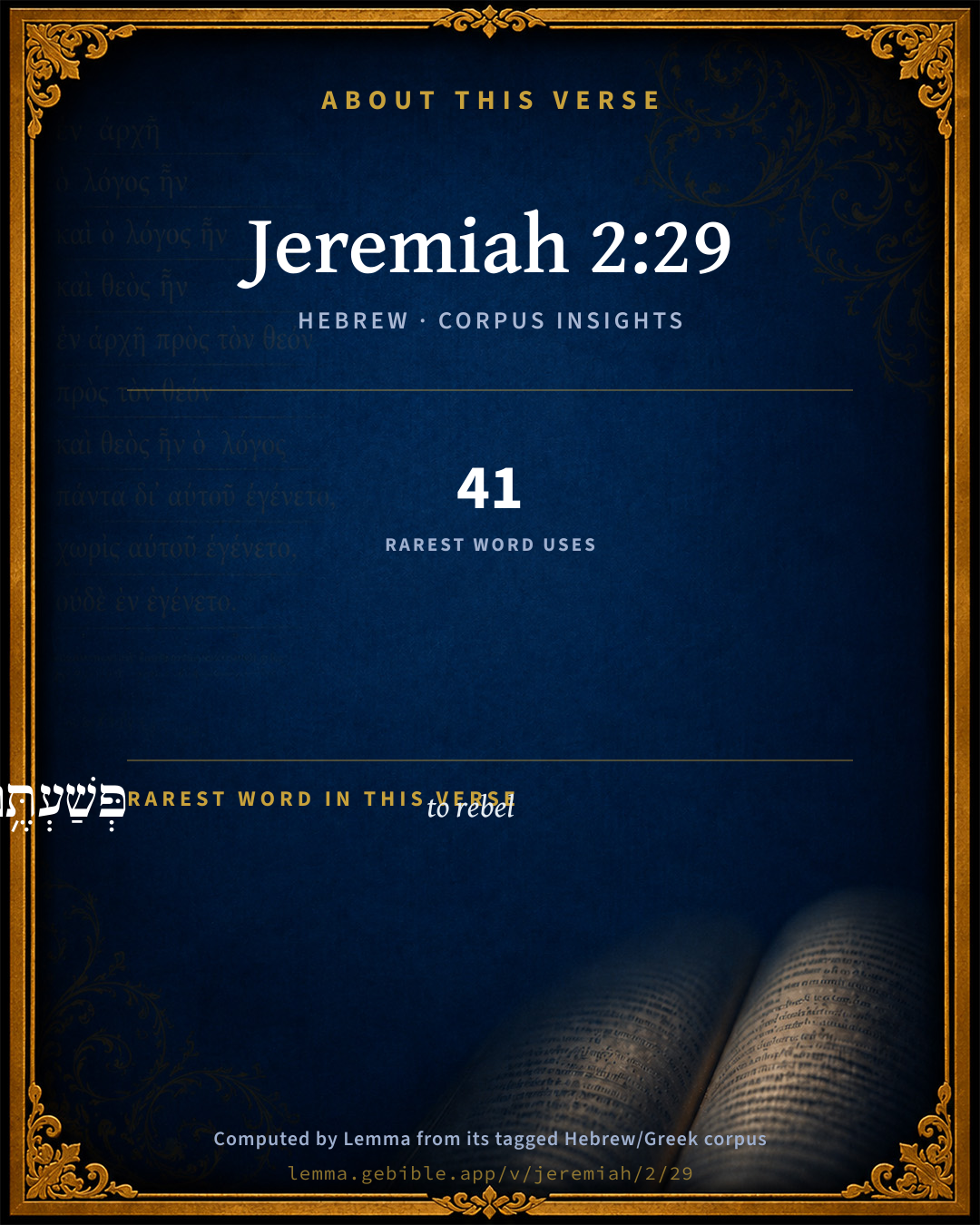
These counts appear in no published source. They are computed here, from the morphology-tagged text and Lemma’s own curated glosses. What Lemma adds →

8
words
7
distinct lemmas
Prophets
section

Shared distinctive vocabulary

פְּשַׁעְתֶּ֥ם to rebel H6586 occurs in 37 verses of the Hebrew Bible. Also found in:

Grammatical profile

  • 2 verbs
  • 3 nouns
  • 2 prepositions
  • 1 particle

Verb forms

  • תָרִ֖יבוּ Qal · Imperfect
  • פְּשַׁעְתֶּ֥ם Qal · Perfect

Cross-references

8

Topical passages linked to Jeremiah 2:29 in the Treasury of Scripture Knowledge — connected by theme and wording, ordered by reader-vote popularity; previews shown in the World English Bible.

  • Jeremiah 5:1 Run you back and forth through the streets of Jerusalem, and see now, and know, and seek in the broad places of it, if you can find a man, if there are any who does justly, who seeks truth; and I will pardon her.
  • Jeremiah 6:13 For from the least of them even to the greatest of them everyone is given to covetousness; and from the prophet even to the priest everyone deals falsely.
  • Daniel 9:11 Yes, all Israel have transgressed your law, even turning aside, that they should not obey your voice: therefore has the curse been poured out on us, and the oath that is written in the law of Moses the servant of God; for we have sinned against him.
  • Jeremiah 2:23 How can you say, I am not defiled, I have not gone after the Baals? see your way in the valley, know what you have done: [you are] a swift dromedary traversing her ways;
  • Jeremiah 2:35 Yet you said, I am innocent; surely his anger is turned away from me. Behold, I will enter into judgment with you, because you say, I have not sinned.
  • Jeremiah 3:2 Lift up your eyes to the bare heights, and see; where have you not been lain with? By the ways have you sat for them, as an Arabian in the wilderness; and you have polluted the land with your prostitution and with your wickedness.
  • Jeremiah 9:2–6 Oh that I had in the wilderness a lodging-place of wayfaring men; that I might leave my people, and go from them! for they are all adulterers, an assembly of treacherous men.
  • Romans 3:19 Now we know that whatever things the law says, it speaks to those who are under the law, that every mouth may be closed, and all the world may be brought under the judgment of God.

Cross-references courtesy of OpenBible.info (CC BY 4.0).

Hebrew and Greek witnesses Masoretic Hebrew ↔ Greek Septuagint

The same verse in the two great witnesses to the Old Testament, shown verse-for-verse.

These are two independent witnesses, not word-aligned to each other, and the Septuagint is shown in lemma (dictionary) form.

Hebrew Jeremiah 2:29 Masoretic · Westminster Leningrad Codex

לָ֥מָּה תָרִ֖יבוּ אֵלָ֑י כֻּלְּכֶ֛ם פְּשַׁעְתֶּ֥ם בִּ֖י נְאֻם יְהוָֽה

Why will you contend with me? you all have transgressed against me, says Yahweh.

World English Bible · Public Domain

Greek LXX Structure differs

In the Septuagint, Jeremiah is about an eighth shorter than the Hebrew and arranges its material differently — the Oracles Against the Nations (Hebrew chapters 46–51) appear in the middle of the Greek book, after 25:13. Because the chapter and verse boundaries do not line up, a verse-for-verse comparison with the Hebrew is not shown.

A verse-for-verse comparison isn’t shown here because the chapters and verses don’t line up. Switch to the LXX edition with the MT / LXX toggle above to read the Greek directly.

On this verse, Keil & Delitzsch discusses the Septuagint’s reading. Read the note in Commentary ↓

Hebrew: Westminster Leningrad Codex (CC BY 4.0). Greek: Septuagint (public domain); English from a public-domain English Septuagint. How the Septuagint differs from the Hebrew →

Targum (Aramaic paraphrase)

1

The Targum is the ancient Jewish Aramaic paraphrase of the Hebrew Scriptures — an interpretive translation, not the Hebrew text itself. Onkelos (literal) and Pseudo-Jonathan (expansive) render the Torah, and Jonathan the Prophets. Coverage is partial: where no permissively-licensed English translation exists for a verse, only the Aramaic is shown. This is verse-level text, not a word-by-word alignment to the Hebrew.

  1. Targum Jonathan Prophets (Joshua–Malachi)
    לְמָא אַתּוּן מְדַמָן לְמֵידַן לִקְבַל פִּתְגָמֵי כּוּלְכוֹן מְרַדְתּוּן בְּמֵימְרִי אֲמַר יְיָ:

    (no public-domain English translation for this verse)

    Targum Jonathan — Aramaic: “Mikraot Gedolot” (public domain). English: “Sefaria Community Translation” (CC0 1.0 (public-domain dedication)); “London "Chaldee Paraphrase," 1871” (public domain). Text via Sefaria.

Commentary

Notes on Jeremiah 2:29 from classic Christian and Jewish commentators (each source and its license shown beneath its notes). The classic Christian expositions comment on the surrounding passage and are grouped to its opening verse, so a note may address several verses; the Jewish commentaries on the Tanakh (Rashi and others) are per-verse, so they appear only where the commentator wrote on this verse.

Lemma curates 59 commentaries, every one of them public domain or Creative Commons licensed, each selected and text-cleaned for this edition rather than reprinted as found. About our sources →

Matthew Henry's Commentary

The prophet here goes on in the same strain, aiming to bring a sinful people to repentance, that their destruction might be prevented.

I. He avers the truth of the charge. It was evident beyond contradiction; it was the greatest absurdity imaginable in them to think of denying it (Jer 2:29): "Wherefore will you plead with me, and put me upon the proof of it, or wherefore will you go about to plead any thing in excuse of the crime or to obtain a mitigation of the sentence? Your plea will certainly be overruled, and judgment given against you: you know you have all transgressed, one as well as another; why then to you quarrel with me for contending with you?"

II. He heightens it from the consideration both of their incorrigibleness and of their ingratitude. 1. They had not been wrought upon by the judgments of God which they had been under (Jer 2:30): In vain have I smitten your children, that is, the children or people of Judah. They had been under divine rebukes of many kinds. God therein designed to bring them to repentance; but it was in vain. They did not answer God's end in afflicting them; their consciences were not awakened, nor their hearts softened and humbled, nor were they driven to seek unto God; they received no instruction by the correction, were not made the better by it; and it is a great loss thus to lose an affliction. They did not receive, they did not submit to, or comply with, the correction, but their hearts fretted against the Lord, and so they were smitten in vain. Even the children, the young people, among them (so it may be taken), were smitten in vain; they were so soon prejudiced against repentance that they were as untractable as the old ones that had been long accustomed to do evil. 2. They had not been wrought upon by the word of God which he had sent them in the mouth of his servants the prophets; nay, they had killed the messengers for the sake of the message: "Your own sword has devoured your prophets like a destroying lion; you have put them to death for their faithfulness with as much rage and fury, and with as much greediness and pleasure, as a lion devours his prey." Their prophets, who were their greatest blessings, were treated by them as if they had been the plagues of their generation, and this was their measure-filling sin, Ch2 36:16. They killed their own prophets, Th1 2:15. 3. They had not been wrought upon by the favours God had bestowed upon them (Jer 2:31): "O generation!" (he does not call them, as he might, O faithless and perverse generation! O generation of vipers! but speaks gently, O you men of this generation!) "see the word of the Lord, do not only hear it, but consider it diligently, apply your minds closely to it." As we are bidden to hear the rod (Mic 6:9), for that has its voice, so we are bidden to see the word, for that has its visions, its views. It intimates that what is here said is plain and undeniable; you may see it to be very evident; it is written as with a sun-beam, so that he that runs may read it: Have I been a wilderness to Israel, a land of darkness. Note, None of those who have had any dealings with God ever had reason to complain of him as a wilderness or a land of darkness. He has blessed us with the fruits of the earth, and therefore we cannot say that he has been a wilderness to us, a dry and barren land, that (as Mr. Gataker expresses it) he has held us to hard meat, as cattle fed upon the common. No; his sheep have been led into green pastures. He has also blessed us with the lights of heaven, and has not withheld them, so that we cannot say, He has been to us a land of darkness. He has caused his sun to shine, as well as his rain to fall, upon the evil and unthankful. Or the meaning is, in general, that the service of God has not been to any either an unpleasant or an unprofitable service. God sometimes has led his people through a wilderness and a land of darkness, but he himself was then to them all that which they needed; he so fed them with manna, and led them by a pillar of fire, that it was to them a fruitful field and a land of light. The world is, to those who make it their home and their portion, a wilderness and a land of darkness, vanity and vexation of spirit; but those that dwell in God have the lines fallen to them in pleasant places. 4. Instead of being wrought upon by these, they had grown intolerably insolent and imperious. They say, We are lords; we will come no more unto thee. Now that they had become a potent kingdom, or thought themselves such, they set up for themselves, and shook off their dependence upon God. This is the language of presumptuous sinners, and it is not only very impious and profane, but very unreasonable and foolish. (1.) It is absurd for us who are subjects to say, We are lords (that is, rulers) and we will come no more to God to receive commands form him; for, as he is King of old, so he is King for ever, and we can never pretend to be from under his authority. (2.) It is absurd for us who are beggars to say, We are lords, that is, We are rich, and we will come no more to God, to receive favours from him, as if we could live without him and need not be beholden to him. God justly takes it ill when those to whom he has been a bountiful benefactor care not either for hearing from him or speaking to him.

III. He lays the blame of all their wickedness upon their forgetting God (Jer 2:32): They have forgotten me; they have industriously banished the thoughts of God out of their minds, jostled those thoughts out with thoughts of their idols, and avoided all those things that would put them in mind of God. 1. Though they were his own people, in covenant with him and professing relation to him, and had the tokens of his presence in the midst of them and of his favour to them, yet they forgot him. 2. They had long neglected him, days without number, time out of mind, as we say. They had not for a great while entertained any serious thoughts of him; so that they seem quite to have forgotten him, and resolved never to remember him again. How many days of our lives have passed without suitable remembrance of God! Who can number those empty days? 3. They had not had such a regard and affection to him as young ladies generally have to their fine clothes: Can a maid forget her ornaments or a bride her attire? No; their hearts are upon them; they value them so much, and themselves upon them, that they are ever and anon thinking and speaking of them. When they are to appear in public they do not forget any of their ornaments, but put every one in its place, as they are described, Isa 3:18, etc. And yet my people have forgotten me. It is sad that any should be more in love with their fine clothes than with their God, and should rather leave their religion behind them, or part with that, than leave any of their ornaments behind them, or part with them. Is not God our ornament? Is he not a crown of glory and a diadem of beauty to his people? Did we look upon him to be so, and upon our religion as an ornament of grace to our head and chains about our neck (Pro 1:9), we should be as mindful of them as ever any maid was of her ornaments, or a bride of her attire, we should be as careful to preserve them and as fond to appear in them.

IV. He shows them what a bad influence their sins had had upon others. The sins of God's professing people harden and encourage those about them in their evil ways, especially when they appear forward and ringleaders in sin (Jer 2:33): Why trimmest thou thy way to seek love? There is an allusion here to the practice of lewd women who strive to recommend themselves by their ogling looks and gay dress, as Jezebel, who painted her face and tired her head. Thus had they courted their neighbours into sinful confederacies with them and communion in their idolatries, and had taught the wicked ones their ways, their ways of mixing God's institutions with their idolatrous customs and usages, which was a great profanation of that which was sacred and made the ways of their idolatry worse than that of others. Those have a great deal to answer for who, by their fellowship with the unfruitful works of darkness, make wicked ones more wicked than otherwise they would be.

V. He charges them with the guilt of murder added to the guilt of their idolatry (Jer 2:34): Also in thy skirts is found the blood of the souls, the life-blood of the poor innocents, which cried to heaven, and for which God was now making inquisition. The reference is to the children that were offered in sacrifice to Moloch; or it may be taken more generally for all the innocent blood which Manasseh shed, and with which he had filled Jerusalem (Kg2 21:16), the righteous blood, especially the blood of the prophets and others that witnessed against their impieties. This blood was found not by secret search, not by diggings (so the word is), but upon all these; it was above ground. This intimates that the guilt of this kind which they had contracted was certain and evident, not doubtful or which would bear a dispute; and that it was avowed and barefaced, and which they had not so much sense either of shame or fear as to endeavour to conceal, which was a great aggravation of it.

VI. He overrules their plea of, Not guilty. Though this matter be so plain, yet thou sayest, Because I am innocent, surely his anger shall turn from me; and again, Thou sayest, I have not sinned (Jer 2:35); therefore I will plead with thee, and will convince thee of thy mistake. Because they deny the charge, and stand upon their own justification, therefore God will join issue with them and plead with them, both by his word and by his rod. Those shall be made to know how much they deceive themselves, 1. Who say that they have not offended God, that they are innocent, though they have been guilty of the grossest enormities. 2. Who expect that God will be reconciled to them though they do not repent and reform. They own that they had been under the tokens of God's anger, but they think that it was causeless, and that they by pleading innocency had proved it to be so, and therefore they conclude that God will immediately let fall his action and his anger shall be turned from them. This is very provoking, and God will plead with them, and convince them that his anger is just, for they have sinned, and he will never cease his controversy till they, instead of justifying themselves thus, humble, and judge, and condemn themselves.

VII. He upbraids them with the shameful disappointments they met with, in making creatures their confidence, while they made God their enemy, Jer 2:36, Jer 2:37. It was a piece of spiritual idolatry they were often guilty of that they trusted in an arm of flesh and their hearts therein departed from the Lord. Now here he shows them the folly of it. 1. They were restless, and unsatisfied in the choice of their confidences: "Why gaddest thou about so much to change thy way? Doubtless it is because thou meetest not with that in those thou didst confide in which thou promisedst thyself." Those that make God their hope, and walk in a continual dependence upon him, need not gad about to change their way; for their souls may return to him, and repose in him, as their rest: but those that trust in creatures will be perpetually uneasy, like Noah's dove, that found no rest for the sole of her foot. Every thing they trust to fails them, and then they think to change for the better, but they will be still disappointed. They first trusted to Assyria, and, when that proved a broken reed, they depended upon Egypt, and that proved no better. Creatures being vanity, they will be vexation of spirit to all those that put their confidence in them; they gad about, seeking rest and finding none. 2. They were quite disappointed in the confidences they made choice of; so the prophet tells them they should be: Thou shalt be ashamed of Egypt, which thou now trustest in, as formerly thou wast of Assyria, who distressed them and helped them not, Ch2 28:20. The Jews were a peculiar people in their profession of religion, and for that reason none of the neighbouring nations cared for them, nor could heartily love them; and yet the Jews were still courting them, and confiding in them, and were well enough served when deceived by them. See what will come of it (Jer 2:37): Thou shalt go forth from him, thy ambassadors or envoys shall return from Egypt re infect - disappointed, and therefore with their hands upon their heads, lamenting the desperate condition of their people. Or, Thou shalt go forth hence, that is, into captivity in a strange land, with thy hands upon thy head, holding it because it aches (ubi dolor ibi digitus - where the pain is the finger will be applied), or as people ashamed, for Tamar, in the height of her confusion, laid her hand on her head, Sa2 13:19. "And Egypt, that thou reliest on, shall not be able to prevent it nor to rescue thee out of captivity." Those that will not lay their hand on their heart in godly sorrow, which works life, shall be made to lay their hand on their head in the sorrow of the world, which works death. And no wonder that Egypt cannot help them, when God will not, If the Lord do not help thee, whence should I? The Egyptians are broken reeds, for the Lord has rejected thy confidences; he will not make use of them for thy relief, will neither so far honour them, nor so far give countenance to thy confidence in them, as to appoint them to be the instruments of any good to thee, and therefore thou shalt not prosper in them; they shall not stand thee in any stead nor give thee any satisfaction. As there is no counsel or wisdom that can prevail against the Lord, so there is none that can prevail without him. Some read it, The Lord has rejected thee for thy confidences; because thou hast dealt so unfaithfully with him as to trust in his creatures, nay, in his enemies when thou shouldst have trusted in him only, he has abandoned thee to that destruction from which thou thoughtest thus to shelter thyself; and then thou canst not prosper, for none ever either hardened himself against God or estranged himself from God and prospered.

Matthew Henry's Commentary on the Whole Bible (1708–1710) — public domain (CC PDM 1.0). Text via the HelloAO Bible API.

Trapp's Complete Commentary

John Trapp

Jer 2:29 Wherefore will ye plead with me? ye all have transgressed against me, saith the LORD.

Ver. 29. Wherefore will ye plead with me?] Putting me to my proofs. Is not the case clear enough? Will ye not yield to reason? See on Jer 2:19.

Ye all have transgressed against me.] And yet ye have the face to ask, as in Jer 16:10, "What is our iniquity, or what is our sin that we have committed against the Lord?" And to say, as in Hos 12:8, "In all my labours they shall find none iniquity in me: that were sin." See there.

John Trapp, A Commentary or Exposition upon All the Books of the Old and New Testament (1647–1656) — public domain. Text from a community e-Sword module.

Joseph Benson's Commentary

Jer 2:29-30. Wherefore will ye plead with me? — Why do you insist upon your innocence? See Jer 2:35. Why do you lay claim to my former promises, as if you had not forfeited your title to them by your sins? In vain have I smitten your children — That is, the children or people of Judah. They had been under divine rebukes of many kinds, whereby God designed to bring them to repentance, but it was in vain: they did not answer God’s end in afflicting them; their consciences were not awakened, nor their hearts softened and humbled, nor were they induced to seek unto God by repentance and prayer. They received no correction — Though they were corrected, yet they would not be instructed and reformed. They did not receive, that is, they did not submit to, or comply with, the correction; but in their hearts fretted against and opposed the Lord. Observe, reader, it is a great loss thus to lose an affliction. Your own sword hath devoured your prophets — You are so far from receiving and improving by God’s chastisements, that you take away the lives of those prophets who, in God’s name, reprove you, and call you to repentance. Thus Zechariah, the son of Jehoiada, was put to death in the reign of Joash, 2Ch 24:20-21. See also 1Ki 19:1; 1Ki 19:10; Neh 9:26; Mat 23:30-37.

Joseph Benson's Commentary on the Old and New Testaments (1811–1818) — public domain. Text from a community e-Sword module.

Keil & Delitzsch

C. F. Keil & F. Delitzsch

Judah has refused to let itself be turned from idolatry either by judgments or by the warnings of the prophets; nevertheless it holds itself guiltless, and believes itself able to turn aside judgment by means of its intrigues with Egypt. Jer 2:29. "Wherefore contend ye against me? ye are all fallen away from me, saith Jahveh. Jer 2:30. In vain have I smitten your sons; correction have they not taken: your sword hath devoured your prophets, like a devouring lion. Jer 2:31. O race that ye are, mark the word of Jahveh. Was I a wilderness to Israel, or a land of dread darkness? Why saith my people, We wander about, come no more to thee? Jer 2:32. Does a maiden forget her ornaments, a bride her girdle? but my people hath forgotten me days without number. Jer 2:33. How finely thou trimmest thy ways to seek love! therefore to misdeeds thou accustomest thy ways. Jer 2:34. Even in thy skirts is found the blood of the souls of the innocent poor ones; not at housebreaking hast thou caught them, but by reason of all this. Jer 2:35. And thou sayest, I am innocent, yea His wrath hath turned from me: behold, I will plead at law with thee for that thou hast said, I have not sinned. Jer 2:36. Why runnest thou so hard to change thy way? for Egypt too thou shalt come to shame, as thou wast put to shame for Asshur. Jer 2:37. From this also shalt thou come forth, beating thy hands upon thy head; for Jahveh rejecteth those in whom thou trustest, and thou shalt not prosper with them." The question in Jer 2:29, Wherefore contend ye against me? implies that the people contended with God as to His visitations, murmured at the divine chastisements they had met with; not as to the reproaches addressed to them on account of their idolatry (Hitz., Graf). ריב with אל, contend, dispute against, is used of the murmuring of men against divine visitations, Jer 12:1; Job 33:13. Judah has no ground for discontent with the Lord; for they have all fallen away from Him, and (Jer 2:31) let themselves be turned to repentance neither by afflictions, nor by warnings, nor by God's goodness to them. לשּׁוא, to vanity, i.e., without effect, or in vain. Hitz. and Graf wish to refer "your sons" to the able-bodied youth who had at different times been slain by Jahveh in war. The lxx seem to have taken it thus, expression לקחוּ by ἐδέξασθε; for the third pers. of the verb will not agree with this acceptation of "your sons," since the reproach of not having taken correction could not apply to such as had fallen in war, but only to those who had escaped. This view is unquestionably incorrect, because, as Hitz. admits the subject, those addressed in לקחוּ, must be the people. Hence it follows of necessity that in בּניכם too the people is meant. The expression is similar to בּני עמּך, Lev 19:18, and is used for the members of the nation, those who constitute the people; or rather it is like בּני יהוּדה, Joe 3:6, where Judah is looked on by the prophet as a unity, where sons are the members of the people. הכּה, too, is not to be limited to those smitten or slain in war. It is used of all the judgments with which God visits His people, of sword, pestilence, famine, failure of crops, drought, and of all kinds of diseases; cf. Lev 26:24., Deu 28:22, Deu 28:27. מוּסר is instruction by word and by warning, as well as correction by chastisement. Most comm. take the not receiving of correction to refer to divine punitive visitations, and to mean refusal to amend after such warning; Ros., on the other hand, holds the reference to be to the warnings and reproofs of the prophets (מוּסר( stehpohic instructionem valet, ut Pro 5:12, Pro 5:23 cet.). But both these references are one-sided. If we refer "correction have they not taken" to divine chastisement by means of judgments, there will be no connection between this and the following clause: your sword devoured your prophets; and we are hindered from restraining the reference wholly to the admonitions and rebukes of the prophets by the close connection of the words with the first part of the verse, a connection indicated by the omission of all particles of transition. We must combine the two references, and understand מוּסר both of the rebukes or warnings of the prophets and of the chastisements of God, holding at the same time that it was the correction of the people by the prophets that Jer. here chiefly kept in view. In administering this correction the prophets not only applied to the hearts of the people as judgments from God all the ills that fell upon them, but declared to the stiff-necked sinners the punishments of God, and by their words showed those punishments to be impending: e.g., Elijah, 1 Kings 17 and 18, Kg2 1:9.; Elisha, Kg2 2:23; the prophet at Bethel, Kg1 13:4. Thus this portion of the verse acquires a meaning for itself, which simplifies the transition from the first to the third clause, and we gain the following thought: I visited you with punishments, and made you to be instructed and reproved by prophets, but ye have slain the prophets who were sent to you. Nehemiah puts it so in Neh 9:26; but Jeremiah uses a much stronger expression, Your sword devoured your prophets like a lion which destroys, in order to set full before the sinners' eyes the savage hatred of the idolatrous people against the prophets of God. Historical examples of this are furnished by Kg1 18:4, Kg1 18:13; Kg1 19:10; Ch2 24:21., Kg2 21:16; Jer 26:23.

The prophet's indignation grows hotter as he brings into view God's treatment of the apostate race, and sets before it, to its shame, the divine long-suffering and love. הדּור, O generation ye! English: O generation that ye are! (cf. Ew. 327, a), is the cry of indignation; cf. Deu 32:5, where Moses calls the people a perverse foolish generation. ראוּ: see, observe, give heed to the word of the Lord. This verb is often used of perceptions by any sense, as expressive of that sense by which men apprehend most of the things belonging to the outward world. Have I been for Israel a wilderness, i.e., an unfruitful soil, offering neither means of support nor shelter? This question contains a litotes, and is as much as to say: have not I richly blessed Israel with earthly goods? Or a land of dread darkness? מאפּליה, lit., a darkness sent by Jahveh; cf. the analogous form שׁלהבתיה, Sol 8:6.

(Note: Ewald, Gram. 270, c, proposes to read with the lxx מאפלּיּה, because (he says) it is nowhere possible, at least not in the language of the prophets, for the name Jah (God) to express merely greatness. But this is not to the point. Although a darkness sent by Jah be a great darkness, it by no means follows that the name Jah is used merely to express greatness. But by תּרדּמת ; Sa1 26:12, it is put beyond a doubt that darkness of Jah means a darkness sent or spread out by Jah.)

The desert is so called not merely because it is pathless (Job 3:23), but as a land in which the traveller is on all sides surrounded by deadly dangers; cf. Jer 2:6 and Psa 55:5. Why then will His people insist on being quit of Him? We roam about unfettered (as to רוּד, see on Hos 12:1), i.e., we will no longer bear the yoke of His law; cf. Jer 2:20. By a comparison breathing love and longing sadness, the prophet seeks to bring home to the heart of the people a feeling of the unnaturalness of their behaviour towards the Lord their God. Does a bride, then, forget her ornaments? etc. קשׁרים, found besides in Isa 3:20, is the ornamental girdle with which the bride adorns herself on the wedding-day; cf. Isa 3:20 with Isa 49:18. God is His people's best adornment; to Him it owes all the precious possessions it has. It should keep fast hold of Him as its most priceless treasure, should prize Him more highly than the virgin her jewels, than the bride her girdle. but instead of this it has forgotten its God, and that not for a brief time, but throughout countless days. ימים is accus. of duration of time. Jeremiah uses this figure besides, as Calv. observed, to pave the way for what comes next. Volebat enim Judaeos conferre mulieribus adulteris, quae dum feruntur effreni sua libidine, rapiuntur post suos vagos amores.

Keil & Delitzsch — Biblical Commentary on the Old Testament (1861–1891) — public domain (CC PDM 1.0). Text via the HelloAO Bible API. (Old Testament only.)

Geneva Bible (1599)

Geneva Bible translators

As though I did you injury in punishing you, seeing that your faults are so evident.

Geneva Bible (1599) marginal notes — public domain. Text via Bolls.life.

Jamieson, Fausset & Brown

Robert Jamieson, A. R. Fausset & David Brown

plead with me--that is, contend with Me for afflicting you (Jer 2:23, Jer 2:35).

Jamieson, Fausset & Brown — Commentary Critical and Explanatory on the Whole Bible (1871) — public domain (CC PDM 1.0). Text via the HelloAO Bible API.

John Calvin's Commentaries

Jeremiah concludes here his previous subject: he says that the Jews gained nothing by alleging against God that they were innocent, and by thinking that they could by mere words escape his judgment, and not only by doing so, but also by hurrying on to such a degree of presumption as to challenge God himself, and to seek to prove him guilty. But God answers them in one word, and says, that they were perfidious. The meaning then is, that the Jews ill consulted their own interest in hardening themselves in their obduracy; for God would hold them fully convicted of impiety, so that they in vain alleged this or that as an excuse.

Now this passage deserves especial notice: for we know how prone we are by nature to hypocrisy; and when God summons us to his tribunal, hardly one in a hundred will acknowledge his guilt and humbly pray for forgiveness; but the greater part complains, nay almost all murmur against God, and still more, they gather boldness, and proudly dare to challenge and defy God. Since, then, hypocrisy thus prevails in us and is deeply fixed in the hearts of almost all, and since hypocrisy generates insolence and pride against God, let us remember what the Prophet says here, — that all who dispute against God gain nothing by their excuses, because he will at length detect their defection and perfidy. It then follows —

John Calvin's Commentaries (1540-1563) — public domain. Text from the Calvin Translation Society English edition (1840s-50s) via the Christian Classics Ethereal Library (ccel.org). Calvin's coverage is partial (roughly two-thirds of the Bible); uncommented books and verses are honest gaps, never fabricated. The 19th-century editor's footnotes and remarks are omitted so the notes are faithfully Calvin's own voice.

Ellicott's Commentary for English Readers

(29) Wherefore will ye plead with me?—The reply of the accuser to the false pleas of the accused. The transgression was too open to be glossed over. No plea was available but that of a full confession of the guilt into which Israel had fallen.

A Bible Commentary for English Readers, edited by Charles John Ellicott (1878–1897) — public domain. Text from a community e-Sword module.

The Cambridge Bible for Schools and Colleges

gen. ed. J. J. S. Perowne

29. plead with me] remonstrate against My wrath. For “plead” see on Jer_2:9, and cp. Jer_12:1.

The Cambridge Bible for Schools and Colleges (gen. ed. J. J. S. Perowne; Cambridge University Press, 1878–1918) — public domain. Text from a community e-Sword module.

John Gill's Exposition

In vain have I smitten your children,.... Or, "for vanity" (g); for vain speaking, for making vain oaths and vows; so it is explained in the Talmud (h); but the sense is, that the rod of chastisement was used in vain; the afflictions that came upon them had no effect on them to amend and reform them; they were never the better for them:

they received no correction; or instruction by them; see Jer 5:3,

your own sword hath devoured your prophets; as Isaiah, Zechariah, and Uriah, who were sent to them to reprove and correct them, but they were so far from receiving their correction, that they put them to death; though Kimchi mentions it as the sense of his father, and which he approves of, that this is to be understood, not of the true prophets of the Lord, but of false prophets; wherefore it is said, "your prophets"; and they had no prophets but false prophets, whose prophecy was the cause of the destruction of souls, and this brought ruin upon the prophets themselves; and this sense of the words Jerom gives into; it follows:

like a destroying lion; that is, the sword of the Lord, according to the latter sense; the judgments of God, by which the people fall, and their false prophets with them, were like a lion that destroys and devours all that come near it. The Septuagint and Arabic versions add,

and ye were not afraid; which confirms what was before said, that chastisement and correction were in vain.

(g) "propter vanitatem, sive vaniloquentiam", Vatablus. (h) T. Bab. Sabbat, fol. 32. 2. & Cetubot, fol. 72. 1.

John Gill's Exposition of the Whole Bible (1746–1763) — public domain (CC PDM 1.0). Text via the HelloAO Bible API.

Matthew Poole's English Annotations

Wherefore will ye plead with me? ye all: q.d. You are all at my mercy, why will you contend? all this that I charge you with is clear and evident, and all makes against you, Jer 2:23,34. Wherefore do you expostulate, and put me to my proofs? This they were good at, Jer 16:10. There is nothing that you can justly reply, Jer 2:19.

Ye all have transgressed against me, i.e. some of all sorts; there is not any one sort of you innocent.

Matthew Poole's English Annotations on the Holy Bible (1683–1685) — public domain. Text from a community e-Sword/MySword module.

The Pulpit Commentary

Wherefore will ye plead with me? How can ye be so brazen-faced as to attempt to justify yourselves?

The Pulpit Commentary (1880–1919), ed. H.D.M. Spence-Jones & Joseph S. Exell — public domain. Text from a community e-Sword module.

Kretzmann's Popular Commentary

Paul E. Kretzmann

The Guilt Established

v. 29. Wherefore will ye plead with Me? contending with the Lord as though He had no right to punish them. Ye all have transgressed against Me, saith the Lord, forsaking Him in rebellious wickedness.

v. 30. In vain have I smitten your children, in endeavoring to bring them to their senses; they received no correction, they would not permit themselves to be guided on the right path; your own sword hath devoured your prophets like a destroying lion. Cf 2Ch 36:16; Neh 9:26; Mat 23:29-31.

v. 31. O generation! Children of perverseness now living! See ye the word of the Lord, which is hereby brought before them with the demand that they regard it. Have I been a wilderness unto Israel, where all the necessaries of life are wanting, a land of darkness? so that they would seem to be under the shadow of death when in His care. Wherefore say My people, We are lords, proudly strutting about as though they were their own masters; we will come no more unto Thee? fatuously boasting that they no longer were in need of Him.

v. 32. Can a maid forget her ornaments or a bride her attire? the precious girdle with which she adorned herself on her wedding-day. Yet My people have forgotten Me days without number. Israel should have clung to her God, her highest and most precious Ornament and Possession, by whom she had been so richly blessed. Instead of that she forsook Jehovah, not only once, in an unguarded moment, but continually.

v. 33. Why trimmest thou thy way to seek love? Israel decking herself like a harlot to accomplish her ends. Therefore hast thou also taught the wicked ones thy ways. As wicked as the Gentiles were in themselves, Israel was able to give them instruction in wickedness.

v. 34. Also in thy skirts is found the blood of the souls of the poor innocents, of holy men and prophets who dared to reprove Israel for her sins. I have not found it by secret search, such a careful scrutiny was not necessary in this case, but upon all these, on account of the sin of idolatry, which finally led to the murder of the Lord’s servants.

v. 35. Yet thou sayest, with brazen boldness. Because I am innocent, surely His anger shall turn from me. Behold, I will plead with thee, citing Israel before the tribunal of His judgment, because thou sayest, I have not sinned, in a self-righteous denial of her guilt.

v. 36. Why gaddest thou about so much to change thy way? in forming alliances with her heathen neighbors. Thou also shall be ashamed of Egypt, whose vassal Israel was for a while, as thou wast ashamed of Assyria, after King Ahaz had sent there for help, 2Ch 28:16-21.

v. 37. Yea, thou shalt go forth from him, from all heathen allies, and thine hands upon thine head, as a sign of deep mourning; for the Lord hath rejected thy confidences, the heathen nations in whom Israel trusted, and thou shalt not prosper in them, have no success in the stays on which she relied. All such as are Christians in name only and rely upon the enemies of the Lord will finally find themselves forsaken by their supposed friends and subject to the punishments of the Lord.

Paul E. Kretzmann, Popular Commentary of the Bible (1921–1924) — public domain. Text from a community e-Sword module.

unfoldingWord translationNotes

Door43 World Missions Community

So why do you accuse me of doing wrong? All of you have sinned against me

God uses this question to rebuke the people of Israel for accusing him of doing wrong. AT: "Israel, you claim that I was wrong when I did not rescue you when you called on me, even though you continue to sin against me" (See: Rhetorical Question and Assumed Knowledge and Implicit Information)

this is Yahweh's declaration

Yahweh speaks of himself by name to express the certainty of what he is declaring. See how you translated this in Jeremiah 1:8. AT: "this is what Yahweh has declared" or "this is what I, Yahweh, have declared" (See: First, Second, or Third Person)

They would not accept discipline

Here "accept discipline" represents learning from discipline. AT: "They refused to learn from discipline" or "When I disciplined them, they refused to learn to obey me" (See: Metaphor)

Your sword has devoured your prophets like a destructive lion

God speaks of the people of Israel killing the prophets as if their sword were a lion that ate the prophets. AT: "You have killed the prophets brutally with your sword like a destructive lion" (See: Metaphor)

destructive

capable of causing a very large amount of damage

You who belong to this generation! Pay attention to my word, the word of Yahweh

The phrase "this generation" refers to the people who lived when Jeremiah lived. AT: "You who live today, pay attention to what I, Yahweh, say to you"

Have I been a wilderness to Israel? Or a land of deep darkness?

Here "a wilderness" and "a land of deep darkness" are metaphors for danger. God uses this question to rebuke the Israelites for behaving as though he had been dangerous. AT: "You act as though I have been like a wilderness or a land of deep darkness to you" (See: Metaphor and Rhetorical Question)

Why would my people say, 'Let us wander around, we will not go to you anymore'?

God uses this question to rebuke his people for saying this. AT: "You my people say 'We can go where we want to go and not worship Yahweh anymore.'" (See: Rhetorical Question)

wander

move around or go to different places usually without any particular purpose or direction

translationWords

accuse

sin

punish

vain

discipline

sword

devour

lions

generation

word

word of God

Israel

people of God

unfoldingWord translationNotes — © Distant Shores Media and the Door43 World Missions Community, licensed CC BY-SA 4.0. Source: git.door43.org/Door43/en_tn.

Rashi

Rabbi Shlomo Yitzchaki (Rashi)

Why do you contend How do you come to contend with the quarrel and say, “We do not sin”?

All of you have rebelled against Me Even the righteous are meant. This is what people say, “With the thorn the cabbage suffers.”

Rashi on the Tanakh — English translations: “The Judaica Press complete Tanach with Rashi, translated by A. J. Rosenberg” (CC BY 4.0); “Pentateuch with Rashi's commentary by M. Rosenbaum and A.M. Silbermann, 1929-1934” (public domain); “The Metsudah Tanach series, Lakewood, N.J” (CC BY 4.0); and “The Book of Joshua, Metsudah Publications, 1997” (CC BY 4.0). Text via Sefaria.

Lesson kit

Teaching starters — assembled from the data on this page, not authored interpretation. Every prompt links to the verse data it draws on. Edit before teaching.

Jeremiah, in the Prophets, opens this verse with 8 words (7 distinct Hebrew lemmas). Its most distinctive word is pâshaʻ (“to rebel”). A historical commentator’s framing appears above. Read the whole chapter for the surrounding context.

Discussion questions

  1. How does “to rebel” (pâshaʻ) shape what this verse is saying?
  2. 1 Kings 8:50 shares the word «to rebel» with this verse. How do the two illuminate each other?
  3. The translations on this page render this verse differently — a whole-verse word diff, not a word-by-word alignment. What might account for the different wordings?
  4. The verb «תָרִ֖יבוּ» is Qal Imperfect. How does its form color the action?
  5. Reading how Matthew Henry's Commentary and Trapp's Complete Commentary read this verse, where do the two commentators agree and where do they part?

Things to notice

Reading settings

Reading text

Shown beneath each verse's original-language words.

Old Testament
Old Testament edition

Read the OT as the Masoretic Hebrew (MT) or the Greek Septuagint (LXX).

English shown for the Greek Septuagint (in the Hebrew ↔ Greek comparison).

Comparing translations? Open the Compare panel on any verse page to stack up to four side by side.