
Isaiah 45:10

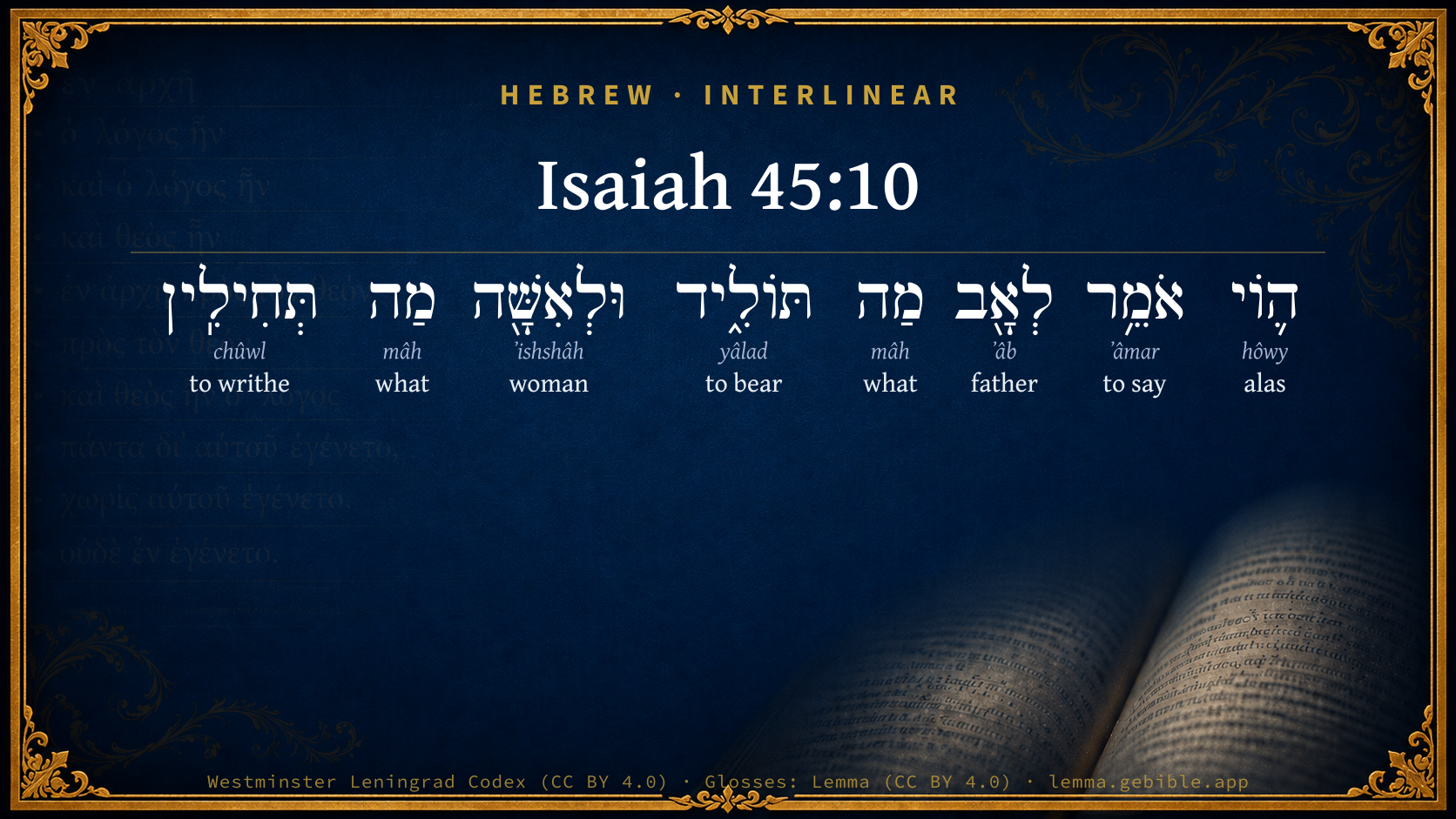
Hebrew (Westminster Leningrad Codex) Isaiah 45:10 appears in the Hebrew Old Testament. The text above is from the Westminster Leningrad Codex. Each word links to its Strong’s number, a concise gloss, and parsing drawn from the Open Scriptures Hebrew Bible morphology. Click any word for its full Brown-Driver-Briggs (BDB) entry.
Download image
Cite this verse

Isaiah 45:10 (World English Bible). Public Domain. Lemma interlinear Bible study tool, https://lemma.gebible.app/v/isaiah/45/10.

Show BibTeX & RIS
BibTeX
RIS
English Translation
Woe to him who says to a father, "What have you become the father of?" or to a woman, "With what do you travail?"
World English Bible · Public Domain
Download a study sheet

One document with this verse’s original text, its word-by-word gloss line, the meaning frame, cross-references with their text, attributed commentary, and full source and license credits — printable, and it pastes into notes with its structure intact.

This verse Autodidact and up

Study sheet (.html) Plain text (.txt)

A passage Seminary Student

Up to 50 verses in one chapter. A passage sheet keeps up to 6 commentary sources and 12 cross-references per verse, in the order this page ranks them, and says so on the sheet whenever that leaves anything out. Ask for a single verse and you get the Autodidact verse sheet above.

Everything on this page stays free to read, with no account — the sheet is a download of what is already on screen, not access to it.

Want to remove ads? Support Godless Engineer
Compare translations 3

The same verse in 3 English versions, stacked beneath the original-language interlinear above. Click any original word for its lexicon entry.

Each is an independent rendering of the whole verse — the interlinear is not word-aligned to these translations.

Highlighted words mark where these versions differ — a whole-verse word diff, not a word-by-word alignment.

  • World English Bible Public Domain
    Woe to him who says to a father, "What have you become the father of?" or to a woman, "With what do you travail?"
  • King James Version Public Domain
    Woe unto him that saith unto his father, What begettest thou? or to the woman, What hast thou brought forth?
  • unfoldingWord Literal Text CC BY-SA 4.0
    Woe to the one saying to a father, “What are you begetting?” or to a woman, “What are you writhing with?” q1

unfoldingWord Literal Text — © unfoldingWord, licensed CC BY-SA 4.0. Word-aligned USFM3 via Door43 (git.door43.org/unfoldingWord/en_ult).

Versions to compare (up to 4)

3 of 4 selected

Show all 18 translations

Every available English version of this verse, each an independent rendering of the whole verse.

  • World English Bible Public Domain
    Woe to him who says to a father, "What have you become the father of?" or to a woman, "With what do you travail?"
  • Berean Standard Bible Public Domain
    Woe to him who says to his father, ‘What have you begotten?’ or to his mother, ‘What have you brought forth?’”
  • Majority Standard Bible Public Domain
    Woe to him who says to his father, ‘What have you begotten?’ or to his mother, ‘What have you brought forth?’”
  • King James Version Public Domain
    Woe unto him that saith unto his father, What begettest thou? or to the woman, What hast thou brought forth?
  • American Standard Version (1901) Public Domain
    Woe unto him that saith unto a father, What begettest thou? or to a woman, With what travailest thou?
  • Revised Version (1885) Public Domain
    Woe unto him that saith unto a father, What begettest thou? or to a woman, with what travailest thou?
  • Geneva Bible (1599) Public Domain
    Woe vnto him that sayeth to his father, What hast thou begotten? or to his mother, What hast thou brought foorth?
  • Douay-Rheims (1899) Public Domain
    Woe to him that saith to his father: Why begettest thou? and to the woman: Why dost thou bring forth?
  • Young's Literal Translation Public Domain
    Wo `to' him who is saying to a father, `What dost thou beget?' Or to a wife, `What dost thou bring forth?
  • Literal Standard Version CC BY-SA 4.0
    Woe [to] him who is saying to a father, What do you beget? Or to a wife, What do you bring forth?”
  • Unlocked Literal Bible CC BY-SA 4.0
    Woe to him who says to a father, 'What are you fathering?' or to a woman, 'What are you giving birth to?'
  • unfoldingWord Literal Text CC BY-SA 4.0
    Woe to the one saying to a father, “What are you begetting?” or to a woman, “What are you writhing with?” q1
  • Darby Bible Public Domain
    Woe unto him that saith unto [his] father, What begettest thou? Or to [his] mother, What hast thou brought forth?
  • World Messianic Bible Public Domain
    Woe to him who says to a father, ‘What have you become the father of?’ or to a mother, ‘What have you given birth to?’”
  • Webster's Bible Public Domain
    Woe to him that saith to his father, What begettest thou? or to the woman, What hast thou brought forth?
  • Free Bible Version CC BY-SA 4.0
    How bad it would be if you said to your father, “Why did you have me?” or to your mother, “Why was I ever born?”!
  • Bible in Basic English Public Domain
    Cursed is he who says to a father, To what are you giving life? or to a woman, What are you in birth-pains with?
  • JPS Tanakh (1917) Public Domain
    Woe unto him that saith unto his father: 'Wherefore begettest thou?' Or to a woman: 'Wherefore travailest thou?'

Literal Standard Version (2020), Covenant Press — licensed CC BY-SA 4.0. Text via the HelloAO Bible API (eBible.org). Unlocked Literal Bible (unfoldingWord) — licensed CC BY-SA 4.0. Text via the HelloAO Bible API (eBible.org). unfoldingWord Literal Text — © unfoldingWord, licensed CC BY-SA 4.0. Word-aligned USFM3 via Door43 (git.door43.org/unfoldingWord/en_ult). Free Bible Version, Dr. Jonathan Gallagher — licensed CC BY-SA 4.0. Text via the HelloAO Bible API (eBible.org).

Word by word

More ways to search: Search by grammar → Find every occurrence → Compare this word →

Practice this passage: Drill this verse → Learn its vocabulary →

About this verse

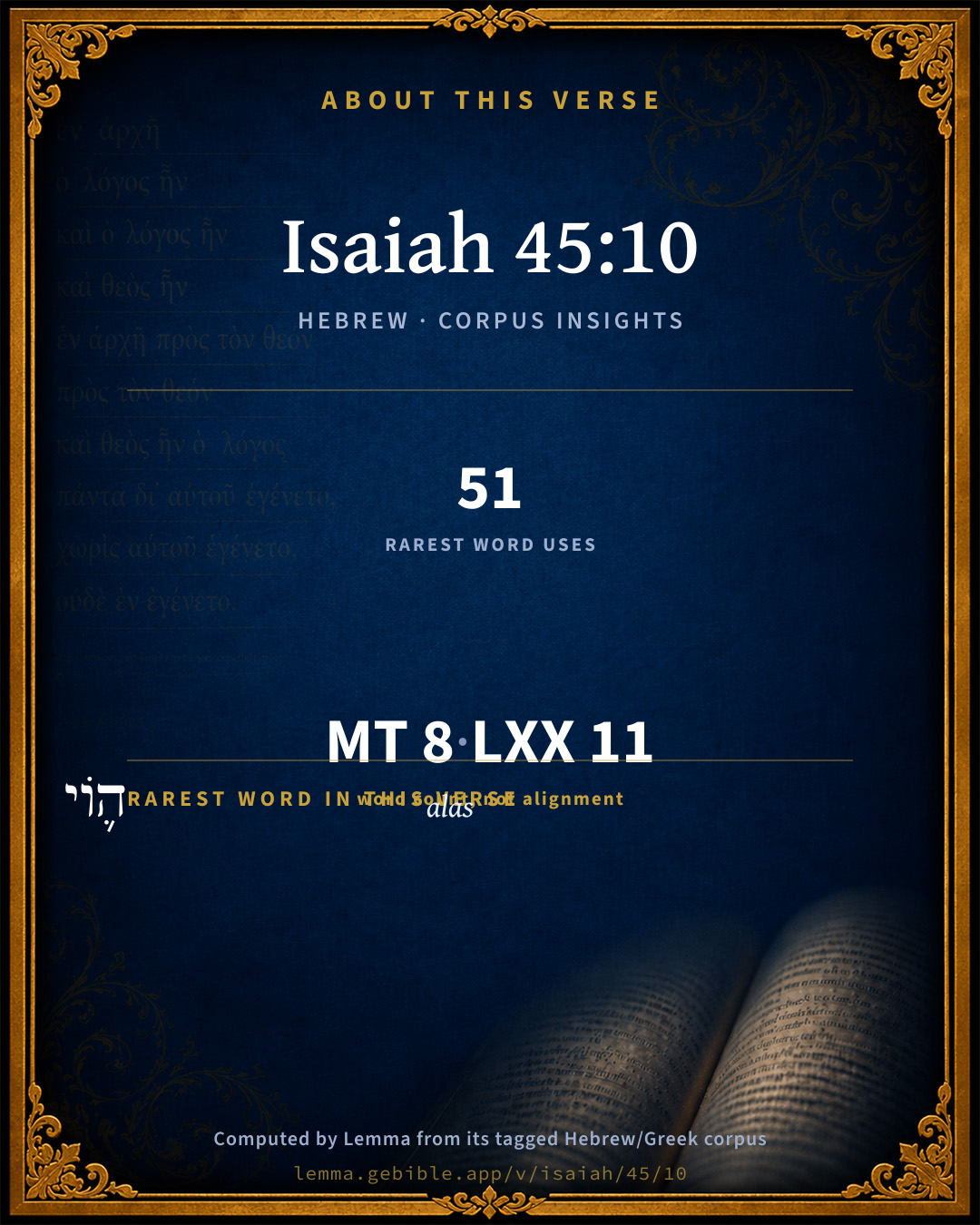
These counts appear in no published source. They are computed here, from the morphology-tagged text and Lemma’s own curated glosses. What Lemma adds →

8
words
7
distinct lemmas
Prophets
section

Shared distinctive vocabulary

ה֛וֹי alas H1945 occurs in 47 verses of the Hebrew Bible. Also found in:

Grammatical profile

  • 3 verbs
  • 2 nouns
  • 3 particles

Verb forms

  • אֹמֵ֥ר Qal · Participle Active
  • תּוֹלִ֑יד Hiphil · Imperfect
  • תְּחִילִֽין Qal · Imperfect

Repetition

A word recurs within this verse — often emphatic in Hebrew:

Hebrew & Septuagint length

In English translation the verse runs 24 words from the Hebrew and 22 from the Septuagint (LXX English) — closely comparable.

A rough comparison of the two English renderings, which tokenize alike — not a word-level alignment.

Word counts can differ between the Hebrew and the Greek without any difference in meaning — e.g. the Hebrew direct-object marker אֵת has no separate Greek word, and Greek often adds the article ὁ.

In the original languages it is 8 Hebrew tokens and 11 Greek tokens — but the two are counted differently (Hebrew bundles its prefixes and suffixes into one token; the Greek is in lemma form), so that isn’t a like-for-like length.

Cross-references

3

Topical passages linked to Isaiah 45:10 in the Treasury of Scripture Knowledge — connected by theme and wording, ordered by reader-vote popularity; previews shown in the World English Bible.

  • Deuteronomy 27:16 Cursed be he who sets light by his father or his mother. All the people shall say, Amen.
  • Malachi 1:6 "A son honors his father, and a servant his master. If I am a father, then where is my honor? And if I am a master, where is the respect due me? Says Yahweh of Hosts to you, priests, who despise my name. You say, 'How have we despised your name?'
  • Hebrews 12:9 Furthermore, we had the fathers of our flesh to chasten us, and we paid them respect. Shall we not much rather be in subjection to the Father of spirits, and live?

Cross-references courtesy of OpenBible.info (CC BY 4.0).

Hebrew and Greek witnesses Masoretic Hebrew ↔ Greek Septuagint

The same verse in the two great witnesses to the Old Testament, shown verse-for-verse.

These are two independent witnesses, not word-aligned to each other, and the Septuagint is shown in lemma (dictionary) form.

Hebrew Isaiah 45:10 Masoretic · Westminster Leningrad Codex

ה֛וֹי אֹמֵ֥ר לְאָ֖ב מַה תּוֹלִ֑יד וּלְאִשָּׁ֖ה מַה תְּחִילִֽין

Woe to him who says to a father, "What have you become the father of?" or to a woman, "With what do you travail?"

World English Bible · Public Domain

Greek LXX Isaiah 45:10 Septuagint · lemma form

ὁ λέγω ὁ πατήρ τίς γεννάω καί ὁ μήτηρ τίς ὠδίνω

As though one should say to his father, What will you beget me? and to his mother, What are you bringing forth?

LXX2012 (modern English Septuagint) · Public Domain

Hebrew: Westminster Leningrad Codex (CC BY 4.0). Greek: Septuagint (public domain); English from LXX2012 (modern English Septuagint) (Public Domain). How the Septuagint differs from the Hebrew →

Targum (Aramaic paraphrase)

1

The Targum is the ancient Jewish Aramaic paraphrase of the Hebrew Scriptures — an interpretive translation, not the Hebrew text itself. Onkelos (literal) and Pseudo-Jonathan (expansive) render the Torah, and Jonathan the Prophets. Coverage is partial: where no permissively-licensed English translation exists for a verse, only the Aramaic is shown. This is verse-level text, not a word-by-word alignment to the Hebrew.

  1. Targum Jonathan Prophets (Joshua–Malachi)
    וַי דַאֲמַר לְאָב מַה תּוֹלִיד וּלְאִתְּתָא מַה תֶּעְדִין:

    Woe to him that saith to his father, What begettest thou? and to his mother, What hast thou brought forth?

    Targum Jonathan — Aramaic: “Mikraot Gedolot” (public domain). English: “Sefaria Community Translation” (CC0 1.0 (public-domain dedication)); “London "Chaldee Paraphrase," 1871” (public domain). Text via Sefaria.

Commentary

Notes on Isaiah 45:10 from classic Christian and Jewish commentators (each source and its license shown beneath its notes). The classic Christian expositions comment on the surrounding passage and are grouped to its opening verse, so a note may address several verses; the Jewish commentaries on the Tanakh (Rashi and others) are per-verse, so they appear only where the commentator wrote on this verse.

Lemma curates 59 commentaries, every one of them public domain or Creative Commons licensed, each selected and text-cleaned for this edition rather than reprinted as found. About our sources →

Trapp's Complete Commentary

John Trapp

Isa 45:10 Woe unto him that saith unto [his] father, What begettest thou? or to the woman, What hast thou brought forth?

Ver. 10. Woe unto him that saith to his father.] Are these fit words to a father? Is it not an impious morosity to talk unto him in this sort, Why hast thou begotten me at all? or if at all, why not rich, fair, wise? &c.

And to the woman,] i.e., To his mother, {as Isa 49:15} but such as he can hardly find in his heart to call mother.

John Trapp, A Commentary or Exposition upon All the Books of the Old and New Testament (1647–1656) — public domain. Text from a community e-Sword module.

Jamieson, Fausset & Brown

Robert Jamieson, A. R. Fausset & David Brown

If it be wrong for a child, born in less favorable circumstances, to upbraid his parents with having given him birth, a fortiori, it is, to upbraid God for His dealings with us. Rather translate, "a father . . . a woman." The Jews considered themselves exclusively God's children and were angry that God should adopt the Gentiles besides. Woe to him who says to one already a father, Why dost thou beget other children? [HORSLEY].

Jamieson, Fausset & Brown — Commentary Critical and Explanatory on the Whole Bible (1871) — public domain (CC PDM 1.0). Text via the HelloAO Bible API.

Ellicott's Commentary for English Readers

(10) Woe unto him . . .—The implied argument is that men accept the accident of birth without questioning father or mother as to that which lay beyond the control of either. Should they not a fortiori accept what God orders for nations and individual men?

A Bible Commentary for English Readers, edited by Charles John Ellicott (1878–1897) — public domain. Text from a community e-Sword module.

The Cambridge Bible for Schools and Colleges

gen. ed. J. J. S. Perowne

10. The impropriety of contending with God exhibited in a still more repellent light. The words “his” and “the” are not expressed in Hebrew; simply “a father,” “a woman.” “The rudest and most outrageous intrusion into an unspeakably delicate and sacred relationship” (Delitzsch).

The Cambridge Bible for Schools and Colleges (gen. ed. J. J. S. Perowne; Cambridge University Press, 1878–1918) — public domain. Text from a community e-Sword module.

John Gill's Exposition

Woe unto him that saith unto his father, what begettest thou?.... That quarrels with him, and complains of him, because he was not of the other sex, or not so wise, or so rich, or so handsome, as others:

or to the woman; disdaining to call her mother:

what hast thou brought forth? equally as absurd and impious it was in the Jews to quarrel with Christ for his conversation with sinners, and the reception of them; or for the regeneration of such persons; or to find fault with God for the conversion of the Gentiles, and resent it, and be angry at it, as they were; see Rom 10:19.

John Gill's Exposition of the Whole Bible (1746–1763) — public domain (CC PDM 1.0). Text via the HelloAO Bible API.

Albert Barnes' Notes on the Bible

Wo unto him that saith unto his father ... - It is wicked and foolish for a son to complain of his father or mother in regard to his birth, or of his rank and condition of life. Probably the idea is, that if a child is by his birth placed in circumstances less advantageous than others, he would have no right to com plain of his parents, or to regard them as having acted improperly in having entered into the marriage relation. In like manner it would be not less improper, certainly, to complain of God who has brought us into existence by his own power, and who acts as a sovereign in the various allotments of our lives. The design is to rebuke the spirit of complaining against the allotments of Providence - a spirit which perhaps prevailed among the Jews, and which in fact is found everywhere among people; and to show that God, as a sovereign, has a right to dispose of his creatures in the manner which he shall judge to be best. The passage proves:

1. That man is formed by God, and that all his affairs are ordered by him as really as the work of the potter is moulded by the hands of the workman.

2. That God had a design in making man, and in ordering and arranging his circumstances in life.

3. That man is little qualified to judge of that design, and not at all qualified to pronounce it unwise, anymore than the clay could charge him that worked it into a vessel with want of wisdom; and,

4. That God is a sovereign, and does as he pleases. He has formed man as he chose, as really as the potter moulds the clay into any shape which he pleases. He has given him his rank in creation; given him such a body - strong, vigorous, and comely; or feeble, deformed, and sickly, as he pleased; he has given him such an intellect - vigorous, manly, and powerful; or weak, feeble, and timid, as he pleased; he has determined his circumstances in life - whether riches, poverty, an elevated rank, or a depressed condition, just as he saw fit; and he is a sovereign also in the dispensation of his grace - having a right to pardon whom he will; nor has man any right to complain.

This passage, however, should not be adduced to prove that God, in all respects, moulds the character and destiny of people as the potter does the clay. Regard should be had in the interpretation to the fact that God is just, and good, and wise, as well as a sovereign; and that man is himself a moral agent, and subject to the laws of moral agency which God has appointed. God does nothing wrong. He does not compel man to sin, and then condemn him for it. He does not make him a transgressor by physical power, as the potter moulds the clay, and then doom him for it to destruction. He does his pleasure according to the eternal laws of equity; and man has no right to call in question the rectitude of his sovereign dispensations.

Albert Barnes' Notes on the Bible (1834–1885) — public domain. Text from a community e-Sword/MySword module.

Haydock's Catholic Bible Commentary

Forth. As such language would be improper to parents, so it is wrong to complain that God places us in any situation. (Menochius)

George Leo Haydock (1774–1849), Haydock's Catholic Family Bible and Commentary, 1859 edition — public domain. Excludes Psalms (Douay-Rheims chapter numbering differs from Protestant) and Deuterocanonical books (Catholic canon only).

Matthew Poole's English Annotations

As it were an absurd and impudent thing for a child to quarrel with his parents, either simply for begetting him, or for begetting him of this or that sex, contrary to his desire; no better is it for any persons to quarrel with God the Maker and

Father of all things, as God is called, 1Co 8:6, for disposing of them and their affairs by his providence as he sees fit, and otherwise than they desire or expect; as. the Jews quarrelled with God for bringing them into captivity, and the Babylonians for translating the empire from them to the Persians.

Matthew Poole's English Annotations on the Holy Bible (1683–1685) — public domain. Text from a community e-Sword/MySword module.

The Pulpit Commentary

Woe unto him that saith unto his father, etc.! A change is made in the metaphor, the relationship of a father and his child being substituted for that of a potter and his clay. What would a man think of a child murmuring against his parent for not having made him stronger, handsomer, cleverer? Would not such a child be regarded as most unnatural, and as deserving to have woe denounced upon him?

The Pulpit Commentary (1880–1919), ed. H.D.M. Spence-Jones & Joseph S. Exell — public domain. Text from a community e-Sword module.

J. A. Alexander on Isaiah

Joseph Addison Alexander

“Woe to (him) saying to a father, What wilt thou beget, and to a woman, What wilt thou bring forth?” The same idea is again expressed, but in a form still more emphatic and revolting. The incongruities which have perplexed interpreters in this verse are intentional aggravations of the impious absurdity which it describes. The writer’s main design is to represent the doubt and discontent of men in reference to God’s future dealings with them as no less monstrous than the supposition of a child’s objection to its own birth. Such an objection, it is true cannot be offered in the case supposed; but in the real case it ought to be held equally impossible. This view of the Prophet’s meaning, if correct, of course precludes the explanation of the words as a complaint of weakness or deformity, or an expression of disgust with life, like that in Job 3:20 and Jer 20:14.

Joseph Addison Alexander, The Prophecies of Isaiah (1846–1847; New York: Scribner, 1870–1878) — public domain. Text from a community e-Sword module.

unfoldingWord translationNotes

Door43 World Missions Community

General Information:

Yahweh continues to scold those who argue with him about what he does.

Woe to him who says to a father, ... 'What are you giving birth to?'

Yahweh speaks of those who would argue him as if they were unborn children who argue with their own parents. (See: Metaphor)

What are you fathering? ... What are you giving birth to?

The unborn child asks these rhetorical questions to scold his parents for giving birth to him. These can be translated as statements. AT: "You should not be my father ... You should give birth to me." or "You are not fathering me correctly ... You are not giving birth to me correctly." (See: Rhetorical Question)

translationWords

woe

ancestor

unfoldingWord translationNotes — © Distant Shores Media and the Door43 World Missions Community, licensed CC BY-SA 4.0. Source: git.door43.org/Door43/en_tn.

Rashi

Rabbi Shlomo Yitzchaki (Rashi)

Woe to him who says to a father, “What do you beget?” He thinks that he has more pity on the son than his father. Another explanation is: Woe is the son who says to his father, “Why have you begotten?” He is analogous to the one who contends with his Creator.

Rashi on the Tanakh — English translations: “The Judaica Press complete Tanach with Rashi, translated by A. J. Rosenberg” (CC BY 4.0); “Pentateuch with Rashi's commentary by M. Rosenbaum and A.M. Silbermann, 1929-1934” (public domain); “The Metsudah Tanach series, Lakewood, N.J” (CC BY 4.0); and “The Book of Joshua, Metsudah Publications, 1997” (CC BY 4.0). Text via Sefaria.

Ibn Ezra

Rabbi Abraham ibn Ezra

He that saith to his father, etc. Or can the son before his birth say to his father, What wilt thou beget, or to the woman, that is, to his mother, what wilt thou bring forth? תחילין Thou will bring forth. Comp. כי חלה נם ילדה ציון Zion travailed, she brought forth (66:8)

Ibn Ezra on the Tanakh — English translations: “Sefaria Community Translation” (CC0 1.0 (public-domain dedication)); “Yalkut, Sifsei Chachomim Chumash, Metsudah Publications, 2009” (CC BY 4.0); and “Commentary of Ibn Ezra on Isaiah - trans. by M. Friedlander, 1873” (public domain). Text via Sefaria.

Lesson kit

Teaching starters — assembled from the data on this page, not authored interpretation. Every prompt links to the verse data it draws on. Edit before teaching.

Isaiah, in the Prophets, opens this verse with 8 words (7 distinct Hebrew lemmas). Its most distinctive word is hôwy (“alas”). A historical commentator’s framing appears above. Read the whole chapter for the surrounding context.

Discussion questions

  1. What does “alas” (hôwy) contribute to the verse as a whole?
  2. How does 1 Kings 13:30, which shares the word «alas», read alongside this verse?
  3. What does the repetition of “what” (2× in this one verse) do in this verse?
  4. These translations render this verse differently. What is at stake in choosing one wording over another?
  5. «אֹמֵ֥ר» is a Qal Participle Active verb. How does that grammatical form shape the action described?
  6. Compare how Trapp's Complete Commentary and Jamieson, Fausset & Brown read this verse. Where do they agree or differ?

Things to notice

Reading settings

Reading text

Shown beneath each verse's original-language words.

Old Testament
Old Testament edition

Read the OT as the Masoretic Hebrew (MT) or the Greek Septuagint (LXX).

English shown for the Greek Septuagint (in the Hebrew ↔ Greek comparison).

Comparing translations? Open the Compare panel on any verse page to stack up to four side by side.