
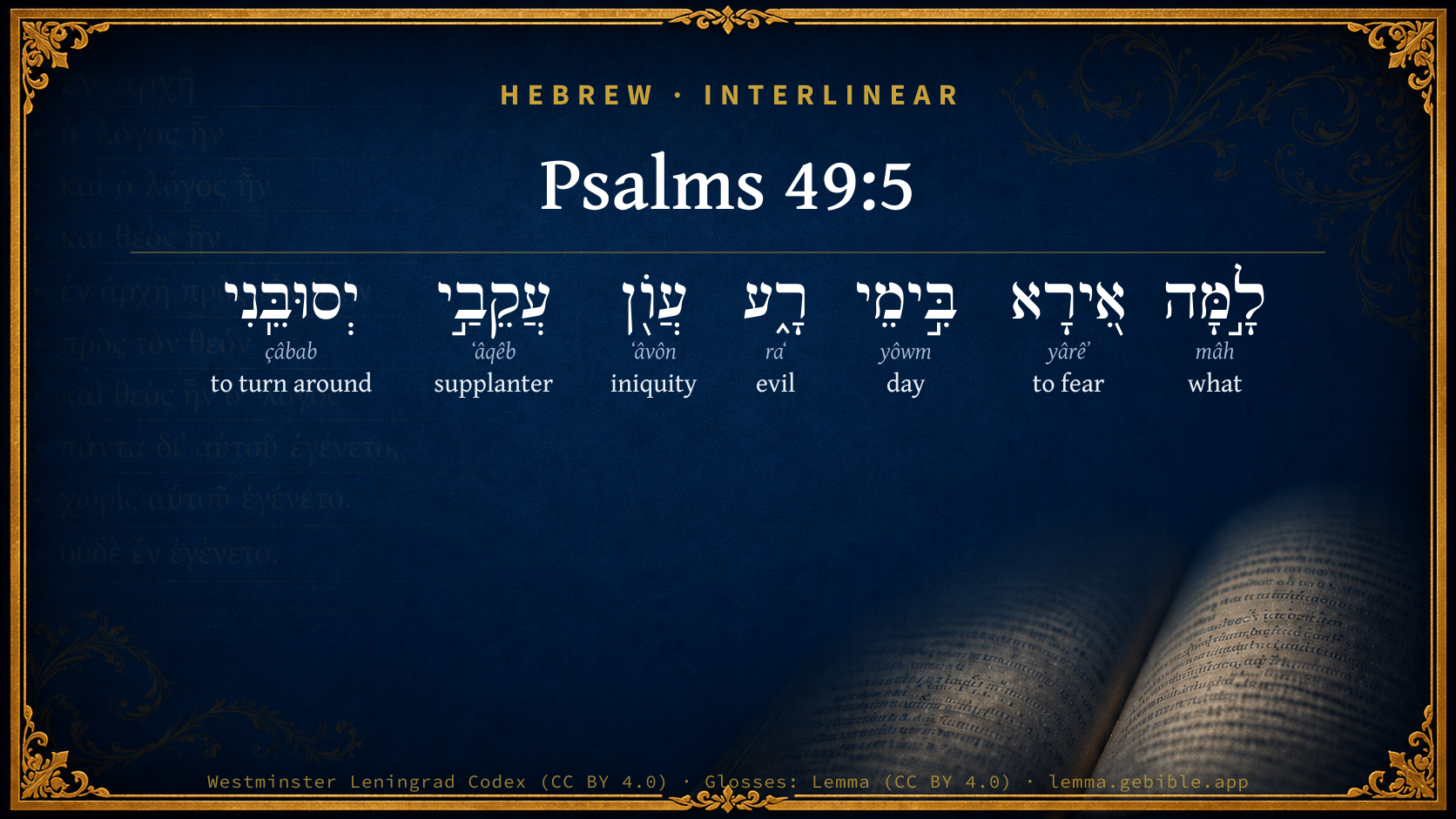
Psalms 49:5

Hebrew (Westminster Leningrad Codex) Psalms 49:5 appears in the Hebrew Old Testament. The text above is from the Westminster Leningrad Codex. Each word links to its Strong’s number, a concise gloss, and parsing drawn from the Open Scriptures Hebrew Bible morphology. Click any word for its full Brown-Driver-Briggs (BDB) entry.
Download image
Cite this verse

Psalms 49:5 (World English Bible). Public Domain. Lemma interlinear Bible study tool, https://lemma.gebible.app/v/psalms/49/5.

Show BibTeX & RIS
BibTeX
RIS
English Translation
Why should I fear in the days of evil, When iniquity at my heels surrounds me?
World English Bible · Public Domain
Highlights
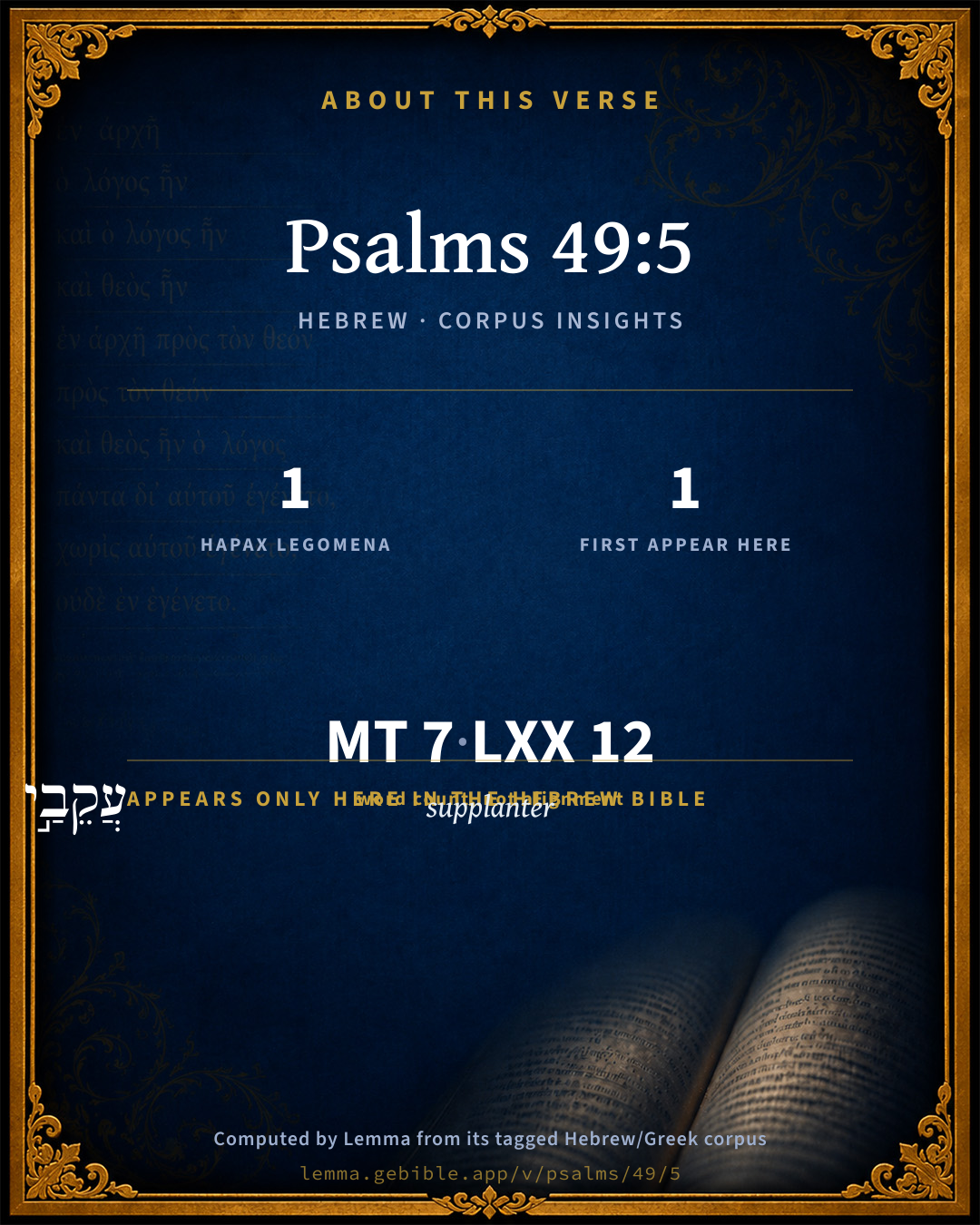
  • 1 hapax legomenon — only here in the Hebrew Bible
  • 1 first appearance in the Hebrew Bible
Full analysis ↓
Download a study sheet

One document with this verse’s original text, its word-by-word gloss line, the meaning frame, cross-references with their text, attributed commentary, and full source and license credits — printable, and it pastes into notes with its structure intact.

This verse Autodidact and up

Study sheet (.html) Plain text (.txt)

A passage Seminary Student

Up to 50 verses in one chapter. A passage sheet keeps up to 6 commentary sources and 12 cross-references per verse, in the order this page ranks them, and says so on the sheet whenever that leaves anything out. Ask for a single verse and you get the Autodidact verse sheet above.

Everything on this page stays free to read, with no account — the sheet is a download of what is already on screen, not access to it.

Want to remove ads? Support Godless Engineer
Compare translations 3

The same verse in 3 English versions, stacked beneath the original-language interlinear above. Click any original word for its lexicon entry.

Each is an independent rendering of the whole verse — the interlinear is not word-aligned to these translations.

Highlighted words mark where these versions differ — a whole-verse word diff, not a word-by-word alignment.

  • World English Bible Public Domain
    Why should I fear in the days of evil, When iniquity at my heels surrounds me?
  • King James Version Public Domain
    Wherefore should I fear in the days of evil, when the iniquity of my heels shall compass me about?
  • unfoldingWord Literal Text CC BY-SA 4.0
    Why should I fear in the days of evil, the iniquity of my heels surrounds me,

unfoldingWord Literal Text — © unfoldingWord, licensed CC BY-SA 4.0. Word-aligned USFM3 via Door43 (git.door43.org/unfoldingWord/en_ult).

Versions to compare (up to 4)

3 of 4 selected

Show all 18 translations

Every available English version of this verse, each an independent rendering of the whole verse.

  • World English Bible Public Domain
    Why should I fear in the days of evil, When iniquity at my heels surrounds me?
  • Berean Standard Bible Public Domain
    Why should I fear in times of trouble, when wicked usurpers surround me?
  • Majority Standard Bible Public Domain
    Why should I fear in times of trouble, when wicked usurpers surround me?
  • King James Version Public Domain
    Wherefore should I fear in the days of evil, when the iniquity of my heels shall compass me about?
  • American Standard Version (1901) Public Domain
    Wherefore should I fear in the days of evil, When iniquity at my heels compasseth me about?
  • Revised Version (1885) Public Domain
    Wherefore should I fear in the days of evil, when iniquity at my heels compasseth me about?
  • Geneva Bible (1599) Public Domain
    Wherefore should I feare in the euil dayes, when iniquitie shall compasse me about, as at mine heeles?
  • Douay-Rheims (1899) Public Domain
    I will incline my ear to a parable; I will open my proposition on the psaltery.
  • Young's Literal Translation Public Domain
    Why do I fear in days of evil? The iniquity of my supplanters doth compass me.
  • Literal Standard Version CC BY-SA 4.0
    Why do I fear in days of evil? The iniquity of my supplanters surrounds me.
  • Unlocked Literal Bible CC BY-SA 4.0
    Why should I fear the days of evil, when iniquity surrounds me at my heels?
  • unfoldingWord Literal Text CC BY-SA 4.0
    Why should I fear in the days of evil, the iniquity of my heels surrounds me,
  • Darby Bible Public Domain
    Wherefore should I fear in the days of adversity, [when] the iniquity of my supplanters encompasseth me? --
  • World Messianic Bible Public Domain
    Why should I fear in the days of evil, when iniquity at my heels surrounds me?
  • Webster's Bible Public Domain
    \\49:4\\I will incline my ear to a parable: I will open my dark saying upon the harp.
  • Free Bible Version CC BY-SA 4.0
    Why should I be afraid when trouble comes, when evil enemies surround me?
  • Bible in Basic English Public Domain
    What cause have I for fear in the days of evil, when the evil-doing of those who are working for my downfall is round about me?
  • JPS Tanakh (1917) Public Domain
    (49-6) Wherefore should I fear in the days of evil, when the iniquity of my supplanters compasseth me about,

Literal Standard Version (2020), Covenant Press — licensed CC BY-SA 4.0. Text via the HelloAO Bible API (eBible.org). Unlocked Literal Bible (unfoldingWord) — licensed CC BY-SA 4.0. Text via the HelloAO Bible API (eBible.org). unfoldingWord Literal Text — © unfoldingWord, licensed CC BY-SA 4.0. Word-aligned USFM3 via Door43 (git.door43.org/unfoldingWord/en_ult). Free Bible Version, Dr. Jonathan Gallagher — licensed CC BY-SA 4.0. Text via the HelloAO Bible API (eBible.org).

Word by word

More ways to search: Search by grammar → Find every occurrence → Compare this word →

Practice this passage: Drill this verse → Learn its vocabulary →

About this verse

These counts appear in no published source. They are computed here, from the morphology-tagged text and Lemma’s own curated glosses. What Lemma adds →

7
words
7
distinct lemmas
Wisdom
section

Notable vocabulary

1 hapax legomenon — a word that appears only here in the entire Hebrew Bible:

  • עֲקֵבַ֣י supplanter H6120

First appearance in Scripture

This word makes its first canonical appearance in the Hebrew Bible here:

  • עֲקֵבַ֣י supplanter H6120

Grammatical profile

  • 2 verbs
  • 3 nouns
  • 1 adjective
  • 1 particle

Verb forms

  • אִ֭ירָא Qal · Imperfect
  • יְסוּבֵּֽנִי Qal · Imperfect

Hebrew & Septuagint length

In English translation the verse runs 16 words from the Hebrew and 16 from the Septuagint (LXX English) — the same length.

A rough comparison of the two English renderings, which tokenize alike — not a word-level alignment.

Word counts can differ between the Hebrew and the Greek without any difference in meaning — e.g. the Hebrew direct-object marker אֵת has no separate Greek word, and Greek often adds the article ὁ.

In the original languages it is 7 Hebrew tokens and 12 Greek tokens — but the two are counted differently (Hebrew bundles its prefixes and suffixes into one token; the Greek is in lemma form), so that isn’t a like-for-like length.

Cross-references

17

Topical passages linked to Psalms 49:5 in the Treasury of Scripture Knowledge — connected by theme and wording, ordered by reader-vote popularity; previews shown in the World English Bible.

  • Proverbs 24:10 If you falter in the time of trouble, Your strength is small.
  • Acts 27:24 saying, 'Don't be afraid, Paul. You must stand before Caesar. Behold, God has granted you all those who sail with you.'
  • Romans 8:33–34 Who could bring a charge against God's chosen ones? It is God who justifies.
  • Philippians 1:28 and in nothing frightened by the adversaries, which is for them a proof of destruction, but to you of salvation, and that from God.
  • Genesis 49:17 Dan will be a serpent in the way, An adder in the path, That bites the horse's heels, So that his rider falls backward.
  • 1 Samuel 26:20 Now therefore, don't let my blood fall to the earth away from the presence of Yahweh: for the king of Israel is come out to seek a flea, as when one does hunt a partridge in the mountains.
  • Psalms 22:16 For dogs have surrounded me. A company of evil-doers have enclosed me. They pierced my hands and my feet.
  • Psalms 23:4 Even though I walk through the valley of the shadow of death, I will fear no evil, for you are with me. Your rod and your staff, they comfort me.
  • Psalms 27:1–2 Yahweh is my light and my salvation. Whom shall I fear? Yahweh is the strength of my life. Of whom shall I be afraid?
  • Psalms 38:4 For my iniquities have gone over my head. As a heavy burden, they are too heavy for me.
  • Psalms 46:1–2 God is our refuge and strength, A very present help in trouble.
  • Psalms 56:6–7 They conspire and lurk, Watching my steps, they are eager to take my life.
  • Proverbs 5:22 The evil deeds of the wicked ensnare him. The cords of his sin hold him firmly.
  • Isaiah 41:10–11 Don't you be afraid, for I am with you; don't be dismayed, for I am your God; I will strengthen you; yes, I will help you; yes, I will uphold you with the right hand of my righteousness.
  • Hosea 7:2 They don't consider in their hearts that I remember all their wickedness. Now their own deeds have engulfed them. They are before my face.
  • Amos 5:13 Therefore he who is prudent shall keep silence in such a time; For it is an evil time.

Cross-references courtesy of OpenBible.info (CC BY 4.0).

Hebrew and Greek witnesses Masoretic Hebrew ↔ Greek Septuagint

The same verse in the two great witnesses to the Old Testament, shown verse-for-verse.

You’re reading Greek Psalm 48 (Hebrew Psalm 49). The Septuagint counts the superscription, so verse numbers can differ from the Hebrew — chapter-level alignment, not verse-by-verse. Numbering follows Rahlfs.

These are two independent witnesses, not word-aligned to each other, and the Septuagint is shown in lemma (dictionary) form.

Hebrew Psalms 49:5 Masoretic · Westminster Leningrad Codex

לָ֣מָּה אִ֭ירָא בִּ֣ימֵי רָ֑ע עֲוֺ֖ן עֲקֵבַ֣י יְסוּבֵּֽנִי

Why should I fear in the days of evil, When iniquity at my heels surrounds me?

World English Bible · Public Domain

Greek LXX Greek Psalm 48:5 Septuagint · lemma form

κλίνω εἰς παραβολή ὁ οὖς ἐγώ ἀναοἴγω ἐν ψαλτήριον ὁ πρόβλημα ἐγώ

Therefore should I fear in the evil day? the iniquity of my heel shall compass me.

LXX2012 (modern English Septuagint) · Public Domain

On this verse, Albert Barnes' Notes on the Bible discusses the Septuagint’s reading. Read the note in Commentary ↓

Hebrew: Westminster Leningrad Codex (CC BY 4.0). Greek: Septuagint (public domain); English from LXX2012 (modern English Septuagint) (Public Domain). How the Septuagint differs from the Hebrew →

Commentary

Notes on Psalms 49:5 from classic Christian and Jewish commentators (each source and its license shown beneath its notes). The classic Christian expositions comment on the surrounding passage and are grouped to its opening verse, so a note may address several verses; the Jewish commentaries on the Tanakh (Rashi and others) are per-verse, so they appear only where the commentator wrote on this verse.

Lemma curates 59 commentaries, every one of them public domain or Creative Commons licensed, each selected and text-cleaned for this edition rather than reprinted as found. About our sources →

Trapp's Complete Commentary

John Trapp

Psa 49:5 Wherefore should I fear in the days of evil, [when] the iniquity of my heels shall compass me about?

Ver. 5. Wherfore should I fear in the days of evil?] All the days of the afflicted are evil, Pro 15:15. But why should either I, or any other afflicted servant of God, be overly troubled, as if some strange thing had befallen us; or staggered at the better condition of worse men, all things considered?

When the iniquity of my heels] Or, of my supplanters, mine enemies, those naughty men (called here iniquity in the abstract) who seek to trip up my heels, and do surround me with their snares for that purpose. See Psa 56:7. Or thus, "When the iniquity of my heels," &c. That is, as some will have it, when my sins come to my remembrance, or are chastened upon me. Every man’s heel hath some iniquity. As we shall have some dirt cleaving to our heels whiles we walk in a dirty world; so there is some defilement upon all our actions, which we may call the iniquity of our heels. "He that is washed," saith our Saviour to Peter, "needeth not save to wash his feet, but is clean every whit," Joh 13:10. The comparison seems to be taken from those that wash in baths; for although their whole bodies are thereby made clean, yet going forth they touch the earth with their feet, and so are fain to wash again; in like manner the saints, although bathed in that blessed fountain opened for sin and for uncleanness, Zec 13:1, and thereby freed from the stain and reign of sin; yet their feet or heels have some filth on them, some relics of corruption do still cleave to them, and cause them some sorrow; yet ought they not to fear, or be dismayed, but by the practice of mortification purge themselves daily from all filthiness of flesh and spirit, perfecting holiness in the fear of God, 2Co 7:1.

John Trapp, A Commentary or Exposition upon All the Books of the Old and New Testament (1647–1656) — public domain. Text from a community e-Sword module.

The Treasury of David

Charles H. Spurgeon

Ver. 5. Wherefore should I fear in the days of evil, when the iniquity of my heels shall compass me about? The man of God looks calmly forward to dark times when those evils which have dogged his heels shall gain a temporary advantage over him. Iniquitous men, here called in the abstract iniquity, lie in wait for the righteous, as serpents that aim at the heels of travellers: the iniquity of our heels is that evil which aims to trip us up or impede us. It was an old prophecy that the serpent should wound the heel of the woman's seed, and the enemy of our souls is diligent to fulfil that premonition. In some dreary part of our road it may be that evil will wax stronger and bolder, and gaining upon us will openly assail us; those who followed at our heels like a pack of wolves, may perhaps overtake us, and compass us about. What then? Shall we yield to cowardice? Shall we be a prey to their teeth? God forbid. Nay, we will not even fear, for what are these foes? What indeed, but mortal men who shall perish and pass away? There can be no real ground of alarm to the faithful. Their enemies are too insignificant to be worthy of one thrill of fear. Doth not the Lord say to us, "I, even I, am he that comforteth thee; who art thou, that thou shouldest be afraid of a man that shall die, and of the son of man which shall be made as grass?"

Scholars have given other renderings of this verse, but we prefer to keep to the authorised version when we can, and in this case we find in it precisely the same meaning which those would give to it who translate my heels, by the words "my supplanters."

Ver. 5. Wherefore should I fear in the days of evil, when the iniquity of my heels shall compass me about? Those that are full of years are approaching the nearer to their happiness. They have finished their voyage, and now are in sight of the haven. Nature's provision is spent, her stock is exhausted, and now the good man doth not so much descend as fall into the grave, and from thence he rises to heaven and eternal bliss. And shall he be disturbed at this? shall he be afraid to be made happy? If I mistake not, this is the meaning of the psalmist's words. They are generally interpreted concerning his ways in general, but they seem to me to refer particularly to the calamity which his old age was incident to: for the days of evil are old age, and are so called by the wise man Ec 12:1; and as the heel is the extreme part of the body, so it is here applied to the last part of man's life, his declining age; and iniquity (as the word is sometimes used among the Hebrews) signifies here penal evil, and denotes the infirmities and decays of the concluding part of a man's life. So that the true meaning of the psalmist's words is thisI will not now in my last days be dejected with fear and trouble of mind, for I am coming towards my happiness, my declining years shall deliver me up to death, and that shall consign me to everlasting life. This certainly is matter of joy rather than of fear. For this reason I account my last days to be the most eligible part of my whole life. John Edwards, D.D. (1637-1716), in "The Theologia Reformata."

Ver. 5. Wherefore should I fear in the days of evil, when the iniquity of my heels shall compass me about? That is, when my sins or failings in what I have done, come to my remembrance, or are chastened upon me. Every man's heels hath some iniquity: as we shall have some dirt cleaving to our heels while we walk in a dirty world, so there is some dirt, some defilement, upon all our actions, which we may call, the iniquity of our heel. Joseph Caryl.

Ver. 5. When the iniquity of my heels shall compass me about? With Bishop Lowth, the celebrated Michaelis, Bishop Hare, and a host of other critics, I decidedly incline to the idea, that (ybqe), rendered "my heels" is to be regarded as the present participle of the verb (bqe), to supplant, to act deceitfully, to deceive, to hold one by the heel, etc., etc. If this be correct, then the proper translation will be:

Wherefore should I fear in the days of adversity,

The iniquity of my supplanters who surround me?

The Syriac and Arabic read, as does also Dr. Kennicott:

Why should I fear in the evil day,

When the iniquity of my enemies compasses me about? John Morison.

Ver. 5-9.

Why should I fear the evil hour,

When ruthless foes in ambush lie,

Who revel in their pride of power,

And on their hoarded wealth rely?

A brother's ransom who can pay,

Or alter God's eternal doom?

What hand can wrest from death his prey,

Its banquet from the rotten tomb?

From "The Psalter, or Psalms of David, in English verse. By a member of the University of Cambridge." (Benjamin Hall Kennedy, D.D.) 1860.

Ver. 5.

1. The effects of our sin remain.

1. In ourselves.

2. In others.

2. In a time of conviction they compass us about: better to do so in this life, than to haunt us as ghosts for ever.

3. When they are pardoned we have nothing to fear. G.R.

Psalms 49:6*

Ver. 5-9. See Psalms on "Ps 49:5" for further information.

From "The Psalter, or Psalms of David, in English verse. By a Member of the University of Cambridge." (Benjamin Hall Kennedy, D.D.) 1860.

Ver. 5-9. See Psalms on "Ps 49:5" for further information.

Ver. 5-9. See Psalms on "Ps 49:5" for further information.

Ver. 5-9. See Psalms on "Ps 49:5" for further information.

Charles H. Spurgeon's The Treasury of David (1869–1885) — public domain. Psalms only. Text from a community e-Sword/MySword module.

Joseph Benson's Commentary

Psa 49:5. Wherefore should I fear in the days of evil — Either, 1st, Of sin; when iniquities of all sorts abound, which is, in many respects, grievous and vexatious to good men. Or, 2d, Of misery; in times of great distress and calamity, either public or private, when wicked men flourish, and good men are oppressed and persecuted. When the iniquity of my heels shall compass me about — That is, the violent and injurious practices of my ungodly and malicious enemies, who lay snares for my feet, and seek to trip up my heels, and cause me to fall into sin or into trouble. The words may, with propriety, be rendered, The iniquity of my supplanters; for the word עקבי, gnakeebai, rendered heels, may be, and is, by some learned interpreters, taken for a participle of that verb which signifies to supplant, or trip up the heels, or circumvent; from whence Jacob had his name. And this character fitly agrees to David’s enemies, who were not only very malicious, but also very deceitful and treacherous, as he everywhere complains. This sense of the words, the reader will observe, is favoured both by the Syriac and Arabic interpreters; the former of whom render the words, the iniquity of my enemies hath compassed me; and the latter thus, When mine enemies shall compass me about. The sense is also agreeable to the main scope of the Psalm, which is to comfort good men against that great trial and stumbling-block, the prosperity of the wicked, and the oppressions and afflictions of the righteous. Bishop Hare translates the verse, “Wherefore should I fear in the days of adversity, when the iniquity of those that lie in wait for me surrounds me?”

Joseph Benson's Commentary on the Old and New Testaments (1811–1818) — public domain. Text from a community e-Sword module.

J. A. Alexander on Psalms

Joseph Addison Alexander

6. (Psa 49:5). Why should I fear in days of evil, (when) the iniquity of my oppressors (or supplanters) shall surround me? The theme of the whole psalm is the negative proposition involved in this interrogation, namely, that the righteous has no cause to fear, even when surrounded by powerful and spiteful enemies. Days of evil, i.e. of misfortune or distress. The word ranslated oppressors commonly means heels; but as this yields no good sense here, it may be taken as a verbal noun, meaning either treaders, tramplers, oppressors, or supplanters, traitors, in a sense akin to which the verbal root is used, Gen 27:36, Hos 12:4 (3). In either case, it is clearly a description of his enemies, as practising violence or fraud against him.

Joseph Addison Alexander, The Psalms Translated and Explained (1850) — public domain. Text from a community e-Sword module.

Tyndale Open Study Notes

Tyndale Open Resources

49:5-8 If enemies who live for material rewards cannot sustain themselves, how can they give life to others?

Tyndale Open Study Notes — © Tyndale Open Resources, licensed CC BY-SA 4.0. Text via the HelloAO Bible API.

Geneva Bible (1599)

Geneva Bible translators

Though wickedness reign, and enemies rage, seeing God will execute his judgments against the wicked in time convenient.

Geneva Bible (1599) marginal notes — public domain. Text via Bolls.life.

Jamieson, Fausset & Brown

Robert Jamieson, A. R. Fausset & David Brown

iniquity--or, "calamity" (Psa 40:12).

of my heels--literally "my supplanters" (Gen 27:36), or oppressors: "I am surrounded by the evils they inflict."

Jamieson, Fausset & Brown — Commentary Critical and Explanatory on the Whole Bible (1871) — public domain (CC PDM 1.0). Text via the HelloAO Bible API.

Adam Clarke's Commentary

Verse 5. The iniquity of my heels] Perhaps עקבי akebai, which we translate my heels, should be considered the contracted plural of עקבים akebim, supplanters. The verse would then read thus: "Wherefore should I fear in the days of evil, though the iniquity of my supplanters should compass me about." The Syriac and Arabic have taken a similar view of the passage: "Why should I fear in the evil day, when the iniquity of my enemies compasses me about." And so Dr. Kennicott translates it.

Adam Clarke's Commentary on the Bible (1810–1826) — public domain. Text from a community e-Sword/MySword module.

John Calvin's Commentaries

5. Wherefore should I fear in the days of evil? The Psalmist now enters upon the point on which he proposed to discourse, That the people of God must not yield to despondency even in the most distressing circumstances, when their enemies may seem to have enclosed them on every side, but must rest assured that God, although he connives for a time, is awake to their condition, and only watches the best opportunity of executing his judgments. This manner of introducing the subject by interrogation is much more emphatic than if he had simply asserted his resolution to preserve his mind undisturbed in the midst of adversity. In the second clause of the verse he particularises the heaviest and most bitter of all afflictions, those which are experienced by the righteous when their enemies triumph in the unrestrained indulgence of their wickedness. When, the adverb of time, must therefore be understood — When the iniquity of my heel shall compass me about There is a different meaning which some interpreters have attached to the words, namely, If I should fear in the days of evil, and be guilty of the excessive anxieties of the unbeliever, — in that case, when the hour of my death came, my iniquity would compass me about. The heel they take to be the end of life. But this interpretation is to be dismissed at once as most unnatural. Nor do I see what reason others have for referring this word to the thoughts, for I believe that in no other part of Scripture can such a metaphor or similitude be found. Others, with more plausibility, have rendered the original word liers in wait, because the Hebrew verb עקב, akab, signifies to deceive; and they consider the Psalmist as intimating, that he would not fear though crafty and treacherous men laid snares for him. In my opinion, there is no figure intended; and he means to say, that he would have no fear when his enemies surrounded him, and in pursuing him, trode, as it were, upon his heel. The French have a similar expression, “Poursuyvre jusques aux talons.” I agree with them, that he speaks of enemies, but it is of their wicked persecution as they press upon him in the height of their power, and with design to destroy him, keep themselves near him, and tread, so to speak, upon his very heel.

John Calvin's Commentaries (1540-1563) — public domain. Text from the Calvin Translation Society English edition (1840s-50s) via the Christian Classics Ethereal Library (ccel.org). Calvin's coverage is partial (roughly two-thirds of the Bible); uncommented books and verses are honest gaps, never fabricated. The 19th-century editor's footnotes and remarks are omitted so the notes are faithfully Calvin's own voice.

Ellicott's Commentary for English Readers

(5) Should I fear?—Here the problem is stated not in a speculative, but personal form. The poet himself feels the pressure of this riddle of life.

When the iniquity of my heels.—The Authorised Version seems to take “heels” in the sense of footsteps, as Symmachus does, and “when the evil of my course entangles me,” is good sense, but not in agreement with the context. Render rather, when iniquity dogs me at the heels, i.e., when wicked and prosperous men pursue him with malice. This is more natural than to give the word heel the derived term of supplanter; the sense, too, is the same. There is no direct reference to Gen_3:15, though possibly the figure of the heel as a vulnerable part, and of wickedness lying like a snake in the path, may have occurred to the poet. The Syriac, however, suggests a different reading, “malice of my oppressors.”

A Bible Commentary for English Readers, edited by Charles John Ellicott (1878–1897) — public domain. Text from a community e-Sword module.

The Cambridge Bible for Schools and Colleges

gen. ed. J. J. S. Perowne

5. in the days of evil] Or, of the evil man: when evil or evil men seem to have the upper hand, uncontrolled by any divine law of righteousness. Cp. Psa_94:13.

when the iniquity of my heels &c.] Apparently this means, when his own false steps and errors of conduct surround him and threaten to prove his ruin. But apart from the strangeness of the expression, this meaning does not suit the context. It is better to render with R.V.,

When iniquity at my heels compasseth me about,

when the injustice of wealthy neighbours dogs his footsteps and threatens to trip him up. But better still is the rendering of R.V. marg., which gives a clear sense, and a good connexion with Psa_49:6,

When the iniquity of them that would supplant me compasseth me about,

Even of them that trust … riches?

He is in danger from wealthy and unscrupulous neighbours, who are eager to trip him up and get him into their power. Cp. Jer_9:4.

5–12. The limits to the power and the possession of wealth.

The Cambridge Bible for Schools and Colleges (gen. ed. J. J. S. Perowne; Cambridge University Press, 1878–1918) — public domain. Text from a community e-Sword module.

John Gill's Exposition

Wherefore should I fear in the days of evil,.... This is the principal thing that all are before called to hearken to. This is the wisdom and understanding the psalmist had been meditating upon, and was about to utter; this is the parable he inclined his ear to, and the dark saying he would open; namely, that a saint has nothing to fear in the worst of times; which is a riddle to a natural man. Aben Ezra interprets "the days of evil" of the days of old age, as they are called, Ecc 12:1, which bring on diseases, weakness, and death; in which a good man has no reason to fear; as that he should want the necessaries of life, since they that fear the Lord shall want no good thing; or that he should not hold out to the end, seeing God, who is the guide of youth, is the staff of old age, and carries to hoary hairs, and will never leave nor forsake; and though the wicked man in old age has reason to be afraid of death and eternity at hand, the saint has not; but may sing, on the borders of the grave, "O death! where is thy sting?" &c. Co1 15:55. Also days in which iniquity abounds, and error and heresy prevail, are days of evil; and though the good man may fear he shall be led aside by the ill example of some, or by the craft of others; yet he need not, since the foundation of God stands sure, and he knows them that are his, and will take care of them and preserve them. Moreover, times of affliction and persecution are evil days; see Eph 5:16; and such will be the hour of temptation, that shall try the inhabitants of the earth, Rev 3:10. Yet the righteous man need not fear, since it is always well with him, let his case and circumstances be what they will. Yea, the day of death, and the day of judgment are days of evil to wicked men; and therefore they put them away far from them, Amo 6:3; but believers have reason to rejoice at them, the day of their death being better than the day of their birth; and the day of judgment will be the time of the glorious appearing of Christ to them. It is added,

when the iniquity of my heels shall compass me about; that is, the sins of life and conversation; "heels" denote "steps", and the word is sometimes so rendered, as in Psa 56:6; and "iniquity" intends sin committed in walking; and so designs not original sin, as some have thought, but actual sins and transgressions: and these may be said to "compass the saints about", when they are chastised for them, and so are brought to a sense and acknowledgment of them, and to be humbled for them; and then they have nothing to fear in a slavish way, since these chastisements are not in wrath, or in a way of vindictive justice, or punishment for sin; but the fruits of love and favour. Or the sense may be, when death, the fruit of iniquity, the wages of sin, surrounds and seizes upon me; "in my end", as the Targum; in my last days, at the heel or close of them, I will not fear; the saint has no reason to fear, when he walks through death's dark valley; for death is abolished as a penal evil, its sting is took away, and its curse removed. Some render the words, "when the iniquity of my supplanters shall compass me about" (o); meaning his enemies, who either lay in wait for him privately, and endeavoured to supplant him; or that pursued him closely, and pressed upon his heels, just ready to destroy him; yet even then he signifies he should not fear: and then the sense is the same with Psa 27:1; to which agree the Syriac and Arabic versions, which render it, "the iniquity of mine enemies"; or, "when my enemies surround me": and it may be literally rendered, when "iniquity surrounds me at my heels" (p); that is, when men, who are iniquity itself, encompass me, are at my heels, ready to seize me, I will not fear.

(o) "iniquitas supplantatorum meorum", Gejerus; "insidiatorum meorum", some in Vatablus. (p) "Iniquitas oppressorum", i.e. "iniquissimi mei oppressores ambiunt me", Gejerus.

John Gill's Exposition of the Whole Bible (1746–1763) — public domain (CC PDM 1.0). Text via the HelloAO Bible API.

Albert Barnes' Notes on the Bible

Wherefore should I fear in the days of evil - This verse is designed evidently to state the main subject of the psalm; the result of the reflections of the author on what had been to him a source of perplexity; on what had seemed to him to be a dark problem. He “had” evidently felt that there was occasion to dread the power of wicked rich men; but he now felt that he had no ground for that fear and alarm. He saw that their power was short-lived; that all the ability to injure, arising from their station and wealth, must soon cease; that his own highest interests could not be affected by anything which they could do. The “days of evil” here spoken of are the times which are referred to in the following phrase, “when the iniquity of my heels,” etc.

When the iniquity of my heels shall compass me about - It would be difficult to make any sense out of this expression, though it is substantially the same rendering which is found in the Vulgate and the Septuagint. Luther renders it “when the iniquity of my oppressors encompasses me.” The Chaldee Paraphrase renders it, “why should I fear in the days of evil, unless it be when the guilt of my sin compasses me about?” The Syriac renders it, “the iniquity of “my enemies.” The Arabic, “when my enemies surround me.” DeWette renders it as Luther does. Rosenmuller, “when the iniquity of those who lay snares against me shall compass me around.” Prof. Alexander, “when the iniquity of my oppressors (or supplanters) shall surround me.” The word rendered “heels” here - עקב ‛âqêb - means properly “heel,” Gen 3:15; Job 18:9; Jdg 5:22; then, the rear of an army, Jos 8:13; then, in the plural, “footsteps,” prints of the heel or foot, Psa 77:19; and then, according to Gesenius (Lexicon) “a lier in wait, insidiator.”

Perhaps there is in the word the idea of craft; of lying in wait; of taking the advantages - from the verb עקב ‛âqab, to be behind, to come from behind; and hence to supplant; to circumvent. So in Hos 12:3, “in the womb he held his brother by the heel” (compare Gen 25:26). Hence, the word is used as meaning to supplant; to circumvent, Gen 27:36; Jer 9:4 (Hebrew, Jer 9:3) This is, undoubtedly, the meaning here. The true idea is, when I am exposed to the crafts, the cunning, the tricks, of those who lie in wait for me; I am liable to be attacked suddenly, or to be taken unawares; but what have I to fear? The psalmist refers to the evil conduct of his enemies, as having given him alarm. They were rich and powerful. They endeavored in some way to supplant him - perhaps, as we should say, to “trip him up” - to overcome him by art, by power, by trick, or by fraud. He “had” been afraid of these powerful foes; but on a calm review of the whole matter, he came to the conclusion that he had really no cause for fear. The reasons for this he proceeds to state in the following part of the psalm.

Albert Barnes' Notes on the Bible (1834–1885) — public domain. Text from a community e-Sword/MySword module.

Matthew Poole's English Annotations

He speaks in his own person, because he had now said that he would incline his ear, Psa 49:4, i.e. learn and practise what he was teaching others; but his meaning is more general, that there is no sufficient cause why he or any good man should fear; which is to be understood of excessive or immoderate and prevailing fear, causing dejection or despondency, or distrust of God’s providence and goodness, or discontent with his condition; in which sense men are bid not to fear, Gen 1:19; Mat 28:5, compared with Mar 16:6. Thus Gen 45:5, Be not grieved, to wit, inordinately; for otherwise they ought, and he would have had them to grieve for their sin. Thus to lead a man into temptation, Mat 6:13, is to suffer him to be overcome by it, by comparing 1Co 10:13. And the object or cause of this forbidden fear is double; the one, the afflictions of good men, here following; the other, the prosperity of the ungodly, as it is declared Psa 49:16, and of which he begins to treat in the very next verse, and continues the discourse of it to the end of the Psalm.

In the days of evil; either,

1. Of sin; when iniquity of all sorts abounds; which is many ways grievous and vexatious to every good man. Or,

2. Of misery; in times of great distress and calamity, either public or private, when wicked men flourish, (of which he speaks in all the rest of the Psalm,) and good men are oppressed and persecuted.

The iniquity of my heels; by which he understands either,

1. His afflictions; which he might justly call the punishment of his sinful actions; for iniquity is commonly put for the punishment of it, and the heels are put for a man’s footsteps, and metaphorically for one’s ways or actions, as Psa 56:6; 89:51. Or,

2.

The iniquity, i.e. the violent and injurious designs and practices of his ungodly and malicious enemies, who, as he here saith,

did compass him about; whereby he notes their prosperous success against him, and his being endangered and vexed by them, as this phrase implies, Job 16:13; Psa 17:9,11; 22:12; 140:9; Hab 1:4; and withal their intention and endeavour to vex and persecute and destroy him, as this phrase is used, Psa 17:9; 22:12,16, and in many other places. This sense is favoured both by the Syriac and Arabic interpreters; whereof the former renders the words thus, the iniquity of mine enemies hath compassed me, and the latter thus, when mine enemies shall compass me about; and by the main scope of the Psalm, which is to comfort himself and other good men against that great scandal of the prosperity of the wicked, and the oppressions and miseries of the righteous. But all the difficulty is why or how he calls this the iniquity of his heels. For the clearing whereof, it is humbly proposed to consideration, that this genitive case, of my heels, seems to note not the efficient or meritorious cause of this iniquity, or punishment of it, but the object about which this iniquity is exercised; as nouns in the genitive case are frequently taken. Thus the spoil of the poor, Isa 3:14, is not that spoil which was made by them, but upon them; and the violence of the children of Judah, as it is in the Hebrew text, Joe 3:19, is that which was done against them, as we truly translate it. See also Dan 4:27; Mat 10:1; Act 4:9. In like manner here,

the iniquity of my heels, is the iniquity wherewith they compass and seek to trip up my heels; for we shall find David oft speaking of the malicious practices of his enemies, with respect to his heels, feet, or steps. So he tells us they pierced his hands and feet, Psa 22:16, they compassed, and marked, and prepared a net for his steps, Psa 17:11; 56:6; 57:6; as Jeremiah also complains of his enemies, that they hid snare for his feet, Jer 18:22. And therefore it is not strange that the iniquity of his enemies is here noted to be exercised about his heels or footsteps as this word signifies; either because they did malignantly observe all his steps or ways, that they might find occasion to load him with reproaches in order to his ruin; or because they purposed to trip up his heels, or to overthrow his goings, as he complains, Psa 140:4. Besides, the words may be rendered, the iniquity of my supplanters; for the Hebrew word rendered heels may be, and is by some learned interpreters taken for a particle of that verb, which signifies to supplant or trip up the heels, or circumvent, from whence Jacob had his name And this character fitly agrees to David’s enemies, who were not only most malicious, but also very deceitful and treacherous, as he every where complains.

Matthew Poole's English Annotations on the Holy Bible (1683–1685) — public domain. Text from a community e-Sword/MySword module.

Whedon's Commentary on the Bible

Daniel D. Whedon

5. Wherefore should I fear—The psalmist strikes at once into his subject.

Days of evil—Days of calamity, persecution, and the apparent defeat of all his hopes.

Iniquity of my heels—An unfortunate, because a too literal, translation. The word, indeed, means heels, but figuratively,—those that take by the heels, that is, supplanters, false friends, deceitful enemies. In Jos_8:13, it is translated “liers in wait,” ambushed enemies. The verb is rendered supplant, Jer_9:4; Gen_27:36. The question is, Why should I fear in the day of adversity, when the iniquity of my insidious foes has encircled or circumvented me? To this question the psalmist addresses his argument.

Daniel D. Whedon (gen. ed.), Commentary on the Old and New Testaments (1874–1909) — public domain. Text from a community e-Sword module.

The Pulpit Commentary

Vers. 5-15. The prelude, or introduction, being over, the substance of the "dark saying" is now brought forth. The problem is propounded. On the one hand are the righteous, fallen upon evil days, surrounded by treacherous foes, ever on the watch to do them a mischief (ver. 5); on the other are the wicked, "trusting in their wealth, and boasting themselves in the multitude of their riches" (ver. 6), so opulent that they build houses which they expect to "continue for ever" and proprietors on such a scale that their lands are "called after their names" (ver. 11); and both parties equally short-lived, soon swept away from earth (vers. 10, 12). How is it that God allows all this, and how is man to reconcile himself to it? Simply by two reflections one, that for the wicked, who have their portion in this life, there is no hope of happiness after death (vers. 14, 17); and the other that "God will redeem the righteous from the power of the grave, and will receive them" (ver. 15).

Wherefore should I fear in the days of evil? i.e. have I reason to fear, or may I trust in God"s protection? Are, or are not, the righteous under his care? When the iniquity of my heels; rather, of my supplanters of those that would trip me up. Shall compass me about; i.e. surround me, lie in wait for me on every side. (comp. Psa_17:10-12)

The Pulpit Commentary (1880–1919), ed. H.D.M. Spence-Jones & Joseph S. Exell — public domain. Text from a community e-Sword module.

John Wesley's Explanatory Notes

In the days - In times of great distress and calamity, when wicked men flourish, and good men are oppressed. Supplanters - This character fitly agrees to David's enemies, who were not only malicious, but deceitful and treacherous.

John Wesley, Explanatory Notes Upon the Whole Bible (1754–1765) — public domain. Text via the GEBible commentary corpus.

Keil & Delitzsch

C. F. Keil & F. Delitzsch

(Heb.: 49:6-13) First division of the sermon. Those who have to endure suffering from rich sinners have no need to fear, for the might and splendour of their oppressors is hastening towards destruction. ימי רע are days in which one experiences evil, as in Psa 94:13, cf. Amo 6:3. The genitive r` is continued in Amo 6:6 in a clause that is subordinate to the בימי of Psa 49:6 (cf. Sa1 25:15; Job 29:2; Psa 90:15). The poet calls his crafty and malicious foes עקבי. There is no necessity for reading עקבי as Bttcher does, since without doubt a participial noun עקב, supplantator, can be formed from עקב, supplantare; and although in its branchings out it coincides with עקב, planta, its meaning is made secure by the connection. To render the passage: "when wickedness surrounds me about my heels," whether with or without changing עון into עון (Hupfeld, von Ortenberg), is proved on all sides to be inadmissible: it ought to have been עול instead of עון; but even then it would still be an awkward expression, "to surround any one's heels,"

(Note: This might be avoided if it were possible for עון עקבי to mean "the sin that follows my heels, that follows me at the heels;" but apart from עון being unsuitable with this interpretation, an impossible meaning is thereby extorted from the genitive construction. This, however, is perhaps what is meant by the expression of the lxx, ἡ ἀνομία τῆς πτέρνης μου, so much spoken of in the Greek Church down to the present day.)

and the הבּטחים, which follows, would be unconnected with what precedes. This last word comes after עקבי, giving minuteness to the description, and is then continued quite regularly in Psa 49:7 by the finite verb. Up to this point all is clear enough; but now the difficulties accumulate. One naturally expects the thought, that the rich man is not able to redeem himself from death. Instead of this it is said, that no man is able to redeem another from death. Ewald, Bttcher, and others, therefore, take אח, as in Eze 18:10; Eze 21:20 (vid., Hitzig), to be a careless form of writing for אך, and change יפדּה into the reflexive יפּדה; but the thought that is sought thus to be brought to is only then arrived at with great difficulty: the words ought to be אך אישׁ לא יפדּה נפשׁו. The words as they stand assert: a brother (אח, as a prominently placed object, with Rebia magnum, = אהיו, cf. Eze 5:10; Eze 18:18; Mic 7:6; Mal 1:6) can a man by no means redeem, i.e., men cannot redeem one another. Hengstenberg and Hitzig find the thought that is to be expected in Psa 49:8: the rich ungodly man can with all his riches not even redeem another (אח), much less then can he redeem himself, offer a כּפר for himself. But if the poet meant to be so understood, he must have written ולא and כּפר נפשׁו. Psa 49:8 and Psa 49:8 bear no appearance of referring to different persons; the second clause is, on the contrary, the necessary supplement of the first: Among men certainly it is possible under some circumstances for one who is delivered over to death to be freed by money, but no כּפר (= פּדיון נפשׁ, Exo 21:30 and frequently) can be given to God (לאלהים).

All idea of the thought one would most naturally look for must therefore be given up, so far as it can be made clear why the poet has given no direct expression to it. And this can be done. The thought of a man's redeeming himself is far from the poet's mind; and the contrast which he has before his mind is this: no man can redeem another, Elohim only can redeem man. That one of his fellow-men cannot redeem a man, is expressed as strongly as possible by the words לא־פדה יפדּה; the negative in other instances stands after the intensive infinitive, but here, as in Gen 3:4; Amo 9:8; Isa 28:28, before it. By an easy flight of irony, Psa 49:9 says that the lu'tron which is required to be paid for the souls of men is too precious, i.e., exorbitant, or such as cannot be found, and that he (whoever might wish to lay it down) lets it alone (is obliged to let it alone) for ever Thus much is clear enough, so far as the language is concerned (וחדל according to the consec. temp. = ויחדּל), and, although somewhat fully expressed, is perfectly in accordance with the connection. But how is Psa 49:10 attached to what precedes? Hengstenberg renders it, "he must for ever give it up, that he should live continually and not see the grave." But according to the syntax, ויהי cannot be attached to וחדל, but only to the futures in Psa 49:8, ranking with which the voluntative ויחי, ut vivat (Ew. 347, a). Thus, therefore, nothing remains but to take Psa 49:9 (which von Ortenberg expunges as a gloss upon Psa 49:8) as a parenthesis; the principal clause affirms that no man can give to God a ransom that shall protect another against death, so that this other should still continue (עוד) to live, and that without end (לנצח), without seeing the grave, i.e., without being obliged to go down into the grave. The כּי in Psa 49:11 is now confirmatory of what is denied by its opposite; it is, therefore, according to the sense, imo (cf. Kg1 21:15): ...that he may not see the grave - no indeed, without being able to interpose and alter it, he must see how all men, without distinction, succumb to death. Designedly the word used of the death of wise men is מוּת, and of the death of the fool and the stupid man, אבד. Kurtz renders: "together with the fool and the slow of understanding;"; but יחד as a proposition cannot be supported; moreover, ועזבוּ would then have "the wise" as its subject, which is surely not the intention of the poet. Everything without distinction, and in mingled confusion, falls a prey to death; the rich man must see it, and yet he is at the same time possessed by the foolish delusion that he, with his wealth, is immortal.

The reading קברם (lxx, Targ., Syr.), preferred by Ewald, and the conjecture קברם, adopted by Olshausen and Riehm, give a thought that is not altogether contrary to the connection, viz., the narrow grave is the eternal habitation of those who called broad lands their own; but this thought appears here, in view of Psa 49:12, too early. קרב denotes the inward part, or that which is within, described according to that which encircles or contains it: that which is within them is, "their houses (pronounce bāttēmo) are for ever" (Hengstenberg, Hitzig); i.e., the contents of their inward part is the self-delusion that their houses are everlasting, and their habitations so durable that one generation after another will pass over them; cf. the similar style of expression in Psa 10:4, Est 5:7. Hitzig further renders: men celebrate their names in the lands; קרא בשׁם, to call with a name = solemnly to proclaim it, to mention any one's name with honour (Isa 44:5). But it is unlikely that the subject of קראוּ should now again be any other than the rich men themselves; and עלי אדמות for בּכל־הארץ or בּארצות is contrary to the usage of the language. אדמה is the earth as tillage, אדמות (only in this passage) in this connection, fields, estates, lands; the proclaiming of names is, according to Sa2 12:28; Kg1 8:43; Amo 9:12, equivalent to the calling of the lands or estates after their (the possessors') names (Bצttcher, Hupfeld, Kurtz). The idea of the rich is, their houses and dwelling-places (and they themselves who have grown up together with them) are of eternal duration; accordingly they solemnly give their own names to their lands, as being the names of immortals. But, adds the poet, man בּיקר, in the pomp of his riches and outward show, abideth not (non pernoctat = non permanet). ביקר is the complement of the subject, although it logically (cf. Psa 45:13) also belongs to בּל־ילין. Bttcher has shown the impropriety of reading בּל־יבין here according to Psa 49:20. There are other instances also of refrains that are not exact repetitions; and this correction is moreover at once overthrown by the fact that בל will not suit יבין, it would stamp each man of rank, as such, as one deficient in intelligence. On the other hand, this emotional negative בל is admirably suitable to ילין: no indeed, he has no abiding. He is compared (נמשׁל like the New Testament ὡμοιώθη), of like kind and lot, to cattle (כּ as in Job 30:19). נדמוּ is an attributive clause to כּבּהמות: like heads of cattle which are cut off or destroyed. The verb is so chosen that it is appropriate at the same time to men who are likened to the beasts (Hos 10:7, Hos 10:15, Oba 1:5, Isa 6:5).

Keil & Delitzsch — Biblical Commentary on the Old Testament (1861–1891) — public domain (CC PDM 1.0). Text via the HelloAO Bible API. (Old Testament only.)

Rashi

Rabbi Shlomo Yitzchaki (Rashi)

I will bend my ear to a parable To the words of Torah, which is called (I Sam. 24:13), “the parable of the Ancient One.”

I will solve this my riddle for you with a lyre. And this is the riddle: Why must I fear in days of misfortune, on the day of the visitation for iniquity? Because the iniquity of my heels surrounds me. The iniquities that I tread with my heels, that I treat lightly, that I view as minor sinsthey condemn me in judgment, and surely the wealthy.

Rashi on the Tanakh — English translations: “The Judaica Press complete Tanach with Rashi, translated by A. J. Rosenberg” (CC BY 4.0); “Pentateuch with Rashi's commentary by M. Rosenbaum and A.M. Silbermann, 1929-1934” (public domain); “The Metsudah Tanach series, Lakewood, N.J” (CC BY 4.0); and “The Book of Joshua, Metsudah Publications, 1997” (CC BY 4.0). Text via Sefaria.

Lesson kit

Teaching starters — assembled from the data on this page, not authored interpretation. Every prompt links to the verse data it draws on. Edit before teaching.

Psalms, in the Wisdom, opens this verse with 7 words (7 distinct Hebrew lemmas). Its most distinctive word is ʻâqêb (“supplanter”). A historical commentator’s framing appears above. Read the whole chapter for the surrounding context.

Discussion questions

  1. How does “supplanter” (ʻâqêb) shape what this verse is saying?
  2. This verse holds 1 word here found nowhere else in the Hebrew Bible. What might the rare word draw attention to?
  3. The word “supplanter” first appears here in Scripture. What is being introduced at this debut?
  4. Proverbs 24:10 shares this passage’s theme. How do the two illuminate each other?
  5. The translations on this page render this verse differently — a whole-verse word diff, not a word-by-word alignment. What might account for the different wordings?
  6. The verb «אִ֭ירָא» is Qal Imperfect. How does its form color the action?
  7. Reading how Trapp's Complete Commentary and The Treasury of David read this verse, where do the two commentators agree and where do they part?

Things to notice

Reading settings

Reading text

Shown beneath each verse's original-language words.

Old Testament
Old Testament edition

Read the OT as the Masoretic Hebrew (MT) or the Greek Septuagint (LXX).

English shown for the Greek Septuagint (in the Hebrew ↔ Greek comparison).

Comparing translations? Open the Compare panel on any verse page to stack up to four side by side.