
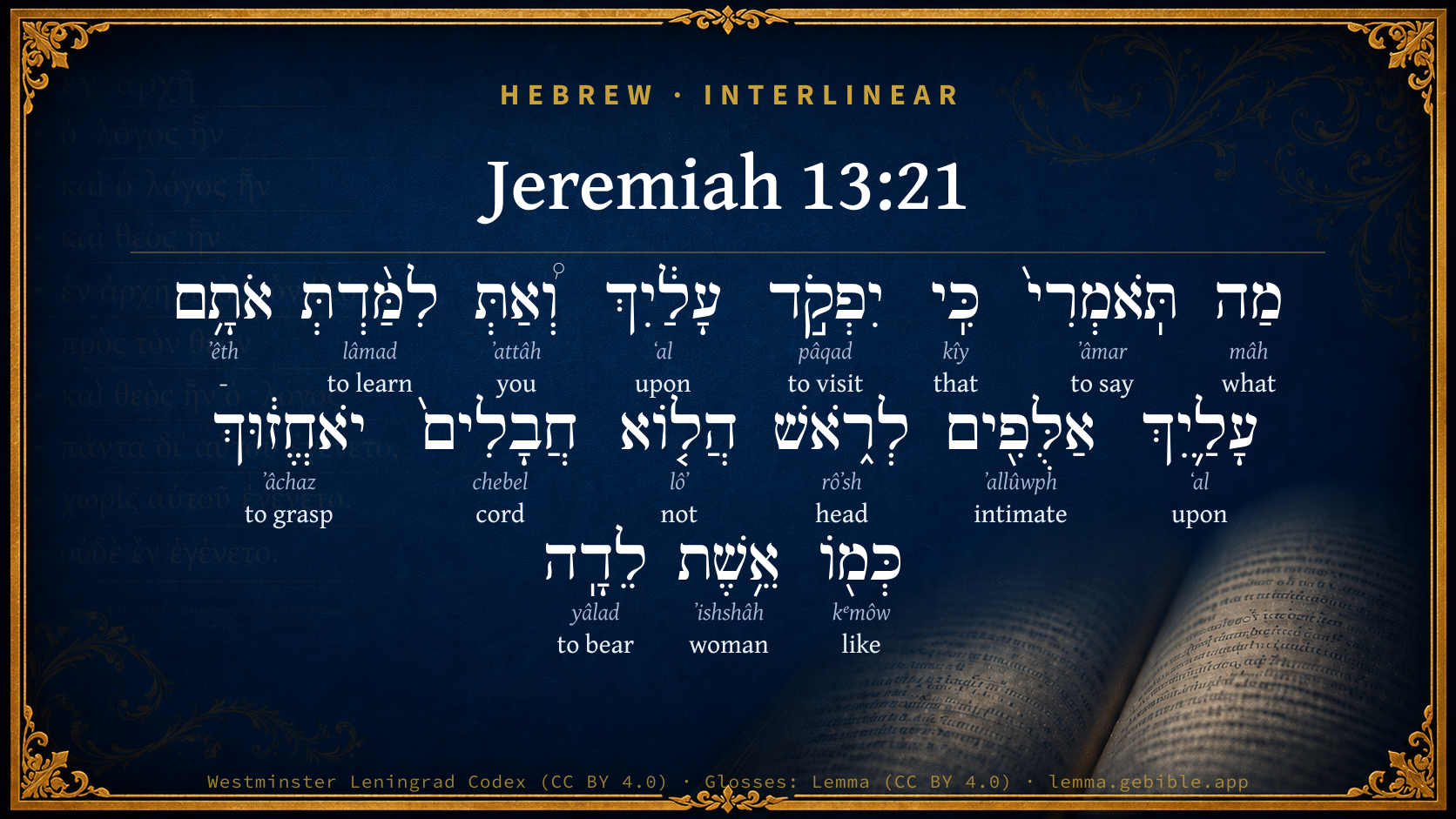
Jeremiah 13:21

Hebrew (Westminster Leningrad Codex) Jeremiah 13:21 appears in the Hebrew Old Testament. The text above is from the Westminster Leningrad Codex. Each word links to its Strong’s number, a concise gloss, and parsing drawn from the Open Scriptures Hebrew Bible morphology. Click any word for its full Brown-Driver-Briggs (BDB) entry.
Download image
Cite this verse

Jeremiah 13:21 (World English Bible). Public Domain. Lemma interlinear Bible study tool, https://lemma.gebible.app/v/jeremiah/13/21.

Show BibTeX & RIS
BibTeX
RIS
English Translation
What will you say, when he shall set over you as head those whom you have yourself taught to be friends to you? shall not sorrows take hold of you, as of a woman in travail?
World English Bible · Public Domain
Download a study sheet

One document with this verse’s original text, its word-by-word gloss line, the meaning frame, cross-references with their text, attributed commentary, and full source and license credits — printable, and it pastes into notes with its structure intact.

This verse Autodidact and up

Study sheet (.html) Plain text (.txt)

A passage Seminary Student

Up to 50 verses in one chapter. A passage sheet keeps up to 6 commentary sources and 12 cross-references per verse, in the order this page ranks them, and says so on the sheet whenever that leaves anything out. Ask for a single verse and you get the Autodidact verse sheet above.

Everything on this page stays free to read, with no account — the sheet is a download of what is already on screen, not access to it.

Want to remove ads? Support Godless Engineer
Compare translations 3

The same verse in 3 English versions, stacked beneath the original-language interlinear above. Click any original word for its lexicon entry.

Each is an independent rendering of the whole verse — the interlinear is not word-aligned to these translations.

Highlighted words mark where these versions differ — a whole-verse word diff, not a word-by-word alignment.

  • World English Bible Public Domain
    What will you say, when he shall set over you as head those whom you have yourself taught to be friends to you? shall not sorrows take hold of you, as of a woman in travail?
  • King James Version Public Domain
    What wilt thou say when he shall punish thee? for thou hast taught them to be captains, and as chief over thee: shall not sorrows take thee, as a woman in travail?
  • unfoldingWord Literal Text CC BY-SA 4.0
    What will you say when he appoints over you and you, yourself, have taught them, friends over you, to head? Will not labor pains seize you like a woman in labor?

unfoldingWord Literal Text — © unfoldingWord, licensed CC BY-SA 4.0. Word-aligned USFM3 via Door43 (git.door43.org/unfoldingWord/en_ult).

Versions to compare (up to 4)

3 of 4 selected

Show all 18 translations

Every available English version of this verse, each an independent rendering of the whole verse.

  • World English Bible Public Domain
    What will you say, when he shall set over you as head those whom you have yourself taught to be friends to you? shall not sorrows take hold of you, as of a woman in travail?
  • Berean Standard Bible Public Domain
    What will you say when He sets over you close allies whom you yourself trained? Will not pangs of anguish grip you, as they do a woman in labor?
  • Majority Standard Bible Public Domain
    What will you say when He sets over you close allies whom you yourself trained? Will not pangs of anguish grip you, as they do a woman in labor?
  • King James Version Public Domain
    What wilt thou say when he shall punish thee? for thou hast taught them to be captains, and as chief over thee: shall not sorrows take thee, as a woman in travail?
  • American Standard Version (1901) Public Domain
    What wilt thou say, when he shall set over thee as head those whom thou hast thyself taught to be friends to thee? shall not sorrows take hold of thee, as of a woman in travail?
  • Revised Version (1885) Public Domain
    What wilt thou say, when he shall set thy friends over thee as head, seeing thou thyself hast instructed them against thee? shall not sorrows take hold of thee, as of a woman in travail?
  • Geneva Bible (1599) Public Domain
    What wilt thou saye, when hee shall visite thee? (for thou hast taught them to be captaines and as chiefe ouer thee) shall not sorow take thee as a woman in trauaile?
  • Douay-Rheims (1899) Public Domain
    What wilt thou say when he shall visit thee? for thou hast taught them against thee, and instructed them against thy own head: shall not sorrows lay hold on thee, as a woman in labour?
  • Young's Literal Translation Public Domain
    What dost thou say, when He looketh after thee? And thou -- thou hast taught them `to be' over thee -- leaders for head? Do not pangs seize thee as a travailing woman?
  • Literal Standard Version CC BY-SA 4.0
    What do you say when He looks after you? And you have taught them [to be] over you—leaders for head? Do pangs not seize you as a travailing woman?
  • Unlocked Literal Bible CC BY-SA 4.0
    What will you say when God sets over you those you had trained to be your special allies? Are these not the beginnings of the labor pains that will seize you just like a woman in childbirth?
  • unfoldingWord Literal Text CC BY-SA 4.0
    What will you say when he appoints over you and you, yourself, have taught them, friends over you, to head? Will not labor pains seize you like a woman in labor?
  • Darby Bible Public Domain
    What wilt thou say when he shall visit thee, since thou thyself hast trained them to be princes in chief over thee? Shall not sorrows take thee, as a woman in travail?
  • World Messianic Bible Public Domain
    What will you say when he sets over you as head those whom you have yourself taught to be friends to you? Won’t sorrows take hold of you, as of a woman in travail?
  • Webster's Bible Public Domain
    What wilt thou say when he shall punish thee? for thou hast taught them to be captains, and as chief over thee: shall not sorrows take thee, as a woman in travail?
  • Free Bible Version CC BY-SA 4.0
    What are you going to say when he puts your enemies in charge of you, people you once counted as your friends? Won't you suffer pains like a woman in labor?
  • Bible in Basic English Public Domain
    What will you say when he puts over you those whom you yourself have made your friends? will not pains take you like a woman in childbirth?
  • JPS Tanakh (1917) Public Domain
    What wilt thou say, when He shall set the friends over thee as head, whom thou thyself hast trained against thee? Shall not pangs take hold of thee, as of a woman in travail?

Literal Standard Version (2020), Covenant Press — licensed CC BY-SA 4.0. Text via the HelloAO Bible API (eBible.org). Unlocked Literal Bible (unfoldingWord) — licensed CC BY-SA 4.0. Text via the HelloAO Bible API (eBible.org). unfoldingWord Literal Text — © unfoldingWord, licensed CC BY-SA 4.0. Word-aligned USFM3 via Door43 (git.door43.org/unfoldingWord/en_ult). Free Bible Version, Dr. Jonathan Gallagher — licensed CC BY-SA 4.0. Text via the HelloAO Bible API (eBible.org).

Word by word

More ways to search: Search by grammar → Find every occurrence → Compare this word →

Practice this passage: Drill this verse → Learn its vocabulary →

חֲבָלִים֙
chebel
H2256
“cords”
Noun, Common, Masculine, Plural, Absolute
Part of Speech
Noun
Type
Common
Gender
Masculine
Number
Plural
State
Absolute
Full BDB Definition

Origin: from H2254

TWOT: 592b , 595a

a cord, rope, territory, band, company - a rope, cord - a measuring-cord or line - a measured portion, lot, part, region - a band or company - pain, sorrow, travail, pang - pains of travail - pains, pangs, sorrows - union - destruction
  1. מַה mâh H4100 “what” Particle, Interrogative
  2. תֹּֽאמְרִי֙ ʼâmar H559 “to say” Verb, Qal, Imperfect, 2nd Person, Feminine, Singular
  3. כִּֽי kîy H3588 “that” Conjunction
  4. יִפְקֹ֣ד pâqad H6485 “to visit” Verb, Qal, Imperfect, 3rd Person, Masculine, Singular
  5. עָלַ֔יִךְ ʻal H5921 “upon · you” Preposition + Suffix, Personal, 2nd Person, Feminine, Singular
  6. וְ֠אַתְּ ʼattâh H859 “and · you” Conjunction + Pronoun, Personal, 2nd Person, Feminine, Singular
  7. לִמַּ֨דְתְּ lâmad H3925 “to learn” Verb, Piel, Perfect, 2nd Person, Feminine, Singular
  8. אֹתָ֥ם ʼêth H853 “- · them” Particle, Direct Object + Suffix, Personal, 3rd Person, Masculine, Plural
  9. עָלַ֛יִךְ ʻal H5921 “upon · you” Preposition + Suffix, Personal, 2nd Person, Feminine, Singular
  10. אַלֻּפִ֖ים ʼallûwph H441 “intimates” Noun, Common, Masculine, Plural, Absolute
  11. לְרֹ֑אשׁ rôʼsh H7218 “to/for · head” Preposition + Noun, Common, Masculine, Singular, Absolute
  12. הֲל֤וֹא lôʼ H3808 “not” Particle, Interrogative + Particle, Negative
  13. יֹאחֱז֔וּךְ ʼâchaz H270 “to grasp · you” Verb, Qal, Imperfect, 3rd Person, Masculine, Plural + Suffix, Personal, 2nd Person, Feminine, Singular
  14. כְּמ֖וֹ kᵉmôw H3644 “like” Preposition
  15. אֵ֥שֶׁת ʼishshâh H802 “woman of” Noun, Common, Feminine, Singular, Construct
  16. לֵדָֽה yâlad H3205 “childbirth” Noun, Common, Feminine, Singular, Absolute

About this verse

These counts appear in no published source. They are computed here, from the morphology-tagged text and Lemma’s own curated glosses. What Lemma adds →

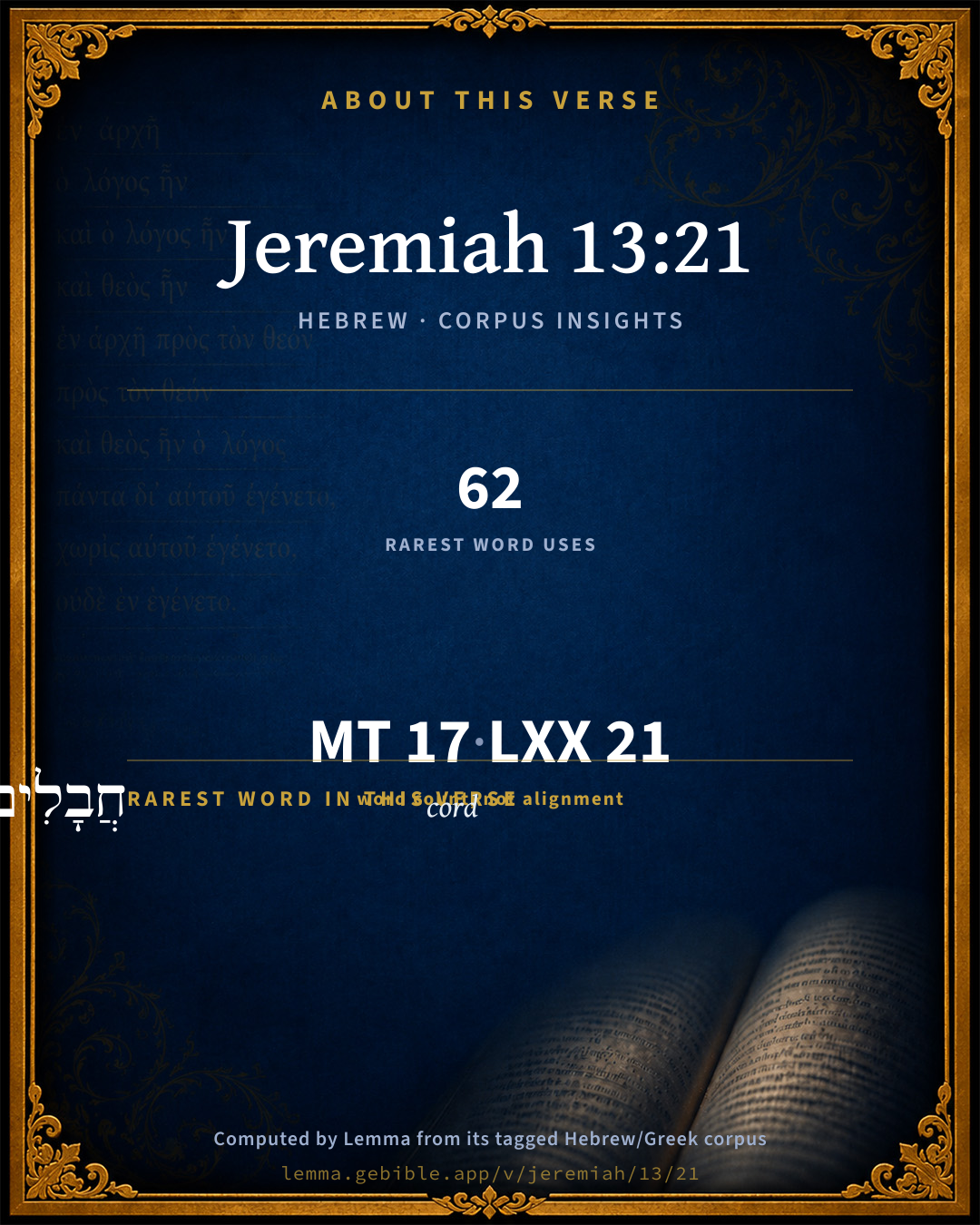
17
words
16
distinct lemmas
Prophets
section

Grammatical profile

  • 4 verbs
  • 5 nouns
  • 1 pronoun
  • 3 prepositions
  • 1 conjunction
  • 3 particles

Verb forms

  • תֹּֽאמְרִי֙ Qal · Imperfect
  • יִפְקֹ֣ד Qal · Imperfect
  • לִמַּ֨דְתְּ Piel · Perfect
  • יֹאחֱז֔וּךְ Qal · Imperfect

Repetition

A word recurs within this verse — often emphatic in Hebrew:

  • עָלַ֔יִךְ upon H5921 ×2

Hebrew & Septuagint length

In the original languages it is 17 Hebrew tokens and 21 Greek tokens — but the two are counted differently (Hebrew bundles its prefixes and suffixes into one token; the Greek is in lemma form), so that isn’t a like-for-like length.

Cross-references

14

Topical passages linked to Jeremiah 13:21 in the Treasury of Scripture Knowledge — connected by theme and wording, ordered by reader-vote popularity; previews shown in the World English Bible.

  • Isaiah 13:8 and they shall be dismayed; pangs and sorrows shall take hold [of them]; they shall be in pain as a woman in travail: they shall look in amazement one at another; their faces [shall be] faces of flame.
  • Jeremiah 4:31 For I have heard a voice as of a woman in travail, the anguish as of her who brings forth her first child, the voice of the daughter of Zion, who gasps for breath, who spreads her hands, [saying], Woe is me now! for my soul faints before the murderers.
  • Isaiah 10:3 What will you do in the day of visitation, and in the desolation which shall come from far? to whom will you flee for help? and where will you leave your glory?
  • Isaiah 39:2–4 Hezekiah was glad of them, and shown them the house of his precious things, the silver, and the gold, and the spices, and the precious oil, and all the house of his armor, and all that was found in his treasures: there was nothing in his house, nor in all his dominion, that Hezekiah didn't show them.
  • Jeremiah 5:31 the prophets prophesy falsely, and the priests bear rule by their means; and my people love to have it so: and what will you do in the end of it?
  • Jeremiah 38:22 behold, all the women who are left in the king of Judah's house shall be brought forth to the king of Babylon's princes, and those women shall say, Your familiar friends have set you on, and have prevailed over you: [now that] your feet are sunk in the mire, they are turned away back.
  • 2 Kings 16:7 So Ahaz sent messengers to Tiglath Pileser king of Assyria, saying, I am your servant and your son: come up, and save me out of the hand of the king of Syria, and out of the hand of the king of Israel, who rise up against me.
  • Isaiah 21:3 Therefore are my loins filled with anguish; pangs have taken hold on me, as the pangs of a woman in travail: I am pained so that I can't hear; I am dismayed so that I can't see.
  • Jeremiah 6:24 We have heard the report of it; our hands wax feeble: anguish has taken hold of us, [and] pangs as of a woman in travail.
  • Jeremiah 22:23 Inhabitant of Lebanon, who makes your nest in the cedars, how greatly to be pitied shall you be when pangs come on you, the pain as of a woman in travail!
  • Jeremiah 30:6 Ask now, and see whether a man does travail with child: why do I see every man with his hands on his loins, as a woman in travail, and all faces are turned into paleness?
  • Jeremiah 48:41 Kerioth is taken, and the strongholds are seized, and the heart of the mighty men of Moab at that day shall be as the heart of a woman in her pangs.
  • Ezekiel 28:9 Will you yet say before him who kills you, I am God? but you are man, and not God, in the hand of him who wounds you.
  • 1 Thessalonians 5:3 For when they are saying, "Peace and safety," then sudden destruction will come on them, like birth pains on a pregnant woman; and they will in no way escape.

Cross-references courtesy of OpenBible.info (CC BY 4.0).

Hebrew and Greek witnesses Masoretic Hebrew ↔ Greek Septuagint

The same verse in the two great witnesses to the Old Testament, shown verse-for-verse.

These are two independent witnesses, not word-aligned to each other, and the Septuagint is shown in lemma (dictionary) form.

Hebrew Jeremiah 13:21 Masoretic · Westminster Leningrad Codex

מַה תֹּֽאמְרִי֙ כִּֽי יִפְקֹ֣ד עָלַ֔יִךְ וְ֠אַתְּ לִמַּ֨דְתְּ אֹתָ֥ם עָלַ֛יִךְ אַלֻּפִ֖ים לְרֹ֑אשׁ הֲל֤וֹא חֲבָלִים֙ יֹאחֱז֔וּךְ כְּמ֖וֹ אֵ֥שֶׁת לֵדָֽה

What will you say, when he shall set over you as head those whom you have yourself taught to be friends to you? shall not sorrows take hold of you, as of a woman in travail?

World English Bible · Public Domain

Greek LXX Structure differs

In the Septuagint, Jeremiah is about an eighth shorter than the Hebrew and arranges its material differently — the Oracles Against the Nations (Hebrew chapters 46–51) appear in the middle of the Greek book, after 25:13. Because the chapter and verse boundaries do not line up, a verse-for-verse comparison with the Hebrew is not shown.

A verse-for-verse comparison isn’t shown here because the chapters and verses don’t line up. Switch to the LXX edition with the MT / LXX toggle above to read the Greek directly.

On this verse, John Gill's Exposition discusses the Septuagint’s reading. Read the note in Commentary ↓

Hebrew: Westminster Leningrad Codex (CC BY 4.0). Greek: Septuagint (public domain); English from a public-domain English Septuagint. How the Septuagint differs from the Hebrew →

Targum (Aramaic paraphrase)

1

The Targum is the ancient Jewish Aramaic paraphrase of the Hebrew Scriptures — an interpretive translation, not the Hebrew text itself. Onkelos (literal) and Pseudo-Jonathan (expansive) render the Torah, and Jonathan the Prophets. Coverage is partial: where no permissively-licensed English translation exists for a verse, only the Aramaic is shown. This is verse-level text, not a word-by-word alignment to the Hebrew.

  1. Targum Jonathan Prophets (Joshua–Malachi)
    מַה תֵּימְרוּן אֲרֵי יִסְעַר עֲלָךְ חוֹבָךְ וְאַתְּ אַלֵיפְתְּ יַתְהוֹן לְמֶעְבַּד בִּישִׁין עֲלָךְ הֲווֹ רַבְרְבִין כִּדְמַן אַוְלָא הֲלָא עָקָא וְחֶבְלִין יִיחְדוּנָךְ הָא כְּחֶבְלִין לְיָלֵידְתָּא:

    (no public-domain English translation for this verse)

    Targum Jonathan — Aramaic: “Mikraot Gedolot” (public domain). English: “Sefaria Community Translation” (CC0 1.0 (public-domain dedication)); “London "Chaldee Paraphrase," 1871” (public domain). Text via Sefaria.

Commentary

Notes on Jeremiah 13:21 from classic Christian and Jewish commentators (each source and its license shown beneath its notes). The classic Christian expositions comment on the surrounding passage and are grouped to its opening verse, so a note may address several verses; the Jewish commentaries on the Tanakh (Rashi and others) are per-verse, so they appear only where the commentator wrote on this verse.

Lemma curates 59 commentaries, every one of them public domain or Creative Commons licensed, each selected and text-cleaned for this edition rather than reprinted as found. About our sources →

Trapp's Complete Commentary

John Trapp

Jer 13:21 What wilt thou say when he shall punish thee? for thou hast taught them [to be] captains, [and] as chief over thee: shall not sorrows take thee, as a woman in travail?

Ver. 21. For thou hast taught them to be captains, and as chief over thee,] scil., By thy crouching unto them, and craving their help, thou hast made the Chaldeans masters of all thou hast. So did the British princes Vortiger and Vortimer bring in the Saxons here, and the Greeks the Turks.

John Trapp, A Commentary or Exposition upon All the Books of the Old and New Testament (1647–1656) — public domain. Text from a community e-Sword module.

The Biblical Illustrator

Joseph S. Exell

Jer_13:21

What wilt thou say when He shall punish thee?

A question to the impenitent

It was in view of certain threatened calamities that were to come on Judah from the hand of the Lord, that this question is asked of her. I put this question to each individual who is not obeying the Gospel of Christ. What wilt thou say, dying as thou art living, appearing before God in judgment as thou appearest to Him now, continuing impenitent, persisting in disobedience to the Gospel, if the character thou carriest into eternity be that which you are now forming for it? But perhaps you have no faith in future punishment; perhaps you do not believe that you, or any sinner will ever be brought into these circumstances. Then you have no faith in the veracity of God, or in the Bible as His Word. You are fulfillers of prophecy, for it is said (1Pe_3:1-22) there should be such as you. But you say, the belief is unreasonable; it conflicts with all our ideas of benevolence and justice. What! that a righteous moral Governor should punish incorrigible offenders, rebels that refuse to be reconciled to Him, though often invited, and the meanwhile most kindly dealt with by their injured Sovereign, and when the terms of reconciliation are easy as they could be made, and the whole expense of bringing it about is borne by God! The question is not, what now you have to say, for now you imagine you have a great deal to say. And some can speak long and fluently in a strain of self-exculpation; but then, when confronted with your Maker and Judge; and when all things are seen by the clear and searching light of eternity; then, what wilt thou say?

1. You will not be able to say that you were ignorant of the existence of the law, for the transgression of which you are condemned.

2. Nor can you say that this law is unintelligible. Whatever obscurity attaches to the doctrines of the Bible, none rests on its precepts.

3. Nor, again, can you reasonably complain of the character of this law. The law is holy, and the commandment holy, lust, and good. Its spirit is love; its tendency happiness.

4. Nor can you complain of any want of adaptation in this law; that it transcends your capacities, exceeds your natural powers of performance. No; you want no new faculty to obey it perfectly. You want only a rectified heart. You want but the will.

5. You cannot plead ignorance of its penalty. You cannot say that you were not warned of the consequences of disobedience; and that God strikes, before He speaks. What has not been done to deter you from sinning? What obstructions have not been thrown in your way to destruction! But you surmount them all. What then wilt thou say, when He shall punish thee? That you have never transgressed this law, or only once, or but seldom, and then inadvertently, through infirmity? This you will not say; you cannot. Who has not sinned many times, and deliberately? Will you say that your sin did no harm, injured no one, no one but God? But you must allow the Lawgiver to be the judge of that. The consequences of a particular sin He alone is able to trace out. Will you be able to say, that, when you had sinned, God hastened the execution of the sentence against you; waited not for a second offence, and gave you no opportunity to evade the stroke; that as soon as you found you had sinned, you were sorry, and penitently sought His face, but was spurned away; and that, seeing your case to be hopeless, you went on sinning in despair? What will you say? That there was an irreversible Divine decree that stood an insurmountable obstruction in your way to heaven, and even impelled you in the downward direction? You will see by the light of eternity that that was not the case, nor indeed the doctrine of those who were supposed to hold it. What then wilt thou say, when He shall punish thee? I can think of nothing, nothing exculpatory, nothing extenuating. You will be speechless, not through intimidation, but from conviction, not as unable to speak, but as having nothing to say; self-condemned, as well as condemned by your Judge; conscience confirming the decision against you, and your own self through all eternity reproaching you, and thus nourishing a worm gnawing within worse than the fire that shall burn about you. And shall it come to this? Shall this be the issue of life? (W. Nevins, D. D.)

Future punishment

I. The punishment supposed.

1. Sometimes it commences in the present world.

2. It will assuredly be inflicted after death.

3. It will be consummated at the judgment day.

4. It will be proportionate (Mat_19:27; Rom_2:6; Rev_2:23).

5. That it will be everlasting.

II. The interrogation presented.

1. Will you say it is unrighteous?

2. Will you say it is severe?

3. Will you say that you were not warned?

4. Will you plead for a further period of trial?

5. Will you confess your guilt, and seek mercy?

6. Will you endeavour to resist the almighty arm? (Isa_27:4; Nah_1:5)

7. Will you endeavour to meet your doom with firmness? (Pro_1:27; Rev_6:17.)

Application--

1. Future punishment may be averted. Bless God that you are favoured with time and opportunities; with mercy, and with gracious invitations.

2. Timely repentance, and sincere faith in the Lord Jesus Christ, will infallibly preserve you from the wrath to come. (J. Burns, D. D.)

The justice of future punishment

I. Offer three general remarks.

1. All the afflictions to the wicked have the nature of punishment: they are not salutary. Grace turns the serpent into a rod; but sin turns the rod into a serpent. The former turns poison into a remedy; the latter, the remedy into poison.

2. Punishment is the natural and necessary consequence of sin. If we drink of the cup of abominations, God will give us the cup of trembling (Psa_75:8).

3. Whoever are the immediate instruments of inflicting punitive evils, God is the author of them.

II. Consider the solemn inquiry in our text. What wilt thou say when He shall punish thee?

1. Wilt thou charge God with injustice, or say that the punishment is undeserved? To admit such a thought betrays the greatest insolence and pride, as well as an entire ignorance of all the principles of truth and righteousness (Rom_3:5-6; Rev_15:3; Rev_16:7).

2. Wilt thou say that God is severe and that though punishment be deserved, yet it is too great for the offence? (2Th_1:6-10.)

3. Wilt thou say that thou wast taken by surprise, without being warned; and that, therefore, judgments came unlooked for? The very heathens cannot say this; for as the creatures instruct them, so conscience warns them.

4. Wilt thou desire a further time of trial, that judgment may be deferred, and a longer season of probation be afforded thee? Instead of wishing for a greater extension of Divine forbearance, God might say to the dying and desponding sinner, The measure of thine iniquities is already full, and further forbearance would only make it run over. Put in the sickle, for the harvest is ripe.

5. Wilt thou say that thou hast sinned by an inevitable necessity, and that thy ruin was predetermined? But if this be the language of sinners in this world, it will not be so in the world to come. They will then know that if they were the slaves of sin and Satan, they were so voluntarily, and by choice; that if they were sold to commit iniquity, like Ahab, they sold themselves; and that if any spiritual blessing were withheld, it was that to which they had no claim and for which they had no desire (Jer_7:10; Isa_63:17; Mat_23:37 Joh_5:40; Act_2:23; Joh_12:39; Joh_15:22; Rom_9:19-20).

6. The question proposed in the text implies that the sinner will have nothing to say when he falls into the hands of God. (B. Beddome, M. A.)

A serious question

I. The punishment referred to. A freethinker once said, I am seventy years old, and have never seen such a place as hell, after all that has been said about it. A child at once replied, But have you ever been dead yet?

1. The punishment itself. This is brought before us--

(1) By express declarations.

(2) In figurative forms.

2. Its infliction.

(1) God, faithful to promises, must also be to threatenings.

(2) Graded, in accordance with degree of crime.

II. The persons on whom it will be inflicted.

1. Atheists.

2. Unbelievers.

3. Hypocrites.

4. Persecutors.

5. Backsliders.

III. The question, What wilt thou say? Many can talk now, revile, question, sneer. What will you say then? (Homiletic Magazine.)

No appeal

Advert to the time when, in the order of the Divine government, ungodly sinners will be punished according to law. What wilt thou say in extenuation of thy guilt, and against the justice of the punishment that He shall inflict upon thee?

1. Will you say that you did not know the law which you had broken? Whose fault was that? Had you not a Bible as your own? Had you not a law in your conscience which acquitted or accused you in the actions of life?

2. That you meant no wrong in what you had done? Then why do wrong? For pleasure? For profit? Was this any justification of wrong-doing?

3. That your sins had not done such evil as to deserve such punishment? Can you be a judge in this?

4. That God might have prevented you sinning, and the results of your sins, if He had been so disposed? Yes, had He destroyed your free agency. But did not God use means to prevent you, and you would not?

5. That you sinned only a short time in comparison with the duration of your punishment? Punishment is not given in its duration according to the time taken in the act of transgression. The act of murder, and its punishment.

6. That you have only done as others have done? A thousand doing wrong is no justification or extenuation of one doing a similar or the same wrong that they have committed.

7. That you have not been so bad as others? The law knows nothing of degrees in crime, so far as exempting from punishment. Besides, he that offends in one point is guilty of all.

8. That while you have done many things that have been wrong, you have done others that have been right? Doing a right will not save you from the punishment of doing a wrong.

9. That you had great temptations to do as you have done? But there were at your command resources of help sufficient to keep you from their power.

10. That you were led into sin by bad examples? There were good examples to follow as well as bad, why did you not follow them?

11. That you were never educated? Education has nothing to do with moral principles and actions.

12. That you were never warned or admonished against sin? Can this be true? If you were not, whose fault was it? Had you not warnings and admonitions of conscience and of the Spirit of God?

13. That the Spirit of God never strove with you? This is false, or Gods Word is, and human experience. Perhaps you so quenched the Spirit as to harden your heart.

14. That you were born into the world with a sinful nature, and could not help sinning? But God made every provision to meet your case in this respect.

15. That the inconsistencies of Christians were a stumbling block to you? If one man walk awry, or if he stumble, is that any reason why you should do so

16. That you were preordained by God to do as you have done? This is false, both in reason and in Scripture.

17. That your punishment is too severe? It is no wonder you should say this. Is it undeserved? Is it against law and justice?

18. That your punishment is more than you can bear? You should have thought of this before. Did you in committing sin think of how others could bear the wrong you were doing them? How God could bear your sins? (Local Preachers Treasury.)

The Biblical Illustrator, edited by Joseph S. Exell (c. 1880s–1900s) — public domain. Text from a community e-Sword module.

Geneva Bible (1599)

Geneva Bible translators

By seeking to strangers for help, thou hast made them skillful to fight against thee.

Geneva Bible (1599) marginal notes — public domain. Text via Bolls.life.

Jamieson, Fausset & Brown

Robert Jamieson, A. R. Fausset & David Brown

captains, and as chief--literally, "princes as to headship"; or "over thy head," namely, the Chaldeans. Rather, translate, "What wilt thou say when God will set them (the enemies, Jer 13:20) above thee, seeing that thou thyself hast accustomed them (to be) with thee as (thy) lovers in the highest place (literally, 'at thy head')? Thou canst not say God does thee wrong, seeing it was thou that gave occasion to His dealing so with thee, by so eagerly courting their intimacy." Compare Jer 2:18, Jer 2:36; Kg2 23:29, as to the league of Judah with Babylon, which led Josiah to march against Pharaoh-necho, when the latter was about to attack Babylon [MAURER].

sorrows--pains, throes.

Jamieson, Fausset & Brown — Commentary Critical and Explanatory on the Whole Bible (1871) — public domain (CC PDM 1.0). Text via the HelloAO Bible API.

Adam Clarke's Commentary

Verse 21. Thou hast taught them to be captains, and as chief over thee] This is said of their enemies, whether Assyrians or Chaldeans: for ever since Ahaz submitted himself to the king of Assyria, the kings of Judah never regained their independence. Their enemies were thus taught to be their lords and masters.

Adam Clarke's Commentary on the Bible (1810–1826) — public domain. Text from a community e-Sword/MySword module.

John Calvin's Commentaries

As the Prophet observed that the Jews were in no way moved, he addressed them still further, and set before them what seemed then incredible, even the calamity, from which they thought they were able easily to defend themselves by means of their auxiliaries.

He then adds, What wilt thou then say? For the false teachers made a clamor, and whenever Jeremiah began to speak, they violently assailed him, and the common people also wantonly barked at him. As then they thus petulantly resisted God and his truths, the Prophet intimates that the time would come when they should become mute through shame: What wilt thou say then? he says, “Ye are now very talkative, and God cannot obtain a hearing from you; but he will check your wantonness, when the enemy shall distress you.” It is the same as though he had said, “It will not be the time then for your loquacity, for the Lord will constrain you to be silent.”

Some refer to God what follows, When, he shall visit you; but it ought on the contrary to be applied to the Chaldeans; for he immediately adds, But thou hast accustomed them, etc. There is indeed a change or an anomaly of number, but this is common in the prophets. When he uses the singular, the head of the army is referred to, but afterwards the whole forces are included. What then wilt thou say, when the enemy shall visit thee? He then adds, But then, etc.; that is, “If thou seekest to cast blame on others, when the Assyrians and the Chaldeans shall overwhelm thee, thou wilt attempt it in vain? for thou hast opened a passage for them, and hast accustomed them to be thy leaders over thy head.” For the Assyrians had a long time before been sent for by the Israelites; and the Jews also had formed confederacies with the Chaldeans against the Assyrians, before these monarchies were united. As then they had called them in as auxiliaries, they had accustomed them to rule, and, as it were, had set them over themselves. The case was similar to that of the Turks at this day, were they to pass over to these parts and exercise their authority; for it might be asked the French kings and their counsellors, “Whose fault it is that the Turks come to us so easily? It is because ye have prepared for them the way by sea, because ye have bribed them, and your ports have been opened to them; and yet they have wilfully exercised the greatest cruelty towards your subjects. All these things have proceeded from yourselves; ye are therefore the authors of all these evils.” So also now the Prophet upbraids the Jews, because they had accustomed the Chaldeans to be their leaders; and as they had set them over their own heads, he says to them, that it was no wonder that they were now so troublesome and grievous to them.

He afterwards says, Shall not sorrows lay hold on thee as on a woman in travail? By this comparison he intimates, that the Jews gained nothing by their vain hopes; for when they should say, peace and security, destruction, such as they by no means expected, would suddenly come upon them. This similitude we know often occurs, and it is a very apt one; for a woman with child may be very cheerful and quietly enjoying herself, and yet a sudden pain may seize her. So also it will be with the wicked; they cannot now bear to hear anything sad or alarming, and they drive from them every fear as far as possible; but the more they harden themselves, the heavier is God’s vengeance which follows them, and which will overtake them suddenly and unexpectedly. As then it was incredible to the Jews, that the Chaldeans would soon come to lay waste their land, he says to them, “Surely sorrows will take hold on you, though you look not for them. Though a woman with child thinks not of her coming pain, yet it comes suddenly and cannot be driven away; so you will gain nothing by heedlessly promising to yourselves continual peace and quietness.” I cannot finish what follows today if I go on farther; I shall therefore put it off to the next Lecture.

John Calvin's Commentaries (1540-1563) — public domain. Text from the Calvin Translation Society English edition (1840s-50s) via the Christian Classics Ethereal Library (ccel.org). Calvin's coverage is partial (roughly two-thirds of the Bible); uncommented books and verses are honest gaps, never fabricated. The 19th-century editor's footnotes and remarks are omitted so the notes are faithfully Calvin's own voice.

Ellicott's Commentary for English Readers

(21) What wilt thou say?—The verse is difficult, and requires an entire retranslation. What wilt thou (the daughter of Zion) say? for He (Jehovah) shall set over thee as head those whom thou taughtest (=tried to teach) to be thy familiar friends. This was to be the end of the alliance in which Judah had trusted. She had courted the Chaldean nobles as her lover-guides and friends (the word is the same as in Jer_3:4; Psa_55:13; Pro_2:17; Pro_16:28). Another possible construction gives, shall set over thee those whom thou delightest to be thy friends as head over thee, i.e., those whose supremacy Judah had acknowledged in order that she might court their alliance. What could come then but that which was to the Hebrew the type of extremest anguish (Isa_13:8; Isa_21:3; Psa_48:6), the travail-pangs which were followed by no joy that a man was born into the world (Joh_16:21)?

A Bible Commentary for English Readers, edited by Charles John Ellicott (1878–1897) — public domain. Text from a community e-Sword module.

The Cambridge Bible for Schools and Colleges

gen. ed. J. J. S. Perowne

21. The construction and order in MT. are difficult, and the Hebrew words seem to have suffered some dislocation in the course of transmission. The general sense is: Those whom thou considerest to be thy friends (meaning Babylon, and perhaps the lesser neighbouring nations) are now to be thy harsh masters. This however is not clearly expressed in either text or mg. It is better, therefore, with Dr., to render “What wilt thou say, when he shall set over thee as head those whom thou hast thyself taught to be friends unto thee?” Cp. Eze_23:22 ff., where the “lovers” are enumerated.

The Cambridge Bible for Schools and Colleges (gen. ed. J. J. S. Perowne; Cambridge University Press, 1878–1918) — public domain. Text from a community e-Sword module.

John Gill's Exposition

Can the Ethiopian change his skin?.... Or, "the Cushite"; either, as the Arabic version, the "Abyssine", the inhabitant of the eastern Ethiopia; properly an Ethiopian, as the Septuagint and Vulgate Latin versions render it; or, the "Chusean Arabian"; the inhabitant of Arabia Chusea, which was nearer Judea than the other Ethiopia, and better known, and which were of a dark complexion. The Targum renders it, the Indian; and so does the Syriac version. In the Misna (i) mention is made of Indian garments, with which the high priest was clothed on the day of atonement; upon which the gloss (k) is, that they were of linen of the country of India; and which is the land of Cush (or Ethiopia), as Jonathan Ben Uzziel interprets Jer 13:23.

"can the Cushite, the Indian, change his skin?''

and it is highly probable, that, in the time of Jeremiah, no other India was known by the Jews but Ethiopia, or Arabia Chusea, and no other black people but the inhabitants thereof, or any other than the Arabians; and, as Braunius (l) observes, it need not be wondered at, that with the Jews, in those times, Ethiopia and India should be reckoned the same country; when with the ancients, whatever was beyond the Mediterranean sea, as Arabia, Ethiopia, and even Judea itself, was called India; so Joppa, a city of Phoenicia, from whence Andromeda was fetched by Perseus, is by Ovid (m) said to be in India; so Bochart (n) interprets the words of the Saracens or Arabians, who are of a swarthy colour, and some black; and indeed have their name from the same word the raven has, which is black; and particularly the inhabitants of Kedar were black, one part of Arabia, to which the allusion is in Sol 1:5. Jarchi interprets the word here by "the moor", the blackamoor, whose skin is naturally black, and cannot be changed by himself or others; hence to wash the blackamoor white is a proverbial expression for labour in vain, or attempting to do that which is not to be done:

or the leopard his spots? a creature full of spots, and whose spots are natural to it; and therefore cannot be removed by any means. Some think a creature called "the ounce", or "cat-a-mountain" is meant, whose spots are many, and of a blackish colour; but the description well agrees with the leopard, which is a creature full of spots, and has its name in the eastern languages, particularly the Chaldee and Arabic, from a word (o) which signifies "spotted", "variegated", as this creature is; so the female is called "varia" by Pliny (p), because, of its various spots; and these spots are black, as the Arabic writers in Bochart (q). The word here used signifies such marks as are made in a body beat and bruised, which we call black and blue; hence some render it "livid", or black and blue spots (r); and these marks are in the skin and hair of this creature, and are natural to it, and cannot be changed; and it is usual with other writers (s) to call them spots, as well as the Scripture:

then may ye also do good, that are accustomed to do evil; signifying that they were naturally sinners, as blackness is natural to the Ethiopian, and spots to the leopard; and were from their birth and infancy such, and had been so long habituated to sin, by custom founded upon nature, that there was no hope of them; they were obstinate in sin, bent upon it, and incorrigible in it; and this is another reason given why the above calamities came upon them. The metaphors used in this text fitly express the state and condition of men by nature; they are like the Ethiopian or blackamoor; very black, both with original and actual sin; very guilty, and very uncomely; and their blackness is natural to them; they have it from their parents, and by birth; it is with them from their infancy, and youth upwards; and very hard and difficult to be removed; it cannot be washed off by ceremonial ablutions, moral duties, evangelical ordinances, or outward humiliations; yea, it is impossible to be removed but by the grace of God and blood of Christ. Their sins are aptly compared to the leopard's spots, which are many and natural, and difficult to get clear off. What is figuratively expressed in the above metaphors is more plainly signified by being "accustomed" or "taught to do evil" (t); which denotes a series and course of sinning; a settled habit and custom in it, founded on nature, and arising from it; which a man learns and acquires naturally, and of himself, whereby he becomes void of fear and shame; and there is a good deal of difficulty, and indeed a moral impossibility, that such persons should "do good": nothing short of the powerful and efficacious grace of God can put a man into a state and capacity of doing good aright, from right principles to right ends, and of continuing in it; for there is no good in such men; nor have they any true notion of doing good, nor inclination to it, nor any ability to perform it: in order to it, it is absolutely necessary that they should first be made good men by the grace of God; that they should be regenerated and quickened by the Spirit of God; that they should be created in Christ Jesus unto good works, and have faith in him; all which is by the grace of God, and not of themselves.

(i) Yoma, c. 3. sect 7. (k) In T. Bab. Yoma, fol. 34. 2. (l) De Vestitu Sacerdot. Heb. l. 1. c. 7. sect. 9. p. 150, 151. (m) "Andromedam Perseus nigris portarat ab Indis". De Arte Atnandi, l. 1. (n) Phaleg. l. 4. c. 2. col. 215, 216. (o) Vid. Golium, col. 2459, 2460. Castel. col. 2321, 2322. (p) Nat. Hist. l. 8. c. 17. (q) Hierozoic. par 1. l. 3. c. 7. col. 786, 787. (r) "liventee maculas suas", Junius & Tremellius. (s) Vid. Plin. Nat. Hist. l. 8. c. 19. Juvenal. Satyr. 15. (t) "docti malefacere", Montanus; "edocti malefacere", Junius & Tremellius, Piscator; "qui edocti estis malum", Schmidt.

John Gill's Exposition of the Whole Bible (1746–1763) — public domain (CC PDM 1.0). Text via the HelloAO Bible API.

Albert Barnes' Notes on the Bible

Translate, “What wilt thou say, O Jerusalem, when He, Yahweh, shall set over thee for head those whom thou hast taught to be thy bosom friends?” The foreign powers, whose friendship she has been courting, will become her tyrants.

Albert Barnes' Notes on the Bible (1834–1885) — public domain. Text from a community e-Sword/MySword module.

Haydock's Catholic Bible Commentary

Head. Achaz called the Assyrians into the country, and Ezechias had shewn his treasures to the Babylonians. Other kings excited God’s indignation.

George Leo Haydock (1774–1849), Haydock's Catholic Family Bible and Commentary, 1859 edition — public domain. Excludes Psalms (Douay-Rheims chapter numbering differs from Protestant) and Deuterocanonical books (Catholic canon only).

Matthew Poole's English Annotations

That is, thou wilt have nothing to say, but be wholly confounded and ashamed when God shall visit thee with this sore judgment, or when Nebuchadnezzar’s army sent by God shall visit thee; for thou, either by thy commerce and trading with them, or by thy so often calling them to thy assistance, or by thy idolatry borrowed from them, and other nations, hast taught them to be captains over thee; thy sorrows and affliction will come upon thee suddenly and terribly, as pain cometh upon a woman in travail; yea, and as certainly also.

Matthew Poole's English Annotations on the Holy Bible (1683–1685) — public domain. Text from a community e-Sword/MySword module.

Whedon's Commentary on the Bible

Daniel D. Whedon

21. When he shall punish thee — This verse should read: What wilt thou (Jerusalem) say if he (Jehovah) shall set over thee, for a head, those whom thou accustomed to be thy bosom friends? The word “punish,” in our version, is quite incorrect. The thought is: You cannot complain of the divinely appointed visitation of these heathen enemies, since you have courted their intimacy.

Daniel D. Whedon (gen. ed.), Commentary on the Old and New Testaments (1874–1909) — public domain. Text from a community e-Sword module.

The Pulpit Commentary

What wilt thou say, etc.? The rendering of the verse is uncertain, though the Authorized Version undoubtedly requires correction. The alternatives are, What wilt thou say when he shall appoint over thee (but thou thyself hast trained them against thee) familiar friends as thy head? and, What wilt thou say when he shall appoint over thee those whom thou hast taught thy familiar friends as thy head? The rendering "familiar friends" is justified by Psa_55:13 Pro_16:28 Pro_17:9 Mic_7:5. The "captains" of Authorized Version, or rather "tribal chiefs," is unsuitable.

Vers. 21, 22. Sin its own scourge.

I THERE ARE OTHER SCOURGES FOR SIN. The direct and positive inflictions of the Divine wrath. Not alone the Bible but the great books of history and experience must all be denied if we deny such positive punishment of sin. Never has there been yet any system of laws for moral beings which has been left to be simply self-acting, and which therefore have had no positive sanctions of penalty for transgression added. And God"s Law is not such. As the Jews and other nations and individuals have found, and as the unrepentant will find hereafter, if not now, God"s Word upon this matter is most assuredly true.

II BUT SIN IS ITS OWN SCOURGE. That scourge is woven and knotted with many cords.

1. Conscience, ever passing sentence of judgment.

2. Habits of wrong-doing, hateful but fast clinging to the soul, and by which it is tied and bound.

3. The manifold difficulty of repentance. The man would heartily turn from his evil way, but he has got into the current just above the falls, and it is bearing him on and down, resist as he will.

4. The sight of children, companions, etc., corrupted and perhaps ruined by our evil example. Oh, what a horror is this: seeing those whom, for every reason human and Divine we were bound to cherish and guard from evil, cursed by our sin!

5. The moral disapprobation of the good around us. Their sentence of condemnation is felt to have a binding power. What they bind on earth is bound in heaven.

6. The fearful looking for of judgment." Such are some of the cords which, woven together, make up the dreadful scourge wherewith sin scourges itself.

III AND THIS SELF-MADE SCOURGE IS THE MOST TERRIBLE OF ANY. Deep and unfathomable as were the sufferings of our Lord, he distinctly declared that those coming on his enemies were worse. "Weep not for me," he said, "but weep for yourselves, and for your children If they do these things in a green tree," etc. It is evident, therefore, that suffering in which the consciousness of sin enters must be worst of all. Those "stripes by which we are healed," though they "ploughed deep furrows" on the body of our blessed Lord, yea, upon his inmost soul, still there are stripes more terrible even than they. The quenchless fire of God"s positive inflictions would be more tolerable were it not for the gnawing of that undying worm the sinner"s own remorse. Are not they, then, "fools" indeed who "make a mock at sin"? C.

The Pulpit Commentary (1880–1919), ed. H.D.M. Spence-Jones & Joseph S. Exell — public domain. Text from a community e-Sword module.

John Wesley's Explanatory Notes

What wilt thou say - Thou wilt have nothing to say, but be wholly confounded when God shall visit thee with this sore judgment, for by thy so often calling them to thy assistance, thou hast taught them to be captains over thee.

John Wesley, Explanatory Notes Upon the Whole Bible (1754–1765) — public domain. Text via the GEBible commentary corpus.

Rashi

Rabbi Shlomo Yitzchaki (Rashi)

What will you say when He visits i.e., when the Holy One, blessed be He, visits upon you?

when you accustomed them to be princes at your head You sent emissaries to the Chaldees to bring their idols from there to worship them, as it is written in Ezekiel (23 16): “And she lusted for them to the sight of her eyes, and she sent emissaries to them, to the Chaldees.” Another explanation of “you accustomed them to be princes over you”: Hezekiah who showed the emissaries of Merodach-baladan his entire treasure house (Isaiah 39:2, II Kings 20:13).

Rashi on the Tanakh — English translations: “The Judaica Press complete Tanach with Rashi, translated by A. J. Rosenberg” (CC BY 4.0); “Pentateuch with Rashi's commentary by M. Rosenbaum and A.M. Silbermann, 1929-1934” (public domain); “The Metsudah Tanach series, Lakewood, N.J” (CC BY 4.0); and “The Book of Joshua, Metsudah Publications, 1997” (CC BY 4.0). Text via Sefaria.

Lesson kit

Teaching starters — assembled from the data on this page, not authored interpretation. Every prompt links to the verse data it draws on. Edit before teaching.

Jeremiah, in the Prophets, opens this verse with 17 words (16 distinct Hebrew lemmas). Its most distinctive word is chebel (“cord”). A historical commentator’s framing appears above. Read the whole chapter for the surrounding context.

Discussion questions

  1. How does “cord” (chebel) shape what this verse is saying?
  2. Isaiah 13:8 shares this passage’s theme. How do the two illuminate each other?
  3. “upon” occurs 2× in this one verse. What is the effect of the repetition?
  4. These translations render this verse differently. What is at stake in choosing one wording over another?
  5. The verb «תֹּֽאמְרִי֙» is Qal Imperfect. How does its form color the action?
  6. Reading how Trapp's Complete Commentary and The Biblical Illustrator read this verse, where do the two commentators agree and where do they part?

Things to notice

Reading settings

Reading text

Shown beneath each verse's original-language words.

Old Testament
Old Testament edition

Read the OT as the Masoretic Hebrew (MT) or the Greek Septuagint (LXX).

English shown for the Greek Septuagint (in the Hebrew ↔ Greek comparison).

Comparing translations? Open the Compare panel on any verse page to stack up to four side by side.